Disclosure: As an Amazon Associate, topratedkitchenware.com earns from qualifying purchases. Links on this page are affiliate links; they cost you nothing extra. Prices and availability change often, so check the current Amazon listing before you buy.
Anyone researching kitchenaid deluxe vs artisan is standing on the middle rungs of a ladder, and the first service this comparison can do is show the whole ladder at once. At the bottom sits the Classic, the family’s plain 4.5-quart workhorse. At the top of the tilt-head range sits the Artisan, the 5-quart machine with the famous colour palette. Between them, at certain retailers, sits the Deluxe: a 4.5-quart tilt-head variant that borrows Artisan-style presentation and bundles a few extras the Classic leaves out. The question is whether that middle rung is a genuine step or merely a landing, and the answer depends on which specific differences a given Deluxe listing actually contains. This guide explains what the Deluxe name has meant across its retail appearances, compares it point by point with the Artisan above it, and gives you a method for judging any Deluxe offer you meet against the Artisan’s known quantity.
Kitchenaid Deluxe Vs Artisan: The Short Answer
The Artisan is the more capable and more certain purchase: a larger 5-quart bowl, the widest colour range in the family, a handled bowl and pouring shield in its standard verified listing, and availability everywhere. The Deluxe is a retailer-specific 4.5-quart variant whose value rises and falls with its bundle: where it includes extras such as a flex-edge beater or an upgraded bowl at a modest premium over the Classic, it can be a shrewd buy; where it is priced close to the Artisan while offering a smaller bowl and a thinner colour list, the Artisan wins on arithmetic alone. When we verified products for this guide through the retail catalogue, no distinct Deluxe model appeared with its own listing; searches resolved to the Classic and Artisan themselves. That is why the Deluxe is discussed here as a proposition to evaluate rather than a machine to link, and why the purchasable anchors of this comparison are the Artisan and, as the value reference, the Classic. The full family layout is in our complete KitchenAid mixer comparison.
In this guide
What the Deluxe Is: A Retail Rung on the Ladder
The Deluxe name has been used by big-box retailers for a 4.5-quart tilt-head KitchenAid positioned and packaged above the Classic. Its recurring themes across appearances are consistent enough to describe: Artisan-influenced styling rather than the Classic’s plain dress, a bundle that reaches one rung up the accessory ladder, and a colour list longer than the Classic’s but shorter than the Artisan’s. What is not consistent is the exact contents, because each retail programme assembles its own box. One season’s Deluxe may headline a flex-edge beater; another’s may headline a particular finish or a second tool. This variability is not a scandal, but it does mean the Deluxe cannot be compared the way fixed models are compared. It must be audited, listing by listing, against the two fixed points on either side of it.
That audit is easier than it sounds because the platform underneath is familiar. A 4.5-quart tilt-head KitchenAid with ten speeds and planetary action is the Classic’s architecture, and everything known about that architecture’s behaviour, its dough envelope, its whipping manners, its hinge care, applies to the Deluxe in full. The Deluxe proposition is never about different mixing. It is about presentation and packaging at a particular price, judged against neighbours whose contents are known to the last beater.
The Ladder Compared: Classic, Deluxe, Artisan
| Attribute | Classic | Deluxe (retail variant) | Artisan |
|---|---|---|---|
| Bowl size | 4.5 quarts | 4.5 quarts | 5 quarts |
| Design and speeds | Tilt-head, 10 speeds | Tilt-head, 10 speeds | Tilt-head, 10 speeds |
| Presentation | Plain, practical finishes | Artisan-influenced styling, mid-length colour list | The family’s widest colour range |
| Box character | Core trio of tools | Core tools plus bundle extras that vary by retailer | Core trio plus pouring shield in the verified listing |
| Availability | Everywhere | Specific retailers and seasons | Everywhere |
| Role | Value anchor | Bundle proposition to audit | Capability and choice anchor |
The table exposes the Deluxe’s strategic problem and its opportunity in a single glance. Its bowl and architecture match the Classic below it, so its case must be made on presentation and extras; its price often reaches toward the Artisan above it, whose bowl is bigger and whose colours are famous. A Deluxe offer wins when its extras are ones you value and its price stays clearly below the Artisan’s street price. It loses when the gap narrows, because at near-Artisan money the rational purchase is the Artisan. Everything else in this guide is commentary on that paragraph.
Capacity: Half a Quart, Honestly Weighed
The Artisan’s extra half quart over the Deluxe’s 4.5 is the one hard specification difference in this comparison, and it deserves neither exaggeration nor dismissal. In batter terms it is the difference between a comfortable fold and a careful one on large sponges; in dough terms, between the standard loaf with headroom and the same loaf at the bowl’s polite limit; in cookie terms, between a full recipe taken in stride and a full recipe whose final additions ask for patience. Households baking at standard scale for three to five people will rarely feel the Deluxe’s ceiling. Households that double, that bake for gatherings, or that keep a weekly bread rhythm will feel it exactly as often as they bake, which is the correct way to price a specification: by the frequency with which your life touches it. Our guide to choosing a stand mixer develops this frequency test for the whole category, and it is the single most useful habit a mixer shopper can learn.
Presentation: Where the Deluxe Spends Its Budget
Stand mixers live in sight, and the Deluxe’s reason to exist is that many buyers want more visual pleasure than the Classic offers without paying the Artisan’s full tariff. Its finishes lean toward the Artisan’s world: richer colours, a more deliberate trim, a machine that looks chosen rather than issued. Judged purely as furniture, a well-priced Deluxe can be the sweet spot of the range, and there is no shame in weighting that heavily for an appliance that will decorate your counter for a decade. The Artisan, though, remains the wardrobe champion, with a rotating palette no retail variant matches, including the seasonal and design-led finishes that never reach bundle programmes. If a specific colour is the dream, the Artisan is where dreams are stocked. If a handsome machine at a fair bundle price is the dream, the Deluxe was invented for you, provided the bundle audit, described next, confirms the fairness.
The Bundle Audit, Applied to the Deluxe
Because Deluxe contents vary, audit any offer in four moves. First, write down everything in the box from the listing itself, not the headline. Second, mark the items you would buy separately within a year; a flex-edge beater is the usual candidate, because it is the tool owners of every tilt-head model most often add. Third, price the offer against two baselines on the same day: the Classic’s street price, which values the Deluxe’s extras, and the Artisan’s street price, which values its bigger bowl and colours. Fourth, decide by position: a Deluxe priced near the Classic with a marked extra included is a bargain; a Deluxe priced near the Artisan with only presentation to show is a mirage. This audit takes ten minutes and converts a foggy name into arithmetic. It is the same discipline we recommend for every retail variant in the family, including the bundle examined in our artisan versus artisan plus comparison.
The Artisan, Considered as a Pick
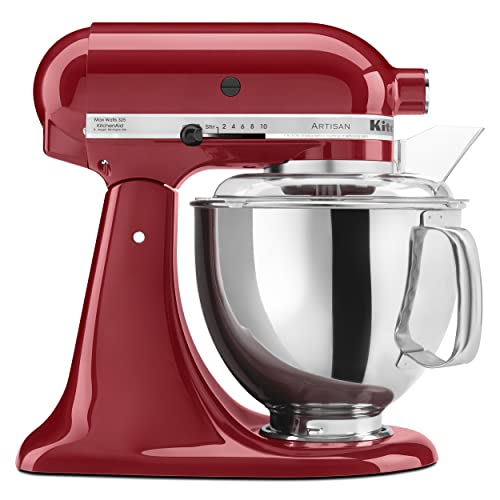
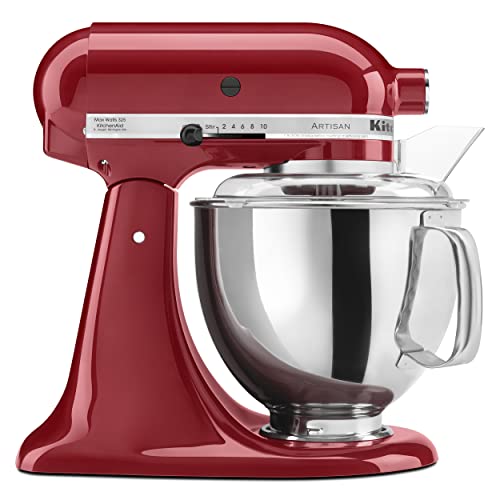
At a glance: KitchenAid Artisan 5-quart tilt-head stand mixer (KSM150PS), 10 speeds, handled stainless bowl, pouring shield included in the verified listing, with flat beater, dough hook, and wire whip.
In this comparison the Artisan is both a contestant and the measuring stick: the fixed point of capacity, colour, and availability against which any Deluxe offer is judged. Its planetary action and ten speeds match the Deluxe’s platform behaviour while its bowl gives the extra headroom described above.
Strengths
- The largest tilt-head bowl in this comparison and the widest colour range
- Pouring shield and handled bowl in the standard verified box
- Sold everywhere, with the family’s deepest accessory and parts support
Trade-offs
- The highest tier of the three ladder rungs discussed here
- Tall with the head raised, like every full-size tilt-head
- Its extras are the standard kit; bundle-style bonuses are not its game
Best for: bakers who want the tilt-head format at full size with maximum choice. Not suited for: bargain hunters whose needs the Classic already covers.

The Classic, as This Comparison’s Value Reference
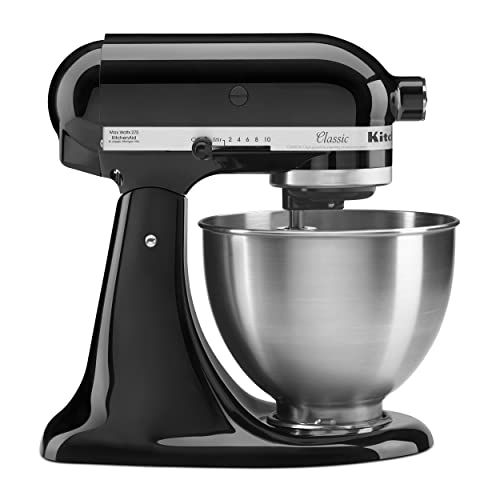
At a glance: KitchenAid Classic Series 4.5-quart tilt-head stand mixer (K45SS), 10 speeds, metal construction, 59 touchpoints, in Onyx Black in the verified listing.
The Classic belongs in this guide because every Deluxe offer is secretly a Classic offer with extras, and you cannot price the extras without pricing the base. If a Deluxe’s premium over this machine exceeds the value of its marked extras, the Classic plus separately chosen accessories is the smarter assembly of the same kitchen capability.
Strengths
- The same 4.5-quart platform and ten speeds at the family’s lowest tier
- Full hub compatibility for the entire attachment range
- A decades-deep installed base that keeps parts and advice plentiful
Trade-offs
- Plain presentation and the shortest colour list of the three
- No bundle extras; everything beyond the core trio is on you
- The same 4.5-quart ceiling as the Deluxe
Best for: value-first buyers and anyone assembling their kit piece by piece. Not suited for: buyers who want the dressed-up presentation out of the box.
Baking Behaviour: What the Shared Platform Means at the Bowl
Because the Deluxe shares the 4.5-quart tilt-head architecture, a baker moving between it and the Artisan notices workflow differences rather than quality differences. Creaming, beating, and whipping proceed identically at equal batch sizes; the planetary action leaves the same minimal residue at the bowl’s base; the dough hook develops a standard loaf with the same unhurried competence. The Artisan’s bowl simply postpones the moment at which a growing batch becomes a negotiation. Technique transfers completely between the two, including the habits that matter: start dry ingredients at stir, scrape once during creaming, knead at the low speeds only, and respect the flour envelope the bowl implies. A household that learns on either machine has learned on both, which is why choosing between them on price, colour, and capacity is not a compromise but the correct level of analysis. Our notes on stand mixers for bread dough mark where this whole tilt-head class, Deluxe included, hands over to heavier machinery.
Who Should Buy Which, in This Comparison
Buy the Artisan if your batches run large or doubled, if a particular colour matters, if you want the handled bowl and shield as standard, or if any Deluxe you are considering is priced within easy reach of the Artisan’s street price. It is the rung with no regrets attached.
Buy a Deluxe if the specific offer in front of you passes the audit: extras you marked, priced clearly below the Artisan, in a finish you prefer to the Classic’s. In that configuration it is the ladder’s clever rung, and its owners are usually pleased with themselves for good reason.
Buy the Classic if the audit fails, because the same platform without the bundle premium, plus the one extra you actually wanted bought separately, reconstructs the Deluxe’s value at a lower total. The ladder’s bottom rung is not a booby prize; it is the reference every other rung must beat.
Why Mid-Tier Variants Exist: A Short Retail History
The Deluxe’s existence follows a logic worth understanding, because it predicts where such variants appear and how long they last. Appliance manufacturers sell through retailers who compete fiercely on headline products, and a retailer that stocks the identical Classic and Artisan as every rival can compete only on price. An exclusive middle variant breaks that symmetry: it gives the retailer a model no rival stocks, a bundle whose value cannot be comparison-shopped in one click, and a shelf story about stepping up. Manufacturers cooperate because the arrangement moves volume and because the variant costs them little: the platform is unchanged, the changes are trim, finish, and carton contents. The Deluxe is this logic wearing a KitchenAid badge, and recognising the logic is not cynicism. Some exclusive bundles are assembled generously and priced keenly to win the retailer’s season; others are assembled thinly and priced on confusion. The variant system produces both, which is why the audit matters more than the badge, and why this guide refuses to give the Deluxe a fixed score. Its score is printed on the specific box, in the specific store, in the specific week you meet it.
Finishes and Trim, Taken Seriously
Because presentation is the Deluxe’s home ground, it deserves more than a passing nod. A stand mixer’s finish is experienced in three ways: as colour, as surface, and as the small hardware of trim bands, hubs caps, and levers. The Classic keeps all three plain, in finishes chosen to be inoffensive in any kitchen and to hide the marks of work gracefully. The Deluxe programmes typically reach for richer colour and a more finished trim, narrowing the visual distance to the Artisan until the two machines, side by side on a shelf, are hard to tell apart at a glance. The Artisan then wins the presentation contest on depth rather than on any single unit: more colours, more rotations, more limited finishes, and the confidence of a line whose identity is its palette.
There is a practical footnote to the beauty contest. Dark, glossy finishes show flour dust most; pale and matte finishes forgive a working kitchen’s daily evidence. A mixer that lives out, as these machines should, accumulates a fine patina of use no matter its colour, and owners who bake daily learn to love the finishes that age gracefully over the ones that photograph perfectly. If your Deluxe candidate and your Artisan candidate are otherwise tied, choose the finish that will look best after a year of Tuesdays, not the one that looks best under the shop’s lights.
The Second-Bowl Economy on the 4.5-Quart Platform
One under-examined way the ladder’s rungs differ is in the ecosystem around them. The 4.5-quart class, shared by the Classic and the Deluxe, has been sold in such volume and for so long that second bowls, replacement beaters, and shields circulate widely, including in the secondhand market, and a baker can assemble a two-bowl workflow for modest money. The Artisan’s 5-quart ecosystem is equally deep in absolute terms, being the family’s most popular size. Neither platform strands its owner; the point is subtler. A Deluxe bought partly for its bundle can still be expanded cheaply through its class’s vast accessory pool, while its included extras, if well chosen, delay the day you need to. When auditing a Deluxe, therefore, count not only what is in the box but how cheaply the box’s omissions can be repaired later. A missing shield on a 4.5-quart machine is a small, findable purchase; the audit should price it as such rather than treating every omission as fatal or every inclusion as gold.
Care and Keeping on the Shared Platform
Ownership of either machine follows the tilt-head routine this family is known for. Keep the hinge free of dried batter so the head tilts cleanly; check the hinge pin occasionally for drift if the head develops a wobble; run the coin test for beater clearance when mixing behaviour changes; wash tools promptly after egg work; and store the beater, hook, and whip in the bowl with a cloth between them. The Deluxe’s finer finishes ask for one extra courtesy: wipe them with a soft cloth rather than an abrasive pad, because presentation you paid for deserves preservation. None of this differs meaningfully from the Classic’s care, which is the platform’s point. A buyer choosing the Deluxe for its looks is not signing up for a diva’s maintenance regime, and a buyer choosing the Artisan for its capacity is not excused from the same ten minutes of monthly attention. Both machines repay that attention in decades, and both sulk, in the small ways machines do, when it is withheld for years.
Three Kitchens, Three Answers
The new baker furnishing a first real kitchen
You bake monthly and rising, own nothing, and are choosing the machine that will teach you the craft. If a Deluxe offer in your store includes the flex-edge beater at a gentle premium over the Classic, it is a genuinely good first machine: the platform is right, the presentation will please you daily, and the extra beater will be used from the first month. If the Deluxe’s price has drifted toward the Artisan’s, buy the Artisan instead and let its bigger bowl be your headroom for the baker you are becoming. Either way you are choosing well; the only poor outcome is paying Artisan money for a 4.5-quart machine by inattention.
The experienced baker replacing a worn machine
You know your batch sizes to the gram and your preferences to the finish. Your audit is ruthless and quick: the Deluxe wins only if its bundle replaces tools you were about to rebuy, because everything else about it duplicates what you already understand. Most replacers land on the Artisan for the bowl or on the Classic for the value, and the Deluxe’s middle position, so attractive to newcomers, has the least to offer the cook who has already decided what matters. Trust that instinct; it is experience, not prejudice.
The gift buyer at the seasonal display
You are buying for someone whose baking you admire and whose kitchen you know imperfectly. The Deluxe display is engineered for you, and it is not a trap: a handsome machine with a useful extra is a fine gift. Apply the audit anyway, because the difference between a generous bundle and a dressed-up one is invisible until the box is opened at home. If the audit leaves you unsure, the Artisan in a safe colour is the gift that cannot miss, and the Classic is the gift that respects a budget while still giving the whole platform. All three rungs make the recipient happy; the audit merely decides which one makes you happiest about the price.
If You Already Own One of Them
Comparisons are usually read before purchase, but a share of readers arrive owning one side and wondering about the other. If you own a Deluxe and are eyeing the Artisan, the honest gain is half a quart and a colour catalogue; your tools in the 4.5-quart fitment will not follow you, so price the switch as a full re-equipment, and ask whether the capacity is a weekly need or an annual wish. If you own an Artisan and are eyeing a Deluxe for a second property, the logic reverses pleasantly: your skills transfer, the smaller machine suits a smaller kitchen, and the audit applies to a buyer who needs no persuading about the platform. If you own the Classic and are eyeing either, you already own the platform’s substance, and the step up buys presentation and, in the Artisan’s case, capacity, in that order. None of these moves is foolish; all of them should be made with the frequency test in hand, because machines bought for annual wishes spend fifty weeks as furniture.
When the Ladder Continues Upward
Both machines in this comparison are tilt-heads, and the tilt-head format has a ceiling that no rung of this ladder removes: the hinged head that makes access delightful also sets the limit on stiff-dough authority. Readers whose baking is migrating toward large, lean, demanding doughs should not climb from Deluxe to Artisan expecting transformation; they should step sideways to the bowl-lift branch, where the frame and drive were designed for that work, a migration mapped in our artisan versus professional comparison. Similarly, readers whose kitchens are shrinking should look down the ladder to the Mini rather than forcing either of these full-size frames into a space that resents them, as our classic versus artisan mini comparison explains. The ladder metaphor serves best when you remember it has more than three rungs and that the right rung is the one under your feet, in your kitchen, at your batch size.
The Flex-Edge Beater, Explained Properly
Since this single accessory decides so many Deluxe audits, it merits a clear explanation. A standard flat beater pushes ingredients around the bowl and relies on the planetary action to bring everything through its path; a thin layer on the bowl’s wall and a pocket at the base escape it, which is why recipes instruct you to stop and scrape. The flex-edge variant adds a flexible fin along one edge of the beater that rides the bowl’s wall as it turns, wiping that layer back into the mixture continuously. The effect is most valuable in creaming, where unmixed butter streaks are the enemy, and in batters that cling. It does not eliminate scraping entirely, the centre dimple of the bowl still hides a spoonful, but it reduces two or three stops to one. Owners who bake weekly feel the benefit constantly, which is why the tool tops the aftermarket lists for every tilt-head model and why its presence in a Deluxe box is the strongest card the variant holds. When you audit, value it as what it is: the rare accessory that improves the machine’s core task rather than adding a new one.
Daily Handling: Living on the Middle Rungs
Day-to-day life with either machine is the tilt-head routine at its most familiar. The head tips with a light, positive action; the bowl twists onto its plate and off again with a quarter-turn that becomes muscle memory; the speed lever sits where a thumb expects it. The Deluxe and the Artisan share a stance and a weight class, so neither asks its owner for a different kitchen, and both reward a permanent counter home near the flour and the oven. Under-cabinet clearance with the head raised is the measurement that matters, and it is effectively the same errand for both. Where the machines part company in daily feel is at the bowl: the Artisan’s handled bowl pours and carries with a confidence the plain bowl style does not quite match, and over years of batters that small ergonomic grace compounds. It is not a reason to pay any price, but in a close audit it is a legitimate point on the Artisan’s side of the ledger, worth more than another line of trim.
Seasonal Pricing Patterns, Without Numbers
Mixer pricing in this family follows the retail calendar faithfully enough to plan around. The standard models, Classic and Artisan, are promoted in waves across the year, with the deepest cuts clustering around the major gift seasons and the spring wedding-registry period. Retail variants like the Deluxe follow their own stores’ calendars, which means the audit’s same-day rule is not pedantry: a Deluxe compared against the Artisan’s list price in the Artisan’s off week will look like a bargain that evaporates the following week when the Artisan’s promotion lands. Patient buyers pick their machine first and their week second. Impatient buyers, and gift buyers on deadlines, should at least run the audit with both machines’ current street prices rather than their ticket prices, because the gap between ticket and street is where middle-rung variants earn their keep or lose their case. None of this requires expertise, only the discipline to compare like with like on the same afternoon.
Noise, Vibration, and the Working Kitchen
Both machines speak with the same voice, the purposeful gear note of the tilt-head platform, brighter at whip speeds and deeper under dough load. Neither is a quiet appliance in absolute terms, and neither is offensively loud for its class; the practical differences in a real kitchen come from placement rather than model. A machine on a stone counter over a hollow cabinet will drum; the same machine on a mat, against a wall, will merely hum. The Deluxe’s finer finishes change nothing acoustically, and the Artisan’s larger bowl changes nothing that matters. Owners in open-plan homes learn to run the whip before the baby sleeps or after, and to let dough knead whenever, because low speeds are neighbourly on both machines. If noise is a deciding anxiety, spend your diligence on the mat and the placement, and buy either rung with a calm mind.
Longevity and the Resale Ladder
Durable goods should be judged partly by their exits. The Artisan, as the family’s most recognised model, resells with the least explanation: buyers know it, want it, and price it confidently, and its colour can even be the selling point. The Classic resells on utility, cheaply and quickly, to buyers furnishing first kitchens. The Deluxe resells with a footnote: its value depends on the buyer understanding what the variant is, which the used market does imperfectly, so sellers should list the model code, the full contents, and the extras prominently, and expect the machine’s worth to be argued from its platform rather than its badge. None of this should dominate a purchase you intend to keep for a decade, but for households that trade up as their baking grows, the ladder’s resale shape is one more reason the Artisan’s premium is partly recoverable and the Deluxe’s premium should be paid only for extras you will use yourself. Buy the machine for your kitchen first and the market second, and both will treat you fairly.
The Verdict Restated, With the Reasoning Exposed
Everything in this comparison reduces to a single disciplined habit: separate the platform from the proposition. The platform, shared by the Deluxe and the Classic and closely related to the Artisan’s, is excellent and not in dispute. The proposition is where the Deluxe lives: a bundle and a finish at a price, offered by one retailer, in one season. Propositions are judged by arithmetic, and arithmetic needs the same-day prices of the fixed points around it. Run that arithmetic and the Deluxe is sometimes the cleverest buy on the ladder and sometimes an expensive way to buy a smaller Artisan. The Artisan, by contrast, asks no arithmetic of you beyond its own price: it is the complete tilt-head proposition, bigger bowl, broader palette, everywhere available. Choose the certainty when the numbers are close, choose the bundle when the numbers are kind, and choose the Classic when the numbers say the bundle was never kind at all. That is the whole of the Deluxe-versus-Artisan question, and it is enough.
What 4.5 Quarts Cooks, Recipe by Recipe
Since the Deluxe’s bowl defines its ceiling, it is worth touring the repertoire that fits beneath it, because the list is longer than sceptics expect. Every standard cake in the home canon fits: the two-layer birthday cake, the bundt, the loaf cakes, the sponge that needs its whites folded in a separate pass. Cookie recipes in their published, undoubled form fit with room for the mix-ins. A single loaf of bread, a dozen rolls, a family pizza dough, a brioche batch: all fit, kneaded at the class’s unhurried low speeds. Meringue for a pavlova fits; the whites for a large angel cake ask for care at the fold rather than a bigger machine. Mashed potatoes for six fit; for twelve, the pot does double duty in two batches, which holiday cooks have always accepted. What does not fit is the doubled, the tripled, and the production-scaled, and the honest question for a Deluxe candidate is not whether those batches are imaginable but whether they are scheduled. A machine should be bought for the calendar you keep, and most calendars, read honestly, are written in the standard quantities this bowl was designed around.
Support, Warranty, and Parts Across the Ladder
Support is the ladder’s most egalitarian feature. All three rungs are KitchenAid machines with the manufacturer’s backing for new purchases, and the 4.5-quart class’s enormous population means its bowls, beaters, hooks, whips, and shields are stocked widely and understood by every repairer who touches the brand. A Deluxe owner is not maintaining an orphan; the variant’s badge may be retail-specific, but its model code leads straight to the platform’s parts catalogue. Keep the code recorded, keep the receipt with it, and every future interaction, from a chipped beater coating to a lost shield, resolves through ordinary channels. The Artisan’s support is identical in kind and slightly broader in colour-specific trim availability, a footnote rather than a factor. Buyers sometimes imagine that exclusive variants carry exclusive headaches; in this family, at least, the exclusivity stops at the carton, and the machine underneath is as well supported as anything the company sells.
Energy, Materials, and the Long View
A stand mixer is among the most defensible appliances a kitchen can own from a materials standpoint: a metal-bodied machine, built to be serviced, with no consumables and a working life measured in decades when its batches stay within its design. Both rungs of this comparison share that character, and the choice between them has no meaningful environmental dimension except one: buying the size you will keep. A Deluxe replaced in three years by an Artisan, because the bowl was wished bigger from the start, wastes more than any finish or bundle can justify; an Artisan bought for prestige and used monthly wastes counter space rather than resources, which is the lesser sin but still a sin against the kitchen. The frequency test that runs through this guide is therefore also the sustainability test. Project your baking honestly, buy the rung that fits it, maintain the machine lightly, and the purchase will justify itself in every ledger that matters, including the planetary one.
A Word About Display Models and Open Boxes
Middle-rung variants circulate through display and open-box channels more than fixed models do, because retailers rotate their exclusive programmes and clear the stage for the next one. An open-box Deluxe can be the audit’s happiest ending: the platform is durable, the discount is real, and the risks are enumerable. Inspect the machine as you would any used example, run every speed, tilt the head, lock the bowl, and inventory the box against the listing with particular care, since open boxes are where a bundled extra quietly goes missing. Confirm the model code and the return terms in writing. A complete, sound, discounted Deluxe is precisely the purchase this guide’s method exists to find, and a incomplete one at the same price is precisely what the method exists to refuse. The ten minutes of inspection is the whole difference.
Teaching Someone Else: The Shared-Kitchen Factor
Houses with more than one cook, or with a teenager learning to bake, benefit from a variable this comparison has not yet named: teachability. The tilt-head platform shared by both machines is the easiest format in the category to teach, because the controls are a single lever, the head’s motion is intuitive, and the bowl’s removal is obvious to a newcomer in a way the bowl-lift’s lift-and-unclip is not. Between the two rungs, the Deluxe’s bundle can help or hinder the lesson: a flex-edge beater forgives a beginner’s reluctance to scrape, while a carton of extra attachments invites experiments the household may not be ready to supervise. The Artisan’s standard kit is the cleanest teaching set. None of this should steer a purchase by itself, but in a household where the machine is a shared teacher as much as a tool, simplicity has a value that belongs in the audit alongside the extras, and it mildly favours whichever box is simpler on the day you compare them.
And a closing observation for the reader who has followed the argument this far: the Deluxe-versus-Artisan question feels bigger than it is because the names suggest a hierarchy of machines. Underneath, there is one excellent platform, two bowl sizes, and a retail proposition that must justify itself in arithmetic. Readers who internalise that structure will never be confused by a mixer badge again, in this family or any other, and that clarity, more than any single verdict, is what a comparison owes its audience. Choose by bowl, by bundle, and by the calendar of your baking, and the name on the trim band can be whatever the arithmetic leaves standing.
Storage and Counter Planning for the 4.5-Quart Class
Both machines in this comparison occupy the full-size tilt-head stance, so their domestic planning is identical and worth stating once, clearly. Reserve a counter position with the raised-head clearance the tilt demands, depth for the bowl’s removal arc, and proximity to both the flour storage and a landing space for hot trays. If the machine must be stored rather than displayed, choose a low shelf rather than a high cupboard, because its weight makes overhead lifting a genuinely bad idea repeated weekly. A sliding tray or a simple mat eases the forward pull for use under cabinets. These arrangements sound mundane, and they are, but they decide whether a mixer is a daily instrument or a monthly event, and they apply with equal force to the Classic below and the Artisan above. The Deluxe’s finer finish adds one planning note: give it the position where it will be seen, since its presentation was part of its price, and a machine bought partly for beauty should not be sentenced to a cupboard.
Bowl Options in This Class: Steel, Glass, and Handles
Bowls deserve a section of their own because they are the part of the machine you handle most and the part where the rungs quietly diverge. The standard across this class is stainless steel: light for its size, unbreakable in any accident a kitchen can plausibly stage, and indifferent to temperature shocks between freezer and mixer. Glass bowls exist within the family’s ecosystem for certain models and appeal to bakers who like to watch a batter’s consistency and to microwave butter in the same vessel; they are heavier, chip at the rim if treated carelessly, and must be matched to the model with the same code discipline as any tool. Handles, or their absence, shape daily feel more than material does: a handled bowl pours batter in a controlled ribbon and carries a full load one-handed with confidence, which is one of the Artisan’s standard-box graces and a feature to check explicitly on any Deluxe listing, since bundle bowls vary. When you audit, put the bowl on your checklist as an item in its own right, material, handle, and capacity all confirmed from the listing’s specifications rather than its photograph, because photographs in retail programmes are shared across variants with a freedom that has misled many careful shoppers.
Finally, a word to the reader who came here hoping for a simple winner and is leaving with a method instead. That trade is deliberate, and it favours you. A verdict printed today would expire with the next retail programme, because the Deluxe is a moving target by design; the method, platform first, proposition second, arithmetic always, will still be correct when the next variant name appears on the shelf, as it certainly will. The Artisan’s role in that future is secure: it is the fixed point the variants orbit. Buy the fixed point when in doubt, buy the variant when the audit smiles, and bake with whichever arrives in the confidence that the platform underneath has been proving itself in home kitchens for a very long time.
It is also worth recording what this comparison did not find, because absences are evidence too. No credible specification surfaced anywhere in our verification suggesting the Deluxe mixes with a different motor tune, a different gearbox, or a different speed map from its class; no owner literature treats it as a separate machine with separate foibles; and no parts catalogue gives it a private set of wear items. The Deluxe is a chapter in the platform’s retail history, not in its engineering history, and a buyer who understands that distinction holds the entire comparison in one sentence. Everything else, the colours, the bundles, the seasonal arithmetic, is negotiation around that settled core, and negotiation, unlike engineering, is a game the prepared buyer can win.
The Rung You Skip: A Note on Buying the Classic and the Beater
There is a composite purchase that haunts this comparison and deserves to be named as a formal option: the Classic, bought at its promotional price, plus the flex-edge beater bought separately in the correct fitment. That assembly reproduces the most common Deluxe proposition, platform and prized extra alike, at a total the audit can compute in advance and compare against any live Deluxe offer. Its weakness is presentational, since no separate purchase upgrades the Classic’s finish, and its strength is control, since every element is chosen rather than bundled. When a Deluxe offer beats the composite on price, buy the Deluxe with this guide’s blessing. When it does not, the composite is the rational monument to the audit’s method, and its owner can enjoy a private satisfaction every time the beater sweeps the bowl: the ladder’s middle rung, built by hand, at the bottom rung’s price.
Frequently Asked Questions
Is the KitchenAid Deluxe a real model or a store name?
It is a retail-channel variant name applied to a 4.5-quart tilt-head KitchenAid positioned above the Classic, with contents and finishes set by the retailer’s programme. When we verified products for this guide, no distinct Deluxe listing appeared in the main online catalogue; searches resolved to the Classic and Artisan. Always judge a Deluxe by its model code and its listed box contents rather than by the name.
Is the Deluxe more powerful than the Classic?
There is no evidence of a different mixing platform: the Deluxe shares the 4.5-quart tilt-head architecture, ten speeds, and planetary action of its class. Its proposition is presentation and bundled extras, not stronger mixing. If a listing implies a performance advantage, ask for the specification that supports it; the honest differences are in the box and the finish.
What does the Artisan give me that the Deluxe does not?
A larger 5-quart bowl with a handle, the pouring shield in its standard verified box, the widest colour range in the family, and universal availability with the deepest parts and accessory support. Whether those advantages matter depends on your batch sizes and your feelings about colour, which is why this guide prices them rather than merely listing them.
Can the Deluxe use Artisan attachments and bowls?
Hub attachments yes, completely, since the powered front hub is common across the family. Bowls and bowl-mounted tools are sized by model class: the Deluxe’s 4.5-quart fitments match its own class, and the Artisan’s 5-quart bowl and tools are not interchangeable with it. Buy spares by model code.
Is the Deluxe good for bread dough?
Within the 4.5-quart tilt-head envelope, yes: standard loaves, pizza batches, and rolls knead properly with the hook at low speed. Its limits are the class’s limits, reached by large or stiff batches, at which point the correct move is splitting the batch or stepping up to a bowl-lift machine, not blaming the Deluxe badge.
How do I know if a Deluxe offer is good value?
Run the four-move audit: list the box contents, mark the extras you would genuinely buy, price the offer against the Classic and the Artisan on the same day, and buy only if its position between them is justified by the marked extras. A Deluxe near Classic money with a flex-edge beater included is value; a Deluxe near Artisan money with only styling to show is not.
How should I split a double cake recipe between two bakes on the 4.5-quart platform?
Mix the full batter only if it stays comfortably below the bowl rim with the beater fitted; a doubled sponge batter often looks manageable dry, then climbs once the eggs and flour are fully incorporated. The safer routine is to weigh the mixed batter, bake the first layer, and hold the remainder covered for the shortest possible time, since leavening begins losing lift as it waits. For frequent double batches, treat that repeated compromise as useful evidence: it is the capacity limit, not technique, that is shaping your baking, and it points more honestly toward the larger Artisan bowl than toward another accessory for the smaller platform.