Disclosure: As an Amazon Associate, topratedkitchenware.com earns from qualifying purchases. Links on this page are affiliate links; they cost you nothing extra. Prices and availability change often, so check the current Amazon listing before you buy.
Every stand mixer decision eventually becomes the kitchenaid tilt head vs bowl lift question, because those two phrases describe the only two ways a serious mixer can be built: either the head moves, or the bowl does. In a tilt-head machine the motor housing hinges backward, opening the bowl like a lid. In a bowl-lift machine the head is a fixed bridge and the bowl rides up to meet it on a pair of arms. That single mechanical choice radiates into everything owners care about: how the machine handles stiff dough, how tall it stands, how it feels to scrape a bowl at midnight, how it sounds, and how it ages. This guide explains both architectures from the metal outward, scores them task by task with the reasoning exposed, and ends with a decision method based on your dough, your batches, and your cabinets. Two verified machines anchor the discussion, the Artisan for the tilt-head and the current 7-quart bowl-lift for its side, with the family’s other models appearing where they sharpen the picture. Readers who want the whole range mapped at once should pair this guide with our complete KitchenAid mixer comparison.
Kitchenaid Tilt Head Vs Bowl Lift: The Verdict in One Paragraph
Choose tilt-head if your baking is varied and social, cakes, cookies, whipped work, and the occasional loaf, and if easy access matters to your pleasure in the process: it is the friendlier architecture, and for most households friendliness is the specification that decides satisfaction. Choose bowl-lift if dough is a weekly discipline, if batches double as a matter of routine, or if you bake in production quantities: its fixed frame converts torque into work instead of motion, and it will never ask you to rest a hand on its head while it kneads. Everything after this paragraph is the evidence, the exceptions, and the measurements, for readers who want to see the verdict earned rather than asserted.
In this guide
How a Tilt-Head Mixer Is Built
The tilt-head layout places the motor in a head that pivots on a hinge at the rear of the pedestal. A latch or lever releases the head, which tips back and up, carrying the beater clear of the bowl. The bowl itself locks onto a clamping plate on the pedestal with a short twist. The design’s elegance is its access: with the head raised, the bowl is a completely open vessel, and the cook can add, scrape, taste, and remove it in one motion. Its mechanical compromise is equally visible: the hinge that grants the access is a joint, and joints flex under load. KitchenAid’s tilt-heads manage the compromise with a locking head, a hinge pin that can be checked and adjusted, and beater clearance set by a screw in the hinge, small engineering courtesies that keep the format honest through years of use. The format dominates the home market because most home baking is access work punctuated by mixing, not mixing punctuated by access, and the tilt-head optimises for the majority rhythm.
How a Bowl-Lift Mixer Is Built
The bowl-lift layout fixes the head as a rigid bridge across a column and mounts the bowl on two arms that a lever raises and lowers. The bowl hangs from pins and a bracket, locked in three dimensions, and the beater descends into it from the immovable head. Nothing in the load path hinges, so the torque of a stiff dough goes into the dough rather than into rocking the machine. The format descends directly from commercial planetary mixers, which are bowl-lifts at every size that matters, and it carries the commercial virtues with it: stability, capacity, and indifference to repetition. Its compromises are domestic rather than mechanical. The machine is as tall working as resting, the bowl’s removal is a small procedure rather than a gesture, and small quantities sit deep in large bowls where tools reach them less eagerly. Current home bowl-lifts soften the last point with a half-speed setting for gentle work, a refinement the retired Professional generation lacked and the modern machines wear well.
The Dough Test: Where the Architectures Truly Divide
Kneading is the only common task that loads a mixer to its design limits, which is why it decides this comparison for the households it decides for. A developing dough is an elastic opponent: it climbs, pulls, and resists in rhythm, and the machine’s frame determines whether that rhythm becomes work or theatre. On a tilt-head, a standard loaf kneads cleanly, the head nodding almost imperceptibly, the hook folding the dough against the bowl in the familiar cadence. Scale the batch up or stiffen the hydration and the symptoms arrive in a predictable order: the nod becomes a rock, the machine creeps a few millimetres across a polished counter, the dough begins climbing the hook instead of folding, and the cook’s hand comes to rest on the head in the universal gesture of tilt-head ownership. None of this is failure; it is a format announcing its envelope.
On a bowl-lift, the same escalation mostly does not happen. The frame absorbs what the dough offers, the bowl stays where the pins put it, and the drive, specified for sustained low-speed torque, holds its note. Batches double without negotiation, and stiff doughs like bagel and pasta doughs are kneaded as routine rather than as events. This is why professional kitchens, where dough is not a hobby but a throughput, standardised on the format a century ago. The honest summary is not that tilt-heads cannot knead, they demonstrably can, within their envelope, but that bowl-lifts knead without an envelope becoming part of the conversation. Households that knead weekly should weight this section above all others; households that knead monthly should read on, because the next sections belong to the tilt-head.
Access, Scraping, and the Rhythm of Real Baking
Most baking time is not mixing time. It is the adding of eggs one at a time, the scraping down of a creaming bowl, the folding in of flour, the transfer of batter to a pan, the tasting and adjusting. The tilt-head was designed by people who understood this rhythm in their hands. The head tips with a thumb’s pressure, the beater clears the bowl completely, the bowl twists off and becomes a pouring vessel with a handle, and the whole machine feels like a collaborator in the stop-start choreography of cakes and cookies. The bowl-lift’s rhythm is more deliberate: lower the bowl, unclip, lift it free; reverse to resume. It is not difficult, and owners cease to notice it, but it is a procedure where the tilt-head offers a gesture, and across the hundreds of small interactions in a year of baking, gestures compound into affection.
Scraping deserves its own sentence because it is where access becomes quality. A creaming mixture scraped thoroughly beats evenly; a batter whose bowl walls are wiped into the mass bakes uniformly. The tilt-head’s open bowl invites the scrape and rewards it instantly. The bowl-lift’s bowl, deeper and mounted, asks the cook to lower it for a proper scrape, a step that hurried bakers skip and then blame on the machine. Neither format prevents excellence; one of them makes excellence the path of least resistance, and for the varied, social baking that fills most kitchens, that path matters more than torque.
Height, Footprint, and the Cabinet Problem
More mixers are defeated by cabinets than by dough, so measure before you fall in love, and measure the right dimension for each architecture. A tilt-head needs its resting height to fit under the wall cabinet and then additional clearance above for the head to tip back fully, unless it will be slid forward for every use, a routine its weight makes tiresome. A bowl-lift needs its full working height at all times, since nothing folds away, plus a little depth for the lift lever’s travel and the bowl’s removal path. On the counter itself the two formats occupy similar footprints, with the bowl-lift reading as the more monolithic presence. Kitchens with low cabinets and deep counters often suit the bowl-lift’s fixed profile, slid back against the wall; kitchens with open shelving or island counters suit either. Our notes for stand mixers in small kitchens work through the measurement routine in detail, and the family’s compact answer, for kitchens that fail both architectures’ tests, is examined in our classic versus artisan mini comparison.
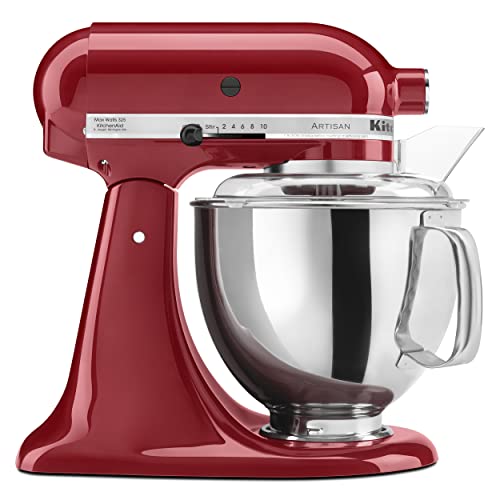
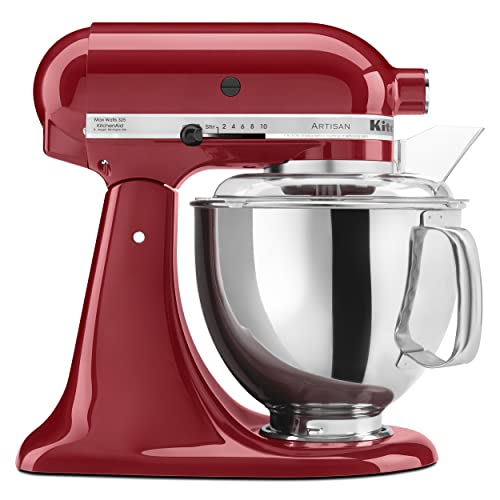
The Tilt-Head Exemplar: KitchenAid Artisan
At a glance: KitchenAid Artisan 5-quart tilt-head stand mixer (KSM150PS), 10 speeds, handled stainless bowl, pouring shield included in the verified listing, full hub compatibility.
The Artisan is the tilt-head architecture at its most complete: full size, full polish, and the family’s widest colour range. As this comparison’s exemplar it demonstrates the format’s thesis, that access and versatility serve the median kitchen better than torque it will never request.
Strengths
- Effortless access for adding, scraping, and pouring
- Balanced performance across the whole repertoire
- The deepest accessory ecosystem and colour range
Trade-offs
- Head flex and counter creep at the top of its dough envelope
- Raised-head height can clash with low cabinets
- Capacity ceiling below the bowl-lift branch
Best for: varied home bakers who value the process as much as the result. Not suited for: production dough work.

The Bowl-Lift Exemplar: KitchenAid 7-Quart Bowl-Lift
At a glance: KitchenAid 7-quart bowl-lift stand mixer (KSM70 family), 11 speeds including a half speed, with an accessory bundle in the verified listing that includes a double flex-edge beater among five accessories.
The flagship of the current bowl-lift generation shows the format’s modern face: commercial architecture, domestic manners. The half speed folds delicately, the frame ignores stiff dough, and the bundled tools equip it as a production system. Its smaller sibling, the 5.5-quart model, carries the same architecture into a slightly gentler footprint and is the version most bread households should audition first.
Strengths
- Rigid, planted performance at any home batch size
- Half-speed delicacy unusual in a machine this size
- Production capacity with a complete accessory bundle
Trade-offs
- Fixed tall profile and the family’s heaviest presence
- Bowl routine is a procedure rather than a gesture
- Small batches sit low in the large bowl
Best for: bread-led and production households. Not suited for: small kitchens or mostly-small-batch baking.
Task by Task: A Scorecard With Reasons
Cakes and batters: tilt-head, on access and scraping, with quality identical. Cookies: tilt-head for standard batches, a draw at doubled scale where the bowl-lift’s capacity speaks. Whipping: tilt-head for small quantities, a draw at family scale, bowl-lift only with its half speed for folding what was whipped. Bread dough: bowl-lift, decisively, for the reasons the dough section gave. Mashed and savoury loads: a draw at family scale, bowl-lift when the holiday quantity arrives. Pasta and hub attachments: a genuine draw, since the hub is common and the work is the attachment’s, though the bowl-lift’s stability flatters the grain mill’s long runs. Daily affection: tilt-head, for most cooks, most days, which is not a soft criterion but the one that determines whether a machine is used or admired. A scorecard is a summary, not an argument; the arguments are the sections above it, and readers whose baking inverts this guide’s weightings should invert the scorecard with confidence.
Sound, Vibration, and the Physics of a Working Frame
The two architectures sound like their structures. A tilt-head’s voice has a liveliness in it, the head’s small movements under load adding a percussive edge at the dough’s hardest moments, while at batter and whipping speeds it settles into the bright mechanical note common to the format. A bowl-lift’s voice is lower and more uniform, the fixed frame giving vibration nowhere conversational to go, and its electronic speed control holds the pitch steadier as dough resistance rises and falls. On hollow counters and resonant cabinetry, either machine can be made to drum, and the remedy is shared: a mat, a solid position, and respect for the fact that a counter is a sounding board. In open-plan homes the bowl-lift is generally the easier neighbour at dough speeds and the tilt-head at whipping speeds is no worse than its rival; neither will pass unnoticed at full tilt, and households with sleeping children learn to schedule meringues with the same realism they apply to blenders.
Cleaning and Wear: Each Architecture’s Pressure Points
Both formats clean easily in the daily sense, bowls and tools washing conventionally and exteriors wiping down, but their long-term pressure points differ and owners should know their own machine’s list. The tilt-head asks attention at the hinge: dried batter migrates there, the pin can drift a fraction over years of heavy use and announce itself as a wobble, and the beater clearance screw in the hinge is the adjustment that keeps mixing thorough. All three are five-minute, manual-guided matters. The bowl-lift asks attention at the lift: the arms and pins that locate the bowl must stay clean and true, because a bowl that sits a fraction off its pins will rock under torque and wear its mounts; the lever’s travel should stay smooth and positive. Neither list is burdensome, and both machines repay the attention with the family’s characteristic decades. The deeper point is that architecture determines maintenance the way it determines everything else in this comparison, and a buyer who knows their machine’s two or three pressure points in advance will never mistake normal care for decline.
Small Batches on a Bowl-Lift: The Honest Workarounds
The bowl-lift’s one recurring domestic complaint deserves a practical answer rather than a shrug. Small quantities in a large bowl sit shallow, and a whip or beater designed for the bowl’s full geometry engages them less completely. Owners solve this in three established ways. The first is the smaller bowl: bowl-lift households that regularly work small keep a second, smaller bowl in the machine’s fitment where the range offers one, swapping by task. The second is technique: creaming small amounts begins with the beater and a spatula’s help for the first turns, after which the planetary action takes over competently. The third is delegation: a hand mixer lives in a drawer for the half cup of cream and the two egg whites, a division of labour that production kitchens have always practised. None of these is an apology for the format; they are the standard operating procedures of a machine optimised for scale, and households whose work is mostly small should read them as the signpost they are, pointing back toward the tilt-head’s native small-batch grace.
The Middle Path: The 5.5-Quart Bowl-Lift
Readers torn between the architectures often discover that their real question is not which format but how much of it, and the family’s smaller bowl-lift exists for them. The 5.5-quart model carries the fixed frame, the torque-first drive, and the half speed into a presence only modestly larger than a full-size tilt-head’s, narrowing the bowl-lift’s domestic costs while keeping its structural argument intact. For the household whose dough is weekly and whose cakes are constant, it is the closest thing the family offers to a synthesis: bowl-lift where dough is concerned, nearly tilt-head in its demands on the kitchen. It does not repeal the trade-offs this guide has catalogued, access remains a procedure and small batches remain small, but it reprices them. Shoppers whose scorecard came out close should audition it before deciding, because in this comparison the middle path is not a compromise in the pejorative sense; it is a third answer, engineered rather than improvised. Our artisan versus professional comparison examines it directly against the tilt-head benchmark.
A Short History of the Two Formats
The bowl-lift is the elder design by decades. Commercial planetary mixers of the early twentieth century, built for bakeries that measured dough in tens of pounds, fixed their heads and lifted their bowls because no hinge survives that duty and no cook lifts a bowl that size by hand. The tilt-head arrived as the domestic translation: when manufacturers shrank the planetary mixer for home counters in the middle of the century, the hinged head made the machine approachable, pretty, and easy to live with, and it carried the home market so completely that many bakers have never seen the older format outside a bakery window. KitchenAid’s own lineage runs through both, descending from commercial equipment on one side and defining the domestic tilt-head on the other, which is why its current family offers the two architectures as equals rather than as good and better. The history carries a lesson for buyers: neither format is the other’s replacement. They are parallel answers, one optimised for throughput and one for domesticity, and the century has not settled the question because the question is not technical. It is about what your kitchen does all week.
Torque, Explained Without a Physics Degree
Torque is the twisting force that kneading consumes, and a mixer’s relationship with it explains most of this comparison’s behaviour. When a dough hook turns through a stiff dough, the dough twists back with equal enthusiasm. That answering twist must be absorbed somewhere in the machine. In a bowl-lift, it travels down a rigid column into the counter and is gone. In a tilt-head, it arrives at a hinge, and the hinge, however well locked, yields a fraction, which the cook sees as the head’s nod and feels as the machine’s liveliness. The motor’s job is identical in both; the frame’s job is what differs. This is also why consumption figures mislead shoppers comparing the formats: two machines can draw similar power while delivering very different kneading experiences, because one spends a share of its composure on motion and the other spends none. Judge the formats by their structures and their batch guidance, and the physics will take care of itself in your kitchen exactly as it does in this guide.
Owners Who Switched: What Actually Changed
The most instructive evidence in this comparison comes from households that have owned both formats, usually by graduating from a tilt-head to a bowl-lift as their bread habit grew. Their reports are remarkably consistent. What changed completely: dough days, which went from supervised events to background routines, and doubled batches, which stopped requiring arithmetic. What changed somewhat: the first month’s bowl routine, missed briefly and then forgotten, and the counter, which had to be reorganised around a taller, more permanent resident. What did not change: cake quality, cookie quality, whipping quality, and the accessory shelf, since the hub carried everything across. The reverse migration, from bowl-lift to tilt-head in a downsized kitchen, produces the mirror report: dough days shrink to the new household’s scale without regret, and the daily access is welcomed back like an old friend. Both migrations testify to the same truth, that the architectures serve life stages and workloads rather than hierarchies of worth, and that a switch in either direction, made for honest reasons, tends to satisfy.
The Decision Worksheet: Score Your Own Kitchen
Abstract comparisons end in indecision, so here is the method this guide recommends, scored in your own kitchen with your own facts. Award points honestly; the architecture with the higher total is your answer, and a tie means the tilt-head, because friendliness breaks ties in domestic life.
Dough frequency. Kneading weekly or more: three points to bowl-lift. Monthly: one point to bowl-lift. Rarely: two points to tilt-head.
Batch habit. Doubling as a routine: three points to bowl-lift. Standard recipes as published: one point to tilt-head. Halving as a routine: three points to tilt-head.
Dough stiffness. Bagels, pasta dough, lean and stiff doughs in your repertoire: two points to bowl-lift. Soft and enriched doughs only: one point to tilt-head.
Process pleasure. You bake socially, scrape constantly, taste and adjust: two points to tilt-head. You bake in production runs and value set-and-forget: two points to bowl-lift.
The kitchen’s vote. Cabinets low and counters deep: one point to bowl-lift, which stands still. Cabinets high or open: one point to tilt-head, which needs to swing. Space genuinely tight: stop scoring and consider the compact end of the family, where neither architecture in this guide is the right answer.
The decade test. Picture the machine in ten years, in the household you are becoming. If the picture’s baking is bread-led, add two to bowl-lift; if it is celebration-led, add two to tilt-head.
Total the columns and buy the winner without relitigating, because a worksheet answered honestly contains more truth about your kitchen than any review, including this one, can hold. The method generalises, too: it is the same discipline our stand mixers for bread dough guide applies when it ranks machines by a single task.
Resale and the Second Life of Both Formats
Both architectures resell like the durable tools they are, with nuances worth a paragraph. Tilt-heads dominate the secondhand market’s volume, the Artisan above all, which makes them easy to buy, easy to price, and easy to sell onward when life changes. Bowl-lifts circulate in smaller numbers to a more knowing audience; the retired Professional generation demonstrated the format’s long second life, remaining desirable years after production ended because its structure ages slowly and its parts stayed available. Buyers in the used market should apply the architecture-specific checks this guide has given: hinge and pin on the tilt-head, lift arms and bowl seating on the bowl-lift, full speed range and honest sound on both. A machine that passes its own format’s checks is among the safest used purchases in the kitchen, and the format you choose today is therefore not a life sentence but a long, well-supported tenancy, which should make the choosing calmer.
Gifts, Registries, and Other People’s Kitchens
Choosing an architecture for someone else is this comparison’s hardest mode, because the deciding facts, their dough habits and their cabinets, are only partly visible from outside. The registry solves it when one exists: buy the registered architecture by its model code, since the couple’s research encodes their kitchen’s measurements and their baking’s true centre of gravity. Without a registry, the tilt-head is the safer gift by a wide margin, because its failure mode in an unknown kitchen is mild inconvenience while the bowl-lift’s failure mode is a machine too tall for its home and too specialised for its owner’s repertoire. The exception proves the rule: for the recipient whose bread devotion you have personally witnessed over years, the bowl-lift is not a risk but a recognition, the gift that says you understand what their Saturdays are for. In gift-giving as in buying, architecture follows knowledge, and where knowledge is thin, friendliness is the hedge.
Materials and the Long View, Once More
Both formats are built, in this family, as durable goods: metal structures, serviceable mechanisms, parts catalogues that outlast production runs. Their environmental and financial ledgers therefore turn on the same variable as every comparison in this series, which is replacement. A tilt-head replaced in three years by the bowl-lift its owner always needed wastes more than any specification difference between them; a bowl-lift exiled to storage by a kitchen it never fit wastes its own considerable virtues. The worksheet above is, among other things, an anti-replacement device, and using it honestly is the most sustainable act available to a mixer shopper. Buy the architecture your life describes, maintain its two or three pressure points, and the machine will still be answering the tilt-head-versus-bowl-lift question in your kitchen, by demonstration, long after the question’s asker has stopped needing an answer.
Modern Refinements: How the Gap Narrows at the Edges
Recent generations have softened both architectures’ classic weaknesses, and a current comparison should acknowledge the softening. The bowl-lift’s historic clumsiness with delicate work is answered by the half speed, which folds and starts gently enough to keep whipped components alive, and by electronic control that holds speeds honest under changing loads. The tilt-head’s historic dough ceiling is answered, partially, by better hinge locking, by flex-edge beaters that improve its everyday thoroughness, and by honest batch guidance that keeps owners inside the envelope where the format shines. Neither refinement repeals its architecture’s nature: a tilt-head will still flex before a bowl-lift notices a dough, and a bowl-lift will still ask a small batch to meet it halfway. But the refinements matter to buyers comparing new machines against old reputations, because the current versions of both formats are the most liveable ever made, and a decision formed on a decade-old encounter with either deserves a fresh test.
Beyond This Family: The Formats in the Wider Market
The tilt-head-versus-bowl-lift question is KitchenAid’s vocabulary for a division the whole market observes. Most rival generalists are tilt-heads, following the domestic format’s popularity; the dough specialists of the wider market escape the dichotomy entirely, driving from below or rotating the bowl, as our kitchenaid mixer alternatives guide explores. A shopper who has settled the architecture question here has therefore done transferable thinking: access versus rigidity, gesture versus procedure, envelope versus headroom. Those axes organise every stand mixer worth considering, whatever badge it wears, and a reader who can score their own kitchen on them will never again be dependent on a comparison, including this one, to choose well. That independence is the real product of a guide like this, and it is why the worksheet, the physics, and the history were worth their paragraphs.
One Week, Two Kitchens
Abstractions settle when they are lived, so consider the same week in two kitchens. In the tilt-head kitchen, Monday’s pancakes are mixed at stir speed in a bowl that opens like a book; Wednesday’s birthday cake is creamed, scraped, and poured in a rhythm so fluent the cook chats through it; Friday’s pizza dough kneads while the cook rests a hand on the head during its stiffest minute, a gesture as affectionate as it is functional; Sunday’s whipped cream takes ninety seconds and no thought at all. Nothing in the week strained the machine, and the machine never once made the cook think about architecture. In the bowl-lift kitchen, Tuesday’s double sourdough batch kneads unattended while the cook shapes the previous loaf; Thursday’s bagels, stiff as they come, are a deeper motor note and nothing more; Saturday’s bake-sale production runs through the big bowl in shifts that would have split a lesser machine’s day into negotiations; and Sunday’s small meringue is made, with a shrug, in the hand mixer that lives in the drawer for exactly that purpose. Nothing in that week strained its machine either. Both weeks are successes. They are simply different kitchens, and the architectures, read honestly, are how those kitchens describe themselves.
The Comparison, Closed
Tilt-head is the architecture of access: a hinge that turns mixing into a conversation. Bowl-lift is the architecture of authority: a frame that turns dough into a routine. The home market chose the first as its default because most kitchens converse more than they produce, and the professional world keeps the second because production is its whole conversation. Your kitchen knows which it is. Score it with the worksheet, measure it with the tape, and buy the architecture that matches, in whichever model and colour the family’s range offers at that intersection. Then bake, and let the machine’s structure disappear into the work, which is what both of these honourable designs were built to do.
First Week With Each Architecture: Setup and Calibration
Whichever format comes home, its first week should be a calibration rather than a performance. For the tilt-head, begin by setting the beater clearance with the manual’s coin test, because a machine whose flat beater just grazes the bowl’s base mixes the way its designers intended, and learn the hinge’s lock by feel so the gesture becomes thoughtless. Make the first bake something you know by heart, and note how the head behaves at your dough’s stiffest moment, because that note is your personal envelope marker for the decade. For the bowl-lift, begin by practising the bowl’s seating until the pins and bracket engage with a single confident motion, and by running the half speed on something delicate to learn how gently the big machine can move. Make the first dough a familiar one and listen to the frame’s calm, so you recognise the sound of a machine inside its envelope and, by contrast, would recognise strain if you ever heard it. In both cases, record the model code, store the tools in the bowl with a cloth between them, and position the machine where the worksheet said it belonged. A calibrated first week is the cheapest insurance in this entire comparison, and it costs nothing but attention.
Hub Attachments in Practice, Per Architecture
The shared hub makes attachments a draw on paper, and in the kitchen the draw mostly holds, with two honest nuances. Long, steady jobs, grain milling above all, flatter the bowl-lift’s stability, because the machine’s planted frame and sustained drive turn an hour of milling into a background task rather than a supervised one. Quick, intermittent jobs, a citrus press here, a spiralizer there, flatter the tilt-head’s rhythm, because the machine is already living in gesture mode and the attachment joins a workflow of constant small accesses. Pasta sits between the two, its rolling indifferent to architecture and its enjoyment dependent on counter space for the sheets, which both formats must surrender equally. None of this should steer the architecture decision by itself, since the hub’s whole output is available to both, but households whose attachment life is already known can let it cast a small vote, and households whose attachment life is unwritten should ignore the category entirely and decide on dough, batches, and cabinets, where the real differences live.
The Architecture Question Across a Baking Life
It is worth ending the analysis where lives actually happen, across time. The young baker in a first kitchen usually needs access, versatility, and forgiveness, which is the tilt-head’s whole personality, and the secondhand market is full of tilt-heads that taught someone to bake and were passed on with love. The family years reward whichever architecture matches the household’s centre of gravity, celebrations or bread, and punish only the mismatch. The production chapter, if it comes, belongs to the bowl-lift without argument, and the downsizing chapter, when it comes, often returns the baker to a tilt-head or below it to the family’s compact machines, with skills that make any format feel easy. Seen across a life, the question is not which architecture is best but which chapter you are in, and the family’s wisdom is to build both architectures well enough that chapters can change without the brand having to. Choose for the chapter you are entering, keep the machine maintained, and let the next chapter make its own case when it arrives.
Two Myths That Survive Every Comparison
The first myth holds that bowl-lift machines are professional and tilt-heads are toys, a confusion of habitat with quality. The tilt-heads in this family are metal-built, decades-serving machines whose format was chosen for domestic rhythm, not for cheapness, and the proof is in the secondhand market, where elderly tilt-heads sell as working tools. The second myth inverts the first, holding that bowl-lifts are overkill whose owners are performing seriousness. The bowl-lift’s owners are simply the households whose dough made the decision for them, and their machines’ calm under load is a fact of structure, not a pose. Both myths dissolve on contact with the worksheet, which is why this guide built one. Architectures are answers to workloads. Prestige, in either direction, is the one ingredient neither machine can mix into your baking.
A final practical word belongs to the shoppers who will meet these machines in a store, because the architectures reveal themselves to the hands faster than to the eyes. Tilt the tilt-head and feel the latch’s positivity; lower its bowl onto the plate and twist it home. Raise the bowl-lift’s bowl on its lever and feel the frame’s indifference to your effort; lower it and unclip the bowl in one rehearsed motion. Stand back from both and look at their silhouettes against your memory of your own cabinets. Five minutes of that handling, added to the worksheet’s arithmetic, will decide the question more reliably than another hour of reading, and this guide, having given you the physics, the scorecard, and the method, is content to hand the decision to your hands. They are, after all, the instruments the winning machine will serve.
Running Costs and Energy, Briefly
Neither architecture will trouble a household energy budget; mixers work in minutes, not hours, and the difference between formats across a year of baking is smaller than the cost of the flour dusted across the counter in the same period. The meaningful running costs are the human ones this guide has kept returning to: the minutes spent steadying a machine outside its envelope, the batches split or combined to suit a format, the small daily pleasure or friction of the bowl routine. Priced in those currencies, the right architecture is dramatically cheaper than the wrong one at any ticket price, which is the economic form of the comparison’s whole argument. Buy the structure your work describes, and the machine will pay you back in the only coin that compounds in a kitchen: unconsidered, reliable use, week after week, year after year.
And if, after the worksheet and the handling and the history, the decision still feels balanced on a knife edge, take that as information rather than failure: a genuinely tied score means your baking sits exactly at the formats’ border, where either machine will serve you well and neither will serve you perfectly. In that country, choose the tilt-head for its daily grace and manage the rare oversized dough by splitting it, as bakers did for the entire century before home bowl-lifts existed, or choose the bowl-lift for its headroom and delegate the small whipped jobs to a hand mixer, as production kitchens have always done. Both are honourable settlements. What the border country does not forgive is choosing by prestige, by a neighbour’s certainty, or by the size of a discount, because those reasons expire while the machine, whichever it is, remains. Choose by your work, and the work will confirm the choice.
A Note on Renting, Borrowing, and the Trial Bake
Because architecture is felt rather than read, the undecided should manufacture experience before manufacturing a decision. Borrow the format you do not own, from the friend or relative who evangelises it, and bake your own most representative recipe on it: your dough, at your hydration, in your batch size. One bake on borrowed machinery teaches more than a specification table because it engages the exact variables, access, torque, bowl routine, that this comparison has been describing in the abstract. Where borrowing is impossible, some retailers’ return windows function as the trial, provided the machine is used gently and kept complete. And where neither is possible, the worksheet’s arithmetic, honestly answered, remains a better prophet than anxiety. The formats have coexisted for a century because both are right answers; the trial bake exists to discover which one is yours, and it is worth the asking, because bakers lend mixers the way musicians lend instruments, gladly, to anyone who will take the machine seriously.
The Verdict, Restated for the Impatient
For the reader who scrolled: dough weekly, batches doubled, production in your present or your near future, and the bowl-lift is your architecture, in the 5.5-quart for most homes and the 7-quart for true production. Everything else, the cakes, the cookies, the whipped work, the occasional loaf, the social baking that fills most kitchens with most of their joy, belongs to the tilt-head, whose access and grace will be felt at every single bake rather than merely at the demanding ones. The border between the two is honest, the worksheet in this guide will place you on it precisely, and both sides of it are served by machines built to last decades. That is the whole comparison, and everything above this paragraph is its evidence.
A Short Glossary for the Specification Sheet
Three terms recur in listings for both architectures and reward a precise understanding. Planetary action means the beater spins on its own axis while that axis orbits the bowl, which is how a single tool reaches the bowl’s whole interior, and it is common to both formats here. Touchpoints count the positions at which the beater passes the bowl’s wall in one orbit, a measure of thoroughness rather than of power. Rated flour capacity, where a manufacturer publishes it, expresses the largest dough batch the machine is designed to work, and it is the most honest capacity figure in the category, worth more to a bread baker than bowl volume, motor consumption, and speed count combined. Read listings for those three, in that order, and the architectures will describe themselves accurately even in a manufacturer’s own language. A shopper fluent in just these terms can walk into any appliance aisle in the country and read a stand mixer shelf the way a mechanic reads an engine bay, which is to say, for what the machines will actually do rather than for what their badges promise.
Frequently Asked Questions
Which is more powerful, tilt-head or bowl-lift?
The bowl-lift architecture delivers its power more usefully for heavy work, because its fixed frame and torque-oriented drive waste nothing on flex or motion. Raw consumption figures do not capture the difference and are not comparable across designs. For the tasks most kitchens perform, both architectures have power in surplus; the difference appears only under sustained dough load, where the bowl-lift’s structure is the specification that matters.
Can a tilt-head mixer really knead bread dough?
Yes, within its envelope: standard loaves, pizza batches, and rolls knead properly with the hook at low speed. The format’s limits are large batches and stiff, low-hydration doughs, where the hinged head flexes and the machine works at its edge. Occasional and moderate bread bakers are well served by tilt-heads; weekly, doubled, or stiff-dough bakers are the bowl-lift’s natural constituency.
Is bowl-lift harder to use day to day?
It is more deliberate rather than harder: lowering and unclipping the bowl replaces the tilt-head’s single gesture, and the machine’s fixed height asks for permanent counter space. Owners adapt within a week and stop noticing. The cooks who continue to notice are those whose baking is a constant stream of small additions and scrapes, which is the tilt-head’s home rhythm.
Which fits better under kitchen cabinets?
It depends on the cabinet. A tilt-head needs resting clearance plus room to raise its head, or a willingness to slide it forward for use. A bowl-lift needs its full height permanently but nothing above it. Measure both profiles against your kitchen’s actual numbers; in low-cabinet kitchens the bowl-lift often wins by standing still, while in open or island kitchens the tilt-head’s flexibility is free.
Do the two designs use the same attachments?
Hub attachments are shared completely across the family, so pasta, grinding, and milling equipment fits both architectures. Bowls and bowl-mounted tools are specific to each model and architecture and do not interchange. Buy hub tools freely and bowl tools by model code.
If I bake everything, which should I choose?
The baker who truly does everything should choose by the heaviest regular demand, because that is where the architectures diverge, and rent the other format’s virtues with technique: the bowl-lift owner keeps a hand mixer for small whipped work, the tilt-head owner splits the occasional oversized dough. For most everything-bakers, the tilt-head’s daily affection wins the decade; for everything-bakers whose everything includes weekly bread in quantity, the bowl-lift is the honest answer.
Does the choice affect how I should scale a recipe up or down?
Yes, in opposite directions. On a tilt-head machine, scaling up is limited mainly by bowl volume and flour capacity, while small batches still mix well because the beater sits close to the bowl floor. On a bowl-lift machine, large batches are the natural territory, but halving a recipe can leave too little material for the beater to engage evenly, so small quantities may need a brief stop-and-scrape or a smaller accessory bowl where one is offered. Match your scaling direction to the format: frequent doubling suits bowl-lift ownership, while frequent halving for two-person households suits tilt-head ownership. Checking that fit before you buy prevents most disappointing first bakes on either design.