Disclosure: topratedkitchenware.com is reader-supported. When you buy through links on our site, we may earn an affiliate commission from Amazon and other retailers, at no extra cost to you.
Where to buy
The six machines below are the verified picks in this guide to the best commercial coffee makers bunn, for readers researching commercial coffee through the BUNN benchmark. Each name links to its Amazon listing, where you can check the latest price on Amazon and confirm the current configuration. The introduction explains plainly how these home and light-duty machines relate to genuine commercial BUNN equipment.
- Tastyle Mini Hot and Iced Coffee Maker
- Keurig K-Express (Evergreen)
- Keurig K-Express (Mint)
- Hamilton Beach FlexBrew Advanced 4-in-1
- Ninja Single Serve Coffee Maker PB051
- Keurig K-Elite
Read the full guide ↓ for the reasoning behind the order, the honest limitations of every pick, and the checks that matter more than any headline claim.
People searching for the best commercial coffee makers bunn are usually chasing a reputation: BUNN is the name on the brewer in every diner, office kitchen and church hall in America, associated with speed, volume and machines that simply keep working. This guide owes those readers a straight answer in its first paragraph. The verified pool ranked here contains no BUNN machine, and none of the six picks is a true commercial brewer. They are home and light-duty single-serve machines, and the guide will assess them honestly against the commercial standard rather than dress them in it.
That assessment is still worth reading, because the commercial question splits in two. Genuine commercial duty — a café, a busy diner, a large office floor — needs plumbed, high-volume equipment of exactly the kind BUNN built its name on, and no machine here belongs in that conversation. But a large share of commercial searches come from lighter settings: a small office, a salon waiting room, a bed and breakfast, a home that hosts like a business. For those settings, the strongest machines in this pool — the Ninja PB051 and the Hamilton Beach FlexBrew above all — are legitimate candidates, and this guide ranks all six by how far up the duty ladder each can honestly climb.
The sections below therefore do two jobs: they explain what makes a brewer commercial, using the BUNN benchmark as the yardstick, and they place each pick on the ladder from home counter to light commercial duty with its ceiling stated. Readers who discover they need the genuine article will leave knowing why; readers in the lighter settings will leave with a ranked shortlist. The neighbouring Best Commercial Coffee Makers For Office and Best Commercial Coffee Makers For Home Use guides cover the two most common light-duty settings in their own right.
Key Takeaways
- No BUNN machine and no true commercial brewer is in this verified pool; the guide uses BUNN as the benchmark and says so openly.
- The Ninja PB051 climbs highest toward light commercial duty, with a 56 oz reservoir, 24 oz cups and both coffee formats.
- The Hamilton Beach FlexBrew follows, pairing a 45 oz reservoir and fast brewing with hot and iced modes.
- Pod machines suit small offices and waiting rooms because every user can operate them and nobody manages grounds.
- Cafés and high-volume venues should buy genuine commercial equipment; no pick here is a substitute for it.
In this guide
Quick Picks
The six verified picks below are ordered by how far each climbs from home duty toward light commercial service. Badges name the setting each machine honestly fits, consistently across the Quick Picks, the detailed reviews and the comparison table.
| Pick | Badge | Best for | Link |
|---|---|---|---|
| Tastyle Mini Hot and Iced Coffee Maker | Best for Tiny Offices | Micro-offices, salons and studios serving a handful of drinks a day | Check on Amazon |
| Keurig K-Express (Evergreen) | Best Pod All-Rounder | Small offices and waiting rooms wanting reservoir-fed pod service | Check on Amazon |
| Keurig K-Express (Mint) | Best Light Finish | Client-facing small spaces wanting the K-Express pattern in a bright finish | Check on Amazon |
| Hamilton Beach FlexBrew Advanced 4-in-1 | Best for Small Offices | Small offices and B&Bs serving varied drinks through the day | Check on Amazon |
| Ninja Single Serve Coffee Maker PB051 | Best Overall | Busy small offices and heavy home use at the top of light duty | Check on Amazon |
| Keurig K-Elite | Best Premium Pod Pick | Executive offices and client suites where presentation matters | Check on Amazon |
How These Picks Were Chosen
For a commercial brief, selection used a duty ladder. The verified specifications were read against the demands that define commercial service: water capacity for back-to-back brewing, pace, format simplicity for untrained users, and the ability to serve variety without a skilled operator. Machines were then placed at the highest rung their design honestly supports — home, heavy home, micro-office, small office — and ranked within that placement. No machine was promoted past its design on the strength of enthusiasm, which is why this guide’s top pick is described as light-duty rather than commercial.
The method is research-led, and its central discipline is the same one applied to the BUNN name itself: a brand benchmark is a standard to measure against, not a label to borrow. Where a pick’s verified listing confirms little — the K-Elite confirms format and finish — the review restricts itself accordingly and places the machine on the ladder by its format alone. Readers deserve a guide that would rather under-claim than sell them a home machine for a commercial job and leave them to discover the difference on a busy morning.
The 6 Best Commercial Coffee Makers Bunn Fans Should Measure First
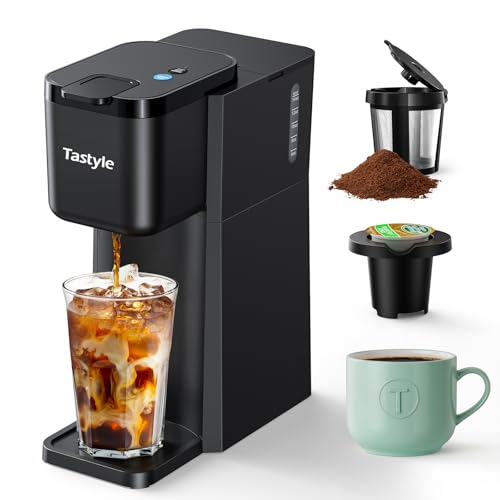
Tastyle Mini Hot and Iced Coffee Maker
Badge: Best for Tiny Offices
The Tastyle Mini is the most flexible small machine in this pool, because it accepts both K-Cup pods and ground coffee and brews both hot and iced drinks across a 6 to 14 oz range. That combination covers an unusual amount of ground for a mini machine: a pod on a rushed morning, your own grounds when you want a particular bag, a small strong cup or a full travel mug, and an iced coffee in the afternoon without a second appliance. The included recipe book nudges experimentation, and the 120V design is pitched at homes, travel, RVs, offices and dorms — anywhere a full-size brewer is too much machine. The honest limits are size and throughput: this is a one-cup-at-a-time mini, with filling and brewing per cup rather than a reservoir rhythm. For a single drinker or a couple with varied tastes, that trade buys remarkable versatility in a very small footprint.
The Tastyle’s commercial case is about fit for the smallest professional settings: a salon, a studio, a two-person office where coffee is a courtesy rather than a service. Its virtues there are variety and size — pods for clients who want them, grounds for the owner’s own coffee, iced drinks in summer, all from a machine that fits on a side counter and asks nothing of the building. Its ceiling is throughput, and it arrives quickly: one cup at a time, filled per cup. A venue serving six drinks a day will find it charming; a venue serving six drinks an hour will find it impossible, and the guide’s honesty about that line is the most commercial thing about this review.
Strengths
- Genuinely dual-format: K-Cup pods and ground coffee
- Hot and iced modes in one compact machine
- Wide 6 to 14 oz brew range covers espresso-style small cups to travel mugs
Trade-offs
- Mini format means filling and brewing one cup at a time
- No large reservoir for back-to-back group service
- Iced results still depend on using enough ice and strong settings
Key specifications
- Format: Single-serve for K-Cup pods and ground coffee
- Modes: Hot and iced coffee
- Brew sizes: 6 to 14 oz
- Included: Recipe book
- Power: 120V
- Model: K310IC, version 2.0, Classic Black
Best for: Micro-offices, salons and studios serving a handful of drinks a day / Not suited for: Any venue with a morning rush

Keurig K-Express (Evergreen)
Badge: Best Pod All-Rounder
Evergreen is the boldest colourway of the K-Express, and mechanically it is the same dependable package: a 42 oz removable reservoir, three brew sizes, a Strong Brew button, travel mug clearance and compatibility with all K-Cup pods. A deep green machine makes a deliberate statement on the counter, pairing well with brass fittings, cream cabinetry and the plant-filled kitchens that are currently fashionable, and it hides coffee splashes better than pale finishes do. The brewing story is unchanged and that is a virtue: pods are the fastest route from sleepy to caffeinated, the reservoir stretches across a morning of cups, and the Strong Brew setting answers the most common pod-coffee complaint, a cup that tastes thin, by slowing the extraction for a bolder result. Choose Evergreen when you want the K-Express routine and a machine that looks like a chosen object rather than an appliance that merely happened to you.
Evergreen represents the pod-reservoir pattern that small professional settings actually run on: a 42 oz tank of ready water, a pod library that covers every visitor’s preference including decaf, and an operation so simple that no training, rota or instruction card is needed. In a waiting room or a small office kitchen, those are commercial virtues in miniature — uptime, simplicity, variety — even though the machine itself is a home brewer. The Evergreen finish suits client-facing spaces. Its ceiling is the home design underneath: a venue whose mornings involve a queue should climb to the Ninja or leave this pool for genuine commercial equipment.
Strengths
- Full K-Express feature set in a distinctive green finish
- 42 oz reservoir supports back-to-back cups for a household
- Strong Brew button adds intensity without changing pods
Trade-offs
- Evergreen is a commitment if your kitchen colours change
- Pods only in normal use, so running costs follow pod prices
- No dedicated iced or cold-brew programme
Key specifications
- Format: Single-serve K-Cup pod coffee maker
- Brew sizes: 3 brew sizes
- Reservoir: 42 oz, removable
- Feature: Strong Brew button
- Mug fit: Travel mug friendly
- Finish: Evergreen
Best for: Small offices and waiting rooms wanting reservoir-fed pod service / Not suited for: High-volume venues

Keurig K-Express (Mint)
Badge: Best Light Finish
The Mint K-Express brings the standard K-Express formula — 42 oz removable reservoir, three brew sizes, Strong Brew button, travel mug friendly, works with all K-Cup pods — in a pale mint finish that suits retro-leaning and pastel kitchens. Functionally nothing separates it from its black, Warm Stone and Evergreen siblings, so the honest advice is to choose it for the colour and enjoy the same routine: several cups per reservoir fill, a bolder option when a pod tastes weak, and clearance for the travel mug on workday mornings. The pale finish does ask for a little more wiping, because coffee drips and grounds dust show against mint more readily than against black or green. In exchange, the machine brightens a counter corner instead of darkening it. For a renter, a student house or anyone furnishing a small kitchen with some personality, Mint is the K-Express that does not take itself too seriously.
Mint brings the same small-setting pod service as Evergreen in the finish that suits bright, client-facing interiors — the boutique, the clinic waiting room, the design studio. Its commercial note is housekeeping: client-facing machines are wiped by whoever notices, and a pale finish shows every splash, which paradoxically keeps it cleaner in practice because the evidence is never hidden. The capability is the K-Express standard, and its duty ceiling is the same. Choose it where the machine will be seen by the people it serves, and where the daily count is measured in cups rather than rushes.
Strengths
- Full K-Express feature set in a light, retro-leaning mint finish
- 42 oz removable reservoir is easy to carry to the tap
- Three brew sizes plus Strong Brew cover most single-cup needs
Trade-offs
- Pale finish shows coffee splashes and needs wiping more often
- Pods only in normal use, with pod cost per cup to budget for
- No dedicated iced or cold-brew programme
Key specifications
- Format: Single-serve K-Cup pod coffee maker
- Brew sizes: 3 brew sizes
- Reservoir: 42 oz, removable
- Feature: Strong Brew button
- Mug fit: Travel mug friendly
- Finish: Mint
Best for: Client-facing small spaces wanting the K-Express pattern in a bright finish / Not suited for: Back-of-house high-volume duty

Hamilton Beach FlexBrew Advanced 4-in-1
Badge: Best for Small Offices
The Hamilton Beach FlexBrew Advanced 4-in-1 is the pool member that tries to end arguments. It brews hot and iced coffee, it accepts both pod packs and ground coffee, and it carries a removable 45 oz reservoir — the largest water capacity in this guide alongside genuinely fast brewing. That combination means a household split between pod loyalists and grounds drinkers can share one machine, and a drinker who wants iced coffee in summer and hot coffee in winter is not maintaining two appliances. The reservoir changes the morning maths: several cups can be brewed back to back before anyone visits the tap, which is exactly when single-serve machines usually show their limits. It remains a single-serve design, so there is no carafe for a brunch table, and its broader brief takes more counter space than the minis. As a one-machine answer to mixed household tastes, though, it is the most complete package here.
The FlexBrew is the pool’s second-strongest light-duty candidate because it answers the small venue’s two real questions: variety and pace. Pods and grounds cover the staff-versus-guest split, hot and iced cover the seasons, fast brewing shortens the small queue that forms even in a ten-person office, and the 45 oz reservoir stretches across a morning. A bed and breakfast serving a table of guests their individual drinks is this machine’s portrait. Its ceiling remains its home design — it is a sprinter for short rounds, not a marathoner for continuous service — and venues approaching the marathon should take the hint the BUNN benchmark offers and buy accordingly.
Strengths
- Largest reservoir here paired with hot and iced modes
- Takes both pod packs and grounds, so no format lock-in
- Fast brewing suits back-to-back morning cups
Trade-offs
- Bigger brief than the minis, so it needs real counter space
- Still a single-serve machine: no carafe for a table of guests
- More modes means more settings for a household to learn
Key specifications
- Format: 4-in-1 single-serve coffee maker
- Modes: Hot and iced coffee
- Reservoir: 45 oz, removable
- Inputs: Pod packs and ground coffee
- Brewing: Fast brewing
- Finish: Black
Best for: Small offices and B&Bs serving varied drinks through the day / Not suited for: Cafés and venues with continuous demand

Ninja Single Serve Coffee Maker PB051
Badge: Best Overall
The Ninja PB051 is the heavyweight of this pool: a single-serve combo machine that takes both K-Cup pods and ground coffee, offers four styles of brewing, brews cup sizes up to 24 oz and carries a 56 oz removable reservoir — the largest water capacity and the largest single cup in this guide. Those numbers translate into a specific kind of freedom. The reservoir covers a full morning of household cups, the 24 oz ceiling means the biggest travel mug is filled in one brew rather than two, and the pod-plus-grounds format means a new bag of beans and a box of pods can coexist without a second machine. Four brew styles let the same coffee land differently in the cup, from an everyday mug to a more concentrated style for milk drinks or iced coffee. The costs are counter space and a modest learning curve. For households that brew often and in quantity, the PB051 is built exactly for that life.
The Ninja climbs highest in this pool because its numbers point the commercial direction: the largest reservoir at 56 oz, the largest cups at 24 oz for the travel mugs a working morning runs on, both formats for the office that stocks pods but employs a grounds drinker, and four styles to vary the offering. In a busy small office it behaves like light commercial equipment in everything except plumbing and duty rating. The guide’s discipline requires the caveat in the same breath: it is a home machine working hard, without a commercial service network behind it, and a venue whose income depends on coffee should not build that income on it. For offices, studios and heavy homes, it is the strongest honest answer here.
Strengths
- Biggest reservoir in the pool at 56 oz, removable
- Pods and grounds in one machine, with four brew styles
- Brews up to 24 oz, covering large travel mugs in one pass
Trade-offs
- The largest brief here, so small counters should measure first
- Four styles add a learning curve for guests and family
- Still single-serve: big cups, but no carafe
Key specifications
- Format: Single-serve combo machine for K-Cup pods and grounds
- Brew styles: 4 styles of brewing
- Cup sizes: Up to 24 oz
- Reservoir: 56 oz, removable
- Model: PB051
- Finish: Black
Best for: Busy small offices and heavy home use at the top of light duty / Not suited for: True commercial venues needing plumbed, continuous service

Keurig K-Elite
Badge: Best Premium Pod Pick
The Keurig K-Elite in brushed silver is the premium-leaning pod machine in this pool: a single-serve K-Cup brewer whose metal-toned finish is designed to be seen rather than hidden. Where the K-Express models compete on reservoir size and brew-size lists, the K-Elite competes on presence — it is the machine for a counter that is part of the room, in an open-plan kitchen or a smart office kitchenette where a plastic-looking appliance would jar. The coffee routine is the familiar Keurig one: a pod, a button, a cup, with the entire K-Cup range available to choose from. Buyers should note honestly that the verified listing for this model confirms fewer headline specifications than its K-Express siblings, so the decision here rests on finish, format and brand tier rather than on a longer feature list. If those are your criteria, the K-Elite is the pool member aimed at you.
The K-Elite’s commercial niche is presentation. In an executive office or a client suite, the coffee machine is part of the room’s signal, and a brushed silver Keurig signals order and quality while serving the pod routine every visitor already understands. Its duty ceiling is low — this is a machine for the meeting of four, not the floor of forty — and its verified listing confirms the least in the pool, so the guide places it by format and finish alone. Within that niche it is genuinely apt: professional spaces are full of beautiful objects that serve small numbers of people very well, and the K-Elite is the coffee version of that idea.
Strengths
- Brushed silver finish suits visible, design-led counters
- Single-serve K-Cup format gives access to the full pod range
- A step-up Keurig nameplate for buyers who want the premium tier of pod machines
Trade-offs
- Listing confirms fewer headline specs than the K-Express models
- Pods only, so grounds drinkers are not served
- Premium positioning without a carafe or second format
Key specifications
- Format: Single-serve K-Cup pod coffee maker
- Finish: Brushed Silver
Best for: Executive offices and client suites where presentation matters / Not suited for: Volume service of any kind
Read the order above as a ladder rather than a league table. Each machine is placed at the highest duty its design honestly supports, and the gaps between rungs are the story: the distance from the Ninja to the FlexBrew is small, the distance from either to a plumbed commercial brewer is a category. The table that follows keeps the ladder’s facts in one view — formats, water and ceilings — so a reader can locate their own setting on it before reading another word.
Comparison Table
Read this table as a duty ladder: format and water first, then the trait that sets each machine’s ceiling. The distance between the top row and a genuine commercial brewer is discussed honestly in the sections that follow.
| Pick | Format | Water capacity | Standout trait | Link |
|---|---|---|---|---|
| Tastyle Mini Hot and Iced Coffee Maker | K-Cup pods and grounds | Fill per cup, 6 to 14 oz | Hot and iced modes in a mini body | Check on Amazon |
| Keurig K-Express (Evergreen) | K-Cup pods | 42 oz reservoir | Strong Brew button, Evergreen finish | Check on Amazon |
| Keurig K-Express (Mint) | K-Cup pods | 42 oz reservoir | Mint finish, full K-Express feature set | Check on Amazon |
| Hamilton Beach FlexBrew Advanced 4-in-1 | Pod packs and grounds | 45 oz reservoir | Hot and iced modes with fast brewing | Check on Amazon |
| Ninja Single Serve Coffee Maker PB051 | K-Cup pods and grounds | 56 oz reservoir | Four brew styles, cups up to 24 oz | Check on Amazon |
| Keurig K-Elite | K-Cup pods | Reservoir format, size not confirmed in listing | Brushed silver premium finish | Check on Amazon |
How to Choose When Commercial Is the Question
Measure your peak, not your day. Commercial fitness is decided in the busiest fifteen minutes: how many drinks, in how many varieties, served by whom. A setting whose peak is four drinks in fifteen minutes can be served well by the top of this pool. A setting whose peak is forty needs plumbed commercial equipment with a service contract, and the honest guide says so before the purchase rather than after the breakdown. Write the peak down; it is the specification that outranks every other in this category.
Then weigh operability, the commercial virtue home buyers underestimate. In professional settings the machine is used by people who did not choose it, will not read its manual and cannot be trained beyond a sentence. Pod machines dominate light commercial duty for exactly this reason: the sentence is “choose a pod, press the button”. Grounds formats serve settings with a named operator — the B&B host, the office manager — and fail in anonymous ones. Match the format to the operator reality, not to your personal preference.
Finally, think about failure. A home machine that stops is an inconvenience; a venue machine that stops during service is a small crisis with a queue attached. Genuine commercial equipment is bought with service networks and swap-out arrangements behind it, and that infrastructure, more than any brewing specification, is what the commercial price buys. Light settings can accept the risk with a spare machine or a kettle as the plan B. Settings that cannot accept it should leave this pool entirely, taking the Best Commercial High Performance Coffee Makers conversation as their next step.
How to Run a Light-Duty Coffee Station Like a Professional
Borrow the professional’s first habit: a station that is always ready. Reservoir filled at close of day, pods stocked in a visible system that shows when it is running low, mugs and supplies in fixed places, a small bin for used pods within reach. Commercial brewers earn their reputation partly through the rituals around them, and a home or office station run with the same rituals gets most of the reliability without the commercial hardware. Assign the station an owner, even in a small office — unnamed stations decay, owned stations gleam.
Run a simple service rhythm. Refresh reservoir water daily in professional settings, wipe the splash zone after the morning round, empty the drip tray before it is full rather than after, and descale on a calendar set by your water hardness rather than by symptoms. Keep a one-line instruction card by the machine for visitors and new staff: the pod goes here, the button is this one, the bin is there. Professionalism at this scale is mostly the absence of small confusions, repeated daily.
Problem: the morning queue outgrows the machine → the setting has crossed a duty line; add a satellite machine for the peak or step up a class, rather than working a home machine to death. Problem: coffee quality complaints in a shared setting → variety is usually the real issue; widen the pod library before blaming the brewer, and add a decaf and a tea option. Problem: the station looks neglected by Friday → ownership has lapsed; reassign it, restock it, and reset the closing ritual, because standards in shared spaces are a habit, not a purchase.
Keep records like a professional, in miniature. Note when the machine was descaled, when supplies run low, and when anything tastes off. A small notebook by the station turns mysteries into patterns — the week the water changed, the batch of pods nobody liked — and patterns are what separate a station that is managed from one that is merely used.
What Makes a Brewer Commercial: The BUNN Benchmark Explained
BUNN built its reputation on a specific set of engineering answers to commercial problems. Speed: commercial brewers keep water hot and ready so a full pot brews in minutes, because a diner cannot wait. Volume: large, often plumbed reservoirs and batch sizes measured in pots rather than cups. Durability: bodies and components specified for thousands of cycles by users who will never be gentle. Serviceability: a network that repairs or replaces fast, because downtime is lost revenue. Any machine measured against the benchmark should be measured on those four axes, and the pool in this guide scores honestly: respectable on convenience, modest on volume, unproven on durability at commercial cycles, and backed by consumer rather than commercial support.
That gap is not an insult to the machines here; it is a category boundary. The confusion arises because light-duty settings borrow commercial language for home equipment, and because a small office’s needs genuinely overlap with a home’s. The benchmark’s real gift to a buyer is calibration: once you know what commercial actually means, you can see precisely which parts of it your setting needs — usually the simplicity and the readiness, rarely the plumbing — and buy exactly those parts.
The Light-Duty Middle: Where This Pool Honestly Belongs
Between the home counter and the café sits a wide middle of settings that serve coffee as a courtesy: offices under twenty people, salons, clinics, studios, places of worship, small hospitality. Their shared traits are a modest daily count, an intense small peak, untrained users and no dedicated operator. This middle is where single-serve pod machines have quietly become the standard answer, because they trade the commercial virtues they cannot offer — volume and plumbing — for the ones the middle values most: variety, simplicity and a fresh cup for every person.
The Ninja and FlexBrew top this guide because they serve the middle’s upper edge, where counts and peaks grow. The K-Express models serve its centre, the minis its smallest rooms, and the K-Elite its most presentational corners. Readers who recognise their setting in this middle can buy from this pool with confidence; readers who recognise a café should close this guide and buy commercial, with the Best Commercial Coffee Makers For Home Use article as the bridge for homes that merely feel commercial on a Sunday.
Why Brand Benchmarks Help and Mislead in Equal Measure
Searching by a famous name is a reasonable instinct: the name encodes a standard the buyer trusts. It misleads only when the name is treated as a feature that other machines can borrow by association. No machine in this pool becomes commercial by being compared to BUNN, just as no family car becomes a truck by being compared to one. The useful move is the one this guide attempts: extract the standard from the name — speed, volume, durability, service — and measure everything, including the famous name’s own smaller models, against it without favour.
Buyers who internalise that move become hard to mislead in any category. They ask for the peak the machine can serve, the cycles it is built for and the support behind it, and they let brands argue their case in those terms. It is the same discipline the Best Commercial Pour Over Coffee Makers guide applies to a very different brewing method, and it travels well.
Reading a Commercial Specification Like a Buyer, Not a Fan
Commercial equipment is sold on specifications that home listings rarely print, and learning to ask for them is the portable skill this category teaches. Duty cycle: how many brews, back to back, before the machine needs rest. Recovery: how quickly the water returns to temperature after a round. Batch logic: whether output is measured in cups or in pots, and what a full cycle actually delivers. Support: who repairs it, how fast, and what happens to your service while they do. A buyer who asks those four questions of any machine — famous name or not — will never be sold a home appliance for a commercial job again.
Apply the questions to this pool and its honesty becomes visible. The Ninja answers with the largest reservoir and cups in its class and a consumer support model; the FlexBrew answers with pace and format range; the pod machines answer with operability. None answers with a commercial duty cycle or a service van, and the guide has not pretended otherwise in a single review. That is the correct shape of a buying guide for this keyword: the benchmark honoured, the pool placed beneath it accurately, and the reader equipped to climb higher the moment their setting demands it.
A final calibration for the reader who arrived here from a workplace search: the most common true-commercial settings — the diner, the café, the large office kitchen — share one trait this pool cannot serve, which is a named person whose job includes the machine. Commercial equipment assumes an operator and a maintenance relationship; light-duty settings assume neither. Buying across that line in either direction wastes money or service, and the line itself, once seen, is easy to respect. The machines above are for the settings without the operator, and within those settings several of them are genuinely excellent.
Two Settings, Two Verdicts: A Tale of Honest Placement
Consider two buyers who might both land on this guide. The first runs a twelve-person design studio: a morning rush of eight drinks, a client meeting most afternoons, a team that includes a decaf drinker and a tea drinker, and nobody whose job is coffee. For that buyer, the Ninja or FlexBrew from this pool is not a compromise but the correct professional answer — reservoir enough for the rush, formats enough for the people, operability enough for the clients — and buying plumbed commercial equipment would saddle the studio with installation, batch waste and a service contract it will never use. The guide’s ladder places the studio near the pool’s top rung, and the placement is a compliment to the machines.
The second buyer runs a forty-seat café. For that buyer, every machine in this pool is the wrong purchase at any price, because the café’s coffee is the product, its rush is continuous, and its downtime is lost revenue measured in an hour’s takings. The café needs the benchmark’s world: plumbed water, batch volume, duty ratings and a service van that answers the phone. A guide that sold the café a home machine with commercial adjectives would be committing a small fraud with a large invoice attached, and the reader would discover it on the first Saturday.
The distance between those two buyers is the entire subject of this keyword. Commercial is not a compliment that machines earn by being large or expensive-looking; it is a fit between a duty and a design, measurable in peaks, cycles and support. Readers who locate their setting on that scale before spending will buy correctly in either direction — and will understand, as the studio owner and the café owner both do by the end, that the famous name on the benchmark was never the point. The standard behind the name was the point, and standards, unlike brands, can be applied to anything.
Common Buying Mistakes
The gravest mistake in this category is buying a home machine for a commercial job and discovering the difference during a rush, with customers watching. Duty is a specification; read the peak your setting produces and respect the ladder this guide has drawn.
The second mistake is the reverse vanity: installing genuine commercial equipment in a setting that serves eight cups a day, then living with the plumbing, the warm-up and the batch waste. Commercial is a fit, not a compliment.
Third, do not ignore the operator question. A grounds machine in an anonymous shared setting will be misused, left dirty and quietly resented; a pod machine in the same setting will simply work. Format follows the users, not the buyer.
Finally, avoid running any shared station without an owner and a ritual. Machines in common spaces fail socially before they fail mechanically, and the fix — a name, a rota, a closing routine — costs nothing and is skipped constantly.
Final Recommendation
Within this pool, the strongest light-duty answer is the Ninja Single Serve Coffee Maker PB051: the biggest reservoir, the biggest cups and both formats make it the machine for busy small offices and heavy homes. The Hamilton Beach FlexBrew Advanced 4-in-1 follows for settings that also need iced drinks and grounds flexibility in the same body.
Smaller and more presentational settings are well served by the Keurig K-Express (Evergreen) and its K-Express siblings, which deliver the pod simplicity that shared spaces run on. And if your peak count, read honestly, belongs to genuine commercial duty, let this guide’s benchmark do its work: buy the commercial equipment, with its service network, and let these machines do the lighter jobs they were built for, brilliantly.
Related guides
Frequently Asked Questions
Are any of these machines actually made by BUNN?
No. The verified pool for this keyword contains no BUNN model, and the guide states that from the first paragraph. BUNN is used as the benchmark for what commercial means — speed, volume, durability and service — and each pick is measured against that standard and placed on the duty ladder honestly.
Which pick suits a small office best?
The Ninja PB051 for a busy small office, thanks to its 56 oz reservoir, 24 oz cups and pod-plus-grounds flexibility. The Hamilton Beach FlexBrew is the alternative when iced drinks and fast brewing matter, and the K-Express models suit quieter offices that prize simplicity.
What daily drink count is too much for these machines?
There is no single number, because peaks matter more than totals, but a setting regularly facing queues of several people at once, or serving continuously through the day, has crossed into genuine commercial territory and should buy equipment built and supported for it.
Why do offices prefer pod machines?
Because anyone can use one with a single sentence of instruction, every drinker gets their own choice including decaf, and there are no grounds to measure, spill or clean. In shared spaces, operability by untrained users is the feature that decides satisfaction.
Can a home machine handle a bed and breakfast?
A small one, yes — the FlexBrew or Ninja can serve a table of guests their individual drinks gracefully, and guests often prefer choosing their own. Larger properties with a breakfast rush should step up to commercial equipment.
What should I buy if I need true commercial performance?
A plumbed commercial brewer from an established commercial maker, bought with a service arrangement. Judge it on brew speed, batch volume, duty rating and the local service network — the four axes of the benchmark explained in this guide.
Does BUNN make home machines too?
Yes, the brand sells home brewers alongside its commercial line, which is one reason the name appears in home searches so often. A home model from a commercial maker is still a home machine, judged by the same duty questions as any other pick — which is exactly the discipline this guide recommends applying to every brand, famous or not.


