Disclosure: topratedkitchenware.com is reader-supported. When you buy through links on our site, we may earn an affiliate commission from Amazon and other retailers, at no extra cost to you.
Where to buy
All six picks in this guide to best mixers for baguettes are listed on Amazon, where you can check the latest price on Amazon, confirm the exact model and finish, and read the current listing details before ordering. Bundles and colours change, so match the full model name on the listing to the pick reviewed below before you buy.
- Best Overall for Baguette Prep: Hamilton Beach 6-Speed Electric Hand Mixer with QuickBurst and Bowl Rest, 62682G — Check on Amazon
- KitchenAid 5 Ultra Power Speed Hand Mixer, KHM512, Empire Red — Check on Amazon
- LILPARTNER Hand Mixer Electric, 7-Speed — Check on Amazon
- KitchenAid 5 Ultra Power Speed Hand Mixer, KHM512, Contour Silver — Check on Amazon
- Cuisinart Power Advantage Plus 9-Speed Hand Mixer, HM-90S — Check on Amazon
- WEPSEN 5-Speed Electric Hand Mixer with 4 Large Mixing Bowls Set — Check on Amazon
Read the full guide ↓
Baguette dough is lean, wet and deceptively demanding, so the best mixers for baguettes are not simply the most powerful machines on a shelf; they are the ones that bring flour and water together cleanly, mix a preferment evenly, and help with the early stages of dough without tearing it or overheating it. A classic baguette dough is little more than flour, water, salt and yeast, often at a hydration that makes it sticky and elastic. The mixing job is about hydration and gentle development, not brute force, and that shapes every recommendation in this guide.
One disclosure belongs right at the front, because honesty matters more than a tidy list: every verified pick in this guide is a hand mixer. None of them is a stand mixer, and none of them will knead a large, stiff batch of baguette dough the way a stand mixer with a dough hook can. What these six machines genuinely do well is the work around baguettes: mixing poolish and preferments, starting small or high-hydration doughs, handling soft enriched variations, and portioning the mixing into stages that finish with stretch-and-fold kneading by hand. Bakers who work that way, and many home baguette bakers do, will find real picks here. Bakers who want to load a big batch and walk away should read the limitations in each review and choose a stand mixer instead; we will not pretend otherwise.
With that boundary clear, the six picks below were checked against their verified listings, and only listed specifications are quoted: speed counts, the 250 watt motor Hamilton Beach publishes for the 62682G, the accessories each listing names, and storage features like snap-on cases and bowl rests. There are no prices and no ratings here. Each pick is matched to the baguette job it can honestly do, from preferments to small soft doughs, with its ceiling stated in plain language.
Key Takeaways
- Full disclosure: all six picks are hand mixers. They suit preferments, small batches and high-hydration dough starts, not large stiff doughs kneaded start to finish by machine.
- Baguette dough rewards gentle, staged mixing: hydrate first, rest, then develop with stretch-and-folds. A hand mixer handles the first stages well.
- The Hamilton Beach 62682G leads for baguette prep thanks to six speeds, a verified 250 watt motor, QuickBurst and a bowl rest.
- The LILPARTNER lists accessories for whipping dough and has seven speeds, making it the most dough-oriented hand mixer set here, still within small-batch limits.
- The Cuisinart HM-90S offers nine speeds and SmoothStart, the finest control for bringing flour and water together without a flour cloud.
- The WEPSEN bundle includes four nesting bowls, which suit the multi-stage life of baguette dough: mixing, resting and proofing in separate bowls.
In this guide
Quick Picks
Read this table with the disclosure above in mind: these are the best hand-mixer options for the mixing stages of baguette making, ranked by how well each one handles preferments, hydration and small dough work.
| Badge | Pick | Why it is here | Link |
|---|---|---|---|
| Best Overall for Baguette Prep | Hamilton Beach 6-Speed Hand Mixer, 62682G | Six speeds, QuickBurst and bowl rest for staged dough mixing. | Check on Amazon |
| Best for Preferments and Starters | KitchenAid KHM512 Hand Mixer, Empire Red | Turbo Beaters for smooth poolish and preferment mixing. | Check on Amazon |
| Best for Small, Soft Dough Batches | LILPARTNER 7-Speed Hand Mixer | Seven speeds and accessories listed for dough whipping; small batches only. | Check on Amazon |
| Best for Enriched and Softer Doughs | KitchenAid KHM512 Hand Mixer, Contour Silver | Gentle, compact mixing for soft and enriched doughs. | Check on Amazon |
| Best Speed Control | Cuisinart Power Advantage Plus 9-Speed Hand Mixer | Nine speeds with SmoothStart for controlled hydration. | Check on Amazon |
| Best Value Set for Mixing and Proofing | WEPSEN 5-Speed Hand Mixer and Bowl Set | Four nesting bowls for mixing, resting and proofing stages. | Check on Amazon |
How These Picks Were Chosen
The picks come from the verified pool for this site, cross-checked against Amazon listing data through the Creators API, with ASIN, title and image recorded in the sources file. We quote only specifications the listings themselves state. That discipline matters for this keyword in particular, because dough capability is easy to exaggerate: where a listing names dough accessories, we say so; where it names only beaters, we do not upgrade the machine into a dough kneader in our prose.
Selection for baguettes then followed the actual workflow of the bread. First, preferment mixing: poolish and biga need even hydration without lumps. Second, initial dough mixing: flour and water must come together without splashing or tearing. Third, portion and batch realism: home baguette batches are usually two to four loaves, and the mixing stages for that scale are what a good hand mixer can share with hand kneading. Machines were ranked on speed control, published motor figures where available, included accessories, and practical touches like bowl rests and storage cases.
This is a research-led guide. We do not claim laboratory testing or hands-on trials that did not happen. The judgements rest on verified specifications and established baguette technique: autolyse rests, bassinage, stretch-and-fold development, and temperature control. Where the hand-mixer format hits a hard limit, and it does, the reviews say exactly where that limit is, so a reader who needs full machine kneading can make a different choice with clear eyes.
The 6 Best mixers for baguettes
Each review states what the machine can do in a baguette workflow, where its ceiling is, and who should buy it anyway. Read the limitations as carefully as the strengths; for this keyword they are half the story.

Hamilton Beach 6-Speed Electric Hand Mixer with QuickBurst and Bowl Rest, 62682G
Badge: Best Overall for Baguette Prep
Strengths
- QuickBurst gives a short extra push of power for a stubborn pocket of mixture
- The bowl-rest design lets you set the mixer on the bowl rim between additions instead of on the counter
- A verified 250 watt motor and six speeds cover everyday mixing well
Trade-offs
- The listed attachment is traditional beaters, so whisk and hook work is not covered in the box
- Bowl rest only helps if your bowl rim suits it
- White plastic can pick up stains from coloured batters
Mini spec box
- 6 speed settings
- QuickBurst extra-power button
- 250 watt motor
- Traditional beaters included
- Bowl-rest feature
- Snap-on storage case
- Finish: White
- Model: 62682G
The 62682G earns the top spot for baguette prep because its features map onto staged dough work. Six speeds let you bring flour and water together slowly, the verified 250 watt motor is the clearest power figure in this hand-mixer set, and QuickBurst gives a short extra push when a dry pocket of flour resists at the bottom of the bowl. The bowl rest is a small feature with outsized value in bread making: baguette mixing involves pauses, for an autolyse rest, for salt, for a bassinage addition of water, and parking the mixer on the bowl rim keeps beaters out of the dough and off the counter.
Use it for preferments and for the first mix of a small, reasonably hydrated dough, then finish development by hand with stretch-and-folds, which baguette dough responds to beautifully. The ceiling is clear: the verified listing names traditional beaters, not dough hooks, and no hand mixer should be asked to knead a full stiff batch to windowpane. Treat this as the best mixing partner in the guide, not a kneading machine, and it will serve a home baguette routine very well.
Best for: staged baguette mixing: preferments, hydration and small dough starts / Not suited for: full machine kneading of large, stiff dough batches
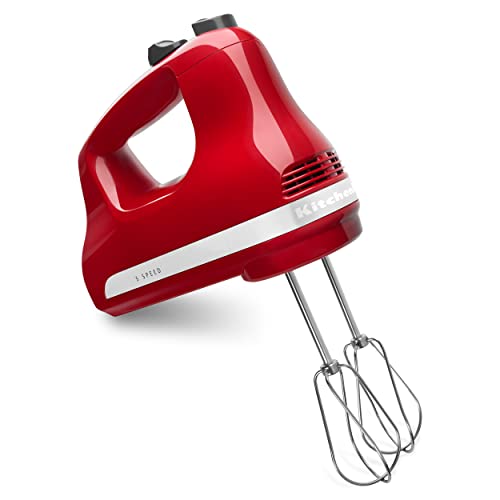
KitchenAid 5 Ultra Power Speed Hand Mixer, KHM512, Empire Red
Badge: Best for Preferments and Starters
Strengths
- Turbo Beaters are efficient on batters and soft mixtures
- Swivel cord locks to either side, which keeps it clear of the bowl rim
- Easy-release button ejects beaters without pulling them by hand
Trade-offs
- A five-speed range is basic next to nine-speed rivals
- The listed set is beaters only, with no whisk or hooks in the title specification
- Like every hand mixer here, it relies on your arm for long mixing jobs
Mini spec box
- 5 speed settings
- Turbo Beaters included
- Lockable swivel cord
- Easy-release beater button
- Dishwasher-safe beaters
- Finish: Empire Red
- Model: KHM512
Preferments are where baguette flavour is built, and the Empire Red KHM512 is the pick we would reach for to mix them. A poolish should end up smooth and evenly hydrated, and the Turbo Beaters pull flour and water together without the clogging that a centre-post beater can suffer in sticky mixtures. Five speeds are simple to run with floury hands, and the easy-release button keeps the process tidy when you are moving between bowls.
The lockable swivel cord helps in the small, crowded space where bread prep happens, usually between a scale, a flour bin and a proofing bowl. Beyond preferments, this mixer handles the wettest, softest dough starts and enriched variations, but the same honest limit applies: beaters only in the listed set, arm-powered mixing, and no claim to full dough development. As a preferment and light-duty specialist in a baguette kitchen, it is genuinely useful; as your only dough tool for big batches, it is not the right buy.
Best for: smooth poolish and preferment mixing / Not suited for: any dough job that needs hooks or hands-free power

LILPARTNER Hand Mixer Electric, 7-Speed
Badge: Best for Small, Soft Dough Batches
Strengths
- The widest speed range of any hand mixer in this guide, which helps when a job needs a genuinely gentle start
- Five stainless steel accessories in the box, more than the typical two-beater set
- Accessories are dishwasher safe, so clean-up after sticky batters is simple
Trade-offs
- A newer, lesser-known brand, so long-term parts and support are less proven than the big names
- The light pink finish will not suit every kitchen
- Top speeds are lively, so flour and cocoa need a deep bowl and a slow start despite the speed range
Mini spec box
- 7 speed settings
- 5 stainless steel accessories
- Accessories listed for whipping dough, cream and cake
- Dishwasher-safe accessories
- Finish: Light Pink
The LILPARTNER is the most dough-curious hand mixer in this guide: its verified listing names five stainless steel accessories for whipping dough, cream and cake, and its seven speeds are the widest range here. For baguettes, that translates to the best hand-mixer option for small, soft dough batches, the kind of single-recipe, high-hydration dough that a home baker mixes in a bowl and finishes by hand. The low gears start hydration gently, and the accessory count means a clean set is available when the first is coated in sticky dough.
Dishwasher-safe accessories matter with dough work, because dried dough is stubborn; being able to soak and wash everything easily keeps the routine pleasant. The limits still apply and we will state them plainly: this is a hand mixer from a newer brand, the listing language is whipping dough rather than kneading stiff dough, and large or low-hydration batches will strain it and your arm. Within small-batch, finish-by-hand baguette making, it is the most capable set here; outside that lane, buy a stand mixer.
Best for: small, soft, high-hydration dough batches finished by hand / Not suited for: low-hydration dough or anyone wanting an established brand

KitchenAid 5 Ultra Power Speed Hand Mixer, KHM512, Contour Silver
Badge: Best for Enriched and Softer Doughs
Strengths
- Turbo Beaters are designed to mix efficiently without the clogging a centre post can cause
- The lockable swivel cord stays left or right, out of the bowl and out of the way
- One-button beater release keeps messy hands off the attachments
Trade-offs
- Five speeds is a narrower range than the nine-speed options in this guide
- Only beaters are listed in the box, so whisk and dough work means add-on attachments
- Hand mixers still ask you to hold the machine for the whole job
Mini spec box
- 5 speed settings
- Turbo Beaters included
- Lockable swivel cord
- Easy-release beater button
- Dishwasher-safe beaters
- Finish: Contour Silver
- Model: KHM512
The Contour Silver KHM512 fits the softer side of the baguette family: enriched doughs, milk breads shaped like small baguettes, and gentle mixing where control matters more than force. Its Turbo Beaters are efficient in fluid and medium mixtures, the five speeds are uncomplicated, and the compact body stores in a drawer, which suits bakers whose bread making shares a small kitchen with everything else.
It is also a sensible second mixer for households that already own heavier equipment and want something quick for preferments and small jobs. The honest limits mirror its red sibling: the listed set is beaters, the format is hand-held, and stiff dough is out of scope. Judged as a light, precise mixing tool for the soft end of baguette-style baking, it earns its place; judged as a kneader, it was never designed to be one.
Best for: soft and enriched doughs and quick preferment jobs / Not suited for: stiff dough development of any kind

Cuisinart Power Advantage Plus 9-Speed Hand Mixer, HM-90S
Badge: Best Speed Control
Strengths
- Nine speeds give the finest control of any hand mixer in this guide
- SmoothStart eases the beaters up to speed, which cuts down on flour clouds and splatter
- The snap-on case stores the mixer and its pieces together, cord included
Trade-offs
- More speeds than casual cooks will ever use, and the control takes a little learning
- The storage case adds bulk in a shallow drawer
- Still a hand mixer, so thick dough work is limited by your grip and patience
Mini spec box
- 9 speed settings
- SmoothStart anti-splatter feature
- Snap-on storage case
- Finish: White
- Model: HM-90S
Speed control is the HM-90S argument, and for baguette mixing it is a strong one. Nine speeds plus SmoothStart mean the first contact between beaters and flour can be genuinely gentle, which keeps flour in the bowl and starts hydration evenly instead of flinging dry flour onto wet dough. As the dough comes together you can step up gradually, feeling the resistance change, something experienced bakers do by instinct and beginners learn faster with finer gears.
The snap-on storage case keeps the machine and its pieces together between bakes, which matters for a tool that may be used in short bursts several times across one bread day: preferment in the morning, dough mix later, a quick enriched batch in between. The limitation is format, again stated plainly: nine speeds do not turn a hand mixer into a kneading machine, and the listing names a beater set rather than dough hooks. For controlled hydration and staged mixing, it is excellent; for full development, your hands and time do that work.
Best for: controlled, splash-free hydration with fine speed steps / Not suited for: hands-free kneading; it remains a hand mixer

WEPSEN 5-Speed Electric Hand Mixer with 4 Large Mixing Bowls Set
Badge: Best Value Set for Mixing and Proofing
Strengths
- The bundle includes four nesting stainless bowls, so mise en place and multi-bowl jobs are covered out of the box
- Whisks as well as a beater are included, which suits egg whites and cream
- Measuring cups and spoons round out a starter-friendly kit
Trade-offs
- A bundle brand, so the mixer itself is less proven than KitchenAid or Cuisinart equivalents
- Five speeds is a basic range
- Four bowls are useful but they do take cupboard space, even nested
Mini spec box
- 5 speed settings
- 4 large stainless steel nesting bowls included
- Whisks and beater included
- Measuring cups and spoons included
- Bowls nest for storage
The WEPSEN set is the systems pick: a five-speed hand mixer bundled with four large stainless steel nesting bowls, whisks, a beater, and measuring cups and spoons. Baguette making is a multi-bowl process, preferment in one bowl, dough mixing in another, proofing in a third, and this bundle covers that rhythm out of the box. The bowls alone make it interesting for a new bread baker who owns nothing suitable yet.
The mixer itself is a basic five-speed unit from a bundle brand, and expectations should be set accordingly: fine for preferments, hydration and light dough starts, not a heavy-duty kneader, and less proven over years than the KitchenAid and Cuisinart names in this guide. Buy it as a starter kit for the whole baguette workflow rather than as a precision instrument, and its value is clear. Readers setting up a broader baking kit may also want our guides to Best Mixers For Baking and Best Mixers For Baking Cakes, which use some of the same machines for batter work.
Best for: new baguette bakers who need bowls and a mixer in one kit / Not suited for: heavy daily dough work or long-term heirloom expectations
Comparison Table
The comparison keeps the honest framing: formats are all hand mixers, so the differences are speed control, published power, accessories and the workflow extras each bundle includes.
| Pick | Badge | Speeds / format | Standout point | Link |
|---|---|---|---|---|
| Hamilton Beach 6-Speed Hand Mixer, 62682G | Best Overall for Baguette Prep | 6 speed settings | 250 watt motor, QuickBurst, bowl rest, snap-on case | Check on Amazon |
| KitchenAid KHM512 Hand Mixer, Empire Red | Best for Preferments and Starters | 5 speed settings | Turbo Beaters, lockable swivel cord | Check on Amazon |
| LILPARTNER 7-Speed Hand Mixer | Best for Small, Soft Dough Batches | 7 speed settings | Five stainless accessories listed for dough whipping | Check on Amazon |
| KitchenAid KHM512 Hand Mixer, Contour Silver | Best for Enriched and Softer Doughs | 5 speed settings | Compact, dishwasher-safe beaters | Check on Amazon |
| Cuisinart Power Advantage Plus 9-Speed Hand Mixer | Best Speed Control | 9 speed settings | Nine speeds, SmoothStart, snap-on case | Check on Amazon |
| WEPSEN 5-Speed Hand Mixer and Bowl Set | Best Value Set for Mixing and Proofing | 5 speed settings | Four nesting bowls plus measuring set included | Check on Amazon |
How to Choose Among the best mixers for baguettes
Choose for the stage of baguette making you actually want help with. If your pain point is lumpy preferments and messy first mixes, any pick here helps, and speed control should drive your choice. If your pain point is kneading itself, be honest that this category of machine only shares that job: a hand mixer starts the dough, and your hands, time and stretch-and-folds develop it. Bakers who find that unacceptable need a stand mixer with a dough hook, which is a different purchase from a different guide, and no badge in this article should be read as claiming otherwise.
Hydration changes everything. Baguette doughs at the wetter end are kinder to hand mixers, because the mixture stays fluid longer and resists less; the machine can genuinely mix a wet dough to a shaggy, even mass. Drier, stiffer doughs fight back immediately, climb the beaters and strain motors. If your preferred recipe is a firm dough, plan on the mixer doing only the first minute of work, or reconsider the format entirely. Recipe choice and machine choice cannot be separated for this bread.
Speed control is the specification to weight most heavily after that. Bringing flour and water together is a splash-prone moment, and a mixer with a gentle first gear, or a feature like SmoothStart on the Cuisinart, keeps the kitchen and the dough in better shape. Fine steps also help you respond as resistance changes. Published wattage helps where it exists, the Hamilton Beach figure of 250 watts is verified in its listing, but many listings omit wattage, and this guide does not guess at the missing numbers.
Accessories and workflow extras decide daily satisfaction. Dough-oriented accessories, where a listing names them, extend what a hand mixer can attempt. A bowl rest suits the stop-start rhythm of bread making. A snap-on case keeps a multi-piece set together across a long bake day. Included bowls, as in the WEPSEN set, can matter more to a beginner than a small difference in speeds. And for readers whose interest in this cluster is drinks rather than dough, note that guides like Best Mixers For Baileys, Best Mixers For Bands, Best Mixers For Barcadi and Best Mixers For Beer cover entirely different meanings of the word mixer.
How to Mix Baguette Dough with a Hand Mixer, Step by Step
Step one: mix the preferment. Combine the preferment flour and water with the yeast in a bowl and mix on a low speed until no dry flour remains and the mixture is smooth. Cover and leave it for the time your recipe specifies. This stage is where a hand mixer is unambiguously excellent: the mixture is fluid, the job is evenness, and every pick in this guide does it well.
Step two: autolyse the main dough. Add the remaining flour and most of the water to a large, deep bowl and mix slowly, the lowest speed that moves the mixture, until it forms a shaggy mass with no dry patches. Stop there. Cover the bowl and rest it for twenty minutes to an hour. The flour hydrates and the dough begins to develop on its own, which dramatically reduces the kneading the dough will need later, from you or any machine.
Step three: add salt and the preferment, and mix briefly. Work on a low speed in short bursts, resting the mixer rather than running it continuously, until the dough looks cohesive. If your recipe uses bassinage, hold back a little water at the autolyse and add it gradually now. The moment the dough starts climbing the beaters or the motor note strains, stop machine mixing; that is the format telling you its stage is done.
Step four: develop by hand. Tip the dough onto a lightly floured or damp surface, or work in the bowl with stretch-and-folds: pull one side up and over, rotate, repeat, then rest the dough and repeat the set at intervals during bulk fermentation. Baguette dough responds superbly to this gentle development, and it preserves the open crumb the bread is famous for. Shape gently, proof on a couche or parchment, score, and bake on a preheated stone or steel with steam for the crust. Clean the beaters promptly, because dried dough sets like cement, and never immerse the mixer body.
Troubleshooting
Problem: dough climbs the beaters and wraps around them → the dough is too developed or too dry for machine mixing. Stop, rest the dough, and switch to stretch-and-folds; forcing it risks the motor and tears the dough.
Problem: flour sprays across the counter at the start → the speed was too high or the bowl too shallow. Use a deep bowl, start at the lowest speed, and let the autolyse approach do the first hydration for you.
Problem: the finished baguettes are dense with a tight crumb → the dough was likely overworked by machine or under-proofed. Shorten machine mixing, lengthen rests and folds, and let the dough, not the clock, decide when it is ready.
Why Baguette Dough Is Developed in Stages
Understanding the stages explains why a hand mixer can be a legitimate baguette tool despite its kneading limit. Hydration comes first: flour needs time to absorb water before any development makes sense, and mixing only needs to be even, not vigorous. Development comes second, and for lean, wet doughs, time plus gentle folds builds strength as effectively as aggressive kneading, with less oxidation and a better-flavoured crumb. Fermentation does quiet work throughout, organising the dough while it rests.
This staged reality is also why recipe writers for home bakers so often specify a brief machine mix followed by folds. The mixer is a hydration tool and a preferment tool. Judged on those jobs, the picks in this guide are not consolation prizes; they are appropriate equipment. Judged as full kneading machines, they are the wrong format, and this guide has said so from its first paragraphs rather than burying the point.
Batch Size, Bowls and the Home Baguette Routine
Home baguette batches are usually modest: two to four loaves from a single recipe. At that scale, the mixing stages a hand mixer handles are a large share of the total work, and the hand-finishing is measured in minutes spread across bulk fermentation, not in one exhausting kneading session. Bowl choice supports the routine: a deep bowl for mixing, a clean bowl for bulk fermentation so you can judge the rise, and the nesting bowls in the WEPSEN set map neatly onto those roles.
Temperature is the other routine worth building. Dough temperature drives fermentation speed, and friction from machine mixing warms dough. Short, staged mixing with rests, exactly the pattern this guide recommends for hand mixers, keeps dough temperature easier to control than long continuous kneading. Use cool water on warm days, rest the dough in a sensible spot, and let fermentation, not force, set the schedule.
Reading a Baguette Recipe Like a Baker
Baguette recipes are written in a compressed language, and understanding it makes every mixing decision in this guide easier. Baker’s percentages express each ingredient as a proportion of the flour weight, so a recipe described as sixty-five percent hydration contains sixty-five parts water for every hundred parts flour. Hydration is the single most useful number for a hand-mixer owner: wetter doughs mix more kindly at the early stages, while drier doughs should be started by machine only briefly, if at all, and developed by hand. Salt typically sits near two percent, yeast varies with temperature and schedule, and those small numbers have large effects on flavour and timing.
Preferments appear in serious baguette recipes because they buy flavour without acidity problems. A poolish is an equal-parts flour and water mixture with a trace of yeast, left until bubbly and domed; a biga is stiffer and cooler-running. Both are mixed the night before or the morning of a bake, both are squarely within hand-mixer ability, and both transform a same-day dough from bland to genuinely interesting. If your current baguette routine has no preferment, adding one will improve your bread more than any equipment change discussed in this article.
Temperature targets tie the recipe together. Bakers talk about desired dough temperature because fermentation is a clock that runs faster when warm. Friction from mixing, warm rooms and warm water all push dough temperature up, while rests and cool water pull the schedule back. The staged, short-burst mixing pattern this guide recommends for hand mixers is not only kinder to motors; it gives you repeated chances to feel the dough, judge its temperature and adjust the plan, which is how bakers actually work.
After the Mixing: Proofing, Shaping and Scoring
Bulk fermentation is where baguette dough quietly becomes bread. The mixed dough rests in a bowl while yeast produces gas and the folds you add at intervals organise that gas into an even network. Judge the end of bulk by the dough, it should be noticeably risen, domed and full of life when the bowl is shaken gently, not by a rigid timer, because room temperature moves the schedule by hours across the year. Dividing and pre-shaping follow: cut the dough into portions without tearing, shape each into a loose round or cylinder, and rest them under a cloth so the surface relaxes before final shaping.
Final shaping is a study in surface tension. The dough is flattened gently, folded, rolled and sealed so the outer skin becomes taut, because that taut skin is what lets a baguette expand upward in the oven instead of spreading. Proof the shaped loaves on a floured couche or on parchment, seam side handled as your recipe directs, until they pass the poke test: a floured finger pressed in should spring back slowly and leave a slight impression. Under-proofed loaves burst at weak points; over-proofed loaves score poorly and bake up pale and flat.
Scoring is the signature skill. A lame or razor blade, held at a shallow angle, cuts overlapping slashes along the loaf so the cuts overlap by roughly a third of their length. The angle creates the ear, the crisp flap that defines a well-baked baguette, and a confident, quick stroke works better than a hesitant saw. None of this stage involves the mixer at all, which is the final perspective this guide wants to leave you with: mixing is the first act of baguette making, not the whole play, and the hand mixers above are recommended honestly for that first act.
Steam, Heat and the Crust at Home
The baguette crust is a baking problem, not a mixing problem, and home ovens need a little engineering to solve it. Professional ovens inject steam during the first minutes of baking, keeping the loaf’s surface supple so it can expand fully before the crust sets, and giving the finished crust its shine and crackle. At home, the usual substitutes are a preheated Dutch oven for boules, a covered tray or cloche for shaped loaves, or a pan of boiling water placed in the oven as the loaves go in. A preheated stone or steel helps the base set quickly and encourages oven spring.
Heat should be genuinely high by home standards, with the oven and its stone or steel preheated long enough to be saturated, not merely showing the target temperature on the dial. Load the loaves quickly, restore steam immediately, and vent the oven for the final part of the bake so the crust dries and deepens in colour rather than staying pale and leathery. The loaves are done when the crust is a deep golden brown, deeper than most beginners dare, and the base sounds hollow when tapped.
Cooling is the last technique. Baguettes should cool on a rack so steam escapes instead of softening the crust, and they should not be cut until the interior has settled, or the crumb will gum. Eaten the day they are baked, as tradition insists, they need no storage plan at all; day-old baguettes are better revived briefly in a hot oven or repurposed into croutons and crumbs. Good mixing starts all of this, but heat and steam finish it.
What to Do With Baguettes Beyond the First Day
A short coda on using the bread well, because home baguette baking produces loaves faster than households expect. Fresh baguettes are at their peak within hours, and the traditional rhythm is to bake small and often rather than large and rarely, another reason the modest batch sizes in this guide suit the bread. Loaves that do survive the day revive surprisingly well: a brief pass through a hot oven, after a light misting of water, restores much of the crust’s crackle, though never all of its first-hour glory.
After that, the bread changes jobs gracefully. Thick slices become croutons for soups and salads, stale sections become breadcrumbs with a keeping quality fresh crumbs cannot match, and the classic French onion soup exists precisely because day-old baguette and good stock were both on hand. Planning a bake day with these second lives in mind removes the waste anxiety that stops many home bakers starting, and it makes the modest, staged mixing workflow recommended here feel complete: mix gently, bake boldly, and use everything.
Common Buying Mistakes
- Expecting a hand mixer to knead like a stand mixer. It will not, and forcing stiff dough through one can strain the motor and tear the dough. Buy the format your workflow needs.
- Skipping the autolyse. Mixing unhydrated flour and water straight into kneading makes everything harder. A simple rest does much of the work for free.
- Running the mixer continuously. Short bursts with rests suit both the machine and the dough; continuous running overheats motors and dough alike.
- Judging by top speed. Baguette mixing lives at the low end of the dial. Gentle starts and control matter; top speed is nearly irrelevant.
- Ignoring bowl depth. Shallow bowls spray flour and let dough climb out. A deep bowl is the cheapest upgrade in baguette making.
- Overworking the dough for a smooth look. Baguette crumb should be open and irregular. Develop gently, proof patiently, and stop handling the dough once it is shaped.
Final Recommendation
For a home baguette routine built on preferments, autolyse and stretch-and-folds, the Hamilton Beach 62682G is the most useful hand mixer here: six speeds, a verified 250 watt motor, QuickBurst for stubborn pockets, and a bowl rest made for the stop-start rhythm of bread. Start with the Hamilton Beach 6-Speed Hand Mixer, 62682G if you want the safest all-round choice. If that does not fit your kitchen or your habits, the KitchenAid KHM512 Hand Mixer, Empire Red is the alternative we would look at next. Choose the LILPARTNER if small, soft dough batches are your main job and you want the dough-oriented accessory set; choose the Cuisinart HM-90S if splash-free, finely controlled hydration is the priority. The WEPSEN set suits a beginner who needs bowls as much as a mixer.
And the standing caveat, one last time: if you want a machine to knead full baguette batches unaided, none of these is that machine, and a stand mixer with a dough hook is the honest recommendation. Within the hand-mixer format, though, these six cover the real mixing work of baguette making well.
Frequently Asked Questions
Can a hand mixer knead baguette dough?
Only partly, and this guide is explicit about it. A hand mixer can mix preferments, hydrate flour and water, and start small or wet doughs. Full development of a stiff dough is beyond the format; finish with stretch-and-folds, which baguette dough responds to very well, or use a stand mixer with a dough hook for full machine kneading.
Which pick is best for poolish and preferments?
The KitchenAid KHM512 models, with their Turbo Beaters, mix fluid preferments smoothly and evenly, and the Hamilton Beach 62682G is equally capable with the convenience of a bowl rest between stages. Preferments are fluid, so every pick here can do the job; the differences are tidiness and control.
How big a baguette batch can these mixers start?
A single home recipe, typically enough for two to four baguettes, is the realistic scale for the initial mixing stages, especially at higher hydration. Doubling a stiff dough and expecting a hand mixer to develop it is where problems start; if you regularly bake double batches, a stand mixer is the right format.
Why does my dough keep climbing the beaters?
Climbing happens when dough becomes elastic and cohesive enough to grip and ride the beaters instead of tumbling. It is a sign the machine stage is finished. Rest the dough and continue with stretch-and-folds, which develop it gently without tearing.
Does the WEPSEN bowl set really help with baguettes?
Yes, in a practical way. Baguette making uses several bowls across preferment, mixing and bulk fermentation, and the set includes four large nesting stainless bowls plus measuring tools. The mixer itself is a basic five-speed unit, so the bundle is best viewed as a starter workflow kit.
What speed should I use to mix baguette dough?
The lowest speed that moves the mixture, in short bursts. Baguette work is about hydration and gentle development, so the bottom of the dial does nearly all of it. Higher speeds belong to batters and whipping, not to lean dough.


