Disclosure: topratedkitchenware.com is reader-supported. When you buy through links on our site, we may earn an affiliate commission from Amazon and other retailers, at no extra cost to you.
Where to buy
The six models below are the verified picks for this guide to the best pressure cookers rangetop cooks can actually use day to day. Each name links to its Amazon listing, where you can check the latest price on Amazon, confirm the current configuration, and read the newest owner feedback before you decide. Start with our top pick here: Check on Amazon.
- Presto 01362 6-Quart Stainless Steel Pressure Cooker
- T-Fal Secure Trendy Stainless Steel Pressure Cooker, 8.5 qt
- MICHELANGELO Stovetop Pressure Cooker, 4.2 qt
- Peterboo Stainless Steel Pressure Cooker, 6 Quart
- RVGMBO Pressure Cooker 12 Quart, 18/8 Stainless Steel
- Peterboo 3Qt Stainless Steel Pressure Cooker
Read the full guide ↓ for the ranking logic, the honest limitations of every pick, and the burner-fit checks that matter more than any headline claim.
Shopping for the best pressure cookers rangetop owners will reach for every week is really a question about your stove, not just about the pot. A rangetop pressure cooker lives or dies by how its base sits on your burners: too small a base on a big gas burner wastes heat up the sides, too wide a pot crowds the back burners, and a base that is not induction-ready is simply dead weight on an induction hob. Unlike an electric countertop cooker, a stovetop model gives you direct control over heat, which means faster searing before the lid goes on, a quicker climb to pressure on a strong burner, and a faster cool-down under the tap when a recipe calls for a quick release. The trade-off is attention: you manage the heat, you watch for the pressure indicator, and you learn your own stove’s personality.
This guide compares six verified stovetop models side by side, from a compact 3-quart pot for one or two people up to a 12-quart canner-sized cooker, and explains exactly how the order and badges were decided. Every pick gets a detailed review with strengths, trade-offs, a mini spec box drawn only from verified listing data, and a plain statement of who should skip it. You will also find a comparison table, a how-to section covering burner setup, heat management, cleaning and troubleshooting, and answers to the questions rangetop buyers ask most. If your cooking leans toward brothy dishes, our companion notes on Best Pressure Cookers Soups pair naturally with this guide, and the recipe-focused angle in Best Pressure Cookers Recipes is worth a look once you have chosen a pot.
Key Takeaways
- Match the pot base to your most-used burner first; capacity comes second when you shop for the best pressure cookers rangetop kitchens can run efficiently.
- Stainless steel bodies with layered bases heat evenly on gas, electric coil, glass and — where the listing confirms it — induction surfaces.
- A 6-quart pot is the all-round size for most households; 3 to 4.2 quarts suits one or two people, and 8.5 to 12 quarts suits batch cooking and canning days.
- Multiple safety systems and a clear pressure indicator matter more on a rangetop than anywhere else, because you control the heat manually.
- Two pressure settings give you a gentler option for vegetables and fish and a full-power option for beans, grains and tough cuts.
In this guide
Quick Picks
| Pick | Badge | Capacity | Standout trait |
|---|---|---|---|
| Presto 01362 | Best Overall | 6 qt | Proven stainless design in the classic all-round size |
| T-Fal Secure Trendy | Best for Families | 8.5 qt | 5-point safety system, 2 cooking modes, steam basket included |
| MICHELANGELO Stovetop | Best for Small Households | 4.2 qt | One-hand easy-open lid and 2 pressure settings |
| Peterboo 6 Quart | Best for Induction | 6 qt | 3-ply composite base with a clear pressure indicator |
| RVGMBO 12 Quart | Best for Canning and Big Batches | 12 qt | Pressure canner size with glass lid and steamer rack |
| Peterboo 3Qt | Best for One or Two People | 3 qt | Compact mini size with 8+ safety features listed |
How These Picks Were Chosen
Every model in this guide comes from a verified pick pool checked against Amazon’s own catalogue data through the Creators API on 2026-11-20, so the names, capacities and features quoted here match the current listings rather than a catalogue from years ago. We only link a product when the API-returned title confirms it is a genuine stovetop pressure cooker in the size stated; anything we could not confirm stayed out of the link set. The ranking weighs burner compatibility first — base construction, induction readiness where claimed, and how the pot behaves across gas, coil, glass and ceramic surfaces — then safety systems, lid handling, capacity fit for real households, and the extras in the box such as steam baskets and spare glass lids.
A note on method: this is a research-led guide, not a hands-on lab test. We compared verified specifications, manufacturer descriptions and the recurring themes in owner feedback, and we flag limitations openly in each review instead of repeating marketing copy. Where a listing makes a claim we cannot verify from the data returned — an exact pressure rating in PSI, for example — we leave it out of the spec box rather than guessing. That discipline matters on a rangetop, where a wrong assumption about base diameter or hob compatibility is the difference between a cooker you love and one that sits in a cupboard.
The 6 Best Pressure Cookers for Rangetop Cooking

Presto 01362 6-Quart Stainless Steel Pressure Cooker
Badge: Best Overall
Strengths
- Classic 6-quart size hits the sweet spot for most rangetop recipes and family dinners.
- Stainless steel body shrugs off the scorching and staining that high burner heat can cause.
- Simple, time-tested design with widely available replacement gaskets and parts.
Trade-offs
- Single-pressure design gives you less finesse for delicate foods than two-setting models.
- No steamer basket or spare glass lid is listed in the verified title data.
- Manual heat management is entirely on you — there is no timer or automatic shut-off.
Mini spec box
- Capacity: 6 quart
- Material: Stainless steel
- Type: Stovetop / rangetop pressure cooker
- Brand: Presto
The Presto 01362 is the cooker we would hand to someone who asked for one dependable rangetop pot and nothing else. Six quarts is the size most published pressure-cooker recipes are written around, so beans, pot roasts, stocks and whole chickens all fit without the juggling that smaller pots demand. On the burner, the stainless body responds predictably: bring it up over medium-high heat, watch for pressure, then drop the burner to the lowest setting that holds it. That rhythm takes one or two sessions to learn on your own stove, and after that it becomes second nature.
Who it suits: households of three to five who cook pressure meals a few times a week and want a pot that will still be serviceable years from now. The honest limitation is versatility — with a single pressure level, delicate vegetables and fish need careful timing and a quick release, where a two-setting model is more forgiving. It is also worth knowing that a 6-quart pot should never be filled beyond two-thirds, and only halfway for foaming foods like beans and grains, so the working capacity is closer to four quarts of food.
Best for: Most households wanting one proven rangetop cooker / Not suited for: Cooks who want multiple pressure settings or a very large batch pot
Day to day, this is also the easiest of the six to live with on a busy rangetop. The footprint suits a standard rear or front burner without swallowing the neighbouring zone, so a kettle or a saucepan of vegetables can share the hob while the main dish cooks under pressure. Because the design has been in production for so long, the small ownership details are well understood: the gasket removes in seconds for washing, the vent pipe clears with a rinse and a pipe cleaner, and if the sealing ring ever tires, replacements are a commodity item rather than a special order. For a first pressure cooker — or a replacement for an aluminium hand-me-down — that depth of support is worth real money over the life of the pot, even though it never appears in a feature list.


T-Fal Secure Trendy Stainless Steel Pressure Cooker, 8.5 qt
Badge: Best for Families
Strengths
- Generous 8.5-quart capacity handles double batches, big soups and whole poultry.
- 5-point safety system and 2 cooking modes are confirmed in the verified listing.
- Steam basket included, and the body is listed as dishwasher-safe and induction compatible.
Trade-offs
- The wide, heavy body needs a large burner and real storage space.
- Too much pot for one or two people — small loads cook unevenly in a big vessel.
- Dishwasher-safe refers to the body; lids and gaskets on pressure cookers are generally hand-wash items, so check the manual.
Mini spec box
- Capacity: 8.5 qt
- Material: Stainless steel
- Safety: 5-point safety system
- Modes: 2 cooking modes
- Included: Steam basket
- Compatibility: Induction (per listing title)
The T-Fal Secure Trendy is the family-sized step up in this line-up. At 8.5 quarts it swallows the batches that make a 6-quart owner cook twice: a double run of chili, a large pork shoulder, or a stockpot’s worth of soup bones. The two cooking modes give you a gentler setting for vegetables and a full setting for the long braises, and the included steam basket makes it easy to keep vegetables above the cooking liquid instead of boiling them into the sauce. On the rangetop it wants your biggest burner; on a small hob the wide base can overhang and heat unevenly, which is the main practical check before buying.
Who it suits: families of five or more, batch cookers who freeze portions, and anyone whose current 6-quart pot keeps running out of room. The honest limitation is everyday convenience — a pot this size is slower to bring to pressure for a small Tuesday-night load, and it is a bulky item to wash and store. If most of your pressure cooking is for two, the smaller picks below will serve you better.
Best for: Large families and batch cooking on a big burner / Not suited for: Small kitchens, small households, or weak compact hobs
One more practical point in its favour: big pots are where pressure cooking saves the most time. A double batch of dried beans or a full load of stock bones takes barely longer under pressure than a small one, because the cooking time at pressure barely changes with volume — only the climb to pressure grows. That arithmetic is why batch cooks gravitate to this size class. The flip side is storage and handling: measure your cupboard and your sink before ordering, because an 8.5-quart pot with its lid is a genuinely large object, and washing it in a small sink is an exercise in angles. If it fits your kitchen, though, it is the pick that turns a Sunday afternoon into a week of dinners.
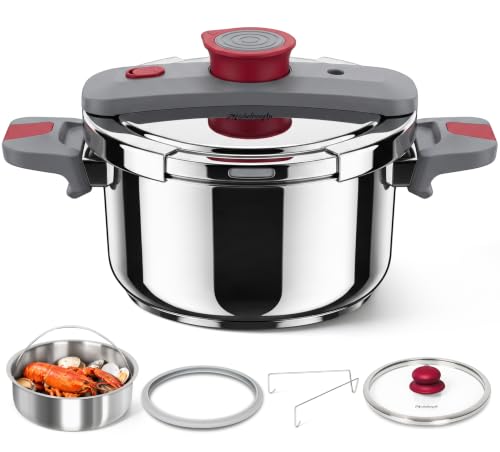
MICHELANGELO Stovetop Pressure Cooker, 4.2 qt
Badge: Best for Small Households
Strengths
- 304 stainless steel construction with a listed 6-fold safety system.
- One-hand easy-open lid is a genuine help when your other hand holds a spoon or a hot pad.
- Two pressure settings plus a steamer basket and a glass lid for non-pressure use.
Trade-offs
- 4.2 quarts is tight for whole chickens or large roasts.
- Glass lid adds storage bulk even though it earns its place for everyday simmering.
- Newer brand name, so long-term spare-part availability is less proven than the legacy brands.
Mini spec box
- Capacity: 4.2 qt
- Material: 304 stainless steel
- Safety: 6-fold safety system
- Lid: One-hand easy-open
- Settings: 2 pressure settings
- Included: Steamer basket and glass lid
- Compatibility: Induction compatible (per listing title)
The MICHELANGELO 4.2 qt is the pick that understands small-household cooking. A pot in this size comes to pressure quickly, releases quickly, and does not ask you to cook a gallon of stew to justify turning on the burner. The one-hand lid is more than a gimmick: locking and unlocking a pressure lid while steadying a hot pot is the fiddliest moment of stovetop pressure cooking, and simplifying it makes weeknight use noticeably calmer. The included glass lid turns the same vessel into an ordinary saucepan for simmering and reheating, which matters in a small kitchen where every pot must do two jobs.
Who it suits: couples, small families, and cooks with limited storage who still want two pressure settings and induction compatibility. The honest limitation is headroom — at the two-thirds fill rule, you have under three quarts of working space, so large roasts and big soup batches are off the menu. Plan on it as a daily driver for grains, beans in modest quantities, curries and steamed vegetables rather than a feast pot.
Best for: One to three people who pressure cook often in small batches / Not suited for: Large roasts, canning, or feeding a crowd
The two pressure settings deserve a word of their own, because they change what a small pot can do. The lower setting is the one to use for eggs, fish, custards and tender vegetables — foods that blow past perfect in the time a full-pressure pot spends coming down. The higher setting handles the beans, grains and braises that justify owning a pressure cooker at all. In a 4.2-quart body that comes to pressure in minutes, the low setting makes this the most delicate-food-friendly stovetop pick in the group, and the glass lid means the same pot can finish a dish uncovered, sauce reducing on the burner, without decanting into a second pan.

Peterboo Stainless Steel Pressure Cooker, 6 Quart
Badge: Best for Induction
Strengths
- 3-ply composite base is built for even heating and is listed for induction, gas and ceramic stoves.
- Pressure indicator plus multiple safeguard devices are confirmed in the verified listing.
- Dishwasher-safe body keeps cleanup simple after heavy stews.
Trade-offs
- No steamer basket or second lid is mentioned in the verified title data.
- Less established brand, so judge it on the listing details and warranty terms.
- Composite bases are heavier than plain stainless, noticeable when the pot is full.
Mini spec box
- Capacity: 6 quart
- Material: Stainless steel
- Base: 3-ply composite base
- Indicator: Pressure indicator
- Compatibility: Induction, gas and ceramic stove (per listing title)
- Care: Dishwasher safe (per listing title)
The Peterboo 6 Quart earns its place on one feature above all: the base. A 3-ply composite base spreads heat across the bottom of the pot, which is exactly what a rangetop cooker needs — hot spots are the enemy of pressure cooking, because a scorched layer of beans or tomato sauce on the base both ruins flavour and makes the pot harder to bring safely to pressure. The listing explicitly names induction, gas and ceramic compatibility, so this is the natural pick for an induction rangetop where not every stainless pot will even register on the hob. The pressure indicator gives you a clear visual target when you are trimming the burner down to the holding setting.
Who it suits: induction and glass-top owners in particular, plus anyone who has scorched the base of a thinner pot before. The honest limitation is the accessory set: with no basket listed, steaming above the liquid means buying a separate insert, and the brand does not yet have the decades-long parts trail of the legacy names. As a 6-quart all-rounder with the right base for modern hobs, though, it is a well-aimed design.
Best for: Induction and glass rangetop owners who want even heating / Not suited for: Buyers who want a full accessory bundle in the box
There is a second, quieter benefit to a composite base on any rangetop, not just induction: forgiveness during the sauté stage. Most pressure recipes begin with browning meat or softening onions in the open pot, and a thin base punishes a moment’s distraction with a scorched patch that then flavours the whole dish and complicates the pressure seal of flavour — nothing seals worse than a burnt layer steaming underneath. A layered base buys you even browning and a cleaner deglaze. If your cooking style starts everything with a proper sear, this is the 6-quart pick aligned with how you actually cook, and the listed dishwasher-safe body is a welcome end to the evening after a heavy stew.

RVGMBO Pressure Cooker 12 Quart, 18/8 Stainless Steel
Badge: Best for Canning and Big Batches
Strengths
- 12-quart capacity is true pressure-canner territory and doubles as a feast-sized cooker.
- 18/8 stainless steel body with one-hand locking, per the verified listing.
- Glass lid and steamer rack included, so it works as a giant stockpot too.
Trade-offs
- Very heavy when full — moving it on and off the burner is a two-hand, planned operation.
- Needs a powerful burner; on a weak hob it is slow to reach pressure.
- Far too large for everyday meals for most households.
Mini spec box
- Capacity: 12 quart
- Material: 18/8 stainless steel
- Format: 3-in-1 pressure cooker / pressure canner
- Lid: One-hand locking; glass lid included
- Included: Steamer rack
- Compatibility: Induction and gas stovetop (per listing title)
The RVGMBO 12 Quart is the specialist of this group: a pot bought for the days when volume is the whole point. Home canners need a vessel that can hold jars with room for water circulation, and batch cooks need room for the kind of stock, beans and pulled pork that fill a freezer in one session. The 18/8 stainless construction is the food-grade grade most buyers look for, and the one-hand locking design helps when you are closing a lid on a pot that already weighs plenty empty. With the glass lid on, it moonlights as the biggest stockpot in the kitchen.
Who it suits: canners, large families, homesteaders and anyone who cooks for gatherings. Two honest cautions. First, pressure canning must follow tested recipes and your local extension guidance exactly — a big pot is equipment, not a guarantee of safe canning, so confirm the model against current USDA guidance for your altitude before processing low-acid foods. Second, check your rangetop: a full 12-quart pot is a serious load, and some glass hobs have weight limits worth confirming in the stove manual.
Best for: Canning days and very large batches / Not suited for: Everyday small meals, weak burners, or glass hobs with low weight limits
Plan the workflow before the first canning day. A pot this size needs a staging area: jars, lids, a funnel and a towel-lined tray within arm’s reach of the burner, because once processing starts you do not leave the stove for long. It also needs cool-down room — natural pressure release on a full canner load takes a while, and the pot will occupy your main burner for the whole session. None of that is a flaw; it is the nature of the format, and cooks who organise for it find the RVGMBO’s capacity liberating. Cooks who wanted a slightly bigger everyday pot, on the other hand, should look at the 8.5-quart T-Fal instead and keep their daily driving sane.

Peterboo 3Qt Stainless Steel Pressure Cooker
Badge: Best for One or Two People
Strengths
- True mini size: 3 quarts, aimed squarely at one or two people per the listing.
- 8+ safety features listed, with induction compatibility.
- Small pot comes to pressure fast and is easy to wash and store.
Trade-offs
- Working capacity is roughly two quarts of food at the two-thirds fill rule.
- The listing’s 8-in-1 multi-cooker wording is broad; treat it as a compact stovetop pressure pot first.
- No basket or spare lid is named in the verified title data.
Mini spec box
- Capacity: 3 qt
- Material: Stainless steel
- Safety: 8+ safety features (per listing title)
- Compatibility: Induction compatible (per listing title)
- Audience: Sized for 1–2 people (per listing title)
The Peterboo 3Qt is the smallest pot in this guide and, for the right kitchen, the most used one. Singles and couples consistently under-use big pressure cookers because the minimum practical batch feels like a commitment; a 3-quart pot removes that friction. Rice for two, a small bean stew, a couple of chicken thighs with sauce — all of it comes to pressure quickly on a small burner and the pot rinses clean in a minute. Its listed safety-feature count is the highest in this group, which is reassuring in a compact lid design.
Who it suits: one- and two-person households, dorm-adjacent and small-apartment kitchens, and owners of a big cooker who want a small partner pot for sides. The honest limitation is scale: this is not the pot for meal-prep Sundays or dinner guests, and foaming foods at the half-fill rule leave you about a quart and a half of working room. Buy it as a specialist and it will earn its shelf space.
Best for: Singles and couples cooking small, fast pressure meals / Not suited for: Families, batch cooking, or entertaining
Small pots also change the economics of leftovers. In a 3-quart cooker you can pressure-cook a single cup of dried beans or a small batch of steel-cut oats without the odd, echoing feeling of a big pot mostly empty — and minimum-liquid requirements are easier to satisfy, so sauces stay concentrated instead of diluted. For a household that cooks fresh most nights rather than batching, that is the difference between a pressure cooker used daily and one used monthly. It also travels well: this is the size that goes to a holiday rental or a camper kitchen and still earns its space, provided the hob there suits a small stainless pot.
Comparison Table
| Model | Capacity | Base / hob notes | Settings | Extras in box | Link |
|---|---|---|---|---|---|
| Presto 01362 | 6 qt | Stainless stovetop body | Single pressure design | — | Check on Amazon |
| T-Fal Secure Trendy | 8.5 qt | Induction compatible; dishwasher-safe body | 2 cooking modes | Steam basket | Check on Amazon |
| MICHELANGELO | 4.2 qt | 304 stainless; induction compatible | 2 pressure settings | Steamer basket, glass lid | Check on Amazon |
| Peterboo 6 Quart | 6 qt | 3-ply composite base; induction, gas, ceramic | Pressure indicator model | — | Check on Amazon |
| RVGMBO 12 Quart | 12 qt | 18/8 stainless; induction and gas | Canner / cooker format | Glass lid, steamer rack | Check on Amazon |
| Peterboo 3Qt | 3 qt | Stainless; induction compatible | Compact multi-use design | — | Check on Amazon |
How to Choose the Right Rangetop Pressure Cooker
Start with your burners, not the recipe book. Measure the diameter of the burner you use most and compare it with the base diameter in the listing photos and Q&A. A base much smaller than a gas burner wastes energy and can overheat handles; a base much larger than an induction zone may not be detected or may heat in a ring. If you cook on induction, only buy a pot whose listing explicitly states induction compatibility — of this group, the T-Fal, MICHELANGELO, both Peterboo models and the RVGMBO state it, while the Peterboo 6 Quart goes furthest by naming induction, gas and ceramic together.
Do the capacity maths honestly. Pressure cookers are filled to two-thirds at most, and only halfway for beans, grains and anything foamy. That means a 6-quart pot cooks about four quarts of stew; a 3-quart pot cooks about two. Households of one or two do best with 3 to 4.2 quarts, three to five people with 6 quarts, and anyone batch cooking or canning with 8.5 to 12 quarts. Oversizing is the most common rangetop mistake: a huge pot on a small burner is slow, and small loads in a huge pot come to pressure reluctantly.
Weigh safety systems and lid handling. Modern stovetop cookers layer several safeguards — locking lids that cannot open under pressure, pressure indicators, and release valves. The listings here range from multi-point systems on the T-Fal and MICHELANGELO to the 8+ features claimed by the Peterboo 3Qt. Just as practical is the lid action: one-hand opening designs reduce the juggling act at the stove. Finally, think about tiers qualitatively: the legacy-brand stainless pot sits in a different confidence tier from a newer name, not because of a price tag but because of parts availability and track record; newer brands compete with richer accessory bundles and more settings. Decide which kind of value matters to you before you shop, and browse Best Pressure Cookers Tested if you want to see how evidence-led comparisons weigh these trade-offs.
Think about what you will cook in the first month. Write down the five dishes you genuinely expect to make — not the aspirational list, the real one. If four of them are weeknight grains, beans and curries for two, the small pots will make you happier than any flagship. If the list is Sunday roasts, stocks and freezer batches, capacity and base quality dominate and the 6- to 8.5-quart class is your home. Matching the pot to the first month matters because a cooker that fits your habits gets used weekly, and a used pressure cooker is the only kind that saves time and money. The exotic use case you might try twice a year should never outvote the meals you cook every week.
How to Use a Rangetop Pressure Cooker Well
Good stovetop pressure cooking is a short routine. First, check the gasket is seated, the vent is clear, and the pot is filled between the minimum liquid line and the two-thirds mark. Second, lock the lid and place the pot centred on a burner matched to its base. Third, bring it up over medium-high heat until the indicator shows full pressure, then immediately trim the heat to the lowest setting that holds pressure steadily — this holding setting is different on every stove, so note yours down the first few times. Fourth, time from the moment pressure stabilises, not from when you turned the burner on. Fifth, release pressure the way the recipe directs: natural release for meats and foamy foods, a careful quick release for vegetables.
Cleaning is simple but specific. Wash the body as the listing allows — two of these bodies are listed dishwasher-safe — but hand-wash lids, rinse the vent under running water, and wash and dry the gasket separately so it does not hold odours. Store the lid upside down on the pot so the gasket is not compressed. Every few months, hold the gasket up to the light: cracks, stiffness or a lingering stretched fit mean it is time for a replacement, and a spare gasket is the cheapest insurance in pressure cooking.
Troubleshooting on the Rangetop
Problem: The cooker will not come to pressure → Check the gasket seating, confirm there is enough thin liquid in the pot, and make sure the burner is large enough and hot enough for the base; a small burner under a wide pot is the classic rangetop cause.
Problem: Steam leaks steadily from the rim → Release pressure, cool the pot, then inspect the gasket for food debris, cracks or a stretched fit, and re-seat or replace it before the next use.
Problem: Food scorches on the base → Your holding heat is too high or the layer of food was too thick and dry; deglaze after sautéing, add enough liquid, and use a lower holding setting or a heat-diffuser on aggressive gas burners.
Rangetop vs Electric: Which Bench Should It Sit On?
Shoppers often land here while also reading about countertop electric models, and the honest answer is that the two formats suit different cooks. A rangetop cooker sears harder, reaches pressure faster on a strong burner, has no electronics to fail, and doubles as a normal pot with a glass lid where one is included. An electric cooker trades that control for automation: it holds pressure without burner-watching and keeps food warm unattended. If your stove has a strong, controllable burner and you enjoy being at the stove, the rangetop format rewards you. If your kitchen time is fragmented and you need to walk away, read the electric-focused comparisons too — the roundup at Best Pressure Cookers Sweethome covers the countertop side of the family, and Best Pressure Cookers Uk looks at regional buying questions for the same category.
Matching the Pot to Your Burners: A Hob-by-Hob Guide
Gas rangetops reward a wide, layered base and punish a narrow one: flames that lick past the base waste fuel and scorch sidewalls and handles. Keep the flame footprint at or inside the base diameter, and once pressure is reached, expect your holding setting to be surprisingly low — many gas burners hold pressure on their smallest ring. If your lowest flame still pushes the regulator to vent constantly, a heat diffuser plate between burner and pot is a cheap fix.
Electric coil and radiant glass hobs cycle their elements on and off, so pressure can surge and dip. A heavier, layered base — the Peterboo 6 Quart’s 3-ply design is the example in this guide — smooths those cycles out. Give the element a head start by preheating the pot’s contents while you prep, and remember that glass hobs stay hot after you switch off, which effectively extends natural release.
Induction is the fastest and most controllable way to run a stovetop pressure cooker, but only with a magnetic base that covers a good share of the cooking zone. Undersized bases on a big zone can buzz or fail to register. Every pick in this guide except the classic Presto explicitly claims induction compatibility in its verified listing; for any pot, the home test is simple — if a fridge magnet clings firmly to the base, the hob will almost certainly accept it. Induction’s instant heat cuts also make quick release under the tap the safer way to stop cooking precisely.
Portable and compact hobs — the kind found in small apartments, rentals and campers — flip the usual advice: choose the 3-quart or 4.2-quart pot, because a small burner under a wide base will struggle to ever reach pressure, and a heavy full pot can exceed a portable hob’s stability and weight comfort. Small pots on small burners are a matched pair, and they pressurise satisfyingly fast.
Storage, Gaskets and the Real Cost of Ownership
A pressure cooker is one of the longest-lived items in a kitchen, and its running costs are almost entirely one part: the gasket. Expect to replace sealing rings periodically, to keep the vent clear, and to store the lid inverted so the ring rests uncompressed. Legacy brands make that easy with deep parts catalogues; newer brands make it easy at purchase time with richer bundles but ask you to confirm spare availability before you commit. Store the pot where the lid cannot be knocked — a dented rim or a warped lid is the one injury a stovetop pressure cooker does not recover from. Nested storage with a cloth between lid and body prevents the rim dings that cause mystery steam leaks years later. Buy the cooker whose parts story you trust, keep one spare gasket in a drawer, and any of the six pots in this guide will pay you back for a very long time.
Common Buying Mistakes
- Buying capacity by the headline number. A 6-quart pot cooks four quarts of food. Size by working capacity, not the number on the box.
- Ignoring the base-to-burner match. A wide pot on a small induction zone or a narrow pot on a huge gas burner wastes heat and cooks unevenly.
- Assuming every stainless pot works on induction. Only magnetic bases register on induction hobs; buy only where the listing says so.
- Forgetting the gasket is a wear part. Budget a spare gasket into ownership and learn how yours removes and refits before the first cook.
- Treating a pressure canner as an everyday pot. The 12-quart class earns its keep on canning and batch days; it is a burden for Tuesday dinner.
- Skipping the stove manual. Glass and ceramic hobs can have weight limits that a full large cooker can exceed.
Final Recommendation
For most kitchens, the first choice is the Presto 01362: the classic 6-quart stainless size that matches most recipes and most burners. If your rangetop is induction or glass and even heating is your worry, step across to the Peterboo 6 Quart and its 3-ply composite base. Families should look at the T-Fal 8.5 qt, small households at the MICHELANGELO 4.2 qt, canners at the RVGMBO 12 Quart, and singles and couples at the Peterboo 3Qt. Whichever you choose, match it to your burner first and the recipes will follow.
Frequently Asked Questions
Can I use a stovetop pressure cooker on any rangetop?
On gas and electric coil, almost any flat-based stainless pot works. On glass and ceramic, check the pot is listed as compatible and respect the hob’s weight limit. On induction, the base must be magnetic — buy only models whose listings explicitly claim induction compatibility, as several in this guide do.
What size pressure cooker is best for a family of four?
A 6-quart model is the standard answer: it cooks about four quarts of food under the two-thirds rule, which covers family stews, roasts and soups. If you regularly double recipes or freeze batches, the 8.5-quart size is the comfortable step up.
How do I know when my rangetop cooker is at pressure?
Use the model’s indicator — a raised pin, a weighted regulator rocking steadily, or a marked pressure indicator like the one on the Peterboo 6 Quart. Start timing when the indicator shows full pressure and stays there after you trim the heat.
Why does my cooker take so long to pressurise?
Usually the burner is too small for the base, the pot is very full or very cold, or the gasket is leaking steam. Match the base to the burner, and check the gasket seating before blaming the pot.
Can a stovetop pressure cooker replace a pressure canner?
Only models designed and sized as pressure canners should be used for canning, and only with tested recipes and current official guidance for your altitude. A standard 6-quart cooker is for cooking, not for processing low-acid foods.
How often should I replace the gasket?
Replace it when it cracks, stiffens, stretches so the lid leaks, or holds odours after washing — typically well before failure if you cook often. Keeping a spare on hand means a worn gasket never cancels a meal.
Is a stovetop pressure cooker safe on a glass-top stove?
Generally yes, with three checks. The pot should sit flat without rocking, its listing or manual should not exclude glass surfaces, and the combined weight of pot plus food should stay within the hob maker’s limit — the caution that matters most for the 12-quart class. Lift rather than slide the pot when you move it, since dragging any heavy base across glass can scratch the surface over time.
Do I need a different cooker for high-altitude cooking?
No, but you do need adjusted expectations and timings. Water boils at a lower temperature as altitude rises, so pressure cookers at altitude work at a lower absolute pressure and foods take longer; standard practice is to increase cooking times modestly and, for canning, to follow altitude-adjusted tested guidance exactly. A weighted-gauge or clearly indicated cooker helps you hold the right setting, and your local extension service publishes the adjustments for your elevation.
Finally, a note on noise: a healthy stovetop cooker at pressure should hiss softly or rock its regulator in a steady rhythm. Loud, constant venting means the heat is too high and you are losing liquid; silence combined with a dropped indicator means pressure has fallen and timing should pause until it recovers. Learning those two sounds is most of what experienced rangetop cooks mean by instinct.
One last word on learning curve: every rangetop in every kitchen behaves a little differently, and the first two or three cooks with any of these pots are calibration sessions. Cook something forgiving first — a bean stew or a stock — note the burner setting that held pressure, and write it on a card kept with the pot. From the fourth cook onward, that card turns your stove and your cooker into a matched, predictable pair.


