Disclosure: topratedkitchenware.com is reader-supported. When you buy through links on our site, we may earn an affiliate commission from Amazon and other retailers, at no extra cost to you.
Where to buy
The six models below are the verified picks for anyone comparing the best prices on pressure cookers 8qt. Each name links to its Amazon listing, where you can check the latest price on Amazon, confirm the current configuration, and read the newest owner feedback before you decide.
- Instant Pot Rio Mini 4 Qt 7-in-1 Electric Pressure Cooker
- CHEF iQ Smart Pressure Cooker with WiFi and Built-in Scale, 6 Quart
- Presto 01362 6-Quart Stainless Steel Pressure Cooker
- T-Fal Secure Trendy Stainless Steel Pressure Cooker, 8.5 qt
- MICHELANGELO Stovetop Pressure Cooker Stainless Steel, 4.2 qt
- Peterboo Stainless Steel Pressure Cooker, 6 Quart Stovetop
Read the full guide ↓ for an unusually honest account of which of these is really an 8-quart cooker, which are smaller alternatives, and how usable capacity actually works.
This guide begins with the disclosure most 8-quart roundups bury: of the six verified picks in its pool, exactly one is a genuine 8-quart-class pressure cooker — the T-Fal Secure Trendy at 8.5 quarts. The other five are smaller machines: three 6-quart models, a 4.2-quart, and a 4-quart. They are not mislabelled here, and they are not filler. They are included, clearly badged as alternatives, because they represent the real choices a shopper comparing prices on pressure cookers 8qt actually faces: pay for the true big pot, or save money and counter space with a smaller cooker that may honestly cover your cooking once you understand usable capacity. What this guide will never do is call a 6-quart cooker an 8-quart cooker. The sizes in every heading, table, and spec box below are the real sizes, taken from the verified listings.
Why does this matter so much? Because pressure cooker capacity is already a slippery number before marketing touches it. A pressure cooker should never be filled to the brim: the working maximum is about two-thirds for most foods, and about half for grains, beans, and anything that foams or expands. That means a nominal 8-quart cooker delivers roughly five quarts of working capacity for a stew, and a nominal 6-quart delivers about four. Shoppers who do not know this buy an 8-quart expecting eight usable quarts, or reject a 6-quart that would actually have served them. This guide does the maths openly, pick by pick, so your money buys the working volume you need — no more, no less.
The pool’s shape also tells a market truth worth knowing: genuine 8-quart-and-up pressure cookers are a minority of listings, concentrated in stovetop stainless models like the T-Fal and in a handful of large electrics, while the category’s centre of gravity sits at 6 quarts. That is why a price search for 8qt returns so many 6-quart results. Rather than pretend otherwise, this guide reviews the one true 8-quart-class pick as its headline, reviews the 6-quart trio as the credible step-downs they are, and reviews the two small models as compact alternatives for shoppers who entered this search overestimating their needs — a more common outcome than you might think. If your interest is specifically in durable, heavy builds, Best Professional Grade Pressure Cookers covers the stovetop philosophy in depth.
Key Takeaways
- Only one pick in this pool is a true 8-quart-class cooker: the T-Fal Secure Trendy at 8.5 quarts. It is badged accordingly and reviewed as the headline pick.
- Usable capacity is what matters: plan on roughly two-thirds of nominal volume for stews and soups, and about half for grains, beans, and foaming foods.
- A 6-quart cooker is the honest step-down for most households that search “8qt” — it covers family dinners and moderate batch cooking at lower cost and size.
- The small picks (4 and 4.2 quarts) suit couples and small kitchens; they appear here as alternatives, never disguised as 8-quart options.
- Stovetop stainless dominates the true big sizes, and brings lifetime durability with it; big electrics exist but are rarer in verified listings.
- Check the latest price on Amazon for each pick, and compare cost per usable quart rather than cost per headline quart.
In this guide
Quick Picks
| Pick | Badge | True size | Type | Link |
|---|---|---|---|---|
| T-Fal Secure Trendy | Best True 8-Quart Pick | 8.5 Qt | Stovetop, induction | T-Fal Secure Trendy |
| Presto 01362 | Best 6-Quart Stovetop Alternative | 6 Qt | Stovetop | Presto 01362 |
| Peterboo 6 Quart Stovetop | Best 6-Quart Induction Alternative | 6 Qt | Stovetop, induction/gas/ceramic | Peterboo 6 Quart |
| CHEF iQ Smart | Best 6-Quart Smart Alternative | 6 Qt | Electric, WiFi | CHEF iQ Smart |
| MICHELANGELO 4.2 qt | Best Compact Stovetop Alternative | 4.2 Qt | Stovetop, induction | MICHELANGELO 4.2 qt |
| Instant Pot Rio Mini | Best Small Electric Alternative | 4 Qt | Electric, 7-in-1 | Instant Pot Rio Mini |
The “True size” column is the most important column in this guide. Every badge contains the word “alternative” except the T-Fal’s, because that is the truth of the pool, and this guide prints the truth where you can see it before you spend anything.
How These Picks Were Chosen
This is a research-led guide built on a verified product pool checked against Amazon’s catalogue data. Verification confirmed each pick as a genuine pressure cooker and recorded its true capacity from the catalogue title — the step that exposed the size gap this guide discloses so prominently. A less careful process would have published the pool under the search’s 8qt banner without comment. Instead, the selection was organised around the disclosure: the one true 8-quart-class model leads, and the remaining picks were chosen to represent the genuine alternatives a size shopper weighs — the mainstream 6-quart class in stovetop, induction stovetop, and smart electric forms, plus two compact models for the many shoppers who discover, mid-search, that their real batches are smaller than their ambitions.
Within each size, the usual disciplines applied: construction and materials, safety systems, compatibility with modern hobs, parts availability, and the pattern of long-term owner feedback. The stovetop tilt of the big end is not editorial preference; it reflects where verified large-capacity listings actually live. Electric 8-quart models exist in the wider market, and shoppers determined to have one should know this pool’s electric picks top out at 6 quarts — stated here rather than discovered after purchase. Honesty about a pool’s limits is part of what a guide owes its readers, alongside honesty about the picks themselves.
No prices are printed, in line with this series’ standing rule, because prices move and printed figures mislead. What the guide gives you instead is the capacity arithmetic and the per-pick value logic, plus links to the live listings where today’s figures wait. Readers whose kitchens run on gentler methods for part of the week may also find Best Professsional Slow Cookers relevant, since big-batch households often pair a large pressure cooker with a large slow cooker for different jobs.
The 6 Best Pressure Cookers for 8qt Shoppers, Honestly Sized
The headline pick first, then the alternatives in descending size. Every review leads with the capacity truth for its model.

T-Fal Secure Trendy Stainless Steel Pressure Cooker, 8.5 qt
Badge: Best True 8-Quart Pick
Strengths
- The genuine article for this search: 8.5 quarts of stainless stovetop capacity, delivering roughly five-plus usable quarts under the two-thirds rule.
- A 5-point safety system and two cooking modes modernise the big stovetop format, with induction compatibility for current hobs.
- Dishwasher-safe body and an included steam basket make a very large pot unusually manageable day to day.
Trade-offs
- Manual stovetop operation: no programs, no timer, no keep-warm. You drive the pressure with your burner.
- It is a big, heavy vessel to store, fill, lift, and wash, even with the dishwasher’s help.
- Two cooking modes is honest simplicity, but pressure variety is limited compared with programmable electrics.
Mini spec box
- Capacity: 8.5 qt (the pool’s only true 8-quart-class pick)
- Type: stovetop pressure cooker
- Material: stainless steel
- Compatibility: induction (per listing)
- Safety: 5-point safety system (per listing)
- Modes: 2 cooking modes (per listing)
- Included: steam basket (per listing)
- Care: dishwasher-safe body (per listing)
Here is the cooker this search is actually about. At 8.5 quarts, the T-Fal Secure Trendy does the jobs that define the big class: a whole large chicken with room to spare, a double batch of stock, a stew for a table of ten, a serious meal-prep session that fills the freezer in one run. Under the two-thirds fill rule, that is a working volume no other pick in this guide approaches, and it arrives in stainless steel on the stovetop, which means the capacity comes with cookware-grade longevity — no electronics to age out, just a gasket to refresh over the years. The 5-point safety system deserves emphasis at this size, because a big pressure vessel concentrates a lot of steam; T-Fal’s layered approach to locking, pressure indication, and controlled release is exactly what a modern large cooker should offer.
The price logic is cookware logic. Big stovetop stainless sits in a steadier pricing world than promotional electrics, and the value case compounds over time: this is a buy-once pot. The honest costs are physical and procedural. You need a burner that suits it, storage that fits it, and the willingness to run pressure manually — bringing it up, holding it steady, timing it, releasing it. Cooks who already work confidently at the stove will find the T-Fal the most satisfying pick in this guide. Cooks who wanted an electric to do all that for them should read the alternatives below with the capacity maths in hand, and consider whether 6 automated quarts might serve them better than 8.5 manual ones.
Best for: large families, entertainers, and batch cooks who truly need 8-quart-class capacity and cook confidently on the stove / Not suited for: anyone wanting automated programs, or small kitchens without storage for a very large pot

Presto 01362 6-Quart Stainless Steel Pressure Cooker
Badge: Best 6-Quart Stovetop Alternative
Strengths
- The archetypal stovetop pressure cooker: stainless, simple, and built for decades of service with only gasket upkeep.
- Six quarts delivers about four usable quarts — enough for most family dinners and moderate batch cooking.
- Deep parts availability from a long-established maker keeps lifetime ownership costs minimal.
Trade-offs
- It is not an 8-quart cooker. Crowd-scale batches will need two runs or a bigger pot.
- Fully manual operation, with no programs or timers of any kind.
- The design is purely functional; it is a tool, not a countertop statement.
Mini spec box
- Capacity: 6 Qt (alternative size — not 8 qt)
- Type: stovetop pressure cooker
- Material: stainless steel
- Brand: Presto
The Presto is the alternative most 8qt shoppers should seriously consider, because it tests the assumption behind the search. If your “big batch” is a family stew, a pot of beans for the week, or soup for six, the Presto’s four usable quarts handle it with room to spare, in a pot that will likely outlast every other appliance in your kitchen. Its price buys the lowest lifetime cost in this guide: stainless steel, a mature parts pipeline, and nothing electronic to fail. Generations of cooks have run exactly this class of pot as their only pressure cooker, which is worth remembering when a search term tries to convince you that you need the biggest size on the shelf.
Where the Presto genuinely cannot follow is true scale. If your cooking includes canning-day volumes, holiday birds, or freezer-filling sessions, 6 quarts will mean relays, and relays erase the convenience that justified pressure cooking in the first place. Be honest about the largest thing you cook in a year. If it fits the Presto’s working volume, this alternative is not a compromise at all — it is the smart buy, and the money saved against the big pot is real. If it does not fit, scroll back up to the T-Fal and buy the true size without regret.
Best for: households whose real batches fit four usable quarts and who value lifetime durability / Not suited for: genuine crowd-scale cooking, which needs the T-Fal’s true 8-quart class


Peterboo Stainless Steel Pressure Cooker, 6 Quart Stovetop
Badge: Best 6-Quart Induction Alternative
Strengths
- Broad hob compatibility — induction, gas, and ceramic — from a 3-ply composite base that spreads heat evenly.
- A pressure indicator and multi-safeguard devices bring clear, modern safety feedback to a manual pot.
- Dishwasher safe, which removes the least pleasant part of owning a mid-size stovetop cooker.
Trade-offs
- Six quarts, not eight: the same step-down arithmetic as the Presto applies.
- A newer brand presence than the heritage makers, so the long-term parts picture is less proven.
- Manual operation throughout; the indicator informs you, but you still run the cook.
Mini spec box
- Capacity: 6 Qt (alternative size — not 8 qt)
- Type: stovetop pressure pot
- Base: 3-ply composite base (per listing)
- Compatibility: induction, gas, and ceramic stoves (per listing)
- Features: pressure indicator, multi safeguard devices (per listing)
- Care: dishwasher safe (per listing)
The Peterboo is the 6-quart alternative for modern kitchens, and its argument is compatibility. Induction hobs have quietly disqualified many traditional stovetop pots, and this one’s composite base is built for them while remaining happy on gas and ceramic. The pressure indicator is a small feature with outsized value for newer pressure cooks: a clear visual confirmation of the pot’s state removes the guesswork that makes first stovetop experiences anxious. Add dishwasher-safe construction and a multi-safeguard design, and you have the most contemporary take on the manual 6-quart in this pool.
Its position in an 8qt guide is the same honest one as the Presto’s: it is the step-down for households whose real volume fits. Choose between the two 6-quart stovetops on your hob and your brand comfort — the Peterboo for induction-first kitchens and modern indicators, the Presto for the longest track record and deepest parts heritage. Either way, you are buying roughly four usable quarts and a pot with no electronics in it, and for a great many families that is the correct purchase wearing an “alternative” badge only because a search term said so.
Best for: induction and mixed-hob kitchens wanting a modern manual 6-quart with clear pressure indication / Not suited for: true 8-quart needs, or buyers who want the heritage brands’ proven parts pipelines

CHEF iQ Smart Pressure Cooker with WiFi and Built-in Scale, 6 Quart
Badge: Best 6-Quart Smart Alternative
Strengths
- The pool’s only electric alternative, with WiFi guided recipes and a built-in scale that calculates cooking from actual ingredient weights.
- Full automation at 6 quarts: programs, timing, and keep-warm that the stovetop alternatives cannot offer.
- A complete 10-in-1 function set, so stepping down in size does not mean stepping down in versatility.
Trade-offs
- Six quarts is six quarts: its usable volume is roughly four quarts, well short of the 8-quart brief.
- Smart features depend on an app ecosystem and reward only cooks who will actually use them.
- Electronics give it a shorter expected service life than the stainless stovetop picks.
Mini spec box
- Capacity: 6 Qt (alternative size — not 8 qt)
- Functions: 10-in-1 multi-cooker — pressure cooker, rice cooker, slow cooker and more (per listing)
- Connectivity: WiFi, guided recipes (per listing)
- Special feature: built-in scale (per listing)
The CHEF iQ is the alternative for the shopper who arrived at “8qt” by a different road: not raw volume, but the feeling that a standard cooker might not be enough machine. Its answer is intelligence instead of quarts. The built-in scale and guided recipes make it the most capable teacher in this pool, and its automation means a 6-quart batch cooks itself while you do anything else. For a household whose real batches are family dinners rather than events, that trade — two theoretical quarts exchanged for guidance and automation — can be the smartest money in this guide.
But let the disclosure be exact: if you need eight quarts of food cooked at once, no amount of intelligence cooks it in a 6-quart pot. The CHEF iQ belongs in this guide as the premium step-down, not as a big cooker in disguise. Buy it because guided, weighed, automated cooking appeals to you and your batches fit its working volume. Do not buy it as an 8-quart substitute, because it is not one, and this guide will not pretend otherwise for the sake of a tidy list.
Best for: cooks who value automation and guidance over raw volume, with family-size batches / Not suited for: genuine 8-quart batch needs, or app-averse traditionalists

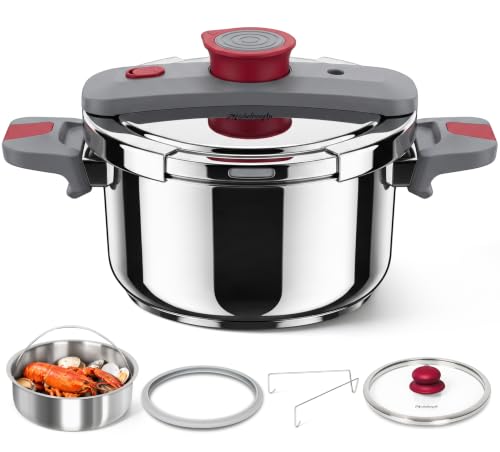
MICHELANGELO Stovetop Pressure Cooker Stainless Steel, 4.2 qt
Badge: Best Compact Stovetop Alternative
Strengths
- Quality compact construction: 304 stainless steel with a 6-fold safety system and a one-hand easy-open lid.
- Two pressure settings give a small pot unusual finesse for delicate versus hearty loads.
- A steamer basket and glass lid are included, and it is induction compatible — a complete small-pot package.
Trade-offs
- At 4.2 quarts it is half the search’s headline size; its usable volume is under three quarts.
- Compact stovetop cooking is fully manual, with small batches demanding the same attention as large ones.
- Not a batch or entertaining pot in any honest accounting.
Mini spec box
- Capacity: 4.2 qt (alternative size — not 8 qt)
- Material: 304 stainless steel (per listing)
- Safety: 6-fold safety system (per listing)
- Lid: one-hand easy-open (per listing)
- Settings: 2 pressure settings (per listing)
- Included: steamer basket and glass lid (per listing)
- Compatibility: induction (per listing)
Every honest size guide needs its reality check, and the Michelangelo is this one’s — included not because it answers the 8-quart brief, but because a meaningful share of “8qt” searchers are really shopping by anxiety rather than by batch. If your household is two people and your pressure cooking is weeknight dinners, this compact stainless pot is arguably the best-made small option in the pool: proper 304 steel, a serious safety stack, two pressure settings that most small pots do not bother with, and the thoughtful inclusion of both a steamer basket and a glass lid for ordinary stovetop use. It will cook your dinners beautifully for years.
What it will not do is grow with you. Buy it as a deliberate small-pot purchase, the way you would buy a small saucepan, and it is a delight. Buy it as a cheap way to tick the pressure cooker box while telling yourself size does not matter, and the first holiday will correct you. This guide’s badges exist to force exactly that moment of honesty before checkout rather than after.
Best for: one- and two-person households that want a premium compact stovetop pot / Not suited for: families, batch cooks, and anyone whose 8-quart search reflects real volume

Instant Pot Rio Mini 4 Qt 7-in-1 Electric Pressure Cooker
Badge: Best Small Electric Alternative
Strengths
- Genuine Instant Pot automation at a compact 4 quarts: pressure, slow cook, rice, steam, sauté, yogurt, keep warm.
- The brand’s ecosystem and recipe base behind a small footprint that fits real kitchens.
- Fast to pressure on small loads, economical to run, and easy to store.
Trade-offs
- Four quarts is the smallest working volume in this guide alongside the Michelangelo; it answers a different question than 8qt.
- No batch or entertaining capacity whatsoever.
- Compact electrics cost more per quart than family sizes.
Mini spec box
- Capacity: 4 Qt (alternative size — not 8 qt)
- Functions: 7-in-1 — pressure cook, slow cook, rice, steam, sauté, yogurt, keep warm (per listing)
- Finish: black
- Brand: Instant Pot
The Rio Mini closes the pool as the small electric alternative, and its presence in an 8qt guide is justified the same way as the Michelangelo’s: it serves the shopper who discovers, honestly, that their cooking is small. If that is you, this is a far better purchase than a cavernous pot — genuine brand automation, the full core program set, and a size that matches two-person dinners and modest sides. It is also a legitimate second-cooker candidate for households that own a big pot already and want rice or vegetables pressure cooking in parallel; in that role, its smallness is the entire point.
For everyone else, let the badge do its work: this is an alternative, not an answer. An 8-quart need will not shrink to fit a 4-quart pot, and no brand loyalty should convince you otherwise. Size honesty runs in both directions — do not buy small for big jobs, and do not buy big for small ones — and this guide’s final recommendation below sorts the pool by that principle alone.
Best for: couples, small kitchens, and owners adding a compact second electric cooker / Not suited for: any genuine 8-quart requirement

Comparison Table
| Pick | Nominal size | Approx. usable (two-thirds rule) | Type | Link |
|---|---|---|---|---|
| T-Fal Secure Trendy | 8.5 Qt | About 5.5 Qt | Stovetop, induction | Check on Amazon |
| Presto 01362 | 6 Qt | About 4 Qt | Stovetop | Check on Amazon |
| Peterboo 6 Quart | 6 Qt | About 4 Qt | Stovetop, induction/gas/ceramic | Check on Amazon |
| CHEF iQ Smart | 6 Qt | About 4 Qt | Electric, WiFi | Check on Amazon |
| MICHELANGELO | 4.2 Qt | Under 3 Qt | Stovetop, induction | Check on Amazon |
| Instant Pot Rio Mini | 4 Qt | Under 3 Qt | Electric | Check on Amazon |
The usable column uses the two-thirds working rule for soups and stews; for grains and beans, halve the nominal figure instead. Shop by the middle column, not the first, and this category’s sizing fog lifts immediately.
How to Choose: The Usable-Capacity Method
Start from your largest honest batch, in servings. A quart of stew serves roughly two to three people as a main, depending on appetites and sides. A family dinner for six therefore needs about three usable quarts — inside a 6-quart cooker’s working range. A gathering of twelve needs five to six usable quarts, which only the T-Fal in this pool provides. Meal prep follows the same maths: count the portions you want from one run, convert to usable quarts, then buy the nominal size above that figure.
Apply the food-specific rules. Soups and stews: two-thirds maximum. Grains, beans, and foaming foods: half maximum, because they expand and froth into the headspace. Anything with a bone or a whole bird: judge by the object’s dimensions against the pot’s, not by quarts at all, and leave room for liquid around it. When a recipe you love sits near a size boundary, size up; pressure cookers forgive extra headroom far more readily than crowding.
Price per usable quart. When you check the live listings, divide each price by the usable figure from the table above rather than the nominal size. This single habit corrects most of the category’s pricing illusions: big pots get credit for their real working volume, small pots stop looking artificially cheap, and the step-down alternatives can be judged fairly against the true 8-quart pick. Shoppers who also want automation with their size should note that the programmable mainstream is covered in Best Programmable Cookers, where 6-quart electrics dominate for exactly the capacity reasons explained here.
Do not forget the physical fit. An 8.5-quart stovetop pot needs a suitable burner, a sink or dishwasher that can take it, and storage that fits it. An electric needs counter clearance under cabinets with the lid open. Measure before you buy; the best-priced cooker in the world is a poor bargain if it lives in the garage.
How to Cook Big Batches Under Pressure
- Scale liquids carefully. Bigger batches do not need proportionally more liquid; pressure loses almost none to evaporation. Increase seasoning and solids freely, liquids cautiously.
- Respect the working fill. Two-thirds for stews and soups, half for grains and beans — in a big pot the temptation to creep upward is strong, and the headspace is doing safety work.
- Allow more time to pressure. A full 8-quart load takes noticeably longer to pressurise than a small one. The cook time at pressure stays similar; the ramp does not. Plan the schedule accordingly.
- Stir before sealing, not after. Distribute thick and thin ingredients evenly before the lid goes on; once sealed, the pot manages itself, and opening mid-cook to stir costs you the pressure you built.
- Release in stages for very full pots. A short natural release first settles foaming and surging, after which a controlled quick release is safer and cleaner.
- Cool and store promptly. Big batches are meal-prep gold only if they are cooled quickly, portioned, and refrigerated or frozen with the same discipline you cooked them with.
Troubleshooting
Problem: a large batch cooks unevenly, with the centre underdone → the pot was filled beyond its working limit or loaded with very uneven piece sizes; keep to the fill rules, cut large items uniformly, and add a few minutes at pressure for dense, full loads.
Problem: liquid spurts from the valve on release → the load was foamy or the pot too full; let it settle with a natural release, and reduce the batch or respect the half-fill rule for grains and beans next time.
Problem: a big stovetop pot takes forever to reach pressure → check the burner is large and hot enough for the pot’s base, the lid and gasket are sealing cleanly, and the load’s liquid is not ice-cold throughout; large cold loads are simply slow to steam.
When Smaller Is Actually Smarter
Since five of these six picks are step-downs, the case for stepping down deserves its own honest hearing. Smaller cookers pressurise faster, which matters on weeknights more than theoretical capacity does. They store in ordinary cupboards, wash in ordinary sinks, and cost less to buy and to fit with accessories. They also match how most households actually cook most of the time: dinners for two to six, not events for twelve. The 8-quart search often begins from a single memorable occasion — a holiday, a party, a freezer project — and generalises it into a permanent requirement. Before paying the big-pot premium in money, space, and handling, count how many times in the last year you genuinely needed more than four usable quarts. If the answer is twice, a 6-quart plus one borrowed or rented big pot for the occasions may be the rational fleet. If the answer is monthly, the T-Fal has already won the argument and you should buy it with confidence.
There is one more consideration, and it favours owning the true big size outright: big batches change behaviour. Households with genuine capacity meal-prep more, host more easily, and buy ingredients in cheaper bulk forms because the pot can absorb them. If you are deliberately building that kind of cooking life, capacity is not an indulgence but the enabling tool, and stepping down would quietly defeat the plan. The programmable and professional ends of this market, compared in Best Programmable Pressure Cookers, wrestle with the same capacity-versus-features balance from the other side.
Big-Pot Cooking Jobs, Sized Honestly
To make the capacity decision concrete, here are the jobs that actually drive the 8-quart search, matched against this pool’s real working volumes. A whole chicken with vegetables: fits the 6-quart class comfortably, and the T-Fal swallows it with room for a second course steaming above. A double batch of beef stock or bone broth: this is where the 6-quarts start relaying and the T-Fal’s five-plus usable quarts earn their keep in a single run. A holiday ham or a large pork shoulder for a crowd: judge by the object’s dimensions as much as by quarts; the big stovetop pot takes cuts that simply will not pass a 6-quart lid. Meal prep for a family week — grains, beans, a stew, a soup in sequence: either class works, but the 8-quart does it in fewer, larger runs, which is the entire point of prepping under pressure. Canning-adjacent ambitions deserve a caution: none of the picks in this pool is presented as a pressure canner, and readers with canning in mind should shop that dedicated category deliberately rather than stretching a cooker beyond its stated purpose.
Notice what is absent from that list: ordinary weeknight dinners. Stews, curries, rice dishes, and soups for two to six people live happily inside four usable quarts, which is why the 6-quart alternatives in this guide are not consolation prizes. They are the correct tools for the majority of cooking, and the big pot is the specialist. Buying the specialist for the majority’s work costs you money, storage, pressurising time, and washing-up effort on every single ordinary night, in exchange for capacity you use a handful of times a year. Buying the mainstream tool for genuinely specialist work costs you relays and frustration on the occasions that matter most to you. The arithmetic is personal, but it is arithmetic — do it with your real calendar, not with the memory of your largest ever dinner party.
Stovetop Versus Electric at the Big End
One structural fact shapes every 8-quart search, and this pool demonstrates it perfectly: at the true big sizes, stovetop stainless is where the verified supply lives. The reasons are economic and physical. Scaling a stovetop pot means scaling a metal vessel — more steel, a bigger gasket, the same simple mechanism. Scaling an electric means a larger heating element, a larger insulated housing, more substantial electronics to manage it all, and a price that climbs accordingly, in a size category where demand is thinner. Manufacturers therefore concentrate their electric ranges at 3, 6, and occasionally 8 quarts, while stovetop lines stretch comfortably beyond. The practical consequence for you is that a determined 8-quart electric shopper may need to look beyond any single guide’s pool, accept a clearer premium, and scrutinise parts availability with extra care, because big electrics are lower-volume products with thinner ecosystems.
The stovetop route, by contrast, offers the T-Fal’s combination of size, safety systems, and permanence at cookware pricing logic. What it asks in return is participation: your burner, your timing, your attention at the release. For the batch-cooking, stock-making, crowd-feeding work that defines the big class, many experienced cooks consider that participation a fair trade or even a preference, because big loads reward a cook who can respond to the pot. Newer cooks should weigh the learning curve honestly — it is a weekend of practice, not a talent — and remember that the 6-quart electrics below will happily automate family dinners while skills develop. There is no law that says your first pressure cooker must be your biggest one.
Living With a Big Pot: Storage, Handling, and Washing
The unglamorous logistics of size deserve one short section, because they decide long-term satisfaction more than any specification. An 8.5-quart stovetop pot full of stew is a serious lift — pot, food, and liquid together — and it asks for a clear path from stove to counter and a cook comfortable moving it. Storage is the second reality: measure the cupboard or shelf before ordering, including the lid and handles, because a pot that lives on the stovetop permanently is a pot that quietly taxes every other pan you own. Washing is the third: the T-Fal’s dishwasher-safe body helps enormously, but the pot still needs a machine that fits it, or a sink deep enough for a proper soak. None of these are arguments against the big size. They are the checklist that separates a big pot that becomes a beloved workhorse from one that becomes a resentment with a lid. Run through it before you buy, and whichever size you choose will feel chosen rather than endured.
Common Buying Mistakes
- Trusting the headline quarts. Nominal capacity is not usable capacity. Shop by the two-thirds and half rules, always.
- Accepting a 6-quart as an “8-quart” because a list said so. Check the true size in the specifications. This guide labels alternatives as alternatives; hold every guide to that standard.
- Buying big for one annual occasion. Count your real big batches across a year before paying the size premium in money and storage.
- Ignoring burner and storage fit. A true 8-quart stovetop pot is a physical commitment. Measure your hob, sink, and cupboards first.
- Overfilling to justify the size. Fill limits are safety engineering. A big pot run within its limits outperforms a big pot abused past them.
- Comparing prices per nominal quart. Cost per usable quart is the only fair cross-size comparison, and it changes rankings more often than you would expect.
Final Recommendation
If you truly need the size, there is one pick: the T-Fal Secure Trendy, the pool’s only genuine 8-quart-class cooker, in durable stainless with a modern safety system. If your honest maths lands at four usable quarts, choose your 6-quart by temperament — the Presto for lifetime stovetop value, the Peterboo for induction kitchens, the CHEF iQ for automated guidance. And if your cooking is genuinely small, the Michelangelo and Rio Mini are excellent small pots that this guide refuses to dress up as anything else. Decide by usable quarts, check the live price per usable quart, and buy the true size of your cooking life.
Frequently Asked Questions
How many of these cookers are really 8 quarts?
One: the T-Fal Secure Trendy, at 8.5 quarts. The others are 6-quart, 4.2-quart, and 4-quart models included and labelled as alternatives. Any guide that presents a 6-quart cooker as an 8-quart pick is misleading you, and you should check sizes in the specifications yourself.
How much food does an 8-quart pressure cooker actually cook?
Working capacity is about two-thirds of nominal for soups and stews — roughly five and a half usable quarts from the 8.5-quart T-Fal — and about half for grains, beans, and foaming foods. That still translates to generous gathering-scale batches: stews for a dozen, double batches of stock, or a week of meal-prep portions in one run.
Is a 6-quart cooker enough for a family?
For most families, yes. Four usable quarts covers dinners for four to six with leftovers, plus moderate batch cooking. Families that regularly cook for eight or more, host often, or prep in bulk are the ones who genuinely graduate to the 8-quart class.
Why are most big pressure cookers stovetop models?
Stovetop construction scales cheaply and durably: a bigger stainless pot is just more metal, while a bigger electric needs a larger heating system, housing, and control package. That is why verified large-capacity listings concentrate in stovetop stainless, as this pool shows, and why big electrics carry clearer price premiums when they appear.
Can I cook small amounts in an 8-quart cooker?
Yes, provided the minimum liquid requirement is met, but it is inefficient: large pots take longer to pressurise small loads, and very small quantities can cook unevenly in a vast chamber. If most of your cooking is small, a smaller cooker is the better daily tool — which is precisely why this guide includes honest compact alternatives.
Are two smaller cookers ever better than one 8-quart?
Sometimes, genuinely. Two 6-quart electrics can run a main and a side in parallel — something one big pot can never do — and for households whose “big cooking” is really “several medium dishes at once”, that flexibility beats raw volume. The costs are counter space, a second set of parts to maintain, and a higher total spend. But if your gatherings are varied menus rather than single giant batches, the two-cooker fleet is a legitimate strategy, and the 6-quart alternatives in this guide are its building blocks.
Does a bigger pressure cooker cook faster?
No — slightly slower to start, in fact. Time at pressure for a given food is essentially the same across sizes, but a large pot with a large load takes longer to come up to pressure and longer to release. What a bigger cooker buys is not speed but single-run capacity: the whole batch in one cycle instead of two. Judge it as a capacity purchase, never as a speed purchase.
What should I check before buying a very large cooker?
Burner size and output for stovetop models, sink and storage dimensions, the weight of the pot when full of food, and your realistic batch frequency. Then confirm the true capacity and box contents on the live listing, and compare prices per usable quart rather than per headline quart.


