Disclosure: topratedkitchenware.com is reader-supported. When you buy through links on our site, we may earn an affiliate commission from Amazon and other retailers, at no extra cost to you.
Where to buy
Ask for the best material for stainless steel kitchen sinks and you are really asking three questions at once: which alloy, which thickness, and which finish — because “stainless steel” is a family, not a single substance, and its members behave differently in a kitchen. The six sinks below span that family’s serious range: an 11-gauge heavyweight, three 16-gauge bowls including two named TRU16 specifications, a handmade compact, and an 18-gauge bowl whose listing names its 304 grade outright. Check the latest price on Amazon for each, and read the full guide ↓ for the metallurgy, translated into buying decisions.
- SANYCASA 30 Inch Undermount Kitchen Sink, 11 Gauge Stainless Steel Workstation — Check on Amazon
- KRAUS KHU100-30 Stainless Steel 30 in 16 Gauge Undermount Kitchen Sink
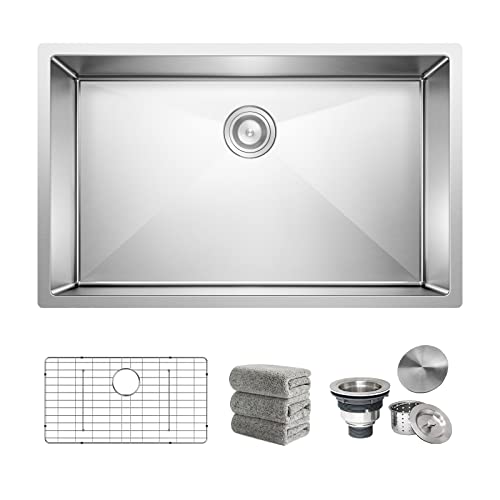
- cozhao 30 Inch Undermount Kitchen Sink, 18 Gauge 304 Stainless Steel with Drain Assembly
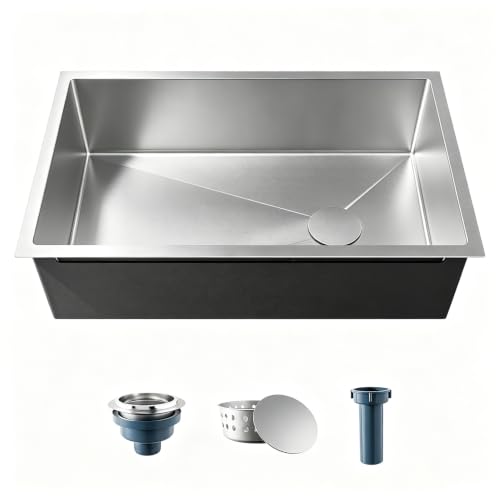
- MAYESAR 28 Inch Undermount Kitchen Sink, 16 Gauge, 9 Inch Deep
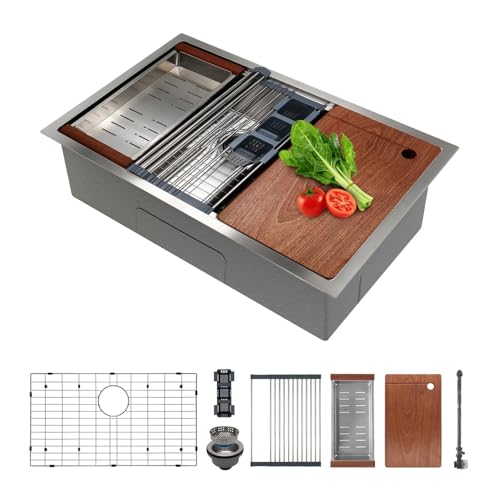
- KRAUS KWU110-32 Stainless Steel 32 in Undermount Workstation Sink
- KRAUS KHU100-32 Stainless Steel 32 in 16 Gauge Undermount Kitchen Sink
Stainless steel resists rust because of what is dissolved inside it: chromium, which reacts with oxygen to form an invisible oxide skin that repairs itself when scratched. That single fact explains most of the material’s behaviour in a kitchen — why it tolerates standing water that would destroy lesser metals, why surface marks wipe away instead of spreading, and why the grade of steel matters: the alloy recipe decides how robust that self-repairing skin is, especially against the chlorides in food, salt and cleaning products that a kitchen sink meets daily. When a listing names its grade — 304 in the cozhao’s case — or its trade specification — TRU16 across the Kraus bowls — it is making a claim about that recipe, and claims that can be checked are the foundation of this guide.
Thickness is the second variable, and it is not a detail. Gauge decides how the steel carries load, sheds dents, and sounds under water; the ladder in this guide runs from 18 gauge at the value end through the 16-gauge premium standard to an 11-gauge bowl that belongs, by thickness, to commercial kitchens. Finish is the third: the brushed grain on these picks is not a style choice but a maintenance technology, hiding fine wear inside its texture. Alloy, gauge, finish — judge every stainless sink on those three axes, and the six reviews below show how each pick distributes its strengths across them.
One promise about the pages ahead: this guide will not pretend the axes always agree. Two of its six picks leave their grade unnamed in the verified data while posting superb thickness credentials; one names its grade beautifully at the ladder’s lighter end. Those tensions are not embarrassments to be smoothed over — they are the actual shape of the market, and learning to weigh a named alloy against a heavier gauge is the single most useful skill a stainless buyer can take from this page. The reviews weigh them in the open, pick by pick, so you can adopt our weights or argue with them using the same evidence.
Key Takeaways
- Grade is the alloy recipe: the cozhao names 304 outright; Kraus’s TRU16 is a named trade specification — both are checkable claims, unlike “premium steel.”
- Gauge is the thickness axis: 11 gauge (SANYCASA) is the heavy extreme, 16 gauge the premium standard, 18 gauge the lighter tier — and the distance between those rungs is something your hands and ears can verify in seconds, which makes gauge the most honestly testable claim in the entire category.
- Brushed finishes are functional — fine scratches blend into the grain instead of announcing themselves, which is why every pick in this guide wears one and why the finish question, alone among material questions, can be settled in a single sentence, for good, today and tomorrow too.
- Sound treatment completes the material: NoiseDefend pads on the Kraus bowls answer steel’s native resonance.
- Construction interacts with material: handmade fabrication (cozhao, MAYESAR) and pressed forming use the same alloy to different geometric ends.
- The self-repairing oxide skin is why stainless dominates — and why surface marks on it are deposits, not damage: wipe the deposit, and the skin beneath is exactly where the alloy left it, which is more than can be said for any coated or enamelled rival.
In this guide
Quick Picks
| Pick | Badge | Material case | Link |
|---|---|---|---|
| SANYCASA 30 Inch Workstation | Best Thickness | 11-gauge (3mm) steel — the alloy at maximum substance | Check on Amazon |
| KRAUS KHU100-30 30 in | Best Balanced Alloy | 16-gauge TRU16 steel, refined corners, grooves, quiet | Check on Amazon |
| cozhao 30 Inch 304 | Best Named Grade | 304 stainless stated in the listing, handmade, drain included | Check on Amazon |
| MAYESAR 28 Inch | Best Compact Material | 16-gauge steel, brushed finish, deep handmade bowl | Check on Amazon |
| KRAUS KWU110-32 Workstation | Best System Steel | TRU16 steel with a fabricated ledge and full accessory set | Check on Amazon |
| KRAUS KHU100-32 32 in | Best Large Alloy | The TRU16 specification at a 32-inch scale | Check on Amazon |
How These Picks Were Chosen
Selection followed the three axes. On alloy: we favoured listings that name a grade or a trade specification, because a named recipe is a verifiable claim about corrosion behaviour. On gauge: we required the number to be stated, and we spanned the honest ladder rather than pretending one thickness suits all kitchens. On finish and treatment: brushed surfaces and declared sound dampening scored, because they decide how the material ages in public. All specifications come from verified product data; where data is silent — a grade unlisted, a pad unmentioned — the reviews record the silence instead of filling it. No hands-on testing is claimed.
For the wider materials landscape beyond steel, our companion survey at Best Materialfor Kitchen Sinks covers the alternatives; for the pure metals question, see Best Metal For Kitchen Sinks. This guide stays inside the alloy, where the differences are smaller, subtler and — for the buyer who reads them — completely decisive.
Best Material for Stainless Steel Kitchen Sinks: The 6 Picks, Reviewed
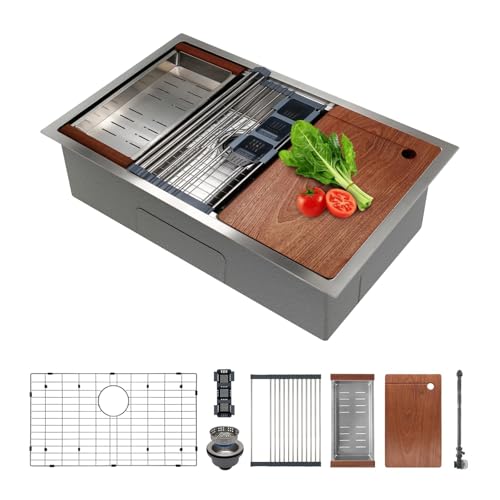
SANYCASA 30 Inch Undermount Workstation Sink, 11 Gauge
Badge: Best Thickness
Strengths
- 11-gauge (3mm) stainless steel: thickness that turns the alloy’s virtues — strength, quiet, dent resistance — up to their maximum.
- Integrated ledge exploits steel’s formability in a way no cast material can match.
- Mass damps sound without relying on pads alone.
Trade-offs
- The listing does not name a specific grade in the verified data, so its alloy claim rests on the stainless designation and its gauge.
- Heaviest handling and support demands in the guide.
- The ledge must match your cooking to justify itself.
Mini spec box: Size: 30 inch · Mount: undermount · Material: stainless steel · Gauge: 11 (3mm) · Bowl: single with integrated ledge · Style: multifunctional workstation set.
Thickness is a material property, and the SANYCASA is this guide’s exhibit for how far it can be pushed. At three millimetres, the steel stops behaving like a skin and starts behaving like a structure: it carries the workstation ledge’s concentrated loads without flex, answers dropped cookware with a thud instead of a dent, and gives the bowl an acoustic calm that thinner steel achieves only with heavy padding. If your material question is “what is stainless steel like when nobody economises on it?”, this is the answer, purchasable and installable in a standard 30-inch run.
Its one paperwork gap is noted in the trade-offs: the verified data does not name a grade. Buyers for whom the alloy recipe is the first question should weigh the named alternatives below; buyers for whom substance is the first question have found their sink.
Best for: substance-first buyers and workstation cooks / Not suited for: light installs or grade-first shoppers

KRAUS KHU100-30 Stainless Steel 30 in Undermount Kitchen Sink
Badge: Best Balanced Alloy
Strengths
- TRU16: a named trade specification at 16 gauge — the alloy and the thickness both declared.
- Rounded corners and channel grooves finish the material for its daily work.
- NoiseDefend pads complete the specification acoustically.
Trade-offs
- A classic bowl: no ledge, no listed accessories.
- Brushed steel’s care rules apply — dry-wipe in hard-water homes.
- Standard size only; wide kitchens should step to its 32-inch sibling.
Mini spec box: Size: 30 inch · Mount: undermount · Material: stainless steel, TRU16 · Gauge: 16 · Bowl: single · Features: rounded corners, channel grooves, NoiseDefend pads.
The KHU100-30 is what a mature material specification looks like. TRU16 names the steel and its gauge in a single term; the finishing — corners radiused for the cloth, a floor grooved for the water — treats the alloy as a working surface rather than a photograph; and the sound pads acknowledge the one property raw steel cannot manage alone. Nothing is left to implication, which is why this bowl is the guide’s balanced recommendation: on all three axes — alloy, thickness, finish-and-treatment — it sits at the category’s considered centre.
For most kitchens, the centre is the correct address. Extremes of thickness or size serve specific briefs; this specification serves the general one — a family kitchen, washed in daily, expected to look and sound composed in year ten — better than any other pick here.
Best for: the majority of buyers; a declared alloy at the standard size / Not suited for: workstation or wide-bowl briefs

cozhao 30 Inch Undermount Kitchen Sink, 304 Stainless Steel
Badge: Best Named Grade
Strengths
- 304 stainless steel named in the title — the grade designation associated with food-grade corrosion resistance.
- Handmade modern construction shows the alloy’s fabricated side.
- Drain assembly included, in matching material spirit.
Trade-offs
- 18 gauge: the grade is exemplary, the thickness is the lighter tier.
- Sound treatment is not specified in the verified data.
- A newer brand name; the specification, not the badge, carries the argument.
Mini spec box: Size: 30 inch · Mount: undermount · Material: 304 stainless steel · Gauge: 18 · Bowl: single · Included: drain assembly · Style: handmade, modern.
In a guide about material, the cozhao holds a special place: it is the pick that answers the alloy question in so many words. “304” designates the chromium-nickel recipe that the food industry standardised on — the grade whose oxide skin handles kitchen chlorides, acids and daily water with the least drama — and a listing that prints the number is a listing that expects to be checked. Around that declaration sits a handmade modern bowl, fabricated rather than pressed, with the drain assembly included so the material story is not interrupted by a mismatched fitting.
The balance of its specification is unusual and worth understanding: grade-first, thickness-second. A buyer whose water is aggressive, whose cooking is salty and acidic, and whose loads are ordinary may rationally prefer this allocation to a thicker bowl of unnamed alloy. The scratch behaviour of named grades is explored further in Best Non Scratch Kitchen Sinks.
Best for: grade-first buyers and design-led value shoppers / Not suited for: heavy-load households needing maximum thickness

MAYESAR 28 Inch Undermount Kitchen Sink, 16 Gauge
Badge: Best Compact Material
Strengths
- 16-gauge steel in a compact handmade bowl — no thickness discount for small kitchens.
- Brushed finish puts the alloy’s most forgiving face forward.
- Round corners and a deep 9-inch bowl complete a serious material specification.
Trade-offs
- The grade is not named in the verified data — the claim is gauge and construction.
- 28-inch width limits the largest cookware.
- Depth may require trap adjustment on install.
Mini spec box: Size: 28 x 18 inch · Mount: undermount · Material: stainless steel · Gauge: 16 · Depth: 9 inch · Bowl: single · Finish: brushed, round corners.
The MAYESAR demonstrates that the material conversation does not shrink with the kitchen. Its specification spends exactly where a materials guide would advise: full 16-gauge thickness, a brushed finish to manage the alloy’s cosmetic life, rounded corners for cleaning, and handmade construction for crisp form — all inside a 28-inch width that most compact ranges fill with unnamed, unmeasured steel. The 9-inch depth is a material decision too: more steel wall containing more splash, giving the small bowl a working volume that feels like a larger sink’s.
Its paperwork gap mirrors the SANYCASA’s — no named grade in the verified data — and the same advice applies: if the recipe is your first question, the cozhao and the TRU16 bowls answer it in writing. If substance at compact scale is the question, this is the strongest answer in the guide.
Best for: compact kitchens wanting full-gauge material / Not suited for: grade-first shoppers or wide-pan cooks

KRAUS KWU110-32 Stainless Steel 32 in Undermount Workstation Sink
Badge: Best System Steel
Strengths
- TRU16 steel fabricated into an integrated ledge — the alloy doing structural work.
- Cutting board and roll-up rack included, extending the material system.
- NoiseDefend soundproofing across a wide, hard-working bowl.
Trade-offs
- 32-inch cabinet requirement.
- A system to use and store, not a bare bowl.
- The ledge’s fabricated edges deserve the same grain-direction care as the bowl.
Mini spec box: Size: 32 inch · Mount: undermount · Material: stainless steel, TRU16 · Gauge: 16 · Bowl: single with integrated ledge · Included: cutting board, roll-up rack · Features: NoiseDefend soundproofing.
A workstation ledge is a material examination that most sinks never sit: the steel must be folded to a true, level working rail, hold it under load, and keep holding it for years. The KWU110-32 sits the exam in TRU16 — the named specification again — and passes with the accessories included, so the system the alloy makes possible is complete from the first day. Add NoiseDefend across the wide panels and the result is the most functionally extended expression of stainless steel in this guide: not just a basin of the material, but a workstation built from it.
Buyers comparing generations of steel design will find this model at the centre of Best Modern Kitchen Sinks as well; in this guide its role is to show that a declared alloy, honestly gauged, is also the foundation the category’s most ambitious formats stand on.
Best for: prep-heavy cooks who want the alloy as a system / Not suited for: narrow cabinets or bare-bowl minimalists

KRAUS KHU100-32 Stainless Steel 32 in Undermount Kitchen Sink
Badge: Best Large Alloy
Strengths
- TRU16 specification — alloy and 16-gauge thickness declared — at a 32-inch scale.
- Rounded corners and channel grooves keep a large steel surface clean and draining.
- NoiseDefend treatment scales with the bowl.
Trade-offs
- No ledge; spaciousness is its feature.
- Needs the cabinet width and a faucet with matching reach.
- No accessories are listed in the verified data.
Mini spec box: Size: 32 inch · Mount: undermount · Material: stainless steel, TRU16 · Gauge: 16 · Bowl: single · Features: rounded corners, channel grooves, NoiseDefend pads.
Scale tests a material specification the way it tests everything else: a wide bowl has more surface to keep true, more floor to keep draining, more panel to keep quiet. The KHU100-32 answers with the same declared TRU16 recipe as its 30-inch sibling, executed at 32 inches — evidence that the specification is a discipline rather than a size. The corners, grooves and pads all scale with the bowl, and the ownership result is the balanced Kraus formula with room to spare: everything fits flat, everything wipes in the round, everything sounds damped.
Choose it when the kitchen and the cookware have outgrown the standard footprint but the material brief has not changed: a named alloy, a premium gauge, a finish that forgives — simply more of each, in the proportions a large kitchen actually uses.
Best for: large kitchens wanting the declared alloy at scale / Not suited for: standard cabinets or workstation seekers
Comparison Table
| Pick | Alloy claim | Size | Gauge | Finish / treatment | Link |
|---|---|---|---|---|---|
| SANYCASA Workstation | Stainless (grade unnamed in data) | 30 in | 11 (3mm) | Brushed, integrated ledge | Check on Amazon |
| KRAUS KHU100-30 | TRU16 | 30 in | 16 | Rounded corners, grooves, NoiseDefend | Check on Amazon |
| cozhao 30 Inch | 304 named | 30 in | 18 | Handmade, drain included | Check on Amazon |
| MAYESAR 28 Inch | Stainless (grade unnamed in data) | 28 x 18 in | 16, 9 in deep | Brushed, round corners | Check on Amazon |
| KRAUS KWU110-32 | TRU16 | 32 in | 16 | Ledge, board + rack, NoiseDefend | Check on Amazon |
| KRAUS KHU100-32 | TRU16 | 32 in | 16 | Rounded corners, grooves, NoiseDefend | Check on Amazon |
How to Choose the Right Stainless Steel for a Kitchen Sink
Work the three axes in order. Alloy first, because it is the hardest to verify later and the most consequential for corrosion: prefer a named grade (304 is the reference designation in this market) or a maker’s named trade specification (TRU16 here) over any formulation of the words “premium” or “high-quality” standing alone. A name is a promise that can be held; an adjective is weather. Gauge second, matched to your loads: 16 for the standard family brief, thicker for workstation and heavy-cookware duty, 18 only with eyes open and a grid planned. Finish third, and here the category has effectively decided for you — brushed, in the grain’s forgiving texture, is the finish that ages in public with the least evidence; treat any mirror or novelty finish as a maintenance commitment you are choosing on purpose.
Then apply the two cross-checks. The consistency check: title, specification and box contents should tell one story — where this guide found a gap (an unnamed grade on an otherwise superb bowl), it said so, and you should demand the same candour from any listing. The system check: a sink is steel plus everything that touches the steel, so a matched drain, a fitted grid and included accessories are material decisions too, because mismatched metals and ill-fitting parts are where corrosion and wear actually begin in real kitchens.
How to Care for Stainless Steel So the Alloy Can Do Its Job
- Rinse and dry. The oxide skin handles water; your cloth handles the minerals water leaves behind. In hard-water homes the dry-wipe is the whole secret.
- Clean with the grain. Soft cloth, ordinary detergent, strokes that follow the brushing. Cross-grain scrubbing is the only common way owners damage the finish themselves.
- Evict wet iron. Do not leave cast iron, steel wool or tin cans standing wet in the bowl; their rust marks are deposits on the surface, easily prevented and mildly annoying to remove.
- Protect the floor. A grid turns the bowl’s most punished surface into a replaceable one.
- Keep chemicals proportionate. The alloy tolerates kitchen life; it does not need, and seals and finishes do not enjoy, industrial-strength soaking.
Troubleshooting. Problem: rust-coloured spots appear → what to do: they are almost certainly deposits from a wet ferrous object, not the sink rusting; lift them with a baking-soda paste on a soft cloth, rinse, and change the habit that left the object standing. Problem: the surface looks dull in patches → what to do: check for cross-grain cleaning marks and mineral film; a vinegar-dampened wipe for the film and grain-direction cleaning thereafter restores the even brushed look. Problem: water spots return daily → what to do: the bowl is being left wet in hard water; the twenty-second dry after the last wash-up ends the cycle more reliably than any product.
Grades, Explained Without the Metallurgy Degree
A grade designation is a recipe card. The numbers in a grade like 304 describe an alloy family — in that case the chromium-and-nickel balance that became the food industry’s default because its protective oxide skin forms reliably and repairs itself in the presence of kitchen acids, salts and detergents. Other recipes exist for other environments — marine air, chemical plants, surgical theatres — and the sink market’s conversation centres on the food-grade family for the obvious reason that a sink is a food environment: raw ingredients, salt water, vinegar, citrus, tomato, and the occasional overnight soak in all of them at once.
Trade specifications like TRU16 approach the same assurance from the maker’s side: a named, standardised material the brand stakes its specification on, paired in Kraus’s usage with the gauge itself. For the buyer, the practical rule is simpler than the chemistry: a sink whose alloy is named — by grade number or by trade specification — comes from a maker willing to be measured, and willingness to be measured correlates with everything else in this guide. The unnamed bowls here are not condemned; two of them carry superb gauge credentials. But when alloy is your first question, the named picks answer it in writing, and in a material purchase, writing is what you are paying for. The newest formulations entering the category are tracked in Best New Kitchen Sinks.
Gauge: The Thickness Ladder and Where You Stand on It
Gauge’s backwards arithmetic — lower number, thicker steel — hides how large the real differences are. The step from 18 to 16 gauge is a meaningful increase in substance: panels stiffen, voices deepen, dents become rarer. The step from 16 to the SANYCASA’s 11 is a change of category, into steel plate territory where the bowl’s behaviour is governed by mass more than by treatment. Neither step is free: thickness is weight on install day, substance in the cabinet, and commitment in the budget tier — which is why this guide refuses to declare one rung correct. Stand on the ladder where your loads stand: ordinary family cooking is honestly served at 16; the heaviest cookware and workstation duty argue upward; lighter households and value tiers live at 18 with a grid and no apology. What is not honest is a listing that will not tell you your rung at all — in a material guide, the missing number is the loudest statement on the page.
Handmade vs Pressed, Read as Material Choices
Construction method is usually filed under style, but in a material guide it belongs under metallurgy, because the two methods treat the alloy differently. Pressing draws a sheet into shape, and drawing stretches: the steel at the corners of a pressed bowl has been thinned by the very act that formed it, which is why heavy starting gauges and engineered corner radii — the Kraus pattern in this guide — are the pressed tradition’s answer, beginning with enough material that the corners can afford their journey. Fabrication, the handmade road taken by the cozhao and MAYESAR, does not stretch the sheet at all: panels are cut at full thickness, folded, and welded, so the material arrives at every point of the bowl at the gauge it started with — at the price of welds that must be made and finished well, and corners whose tightness is a fabricator’s signature.
Neither treatment is a material upgrade over the other; they are different distributions of the same alloy’s strengths. Pressed bowls concentrate their refinement in drainage geometry and production consistency. Fabricated bowls concentrate theirs in uniform thickness and architectural line. The buyer who understands this stops asking which method is “better” and asks the sharper question: given this alloy, at this gauge, which treatment produced the bowl in front of me — and does its specification show the treatment’s homework? In this guide, both traditions show it, which is why both are represented at the top.
Matching the Alloy to Your Water and Your Cooking
Two kitchens can own the identical sink and report different materials, because water and cooking complete the specification. Hard water is the great cosmetic tester: its minerals plate out on any steel left wet, and while the alloy underneath is unharmed, the visible result argues for the dry-wipe habit and for drainage geometry that never leaves the water standing in the first place. Coastal and softened water bring chlorides into the story, and chlorides are the oxide layer’s most persistent opponent — the environment where a named food-grade alloy earns its designation most quietly, year after year, by simply never giving the chemistry a foothold. Aggressive cooking — brines, citrus, vinegar reductions, tomato left to soak — makes the same argument from the other direction: the sink is a food vessel, and food vessels are why the food-grade recipe exists.
None of this requires a laboratory report on your own tap. It requires honesty about which of those descriptions sounds like your kitchen, and then a preference — at the margin, when other things are equal — for the picks whose paperwork answers your environment in writing. The named-grade cozhao and the TRU16 Kraus bowls exist in this guide precisely for the kitchens that test an alloy; the heavy-gauge picks answer kitchens that test a structure. Most kitchens test both, mildly, which is why the balanced centre of this list is where it is.
Reading a Stainless Listing Like a Metallurgist
Everything in this guide reduces to a reading skill, and it transfers to any stainless product you will ever buy. Read a listing in four passes. First pass, the alloy: find the grade number or the trade specification. If neither exists, note the absence in pencil — it may be forgiven by other virtues, but it is never invisible again. Second pass, the gauge: find the number, translate it (lower, thicker), and ask whether the thickness matches the bowl’s size and your loads; a wide bowl at a light gauge is a question, a compact bowl at a heavy gauge is a statement. Third pass, the treatment: finish named (brushed is the working answer), sound treatment declared or not, corners and drainage described in physical terms rather than lifestyle ones. Fourth pass, the system: what touches the steel — drain, grid, accessories — and whether those parts were specified by the same maker to the same standard.
Four passes take perhaps ninety seconds, and they sort the entire category more reliably than an afternoon of photographs. They are also, not coincidentally, the passes this guide’s six picks survived: every one of them declares at least three of the four in writing, and the two that leave the alloy unnamed compensate with gauge credentials stated just as plainly — a trade the reviews flagged openly rather than smoothing over. That flagging is the final lesson. A guide, like a listing, earns trust by showing its gaps. When you shop beyond this page, prefer the sellers who show theirs.
The Patina Question: What Stainless Looks Like at Year Ten
New stainless is a promise; ten-year stainless is a record, and it is worth knowing what the record says on a well-chosen bowl. The brushed grain deepens into an even, satin patina — fine lines from a decade of pans, all running with the grain because the owners cleaned with it, softening the surface’s reflections until the sink looks less like an appliance and more like a material the kitchen was built from. Thick gauges keep their panels true, so the patina spreads evenly rather than pooling around dents. Corners that were rounded stay innocent; floors that were grooved stay unstained at the edges where water once lingered. Nothing about the picture is showroom-new, and everything about it is handsome — the specific handsomeness of a tool that has been used exactly as intended.
Contrast the record of a poorly specified bowl at the same age: a floor mapped by scratches running in every direction, because nobody could clean with a grain that was never properly brushed; dents that hold water and therefore hold marks; corners with permanent shadows. The steel in the two pictures may share an alloy family. What they do not share is specification — the named, numbered decisions made on one day, years earlier, by a buyer who read the listing the way this guide taught. That is the whole argument for caring about material at the level of grades and gauges: the decade is coming either way, and the specification is how you vote on what it will look like.
Why the Market Defaults to Stainless — and the Signal in the Default
It is worth asking why one alloy family came to dominate a category that once belonged to porcelain and stone, because the answer is the buyer’s best shortcut. Stainless won on the combination no rival matched at once: it is strong without being heavy, hygienic without being fragile, formable into any format from farmhouse-adjacent bowls to workstation systems, repairable in appearance through its grain, and recyclable at the end of a life it makes very long. Each rival beats it somewhere — fireclay on stains, cast iron on silence, copper on character — and loses to it on the full card. A default that forms for those reasons is information: it means the burden of proof sits on the alternatives, and on any stainless listing that cannot state its own grade and gauge while its competitors state theirs.
The signal cuts the other way too. Precisely because stainless is the default, it is where lazy specification hides: unnamed alloys and unstated gauges shelter inside the material’s good reputation, borrowing trust the specific product never earned. The six picks in this guide were chosen as the antidote — stainless sinks whose paperwork is as strong as the material’s name. Buy the default, by all means; it became the default honestly. But buy it at the standard of these six, with the recipe and the thickness in writing, and the market’s wisdom and your own will finally be describing the same sink.
Common Buying Mistakes
- Accepting “stainless steel” as a complete specification — ask for the grade or trade name and the gauge, every time.
- Chasing thickness while ignoring alloy, or the reverse; the axes are independent and both are printed in this guide’s table for a reason.
- Choosing a mirror finish for a working kitchen and then blaming the material for showing its life.
- Scrubbing across the grain and manufacturing the only defects the alloy could not prevent.
- Leaving wet cast iron in the bowl and mistaking the deposits for rust in the steel.
- Forgetting the system metals — a mismatched drain assembly can undermine a well-specified bowl at its most vulnerable point.
Final Recommendation
For the most completely declared material specification in a standard size, choose the KRAUS KHU100-30: TRU16 alloy, 16 gauge, finished and hushed. If alloy-in-writing is your first principle and value your second, the cozhao’s named 304 is the honest pick. Step to the SANYCASA when thickness outranks paperwork, to the KWU110-32 when the alloy must also be a workstation, to the KHU100-32 when it must be one at scale, and to the MAYESAR when the kitchen is compact but the standards are not. On every route, you are buying a named, numbered material — which is the only kind of stainless steel worth the name.
Close the guide with the discipline that produced it, because it will serve you long after this purchase: in materials, trust is a paperwork property before it is a product property. The makers who name their alloys and number their gauges are telling you how their factories think, and factories that think in specifications build sinks that behave in kitchens. Choose among the six above by your loads, your water and your format — the material homework is already done, in writing, on every line of the comparison table. Install the winner once, keep the small routine, and let the oxide skin do the quiet chemistry it has been doing, unthanked, in the world’s kitchens for a century.
Frequently Asked Questions
What is the best grade of stainless steel for a kitchen sink?
The grade most associated with kitchen and food use is 304, the chromium-nickel alloy whose self-repairing oxide layer handles food acids, salt and detergents reliably — which is why the cozhao’s decision to name it in its listing matters. Named trade specifications such as Kraus’s TRU16 serve the same buyer need from the maker’s side: a declared, checkable material standard rather than an adjective. A word of proportion: grade is the first axis, not the only one. A named grade at a very light gauge can still disappoint a heavy household, and a superb gauge with an unnamed alloy — two picks in this guide — can still be the right buy for a substance-first brief. Read grade and gauge together, the way the comparison table prints them, and the material will never surprise you.
What does gauge mean, and which gauge is best?
Gauge is thickness measured backwards: lower is thicker. Sixteen gauge is the premium standard for most homes; 18 gauge is lighter and suits gentler use with a grid; the 11-gauge SANYCASA in this guide is the heavy-duty extreme. “Best” follows your loads — but an unstated gauge is never the right answer.
Why does stainless steel not rust?
Its chromium content forms a thin oxide layer on the surface that seals the metal beneath and repairs itself when scratched, as long as oxygen can reach it. That is why surface marks on a stainless sink are almost always deposits sitting on the layer — from water minerals or wet iron objects — rather than corrosion of the sink itself. The layer’s one request of the owner is that it not be smothered: prolonged contact with wet, oxygen-starved debris — a sodden steel-wool pad left in a corner for a week — is the rare circumstance that can mark even good stainless locally. The prevention is the routine itself: rinse, lift the grid, do not let the bowl store wet metal. Housekeeping, in other words, is part of the alloy’s chemistry set.
Is a brushed finish better than a polished one for a sink?
For a working kitchen, yes. Brushing gives the surface a fine grain that absorbs the visual evidence of daily life — micro-scratches blend in instead of standing out — and it is the finish on every pick in this guide for that reason. Polished finishes show every droplet and mark, which suits a showroom better than a sink.
Does the steel grade affect noise?
Indirectly. Noise is governed mainly by thickness and sound treatment — heavy gauges and fitted pads, like the NoiseDefend treatment on the Kraus bowls, are what quiet a sink. Grade governs corrosion behaviour. A complete material specification addresses both, which is why this guide scores alloy and acoustics as separate axes.
Can stainless steel be scratched, and does it matter?
Yes, and mostly no. Fine scratching is inevitable in a working bowl; on a brushed finish it blends into the grain and reads as patina rather than damage. What matters is preventing the deep, directional damage caused by abrasive pads and cross-grain scrubbing — owner-inflicted wounds the alloy cannot forgive. A bottom grid prevents most floor scratching outright. Owners sometimes ask whether the first visible scratch means they chose badly; it means the opposite — the sink has begun its working life, and on a properly brushed, properly gauged bowl, the thousandth scratch will look remarkably like the first: absorbed, aligned, and unremarkable.
How long does a stainless steel sink last?
In the gauges and specifications in this guide, realistically decades — frequently longer than the countertop and faucet around it. The alloy does not wear out in kitchen service; sinks are replaced because they were thin, dented, stained by neglect of the routine, or simply out of fashion, not because the steel expired. There is a useful consequence for budgeting: because the material does not expire, money spent moving up the specification ladder — a named grade, a heavier gauge, a fitted grid — is never spent on a temporary improvement. It compounds quietly for the whole life of the kitchen, which is more than can be said for almost any other line in a renovation budget.