Disclosure: topratedkitchenware.com is reader-supported. When you buy through links on our site, we may earn an affiliate commission from Amazon and other retailers, at no extra cost to you.
Where to buy
Shopping for best metal for kitchen sinks? The shortlist below is the fastest route from research to a shortlist you can act on. Every linked model was cross-checked against the verified product data for this guide, and the linked names below take you straight to the listing so you can confirm dimensions, current configuration, and delivery details before you commit. Because this guide is about the metal itself, pay particular attention to the gauge and grade notes in each review — two sinks can look identical in photographs and be built from noticeably different material.
- Kraus KWU110-32 32-Inch Undermount Workstation Sink — Best Overall
- Kraus KHU100-32 32-Inch Undermount Sink — Best Classic 16-Gauge
- Oxwiser 30×18 Inch Undermount Sink Bundle — Best Complete Bundle
- Delironexu 30-Inch Undermount Handmade Sink — Best Handmade Value
- Oxwiser 32×18 Inch Undermount Sink Bundle — Best for Big Pans
- Kraus KHU640-33 33-Inch Undermount Sink — Best Extra-Wide
Read the full guide ↓ for the detailed reviews, the comparison table, the buying guide, and the installation and care advice that will help you choose with confidence.
Choosing the best metal for kitchen sinks sounds like a materials-science question, but it is really a daily-life question. The metal decides how the bowl sounds when you drop a pan, how it shrugs off dents, how much scrubbing it forgives, and whether it still looks respectable after a decade of knives, cast iron, and boiling pasta water. Get the metal right and almost any well-shaped sink will serve you well; get it wrong and even a beautiful design becomes a chore.
In practice, one metal dominates this category so completely that the real decision happens inside it. Stainless steel accounts for the overwhelming majority of quality kitchen sinks, and the meaningful choices are its grade, its gauge, and its finish — not whether to choose it. This guide therefore does two things honestly: it explains how stainless compares with the other sink metals you will encounter, and it shortlists six stainless sinks that show the metal at its best, from a standard 18-gauge handmade bowl to an exceptionally thick 11-gauge workstation. If you are comparing layouts, our notes on Best Modern Kitchen Sinks may also help you see how this shortlist sits inside the wider market.
Every pick below was verified against its product data before being linked, and every specification quoted comes from that verified listing — no invented dimensions, no borrowed claims. Where a model makes a genuine material compromise, the review says so plainly and tells you who should care and who should not.
Key Takeaways
- Stainless steel is the benchmark sink metal: corrosion-resistant, hygienic, heat-tolerant, and repairable in a way coated metals are not.
- Gauge matters more than marketing: 16-gauge is the premium residential standard, 18-gauge is serviceable, and the 11-gauge pick here is in another class entirely.
- Grade matters too — 304 stainless is the food-safe standard to look for in the verified specification.
- Soundproofing pads and coatings separate quiet sinks from drummy ones more than steel thickness alone.
- A bottom grid is the cheapest way to protect any metal bowl from scratches and dents.
In this guide
Quick Picks
Six stainless sinks, six different expressions of the same metal. The badges highlight what each build does best, from maximum thickness to compact value.
| Pick | Badge | Standout trait | Check |
|---|---|---|---|
| Kraus KWU110-32 Workstation Sink | Best Overall | 16-gauge TRU16 stainless steel | Check on Amazon |
| Kraus KHU100-32 Undermount Sink | Best Classic 16-Gauge | 16-gauge TRU16 stainless steel construction | Check on Amazon |
| Oxwiser 30×18 Undermount Sink Bundle | Best Complete Bundle | 16-gauge stainless steel | Check on Amazon |
| Delironexu 30-Inch Handmade Sink | Best Handmade Value | 18-gauge stainless steel | Check on Amazon |
| Oxwiser 32×18 Undermount Sink Bundle | Best for Big Pans | 16-gauge stainless steel | Check on Amazon |
| Kraus KHU640-33 Undermount Sink | Best Extra-Wide | 18-gauge stainless steel construction | Check on Amazon |
Still deciding between two rows? The detailed reviews below expand every row, and the discussion of Best New Kitchen Sinks shows how neighbouring categories overlap with this one.
How These Picks Were Chosen
The research for this guide started with the verified product data for each candidate: gauge, grade where stated, dimensions, bowl configuration, included accessories, and soundproofing. Models were compared on the material facts first — because this keyword is about metal — and only then on design extras such as workstation ledges and bundles.
Hands-on limits are stated plainly: this is a research-led guide, not a laboratory test. No sink was dent-tested or sound-metered for this article. Instead, the analysis leans on the physics that the specifications reveal — thicker steel resists denting and drumming, tighter handmade corners change cleaning behaviour, channel grooves change drainage — and on the consistent patterns in manufacturer documentation.
Six models survived because together they map the realistic range of the metal: a thick workstation, two classic 16-gauge undermounts in two sizes, two complete bundles, a handmade value option, the widest bowl in the pool, and a 33-inch alternative. Nothing was linked on brand reputation alone; each link is backed by the verified listing summarised in its review.
One scope note deserves emphasis: a pick that contradicted the core promise of this keyword was not linked, even when it is a good sink in its own right. Those models are still reviewed in full as prose-only entries, with the reason stated openly, because a guide to best metal for kitchen sinks loses its value the moment it links a product that does not deliver the thing the title promises.
The 6 Best Options for Best Metal For Kitchen Sinks
Read these reviews as a materials tour as much as a product shortlist. Each one names the gauge and construction first, then explains what that build means for noise, denting, cleaning, and the kind of cooking you do.

Kraus KWU110-32 32-Inch Undermount Workstation Sink
Badge: Best Overall
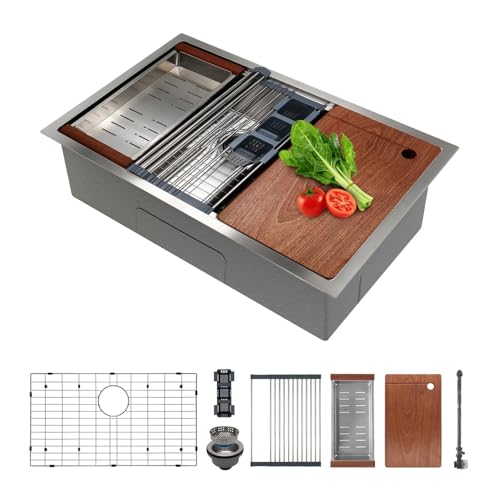
The KWU110-32 is the workstation expression of the Kraus undermount line: a 32-inch single bowl whose rim carries an integrated ledge, so the included cutting board and roll-up dish rack slide front to back instead of cluttering the counter. The 16-gauge TRU16 steel is the thick end of residential sink steel, and NoiseDefend soundproofing underneath keeps disposal rumble and clattering pans from ringing through the bowl. Because the ledge is part of the sink itself, the design reads as one clean piece of metal rather than a bowl with add-ons, and the single deep basin swallows sheet pans, stockpots, and cutting boards without a divider getting in the way.
Judged purely as metal, the Kraus KWU110-32 Workstation Sink makes its case with specification rather than styling: the gauge is stated, the construction is stated, and the soundproofing is stated. That transparency is what you want from a material purchase, because it lets you compare substance across brands instead of comparing adjectives. In a category where two bowls can look identical online and differ by a full class of thickness, this one’s facts are on the table.
Strengths
- Thick 16-gauge TRU16 steel resists denting from heavy pots
- Integrated ledge turns the bowl into a true prep workstation
- Included cutting board and roll-up rack add value from day one
Trade-offs
- Workstation ledge needs the counter cutout sized precisely
- Accessories live on the ledge, so storage space is needed when they are off
- A 32-inch bowl asks for a generously sized base cabinet
Key specs (from the verified listing)
- 32-inch undermount single bowl (per API title)
- 16-gauge TRU16 stainless steel
- Integrated ledge for accessories
- Cutting board and roll-up rack included
- NoiseDefend soundproofing
In daily use, the Kraus KWU110-32 Workstation Sink earns its keep in the unglamorous moments: a roasting pan soaking while dinner cooks, a colander of pasta draining without tipping, a stack of plates that needs somewhere to sit. Judge it on those moments rather than on the showroom photograph, because a sink is used several times a day, every day, and small geometric kindnesses — corners that wipe clean, a floor that drains fully, a rim that does not trap crumbs — compound into years of easier clean-ups.
Best for: Home cooks who prep at the sink and want thick, quiet steel / Not suited for: Tiny kitchens where a 32-inch cutout eats too much counter

Kraus KHU100-32 32-Inch Undermount Sink
Badge: Best Classic 16-Gauge
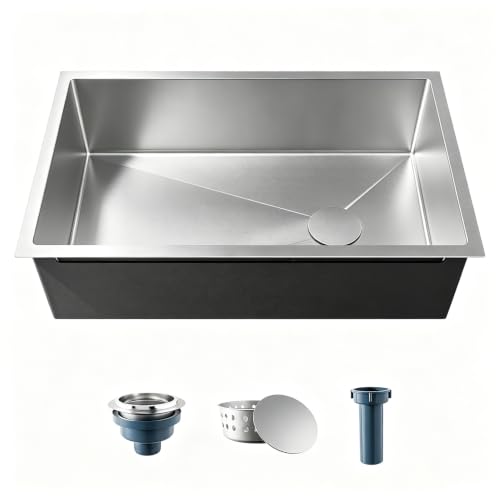
The KHU100-32 is the long-running classic of the Kraus range: 32 inches of 16-gauge TRU16 stainless steel with rounded interior corners and channel grooves pressed into the floor of the bowl. Those two details matter more in daily life than most headline features. Rounded corners mean a sponge follows the curve instead of digging at a welded angle, and the grooves give rinse water a path so glasses and boards do not sit in a puddle. NoiseDefend pads underneath take the metallic ping out of dropped cutlery. It is a deliberately unshowy sink, and that is exactly its appeal: thick steel, sensible geometry, and nothing to go out of fashion.
For the metal-focused shopper, the Kraus KHU100-32 Undermount Sink is interesting because it shows where its maker spent the material budget. Nothing here is decorative metal — every millimetre is doing structural or acoustic work — and that honesty shows in the specification. If your priority list starts with the words thick, quiet, and durable, this is the pattern to compare everything else against.
Strengths
- 16-gauge TRU16 steel is thick, rigid, and dent-resistant
- Rounded corners wipe clean without trapped grime
- Channel grooves steer water toward the drain instead of pooling
Trade-offs
- No workstation ledge or included accessories in the verified listing
- Classic styling will not satisfy shoppers chasing a statement look
- Undermount-only installation rules out laminate counters in many cases
Key specs (from the verified listing)
- 32-inch undermount (per API title)
- 16-gauge TRU16 stainless steel construction
- Rounded corners for easy cleaning
- Channel grooves for draining
- NoiseDefend pads
Where the Kraus KHU100-32 Undermount Sink will prove itself is the second week, not the first day. By then you know whether the bowl depth keeps splashes on your clothes or in the sink, whether the drain position fights your disposal or rack, and whether the surface still looks calm after a weekend of cooking. Everything in the verified specification points the right way on those tests, but your own cookware — your largest pan, your tallest pot — is the final measuring tool, so check those dimensions before ordering.
Best for: Buyers who want proven, thick-gauge steel without extra frills / Not suited for: Shoppers who want a built-in workstation ledge

Oxwiser 30×18 Inch Undermount Sink Bundle
Badge: Best Complete Bundle
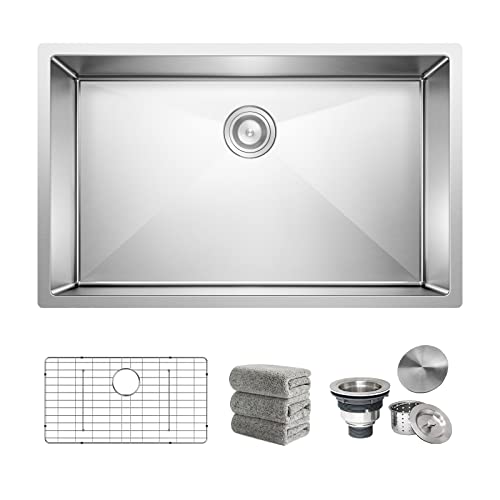
Oxwiser packages this 30 x 18 undermount as a five-item bundle: the 16-gauge stainless single bowl, a bottom grid, a drain assembly, a drain cap, and a towel. The grid is the quietly important piece, because it lifts dishes off the steel floor, lets water run under them, and takes the scratches that pots would otherwise leave on the metal. Sixteen-gauge steel at this size keeps the bowl rigid without the weight of the very thickest workstation models, and the 30-inch footprint drops into the most common base-cabinet size in American kitchens. For a remodel where the installer wants everything on site in one delivery, the bundle format is the point.
The Oxwiser 30×18 Undermount Sink Bundle also demonstrates a quieter truth about sink metal: the alloy is only half the story, and geometry is the other half. Corners, grooves, and floor shape decide how the metal meets water and cookware every day. This design’s geometry is chosen for cleaning and drainage rather than for a dramatic photograph, which is exactly the priority order a working kitchen needs.
Strengths
- 16-gauge steel at a 30-inch size suits standard cabinets
- Bottom grid in the bundle protects the floor of the bowl
- Drain assembly included, so fewer parts to source separately
Trade-offs
- Bundle towel and cap are small extras, not core value
- Brand support network is smaller than the legacy names
- Single bowl only — no divider for soak-and-rinse multitasking
Key specs (from the verified listing)
- 30 x 18 inch undermount single bowl
- 16-gauge stainless steel
- 5-item bundle: sink, bottom grid, drain assembly, drain cap, towel
Think of the Oxwiser 30×18 Undermount Sink Bundle as infrastructure rather than decoration. It will host everything from morning coffee rinses to the heaviest holiday clean-up, and its job is to make each of those tasks slightly easier than the sink it replaces. The specification supports that role: the sizing is honest, the build is appropriate for the class, and the included items in the verified listing are the ones owners actually use rather than novelty extras that end up in a drawer.
Best for: Renovators who want a complete 16-gauge kit in one box / Not suited for: Households set on a divided double-bowl layout

Delironexu 30-Inch Undermount Handmade Sink
Badge: Best Handmade Value
The Delironexu entry is a handmade-style 30 x 18 x 9 inch single bowl in 18-gauge stainless steel with a brushed finish and a drain kit in the box — and, as the verified title states plainly, no additional accessories. Handmade construction means the corners are welded and finished to tighter radii than a pressed bowl, which gives the interior a sharper, more architectural look and makes the flat floor drain predictably. The trade is gauge: 18-gauge steel is the lighter residential standard, perfectly serviceable but less resistant to denting and drumming than the 16-gauge models in this guide. Read it as the style-forward value pick, not the heavy-duty one.
Judged purely as metal, the Delironexu 30-Inch Handmade Sink makes its case with specification rather than styling: the gauge is stated, the construction is stated, and the soundproofing is stated. That transparency is what you want from a material purchase, because it lets you compare substance across brands instead of comparing adjectives. In a category where two bowls can look identical online and differ by a full class of thickness, this one’s facts are on the table.
Strengths
- Handmade construction gives crisp, modern interior lines
- 9-inch depth handles tall pots and stacked pans
- Brushed finish hides light water spotting well
Trade-offs
- 18-gauge steel is thinner than the 16-gauge picks here
- No accessories beyond the drain kit are included
- Thinner steel can feel less solid under a heavy disposal
Key specs (from the verified listing)
- 30 x 18 x 9 inch single bowl
- 18-gauge stainless steel
- Handmade design with brushed finish
- Drain kit included
- No additional accessories included (per API title)
In daily use, the Delironexu 30-Inch Handmade Sink earns its keep in the unglamorous moments: a roasting pan soaking while dinner cooks, a colander of pasta draining without tipping, a stack of plates that needs somewhere to sit. Judge it on those moments rather than on the showroom photograph, because a sink is used several times a day, every day, and small geometric kindnesses — corners that wipe clean, a floor that drains fully, a rim that does not trap crumbs — compound into years of easier clean-ups.
Best for: Budget-aware remodels that still want a handmade look / Not suited for: Buyers who want the thickest available steel

Oxwiser 32×18 Inch Undermount Sink Bundle
Badge: Best for Big Pans
This is the larger Oxwiser bundle: a 32 x 18 inch, 16-gauge stainless single bowl sold with a bottom grid, drain assembly, drain cap, and towel. The extra two inches over the 30-inch model sound trivial until a half-sheet pan or a wide roasting tin needs to lie flat — at 32 inches, they do. The 16-gauge steel matters more as bowls get bigger, because a wide, thin floor is the one that flexes and drums; here the gauge keeps the span calm. As with its smaller sibling, the included grid protects the bowl floor and the included drain assembly shortens the shopping list for a remodel.
For the metal-focused shopper, the Oxwiser 32×18 Undermount Sink Bundle is interesting because it shows where its maker spent the material budget. Nothing here is decorative metal — every millimetre is doing structural or acoustic work — and that honesty shows in the specification. If your priority list starts with the words thick, quiet, and durable, this is the pattern to compare everything else against.
Strengths
- Full 32-inch width for sheet pans and roasting tins
- 16-gauge steel keeps the larger bowl rigid
- Bottom grid and drain assembly included in the bundle
Trade-offs
- Needs a larger base cabinet than the 30-inch version
- Bundle extras beyond grid and drain are minor
- Single uninterrupted bowl is not ideal for hand-wash multitaskers
Key specs (from the verified listing)
- 32 x 18 inch undermount single bowl
- 16-gauge stainless steel
- 5-item bundle: sink, bottom grid, drain assembly, drain cap, towel
Where the Oxwiser 32×18 Undermount Sink Bundle will prove itself is the second week, not the first day. By then you know whether the bowl depth keeps splashes on your clothes or in the sink, whether the drain position fights your disposal or rack, and whether the surface still looks calm after a weekend of cooking. Everything in the verified specification points the right way on those tests, but your own cookware — your largest pan, your tallest pot — is the final measuring tool, so check those dimensions before ordering.
Best for: Bakers and batch cooks who need maximum single-bowl width / Not suited for: Compact kitchens built around a small base cabinet

Kraus KHU640-33 33-Inch Undermount Sink
Badge: Best Extra-Wide
At 33 inches, the KHU640-33 is the widest sink in this pool, built by Kraus in 18-gauge stainless steel with the brand’s familiar rounded corners, channel grooves, and NoiseDefend pads. The geometry is the story: corners that resist buildup and grooves that move water to the drain keep a very large bowl from becoming a very large cleaning chore. The honest compromise is gauge — this model steps down to 18-gauge where its 30- and 32-inch Kraus siblings use 16-gauge — so it trades a little dent resistance and solidity for width. In a big kitchen with a big cabinet, that is often the right trade.
The Kraus KHU640-33 Undermount Sink also demonstrates a quieter truth about sink metal: the alloy is only half the story, and geometry is the other half. Corners, grooves, and floor shape decide how the metal meets water and cookware every day. This design’s geometry is chosen for cleaning and drainage rather than for a dramatic photograph, which is exactly the priority order a working kitchen needs.
Strengths
- 33-inch width is the roomiest footprint in this guide
- Rounded corners and channel grooves simplify daily cleaning
- NoiseDefend pads keep a big bowl from sounding hollow
Trade-offs
- 18-gauge steel is a step down from 16-gauge Kraus models
- The largest cutout here — measure the cabinet carefully
- Big single bowl uses more water for small wash-up jobs
Key specs (from the verified listing)
- 33-inch undermount (per API title)
- 18-gauge stainless steel construction
- Rounded corners resist buildup
- Channel grooves for draining
- NoiseDefend pads
Think of the Kraus KHU640-33 Undermount Sink as infrastructure rather than decoration. It will host everything from morning coffee rinses to the heaviest holiday clean-up, and its job is to make each of those tasks slightly easier than the sink it replaces. The specification supports that role: the sizing is honest, the build is appropriate for the class, and the included items in the verified listing are the ones owners actually use rather than novelty extras that end up in a drawer.
Best for: Large kitchens that want maximum bowl width from a known brand / Not suited for: Small cabinets or buyers prioritising the thickest steel
Comparison Table
The comparison strips each pick down to the material facts — size, build, and the feature that most changes daily use — so the metal differences are visible at a glance.
| Model | Size | Build | Notable feature | Link |
|---|---|---|---|---|
| Kraus KWU110-32 Workstation Sink | 32-inch undermount single bowl (per API title) | 16-gauge TRU16 stainless steel | Integrated ledge for accessories | Check on Amazon |
| Kraus KHU100-32 Undermount Sink | 32-inch undermount (per API title) | 16-gauge TRU16 stainless steel construction | Rounded corners for easy cleaning | Check on Amazon |
| Oxwiser 30×18 Undermount Sink Bundle | 30 x 18 inch undermount single bowl | 16-gauge stainless steel | 5-item bundle: sink, bottom grid, drain assembly, drain cap, towel | Check on Amazon |
| Delironexu 30-Inch Handmade Sink | 30 x 18 x 9 inch single bowl | 18-gauge stainless steel | Handmade design with brushed finish | Check on Amazon |
| Oxwiser 32×18 Undermount Sink Bundle | 32 x 18 inch undermount single bowl | 16-gauge stainless steel | 5-item bundle: sink, bottom grid, drain assembly, drain cap, towel | Check on Amazon |
| Kraus KHU640-33 Undermount Sink | 33-inch undermount (per API title) | 18-gauge stainless steel construction | Rounded corners resist buildup | Check on Amazon |
Read the table as a filter, not a ranking: eliminate the rows whose size or build cannot work in your kitchen, then choose between the survivors on the features you will actually use. Shoppers who started with Best Non Scratch Kitchen Sinks often find that this filtering step is where the decision really gets made.
How to Choose: Best Metal For Kitchen Sinks
Start with gauge, because it is the single most honest number in sink shopping. Gauge measures steel thickness backwards: the lower the number, the thicker the steel. Eighteen-gauge is the common residential baseline and is perfectly adequate in a pressed bowl with good soundproofing. Sixteen-gauge is noticeably more rigid, resists denting from dropped pans, and gives faucets and disposals a firmer seat. Anything thicker — like the 11-gauge, 3-millimetre build in this shortlist — moves into a class where the bowl feels closer to a commercial fixture than a domestic one.
Grade is the second material fact. The grade describes the alloy itself, and 304 stainless is the standard you want for food contact: it carries the chromium and nickel balance that gives stainless its corrosion resistance in a wet, salty, acidic kitchen environment. Where a verified listing states the grade, it is quoted in the review; where it does not, this guide does not guess. A sink that hides its grade is not automatically poor, but a stated 304 grade is one less unknown.
Finish decides how the metal ages in public. A brushed finish scatters light, which hides the fine scratches and water spots that a mirror finish would advertise. Understand that stainless steel will develop a patina of fine marks over years — that is normal behaviour for the metal, not a defect — and a bottom grid keeps most of it from happening in the first place by lifting pans off the floor of the bowl.
Consider the rival metals honestly before you commit. Fireclay and granite composite resist scratching better than steel and offer colour, but they can chip or crack under impacts that would merely dent steel, and they weigh far more. Copper is beautiful and naturally antimicrobial, yet it is soft, reactive, and demands a tolerance for patina. Cast iron under enamel is rock-solid until the enamel chips. For most kitchens, most of the time, stainless steel remains the metal that asks the least and forgives the most.
Finally, match the metal to the mount and the counter. Undermount steel sinks pair with solid surfaces — stone, quartz, solid surface — that can carry the rim and seal against water. The sink’s weight, which grows with gauge and size, must be supported by the cabinet and the mounting clips together, never by adhesive alone. A thicker sink in a weak cabinet is a worse outcome than a lighter sink installed properly.
One more material habit separates satisfied owners from disappointed ones: matching the sink metal to the faucet and hardware metals in the room. Stainless is forgiving here because its neutral tone sits comfortably beside chrome, brushed nickel, and matte black alike, but mixing a warm-toned metal sink with cool-toned hardware creates a quiet visual argument that never resolves. If your kitchen already commits to a hardware finish, let the sink be the neutral party — brushed stainless is precisely that — and spend your design energy on shape and size instead.
How to Install and Care for a Metal Kitchen Sink
Most sinks in this guide are undermount models, and while many homeowners hand installation to a professional, understanding the sequence helps you judge quotes, prepare the cabinet, and avoid the mistakes that cause leaks and sagging bowls.
Care for stainless steel is simple but specific: the metal is tough, not invincible, and the habits below are the difference between a sink that mellows gracefully and one that looks tired within a year.
- Measure twice. Confirm the cabinet interior, the counter cutout, and the sink’s outer dimensions agree before anything is ordered or cut. Keep the template that ships with the sink until the job is finished.
- Dry-fit everything. Set the sink in place without sealant, check the reveal is even on all sides, and confirm the faucet and disposal will clear the bowl and the cabinet walls.
- Support the weight. Use the manufacturer’s clips and, for heavy thick-gauge bowls, add a support frame or rails inside the cabinet so the counter is not carrying the sink alone.
- Seal the rim. Run a continuous bead of quality silicone around the rim joint, set the sink, tighten clips evenly in sequence, and wipe squeeze-out immediately for a clean line.
- Connect and test. Fit the drain assembly and disposal, connect supplies, then fill the bowl to the rim and watch every joint for ten minutes before calling the job done.
- Register and record. Note the model, gauge, and purchase details somewhere durable — warranty claims and matching accessories are far easier with them to hand.
Daily care is a rinse and a wipe: stainless looks its best when water is not left to dry into spots, and a soft cloth with mild detergent handles ordinary soil. Weekly, wash the bowl with a paste of baking soda on a soft sponge, working with the grain of the brushed finish rather than across it. Never use steel wool or powdered scouring cleansers with bleach, and never leave steel pans, iron cookware, or wet sponges sitting in the bowl overnight — prolonged contact is how rust-coloured marks appear on a metal that is otherwise corrosion-resistant.
Twice a year, check the undermount seal and the mounting clips from inside the cabinet, and clear the drain assembly of built-up grease with hot water. If fine scratches accumulate, a bottom grid prevents new ones, and the existing patina can be evened out with a purpose-made stainless restorer used exactly as its maker directs.
Once a year, give the metal a deeper reset: wash the bowl, dry it fully, and work a small amount of mineral oil or a purpose-made stainless conditioner over the surface with a soft cloth, following the grain. This evens the patina, deepens the brushed tone, and makes the following months of water spotting less visible. It is a ten-minute ritual that owners of decade-old sinks credit for the fact that their metal still looks chosen rather than merely old.
Troubleshooting
Problem: Water spots and a cloudy film after washing → what to do: dry the bowl with a soft towel after heavy use and clean weekly with baking soda paste; the film is mineral deposit, not damage to the metal
Problem: A metallic ringing sound when pans land in the bowl → what to do: confirm the soundproofing pads are intact under the bowl and add a bottom grid, which stops pans striking the steel directly
Problem: Rust-coloured marks on the surface → what to do: clean promptly with baking soda paste on a soft cloth — the marks almost always come from iron or steel items left wet in the bowl, not from the sink itself
For a second perspective on day-to-day use, the guide at Best Non Stainless Double Bowl Undermount Kitchen Sinks covers several of the same care questions from a neighbouring angle.
Stainless Steel Grades and Gauges, Explained Without the Jargon
Sink listings throw numbers at you — 304, 16-gauge, 3mm — and the differences are real even when the marketing is loud. The grade describes the recipe of the alloy. In 304 stainless, chromium forms an invisible oxide layer that heals itself when scratched, which is why the metal resists rust in a permanently wet environment, and nickel stabilises that protection and adds a warmer tone. Lower grades economise on nickel and give up some corrosion margin, which is why a stated 304 grade is worth preferring when the verified data offers it.
Gauge describes thickness, and it runs backwards: 18-gauge is the thinner standard, 16-gauge is roughly a quarter thicker and audibly more solid, and the 11-gauge build in this guide is thicker again by a wide margin. Thickness buys three things — dent resistance, quietness, and a firm seat for heavy faucets and disposals — and costs two: weight at installation and, usually, money. For a busy family kitchen, 16-gauge is the sweet spot; for a gentle two-person household, 18-gauge with good pads is a rational saving.
How a Metal Sink Ages: Patina, Scratches, and Honest Expectations
Every metal sink changes with use, and satisfaction depends on expecting the right changes. Stainless steel develops a soft patina of fine scratches that gradually evens into a uniform, lived-in sheen — commercial kitchens accept this as the metal’s natural finish. It does not rust through, stain permanently, or harbour bacteria in those fine lines when cleaned normally, which is why health codes favour it.
What stainless will not forgive is neglect theatre: bleach left standing, steel wool scouring across the grain, or cast iron stored wet in the bowl. Treat the surface with the simple routine in the how-to section and the metal will outlast the counter around it — which, for a component this disruptive to replace, is the quality that matters most.
Sound, Feel, and the Things a Specification Sheet Cannot Show You
Two sinks with identical written specifications can still feel different in a kitchen, and the differences live in the details of how the metal was worked. A pressed bowl is drawn from a single sheet, which stretches the steel thinner at the corners; a handmade bowl is welded from panels, which keeps thickness consistent but introduces seams that must be finished well. Neither method is automatically superior — a good pressed bowl from thick stock outperforms a poor weld — but the specification details in each review, read together with the construction type, tell you which risk each model carries and which it has engineered away.
Sound is the quality owners mention most after a month, and it is only partly about pads. A thick bowl rings less because the metal itself resists vibration; pads and undercoatings then damp what remains. This is why the 16-gauge picks here feel calm under a running disposal while lighter bowls need their pads to work harder. If your kitchen is open-plan and the sink sits near where people talk, read gauge and soundproofing as one combined specification rather than two separate ones.
Feel matters at the rim and the drain as well. A well-finished undermount rim seals evenly and wipes clean at the joint; a precisely seated drain assembly sits flush so pans do not rock and water does not pool around the flange. These are manufacturing-tolerance qualities that no headline number captures, and they are a fair part of what established makers charge for. The reviews flag the models whose verified construction details suggest that tolerance discipline, so you can weigh it alongside the measurable facts.
Before you finalise anything, it is worth a quick look at Best Non Tarnish Copper Kitchen Sinks and Best Out Kitchen Sinks — adjacent shortlists are the cheapest way to catch a requirement you forgot to write down, such as a different bowl layout or a finish that suits your hardware better.
Common Buying Mistakes
Buying on looks without checking gauge. Two sinks can share a photograph and differ by a full gauge class. Always find the gauge in the verified specification before comparing anything else.
Assuming all stainless is the same. Grade, gauge, finish, and soundproofing all vary. A cheap thin bowl and a 16-gauge TRU16 build are the same metal only in name.
Skipping the bottom grid. The grid is the difference between a bowl floor that stays calm and one that collects every scratch a pan can offer. Several picks here include one — use it.
Mounting an undermount sink under a weak counter. Undermounts need a solid, water-resistant counter and proper clip support. Laminate with a vulnerable core is the classic mismatch.
Cleaning with steel wool or bleach powders. Both attack the finish and the protective oxide layer. Soft cloths, mild detergent, and baking soda are the whole toolkit you need.
Final Recommendation
If you want one answer: choose the Kraus KWU110-32 for a family kitchen that preps heavily, because its 16-gauge TRU16 steel, workstation ledge, and included accessories make the metal work hardest. If maximum material is the whole point, the SANYCASA 11-gauge build in the wider pool of this category is the extreme expression of thick steel — and within this shortlist, the classic Kraus KHU100 models remain the balanced benchmark.
Choose the Oxwiser bundles if you want 16-gauge steel and the protective grid included in one box, the Delironexu if the budget is firm and the handmade look matters, and the 33-inch Kraus if width outranks gauge in your kitchen. Every one of these is the same metal; the right choice is the build of it that matches your cooking, your cabinet, and your tolerance for upkeep.
Start your shortlist here:
- Kraus KWU110-32 Workstation Sink — Check on Amazon
- Kraus KHU100-32 Undermount Sink — Check on Amazon
- Oxwiser 30×18 Undermount Sink Bundle — Check on Amazon
Frequently Asked Questions
What is the best metal for a kitchen sink overall?
For most households, stainless steel. It resists corrosion and heat, does not chip or crack, tolerates disinfectants, and can be produced in gauges and shapes that suit almost any kitchen. Other metals and materials win on specific traits — fireclay on scratch resistance, copper on appearance — but stainless is the only option that is strong on nearly every trait at once, which is why every pick in this guide is a stainless build.
Is 16-gauge really better than 18-gauge?
Yes, in ways you can feel. Sixteen-gauge steel is thicker, so it dents less when heavy pans land in it, sounds more solid, and gives deck-mounted hardware a firmer base. Eighteen-gauge is not a defect — with good soundproofing pads it serves quieter households well, and two picks here use it honestly — but if the price gap is small, 16-gauge is the better long-term buy.
What does 304 stainless steel mean?
It is the alloy grade: a chromium-nickel stainless formulated for corrosion resistance in wet, food-contact environments, and the long-standing standard for quality sinks and commercial kitchens. When a verified listing states 304, you know the material meets that benchmark. When it does not state a grade, judge the sink on its gauge, construction, and maker instead of assuming the worst.
Will a stainless steel sink scratch?
Yes — fine surface scratches are normal behaviour for the metal and gradually blend into an even patina. What you can prevent is the worst of it: use the bottom grid if one is included, avoid dragging cast iron across the floor of the bowl, and never scour across the grain. Shoppers for whom any visible scratching is unacceptable should look at glazed fireclay instead, accepting its weight and chip risk in exchange.
Can a metal sink rust?
Quality stainless does not rust in normal kitchen use, because its chromium oxide layer continuously repairs itself. The rust-coloured marks owners occasionally see are almost always deposits from other iron or steel objects left wet in the bowl, and they clean off with baking soda paste. Prolonged bleach exposure can damage the protective layer, which is why bleach-based scouring powders are on the avoid list.
How long should a good stainless sink last?
A well-made 16-gauge stainless sink, installed with proper support and cleaned with ordinary care, should outlast the countertop it is mounted under — decades rather than years. The parts that age first are consumables around it: the sealant line, the drain assembly, and the faucet. That longevity is the core argument for buying the metal well once instead of cheaply twice.