Disclosure: topratedkitchenware.com is reader-supported. When you buy through links on our site, we may earn an affiliate commission from Amazon and other retailers, at no extra cost to you.
Where to buy
Quality in a kitchen sink is not a logo; it is a list of verifiable construction details. The six sinks below earned their places among the best quality kitchen sinks with those details: stated steel gauges, complete bundles, sound treatment, drainage engineering, and dense fireclay fired into a stain-resistant surface. Each links to its Amazon listing so you can confirm the configuration on the day you shop.
- Oxwiser 30×18 Inch Undermount Sink, 16 Gauge Single Bowl Bundle
- Delironexu 30 Inch Undermount Kitchen Sink, 18 Gauge, Drain Kit Included
- Oxwiser 32×18 Inch Undermount Kitchen Sink, 16 Gauge Single Bowl Bundle
- KRAUS KHU640-33 Stainless Steel 33 Inch 18 Gauge Undermount Kitchen Sink
- Miuara Farmhouse Sink 30 x 18 Inch White Fireclay Apron Front
- Miuara Farmhouse Sink 33 x 18 Inch White Fireclay Apron Front
Read the full guide ↓
Ask ten homeowners what makes the best quality kitchen sinks and you will hear ten versions of the same memory: a sink that still looks and feels right after years of daily punishment. Quality in this category is unusually tangible. It is the bowl that does not dent when the skillet slips, the surface that releases last night’s tomato sauce without a fight, the corners that wipe clean in one pass, the drain that empties fully instead of leaving a grey puddle, and the quiet thud of a well-padded bowl instead of a metallic boom that wakes the house.
This guide identifies quality the way an inspector would, from verified construction data rather than brand reputation. Four of the picks are stainless undermounts spanning the sensible gauges and sizes, including two complete Oxwiser bundles; two are white fireclay farmhouse sinks whose quality story is written in density and glaze rather than steel. Read the reviews for who each sink suits, then use the buying guide to audit any other sink you are considering against the same markers.
Key Takeaways
- For stainless, stated gauge is the core quality marker: 16 gauge is the residential sweet spot, and honest makers publish it.
- Complete bundles signal a manufacturer sweating the ownership details: grid, drain assembly, cap, and towel included.
- Rounded corners, channel grooves, and sound pads are quality you feel every day, not brochure decoration.
- Fireclay quality shows in a dense, non-porous glazed surface that resists stains, cracks, heat, and scratches.
- Bowl size is part of quality: a sink that fits your cookware flat serves you better than a finer sink that fights it.
- Installation quality multiplies product quality; even the best sink disappoints when it is under-supported or set out of level.
In this guide
Quick Picks
| Pick | Badge | Why it stands out | Link |
|---|---|---|---|
| Oxwiser 30 Inch Bundle | Best Overall Quality | 16 gauge single bowl with grid, drain assembly, drain cap, and towel included | Check on Amazon |
| Delironexu 30 Inch | Best Handmade Value Quality | 18 gauge handmade bowl, brushed finish, drain kit included, 9 inch depth | Check on Amazon |
| Oxwiser 32 Inch Bundle | Best Large Bundle Quality | Same complete 16 gauge package in a 32 inch bowl | Check on Amazon |
| KRAUS KHU640-33 | Best Engineered Details | Rounded corners, channel grooves, NoiseDefend pads in a 33 inch bowl | Check on Amazon |
| Miuara Farmhouse 30 Fireclay | Best Fireclay Quality | Reversible white fireclay, resistant to stain, crack, heat, and scratch | Check on Amazon |
| Miuara Farmhouse 33 Fireclay | Best Large Fireclay | Wide fireclay bowl with the same durable glazed surface | Check on Amazon |
How These Picks Were Chosen
We started from verified product data and asked a strict question of every candidate: what can be proven about its construction? Steel gauge where the maker states it, bundle contents item by item, named features such as NoiseDefend padding and channel grooves, fireclay properties the manufacturer commits to in writing. Sinks that hide their fundamentals were not eligible for a quality list, because quality that cannot be specified cannot be verified either.
We then balanced the list across the real quality landscape. Stainless quality is mostly about thickness, finishing, and sound; fireclay quality is about firing, density, and glaze. A guide that crowned only one material would mislead the many kitchens where the other is the better long-term answer. Sizes run from 30 to 33 inches because those are the bowls family kitchens actually load with sheet pans and stock pots, and every pick is a single bowl, reflecting how modern cookware has outgrown divided basins.
Our method is research-led: manufacturer documentation, verified specifications, and the patterns in long-term owner feedback, synthesized into guidance. We do not claim hands-on laboratory testing, and each review names its sink’s honest limitation, because a quality guide that admits trade-offs is more useful than one that pretends they do not exist. Readers who want the stainless-only audit can continue in Best Quality Stainless Steel Kitchen Sinks, and those focused on undermount construction specifically in Best Quality Stainless Steel Undermount Kitchen Sinks.
The 6 Best Quality Kitchen Sinks

Oxwiser 30×18 Inch Undermount Sink Bundle, 16 Gauge
Badge: Best Overall Quality
Strengths
- 16 gauge stainless single bowl with a complete five item bundle
- Bottom grid included, protecting the finish from the first day
- Drain assembly and cap included, so the installation set is complete
Trade-offs
- 30 inch bowl angles the very largest pans
- Stainless needs a wipe-down habit to look its best
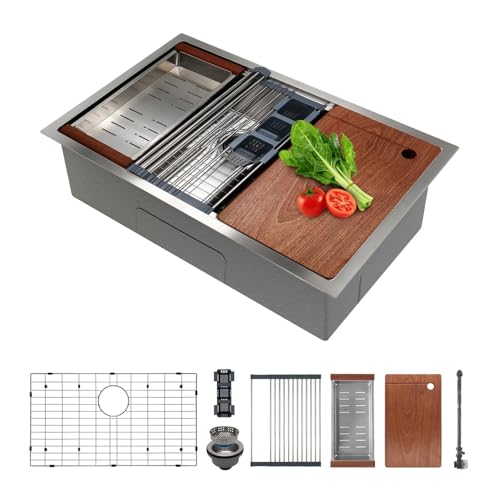
- No workstation ledge for over-sink accessories
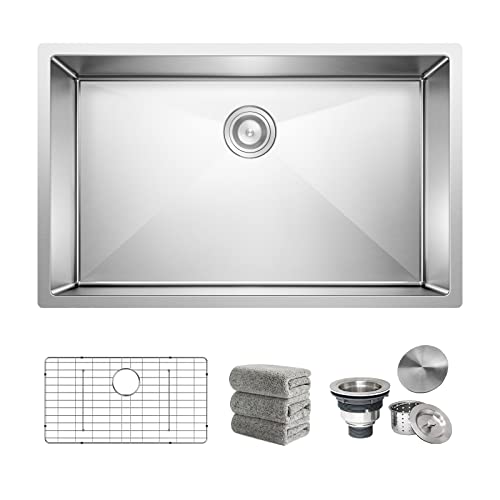
Mini spec box: Size: 30 x 18 inches. Mount: undermount. Material: stainless steel, 16 gauge. Bowl: single. Bundle: sink, bottom grid, drain assembly, drain cap, towel.
Quality is often the accumulation of decisions a manufacturer did not have to make, and the Oxwiser 30 inch bundle is full of them. The steel is the right gauge. The bowl is a single open workspace. And the box contains the parts that separate a finished installation from a shopping list: a bottom grid that keeps cookware and grit off the finish, the drain assembly the sink cannot function without, a drain cap, and even a towel. It reads like a product designed by someone who has actually installed and lived with a sink.
In daily service, the grid quietly becomes the quality feature owners mention most. It turns the bowl floor into a protected landing zone, lets glasses drain without sitting in rinse water, and softens the acoustic of dishes landing. Combined with 16 gauge steel, the whole sink has the settled, substantial feel that people mean when they say a kitchen feels well built.
The limitation is size, plainly. Thirty inches is the standard family footprint, but bakers who live by the half sheet pan will notice the angle. That is what the 32 inch sibling below exists for. Within its size, though, this is the most complete quality package on the list, and it takes the top badge on the strength of having no weak line in its specification.
Best for: most family kitchens wanting a complete, well-specified sink / Not suited for: cooks who need a wider bowl for oversized pans

Delironexu 30 Inch Undermount Kitchen Sink, Handmade
Badge: Best Handmade Value Quality
Strengths
- Handmade single bowl with a 9 inch depth for real capacity
- Brushed finish hides daily marks gracefully
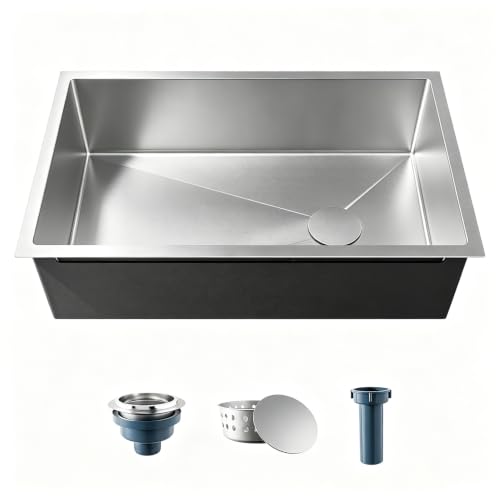
- Drain kit included, with no surprise accessories required to install
Trade-offs
- 18 gauge steel is lighter than the 16 gauge picks
- No additional accessories beyond the drain kit in the described package
- Handmade production means subtle variation between units
Mini spec box: Size: 30 x 18 x 9 inches. Mount: undermount. Material: stainless steel, 18 gauge. Bowl: single. Included: drain kit. Finish: brushed. Style: handmade.
Handmade construction is a genuine quality route in stainless sinks: the bowl is fabricated and finished with tighter, squarer geometry than pressed bowls usually achieve, which gives the sink its crisp modern lines and flat, stable surfaces. The Delironexu pairs that handmade build with a sensible 9 inch depth, so the bowl swallows a stock pot without splashing the counter every time the faucet runs at full flow.
The brushed finish is the pragmatic choice for a working kitchen. Mirror finishes photograph beautifully and then document every droplet; brushed steel diffuses light, softens the appearance of water marks, and ages with a grace that suits a sink expected to serve for many years. The included drain kit keeps the purchase honest, covering the required hardware without forcing a second order.
Where does it concede ground? Gauge. At 18 gauge it is a step lighter than the Oxwiser bundles and the thicker Kraus builds, so a bottom grid is a wise companion purchase and heavy cast iron deserves a gentler landing. Judged as a whole, though, the Delironexu delivers handmade quality cues at a level many buyers can reach, which is a legitimate and useful place in a quality roundup.
Best for: design-conscious buyers wanting handmade geometry at a reachable tier / Not suited for: buyers who prioritize maximum steel thickness

Oxwiser 32×18 Inch Undermount Sink Bundle, 16 Gauge
Badge: Best Large Bundle Quality
Strengths
- Complete five item bundle scaled to a 32 inch bowl
- 16 gauge steel with room for sheet pans to lie flat
- Grid, drain assembly, and cap matched to the sink by the maker
Trade-offs
- Requires a wide base cabinet
- Single bowl shared across all tasks
- Undermount installation demands a suitable countertop
Mini spec box: Size: 32 x 18 inches. Mount: undermount. Material: stainless steel, 16 gauge. Bowl: single. Bundle: sink, bottom grid, drain assembly, drain cap, towel.
Everything praised in the 30 inch Oxwiser applies here with width added, and width is not a trivial upgrade. A 32 inch bowl changes the physics of cleanup: the roasting pan sits flat and soaks properly, the sheet pan slides in without a tilt-and-jam ritual, and a day of cooking dishes stacks without becoming a balancing exercise. Quality of life at the sink is mostly bowl geometry, and this is the geometry busy kitchens ask for.
The matched bundle matters more at this size, not less. A grid cut for a smaller bowl is useless, and a generic drain kit is a compromise; here the accessories are the manufacturer’s own, sized for this sink. That completeness also simplifies installation day, because the installer is working with one coherent set of parts instead of a pile of separate purchases.
Confirm the cabinet before you fall for it. Wide undermounts need wide cabinets plus room for clips and the countertop cutout, and no quality argument survives a fit failure. If the cabinet says yes, this is the large-bowl quality pick, full stop. If it says no, the 30 inch version keeps the same philosophy in the space you have.
Best for: wide cabinets and high-volume family cooking / Not suited for: standard or narrow base cabinets

KRAUS KHU640-33 Stainless Steel 33 Inch Undermount Sink
Badge: Best Engineered Details
Strengths
- Channel grooves engineered for complete drainage
- Rounded corners that resist buildup and clean fast
- NoiseDefend pads for a quieter large bowl
Trade-offs
- 18 gauge steel, lighter than the 16 gauge bundles
- Widest footprint here; cabinet and cutout must agree
- Accessories are not the bundle focus of this model
Mini spec box: Size: 33 inches. Mount: undermount. Material: stainless steel, 18 gauge. Bowl: single. Features: rounded corners, channel grooves, NoiseDefend pads.
Kraus approaches quality as engineering rather than mass, and the KHU640-33 is its argument. The channel grooves in the bowl floor are there to solve the standing-water problem that flat floors create, guiding rinse water to the drain so the bowl dries cleaner and smells fresher. The rounded corners attack the other chronic sink complaint, the grime line that forms where a cloth cannot reach. And NoiseDefend padding keeps a very large bowl from announcing every plate to the whole house.
At 33 inches, this is also the capacity champion of the stainless picks. Entertainers, canners, and big-batch cooks will use every inch, and the single bowl takes the awkward items, grill grates, oven racks, oversized boards, that defeat smaller sinks entirely. A sink that fits the job is a quality feature in itself.
The trade is steel weight: 18 gauge in a bowl this wide asks for a grid and reasonable care with heavy cookware. Buyers for whom thickness is the top priority have the 16 gauge options above. Buyers for whom drainage, cleaning speed, and sheer room lead the list will find this the most thoughtfully engineered sink here. For the report-style research angle on this category, see Best Quality Stainless Steel Undermount Kitchen Sinks Consumer Report.
Best for: entertainers and detail lovers who prize drainage and quiet / Not suited for: thickness-first buyers or narrow cabinets
Miuara Farmhouse Sink 30 x 18 Inch White Fireclay
Badge: Best Fireclay Quality
Strengths
- Dense fireclay surface resists stains, cracks, heat, and scratches
- Reversible apron front offers two finished looks
- Solid, quiet material feel that steel cannot imitate
Trade-offs
- Heavy; needs a purpose-built support frame and cabinet modification
- Installation is the most involved on this list
- Edges deserve respect from heavy cast iron
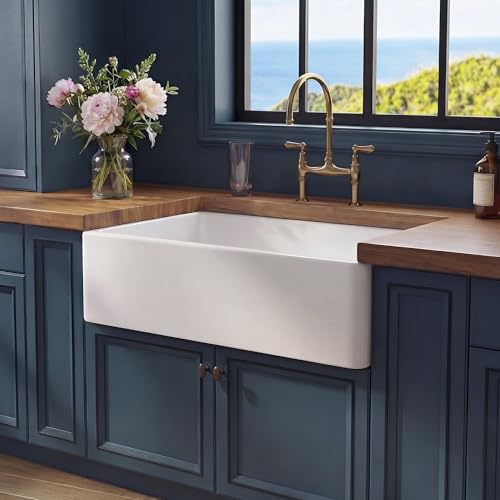
Mini spec box: Size: 30 x 18 inches. Mount: apron front, also described for drop-in or undermount fitting. Material: fireclay. Bowl: single, reversible. Surface: resistant to stain, crack, heat, and scratch.
Fireclay quality begins in the kiln. Fired at extreme temperatures, the material fuses into a dense body with a glazed surface that does not absorb liquids, which is why a white Miuara can face down curry, coffee, and berry stains that would haunt lesser materials. The manufacturer commits to resistance against staining, cracking, heat, and scratching, and that combination is the fireclay quality case in one line: a surface engineered to look new under conditions that age other sinks visibly.
The ownership feel is distinct. There is no metallic ring, no flex, just a cool, solid basin with a bright face that becomes the kitchen’s focal point. The reversible front is a thoughtful touch, letting the installer choose the profile that suits the cabinetry. In a farmhouse, cottage, or transitional kitchen, no stainless sink delivers this presence at any specification.
The cost of admission is installation seriousness. Fireclay is heavy, the cabinet must be opened and reinforced, and the set rewards professional hands. Quality buyers should see that not as a defect but as the format’s nature: this is a fixture installed like furniture. Plan it properly and it will likely outlast the faucet, the counters, and possibly the cabinets around it.
Best for: farmhouse designs and buyers prioritizing surface longevity / Not suited for: fast swaps or unsupported cabinets

Miuara Farmhouse Sink 33 x 18 Inch White Fireclay
Badge: Best Large Fireclay
Strengths
- Wide 33 inch fireclay bowl for serious cookware
- Same stain, crack, heat, and scratch resistant glazed surface
- Reversible front keeps the design decision flexible
Trade-offs
- Needs a wide farmhouse cabinet and strong support
- Heaviest installation on the list
- Single bowl only
Mini spec box: Size: 33 x 18 inches. Mount: apron front, also described for drop-in or undermount fitting. Material: fireclay. Bowl: single, reversible. Surface: resistant to stain, crack, heat, and scratch.
The 33 inch Miuara is the fireclay argument at full scale. Farmhouse kitchens tend to belong to people who cook generously, and this bowl matches that life: roasters soak flat, sheet pans fit, and a holiday’s worth of dishes has somewhere to go. The glazed surface keeps its bright, clean look through all of it, which is precisely the long-term quality promise that justifies choosing fireclay.
Stepping up within the same family is also the calm way to buy width. The material, the care routine, and the design language stay constant; only the capacity grows. If your remodel is already building a farmhouse cabinet, specifying the wider opening from the start costs little compared with wishing for it later.
As with its smaller sibling, respect the installation. Verify the cabinet width and the manufacturer’s requirements, build the support frame properly, and set the sink with enough hands. Done right, this is a generational fixture, the kind of sink a kitchen gets designed around rather than fitted into.
Best for: large farmhouse kitchens and committed home cooks / Not suited for: standard cabinets or minimal remodels
Comparison Table
| Sink | Size | Material / Gauge | Mount | Quality signature | Link |
|---|---|---|---|---|---|
| Oxwiser 30 Bundle | 30 x 18 in | Stainless, 16 gauge | Undermount | Complete matched bundle | Check on Amazon |
| Delironexu 30 | 30 x 18 x 9 in | Stainless, 18 gauge | Undermount | Handmade geometry, drain kit | Check on Amazon |
| Oxwiser 32 Bundle | 32 x 18 in | Stainless, 16 gauge | Undermount | Large complete bundle | Check on Amazon |
| KRAUS KHU640-33 | 33 in | Stainless, 18 gauge | Undermount | Grooves, corners, sound pads | Check on Amazon |
| Miuara Farmhouse 30 | 30 x 18 in | Fireclay | Apron front | Glazed stain resistance | Check on Amazon |
| Miuara Farmhouse 33 | 33 x 18 in | Fireclay | Apron front | Wide glazed bowl | Check on Amazon |
How to Choose a Quality Kitchen Sink: The Audit That Works on Any Model
Run any candidate sink through five checks. First, can the maker state its fundamentals? For stainless that means gauge and, ideally, alloy; for fireclay it means the firing and surface properties the brand will commit to in writing. Vague listings are the single most reliable predictor of a disappointing sink, because manufacturers with good numbers publish them.
Second, examine the bowl’s working geometry. Corners should be radiused enough to clean without a brush ritual. The floor should encourage water toward the drain, through slope or grooves, rather than hosting puddles. Depth should match your cookware and your height: deep enough to contain a stock pot session, shallow enough that the shortest regular cook is not reaching into a well all evening.
Third, inventory the complete package. A quality ownership experience includes the drain assembly that fits, a grid that protects the floor, and, for workstation designs, accessories that actually ride the ledge. Manufacturers who bundle thoughtfully, as Oxwiser does here, are telling you how they think about the years after the sale.
Fourth, match material to temperament. Stainless is light, repairable in appearance with grain-direction care, and suits almost every design. Fireclay is dense, bright, and stain-shedding, but demands structural respect and gentleness with heavy iron. Composite and other materials have their own ledgers; the quartz family, for instance, is surveyed in Best Quartz Composite Kitchen Sinks. The right material is the one whose care routine matches the household that will perform it.
Fifth, respect installation as part of quality. A superb sink set out of level will puddle; a superb fireclay sink on a weak frame will eventually announce the error. Budget the support, the sealant, the correct drain hardware, and, where the format demands it, professional labor. Quality is a system, and the sink is only its most visible part.
How to Install and Maintain a Quality Sink So It Stays One
For undermount stainless, the professional sequence is template, dry fit, seal, support, plumb. The countertop cutout follows the manufacturer’s template, the flange gets a continuous silicone bead, and clips, rails, or a cradle carry the bowl’s loaded weight. Never let adhesive alone hold a sink that will be filled with water and cookware. Connect the drain assembly as directed, align the trap without stress, and leak-test with a long run of water and a dry paper towel at every joint.
For fireclay farmhouse models, build the support frame before the sink arrives, cut the cabinet face to the apron, dry-fit to confirm the reveal and the reversible face you intend to show, then set with enough help to place the weight gently and squarely. Seal the joints neatly, because the apron is a visible furniture surface and sloppy sealant lines will bother you for years.
Maintenance divides by material. Stainless wants rinsing, soft sponges, grain-direction wiping, and a grid between steel and heavy pans; avoid abrasive powders and never let steel wool sit in the bowl. Fireclay wants prompt rinsing of strong pigments, a mat under cast iron, and non-abrasive cleaning of the glaze. Both want a twice-yearly inspection of the plumbing below, where five minutes with a flashlight prevents the only truly expensive sink problem, the slow hidden leak.
Troubleshooting mini-guide. Problem: a stainless bowl develops dull patches → they are usually mineral film or micro-scratches from abrasive cleaning; restore with a stainless-safe cleaner worked along the grain. Problem: the fireclay front shows a grey mark after a pan bump → it is typically metal transfer on the glaze, and a gentle non-abrasive clean usually lifts it. Problem: any sink smells stale despite cleaning → check for standing water from an out-of-level set and for residue in the drain assembly, the two usual sources.
Why Single Bowls Dominate Serious Kitchens Now
Every pick on this list is a single bowl, and that is a quality statement about modern cooking rather than a fashion. Cookware has grown: half sheet pans, large Dutch ovens, grill grates, and roasting racks all demand one uninterrupted space. Divided bowls served a era of smaller pans and hand-washing rituals that dishwashers have since absorbed. Today’s quality question is not how a sink divides its space but how well its one space is built, drained, and protected.
The single bowl’s one genuine weakness, separating tasks, has easy workarounds. A removable basin creates a soak zone on demand. A grid creates a draining level above the bowl floor. A workstation ledge, on models that offer it, creates a prep level above that. Each solution appears when needed and vanishes when the big pan arrives, which is more than any fixed divider can promise.
How a Quality Sink Changes the Whole Kitchen’s Daily Rhythm
A sink is the most-used workstation in the kitchen, touched more often than the stove by most households, and its quality radiates outward into habits. A bowl that fits the cookware ends the nightly negotiation about what soaks where. A surface that releases food easily shortens cleanup enough that people actually do it immediately, which keeps the whole kitchen calmer. A quiet bowl lowers the background stress of an open-plan evening in a way visitors feel without identifying. These are not luxuries; they are the compounding daily returns on a fixture chosen well, and they are why quality in this category is worth more analytical effort than its price tag suggests.
The reverse compounds too. A sink that puddles breeds a permanently damp sponge corner. A bowl too small for the roaster teaches the household to dread big cooking days. A finish that marks easily trains everyone to stop caring, and kitchens people stop caring about deteriorate in a hundred small ways. When you audit a candidate sink with the five checks in this guide, you are not being fussy about a basin; you are choosing the rhythm the kitchen will keep for the next decade, and that is a decision worth the twenty minutes it takes to make properly.
Warranties and What They Actually Tell You
Read a sink’s warranty the way you would read any quality signal: for what it reveals about the maker’s confidence, not as a promise you plan to redeem. Coverage that addresses defects in material and workmanship for a long term suggests a manufacturer expecting the product to survive long terms. Exclusions teach the complementary lesson, usually naming the care boundaries this guide has already described: abrasive damage, improper installation, and chemical misuse are on the owner, which is fair, because no factory can warranty a household’s habits.
Keep the practical paperwork. Save the order record, the model and serial information if provided, and a photo of the installed sink, somewhere they will survive a phone change. If a genuine defect ever appears, a finish flaw present from the start, a weld imperfection, that documentation turns a frustrating claim into a short one. Quality ownership includes this small administrative habit, and it costs one folder and two minutes on installation day.
Sink Sound, Light, and the Sensory Side of Quality
Quality has a sensory signature that specifications only partly capture. Sound is the first channel: a well-built sink answers a running faucet with a muted rush and a dropped pan with a low, brief note, because mass and padding absorb energy instead of broadcasting it. Owners rarely list quietness as their reason for loving a sink, yet in open-plan homes it shapes every evening. When you compare candidates, weight the named sound systems in these reviews as heavily as any visual feature, because you will hear the sink far more often than you admire it.
Light is the second channel. A sink lives under the kitchen’s best task lighting, and its surface tells the truth there: even finishes glow softly, tired finishes scatter glare, and a bright fireclay front can lift the perceived light of the whole room. The third channel is touch: the cool solidity of fireclay, the smooth drag of a cloth along stainless grain, the reassuring absence of flex when you lean on the bowl’s edge while scrubbing. A quality sink is a small daily pleasure across all three channels, and that accumulation, thousands of unremarkable but pleasant interactions, is what owners actually mean when they say a kitchen feels well made.
Planning the Project Around a Quality Sink
Sequence protects quality in a remodel. Choose the sink before the countertop is templated, because the cutout, the reveal, and the cabinet plan all derive from the sink’s template. Confirm the cabinet’s readiness next: width for the bowl, support for its loaded weight, and, for farmhouse models, the modified front that receives the apron. Schedule plumbing with the drain hardware physically present, and let the faucet decision ride on the sink’s dimensions rather than preceding them, so reach and clearance are solved by measurement instead of hope.
Build one contingency into the plan: time. Sealant cures on its own schedule, fireclay sets benefit from unhurried hands, and a quality installation occasionally pauses to correct a cabinet that is not as level as it looked. Households that grant the project that patience receive the version of the sink the manufacturer intended. Households that rush it receive a compromise wearing a quality product’s name, which is the most expensive outcome in this entire category.
Two Kitchens, Two Right Answers: A Tale of Fit
Consider two households shopping this same list on the same day. The first is a family of five in a farmhouse-style home mid-remodel, with a wide cabinet run, a baker’s calendar, and a white-and-wood design that begs for an apron front. For them, the Miuara 33 is not the indulgent choice; it is the correct one, because its width serves their cookware, its glaze serves their staining-prone cooking, and the cabinet work it demands is already in their plan. The second household is a couple in a compact city condo with stone counters, a 30 inch cabinet, and a strong preference for quiet evenings in an open-plan room. For them the KHU100-30 class of answer, or within this list the Oxwiser 30 bundle with its complete hardware set, delivers every quality virtue they will actually experience, at a size their kitchen can honestly host.
Neither household bought the best sink in any absolute sense, because there is no such object. Each bought the sink whose verified strengths matched their constraints, and each will describe their purchase, years later, as obviously right. That is the destination this guide has been steering toward from its first section: quality is not a crown awarded to one product, but a fit demonstrated between a specification and a life. Read the reviews here with your own constraints in hand, and the right answer will identify itself the same way.
The Cleaning Kit a Quality Sink Actually Needs
Quality ownership runs on a surprisingly short shopping list. A soft sponge and a microfiber cloth handle nearly everything both materials ask for. A mild detergent covers routine washing, and a stainless-safe cleaner earns a place only for periodic finish restoration on steel. A plastic scraper lifts dried food without threatening any surface here. That is close to the whole kit, and its brevity is itself a quality signal: sinks that demand a shelf of specialty products are telling you their surfaces are high-maintenance by design.
What does not belong in the kit matters as much. Steel wool, abrasive powders, and stiff scouring pads are banned from both steel and glazed fireclay in this guide’s care sections, not out of fussiness but because they convert a maintainable finish into a damaged one, permanently in the case of cross-grain scratching. Bleach-heavy sprays should never pool in any bowl. Keep the kit short and gentle, use it briefly and often, and the surfaces in these reviews will repay you with the easiest version of themselves for as long as you own them.
The Resale Question: Does a Quality Sink Pay You Back?
Homeowners sometimes ask whether a quality sink returns its cost when the house sells, and the honest answer is indirect but real. A sink does not appraise like a countertop or an appliance package, yet it sits at the exact center of the kitchen a buyer inspects most closely, hands on the faucet, eyes in the bowl. A bright, solid, quiet sink in a standard size tells that buyer the kitchen was built and kept by careful people, and that inference colors the whole showing. A stained, dented, or echoing sink tells the opposite story at the same volume. You will likely never see a line item for it, but the quality picks in this guide, neutral in style and serious in specification, are the ones that protect the kitchen’s story, and kitchens with good stories sell like it.
How to Talk to a Showroom or a Seller and Get Real Answers
Whether you shop in a showroom or through messages with an online seller, the quality conversation improves when your questions demand specifications instead of opinions. Ask for the gauge and the alloy by name. Ask what is in the box, item by item, and what the minimum cabinet size is for the model in front of you. Ask how the bowl is supported in an undermount installation and what the maker recommends. Sellers who know their products answer these in seconds and often respect the customer more for asking; sellers who pivot back to adjectives have answered your real question, which was whether the quality story survives contact with a specific inquiry. Take the same list to every candidate, including the six here, and the comparison writes itself in the margins of their answers.
Aging Gracefully: The Ten-Year Test Applied to Both Materials
Project each material a decade forward and the quality choice sharpens. Stainless at year ten wears a soft, even patina over a structure that has not changed; its story is written in a finish that records use honestly and, with grain-direction care, attractively. Fireclay at year ten still presents a bright face to the room, its glaze largely indifferent to the decade’s sauces and celebrations, asking only that its edges were respected along the way. Neither future is a consolation prize, which is why this guide crowns no single material. The test is not which sink ages better in the abstract, but which aging story you would rather live inside, and both stories, told by the verified picks here, end well.
A Short Word on Trusting Your Own Hands
Specifications end where your hands begin, and if you can visit a showroom, do one thing: press the floor of the bowl, lift a corner of the sink if it is displayed loose, and run a fingertip around a corner radius. Rigid, smooth, and finished will register instantly, because your hands are excellent instruments for exactly the qualities this guide has been describing in words. Then come home and buy with both kinds of evidence in agreement.
Common Buying Mistakes
- Judging quality by brand fame instead of stated gauge, surface, and bundle evidence.
- Buying a sink with no published gauge and hoping the steel is thick.
- Ignoring drainage design, then living with a bowl that never quite empties.
- Choosing fireclay without planning cabinet support, or undermount without a suitable countertop.
- Letting headline size substitute for interior bowl measurement against your largest pan.
- Skipping the bottom grid on stainless and collecting scratches that no cleaning reverses.
- Treating installation as an afterthought when it is half the quality equation.
Final Recommendation
The Oxwiser 30 inch bundle is the quality benchmark for most kitchens: complete, correctly gauged, and ready to install as a coherent set. Find it at Check on Amazon. With a wider cabinet, its 32 inch sibling at Check on Amazon is the same answer at family scale. For a farmhouse kitchen, the Miuara 30 inch fireclay at Check on Amazon is the quality pick whose surface will still look bright in a decade.
Choose the KHU640-33 when drainage engineering and sheer room lead your list, and the Delironexu when handmade geometry at a reachable tier appeals. Audit every candidate with the five checks above and you will buy quality you can verify rather than quality you were promised.
Frequently Asked Questions
What is the most reliable sign of a quality stainless sink?
A published gauge, with 16 gauge the target for a primary kitchen, ideally paired with sound padding and a stated alloy or branded steel standard. Manufacturers confident in their material print the numbers. A listing that hides gauge and alloy while promising premium quality is asking for trust it has not earned with evidence.
Is fireclay or stainless steel the higher quality choice?
Neither wins outright; they excel differently. Fireclay offers a dense, non-porous glazed surface that resists stains superbly and gives a solid, quiet feel, at the cost of weight and installation effort. Stainless offers lighter weight, easier installation, and a timeless look, with care habits needed to keep its finish even. The higher quality choice is the one matched to your kitchen’s structure and your household’s habits.
Do bundled accessories really indicate quality?
They indicate something valuable: that the manufacturer designed the ownership experience, not just the product photo. A fitted grid protects the bowl, a matched drain assembly installs without improvisation, and small inclusions like a drain cap show attention. Bundles do not replace core construction quality, but on top of a sound specification they are a meaningful positive signal.
How long should a quality kitchen sink last?
A well-made stainless or fireclay sink, correctly installed and reasonably cared for, should serve for many years, typically outlasting faucets and often countertops. Lifespan is governed less by the calendar than by installation quality, water conditions, and care habits, which is why this guide weights those factors alongside the product specification itself.
Why do quality guides favor single bowl sinks?
Because modern cookware is large and dishwashers handle the routine load, the open single bowl fits how kitchens actually work now. It accepts the biggest pans flat, adapts with basins and grids when separation is needed, and avoids the permanent compromise of a divider. The picks here reflect that consensus across both steel and fireclay.
Can a quality sink be installed in a weekend?
A like-for-like undermount replacement on an existing cutout can be a weekend project for an experienced DIYer, though sealant curing time must be respected. A farmhouse fireclay installation with cabinet modification is a bigger undertaking that many homeowners sensibly give to professionals. Match the plan to the format, and quality of installation will match quality of product.
What maintenance does a quality sink actually need?
Less than people fear, but consistently: rinse after use, clean with soft tools and mild detergent, wipe stainless along its grain, protect both materials from grit and heavy impacts with a grid or mat, and inspect the plumbing below twice a year. Those habits preserve the finish and catch small problems while they are still small.