Disclosure: topratedkitchenware.com is reader-supported. When you buy through links on our site, we may earn an affiliate commission from Amazon and other retailers, at no extra cost to you.
Where to buy
The six sinks below are the verified picks behind this guide to the best sound deadened kitchen sinks — steel bowls with engineered sound pads, heavier gauges that ring less, and two fireclay sinks that are quiet by sheer mass. Each name links to its Amazon listing, where you can check the latest price on Amazon, confirm dimensions and included accessories, and read the newest owner feedback, including the noise reports that matter for this category. Start with the complete, quiet bundle here: Check on Amazon.
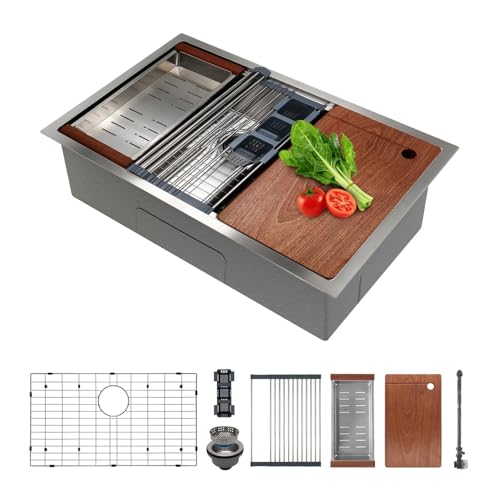
- Oxwiser 30×18 Inch Undermount Sink Set, 16 Gauge, 5 Item Bundle
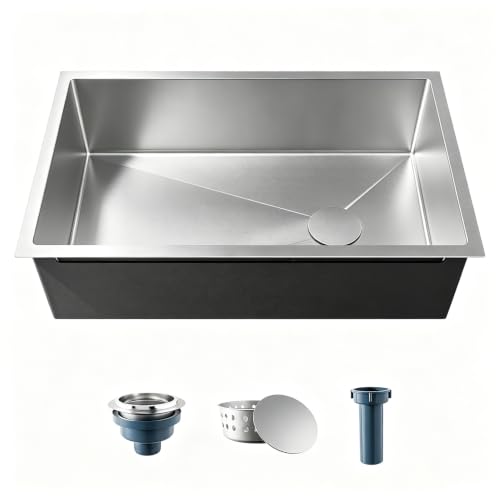
- Delironexu 30 Inch Undermount Kitchen Sink, 18 Gauge, Drain Kit
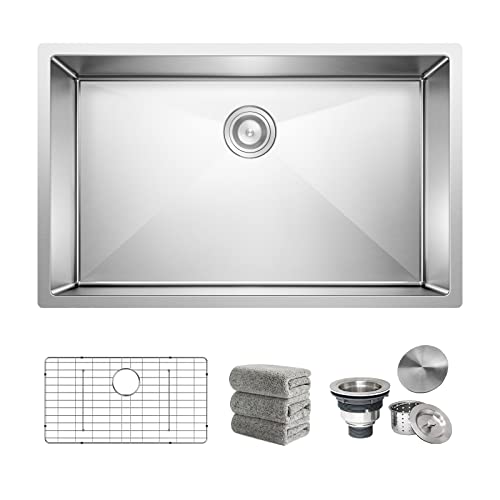
- Oxwiser 32×18 Inch Undermount Sink Set, 16 Gauge, 5 Item Bundle
- KRAUS KHU640-33 33 Inch 18 Gauge Undermount Sink with NoiseDefend
- Miuara Farmhouse Sink 30 x 18 Inch White Fireclay Apron Front
- Miuara Farmhouse Sink 33 x 18 Inch White Fireclay Apron Front
Read the full guide ↓
A kitchen sink is a drum you wash dishes in. Thin steel, a hollow cabinet and a garbage disposer bolted underneath combine into an instrument that announces every rinse, every dropped fork and every grinding cycle to the whole house — and in open-plan homes, to the whole evening. The best sound deadened kitchen sinks attack that noise at its sources: thicker steel that flexes and rings less, rubber sound pads bonded to the bowl’s underside that absorb vibration before it becomes sound, undercoatings that deaden the drum effect, and, at the far end of the strategy, materials like fireclay whose sheer density never rings in the first place. This guide compares six verified sinks across those strategies, from engineered pad systems to solid ceramic mass, so you can choose the kind of quiet that fits your kitchen.
We are honest about the physics up front, because this category attracts vague promises. No sink is silent: running water makes noise in any bowl, and a disposer will always be audible. What good sound deadening changes is the character and carry of the noise — clang becomes thud, ring becomes knock, and the sharp sounds that travel through walls and wake sleeping children are the ones that disappear. If your priority is the quietest possible wash-up in an open-plan or thin-walled home, our companion research on Best Sound Proof Kitchen Sinks goes further down this same road; this guide is the complete map of how the deadening is achieved and which picks do it best.
Key Takeaways
- Sound deadening works three ways: mass (thicker steel or fireclay), absorption (rubber pads bonded under the bowl) and isolation (secure mounting so the cabinet does not amplify vibration).
- The KRAUS KHU640-33 is the engineered answer here — its NoiseDefend pads are named in the verified specification.
- Fireclay sinks (the two Miuara picks) are quiet by nature: dense ceramic does not ring, flex or drum.
- Gauge matters in steel: 16 gauge bowls sound noticeably deader than 18 gauge under the same tap.
- The disposer is half the noise problem — a well-padded sink still deserves a snug mount and a quality disposer.
- Bottom grids and mats quiet the clatter of dishes themselves, the noise source no pad can reach.
- Test any new installation from the next room, with the disposer running, before the installer leaves — that listening test is the only specification that ultimately counts in daily life at home.
In this guide
Quick Picks
| Pick | Badge | Why it stands out | |
|---|---|---|---|
| Oxwiser 30×18 Sink Set | Best Overall Quiet Bundle | 30 x 18 inch, 16 gauge steel, 5 item bundle with bottom grid that also damps dish clatter | Check on Amazon |
| Delironexu 30 Inch Undermount Sink | Best Value | 30 x 18 x 9 inch, 18 gauge, handmade brushed bowl, drain kit included | Check on Amazon |
| Oxwiser 32×18 Sink Set | Best Large Quiet Steel | 32 x 18 inch, 16 gauge steel, 5 item bundle with grid and drain assembly | Check on Amazon |
| KRAUS KHU640-33 | Best Engineered Sound Deadening | 33 inch, 18 gauge steel, NoiseDefend pads, rounded corners, channel grooves | Check on Amazon |
| Miuara Farmhouse Sink 30 Inch | Best Naturally Quiet | 30 x 18 inch white fireclay, reversible single bowl, apron front or undermount | Check on Amazon |
| Miuara Farmhouse Sink 33 Inch | Best Large Fireclay | 33 x 18 inch white fireclay, reversible single bowl, family-scale quiet | Check on Amazon |
How These Picks Were Chosen
This is a research-led guide built on verified data: every ASIN, title and specification here comes from the Amazon Creators API pool, checked on the date recorded in the sources file. For a sound-focused keyword, our screening privileged evidence of deadening in the specification itself — named pad systems like KRAUS NoiseDefend, heavier steel gauges, and materials with inherent damping — over marketing adjectives. We then read owner feedback in aggregate for the noise story behind the specs: which sinks owners describe as a thud and which as a clang, and how much of the difference survives the addition of a garbage disposer.
Two honesty rules shaped the list. First, where a pick’s verified title does not claim a pad system, we do not invent one: the Oxwiser and Delironexu reviews below credit their quiet to gauge, construction and the included grid where applicable, and say plainly that they are not the engineered-pad option. Second, fireclay’s inclusion is deliberate and explained — dense fired ceramic is one of the genuinely quiet sink materials, and a sound-deadened guide that ignored it would be steering readers past one of the two real solutions. Readers comparing the stainless field more broadly will find the material background in our Best Ss Kitchen Sinks roundup.
We also weighted the whole installation, not just the bowl. Sound pads cannot rescue a sink that is loosely mounted in a hollow, resonant cabinet, so the buying guide covers mounting, disposer choice and the simple accessories — grids, mats, in-sink racks — that quiet the noises pads cannot reach. A sink purchase is a decade-long acoustic decision; it deserves the full picture.
The 6 Best Sound Deadened Kitchen Sinks

Oxwiser 30×18 Inch Undermount Sink Set — 16 Gauge, 5 Item Bundle
Badge: Best Overall Quiet Bundle
Strengths
- 16 gauge steel is inherently deader than 18 gauge — less flex, less ring under running water and dropped cutlery.
- The included bottom grid silences the second noise source: dishes and pans land on the grid, not on bare steel.
- Complete 5 item bundle (sink, grid, drain assembly, drain cap, towel) — the quiet system arrives in one box.
Trade-offs
- The verified specification does not name a dedicated pad system like KRAUS NoiseDefend; its quiet comes from gauge and grid.
- The grid is another item to lift and clean around.
- Single bowl at 30 inches is mainstream-sized; very large households may want the 32 inch sibling.
Mini spec box
- Size: 30 x 18 inch, undermount
- Material / gauge: stainless steel, 16 gauge
- Bowl: single bowl
- Included: 5 item bundle — sink, bottom grid, drain assembly, drain cap, towel
The Oxwiser set tops this guide because it attacks kitchen sink noise the way it actually occurs. Spec-sheet sound deadening is about the bowl, but lived noise is a duet: the bowl ringing under water, and the crockery clattering against the bowl. Sixteen gauge steel handles the first half respectably — thicker sheet simply has less of the drum in it, flexing less under impact and settling faster after it — and the included bottom grid handles the second half better than any pad can, because a plate set down on a grid never strikes steel at all. Add the drain assembly and cap in the same box and the whole quiet installation is one purchase, one delivery, one fitting session.
As a sink beyond acoustics, it is the sensible mainstream article: a 30 x 18 inch single bowl that fits standard cabinets, takes sheet pans flat and suits the way most households actually wash up. The steel’s gauge also pays its way in dent resistance and in the solid feel under a full stockpot, qualities that matter long after the noise question fades into habit. Owners stepping up from a thin builder-grade sink — the usual origin story in this category — will hear the difference at the first rinse: water lands with a hush instead of a hiss-and-ring, and the evening wash-up stops announcing itself room to room.
The honest boundary is the pad question. KRAUS builds a named, engineered pad system into its sinks and this one’s verified specification makes no such claim, so if your single overriding priority is maximum engineered absorption in the steel itself, the KHU640-33 below is the specialist pick. The Oxwiser’s claim is broader and, for most kitchens, more useful: a well-gauged bowl, a clatter-killing grid and nothing else to buy. That is what an overall pick looks like.
Best for: most households replacing a loud builder-grade sink and wanting the complete quiet package in one box / Not suited for: buyers who specifically want a named engineered pad system above all else

Delironexu 30 Inch Undermount Kitchen Sink — 18 Gauge, Drain Kit Included
Badge: Best Value
Strengths
- Full 30 x 18 x 9 inch handmade bowl at the value end of this guide.
- Deep 9 inch bowl keeps water noise contained lower in the sink, further from ear level.
- Drain kit included, with the listing explicit that no further accessories are bundled — clean expectations.
Trade-offs
- 18 gauge is the thinnest steel here and the liveliest sounding; it benefits most from an added grid or mat.
- No named pad system in the verified specification.
- Brushed handmade finish needs regular wiping to stay smart.
Mini spec box
- Size: 30 x 18 x 9 inch, undermount
- Material / gauge: stainless steel, 18 gauge
- Bowl: single bowl, handmade design, brushed finish
- Included: drain kit (no additional accessories)
Value picks in a sound guide need careful framing, and the Delironexu’s is this: it is the quietest route available at its tier, not the quietest sink in the guide. Eighteen gauge steel is inherently brighter and more resonant than the 16 gauge bowls here, and no honest review should pretend otherwise. What the Delironexu offers instead is a full-size, deep, handmade bowl — 30 x 18 inches with 9 inches of depth that keeps the water’s impact point low in the bowl, where the steel walls and the water itself absorb some of the splash energy before it reaches your ears — at a position that leaves room in the budget for the accessories that genuinely help it: a bottom grid or a silicone mat, either of which transforms its dish-clatter behaviour.
Bought that way, as a bowl-plus-grid system assembled by the owner, it closes much of the practical gap to heavier sinks at a total outlay that still undercuts them. The handmade construction and brushed finish also mean the value choice does not look like one under the counter, and the included drain kit removes the usual budget-sink surprise charge. The listing’s plain statement that no additional accessories are included is, in its way, a feature: you know exactly what the system costs before it ships.
Who should skip it: households for whom quiet is the whole point of the purchase — a nursery-adjacent kitchen, a thin-walled condo — should buy the engineered or fireclay options and not economise on the very property they came for. Who should take it: anyone replacing a loud old sink on a budget, willing to add a grid, and honest that “much quieter than what I had” is the goal. On those terms it delivers fully.
Best for: budget remodels that will add a grid or mat and want a full-size, deep bowl / Not suited for: maximum-quiet seekers, who should choose the padded KRAUS or a fireclay pick

Oxwiser 32×18 Inch Undermount Sink Set — 16 Gauge, 5 Item Bundle
Badge: Best Large Quiet Steel
Strengths
- Large bowls are the loudest; 16 gauge steel plus the included grid is the practical counter at 32 inches.
- Same complete 5 item bundle as its 30 inch sibling — grid, drain assembly, drain cap and towel included.
- Sheet pans and roasters lie flat, so the big wash-up happens in fewer, quieter loads.
Trade-offs
- No named engineered pad system in the verified specification.
- Needs a wide cabinet, typically 36 inch class.
- A big bowl still carries water noise; depth and grid mitigate, not eliminate.
Mini spec box
- Size: 32 x 18 inch, undermount
- Material / gauge: stainless steel, 16 gauge
- Bowl: single bowl
- Included: 5 item bundle — sink, bottom grid, drain assembly, drain cap, towel
Scale is the enemy of quiet in sink design: the larger the uninterrupted sheet of steel, the more efficiently it vibrates, which is why big thin sinks boom like kettle drums. The 32 inch Oxwiser set is the pragmatic answer at family size. Its 16 gauge steel starts a step deader than the 18 gauge norm at this width, and the included bottom grid does double duty in a large bowl — it protects the wide floor from the roasting pans that live there, and it gives every one of those pans a landing that is not bare steel. In a household where the evening wash-up is a two-person production of sheet pans and stockpots, that difference is the difference between conversation continuing and conversation pausing.
The bundle logic matters more at 32 inches, because the accessories are sized to the bowl: a grid that actually fits a 32 x 18 floor is a deliberate purchase, not a generic afterthought, and here it arrives in the box with the drain assembly and cap. The bowl itself does the family work without argument — pans flat, pots upright, a full load in one fill — and fewer, fuller loads are themselves a noise strategy: one organised wash-up is quieter than three rattling relays of small ones.
As with its 30 inch sibling, the candour point is pads: the verified specification names none, so buyers chasing the engineered maximum in steel should compare the KRAUS below, and buyers chasing silence itself should look at the fireclay pair. The Oxwiser 32 stakes its claim on the system most kitchens actually live with — good gauge, right grid, right size — and for large steel, that system is the sensible summit. Stainless shoppers comparing gauges and finishes across the wider market can cross-check in our Best Stainles Steel Kitchen Sinks guide.
Best for: large households wanting a big steel bowl that behaves acoustically, with accessories included / Not suited for: narrow cabinets, or buyers who want a named pad system or fireclay’s inherent silence

KRAUS KHU640-33 — 33 Inch 18 Gauge Undermount Sink with NoiseDefend
Badge: Best Engineered Sound Deadening
Strengths
- NoiseDefend soundproofing pads are part of the verified specification — engineered absorption, not implication.
- The widest bowl in the guide at 33 inches, yet designed to stay composed acoustically.
- Rounded corners resist buildup and wipe fast; channel grooves keep the floor draining and drying.
Trade-offs
- 18 gauge steel leans on its pads for deadening rather than on raw thickness.
- 33 inches needs a genuinely wide cabinet — measure carefully.
- No grid or accessories in the verified listing; budget for a grid to complete the quiet system.
Mini spec box
- Size: 33 inch width, undermount
- Material / gauge: stainless steel, 18 gauge
- Bowl: single bowl, rounded corners
- Features: NoiseDefend soundproofing pads, channel grooves for draining
This is the specialist’s pick: the sink in the guide whose sound deadening is an engineered, named system rather than a side effect. NoiseDefend, in KRAUS’s implementation, means rubber pads bonded across the bowl’s underside where vibration is born, absorbing energy before the steel can turn it into airborne ring. The effect is most audible exactly where big sinks are worst — the flat floor under running water and the moment a pan lands — converting the sharp, carrying clang of light steel into a short, local thud that stays in the kitchen instead of touring the house.
The interesting engineering tension is that KRAUS achieves this at 18 gauge and 33 inches: the thinnest steel and the widest bowl in the guide, a combination that should be the loudest here and, thanks to the pads, is instead among the best controlled. It makes the KHU640-33 the natural recommendation for open-plan homes that also cook at scale — the apartment or family kitchen where the sink is metres from the sofa and the sheet pan is a weekly event. The rounded corners and drainage channels complete a bowl designed by people who think about day 300: easy to wipe, quick to dry, nothing to harbour grime or standing water.
Two honest notes. First, pads deaden the bowl, not the crockery — add the bottom grid this listing does not bundle, and the system is complete. Second, at 33 inches the cabinet requirement is the strictest in the guide; this is a sink for genuinely wide bases, and forcing it into a marginal cabinet helps no one. Within its brief, it is the engineered benchmark the rest of the category is measured against, a standing it also holds in our Best Sound Proof Kitchen Sinks research.
Best for: open-plan and noise-sensitive homes wanting maximum engineered deadening at maximum width / Not suited for: cabinets below the wide minimum, or buyers who want accessories bundled

Miuara Farmhouse Sink 30 x 18 Inch — White Fireclay Apron Front
Badge: Best Naturally Quiet
Strengths
- Fireclay is quiet by physics: a thick, dense ceramic bowl does not ring, flex or drum — dropped cutlery lands with a knock, not a clang.
- Reversible single bowl, installable apron-front or as a drop-in/undermount per the manufacturer, giving layout flexibility.
- Fireclay resists stains, cracks, heat and scratches per the verified specification, and never shows water spots like steel.
Trade-offs
- Heavy — fireclay apron-front installs need a properly supported, often purpose-built cabinet.
- Ceramic is hard but not forgiving: a heavy cast-iron drop can chip any ceramic sink.
- The white farmhouse look is a strong style commitment compared with neutral steel.
Mini spec box
- Size: 30 x 18 inch, apron front (also drop-in/undermount per manufacturer)
- Material: white fireclay
- Bowl: reversible single bowl
- Properties: resistant to stain, crack, heat and scratch (per manufacturer title)
Every steel sink in this guide is managing a problem that the Miuara simply does not have. Fireclay — ceramic fired until it is dense as stone — has no ring in it. Rap it and it answers with a short knock; run water in it and the sound stays soft and local; drop a fork and there is a click, not a chime. For households whose noise complaint is specifically the metallic voice of a steel bowl, this material change is the most complete solution available, and it arrives wearing the apron-front farmhouse styling that makes the sink the kitchen’s centrepiece rather than its appliance.
The reversible bowl is a thoughtful touch: one face presents a plainer front, the other a more detailed one, so the sink adapts to the kitchen’s style rather than dictating it, and the manufacturer’s specification also allows drop-in or undermount fitting where an apron installation does not suit. Day to day, fireclay’s glazed surface shrugs off the staining that coffee, wine and tomato visit on lesser materials, shows no water spotting between wipes, and asks only for non-abrasive cleaning in return. Households drawn to the farmhouse form itself will find the wider style discussion in our guide to Best Stainless Farmhouse Kitchen Sinks useful for contrast — steel apron-fronts exist, but they cannot match this material’s silence.
The costs are weight and care. A fireclay apron sink is a serious object that needs its cabinet built or reinforced to carry it, with support planned before the countertop arrives; and while the glaze is tough, ceramic does not dent — it chips, if a heavy pan falls edge-first from height. Treat it like the stoneware it is and it will out-quiet and out-last most of the kitchen around it.
Best for: noise-sensitive households that love the farmhouse look and are building the cabinet to suit / Not suited for: lightweight retrofit projects or anyone unwilling to plan structural support

Miuara Farmhouse Sink 33 x 18 Inch — White Fireclay Apron Front
Badge: Best Large Fireclay
Strengths
- All of fireclay’s inherent silence at family scale: 33 inches of bowl that never rings.
- Reversible single bowl with apron-front presence sized for wide cabinet runs.
- Stain, crack, heat and scratch resistance per the verified specification; no water spotting.
Trade-offs
- The heaviest install in the guide — cabinet support is a construction item, not an afterthought.
- Wide footprint demands a wide, often custom, sink base.
- Chips are possible from severe impacts, as with any ceramic.
Mini spec box
- Size: 33 x 18 inch, apron front (also drop-in/undermount per manufacturer)
- Material: white fireclay
- Bowl: reversible single bowl
- Properties: resistant to stain, crack, heat and scratch (per manufacturer title)
The 33 inch Miuara takes the fireclay argument and scales it to the households that need it most. Large families generate the most sink noise — the most loads, the biggest pans, the latest wash-ups — and they generate it in the largest bowls, which in steel are the loudest. A 33 inch fireclay bowl breaks that equation entirely: capacity grows, noise does not. A full holiday wash-up, stacked and rinsed in this bowl, produces the muted knock-and-splash of ceramic at work, a soundscape a sleeping house can ignore in a way it never ignores steel.
Everything said about its 30 inch sibling applies with more emphasis. The reversible bowl lets the apron face suit the room; the glaze resists the stains and heat of serious cooking; the surface needs no drying to look clean, which at family scale is a daily mercy. And the structural conversation is bigger too — at this size and weight, the sink base is effectively a piece of furniture engineered around the sink, and the time to have that conversation is at kitchen design, not at delivery. Planned properly, the installation is a non-event performed once; improvised, it is the hardest retrofit in this guide.
Choose the 33 over the 30 when the cabinet run is wide, the household is large, and the farmhouse front is the look the kitchen is being built around. Choose steel instead if the project is a like-for-like replacement in an existing standard cabinet — the fireclay pair rewards new-build and full-remodel planning, and within those projects they are the quietest objects in this guide by a material mile. Buyers weighing the steel route at this size can compare the full field in our Best Stainless Kitchen Sinks roundup.
Best for: large families in full remodels who want farmhouse presence and inherent quiet at full scale / Not suited for: standard-cabinet replacements or projects without structural support planned
Comparison Table
| Pick | Size | Material / gauge | How it gets quiet | |
|---|---|---|---|---|
| Oxwiser Set 30 | 30 x 18 inch | Stainless, 16 gauge | Heavier steel + included grid stops dish clatter | Check on Amazon |
| Delironexu Undermount 30 | 30 x 18 x 9 inch | Stainless, 18 gauge | Deep bowl contains noise; add a grid to complete it | Check on Amazon |
| Oxwiser Set 32 | 32 x 18 inch | Stainless, 16 gauge | Gauge + grid at family scale | Check on Amazon |
| KRAUS KHU640-33 | 33 inch | Stainless, 18 gauge | NoiseDefend engineered sound pads | Check on Amazon |
| Miuara Farmhouse 30 | 30 x 18 inch | White fireclay | Dense ceramic never rings | Check on Amazon |
| Miuara Farmhouse 33 | 33 x 18 inch | White fireclay | Ceramic mass at family scale | Check on Amazon |
How to Choose a Sound Deadened Kitchen Sink
Begin by identifying your actual noise. If it is the bowl’s ring under running water and the boom when pans land, that is bowl resonance, and it is solved by pads, gauge or fireclay — the subjects of this guide. If it is mostly the garbage disposer, the sink is only an amplifier: a padded bowl and a snug, well-seated disposer mount will help, but the disposer model itself sets the floor. If it is dishes clattering, that is impact noise at the bowl floor, and the cure is a grid or mat, whatever bowl you buy. Most households have all three; the art is spending on the dominant one first.
For steel, read the specification like an engineer. A named pad system (NoiseDefend here) is evidence; the word “quiet” in a headline is not. Gauge is the second signal — 16 gauge bowls are audibly deader than 18 gauge, all else equal — and full-coverage padding beats token pads under the drain. For the alternative route, fireclay and other dense ceramics deaden by mass and need no systems at all; their costs are weight, cabinet work and a style decision, not performance. Granite-composite sinks, outside this guide’s verified pool, work on the same mass principle.
Then audit the installation you are planning, because deadening is a chain. The sink must be mounted tight — an undermount that can flex on its clips will drum against the counter; the cabinet should be solid, and lining a hollow sink base with mass or simply keeping it filled with stored items reduces its life as a resonating box. The faucet matters too: a high, splashing stream is loud in any bowl, while a well-aimed laminar flow is civilised in most. Choose the bowl for its deadening, then give it an installation that does not hand the noise back.
How to Install and Maintain a Quieter Sink
Installation points that protect the quiet. (1) Mount the sink rigidly: clips snug and even, adhesive continuous, no rocking anywhere around the flange. (2) Seat the disposer carefully — its mounting ring fully tightened, the unit hanging plumb; a cocked disposer vibrates against everything. (3) Keep supply and drain lines from pressing hard against the bowl’s underside, where they can buzz sympathetically. (4) If your steel sink’s pads leave the bowl’s outer walls bare and noise persists, aftermarket sound pads can be added to clean, dry steel before installation — never over dirt or moisture. (5) Run the tap and the disposer before the installer leaves and listen from the next room; that is the test that matters, and adjustments are easy while the tools are out.
Daily habits. Use the grid or a mat for glassware and cutlery loads; rinse grit off pan bottoms so you are not grinding it into the floor; avoid dropping — placing — heavy pans. Keep pads and undercoating dry by fixing drips promptly, since trapped moisture under a pad is the one way a deadening system can become a problem. Fireclay asks for even less: non-abrasive cleaning, and a mat or grid if your household drops cast iron from heights.
Troubleshooting. Problem: the sink was quiet at install and has grown louder → check for a loosened disposer mount or a shifted grid first; mounts relax, and re-seating them restores the original sound. Problem: a buzzing note under running water → look for a supply line or the disposer body touching the bowl wall and re-dress the line clear. Problem: the bowl still rings despite pads → confirm the pads actually cover the floor and walls (some designs pad sparingly) and add coverage to bare areas on clean, dry steel.
The Disposer Question: Half the Noise Is Under the Sink
It is worth isolating the garbage disposer, because owners routinely blame a sink for its disposer’s voice. The disposer grinds at a volume set by its own motor, insulation and mount, and the sink-cabinet assembly acts as its loudspeaker. A sound-deadened bowl genuinely helps — a dead bowl radiates less of the disposer’s vibration than a live one — but the pairing decisions matter just as much: a disposer with insulated construction, a mounting system fully seated and tightened, and a sink whose drain flange sits flat so the assembly locks up solid. Batch-feed designs and insulated models exist for exactly this reason.
The practical sequence for a noise-driven remodel is therefore: choose the deadened sink from this guide, choose the quietest disposer your plumbing and habits allow, and have both fitted by someone who will test-listen from the next room before signing off. Households that do all three describe the transformation as the single most noticeable quality-of-life change in the new kitchen — more than the countertop, more than the faucet — because it operates every day, at every meal, mostly below conscious notice once it is gone. It is the rare upgrade whose success is measured in sounds that no longer happen: the bottle rinse nobody hears, the midnight glass washed without a thought, the dinner-party wash-up that stays politely inside the kitchen while the conversation continues in the next room.
How Sink Noise Behaves in Real Homes: Distance, Walls and Night Washing
Noise complaints about sinks are rarely about the loudest moment of the day; they are about the wrong moment. The rinse of a bottle at midnight, the early riser’s coffee routine under a sleeping household, the wash-up that competes with a film in the next room — these are the sounds that drive this category, and they share a profile: short, sharp, high-frequency events that carry through walls and door gaps far better than their actual volume suggests. Metallic ring is almost perfectly designed to travel, which is why deadening that specifically removes ring — pads that shorten the ring’s decay, mass that never starts it — improves household life out of all proportion to any decibel figure.
Room layout decides how much of this you must solve with the sink. In a closed kitchen with a door, even a lively sink is a local issue. In open-plan space, the sink shares air with the sofa, and every choice in this guide matters at full value. Apartments add a vertical dimension: a disposer-driven vibration coupled into a shared structure can be more present in the flat below than in your own kitchen, which is another argument for rigid mounting and against letting a loose assembly turn the cabinet into a sounding board. If you are choosing for a condo, weight the engineered and fireclay picks up a full place in your personal ranking.
There is also a simple behavioural layer worth stating in a research guide: the quietest sink is the one used quietly, and design can help behaviour along. A deep bowl keeps the water’s fall short; a pull-down spray used inside the bowl splashes less than a stream falling from height; a grid invites placing rather than dropping because the landing feels finished. None of this replaces deadening, but households that combine a deadened bowl with these small habits report the night-washing problem simply stops existing — and that, rather than any specification, is the outcome this category is actually selling.
Common Buying Mistakes
- Believing the word “quiet” without evidence. Look for a named pad system, a heavier gauge, or an inherently dead material — adjectives are not deadening.
- Ignoring dish clatter. Pads deaden the bowl, not the plates. A grid or mat is part of the quiet system, not an optional extra.
- Blaming the sink for the disposer. Audit the mount and the unit itself before replacing a bowl that may be innocent.
- Mounting loosely. A flexing undermount drums against the counter and defeats its own pads; rigid mounting is acoustic work.
- Forgetting the cabinet. A hollow, empty sink base is a resonating box; solid construction and stored contents both help.
- Economising on the very property you came for. If quiet is the point of the purchase, the thinnest unpadded steel is a false saving you will hear daily.
Final Recommendation
For most households, the Oxwiser 30×18 Sink Set is the sound-deadened buy: 16 gauge steel for a deader bowl, the grid included to silence the dishes themselves, and nothing else to purchase. If your priority is the engineered maximum in steel — especially in an open-plan home at full width — the KRAUS KHU640-33 and its NoiseDefend pads are the specialist answer. And if the metallic voice of steel is itself the complaint, change materials, not models: the Miuara fireclay sinks are quiet in a way no steel fully imitates, at 30 inches for standard projects and 33 for family-scale remodels with the cabinet built to carry them. Whichever route you take, mount it rigidly, seat the disposer properly, and test-listen from the next room before the installer leaves.
Frequently Asked Questions
What makes a kitchen sink sound deadened?
Three things, alone or combined: mass that resists vibration (thicker steel gauges, or dense fireclay), rubber sound pads bonded to the bowl’s underside that absorb vibration before it becomes airborne noise, and rigid mounting so the sink and cabinet do not amplify what remains. Named systems like KRAUS NoiseDefend are the pad approach made explicit in the specification.
Are fireclay sinks really quieter than stainless steel?
Yes, in character: dense ceramic has no ring or flex, so impacts land as short knocks instead of metallic clang, and running water sounds softer. Steel with good pads can approach fireclay’s overall politeness, but it cannot fully replicate the non-metallic voice. Fireclay’s trade-offs are weight, cabinet support and chip risk from severe impacts.
Does a thicker gauge sink make a big difference to noise?
A noticeable one. Sixteen gauge steel flexes less and settles faster than 18 gauge, so water noise and pan impacts sound shorter and duller. It is not as transformative as a full pad system or a material change, which is why gauge works best combined with pads or a grid — but at equal design, the heavier bowl is always the quieter bowl.
Why is my sink still loud even with sound pads?
Usually the remaining noise is not the bowl: it is dishes striking the floor (add a grid or mat), the disposer (check its mount and model), or loose mounting letting the assembly vibrate (have the clips and disposer ring re-tightened). Work through those three before concluding the pads have failed — in most kitchens one of them is the true culprit.
Can I add sound deadening to an existing sink?
To a degree. Self-adhesive sound pads can be applied to the clean, dry underside of a steel bowl if access allows, and a grid or mat immediately reduces clatter. Access is the limiting factor once a sink and disposer are installed, which is why deadening is best specified at purchase — but the grid-and-mat half of the system can be retrofitted in minutes.
Do sound pads wear out or cause problems?
Quality bonded pads last the life of the sink in normal service. Their one enemy is persistent moisture: a slow drip trapped against a pad can hold damp against the steel, so fix leaks promptly and let an installer inspect the underside if a drip has run for a long time. Beyond that, pads are fit-and-forget equipment. If a pad edge ever lifts after many years, it can be pressed back with fresh adhesive or replaced in kind during any under-sink work — the material itself does not degrade in a dry cabinet, and a well-kept installation should never ask the question at all.
Is a bigger sink always louder?
In steel, generally yes — larger uninterrupted surfaces vibrate more freely, which is why the 32 and 33 inch picks in this guide lean on 16 gauge construction, pads or fireclay mass. It is a tendency, not a law: a well-deadened 33 inch bowl (the KHU640-33) is better behaved than a thin, bare 28 inch one. Design beats dimensions, every time, in every kitchen, at every hour of the day and night.