Disclosure: topratedkitchenware.com is reader-supported. When you buy through links on our site, we may earn an affiliate commission from Amazon and other retailers, at no extra cost to you.
Where to buy
If you are shopping for the best electric glass cooktops and want the short version first, the six models below are the strongest portable glass-top options we found in the current verified listings. Each linked pick was cross-checked against the manufacturer’s listing data, and each one is reviewed in full further down the page.
- ChangBERT Commercial Induction Cooktop — Best Overall · Check on Amazon
- Nuwave Double Pro Induction Cooktop — Best for Two-Pan Cooking
- Duxtop 9100MC Portable Induction Cooktop — Best Simple Classic
- Duxtop 9610LS Portable Induction Cooktop — Best Touch Controls
- Nuwave Pro Chef Induction Cooktop — Best for Precision Cooking
- ISILER Portable Induction Cooktop — Best Compact Value
Read the full guide ↓
The best electric glass cooktops share a simple appeal: a flat ceramic-glass surface that heats fast, wipes clean in seconds, and looks at home in a modern kitchen. The catch is that “glass top” covers two very different technologies. Radiant models glow red as an element heats the glass from below, while induction models keep the glass itself comparatively cool and heat the pan directly through a magnetic field. Almost every portable unit selling today is induction, and that shapes this entire guide: the six picks below are portable induction burners with glass or ceramic-glass surfaces, chosen because they deliver the smoothtop experience — flat, flush, easy-clean — without a full range replacement.
That framing matters because a portable glass-top burner is not a smaller version of a built-in cooktop. It is a single (or, in one case here, double) cooking zone that plugs into a standard outlet, sits on your counter, and stores in a cabinet. For renters, dorm cooks, RV travelers, and anyone whose main stove has one burner too few, that is often exactly the right tool. This guide explains how the six models differ in temperature control, timer range, build, and controls, then walks through how to choose, how to cook on glass without damaging it, and the mistakes that send people back to the returns desk. If your shortlist also includes built-in styles, our companion guide to Best Electric Smoothtop Cooktops covers the same surface technology from the fixed-install angle.
Key Takeaways
- Every pick here is a portable induction burner with a glass or ceramic-glass top — the glass stays far cooler than a radiant smoothtop because the pan, not the surface, does the heating.
- Temperature control is the real dividing line: the Nuwave Pro Chef offers 94 settings in 5°F steps, while simpler models give you 10 power and temperature levels.
- All six linked picks run at 1800W, the practical ceiling for a standard household outlet, so raw power is not the deciding factor — control, coil size, and build are.
- The Nuwave Double Pro is the only two-zone option in the set, with flexible 900W, 1500W, or 1800W wattage settings for shared circuits.
- Glass tops demand flat-bottomed, induction-compatible pans; a simple magnet test on your existing cookware settles compatibility in seconds.
- Two listings in the wider pool were gas built-ins, not glass electrics, so they are not part of this guide’s linked picks.
In this guide
Quick Picks
Six glass-top induction burners, six different priorities — precision, portability, commercial build, or simple value. The badges below stay consistent through the detailed reviews.
| Pick | Badge | Why it stands out | Link |
|---|---|---|---|
| ChangBERT Commercial Induction Cooktop | Best Overall | Commercial-grade stainless body, NSF certification in the listing, a large 8-inch coil and a 10-hour timer — the most complete all-rounder here. | See review below |
| Nuwave Double Pro Induction Cooktop | Best for Two-Pan Cooking | The only double burner in the set: two zones, a 50°F–575°F range, and Dynamic Watt settings of 900W, 1500W, or 1800W for shared outlets. | Check on Amazon |
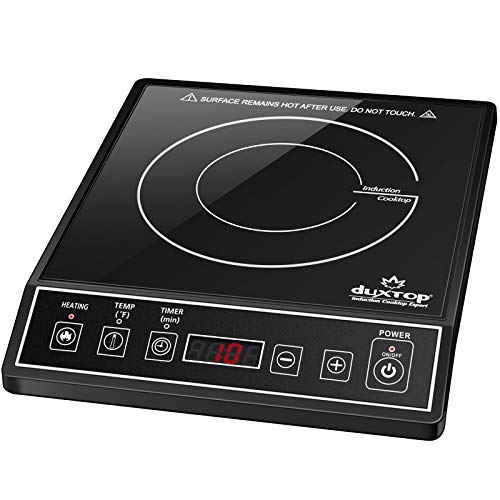
| Duxtop 9100MC Portable Induction Cooktop | Best Simple Classic | Duxtop’s long-running 9100MC design: 1800W, black glass-top format, and a control scheme that favours straightforward power-level cooking. | See review below |
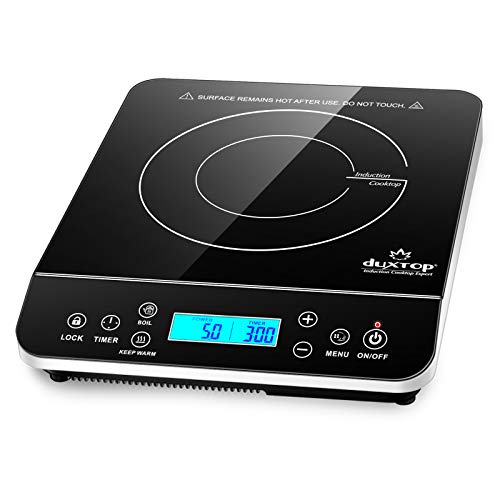
| Duxtop 9610LS Portable Induction Cooktop | Best Touch Controls | The 9610LS pairs 1800W with an LCD sensor-touch panel — the control interface most people picture when they imagine a modern glass cooktop. | See review below |
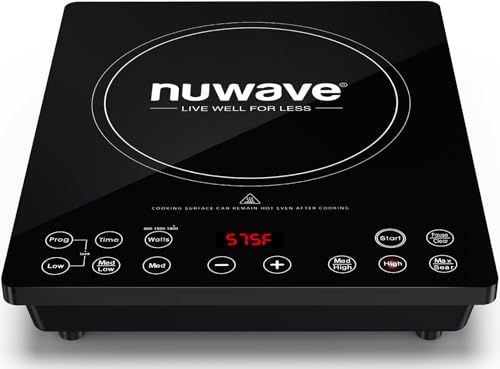
| Nuwave Pro Chef Induction Cooktop | Best for Precision Cooking | 94 temperature settings from 100°F to 575°F in 5°F steps, a large 8-inch coil, and a shatter-proof ceramic glass surface. | See review below |
| ISILER Portable Induction Cooktop | Best Compact Value | A compact 1800W unit with 10 power and 10 temperature settings, 7 cooking presets, a timer, and a safety lock — the family-friendly specification. | See review below |
How These Picks Were Chosen
We built this shortlist from verified retail listings, cross-checking every model against the manufacturer’s own listing data before assigning it a place. A pick only earned a purchase link when its listing title and specifications confirmed the core attributes of this keyword: electric power, a glass or ceramic-glass cooking surface, and a cooktop format a buyer searching this term would actually accept. Models that failed that test — including gas built-in units that surfaced in the same pool — were excluded from the linked picks rather than quietly re-labelled.
Within the qualifying set, we compared the attributes that change daily cooking: the number and fineness of temperature settings, timer range, heating-coil diameter, control style (touch panel versus push-button), body construction, and any certification or surface-durability claims stated in the listing. We weighted fine temperature control heavily, because the gap between 10 coarse levels and 94 fine steps is the difference between a burner that scorches chocolate and one that holds a gentle simmer for hours.
A note on method and honesty: this is a research-led guide. We analysed listing specifications, manufacturer descriptions, and the patterns in owner feedback rather than cooking on every unit in a test kitchen, and we say so plainly because it affects how you should read the verdicts. Where a listing did not state a specification, we left it out instead of guessing. Prices and ratings change constantly, so we do not print fixed figures — use the links to check the current position before you buy, the same approach we take in our guide to Best Electric Oven Cooktops.
Our 6 picks for best electric glass cooktops, reviewed one by one
Read the reviews in badge order if you want our ranking logic, or jump straight to the format you need: the double burner for two-pan meals, the commercial builds for heavy daily use, or the compact singles for small counters.

ChangBERT Commercial Induction Cooktop
Badge: Best Overall
Strengths
- Commercial-grade stainless steel body that shrugs off daily knocks better than plastic housings
- Large 8-inch heating coil spreads heat across bigger pans
- 10-hour timer suits long simmers, stocks, and slow braises
Trade-offs
- Stainless body shows fingerprints and needs a wipe to stay smart
- Single zone only, so two-pan meals need a second solution
- Commercial styling is more utilitarian than sleek
Key specs (from the manufacturer listing)
- Power: 1800W
- Heating coil: large 8-inch
- Body: premium stainless steel
- Certification: NSF certified (per listing title)
- Timer: up to 10 hours
- Format: commercial-grade portable countertop burner
The ChangBERT earns the top badge because it covers the widest range of real cooking without an obvious weak point. The listing describes a commercial-grade portable cooker with a premium stainless steel body and NSF certification, which places it a step above the typical plastic-housed portable burner. In practice that build matters most for people who will use the unit daily — in a busy family kitchen as an overflow burner, in a small café or food-truck setting, or as the main cooking surface in a studio where it cannot hide in a cabinet between uses.
Performance is built around an 1800W output and a large 8-inch coil. Coil diameter is the unglamorous spec that decides whether a big skillet heats evenly or develops a hot ring in the middle, and 8 inches is the generous end of the portable class. The 10-hour timer is the other standout: most portables stop at 3 or 4 hours, which is fine for dinner but useless for an overnight stock or a long low braise. The honest limitation is format, not quality — it is still one cooking zone, and the workmanlike stainless finish will not win design awards next to the seamless glass panels elsewhere in this guide. If you want one portable glass-top burner that can be worked hard every day, this is the safest pair of hands here.
Best for: daily heavy use, long simmers, and buyers who value a certified commercial build / Not suited for: anyone who needs two burners at once or wants the sleekest possible look

Nuwave Double Pro Induction Cooktop
Badge: Best for Two-Pan Cooking
Strengths
- Two cooking zones on one countertop unit — unique in this guide
- Wide 50°F to 575°F temperature span covers warming through searing
- Dynamic Watt Technology lets you cap draw at 900W or 1500W for weak circuits
Trade-offs
- Two zones share the unit’s total power budget when both run hard
- Larger footprint than any single burner here
- Touch panel controls are less tactile than physical buttons
Key specs (from the manufacturer listing)
- Burners: double (two cooking zones)
- Temperature range: 50°F-575°F
- Wattage settings: 900W / 1500W / 1800W with Dynamic Watt Technology
- Heating coil: 8-inch
- Surface: shatter-proof ceramic glass
- Controls: seamless IMD touch panel
Most portable induction units force a choice: one pan, one zone, and a queue of ingredients waiting their turn. The Nuwave Double Pro removes that bottleneck with two cooking zones on a single countertop body, each sitting over an 8-inch heating coil, under a shatter-proof ceramic glass surface with a seamless IMD touch panel. For a small apartment where this might be the entire stove, or for a holiday meal where the main range runs out of burners, two zones change what you can realistically cook.
The specification that deserves the most attention is Dynamic Watt Technology, with selectable 900W, 1500W, and 1800W settings. That is a practical answer to a real problem: older kitchens, dorms, and RVs often share a circuit with a microwave or kettle, and a full-draw 1800W burner can trip the breaker mid-service. Capping the draw trades a little speed for reliability. The temperature span is equally broad, running from 50°F for gentle holding up to 575°F for a hard sear. The trade-off is physics — when both zones work hard they share the available power, so two simultaneous rolling boils will be slower than one. Treat it as two flexible zones rather than two full-power burners and it is the most capable format in this guide, a point we return to in Best Electric Radiant Heat Cooktops when comparing heating technologies.
Best for: small kitchens needing two zones, entertainers adding overflow capacity, and RV or dorm cooks on shared circuits / Not suited for: minimalists who want the smallest possible unit to store
Duxtop 9100MC Portable Induction Cooktop
Badge: Best Simple Classic
Strengths
- Proven, widely owned Duxtop design with a deep base of owner experience behind it
- Full 1800W output in a compact single-zone body
- Uncomplicated operation suits cooks who dislike menu-diving
Trade-offs
- Listing states fewer control details than newer rivals — expect a simpler feature set
- Single zone, standard coil class
- Black finish shows dust and dried splashes clearly
Key specs (from the manufacturer listing)
- Power: 1800W
- Model: 9100MC (BT-M20B)
- Finish: black
- Format: portable countertop burner
The Duxtop 9100MC is the establishment candidate in this line-up: a black 1800W portable induction burner from one of the best-known names in the category, with a model history long enough that its strengths and quirks are thoroughly documented by owners. That maturity is itself a feature. When a design has been sold for years, replacement questions are answered, accessory compatibility is known, and there are no first-generation surprises waiting in month two.
What you give up for that maturity is feature depth. The listing for the 9100MC is comparatively terse — it confirms the 1800W output and countertop format without advertising dozens of temperature steps, preset menus, or an extra-long timer. Read that honestly: this is a burner for cooks who think in power levels, want to put a pan on and cook, and do not need a 5-degree increment to feel in control. It will boil, sear, sauté, and simmer perfectly well; it simply offers less fine theatre around those jobs than the Nuwave models. For a second burner, a student kitchen, a camper, or a gift for a technophobe relative, that simplicity is the point. It is also a useful baseline if you are cross-shopping the broader category in Best Elegant Cooktops For Luxury Kitchens, where finish and design language get more attention.
Best for: buyers who want a proven, simple, full-power single burner / Not suited for: precision cooks who want fine temperature steps and long programmable timers
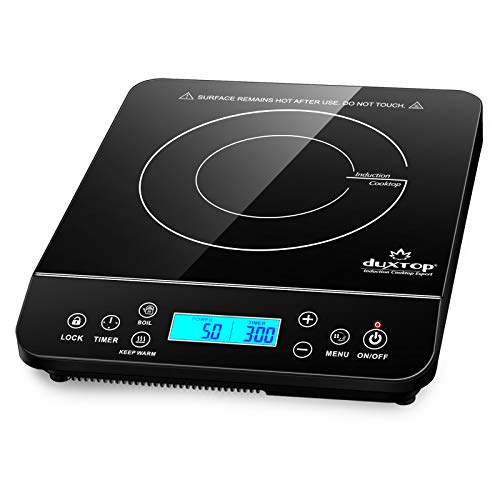
Duxtop 9610LS Portable Induction Cooktop
Badge: Best Touch Controls
Strengths
- LCD sensor-touch controls give the true smoothtop experience — no knobs to trap grease
- 1800W output matches the strongest singles here
- Touch panel wipes clean with the rest of the glass surface
Trade-offs
- Touch sliders can be fiddly with wet or greasy fingers
- Single cooking zone
- Feature set centres on controls rather than timers or presets
Key specs (from the manufacturer listing)
- Power: 1800W
- Model: 9610LS (BT-200DZ)
- Controls: LCD sensor touch
- Finish: black
- Format: portable countertop burner
If the appeal of a glass cooktop is the seamless, wipe-clean control surface, the Duxtop 9610LS is the pick that delivers it most completely. Its LCD sensor-touch panel sits flush with the cooking surface, so the whole unit presents as one continuous sheet — no dial to unscrew during a deep clean, no seam where sauce can bake in. Owners of built-in smoothtops will feel immediately at home, and for anyone whose main complaint about portable burners is that they look like camping equipment, this is the counter-argument.
Under the panel it is a full-strength 1800W single-zone burner, so the styling does not cost cooking power. The honest caveat belongs to all touch interfaces: they respond best to dry, deliberate fingers. Mid-recipe, with wet hands and a pan that needs the heat dropped now, a slider can take two attempts where a knob takes one twist. Most cooks adapt within a week, and the timer and lock functions typical of this control family help, but if you know you hate touch controls from your current stove, believe yourself and choose the push-button OneSetNuf pattern instead. For everyone else, the 9610LS is the closest a portable gets to the built-in glass experience.
Best for: design-led kitchens and anyone who wants flush, wipe-clean touch controls / Not suited for: cooks who strongly prefer physical buttons or knobs

Nuwave Pro Chef Induction Cooktop
Badge: Best for Precision Cooking
Strengths
- 94 temperature settings in 5°F increments — the finest control in this guide by a wide margin
- Large 8-inch coil for even heating under bigger pans
- Shatter-proof ceramic glass surface stated in the listing
Trade-offs
- Precision features reward cooks who use them; casual users may never leave the middle settings
- Single zone
- Commercial-grade positioning without the ChangBERT’s NSF note in its title
Key specs (from the manufacturer listing)
- Power: 1800W
- Heating coil: large 8-inch
- Temperature settings: 94, from 100°F to 575°F in 5°F increments
- Surface: shatter-proof ceramic glass
- Grade: commercial-grade portable burner
Temperature granularity is where portable induction burners separate into toys and tools, and the Nuwave Pro Chef is the tool. Its listing specifies 94 temperature settings spanning 100°F to 575°F in 5°F increments. That fineness changes specific jobs: chocolate holds without seizing, milk scalds without catching, a delicate sauce stays at a bare simmer instead of cycling between off and boiling, and low-and-slow braises sit exactly where you set them for hours. Cooks who sous-vide will recognise the mindset — this is set-a-number-and-trust-it cooking.
The supporting hardware matches the ambition: 1800W of power, a large 8-inch coil for even coverage, and a shatter-proof ceramic glass surface, all in a commercial-grade portable body. The limitation is not capability but audience. If your cooking is mostly boiling pasta and frying eggs, the extra settings are decoration, and a simpler model will serve you identically for less complexity. If, on the other hand, you have ever stood over a pan nudging a dial between too-hot and not-hot-enough, the Pro Chef was designed for you. Precision shoppers comparing across categories will also want our notes in Best Elevtric Cooktops, where the same control questions are weighed for the wider electric field.
Best for: precision cooks, sauce and chocolate work, and anyone who simmers by number / Not suited for: casual cooks who only need boil, fry, and off

ISILER Portable Induction Cooktop
Badge: Best Compact Value
Strengths
- 7 cooking presets lower the learning curve for new induction users
- Safety lock is a genuine asset in households with small children
- Compact footprint stores easily between uses
Trade-offs
- 10 temperature levels are coarse next to the Nuwave Pro Chef’s 94
- Presets cover common jobs but limit improvisation
- Compact body means standard portable coil coverage — very large pans will overhang
Key specs (from the manufacturer listing)
- Power: 1800W
- Heating plate: 8-inch
- Settings: 10 power and 10 temperature levels
- Presets: 7 cooking presets
- Safety: timer and safety lock
- Format: compact portable design
The ISILER portable induction cooktop is specified like a product designed by someone who watched beginners use induction for the first time. Ten power levels and ten temperature settings keep the interface unintimidating, seven cooking presets handle the jobs most people actually repeat, and a safety lock addresses the worry every parent has about a flat, button-covered surface at counter height. The 8-inch heating plate and full 1800W output mean none of this accessibility costs real cooking ability.
This is the pick we would hand to a first-time induction buyer, a grandparent, or a family adding an overflow burner for holiday cooking. The presets are not a gimmick for that audience — they convert “what temperature fries an egg?” into one touch, and the lock converts a nagging worry into a non-issue. The trade-off appears when your cooking outgrows the template: ten temperature steps cannot hold the in-between points a sauce cook wants, and preset logic is only as good as its match to your pans and portions. As a first glass-top burner, though, it balances capability, safety, and simplicity better than anything else in this set.
Best for: first-time induction users, families with children, and small counters / Not suited for: experienced cooks who want fine manual temperature steps
Comparison Table
Side by side, the six differ less in power — all are 1800W class — than in control fineness, zone count, and build. Use the table to find your priority, then read that pick’s full review.
| Pick | Type | Power / Output | Controls & standout feature | Link |
|---|---|---|---|---|
| ChangBERT Commercial Induction Cooktop | Portable induction, single zone | 1800W | Stainless commercial body, NSF certified in listing, 10-hour timer | Check on Amazon |
| Nuwave Double Pro Induction Cooktop | Portable induction, double zone | 900W / 1500W / 1800W selectable | Dynamic Watt Technology, 50°F–575°F, ceramic glass | Check on Amazon |
| Duxtop 9100MC Portable Induction Cooktop | Portable induction, single zone | 1800W | Classic Duxtop design, black finish | Check on Amazon |
| Duxtop 9610LS Portable Induction Cooktop | Portable induction, single zone | 1800W | LCD sensor-touch panel, black finish | Check on Amazon |
| Nuwave Pro Chef Induction Cooktop | Portable induction, single zone | 1800W | 94 temp settings in 5°F steps, ceramic glass | Check on Amazon |
| ISILER Portable Induction Cooktop | Portable induction, single zone | 1800W | 10 + 10 settings, 7 presets, safety lock | Check on Amazon |
How to Choose the Best Electric Glass Cooktops for Your Kitchen
Start with the technology: induction versus radiant glass
Every model in this guide is induction, and it is worth understanding what that means before you spend anything. An induction burner creates a magnetic field that heats the pan itself; the glass surface warms mainly from contact with the hot pan, so it cools quickly and rarely bakes spills on. A radiant glass cooktop uses a glowing element under the glass — the surface gets genuinely hot, stays hot after switch-off, and behaves more like a traditional electric hob. Induction is faster to boil, more responsive to reduce, and more efficient; radiant accepts every pan material without question. If your cookware is aluminium or copper without a magnetic base, radiant (or a different format entirely, such as those in Best Eolectric Cooktops) is the compatible route.
The magnet test settles which camp your kitchen is in: if a fridge magnet sticks firmly to the base of a pan, that pan works on induction. Run it over your whole collection before ordering. Many households find most of their stainless and cast iron passes and one or two favourite pans fail — budget for replacing a single saucepan rather than rejecting induction outright.
Temperature control: levels, steps, and why the count matters
Manufacturers describe control three ways: power levels (a 1-to-10 scale of output), temperature levels (the same idea in degrees), and true fine-step temperature control. For everyday cooking — boiling, frying, sautéing — 10 honest levels are enough, and the ISILER and Duxtop models prove it. Fine-step control earns its keep in narrow jobs: holding chocolate at melting point, keeping a hollandaise below splitting temperature, poaching, and long gentle simmers where a coarse burner cycles between too much and too little. The Nuwave Pro Chef’s 94 settings in 5°F steps are the extreme example in this guide.
A related trap is the low end. A burner whose lowest setting is still fierce cannot simmer rice or keep soup warm without scorching; check the bottom of the stated temperature range, not just the headline maximum. The Double Pro’s 50°F floor and the Pro Chef’s 100°F floor both signal genuine low-heat intent.
Coil size, pan size, and the overhang question
Portable induction coils cluster around 8 inches, and every pick here sits in that class. The coil, not the glass, defines the heated area: a 12-inch skillet on an 8-inch coil cooks with a hot centre and cooler rim, which matters for pancakes and omelettes more than for a pot of soup. Match your most-used pan’s base diameter to the coil. Modest overhang is normal and safe on glass tops; extreme overhang wastes energy and can overheat the unit’s edge electronics on long, high sessions.
Weight matters too. Glass surfaces have load limits, and a full stockpot plus a heavy Dutch oven concentrates serious weight on one spot. Commercial-style builds like the ChangBERT exist precisely for cooks who regularly lift that kind of load onto the burner.
Timers, locks, and the features that change daily life
Timers divide into two camps: short timers that suit a boiled egg, and long timers — the 10-hour units on the ChangBERT and OneSetNuf pattern — that enable unattended stocks and braises. Decide which cook you are. Safety locks matter in family kitchens; auto shut-off when a pan is removed is standard induction behaviour and one of its quiet safety advantages. Presets are training wheels that many owners keep using for years on repeat jobs. None of these features appears on a spec-sheet headline, yet they decide satisfaction more often than wattage does.
Glass itself: grades, durability, and replacement reality
Not all glass tops are equal, and the listings that say so deserve the attention. Ceramic glass — the material named in the Nuwave models’ listings — is engineered for thermal shock: it tolerates a hot pan beside a cold zone because it barely expands with heat. “Shatter-proof” claims, where a listing makes them, refer to reinforced construction rather than literal indestructibility; treat any glass top as a surface that rewards respect — no dropped Dutch ovens from height, no cold water onto a screaming-hot zone. If a top does crack, the honest reality of the portable format is that the unit is replaced rather than re-glazed, which is one more argument for the commercial builds if your cooking is heavy: the ChangBERT’s stainless body protects its edges and corners, where chips begin.
Durability also has a daily, unglamorous dimension: edge design. A top whose glass sits proud of the body catches pan rims and belt buckles; a top recessed or framed by the body survives the same kitchen longer. None of the listings in our verified pool publishes drop-test data, so we do not rank on it — but when your shortlist narrows to two, the one whose glass looks sheltered by its own body is the one a decade of Tuesdays will treat better.
How to Use a Glass-Top Induction Burner Safely and Well
Setup and first use
Place the burner on a flat, stable, heat-resistant surface with clear space around its vents — induction units cool their electronics with internal fans, and a blocked vent shortens the unit’s life. Plug it directly into a wall outlet rather than a lightweight extension lead, and keep the cord clear of the cooking zone. Before the first real meal, boil a small pan of water: you will hear the fan, learn the control response, and confirm your pan is compatible if the water heats quickly and evenly.
Wipe the glass before every session. Grit trapped under a pan is the main cause of scratched glass tops, and it takes two seconds to prevent. Lift pans rather than sliding them, especially cast iron with rough bases.
Everyday cooking technique on glass
Induction responds almost instantly, so preheat gradually: start a pan at a medium setting for a minute before going high, which protects both the pan from warping and the glass from thermal shock. Because the pan is the heat source, an empty pan on full power gets dangerously hot very fast — never preheat an empty pan unattended. Use the temperature mode for sauces and simmering, power mode for boiling and searing, and expect to drop settings earlier than you would on gas, because there is no residual element heat carrying the cooking after you turn down.
Step by step for a perfect simmer: bring the liquid to the boil on a high power level, drop straight to your chosen temperature setting, wait ninety seconds for the pan to settle, then adjust once. Chasing the temperature with constant small changes is the most common beginner habit and the least necessary — induction holds a set point patiently.
Cleaning and protecting the glass
Let the surface cool until it is comfortable to touch, then wipe with a soft cloth and warm soapy water for daily spills. Sugary spills are the emergency case: sugar can pit glass as it cools, so remove sugary splashes promptly once the surface is safe to approach, using a suitable scraper held flat. Avoid abrasive pads and powdered scouring cleaners, which dull the finish over time. The touch-control models have an obvious advantage here — the whole top is one wipeable plane.
Troubleshooting: three common problems
Problem: the burner beeps, shows an error, or will not start → check the pan first. The base must be flat, magnetic, and centred on the marked zone, and it must be large enough for the unit’s pan detection. Try a pan you know is induction-compatible before assuming a fault.
Problem: the unit shuts down mid-cook → look at ventilation and load. Blocked vents, a pan far larger than the coil on maximum power for a long stretch, or a shared circuit under strain can all trigger protective shut-off. Clear the vents, reduce the setting, and let the unit cool before restarting.
Problem: food scorches in the centre while the edges lag → your pan base is larger than the coil or the pan’s base is thin and warps when hot. Drop one power level, give liquids a stir, and for regular large-pan cooking consider the wider-coil or double-zone options rather than forcing a small coil to do a big pan’s job.
Glass Versus the Alternatives: Radiant, Coil, and Gas
Shoppers land on this keyword from three directions, and it helps to name them. Some are replacing a coil stove and want the clean look; for them any glass top is an aesthetic leap, and the touch-control Duxtop 9610LS delivers the biggest visual change. Some are chasing speed and efficiency; for them induction’s direct pan heating is the point, and control fineness separates the picks. Some simply want a surface that cleans in one wipe — and here glass induction beats radiant glass, because spills sit on a cooler surface and rarely carbonise.
Against gas, the comparison is about control style and infrastructure. Gas gives visible flame and universal pan compatibility but needs a supply line or a bottle, produces combustion moisture and heat in the room, and in portable form means a different product class entirely. The electric glass route plugs into the outlet you already have. Neither is universally better; they optimise for different kitchens, which is why our guides treat fuel type as a first-order decision rather than a detail.
What “Best” Means at Different Budgets, Without the Price Tag
We do not print fixed prices — they move too often to be honest in a guide — but the tier logic is stable. In the lower tier, expect a competent single-zone burner with around ten control levels and a short timer: the ISILER pattern. The middle tier buys build and interface — stainless commercial bodies, LCD touch panels, longer timers. The upper tier buys control sophistication: the Pro Chef’s fine temperature steps or the Double Pro’s two zones with wattage management. Notice that wattage does not rise with tier; 1800W is the ceiling everywhere, set by the household outlet. Spend on the attribute you will feel daily — control, zones, or build — not on a bigger number that does not exist.
Also budget honestly for the hidden line item: pans. If half your cookware fails the magnet test, the true cost of switching to induction includes replacements, and a radiant or dual-fuel plan may be the smarter spend. The picks themselves hold their value logic regardless of which week you buy them.
Who Should Not Buy a Portable Glass-Top Burner
Honest guides owe readers the negative space, so here it is. If your household cooks four pans simultaneously most nights, a portable single zone — however good — will frustrate you daily; your answer is a full hob, possibly with one portable as its fifth zone. If your cookware is a beloved set of non-magnetic aluminium and copper that you will not replace or supplement, induction in any form is the wrong technology and a radiant glass cooktop is your honest route. If your kitchen’s outlets are already strained — breakers tripping at current loads — solve the electrical question before adding 1800W of ambition to it.
There is also a temperament test. Glass rewards the cook who wipes as they go and lifts what they carry; it punishes, slowly and cosmetically, the cook who drags, drops, and defers cleaning to the weekend. Neither cook is wrong, but they should not buy the same surface. If the second portrait is yours, the stainless-bodied commercial picks will forgive you more than the seamless glass showpieces will — one more reason this guide ranks builds, not just specifications.
Everyone else — renters, small households, overflow cooks, the glass-curious — is who this format was invented for, and the six reviews above were written with your kitchens in mind.
Renting With Glass: High-End Cooking, Deposit Intact
Renters live under a double constraint — cook properly, change nothing — and the portable glass-top burner threads it elegantly. It asks for no installation, no landlord negotiation, and no rewiring; it improves on the hob that came with the flat without touching it; and when the lease ends it leaves in a box, taking its scratches, if any, with it rather than leaving them on someone else’s worktop for the deposit discussion. For the length of a tenancy it is often the single highest-impact kitchen upgrade available at any price.
Two renter-specific habits complete the picture. Photograph the counter where the unit will live before first use, as you would for any tenancy record — not because the burner endangers surfaces, but because the habit costs nothing. And keep the unit’s box: landlords aside, the box is the difference between a glass top that survives the move and one that arrives at the next kitchen as a cautionary tale.
Common Buying Mistakes
Assuming every pan works. Induction needs a magnetic, flat base. Test your collection with a magnet before ordering, and measure base diameters against the roughly 8-inch coils used across this guide.
Buying on wattage alone. Every serious portable here is 1800W because that is what a standard outlet supports. Control steps, timer length, coil size, and build quality are where models actually differ.
Ignoring the timer’s ceiling. A 3-hour timer is fine for dinner and useless for an overnight stock. If long unattended cooking is your plan, the 10-hour class is not a luxury — it is the requirement.
Sliding heavy pans across the glass. Grit under a dragged cast-iron pan is how glass tops get scratched. Wipe the surface, lift the pan, and your cooktop will look new for years.
Running a big burner on a shared, loaded circuit. A microwave plus an 1800W burner on one circuit is a tripped breaker waiting for its moment. Know your kitchen’s circuits, or choose a wattage-capping model like the Double Pro.
Final Recommendation
For most buyers, the ChangBERT is the recommendation to beat: commercial build, a generous coil, NSF certification in its listing, and a 10-hour timer make it the most complete single burner here. Choose the Nuwave Pro Chef instead if precise temperature work is your cooking’s centre of gravity, and the Double Pro if two zones matter more than anything else. The Duxtop pair split the difference by taste — the 9100MC for proven simplicity, the 9610LS for the flush touch-control experience — while the ISILER is the friendliest first induction burner and the one we would give a family with young children.
Whichever you choose, run the magnet test tonight, measure your favourite pan, and check your circuit before the box arrives. Those three five-minute checks prevent nearly every disappointment this product category produces.
Start with our top pick here: Check on Amazon
Frequently Asked Questions
Are portable induction burners really “glass cooktops”?
Yes, in the way that matters to a buyer: the cooking surface is a flat glass or ceramic-glass sheet, flush and wipe-clean, exactly like a built-in smoothtop. The difference is underneath — induction heats the pan magnetically rather than heating the glass with an element, so the surface runs cooler and responds faster.
Can I use my existing pans on these burners?
Only if a magnet sticks firmly to the pan’s base and the base is flat. Cast iron and most stainless steel pass; pure aluminium, copper, and glass pans do not, unless they have a magnetic induction plate built into the base. Test before you buy — it takes a minute.
Why is every model 1800W?
Because that is approximately the maximum a standard North American household outlet supplies continuously. Manufacturers compete on control, coil design, and features instead, which is why this guide weighs those attributes more heavily than power.
Is a double induction burner better than two singles?
For counter space and circuit management, usually yes: the Double Pro shares one footprint and can cap its total draw with selectable wattage. Two singles give you placement flexibility and redundancy. Households that cook two-pan meals most nights benefit most from the double.
How do I stop the glass from scratching?
Wipe the surface before cooking so grit cannot grind under the pan, lift pans instead of sliding them, and avoid dragging rough cast-iron bases. Clean spills promptly — especially sugary ones — once the surface has cooled enough to touch safely.
What does a safety lock actually do?
It disables the touch controls so a child, a pet, or an accidental brush of a sleeve cannot change settings or switch the burner on. On models like the ISILER it is a headline feature because portable burners live at counter height, within reach of small hands.
How long will a portable glass-top burner last?
There is no honest fixed number — it depends on use, ventilation, and load. Commercial-style stainless builds and certified models are designed for heavier daily duty. Keeping vents clear, avoiding oversized pans on maximum power for hours, and not exceeding sensible pan weights are the habits that extend any unit’s life.