Disclosure: topratedkitchenware.com is reader-supported. When you buy through links on our site, we may earn an affiliate commission from Amazon and other retailers, at no extra cost to you.
Where to buy
If you are looking for the best electric oven cooktops — the burner power you use alongside, above, or instead of a conventional oven — the four linked portable induction models below are the picks that meet the electric brief, followed by two built-in gas units we review in prose only for cross-shoppers. Every linked pick was verified against its manufacturer listing.
- Duxtop 9100MC Portable Induction Cooktop — Best Overall · Check on Amazon
- Duxtop 9610LS Portable Induction Cooktop — Best Touch Controls
- Nuwave Pro Chef Induction Cooktop — Best for Precision Oven Pairing
- ISILER Portable Induction Cooktop — Best for Families
- VEVOR 30-Inch 5-Burner Gas Cooktop — Gas Alternative — Prose-Only (reviewed in full below; no purchase link — see the review for why)
- ThermoMate 36-Inch 5-Burner Gas Cooktop — Gas Alternative — Prose-Only (reviewed in full below; no purchase link — see the review for why)
Read the full guide ↓
Searches for the best electric oven cooktops usually start from one of three kitchens. In the first, a range’s oven works perfectly but one burner has died, and the owner wants cooking capacity back without replacing the whole appliance. In the second, a keen cook roasts and bakes in the oven while the stovetop runs out of zones — think holiday dinners, where the gravy, the vegetables, the potatoes, and the custard all need heat at once. In the third, a small apartment, studio, or annex has an oven but no real hob at all. All three problems share one practical answer in 2026: a portable electric induction burner that works beside the oven, plugs into a standard outlet, and stores away when the feast is over.
This guide reviews four of those burners as linked picks, chosen for control quality, build, and how well they pair with oven-centred cooking. It also reviews — honestly, and without purchase links — two built-in gas cooktops that constantly surface in the same searches. They are capable products, but they are gas, not electric, and they install permanently rather than complementing an existing oven, so they cannot be linked recommendations in a guide with this title. Understanding that distinction is half of shopping this category well; the other half is matching control style and timer length to the way you actually cook alongside an oven. Readers comparing surface technologies should also see Best Electric Radiant Heat Cooktops for the radiant side of the electric family.
Key Takeaways
- The four linked picks are portable induction burners — the practical way to add electric cooking power beside an existing oven without rewiring or replacing the range.
- Long timers matter in oven-centred cooking: a burner that holds a sauce for hours while the oven roasts is worth more than raw wattage.
- All four linked picks are 1800W class, the ceiling for a standard outlet, so control fineness and build separate them — not power.
- The two gas built-ins reviewed later are prose-only on purpose: they are good products that fail this keyword’s core requirement — they are not electric.
- Check your circuit before holiday cooking: an oven plus an 1800W burner plus a microwave can exceed what one kitchen circuit delivers.
- Induction burners need magnetic pans; run the magnet test over your oven-to-table cookware before ordering.
In this guide
Quick Picks
Four electric picks that genuinely belong in this guide, then two gas built-ins included transparently as prose-only comparisons for readers cross-shopping a full range replacement.
| Pick | Badge | Why it stands out | Link |
|---|---|---|---|
| Duxtop 9100MC Portable Induction Cooktop | Best Overall | Duxtop’s proven 9100MC: full 1800W, a mature design, and the simplest possible partnership with your oven — plug in, cook, store away. | See review below |
| Duxtop 9610LS Portable Induction Cooktop | Best Touch Controls | The 9610LS brings a flush LCD sensor-touch panel — the range-style glass experience in a portable that parks beside your oven. | Check on Amazon |
| Nuwave Pro Chef Induction Cooktop | Best for Precision Oven Pairing | 94 temperature settings in 5°F steps from 100°F to 575°F — the burner that holds a sauce exactly where your roast needs it. | See review below |
| ISILER Portable Induction Cooktop | Best for Families | Seven presets, a timer, and a safety lock in a compact 1800W body — the friendly extra burner for busy family oven nights. | See review below |
| VEVOR 30-Inch 5-Burner Gas Cooktop | Gas Alternative — Prose-Only | A 30-inch, 5-burner built-in gas cooktop — capable, but gas and permanently installed, so it is reviewed here without a link for cross-shoppers only. | Prose-only pick |
| ThermoMate 36-Inch 5-Burner Gas Cooktop | Gas Alternative — Prose-Only | A 36-inch, 5-burner built-in gas hob with Italy Sabaf burners and CSA certification in the listing — again, gas, so prose-only here. | Prose-only pick |
How These Picks Were Chosen
Our method was to verify every candidate against its manufacturer listing and then apply this keyword’s core test without exceptions: is it electric, and does it function as cooktop power for an oven-centred kitchen? Four portable induction burners passed cleanly. Two heavily promoted built-in units failed the first question — they burn gas — so rather than drop them silently or, worse, present them as electric picks, we review them in full as prose-only entries with no purchase links and no images. That transparency is the difference between a guide and a catalogue.
Among the qualifying electric picks, we compared temperature-control fineness, timer ceilings, control interface, and build quality, weighting the attributes that matter when a burner works in partnership with an oven: holding a sauce at a bare simmer for the length of a roast, keeping vegetables warm without continued cooking, and boiling fast when the oven is busy and the clock is not. Fine temperature steps and long timers scored heavily; headline wattage did not, because every serious candidate sits at the same 1800W outlet ceiling.
This is a research-led guide built from listing specifications and manufacturer documentation, not from a test kitchen where we cooked on every unit — we would rather state that plainly than borrow authority we have not earned. Where a listing omits a specification, we omit it too. Prices move constantly, so we print none; check the current figure through the links, as we advise in Best Electric Smoothtop Cooktops as well.
Our 6 picks for best electric oven cooktops, reviewed one by one
The electric picks come first, in ranked order. The gas pair follows, clearly badged as prose-only alternatives, for readers whose real project is a range replacement rather than an oven companion.
Duxtop 9100MC Portable Induction Cooktop
Badge: Best Overall
Strengths
- Long-running Duxtop design with a deep record of owner experience
- Full 1800W output for fast boiling beside the oven
- Simple operation that never gets in the way during a big cook
Trade-offs
- Listing is light on control detail — a simpler feature set than newer rivals
- Single zone only
- No headline long-timer or fine-step temperature claims in the listing
Key specs (from the manufacturer listing)
- Power: 1800W
- Model: 9100MC (BT-M20B)
- Finish: black
- Format: portable countertop burner
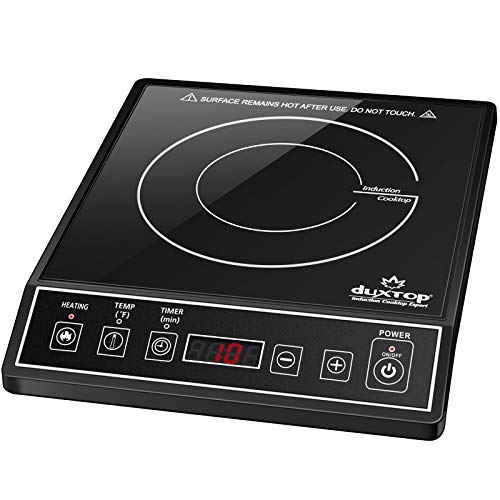
The Duxtop 9100MC takes the top badge here because oven-companion duty rewards reliability and simplicity above almost everything else. When the oven is full, the kitchen is hot, and three dishes are converging on the same serving minute, the last thing you need is a burner with a learning curve. The 9100MC is a mature, widely owned 1800W portable induction burner in a compact black countertop body: put a pan on it, set a level, and cook. Its years in the market mean its behaviour is thoroughly documented and its quirks are known quantities.
Its limitations are the flip side of that maturity. The listing does not advertise the fine temperature steps of the Nuwave Pro Chef or an extra-long timer, so if your oven partnership involves holding a delicate sauce at one precise temperature for a three-hour roast, a more specialised pick below serves you better. For the classic jobs — boiling the potatoes while the chicken roasts, frying the onions the oven cannot, keeping a fifth dish alive at a buffet — the 9100MC is exactly the uncomplicated tool the situation calls for, and it stores in a drawer when the occasion passes.
Best for: range owners adding a fifth burner, holiday cooks, and anyone who values proven simplicity / Not suited for: precision sauce work held for hours at an exact temperature
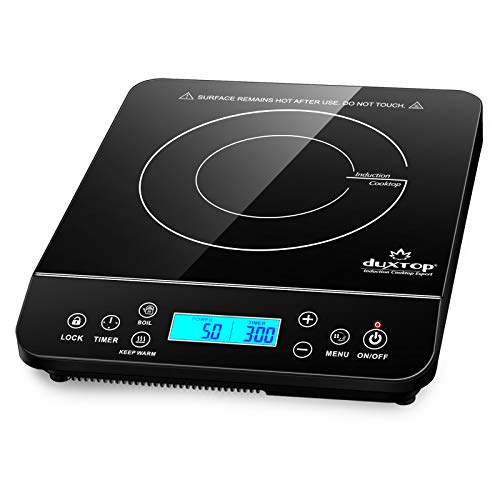
Duxtop 9610LS Portable Induction Cooktop
Badge: Best Touch Controls
Strengths
- LCD sensor-touch panel sits flush, matching a modern range’s glass aesthetic
- 1800W output equals the strongest singles here
- Whole surface wipes clean — valuable in a splattering roast-day kitchen
Trade-offs
- Touch controls can misread wet or greasy fingers mid-service
- Single zone
- Interface-led feature set rather than timer-led
Key specs (from the manufacturer listing)
- Power: 1800W
- Model: 9610LS (BT-200DZ)
- Controls: LCD sensor touch
- Finish: black
- Format: portable countertop burner
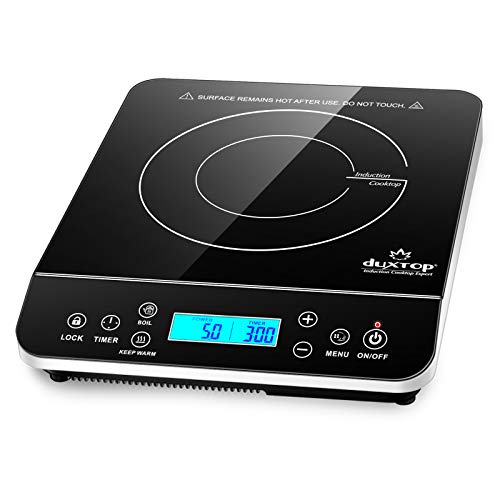
Kitchens with a sleek glass-topped range often reject portable burners on sight: the camping-stove look clashes with the room. The Duxtop 9610LS answers that objection with an LCD sensor-touch control panel that lies flush with its surface, echoing the built-in glass experience. Beside a modern oven it looks intentional rather than improvised, and when the cooking is done the entire top — controls included — cleans with a single wipe, which on a roast day, with fat in the air and gravy on every surface, is worth more than it sounds.
Cooking ability is full-strength: 1800W through a single zone, with the responsive, pan-centred heating that makes induction such a good partner to oven work — the burner reacts the moment you adjust it, even while your attention is on the roasting tin. The standing caveat for touch panels applies: they prefer dry fingers, and mid-service adjustments with wet hands can take a second touch. Cooks who know they dislike touch controls from their current range should take the hint and choose a button-led model instead. For everyone else, this is the oven companion that disappears visually into a modern kitchen.
Best for: modern glass-range kitchens and cooks who want flush, wipe-clean controls / Not suited for: anyone who strongly prefers physical knobs or buttons

Nuwave Pro Chef Induction Cooktop
Badge: Best for Precision Oven Pairing
Strengths
- 94 temperature settings in 5°F increments — unmatched control in this guide
- Large 8-inch coil heats wide pans evenly
- Shatter-proof ceramic glass surface stated in the listing
Trade-offs
- Precision is wasted on boil-and-fry cooking
- Single zone
- Commercial-grade focus rather than preset-led convenience
Key specs (from the manufacturer listing)
- Power: 1800W
- Heating coil: large 8-inch
- Temperature settings: 94, from 100°F to 575°F in 5°F increments
- Surface: shatter-proof ceramic glass
- Grade: commercial-grade portable burner
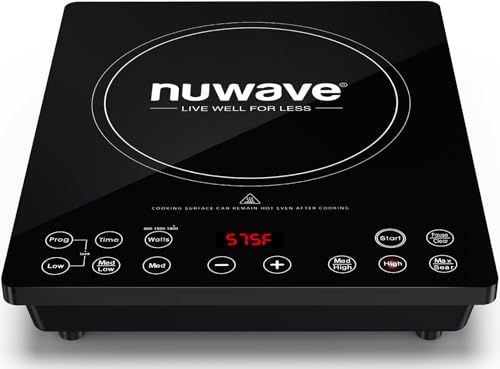
Oven cooking creates a specific burner job that coarse burners do badly: the long hold. A roast rests, a joint braises, a pudding steams — and meanwhile the sauce, the custard, or the gravy must sit at one gentle temperature, neither climbing nor falling, for an hour or more. The Nuwave Pro Chef is built for exactly that job, with 94 temperature settings from 100°F to 575°F in 5°F increments, so the difference between “barely simmering” and “splitting” becomes a number you set once instead of a dial you babysit.
The rest of the specification supports serious use: 1800W of power, a large 8-inch coil that treats a wide sauté pan fairly, and a shatter-proof ceramic glass surface in a commercial-grade portable body. The honest trade-off is audience fit. If your oven partnership is mostly boiling vegetables and frying accompaniments, this level of control is decoration. If you cook the kind of food where two degrees and twenty minutes matter — custards, emulsions, chocolate work for the dessert the oven is baking — the Pro Chef is not merely the best pick here, it is the only pick here designed around your problem. Precision-focused readers will find the same philosophy applied across Best Europian Induction Cooktops.
Best for: sauce, custard, and emulsion cooks who hold temperatures for the length of a roast / Not suited for: cooks whose stovetop work is boiling and frying only

ISILER Portable Induction Cooktop
Badge: Best for Families
Strengths
- Safety lock matters when a portable burner sits at counter height near children
- 7 cooking presets simplify repeat jobs like pasta water and pan sauces
- Compact body stores in a cabinet between big cooks
Trade-offs
- 10 temperature levels are coarse for delicate holding work
- Preset logic cannot match every pan and portion
- Compact format suits standard pans; very wide pans overhang
Key specs (from the manufacturer listing)
- Power: 1800W
- Heating plate: 8-inch
- Settings: 10 power and 10 temperature levels
- Presets: 7 cooking presets
- Safety: timer and safety lock
- Format: compact portable design
Family oven nights — the Sunday roast, the birthday bake, the exam-week comfort food — need an extra burner that anyone in the house can operate safely. The ISILER portable induction cooktop is specified for that household: 10 power and 10 temperature settings that never intimidate, 7 cooking presets for the repeat jobs, a timer, and a safety lock that disables the touch surface against small fingers and accidental sleeves. Its 8-inch heating plate and 1800W output keep it a real cooking tool rather than a warmer.
In oven partnership it shines on the simple, simultaneous jobs: pasta boiling while the bake finishes, garlic bread’s sauce warming, vegetables steaming in their final ten minutes. What it will not do is hold a hollandaise at a whisper for an hour — ten temperature steps are too coarse — and its presets assume typical pans and portions. As the family-safe, anyone-can-drive-it extra burner, though, nothing else in this guide balances approachability and capability as well.
Best for: families, shared houses, and occasional big-cook overflow / Not suited for: precision cooks who need fine temperature steps
VEVOR 30-Inch 5-Burner Gas Cooktop
Badge: Gas Alternative — Prose-Only
Strengths
- Five burners across a 30-inch built-in format for range-replacement projects
- NG/LPG convertible, suiting mains gas or bottled supply
- Thermocouple protection stated in the listing for flame-failure safety
Trade-offs
- It is gas, not electric — it fails this guide’s core requirement outright
- Built-in installation is permanent and needs a cut-out and a gas connection
- It replaces a cooktop rather than complementing an existing oven
Key specs (from the manufacturer listing)
- Fuel: gas, NG/LPG convertible
- Size: 30 inch, built-in
- Burners: 5, 12250 BTU (per listing title)
- Body: stainless steel
- Safety: thermocouple protection
Transparency first: the VEVOR 30-inch gas cooktop does not belong in an electric guide’s linked picks, and it has none — no purchase link, no product image. We review it because it floods the search results for this keyword family, and readers deserve an honest account of what it is rather than silence. What it is: a built-in, five-burner gas hob in stainless steel, convertible between natural gas and LPG, with thermocouple flame-failure protection and a stated total output figure in its listing. As a range-replacement component in a kitchen being rebuilt around gas, that is a coherent product.
As an answer to this keyword, it fails on the fundamentals. It is not electric. It does not sit beside your oven as flexible extra capacity; it must be cut into a counter, connected to a gas supply by a qualified installer in most jurisdictions, and committed to. If your actual project is “replace my cooktop with gas while keeping a separate oven,” this class of product is your real shortlist — and gas-specific coverage, not an electric guide, is the right place to shop it. If your project is the one this page addresses — more electric cooking power alongside the oven you own — the four linked picks above are the answer, and this unit is a category error, however competent it may be.
Best for: range-replacement projects committed to gas, assessed in our gas guides / Not suited for: anyone seeking electric oven-companion burners — it is the wrong fuel and the wrong format
ThermoMate 36-Inch 5-Burner Gas Cooktop
Badge: Gas Alternative — Prose-Only
Strengths
- Generous 36-inch width spreads five burners with real pan room
- Italy Sabaf burners and 304 stainless steel signal a serious build brief
- CSA certification and thermocouple protection stated in the listing
Trade-offs
- Gas fuel disqualifies it from this electric guide’s linked picks
- 36-inch built-in format demands a major counter cut-out
- It is a renovation component, not an oven companion
Key specs (from the manufacturer listing)
- Fuel: gas, NG/LPG convertible
- Size: 36 inch, built-in
- Burners: 5 Italy Sabaf power burners
- Body: 304 stainless steel
- Safety: thermocouple protection, CSA certified (per listing title)
The ThermoMate 36-inch gas cooktop gets the same transparent treatment as the VEVOR: a full review, no link, no image, because it is a gas appliance in an electric guide. On its own terms it is the more premium of the two gas units — five Italy Sabaf burners set in 304 stainless steel across a wide 36-inch built-in body, NG/LPG convertible, with thermocouple protection and CSA certification stated in its listing. For a large kitchen being designed around flame cooking, those are meaningful credentials, and the width genuinely helps when three wide pans compete for space.
None of that changes the category maths for this page. A reader with a working oven who wants electric burner capacity gains nothing from a 36-inch gas installation except a building project. We include the review so that readers who arrived here mid-renovation can make an informed turn — toward gas coverage for the renovation, or toward the wider electric field mapped in Best Elevtric Cooktops — and so that everyone else can see exactly why the linked picks above — portable, electric, plug-in — are the honest answer to the keyword as written.
Best for: large gas renovation projects, assessed in our gas guides / Not suited for: electric oven-companion use in any form
Comparison Table
The table makes the category split impossible to miss: four portable electrics that answer the keyword, and two built-in gas units that answer a different question entirely.
| Pick | Type | Power / Output | Controls & standout feature | Link |
|---|---|---|---|---|
| Duxtop 9100MC Portable Induction Cooktop | Portable induction, single zone | 1800W | Classic Duxtop design, black finish | Check on Amazon |
| Duxtop 9610LS Portable Induction Cooktop | Portable induction, single zone | 1800W | LCD sensor-touch panel, black finish | Check on Amazon |
| Nuwave Pro Chef Induction Cooktop | Portable induction, single zone | 1800W | 94 temp settings in 5°F steps, ceramic glass | Check on Amazon |
| ISILER Portable Induction Cooktop | Portable induction, single zone | 1800W | 10 + 10 settings, 7 presets, safety lock | Check on Amazon |
| VEVOR 30-Inch 5-Burner Gas Cooktop | Built-in GAS cooktop, 5 burners | 30 inch, NG/LPG | Thermocouple protection, stainless steel | Prose-only pick |
| ThermoMate 36-Inch 5-Burner Gas Cooktop | Built-in GAS cooktop, 5 burners | 36 inch, NG/LPG | Italy Sabaf burners, CSA certified in listing | Prose-only pick |
How to Choose Electric Cooktop Power That Works With Your Oven
Decide what problem the burner is solving
Oven-companion burners get bought for three jobs, and each job favours a different pick. Overflow capacity — one more zone on the busiest cooking day of the year — rewards simplicity and storage size: the Duxtop 9100MC pattern. The long hold — sauces and custards waiting on a roast — rewards fine temperature steps: the Nuwave Pro Chef. Household duty — an extra burner any family member can use — rewards presets and a lock: the ISILER. Naming your job before shopping prevents the classic error of buying the most featured burner for the simplest task, or the simplest burner for a precision job.
If your real problem is different — a dead range you intend to replace wholesale — say so honestly and shop that category instead. Built-in electrics, ranges, and yes, gas hobs like the prose-only pair live in that world, where finish and permanence matter as much as fuel — the territory of Best Elegant Cooktops For Luxury Kitchens.
Power, circuits, and the holiday-load problem
Every linked pick draws up to 1800W because that is what a standard outlet offers. The complication is company: an electric oven on the same circuit can draw several times that, and adding a microwave or kettle completes the overload. Before a big cook, learn which outlets share a circuit with your oven — the breaker panel’s labels, or a methodical test with a lamp, will tell you. Plug the portable burner into an outlet on a different circuit from the oven where possible, and never run it from a lightweight extension lead.
This is also where induction quietly outperforms a plug-in radiant hotplate as an oven partner: it puts its energy into the pan rather than heating the room, which matters when the oven has already raised the kitchen’s temperature by several degrees.
Control style: your future self at the pass
Picture the moment of use honestly: oven gloves on one hand, a roasting tin resting, three timers in your head. In that moment, is a touch slider your friend? Touch panels clean beautifully and look the part beside a glass range, but they ask for a dry, free hand. Preset-led and simpler interfaces ask for less. There is no universal right answer — there is only the interface you will still like on your fiftieth family dinner, and the reviews above are written to help you simulate that moment before you spend.
Pan compatibility for oven-to-burner cooking
Oven-centred cooking moves pans between oven and burner — a Dutch oven that starts on the hob and finishes in the oven, a roasting tin deglazed on the burner for gravy. On induction, those pans must pass the magnet test: cast iron and enamelled cast iron pass easily, which is one reason they dominate this style of cooking; many stainless roasting tins pass; pure aluminium trays do not, and gravy made in the tin then needs a transfer to a compatible pan. Check your two or three most-used oven pans before choosing induction, because they define your workflow more than any single burner feature.
Footprint and placement beside a working oven
A portable burner earns its keep only if it has somewhere honourable to stand. Measure the counter run beside your oven before ordering: the unit needs its own footprint plus a hand’s width of air around its vents, and its cord must reach an outlet — ideally on a different circuit — without crossing the oven door’s swing or trailing over a hot hob. In many kitchens the winning spot is not beside the oven at all but on the opposite counter, where the burner becomes a true second station: one cook at the range, one at the burner, no elbow negotiations.
Heat geography matters too. An oven vents warm air as it works, and a portable placed in that stream breathes pre-heated air and runs its cooling harder. A foot or two of separation, or the opposite counter, keeps both appliances in their comfort zones. Decide the spot first and the storage slot second; a burner with a home gets used, and a burner without one gets buried.
How to Cook With a Portable Burner and an Oven as One System
Plan the cook as a timeline, not a pile of recipes
Write the serving time at the top of a page and work backwards: the oven dish with the longest cook anchors the schedule, resting time included. Assign the burner jobs to the gaps — sauces that hold well go early on a low, precise setting; fast vegetables go in the final fifteen minutes. The burner’s timer is your second pair of hands here: set it for the job that must stop, not just the job that must start, and let the oven’s timer own the roast.
Step by step: preheat the oven and start the longest oven dish; while it cooks, prep every burner ingredient; start hold-friendly burner items at low settings; bring quick items on in the final stretch; rest the oven dish — which frees the oven’s heat and your attention — while the burner finishes the last sauce. Served together, hot, without panic.
Using the burner as a holding station
A precise low setting turns the portable burner into a holding station that a warming drawer would envy. Keep mashed potatoes over the lowest gentle heat with a lid ajar, hold gravy at serving temperature without the skin-forming reheats, and keep a custard at its set point while the pudding finishes in the oven. The rules: stir occasionally, keep lids mostly on, and prefer temperature mode over power mode — temperature holds a point; power mode pulses around one.
Cleaning and storage between big cooks
Wipe the glass once cool, coil the cord loosely, and store the unit upright in its cabinet or drawer — glass tops dislike being stored under heavy pans. Check the vents for the dust and flour that kitchen storage sheds into them, and give the fan intake a soft brush every few months. A portable burner that lives clean starts every big cook ready; one that lives under the baking trays starts it late.
Troubleshooting: three common problems
Problem: the breaker trips during a big cook → the oven and burner are almost certainly sharing a circuit with something else hungry. Move the burner to an outlet on another circuit, stagger the microwave, and never solve it with a bigger extension lead.
Problem: the sauce held fine for an hour, then caught at the base → the setting was a touch high for the pan’s base thickness, and sugars concentrated as the sauce reduced. Drop one step, stir the base into the routine, and choose temperature mode so the burner stops compensating blindly.
Problem: the burner will not recognise the roasting tin for gravy → the tin is almost certainly non-magnetic. Decant the juices into a compatible saucepan — you lose a little theatre and keep all the flavour — and add “magnetic base” to the checklist when the tin is eventually replaced.
Why Gas Cooktops Appear in Electric Searches — and How to Read Them
Search engines group by kitchen project, not by fuel, so a reader typing an oven-cooktop query mid-renovation gets served both worlds at once. The two gas units reviewed above are the visible result. Read them the way we wrote them: as competent answers to a different question. Gas offers instant visible heat, universal pans, and a cooking feel many people love; it also requires a supply, ventilation thinking, and permanent installation. Electric portables offer plug-in flexibility and precision at the cost of pan restrictions. The mistake is not preferring either — it is buying one while shopping for the other, which is why this guide keeps the categories labelled rather than blended. Shoppers who decide gas is genuinely their direction should continue in gas-specific coverage rather than improvising from an electric shortlist; shoppers who stay electric will find the wider field surveyed in Best Eolectric Cooktops.
The same labelling discipline applies in reverse: if a gas guide tried to sell you a plug-in induction burner as a hob replacement, you would rightly object. Category honesty is what makes any of these guides usable.
Renters, Annexes, and the Oven-But-No-Hob Kitchen
A growing slice of this keyword’s audience lives in spaces that have an oven but no real hob: annexes, in-law suites, studio conversions, and rental flats where the landlord’s appliance choices were eccentric. For them the portable electric burner is not an accessory — it is the stovetop, and the buying logic shifts accordingly. Durability and control range matter more than storage size; a unit that will cook twice a day for years justifies stepping up to the commercial-style builds or the precision models rather than the occasional-use end of the range.
Two practical notes for that audience. First, confirm the space’s electrical reality before falling for any appliance: older annex wiring may share one circuit across the whole kitchenette, which caps what can run simultaneously with the oven. Second, plan the pan set as part of the purchase — a compatible saucepan, a frying pan, and a lidded pot cover nearly everything, and buying them with the burner ends the compatibility question on day one.
The Holiday Test: Running Oven and Burner Through One Full Menu
Abstract advice becomes concrete at a full menu, so walk through one. The bird goes into the oven at its hour; nothing else needs heat for forty minutes, which is when the burner earns its first wage making the starter — a soup, brought up gently and parked at a low hold on a precise setting while the kitchen fills with people. Notice what the pairing has already bought: the range’s own burners are still free, the soup is not one of them, and the cook is not stirring anything.
Ninety minutes out, the oven is crowded and the burner’s second shift begins: potatoes boiling at full power — the job induction does fastest — while the range handles the vegetables its owner prefers there. The potatoes drain, mash, and return to the burner at its lowest hold, lidded, freeing everything else. Thirty minutes out, the bird rests — resting is the schedule’s gift — and the burner takes the gravy in the compatible pan, then the custard for dessert, held at its exact point on the Pro Chef pattern while the table is set. Each dish arrived hot, in sequence, without a single moment of four-things-at-once panic.
The lesson generalises beyond holidays. An oven-plus-burner kitchen succeeds by sequence, not simultaneity: the oven owns the long, hot, unattended work; the burner owns the timed, the delicate, and the last-minute. Buy the burner whose strengths match the jobs your menus actually assign — holding, boiling, or babysitting — and the system will feel less like two appliances and more like one well-run kitchen.
Breakfast: The Quiet Daily Test of the Partnership
Holiday dinners justify the extra burner in a single afternoon, but breakfast is where the oven partnership proves itself three hundred mornings a year. The pattern is small and perfect: the oven holds yesterday’s bake or warms the plates and the bread, while the burner does the two-minute work — eggs at a gentle, exact setting, coffee’s milk, the porridge that must not catch. Neither appliance could do the other’s half as well: the oven is a blunt instrument for a frying pan, and the burner cannot warm a stack of plates while it cooks.
Notice what the pairing does to the cook’s morning. The hob that came with the range is often the kitchen’s contested territory at breakfast — kettle, pan, pot, and toast all arriving at once. Moving the pan work to the portable, on the opposite counter, dissolves the contest into two calm stations. Households that bought the burner for Christmas find, by February, that they would surrender it only after the kettle.
If you are still deciding whether the partnership is worth a purchase, run the honest experiment in your head across one ordinary week: count the mornings and evenings where a second, independent cooking station would have changed the meal’s stress rather than its menu. For most oven-owning households the count is not small — and it recurs weekly, which is the arithmetic that justifies the four linked picks above far more than any feast day does.
Repair, Supplement, or Replace: The Decision Behind the Search
Many readers arrive here mid-deliberation about a failing range, so here is the decision stated cleanly. Repair the range when the fault is single, diagnosed, and the appliance is otherwise young — one burner element is a part, not a funeral. Supplement with a portable when the oven is sound and the shortfall is capacity or a single dead zone: the portable restores the kitchen this week, at a small fraction of replacement cost, and remains useful forever after as the fifth zone. Replace when faults multiply, the oven itself is unreliable, or the household’s cooking has outgrown the appliance’s format entirely.
The supplement path is underrated because it feels provisional, but its economics are decisive: years of restored capacity for the price of a modest appliance, with the replacement decision deferred until it can be made from strength rather than from a broken stove’s deadline. The four linked picks in this guide are, in effect, the supplement path made specific — and households that take it rarely regret the order in which they spent.
Common Buying Mistakes
Shopping for a replacement when you need a companion. If your oven works, a portable electric burner solves the capacity problem this week for a fraction of a range replacement’s cost and disruption. Do not let search results talk you into a renovation.
Ignoring the circuit map. An oven, an 1800W burner, and a microwave on one circuit is a tripped breaker at the worst moment of the meal. Learn your circuits before the big cook, not during it.
Assuming the roasting tin works on induction. Many beloved roasting tins are non-magnetic aluminium. Test yours; gravy plans depend on the answer.
Buying fine precision for simple jobs — or vice versa. A 94-step burner for boiling pasta is overkill; a 10-level burner for a three-hour custard hold is misery. Match the control to the job you actually described.
Storing the burner under heavy pans. Glass tops chip and scratch under stored weight. A clear drawer or an upright cabinet slot keeps the unit ready and intact.
Final Recommendation
Start with the Duxtop 9100MC if your need is the classic one — a dependable extra electric burner beside a working oven. Move to the Nuwave Pro Chef when the partnership involves long, precise holds; to the 9610LS when flush touch controls and easy cleaning lead your priorities; and to the ISILER when the whole household will use it and a safety lock earns its place. Treat the two gas units as what they are — respectable products from a different category, reviewed so you can recognise and route around the category error.
Before the next big cook: run the magnet test over your oven pans, find an outlet on a different circuit from the oven, and clear a storage slot. Those three small acts turn a good purchase into a system that works every time the oven does.
Start with our top pick here: Check on Amazon
Frequently Asked Questions
Can a portable induction burner really replace a broken range burner?
For cooking capacity, yes — an 1800W portable delivers full burner power and, being induction, boils faster than most fixed electric burners. What it does not replace is the integrated look and the always-ready convenience of a built-in zone. Many owners run a portable for years as the practical fix.
Why are the two gas cooktops reviewed without links?
Because this guide’s keyword specifies electric, and they are gas. Linking them as recommendations would mislead readers mid-search. We review them in full, with their genuine strengths, so cross-shoppers can make an informed decision — and point them to our gas guides for linked options.
Will the portable burner trip my breaker when the oven is on?
It can, if both share a circuit and other heavy appliances join in. Electric ovens draw heavily; the safe pattern is the burner on a different circuit’s outlet. Check your panel labels, and test before an important meal rather than during it.
What pans move best between oven and induction burner?
Enamelled cast iron and cast iron are the classic double-duty choice — oven-proof, magnetic, and superb at both roasting and stovetop finishing. Magnetic stainless with an oven-safe handle is the lighter alternative. Pure aluminium and glass need a transfer pan for burner work.
Is induction safe to use beside a hot oven?
Yes, with ordinary kitchen sense: keep the burner’s vents clear, route its cord away from the oven door’s swing and heat, and give both appliances elbow room. The induction surface itself adds far less ambient heat than a radiant hotplate would.
Which pick is best for holding a sauce during a long roast?
The Nuwave Pro Chef, because its 94 temperature settings in 5°F steps let you park a sauce at an exact gentle point for hours. Coarse burners cycle around the target and demand supervision the roast has already claimed.