Disclosure: topratedkitchenware.com is reader-supported. When you buy through links on our site, we may earn an affiliate commission from Amazon and other retailers, at no extra cost to you.
Where to buy
You typed best eolectric cooktops — the word you want is “electric,” and the good news is that the products are exactly the same either way. The six verified portable induction models below are our electric picks, cross-checked against their manufacturer listings and explained here without jargon.
- ChangBERT Commercial Induction Cooktop — Best Overall · Check on Amazon
- Nuwave Pro Chef Induction Cooktop — Best for Precise Temperatures
- Nuwave Double Pro Induction Cooktop — Best for Two Pans at Once
- ISILER Portable Induction Cooktop — Best for Beginners and Families
- Duxtop 9610LS Portable Induction Cooktop — Best Touch Controls
- Duxtop 9100MC Portable Induction Cooktop — Best Simple Classic
Read the full guide ↓
Every spelling of this search leads to the same honest question: which electric cooktop should I actually buy? This guide answers it in plain language. The short version is that the best eolectric cooktops — electric cooktops, to use the spelling the manufacturers prefer — are portable induction burners: flat-topped units that plug into a normal socket, heat the pan directly, and boil water startlingly fast. Six models earned a place below, and they are not six versions of the same thing. One is a certified commercial workhorse, one is a precision instrument with 94 temperature settings, one cooks two pans at once, and the rest divide the everyday territory between them.
We have written this version of the guide for the first-time buyer who does not yet speak the category’s dialect. So: no unexplained abbreviations, no assumed knowledge, and every technical term translated the first time it appears. You will learn the one test to run on your pans before spending anything (it involves a fridge magnet and takes a minute), the reason every model advertises the same power number, and the three specifications that actually separate a burner you will love from one you will tolerate. Readers who already speak fluent cooktop can compare the same engineering in the more technical Best Frameless Glass Cooktops.
Key Takeaways
- “Eolectric” is a typo for electric — the products, prices, and listings are identical to the correctly spelled search.
- The type to buy, for most people, is a portable induction burner: it heats the pan itself, so it is fast, responsive, and easy to clean.
- Every pick runs at 1800 watts — the most a normal plug socket provides — so choose by temperature control, timer length, and build quality instead.
- Your pans must be magnetic. If a fridge magnet sticks to the base, the pan works; if not, it never will on induction.
- The ChangBERT is the safest all-round buy; the Nuwave Pro Chef is the precision pick; the Nuwave Double Pro is the two-pan pick.
- Long timers (10 hours) suit stocks and slow cooking; presets and safety locks suit families and beginners.
In this guide
Quick Picks
Six electric burners in plain terms — what each one is for, in one line each, with the detailed reviews following the same order.
| Pick | Badge | Why it stands out | Link |
|---|---|---|---|
| ChangBERT Commercial Induction Cooktop | Best Overall | A commercial-grade stainless burner with certification in its listing, a large heating area, and a 10-hour timer — the buy-it-once choice. | See review below |
| Nuwave Pro Chef Induction Cooktop | Best for Precise Temperatures | 94 temperature settings in small 5-degree steps — the burner for sauces, chocolate, and anything that punishes guesswork. | Check on Amazon |
| Nuwave Double Pro Induction Cooktop | Best for Two Pans at Once | Two cooking zones in one unit, with a power setting you can lower for older wiring — the small kitchen’s complete stove. | See review below |
| ISILER Portable Induction Cooktop | Best for Beginners and Families | Preset programmes for common jobs, a timer, and a safety lock — the friendliest first induction burner here. | See review below |
| Duxtop 9610LS Portable Induction Cooktop | Best Touch Controls | A flush LCD touch panel with 1800 watts behind it — the model that looks and cleans like a modern glass hob. | See review below |
| Duxtop 9100MC Portable Induction Cooktop | Best Simple Classic | Duxtop’s long-running 9100MC design: proven, compact, full-powered, and free of anything you need to learn. | See review below |
How These Picks Were Chosen
We checked every candidate against the manufacturer’s own listing before including it: the model had to be a genuine electric cooktop of the kind this search intends, with specifications we could state accurately. Anything gas-powered, anything mislabelled, and anything whose listing could not confirm its basic claims was left out. A misspelled keyword deserves more care with the facts, not less — the reader has already had one thing go wrong today.
The six survivors were then compared on the things that change daily life: how precisely they control temperature, how long their timers run, how wide an area they heat, how their controls behave with real (wet, busy) hands, and how solidly they are built. We also weighed how forgiving each model is for a beginner, because a large share of this keyword’s readers are buying their first induction burner and deserve a guide that remembers that.
Our method is research, not theatre: we worked from verified listing data and manufacturer documentation, we did not cook staged tests on every unit, and we print no prices or star ratings because both change too quickly to remain true. Check today’s figure through any link in the guide. It is the same standard we apply in Best Europian Induction Cooktops, where the comparison turns to European-style models.
Our 6 picks for best eolectric cooktops, reviewed one by one
The order below is a recommendation order for the general first-time buyer: safest all-rounder first, then the specialists in the order most readers ask about them.

ChangBERT Commercial Induction Cooktop
Badge: Best Overall
Strengths
- Commercial-grade stainless steel body built for daily use
- Certification (NSF) stated in the listing — an independent standard, not just a claim
- Large 8-inch heating coil and a 10-hour timer cover both wide pans and long cooking
Trade-offs
- Looks like professional equipment, which not every kitchen wants
- One cooking zone only
- Stainless shows fingerprints until wiped
Key specs (from the manufacturer listing)
- Power: 1800W
- Heating coil: large 8-inch
- Body: premium stainless steel
- Certification: NSF certified (per listing title)
- Timer: up to 10 hours
- Format: commercial-grade portable countertop burner
If you want one recommendation to act on, it is this one. The ChangBERT induction cooktop is a commercial-grade portable burner — “commercial-grade” meaning built to the standard of a working kitchen rather than a occasional-use gadget — in a premium stainless steel body. Its listing states NSF certification, which is an independent food-equipment standard; in a category full of adjectives, a certification is a fact, and it is a large part of why this model leads the guide.
The practical specification is complete: 1800 watts of power (the socket’s maximum, like every pick here), a large 8-inch heating coil — the coil is the ring under the surface that does the heating, and a bigger one heats wide pans more evenly — and a timer that runs to 10 hours, long enough for stocks and slow braises that shorter timers abandon mid-recipe. Its honest limits are a single cooking zone and a professional appearance that will look like catering equipment in a soft, pretty kitchen. For the buyer who wants the electric cooktop question answered once, durably, this is the answer.
Best for: most buyers, especially anyone replacing a stove’s worth of daily cooking / Not suited for: anyone who needs two pans cooking at once

Nuwave Pro Chef Induction Cooktop
Badge: Best for Precise Temperatures
Strengths
- 94 temperature settings — by far the finest control here
- Temperature range from gentle (100°F) to fierce (575°F)
- Shatter-proof ceramic glass surface stated in the listing
Trade-offs
- More control than boil-and-fry cooks will ever use
- One cooking zone
- Rewards cooks who cook by number; others may find it fussy
Key specs (from the manufacturer listing)
- Power: 1800W
- Heating coil: large 8-inch
- Temperature settings: 94, from 100°F to 575°F in 5°F increments
- Surface: shatter-proof ceramic glass
- Grade: commercial-grade portable burner
Most burners offer a handful of heat levels — low, medium, high, and a few stops between. The Nuwave Pro Chef offers 94 temperature settings, adjustable in 5-degree steps between 100°F and 575°F. In plain terms: instead of guessing where “medium-low” lives today, you set the exact temperature your recipe needs and the burner holds it. Chocolate melts without seizing, milk warms without catching, sauces simmer at a bubble-per-second instead of swinging between still and boiling.
The supporting details are serious: 1800 watts, a large 8-inch heating coil, and a shatter-proof ceramic glass surface on a commercial-grade portable body. Who should skip it? The cook whose repertoire is pasta, eggs, and stir-fries — the extra settings will sit unused, and a simpler pick below will feel friendlier. Who should insist on it? Anyone who has ever ruined a custard, a caramel, or a hollandaise by a few degrees and a few seconds. That cook knows exactly what 94 settings are worth, and it is more than the difference between this model and the rest.
Best for: sauce-makers, bakers’ assistants, and anyone who cooks by exact temperature / Not suited for: cooks who only boil, fry, and reheat

Nuwave Double Pro Induction Cooktop
Badge: Best for Two Pans at Once
Strengths
- Two zones: a main dish and a side, cooking together
- Adjustable wattage (900, 1500, or 1800) protects older or shared circuits
- Very low 50°F setting keeps food warm without cooking it further
Trade-offs
- When both zones work hard, they share the power and slow down
- The largest unit here — measure your counter
- Touch controls need reasonably dry fingers
Key specs (from the manufacturer listing)
- Burners: double (two cooking zones)
- Temperature range: 50°F-575°F
- Wattage settings: 900W / 1500W / 1800W with Dynamic Watt Technology
- Heating coil: 8-inch
- Surface: shatter-proof ceramic glass
- Controls: seamless IMD touch panel
A single burner means cooking in turns: the pasta waits while the sauce cooks, the sauce cools while the vegetables fry. The Nuwave Double Pro removes the queue with two cooking zones on one countertop unit, each with its own 8-inch heating coil, under one shatter-proof ceramic glass surface. For a small flat, a studio, or a caravan, this is not an extra burner — it is the whole stove, in a box that stores away.
Its cleverest feature is adjustable wattage: you can set the unit to draw 900, 1500, or 1800 watts. Older homes and shared circuits sometimes cannot spare the full amount alongside other appliances; lowering the draw trades a little speed for never tripping the breaker mid-dinner. The temperature range runs from 50°F — a keeping-warm whisper — to 575°F for searing. One honest warning: with both zones at full power, they share the supply, so two furious boils take longer than one. Cooked with that in mind, it is the most capable design in this guide, and the one we point two-pan households to first, ahead of the alternatives surveyed in Best Fan Cooling On Portable Induction Cooktops.
Best for: small kitchens, two-pan meals, and homes with older wiring / Not suited for: tiny counters or strictly one-pan cooks

ISILER Portable Induction Cooktop
Badge: Best for Beginners and Families
Strengths
- 7 preset programmes turn common jobs into one touch
- Safety lock disables the controls against small fingers
- Compact size stores in a cupboard between uses
Trade-offs
- 10 temperature levels are coarse next to the Pro Chef’s 94
- Presets assume typical pans and portions
- Compact body: very wide pans will overhang the heated area
Key specs (from the manufacturer listing)
- Power: 1800W
- Heating plate: 8-inch
- Settings: 10 power and 10 temperature levels
- Presets: 7 cooking presets
- Safety: timer and safety lock
- Format: compact portable design
The ISILER portable induction cooktop is designed for the person this keyword often belongs to: a first-time buyer who wants dinner, not a new hobby. It offers 10 power levels and 10 temperature settings — fewer, clearer choices — plus 7 preset programmes for the jobs people repeat, a timer, and a safety lock that freezes the touch controls. That lock matters more than it sounds: a portable burner lives on the counter at exactly the height small children can reach, and a flat surface covered in interesting lights invites investigation.
None of the friendliness costs cooking ability: the unit runs at the full 1800 watts over an 8-inch heating plate, boils and fries like everything else here, and its compact body stores in a cupboard — a real consideration in the small kitchens this keyword usually serves. Its ceiling appears only when cooking gets ambitious: ten temperature steps cannot hold the delicate in-between points, and presets are only as accurate as their assumptions about your pan. As a first electric cooktop, or the family-safe spare, it is the easiest recommendation in the guide to live with.
Best for: first-time buyers, families with children, and small kitchens / Not suited for: experienced cooks wanting fine manual control
Duxtop 9610LS Portable Induction Cooktop
Badge: Best Touch Controls
Strengths
- Touch panel sits flush: the whole top wipes clean in seconds
- Full 1800W power with instant induction response
- Modern appearance that suits glass-hob kitchens
Trade-offs
- Touch controls can miss a touch from wet fingers
- One cooking zone
- Fewer headline extras than the timer-led models
Key specs (from the manufacturer listing)
- Power: 1800W
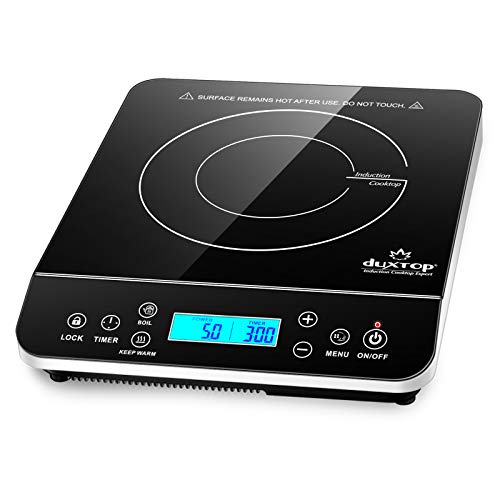
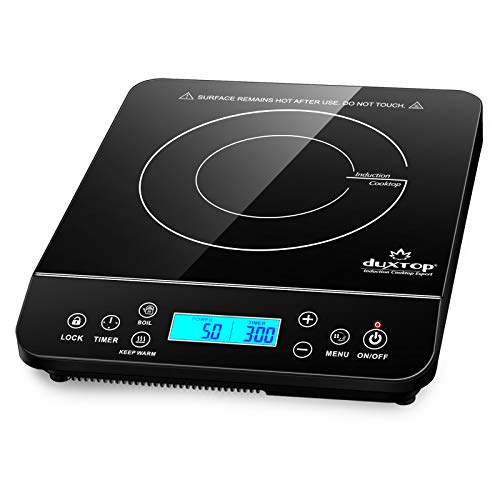
- Model: 9610LS (BT-200DZ)
- Controls: LCD sensor touch
- Finish: black
- Format: portable countertop burner
The Duxtop 9610LS is the electric cooktop for people who choose with their eyes as well as their hands. Its controls are an LCD sensor-touch panel — a flat, light-up surface you tap and slide, with no knobs and no dials — set flush into the top, so the entire unit is one smooth sheet that cleans with a single wipe. If your kitchen already has a glass hob, this portable looks like its relative rather than its poor relation.
Behind the panel it is a full-strength 1800-watt single-zone burner with induction’s usual virtues: fast boiling, instant adjustment, a surface that stays comparatively cool. The one compromise is the interface itself. Touch panels respond best to dry fingers; with wet hands and a pan boiling over, a second tap is sometimes needed, where a physical button would have worked first time. If that sentence already annoys you, choose the push-button style described in our wider flat-top coverage at Best Flat Cooktops. If you have used and liked touch controls on a hob before, you will feel at home here within a day.
Best for: design-conscious kitchens and anyone who hates cleaning around knobs / Not suited for: cooks who strongly prefer physical buttons
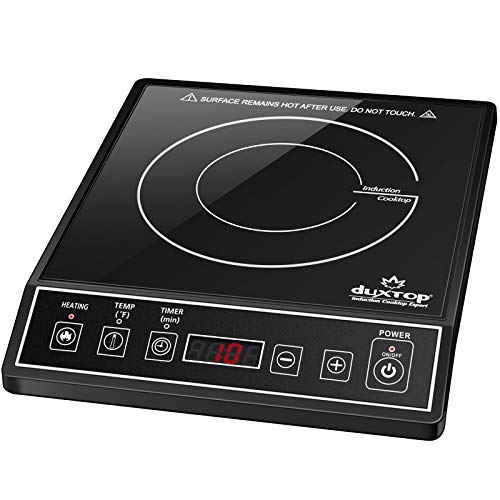
Duxtop 9100MC Portable Induction Cooktop
Badge: Best Simple Classic
Strengths
- A design sold for years — its behaviour is thoroughly known
- Full 1800W in a compact body
- Nothing to learn: set a level and cook
Trade-offs
- The listing describes a simpler feature set than newer models
- One cooking zone
- No long-timer or fine-temperature headlines
Key specs (from the manufacturer listing)
- Power: 1800W
- Model: 9100MC (BT-M20B)
- Finish: black
- Format: portable countertop burner
The Duxtop 9100MC is the veteran of this line-up: a black 1800-watt portable induction burner from the best-known name in the category, with a model history long enough that thousands of owners have already discovered everything there is to discover about it. That is a genuine virtue. A new buyer inherits certainty — about reliability, about behaviour, about what it will not do — that no launch-year product can offer.
What it will not do is impress a feature-counter. The listing keeps its claims modest: full power, portable format, proven design. There is no 94-step temperature control and no ten-hour timer, because this burner was designed for the centre of cooking — boiling, frying, sautéing, simmering — done simply and repeatedly. As a spare burner, a student-kitchen stove, a camping upgrade, or a gift for someone who distrusts complicated appliances, that simplicity is the entire point, and it closes this guide as the reminder that “best” sometimes means “least to go wrong.”
Best for: students, spare-burner duty, and anyone who wants zero learning curve / Not suited for: precision cooking or marathon timers
Comparison Table
All six at a glance. Read the “standout” column first — it is the honest difference between models that otherwise share the same power.
| Pick | Type | Power / Output | Controls & standout feature | Link |
|---|---|---|---|---|
| ChangBERT Commercial Induction Cooktop | Portable induction, single zone | 1800W | Stainless commercial body, NSF certified in listing, 10-hour timer | Check on Amazon |
| Nuwave Pro Chef Induction Cooktop | Portable induction, single zone | 1800W | 94 temp settings in 5°F steps, ceramic glass | Check on Amazon |
| Nuwave Double Pro Induction Cooktop | Portable induction, double zone | 900W / 1500W / 1800W selectable | Dynamic Watt Technology, 50°F–575°F, ceramic glass | Check on Amazon |
| ISILER Portable Induction Cooktop | Portable induction, single zone | 1800W | 10 + 10 settings, 7 presets, safety lock | Check on Amazon |
| Duxtop 9610LS Portable Induction Cooktop | Portable induction, single zone | 1800W | LCD sensor-touch panel, black finish | Check on Amazon |
| Duxtop 9100MC Portable Induction Cooktop | Portable induction, single zone | 1800W | Classic Duxtop design, black finish | Check on Amazon |
How to Choose an Electric Cooktop, in Plain Language
The one test to run before you buy anything
Induction burners heat pans with magnetism, which means the pan must contain iron. The test takes a minute: take a fridge magnet and touch it to the base of each pan you own. If it sticks firmly, the pan works. If it slides off, that pan will never work on any induction burner — not “work badly,” but not heat at all. Cast iron and most stainless steel pass; plain aluminium, copper, and glass fail unless they were built with a magnetic base layer.
Do this before ordering, not after delivery. Most households find most of their pans pass, and the few that fail can be replaced one at a time. It is the single most useful minute in this entire guide — more useful than any specification below — and it is the same advice, in more technical dress, that we give in Best Freestanding Oven Cooktops.
Why every model says 1800 watts
A normal plug socket in North America supplies about 1800 watts continuously, so every full-size portable electric cooktop advertises the same number. It is not a coincidence and it is not a tie that better shopping can break — it is the wall’s limit, not the burner’s. This is good news for buyers: power is the one thing you can stop comparing. Two burners can both say 1800 watts and behave completely differently, because what matters is how the power is controlled and spread, which is what the next two sections cover.
The exception that proves the rule is the Double Pro’s lower settings — 900 and 1500 watts — which exist so the burner can share a weak circuit politely instead of tripping it.
Temperature settings: how many do you actually need?
Think of temperature control as the difference between a light switch and a dimmer. Ten levels is a good dimmer: enough for boiling, frying, and ordinary simmering. Ninety-four settings, like the Pro Chef’s, is a laboratory instrument: it exists for jobs where a few degrees decide success — chocolate, custards, delicate sauces, candy. Most cooks live happily at the dimmer end for years. Buy the instrument only if your cooking already includes the jobs that need it; otherwise the extra settings are decoration you paid for.
Also look at the lowest setting, not just the highest. A burner that cannot go truly gentle cannot keep soup warm or melt butter without catching it, no matter how powerful its maximum is.
Timers, locks, and presets: the features you will feel weekly
A timer sounds like a spec-sheet extra until the first time it saves a stock. Short timers suit eggs and pasta; the 10-hour timers on the commercial models suit the way real slow cooking actually happens — unattended, for most of a day. A safety lock sounds minor until a toddler discovers the interesting flat toy on the counter. Presets sound like a gimmick until the twentieth time one touch starts the rice. Judge each feature against your actual week, and the right model usually identifies itself.
Your first shopping list: what to have ready when the box arrives
Three things should be waiting for a first induction burner. First, one pan you have already magnet-tested — ideally the saucepan or frying pan you use most — so the first cook is a success rather than a compatibility investigation. Second, a soft cloth reserved for the surface; the burner’s whole cleaning religion is that cloth, used for two seconds before each session. Third, a home for the unit: a cupboard slot or drawer where it will live upright and unburied, because a burner with a home gets used and a burner without one gets forgotten under the baking trays.
That is the complete list. Everything else the internet suggests for day one — interface discs, special cleaners, accessory bundles — can wait until your own cooking asks for it, which for most households is never. Spend the accessory money on one good magnetic pan instead; it is the only upgrade that changes what the burner can do.
How to Use an Electric Induction Cooktop: The First-Week Guide
Setting up without drama
Put the burner on a flat, steady surface, with space around its vents — there is a cooling fan inside, and it needs air the way you do. Plug it straight into a wall socket, not a flimsy extension lead. Before cooking anything real, boil a small pan of water in a pan that passed the magnet test. You will hear the fan, see how fast “fast” is, and learn the controls with nothing at stake.
Wipe the surface before every use. Dust and grit trapped under a pan are how glass surfaces get scratched, and the wipe takes two seconds. Lift pans on and off; do not slide them, especially heavy cast iron.
Cooking: what feels different, and what to do about it
Two things surprise every new owner. First, speed: the pan heats almost immediately, so heat pans gradually — a minute on a medium setting before going high — and never leave an empty pan on full power, because it will get hotter than you expect, faster than you expect. Second, obedience: when you turn the heat down, the pan cools at once, because there is no glowing element staying hot underneath. Sauces stop boiling when you say so. Most cooks decide within a week that they prefer giving orders to making requests.
A starter routine for a simmer: boil on high, drop straight to your simmer setting, wait a minute and a half for the pan to settle, then adjust once. Constant fiddling is a habit carried over from slower cooktops; induction rewards setting and trusting.
Cleaning: easier than you are used to
Because the surface itself stays relatively cool, spills rarely burn on. Let the top cool until it is comfortable to touch, then wipe with a soft cloth and warm soapy water. The exception is sugary spills — jam, caramel, syrup — which can mark glass as they harden: lift them off promptly once the surface is safe, with a flat scraper held at a low angle. Never use scouring pads or abrasive powders; they dull the surface permanently in exchange for one afternoon’s impatience.
Troubleshooting: three common problems
Problem: the burner beeps, flashes, or refuses to start → it cannot detect a suitable pan. Check that the pan is magnetic, flat-based, centred, and big enough to cover the marked circle. Try a pan you know passes the magnet test.
Problem: it switches off during a long cook → it is protecting itself. The vents may be blocked, or a very large pan on maximum power for a long time has overheated it. Clear the vents, let it cool, and restart at a lower setting.
Problem: a pan buzzes or clicks → thin or layered pan bases can vibrate in the magnetic field. It is annoying rather than dangerous; heavier, flatter pans run quietly. See also the cooling discussion in Best Fan Cooling On Portable Induction Cooktops if fan noise joins the buzz.
Why a Whole Guide Exists for a Typo
It is worth pausing on the small sociology of this page. “Eolectric” — like its sibling “elevtric” — is what happens when real people search quickly, on phones, often mid-task. Search engines learned to forgive these spellings long ago, and the listings at the end of them are the genuine article. We write the guide under the misspelled title for the same reason a shopkeeper answers to a mispronounced name: the person asking deserves the real answer, not a correction.
There is a practical consequence for you as a buyer: reviews, comparisons, and owner discussions of these same models live under the correctly spelled searches. Once you know the model you want, searching its exact name will find you the deepest pool of owner experience — spelling, in the end, is just the door, and you are already through it.
Electric, Explained Honestly: Induction Versus the Rest
“Electric cooktop” covers three technologies, and only one of them is in this guide’s picks, so the others deserve a fair paragraph. Radiant electric heats a glowing element under glass — it accepts every pan and behaves like a traditional hob, only slower to respond and hotter to the touch. Exposed-coil electric is the budget classic: cheap, rugged, and nobody’s idea of easy to clean. Induction — every pick here — heats the pan directly and wins on speed, control, safety, and cleaning, at the price of the magnetic-pan rule.
If your pans fail the magnet test and replacing them is out of the question, a radiant model is your honest route, and that technology deserves to be chosen deliberately, on its own terms, rather than as a consolation prize. For everyone else, induction’s takeover of the portable market is not fashion; it is the scoreboard.
Your First Five Induction Meals, in the Right Order
Meal one is boiled eggs and toast’s companion jobs — water, timing, nothing that can be ruined — because the first lesson is the speed: watch how fast the water boils and recalibrate every instinct you own. Meal two is a stir-fry or sauté, where the lesson is responsiveness: the pan obeys the setting instantly, so have everything chopped before the pan is hot, a discipline induction will enforce on you kindly now or rudely later. Meal three is a simmered sauce or soup, where the lesson is the low end — find the setting that holds a bare bubble and note it; that number is now part of your kitchen’s permanent knowledge.
Meal four is something delicate — eggs scrambled low and slow, or a custard — where fine control stops being a specification and becomes the difference between silk and scramble; if your model has many temperature settings, this is their audition. Meal five is your signature dish, the one you have cooked a hundred times on the old hob, cooked start to finish on the new burner. By its end you will know your model’s personality — its fan’s voice, its controls’ manners, its pan preferences — better than any review, including this one, can teach you. That is the real unboxing; the cardboard was just the beginning.
When Something Seems Wrong: A Calm Checklist Before You Return It
Most “faulty” induction burners are healthy burners meeting an untested kitchen, so run this checklist before the returns label. One: the pan — magnet-tested, flat-based, centred, and covering the marked circle? Two: the vents — clear on every side, with the unit on a solid surface rather than a towel or a tray? Three: the circuit — is the unit sharing an outlet run with a microwave or kettle that chose that moment to join in? Four: the setting — is the unit in a preset or timer mode whose behaviour you have not yet learned, doing exactly what it was told?
Work the list in order and the large majority of mysteries resolve at step one. If the unit still misbehaves with a known-good pan, clear vents, and a quiet circuit, then it has earned its return — and you will process it with the confidence of someone who actually diagnosed the problem, which is a better position in every conversation with every support line.
Cooking for One: The Single-Zone Case, Made Properly
Cooking for one has a reputation for sadness that the equipment shares unfairly. In truth the single household is the portable induction burner’s natural aristocracy: one pan is not a limitation when one pan is the meal, the unit stores in the footprint of a chopping board, and the energy goes into the food rather than into heating a four-zone hob’s worth of kitchen. The solo cook’s repertoire — the perfect omelette, the small pot of soup eaten across two days, the steak seared at a temperature a shared kitchen’s compromises never allowed — maps onto a single zone without a single apology.
The buying logic sharpens accordingly. Control fineness outranks zone count entirely: the solo cook eats every meal from this burner, so the Pro Chef’s precision is not a luxury but the whole point. Storage outranks stamina: the ISILER’s compactness matters daily, its timer ceiling rarely. And the magnet test shrinks to a kindness — a solo household can replace its two failing pans in one small order and be done with compatibility forever.
Noise, Light, and Company: What Living With One Is Actually Like
Specifications end where the senses begin, so here is the sensory truth of these machines. The fan is a presence — a soft, load-following breath that rises with hard work and settles with simmers, closer to a laptop under effort than to an extractor’s roar. The controls light up; on touch models the panel glows its numbers into a dim kitchen, which night-cooks find either companionable or worth covering with the unit’s own shadow. The pan may hum faintly at high settings, a thin, honest sound that heavier pans mostly decline to make.
None of this appears on a listing, and all of it decides whether a burner is loved at month six. The households that thrive with induction tend to share a trait: they read these small sensations as the machine’s conversation — the fan reporting its work, the panel its setting, the pan its coupling — rather than as noise to be forgiven. Choose a model whose conversation you can imagine enjoying, at the volumes your kitchen’s hours involve.
Flats, Landlords, and the Portable Advantage
For renters, the portable electric cooktop solves a problem no other appliance class touches: it upgrades the kitchen without altering it. No installation, no permission letters, no deposit risk — the unit arrives, plugs in, and leaves with you, having spent its life improving a stove it never touched. In furnished flats with eccentric hobs, in house-shares where the oven is communal territory, in the first home whose kitchen renovation is years away, this is not a compromise purchase; it is the only category of purchase that fits the legal facts.
Two courtesies keep the arrangement sweet. Keep the counter beneath the unit clean and the unit’s feet intact, so it leaves the surface as it found it. And keep the box — for the move, for storage between homes, and for the day the burner becomes a hand-me-down to the next first kitchen, which in this category’s long and honourable tradition, it very often does.
Dorm Rooms and Shared Houses: The Rules of the Building
Many dormitories and shared houses restrict cooking appliances, and the rules usually turn on one distinction: open flames and exposed glowing coils are banned, while enclosed, flameless appliances are tolerated or explicitly allowed. Induction sits on the right side of that line in most buildings — no flame, no glowing element, automatic shut-off when the pan lifts — which is a large part of why this category owns the student market. Check your own building’s wording before ordering, because “most” is not “yours,” and a confiscated burner teaches the lesson at full price.
Where the burner is welcome, shared-house etiquette is the remaining specification: wipe the glass after yourself (thirty seconds, and the next cook thanks you), respect the circuit you now know is shared, and store the unit in your own space rather than colonising the communal counter. The households that keep a portable for years are the ones whose rules were agreed in week one.
Common Buying Mistakes
Ordering before the magnet test. One minute with a fridge magnet prevents the commonest disappointment in this category. Test every pan you care about.
Comparing wattage as if it differed. It does not — the socket decides. Compare control, coil size, timers, and build.
Leaving an empty pan on full power. Induction heats the pan itself, extremely fast. Empty pans overheat, warp, and can damage the surface beneath them.
Buying 94 settings for a 4-job repertoire. Precision features only pay rent if your cooking charges it. Match the control to the food you actually make.
Assuming a typo means a different product. “Eolectric” listings are the same electric cooktops sold under the correct spelling — same models, same sellers, same warranties.
Final Recommendation
If you read nothing else: the ChangBERT is the buy-once answer for most households, the Nuwave Pro Chef is the precision instrument, the Double Pro is the two-pan and small-kitchen solution, the ISILER is the beginner- and family-friendly start, the Duxtop 9610LS is the touch-control moderniser, and the 9100MC is the proven simple classic. Every one is a verified electric pick, and every review above states its limits as plainly as its strengths.
Before you order: magnet-test your pans, measure your most-used pan’s base, and glance at your counter’s storage plan. Three small acts, and the typo that brought you here becomes the best appliance decision of your year.
Start with our top pick here: Check on Amazon
Frequently Asked Questions
Did I find the right page? I searched for “eolectric” cooktops.
Yes. “Eolectric” is a common misspelling of “electric,” and search engines route it to the same products. This guide covers the verified electric models that search intends, with no difference in the products or the advice.
What is an induction cooktop, in one sentence?
It is an electric cooktop that heats the pan itself using magnetism, instead of heating a surface and waiting for the surface to heat the pan — which is why it is faster and stays cooler to the touch.
Do I need new pans?
Only the non-magnetic ones. If a fridge magnet sticks firmly to a pan’s base, keep it; cast iron and most stainless steel pass. Aluminium, copper, and glass pans need a magnetic base layer to work, and most do not have one.
Why is 1800 watts the maximum everywhere?
That is roughly what a standard household socket can supply continuously. Manufacturers compete on control, heating area, timers, and build quality instead — which is where the real differences in this guide live.
Which model is best for a small flat?
The Double Pro if you cook two-pan meals — it is a complete two-zone stove that stores as one unit. The ISILER if you cook simply and store in a cupboard: compact, preset-led, and family-safe.
Is induction safe around children?
It has real advantages: no flame, a surface that heats mainly through the pan and cools quickly, and automatic shut-off when the pan is removed. Several models add a control lock — the ISILER’s is a headline feature — and ordinary supervision still applies.