Disclosure: topratedkitchenware.com is reader-supported. When you buy through links on our site, we may earn an affiliate commission from Amazon and other retailers, at no extra cost to you.
Where to buy
The six best enamelled dutch ovens in this guide are verified enameled cast iron pots — the spelling differs between British and American English, but the cookware is identical. Each name below links to its Amazon listing, and each detailed review carries its own link so you can check the latest price on Amazon for the exact pot. Confirm the finish and included items on the listing before you order, because bundles vary.
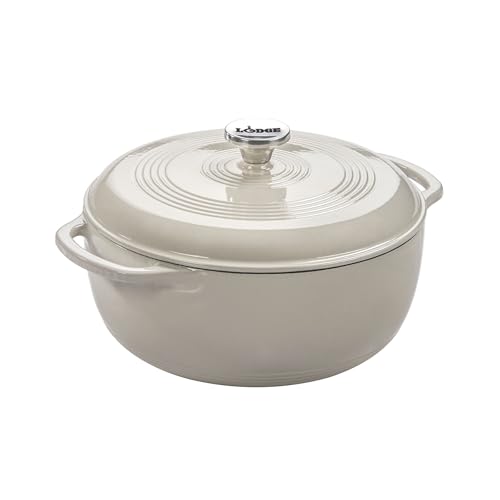
- Lodge Essential Enamel Cast Iron Dutch Oven, 6 Quart, Oyster White — Best Overall Value. Best for families who braise and slow-cook weekly.
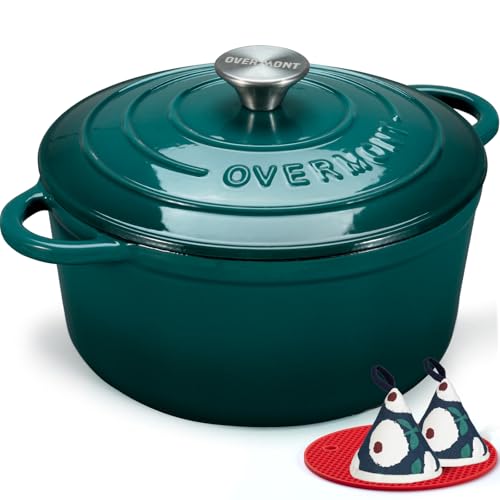
- Overmont Enameled Cast Iron Dutch Oven, 5.5QT, White — Best Bundle. Best for new owners who want a cookbook and potholders included.
- Overmont Enameled Cast Iron Dutch Oven, 7QT — Best Large Capacity. Best for batch cooking and big gatherings.
- Amazon Basics Enameled Cast Iron Dutch Oven, 6-Quart, Blue — Best Simple Format. Best for pragmatic buyers who want six round quarts and dual handles.
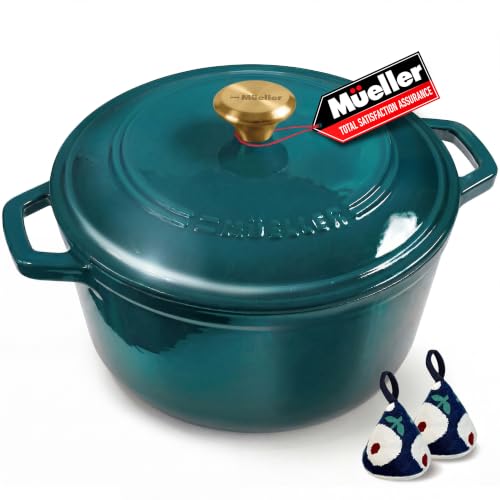
- Mueller DuraCast 6 Quart Enameled Cast Iron Dutch Oven, Emerald — Best Stated Specifications. Best for buyers who want an explicit oven-safe figure and all-cooktop positioning in the listing.
- Lodge Essential Enamel Cast Iron Dutch Oven, 6 Quart, Island Spice Red — Best Classic Red. Best for cooks who want the sealing-lid Lodge in a traditional finish.
Read the full guide ↓ for badges, honest trade-offs, a comparison table and advice on choosing between near-identical pots.
Whether you type the best enamelled dutch ovens with the British double-l or the American single-l, you are shopping for the same thing: a cast iron pot fused with an enamel coating, built for braising, slow cooking, soups and enclosed bread baking. This guide keeps the keyword’s spelling in its headings and answers the question in full — which enamelled (enameled) Dutch ovens deserve your money, in which sizes, with which verified features. The shortlist below is deliberately practical. It contains two Lodge six-quart pots in different finishes with a lid the listing calls moisture-sealing, two Overmont pots at family and batch sizes, a plain Amazon Basics six-quart round, and a Mueller whose listing states its oven-safe figure and cooktop compatibility outright — a level of specification most rivals leave unstated.
A note for British and international readers who land here through the spelling: these listings are from the American marketplace, so check the listing for delivery, sizing in quarts rather than litres, and any regional details before ordering. A quart is slightly smaller than a litre, so a six-quart pot is a generous family vessel by any measure. Readers comparing the American-spelling edition will find the same core shelf in Best Heat Tolerant Dutch Ovens, which re-ranks several of these pots by their stated heat positioning.
Key Takeaways
- Enamelled and enameled are the same coating and the same cookware; only the spelling changes between British and American English.
- Six quarts is the family centre of this shortlist — three of the six picks sit at that size in different finishes and tiers.
- The Mueller listing is the most explicit here: it states 500°F oven safe positioning, PFOA-free positioning and all-cooktops-including-induction compatibility in its title.
- Both Lodge picks name a moisture-sealing lid and dual handles — verifiable features that matter for braising and safe lifting.
- The Overmont pair brackets the range: a bundled 5.5QT starter pot and a 7QT batch pot with an enclosed lid-knob design named in its listing.
- Colour variants are the same pot underneath; buy the finish once, for the kitchen you have.
In this guide
Quick Picks
Six picks, six jobs, badges repeated in the detailed reviews so each pot is easy to track from summary to verdict.
| Pick | Badge | Who it suits |
|---|---|---|
| Lodge Essential Enamel Cast Iron Dutch Oven, 6 Quart, Oyster White | Best Overall Value | Families who braise and slow-cook weekly |
| Overmont Enameled Cast Iron Dutch Oven, 5.5QT, White | Best Bundle | New owners who want a cookbook and potholders included |
| Overmont Enameled Cast Iron Dutch Oven, 7QT | Best Large Capacity | Batch cooks and hosts feeding a crowd |
| Amazon Basics Enameled Cast Iron Dutch Oven, 6-Quart, Blue | Best Simple Format | Pragmatic buyers who want six round quarts, no extras |
| Mueller DuraCast 6 Quart Enameled Cast Iron Dutch Oven, Emerald | Best Stated Specifications | Buyers who want explicit oven and cooktop claims in writing |
| Lodge Essential Enamel Cast Iron Dutch Oven, 6 Quart, Island Spice Red | Best Classic Red | Cooks who want the sealing-lid Lodge in a heritage finish |
How These Picks Were Chosen
This is a research-led, listing-verified guide. Every pick’s title was checked to confirm enameled cast iron construction — the material this keyword is about — before it was shortlisted. We then spread the selection across the decisions buyers actually face: three capacities (5.5, 6 and 7 quarts), finishes from Oyster White and White through Blue and Emerald to Island Spice Red, and bundles from a bare pot to a pot with cookbook and potholders. Specifications in the reviews come only from the verified titles. That discipline cuts both ways: it lets us quote the Mueller’s stated oven-safe figure and induction positioning with confidence, and it obliges us to stay silent about equivalent figures for pots whose listings do not state them. Always confirm the current listing before buying, since finishes and bundles change.
We also treated spelling honestly. A British-spelling search does not imply a different product standard, so we did not invent a separate British shortlist or pretend these American listings are anything other than what they are. What the spelling does signal is a reader who may be converting sizes mentally and comparing across marketplaces, so the buying guide includes the practical conversions and checks that reader needs. The companion ranking at Best Large Dutch Ovens takes several of these same pots and judges them purely on capacity, for readers whose first question is size.
The 6 Best Enamelled Dutch Ovens in Detail

Lodge Essential Enamel Cast Iron Dutch Oven, 6 Quart, Oyster White
Badge: Best Overall Value
Strengths
- Moisture-sealing lid and dual handles are named in the listing — the two features braising households use most.
- Six quarts matches family recipes as written, from stews to whole chickens with vegetables.
- An established cast iron name at a value tier, in a neutral finish that suits most kitchens.
Trade-offs
- No potholders are listed as included, so add mitts if you do not own them.
- Oyster White enamel will show cooking stains over time.
- Buyers wanting a bold finish should choose its Island Spice Red sibling below instead.
Mini spec box
- Material: enamel cast iron (per listing title)
- Capacity: 6 Quart
- Features named in listing: moisture-sealing lid, dual handles
- Colour: Oyster White
- Listed uses: bread baking, braising, marinating, slow cooking
The Lodge in Oyster White leads this shortlist because it gets the fundamentals verifiably right at a sensible tier. Six quarts is the size family recipes assume. A moisture-sealing lid keeps braising liquid in the pot where it bastes the meat instead of escaping as steam. Dual handles make a full pot a safe two-handed lift rather than a wrist-straining gamble. Lodge’s entire reputation rests on cast iron, and this enamelled version applies that heritage to the low-maintenance format most modern households prefer: no seasoning, acid-friendly, soap-and-water cleaning. For bread baking, braising, marinating and slow cooking — the uses its listing names — it is the complete everyday answer.
It suits families who will cook in it several times a week and want features they can point to rather than promises. The honest limitations are the pale finish’s staining and the absence of bundled potholders. Neither touches the cooking. If you like everything about this pot except the colour, the same design closes this guide in Island Spice Red.
Best for: families who braise and slow-cook weekly / Not suited for: buyers who want bundled accessories or a stain-hiding finish
Check on Amazon to see the current listing for the Lodge Essential 6 Quart in Oyster White.

Overmont Enameled Cast Iron Dutch Oven, 5.5QT, White
Badge: Best Bundle
Strengths
- Cookbook and cotton potholders included — a self-contained start for a first-time owner.
- 5.5QT sits in the versatile middle that most recipes target.
- Listing positions it for braising, stews, roasting and sourdough baking.
Trade-offs
- White enamel shows stains readily.
- Experienced cooks gain less from the bundled extras.
- No named lid feature in the listing, unlike the Lodge picks and the larger Overmont.
Mini spec box
- Material: enameled cast iron
- Capacity: 5.5QT
- Includes: lid, cookbook and cotton potholders (per listing title)
- Colour: White
- Listed uses: braising, stews, roasting, sourdough baking
The Overmont 5.5QT is the pick for anyone who wants to open one box and cook. A first Dutch oven raises immediate practical questions — what do I hold it with, what do I make first — and this bundle answers both with cotton potholders for the genuinely hot handles and a cookbook for the repertoire. The capacity is well judged for beginners too: large enough for family stews and standard loaves, small enough to lift, wash and store without drama. Sourdough baking is named in its positioning, and the enclosed, preheated pot method described later in this guide is exactly how a pot like this earns its place in a baker’s routine.
It suits new owners and gift buyers most. Veterans with mitts and recipes already in the drawer should weigh the Lodge’s named lid or step up to the seven-quart Overmont instead. The white finish will record your cooking; many owners consider that a fair trade for a pot that looks bright on the stove from day one.
Best for: first-time owners and gift buyers / Not suited for: experienced cooks who already own the accessories
Check on Amazon to see the current listing for the Overmont 5.5QT in White.

Overmont Enameled Cast Iron Dutch Oven, 7QT
Badge: Best Large Capacity
Strengths
- Seven quarts covers batch cooking, whole birds and large loaves in one vessel.
- The listing names an enclosed lid-knob design and oven-safe positioning for sourdough, braising, stews and roasting.
- Cookbook and cotton potholders are included, scaled to the big pot’s needs.
Trade-offs
- Heavy when full; a two-handed, planned lift every time.
- Demands storage space and suits larger ovens and burners best.
- More pot than one- or two-person households will fill.
Mini spec box
- Material: enameled cast iron
- Capacity: 7QT
- Includes: lid, cookbook and cotton potholders (per listing title)
- Features named in listing: enclosed lid-knob design, oven safe positioning
- Listed uses: sourdough baking, braising, stews, roasting
Where the smaller Overmont is a starter pot, the 7QT is a commitment to cooking at scale — and its listing adds a design detail the smaller one’s does not: an enclosed lid-knob design. At seven quarts, the meals change character. A double batch of stew for the freezer cooks in one go. A chicken roasts with its vegetables in a single layer instead of a stack. A large loaf bakes without the dough meeting the lid. The included cookbook and potholders remain, which suits buyers stepping up in ambition as well as size. Oven-safe positioning for sourdough baking, braising, stews and roasting is stated in the title, so the pot’s intended theatre of work is explicit.
It suits hosts, batch cooks and large families. Its limitations are the physics of size: weight, footprint and the waste of heating seven quarts for two portions. Measure your oven’s shelf spacing and your storage before ordering, and it will reward you every time the guest list grows.
Best for: batch cooking and regular entertaining / Not suited for: small households or tight kitchens
Check on Amazon to see the current listing for the Overmont 7QT.

Amazon Basics Enameled Cast Iron Dutch Oven, 6-Quart, Blue
Badge: Best Simple Format
Strengths
- Six round quarts with dual handles and oven-safe positioning stated in the listing.
- Saturated blue finish hides cooking marks better than the pale pots here.
- No bundle costs — the money buys the pot itself.
Trade-offs
- No included potholders or cookbook, and no named lid feature.
- The title confirms a round shape — buyers seeking oval should look elsewhere in the category.
- Plain presentation compared with the heritage names in this guide.
Mini spec box
- Material: enameled cast iron
- Capacity: 6-Quart
- Shape: round (per listing title)
- Features named in listing: dual handles, heavy-duty, oven safe positioning
- Colour: Blue
- Listed uses: stews, roasting, baking
The Amazon Basics pot is the shortlist’s exercise in restraint: enameled cast iron, six quarts, round, dual handles, oven-safe positioning for stews, roasting and baking, in blue. Nothing is bundled and nothing is embellished, which is precisely its appeal for buyers who already own the accessories and simply want the material at the straightforward end of the market. Six quarts covers family cooking as recipes are written, the round shape sits honestly on standard burners, and the saturated finish will not advertise every sauce it has ever held.
It suits pragmatic buyers, second-pot purchases and dedicated bread pots that will live a working life rather than a display life. The honest limitation is absence: no sealing-lid claim, no extras, no flourish. This guide contains picks that offer each of those; if none of them move you, this is the clean buy.
Best for: pragmatic buyers who want six honest quarts / Not suited for: buyers who want bundles or named design features
Check on Amazon to see the current listing for the Amazon Basics 6-Quart in Blue.

Mueller DuraCast 6 Quart Enameled Cast Iron Dutch Oven, Emerald
Badge: Best Stated Specifications
Strengths
- The listing states its heat positioning outright: 500°F oven safe, per the title.
- All cooktops including induction are named in the title — the only pick here that confirms induction in writing.
- PFOA-free positioning is also stated in the listing, and the Emerald finish hides stains well.
Trade-offs
- No potholders or cookbook are listed as included.
- No named lid feature in the title, unlike the Lodge picks.
- Buyers must still confirm current listing details, as specifications can be revised.
Mini spec box
- Material: enameled cast iron
- Capacity: 6 Quart
- Stated in listing: 500°F oven safe; PFOA-free; all cooktops incl. induction
- Colour: Emerald
- Listed uses: sourdough bread baking, braising, slow cooking
The Mueller DuraCast earns a distinctive badge in this guide: it is the pick whose listing does the most specifying. Where most titles in this category stay silent on numbers, the Mueller title states 500°F oven safe positioning, names all cooktops including induction, and adds PFOA-free positioning. For buyers — especially induction owners, who cannot assume compatibility — that explicitness removes the guesswork this guide otherwise warns about. None of this means rival pots lack heat tolerance or induction bases; it means the Mueller puts its claims in writing where shoppers can verify them, and verifiable claims are the currency of this entire shortlist.
At six quarts in Emerald, it covers family braising, slow cooking and sourdough baking in a stain-forgiving finish. It suits specification-driven buyers and induction households first. Its limitations are the missing bundle and the absence of a named lid feature. If written specifications calm your buying nerves — a reasonable position — this is your pick; readers ranking heat claims across the whole shelf should also see Best Le Creuset Dutch Ovens Braisers for how the premium name’s listings compare in stated detail.
Best for: induction owners and buyers who want specifications in writing / Not suited for: buyers who want bundled accessories
Check on Amazon to see the current listing for the Mueller DuraCast 6 Quart in Emerald.

Lodge Essential Enamel Cast Iron Dutch Oven, 6 Quart, Island Spice Red
Badge: Best Classic Red
Strengths
- The same moisture-sealing lid and dual handles as the Oyster White Lodge, in the heritage red finish.
- Red enamel conceals the staining that pale finishes display.
- Six quarts and an established cast iron name at a value tier.
Trade-offs
- Functionally identical to the first pick in this guide — this is the finish variant.
- No potholders listed as included.
- A bold red pot dominates a muted kitchen palette.
Mini spec box
- Material: enamel cast iron (per listing title)
- Capacity: 6 Quart
- Features named in listing: moisture-sealing lid, dual handles
- Colour: Island Spice Red
- Listed uses: bread baking, braising, marinating, slow cooking
Closing the guide with the Island Spice Red Lodge is an act of transparency: it is the first pick in a different finish, included because finish is a genuine decision and red is the colour most buyers picture for this category. Everything verified about the Oyster White version applies — the moisture-sealing lid, the dual handles, the six-quart family format, the bread baking, braising, marinating and slow cooking positioning. What changes is how the pot ages and presents. Tomato sauces, paprika-rich stews and wine reductions that would mark a pale exterior blend into red, and the pot arrives at the table looking like the centrepiece of a traditional kitchen.
Choose it if you want the Lodge’s verified features in the forgiving, classic finish. Choose the Oyster White if your kitchen is pale and calm. Do not buy both expecting variety in performance — the variety is visual only, and this guide would rather tell you that than sell you a second pot.
Best for: cooks who want the sealing-lid Lodge in a heritage finish / Not suited for: anyone expecting a different pot from the Oyster White version
Check on Amazon to see the current listing for the Lodge Essential 6 Quart in Island Spice Red.
Comparison Table
| Pick | Capacity | Colour | Named feature or extras | Link |
|---|---|---|---|---|
| Lodge Essential Dutch Oven | 6 Quart | Oyster White | Moisture-sealing lid, dual handles | Check on Amazon |
| Overmont Dutch Oven | 5.5QT | White | Cookbook, cotton potholders | Check on Amazon |
| Overmont Dutch Oven | 7QT | Not stated in title | Enclosed lid-knob design, cookbook, potholders | Check on Amazon |
| Amazon Basics Dutch Oven | 6-Quart | Blue | Dual handles, round shape | Check on Amazon |
| Mueller DuraCast Dutch Oven | 6 Quart | Emerald | 500°F oven safe and induction stated in listing | Check on Amazon |
| Lodge Essential Dutch Oven | 6 Quart | Island Spice Red | Moisture-sealing lid, dual handles | Check on Amazon |
How to Choose Your Enamelled Dutch Oven
Begin with capacity, converted into your own measures if you think in litres: five and a half quarts is a versatile five-litre-class pot, six quarts is the family standard, and seven quarts is the batch-and-guests size. Most households should start at six unless their cooking clearly points smaller or larger, because published recipes assume it and whole birds fit it. Next, decide how much specification you need in writing. If your hob is induction, the Mueller’s title-level confirmation is genuinely valuable; on gas or electric, every pot here is in its natural habitat, though you should still confirm the individual listing. Then weigh named features: the Lodge lid for braisers, the Overmont knob design and bundles for new owners and batch cooks, the Amazon Basics plainness for minimalists.
Finish comes last and should be decided by your cooking, not just your décor. Pale finishes show you the fond and the stains in equal measure; saturated finishes — red, blue, emerald — hide the record of sauce-heavy cooking. If your repertoire leans on tomatoes, curries and wine, a forgiving finish will keep the pot looking cared-for with ordinary washing. Tier, finally, is a comfort decision: every pick here is verified enameled cast iron and cooks by the same methods, so spend where the features and finish you actually value live, and do not pay for a bundle you will not open or a size you will not fill.
One more consideration belongs in the choosing, because it is so often discovered afterwards: how the pot behaves with your favourite recipes’ first step. Many braises and soups begin with a long, slow softening of onions or a hard sear, and both reward the even, stored heat of cast iron. But the same mass that steadies heat also slows responsiveness — an enamelled pot will not cool quickly when you drop the burner, the way a thin pan does. Cooks who love that steadiness, which is most braise and bread cooks, find it calming; cooks who want instant response for delicate sauces keep a lighter pan for those jobs and let the Dutch oven do what it is best at. Knowing which cook you are is worth more than any single feature in this guide, and it costs nothing to decide before the pot arrives.
How to Cook, Clean and Care: The Enamelled Routine
Daily technique is short and consistent. Preheat the pot gradually over low to medium heat with oil or liquid in it — never blast an empty enamelled pot on full power. Brown meat in uncrowded batches, deglaze to lift the fond, and braise covered at a gentle oven heat or the barest stovetop simmer. For bread, preheat pot and lid together in the oven, bake the loaf covered for the steam phase, then uncover for colour and crust. Serve from the pot at the table if you like; enamelled cast iron is made for that journey.
Cleaning asks for patience rather than products. Let the pot cool before it meets water, soak in warm soapy water, and use a soft sponge. A simmer of water with a spoonful of baking soda loosens stubborn residue and lifts much staining. Keep metal utensils, steel wool and harsh powders away from the enamel; wood and silicone are its friends. Dry the pot before storing, keep the lid slightly ajar in humid kitchens, and avoid dragging it across glass hobs.
Troubleshooting, in brief. Problem: a stew’s sauce stays thin → the sealing lid did its job too well; finish with the lid ajar so the sauce can reduce. Problem: meat steams instead of browning → the pot was crowded or the meat was wet; dry the surface and brown in smaller batches. Problem: bread crust is pale → the pot was not fully preheated or stayed covered too long; extend the preheat and uncover earlier for the finishing stage.
Enamelled Cast Iron vs Stainless Steel and Bare Iron
British-spelling shoppers often arrive with a shortlist that mixes materials, so a plain comparison helps. Stainless steel casseroles are lighter and shrug off impacts, but their thinner bases hold less heat, so braises respond faster to burner changes and bread bakes less evenly unless the base is heavily clad. Bare cast iron matches enamelled iron for heat and beats it over open fire, but asks for seasoning and dislikes long, acidic simmers. Enamelled cast iron sits between them: iron’s thermal behaviour with a surface that behaves more like glass — non-reactive, soap-friendly, rust-proof — at the price of chip risk and weight. For the hob-to-oven, tomato-friendly, bread-baking repertoire that most households mean by a casserole pot, enamelled cast iron is the balanced choice, which is why this entire shortlist is built from it and why the shape-focused companion at Best Oval Dutch Ovens draws on the same material shelf.
Quarts, Litres and Shopping Across Spellings
British-spelling shoppers meet two frictions the American marketplace creates: sizes in quarts and listings written for American hobs. The conversions are friendly. A quart is a little under a litre, so the six-quart pots here are roughly five-and-a-half-litre vessels — the size British recipes usually call a large casserole. Five and a half quarts lands near five litres; seven quarts near six and a half. If a favourite recipe specifies a casserole volume, match to the nearest size up rather than down, since headroom prevents boil-overs and crowding. On compatibility, the Mueller’s listing confirms all cooktops including induction in writing; for other models, confirm the listing rather than assuming, and remember that enamelled cast iron’s weight demands a hob and oven shelf that can take it. None of this changes the cooking — a braise is a braise in any spelling — but it prevents the two classic cross-market mistakes: a pot a size too small, and a compatibility assumption a listing never made. Readers who cook outdoors as well should note that these enamelled pots are kitchen and patio tools; the campfire end of the category is discussed, with its caveats, in Best Outdoor Dutch Ovens.
Lids, Knobs and Handles: The Working Parts That Differ
Strip away finishes and bundles and an enamelled Dutch oven is three working parts beyond the pot itself: the lid, the knob and the handles. The lid governs moisture. A lid that seals well — the property the Lodge listings name outright — keeps braising liquid circulating inside the pot, so meat bastes itself and sauces stay where the flavour is. A loose lid is not a disaster; cooks have compensated with a sheet of parchment under the lid for generations, but a sealing lid removes the workaround. When you compare listings, a named lid behaviour is one of the few claims that translates directly into dinner, and it deserves the weight this guide gives it.
The knob governs handling at the exact moment the pot is hottest. The larger Overmont’s listing names an enclosed lid-knob design; other listings here do not describe their knobs, and this guide does not guess at their materials or limits. The practical advice is universal: treat every knob as hot, grip it with the potholders or mitts you should be using anyway, and confirm any specific heat claims on the listing of the pot you buy. The handles, finally, govern safety. Dual handles — named on the Lodge and Amazon Basics listings — spread a heavy load across two hands and two wrists. On a full six- or seven-quart pot, that is the difference between a confident carry and a risky one, and it is why handle design earns a line in every spec box in this guide where the listing states it.
A Braising Walkthrough: The Dish These Pots Exist For
Consider the beef braise that justifies the category, step by step, because each step uses a property of enamelled cast iron. You begin on the hob: the pot preheats gradually, oil shimmers, and dried cubes of beef go down in a single uncrowded layer. The iron’s mass holds its temperature as the cold meat lands, so the beef sears instead of slumping into its juices. Batch two follows, then the aromatics soften in the rendered fat, and a splash of wine lifts the fond — those browned, flavour-dense deposits — into the liquid. Bare iron would have given up its seasoning to the wine’s acidity over a long cook; the enamel simply does not care, which is the material’s quiet superpower.
Then the lid goes on and the pot moves to a gentle oven, where surrounding heat replaces the hob’s single-direction heat and the braise settles into hours of unattended transformation. The sealing lid keeps the liquid in the pot. The iron smooths the oven’s temperature cycles. You return to meat that yields to a spoon, in a sauce built from everything that happened in the same vessel. No transfer pans, no lost fond, no seasoning ritual afterwards — a soak, a soft sponge, and the pot is ready for tomorrow’s soup or loaf. Every pick in this guide performs this walkthrough; they differ in how much of it they hold at once, which finish it wears while doing so, and which verified extras ride along. That is an honest basis for choosing, and it is the basis this guide used. For readers who want the build-quality ranking of the same shelf, Best Made Dutch Ovens re-orders these pots by construction cues alone.
Storage, Weight and Living With the Pot
The final selection factor is domestic logistics. Enamelled cast iron is heavy empty and formidable full, and the seven-quart format is a genuine two-person lift for some cooks when it is full of stew. Plan the pot’s home before it arrives: a low, strong shelf or deep drawer near the hob, never a high cupboard. If it will live on the hob — a common and sensible arrangement for daily cooks — the finish becomes part of your kitchen’s furniture, which is a legitimate reason to choose the red, blue or emerald that pleases you over a marginally cheaper pale option. Protect the enamel in storage by avoiding unlined stacking of other pans inside it; a folded cloth between nested cookware prevents the rim chips that start as storage accidents rather than cooking damage.
Weight also argues for honesty about household fit. A cook who finds a full six-quart pot daunting will use a five-and-a-half-quart pot more, and a pot used weekly for years beats a larger pot used monthly on every measure that matters — meals cooked, skills built, value returned. The shortlist’s spread from 5.5 to 7 quarts exists so that fit, not fashion, makes the decision. Measure your oven’s shelf clearance too, lid included, especially for the seven-quart Overmont: a pot that only fits with the shelf removed and the lid inverted is a pot whose owner needed a tape measure before the purchase, not after it.
Common Buying Mistakes
- Paying for the same pot twice in two colours. The two Lodge picks differ only in finish. Choose Oyster White or Island Spice Red, not both.
- Assuming unstated specifications. Only the Mueller states its oven figure and induction compatibility here. Verify rivals on their own listings.
- Converting sizes carelessly. Quarts are slightly smaller than litres; size up when a recipe’s volume matters.
- Shocking the enamel. Cold water on a hot pot and full-power empty preheats are how coatings get stressed. Heat and cool gradually.
- Forgetting hand protection. Handles reach cooking temperature. Use bundled potholders where included, or your own mitts.
- Buying seven quarts for two people. Oversize pots heat slowly, wash heavily and get used less. Fit the pot to the household.
Bread in an Enamelled Pot: Why Bakers Keep One
Several listings in this guide name sourdough or bread baking, and the method deserves its own explanation because it converts sceptics. A home oven is a hostile place for a young loaf: dry air sets the crust before the dough has finished expanding, and the result is a tight crumb and a pale exterior. The enamelled pot solves the problem by becoming the loaf’s private atmosphere. Preheated with its lid on, the iron stores the heat a deck oven would provide; the dough, lowered in on parchment, bakes in the steam of its own moisture trapped by the lid, so the crust stays supple while the loaf springs. Uncover for the final stage and the same pot, now dry-heated, colours and crisps the crust. The loaf that emerges — blistered, singing faintly as it cools — is the one that convinces people this category is not nostalgia.
Size matching matters here. Standard home sourdough recipes suit the five to five-and-a-half-quart pots; larger or doubled loaves want the seven-quart Overmont’s headroom so the expanding dough does not meet the lid. Round pots suit round boules, which is what most home recipes shape. If bread is your primary purpose, weight the picks whose listings name baking — the Lodges, the Overmonts and the Mueller all do — and treat the pot’s preheat as non-negotiable: a half-heated pot gives a half-hearted loaf, whatever the brand on the lid.
Final Recommendation
Start with the Lodge Essential 6 Quart in whichever finish suits your kitchen — Oyster White for a calm, pale look, Island Spice Red for the forgiving classic. It pairs the family capacity with a moisture-sealing lid and dual handles at a value tier, and it will cover most households’ braising, baking and slow cooking for years. Induction owners and specification-first buyers should choose the Mueller DuraCast for its stated oven figure and all-cooktop confirmation. New owners should take the Overmont 5.5QT bundle, hosts the Overmont 7QT, and minimalists the Amazon Basics 6-Quart. Whichever spelling brought you here, the pot that fits your household is the right one.
If you want a fast answer, start with one of these three and read its detailed review above: Lodge Essential Enamel Cast Iron Dutch Oven, 6 Quart, Oyster White, Mueller DuraCast 6 Quart Enameled Cast Iron Dutch Oven, Emerald, Overmont Enameled Cast Iron Dutch Oven, 7QT. They cover the value, specification and capacity cases between them.
A final practical note: order the pot when you have a first dish planned for it. Owners who cook in a new Dutch oven within days — a soup, a loaf, a simple braise — bond with it immediately and learn its heat quickly. The pot that waits in its box for a special occasion tends to keep waiting, and the special occasion, when it comes, deserves a cook who already knows their pot.
Whichever you choose, buy it for the cooking you actually do — the family braise, the weekly loaf, the batch that fills the freezer — and the enamelled pot will repay the decision for years, in either spelling.
Frequently Asked Questions
Is there any difference between enamelled and enameled Dutch ovens?
None at all in the cookware. Enamelled is the British spelling and enameled the American spelling of the same word: a cast iron pot coated with fused enamel. Listings on American marketplaces use the single-l spelling, which is why the product names in this guide read that way even though the keyword does not.
How many litres is a 6-quart Dutch oven?
Roughly five and a half litres — a large family casserole by British recipe standards. Six quarts suits families of three to six for stews, braises and whole chickens. If a recipe’s volume is critical, size slightly up: the seven-quart Overmont sits near six and a half litres.
Which pick is confirmed for induction hobs?
The Mueller DuraCast’s listing states all cooktops including induction in its title, alongside its stated oven-safe figure. For the other picks, confirm induction compatibility on the individual listing before buying, because this guide only repeats specifications the listings themselves state.
Should I choose Oyster White or Island Spice Red in the Lodge?
They are the same pot — same capacity, same moisture-sealing lid, same dual handles. Choose by kitchen and cooking: Oyster White is calm and shows fond clearly but records stains; Island Spice Red is the classic finish and hides the evidence of sauce-heavy cooking. Performance does not enter into it.
What does a moisture-sealing lid actually do?
It keeps braising moisture inside the pot, where it condenses and bastes the food instead of escaping as steam. Braises stay succulent without constant topping-up, and flavours concentrate in the meat rather than the kitchen air. It is one of the few listing claims that maps directly onto a cooking result, which is why this guide weights it.
How do I remove stubborn stains from light enamel?
Soak first, then simmer water with a spoonful of baking soda in the pot and let it cool before washing with a soft sponge. That routine lifts most cooking discolouration. Avoid bleach soaks, steel wool and abrasive powders, which dull or damage the surface. Accept that a pale interior on a well-used pot carries a gentle patina — it is the record of meals, not a defect, and it has no effect on cooking.
What is the difference between a Dutch oven and a casserole?
In British usage the same vessel is often called a casserole or casserole pot; in American usage, Dutch oven is the standard name for the heavy lidded pot itself, while casserole can also mean the baked dish inside it. The cookware in this guide — heavy enamelled cast iron with a lid, for hob and oven — is what both terms point to. When a recipe calls for a large lidded casserole, these are the pots it means.
Can I put an enamelled Dutch oven under the grill or broiler?
Treat that as a listing-specific question. Oven-safe positioning is stated for some picks here — the Mueller most explicitly, with its stated figure — but grill and broiler exposure is more intense and knob materials vary. Confirm the individual listing for the model you choose rather than generalising from oven use.