Disclosure: topratedkitchenware.com is reader-supported. When you buy through links on our site, we may earn an affiliate commission from Amazon and other retailers, at no extra cost to you.
Where to buy
This guide to the best large dutch ovens draws a clear line at six quarts: pots at or above it are the large picks, fully reviewed and linked below, while the three smaller pots in the pool are reviewed honestly as prose-only comparison points — excellent cookware that does not meet this keyword’s size promise, and therefore carries no purchase link here. Each linked name below goes to its Amazon listing, and each linked review carries its own link so you can check the latest price on Amazon.
- Mueller DuraCast 6 Quart Enameled Cast Iron Dutch Oven, Emerald — Best Documented Large Pot. Best for buyers who want stated oven and induction specifications at a true large size.
- Lodge Essential Enamel Cast Iron Dutch Oven, 6 Quart, Island Spice Red — Best Large Pot for Braising. Best for family braises with a moisture-sealing lid.
- Le Creuset Enameled Cast Iron Round Dutch Oven, 5.5 qt., Cerise — prose-only comparison point: a premium mid-size pot that sits below the large threshold.
- Umite Chef 7QT Enameled Cast Iron Dutch Oven, Emerald — Best True Batch Size. Best for whole birds, double batches and feeding a crowd.
- Umite Chef 5QT Enameled Cast Iron Dutch Oven, Cream White — prose-only comparison point: a fine everyday pot, but a mid-size, not a large one.
- Umite Chef 5QT Enameled Cast Iron Dutch Oven, Red — prose-only comparison point: the same mid-size pot in red.
Read the full guide ↓ for the capacity maths, honest verdicts on all six pots, and the buying advice that keeps a large purchase from becoming a storage problem.
Searching for the best large dutch ovens means you have already outgrown the standard pot — or you feed enough people that the standard pot was never going to work. Large, in this guide, is a promise with a number on it: six quarts and up, the territory where a whole chicken roasts with its vegetables in one layer, where a stew doubles without a second vessel, and where a batch of soup becomes a week of lunches. Three of the six pots in the verified pool meet that line — the Mueller and Lodge at six quarts, and the Umite Chef at a full seven — and they are this guide’s linked recommendations. The other three are good pots that fail this keyword’s specific test, and rather than quietly relabel five quarts as large, we review them openly as the mid-size alternatives they are, without links, so you can see exactly what you would be giving up and gaining by stepping down.
That discipline matters because capacity is the least forgiving specification in cookware. A pot that is too small announces it at the worst moment — meat crowded and steaming, soup at the rim, a loaf pressed against the lid — while a pot that is too large merely asks more of your arms and your cupboard. This guide therefore ranks by usable volume first and everything else second, and its buying section does the honest maths of people, portions and headroom. If your household’s real question is the broader shelf rather than size alone, the companion guide to Best Made Dutch Ovens ranks many of the same pots by construction instead.
Key Takeaways
- Large means six quarts and up in this guide. The linked picks are the Mueller 6 Quart, the Lodge 6 Quart and the Umite Chef 7QT.
- Three pool pots — the Le Creuset 5.5 qt. and the two Umite Chef 5QT variants — are reviewed prose-only because they sit below the large line, not because they are poor cookware.
- Fill any Dutch oven to about two-thirds for braises and soups, so a six-quart pot works as roughly four quarts of food and a seven-quart as roughly four and a half to five.
- The Umite Chef 7QT is the batch-cooking answer; the Mueller adds stated oven-safe and induction specifications; the Lodge adds a moisture-sealing lid.
- Large pots are heavy when full and need low, strong storage and oven shelves that fit them with the lid on — measure before you buy.
- Stepping down to a mid-size pot is a legitimate choice for smaller households; this guide shows you the trade rather than hiding it.
In this guide
Quick Picks
Three linked large picks and three prose-only mid-size comparison points, with badges repeated in the detailed reviews.
| Pick | Badge | Who it suits |
|---|---|---|
| Mueller DuraCast 6 Quart Enameled Cast Iron Dutch Oven, Emerald | Best Documented Large Pot | Buyers who want stated specs at a true large size |
| Lodge Essential Enamel Cast Iron Dutch Oven, 6 Quart, Island Spice Red | Best Large Pot for Braising | Families who braise with a moisture-sealing lid |
| Le Creuset Enameled Cast Iron Round Dutch Oven, 5.5 qt., Cerise | Premium Mid-Size (Prose-Only) | Cooks tempted to trade a little capacity for the benchmark name |
| Umite Chef 7QT Enameled Cast Iron Dutch Oven, Emerald | Best True Batch Size | Batch cooks, hosts and whole-bird roasters |
| Umite Chef 5QT Enameled Cast Iron Dutch Oven, Cream White | Everyday Mid-Size (Prose-Only) | Smaller households considering a step down |
| Umite Chef 5QT Enameled Cast Iron Dutch Oven, Red | Classic Mid-Size (Prose-Only) | Cooks who want the mid-size pot in a forgiving finish |
How These Picks Were Chosen
The method for this keyword was a measuring jug, applied without sentiment. Every pot in the verified pool had its capacity read from its listing title, and the line for large was set at six quarts — the size at which whole birds, double batches and family braises stop being negotiations. Pots at or above the line were shortlisted as the linked recommendations; pots below it were retained as prose-only comparison reviews, because a buyer researching large pots benefits from seeing the best mid-size alternatives clearly labelled rather than discovering the size gap after purchase. No capacity was rounded up, and no five-quart pot was described as large anywhere in this guide.
Within the large tier, the ranking weighs what large-pot cooking needs: headroom for browning in uncrowded batches, lids that manage braising moisture, handles and potholders for heavy lifts, and — in the Mueller’s case — stated oven-safe and all-cooktop specifications that remove guesswork for induction owners. All specifications come from the verified listing titles; confirm the current listing before buying. Readers who need a shape as well as a size should cross-read Best Oval Dutch Ovens, where the capacity conversation continues in elongated form.
The 6 Best Large Dutch Ovens in Detail

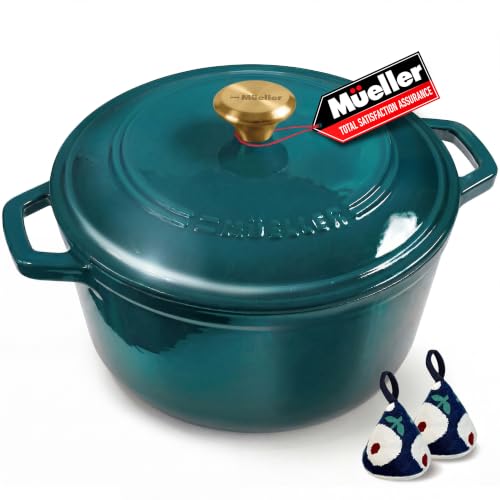
Mueller DuraCast 6 Quart Enameled Cast Iron Dutch Oven, Emerald
Badge: Best Documented Large Pot
Strengths
- A true six-quart large format whose listing also states its oven-safe figure and all-cooktop compatibility in writing.
- Emerald finish hides the marks of big, sauce-heavy cooking sessions.
- Sized for family braises, slow cooking and sourdough, per its listing’s stated uses.
Trade-offs
- Six quarts is the entry to large, not the summit — true batch cooks should look at the seven-quart pick.
- No potholders or cookbook listed as included, and no named lid feature in the title.
- Confirm current specifications on the listing, as with any stated figure.
Mini spec box
- Material: enameled cast iron
- Capacity: 6 Quart
- Stated in listing: 500°F oven safe; PFOA-free; all cooktops incl. induction
- Colour: Emerald
- Listed uses: sourdough bread baking, braising, slow cooking
The Mueller opens the large tier with the best paperwork in the category. Six quarts puts it squarely in family-and-batch territory — a stew for six, a double batch of sauce, a chicken with room to spare — and its listing then does something rare: it states a 500°F oven-safe figure and confirms all cooktops including induction, in the title, where a buyer can verify both before spending anything. For a large pot, which will live much of its life in the oven and may sit on an induction hob, those two written confirmations remove the category’s most common uncertainties. The Emerald finish suits the workload, concealing the evidence of tomato-rich, spice-heavy sessions that a pot this size tends to cook.
It suits families, induction owners and specification-first buyers entering the large tier. Its honest limitation is position: six quarts is where large begins, and households that routinely double recipes for the freezer will fill it to its working limit and wish for the seven-quart Umite Chef instead. Nor does it bundle potholders, so add mitts to the order. As the documented, family-sized entry to large, though, it is the easiest recommendation in this guide to defend line by line.
Best for: families and induction owners who want stated specs at six quarts / Not suited for: true batch cooks who need seven quarts of headroom
Check on Amazon to see the current listing for the Mueller DuraCast 6 Quart in Emerald.

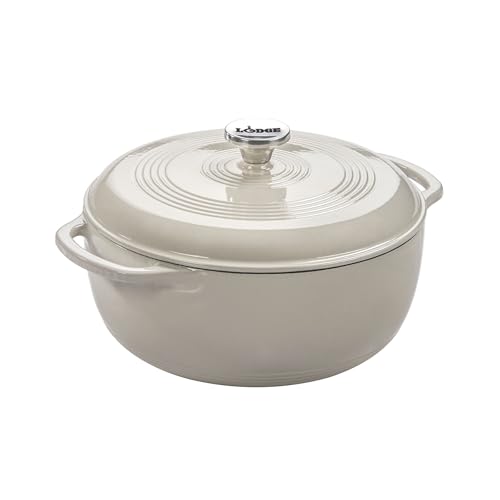
Lodge Essential Enamel Cast Iron Dutch Oven, 6 Quart, Island Spice Red
Badge: Best Large Pot for Braising
Strengths
- Six full quarts plus a moisture-sealing lid named in the listing — the combination braising households actually need.
- Dual handles for safe two-handed moves of a heavy, full pot.
- Island Spice Red conceals cooking marks and suits stove-to-table serving of large dishes.
Trade-offs
- No potholders listed as included.
- Like the Mueller, it is the entry size of large rather than a batch vessel.
- The title states no heat figure; confirm heat details on the current listing if they matter to you.
Mini spec box
- Material: enamel cast iron (per listing title)
- Capacity: 6 Quart
- Features named in listing: moisture-sealing lid, dual handles
- Colour: Island Spice Red
- Listed uses: bread baking, braising, marinating, slow cooking
Braising is the large pot’s defining job, and the Lodge is specified for it in the ways its listing verifies. Six quarts browns a family batch of beef or chicken in fewer, less crowded rounds; the moisture-sealing lid then keeps the braising liquid in the pot across hours of oven time, so the meat bastes instead of drying at the edges; and dual handles make the full pot a planned, two-handed carry rather than a gamble. Lodge’s long cast iron record stands behind the format, but the pick rests on the named features, which map directly onto the cooking. In Island Spice Red it also serves at the table without apology — useful when the braise is the centrepiece and the pot is the serving dish.
It suits families whose cooking centres on braises, stews and slow cooking at scale. Its limitations mirror the Mueller’s: it is large, not largest, and the bundle is bare. Households feeding eight or freezing double batches should step up to seven quarts; households feeding four to six will find this the hardest-working size they own, and the sealing lid the feature they mention most.
Best for: family braising at a true large size / Not suited for: batch cooks who need maximum capacity
Check on Amazon to see the current listing for the Lodge Essential 6 Quart in Island Spice Red.
Le Creuset Enameled Cast Iron Round Dutch Oven, 5.5 qt., Cerise
Badge: Premium Mid-Size (Prose-Only)
Strengths
- The benchmark premium name in enameled cast iron, in a handsome Cerise finish.
- At 5.5 quarts it remains a versatile family pot for most single-batch cooking.
- Round shape suits standard burners and round loaves.
Trade-offs
- It sits below this guide’s six-quart large threshold — half a quart and a category short of the linked picks.
- Premium tier commitment for less capacity than the six-quart value picks here.
- Reviewed prose-only in this guide: no purchase link, by the size rule stated at the top.
Mini spec box
- Material: enameled cast iron
- Capacity: 5.5 qt.
- Shape: round
- Colour: Cerise
- Status in this guide: prose-only — below the large threshold
This is the review that tests the guide’s honesty, so let us be direct: the Le Creuset 5.5 qt. is a superb pot and it is not a large Dutch oven by the standard this keyword demands. Five and a half quarts is the versatile middle of the whole category — it will cook most families’ stews, braises and loaves beautifully, and its name carries the longest premium track record here. But a buyer who searched for large pots and bought this one would discover the gap exactly when it matters: the double batch that does not fit, the bird that crowds, the browning that needs one batch too many. We therefore review it fully and link it nowhere, and we say why in plain words.
Who should still consider it? The cook whose household is three or four, whose recipes are single-batch, and who values the benchmark name and finish over the last measure of capacity — that buyer is not making a mistake, merely a different trade, and the dedicated guide at Best Le Creuset Dutch Ovens Braisers serves them properly. Who should not: anyone whose cooking regularly fills six quarts, because no badge on the lid adds volume to the pot.
Best for: smaller households who prize the premium name over maximum volume / Not suited for: anyone who genuinely needs large capacity

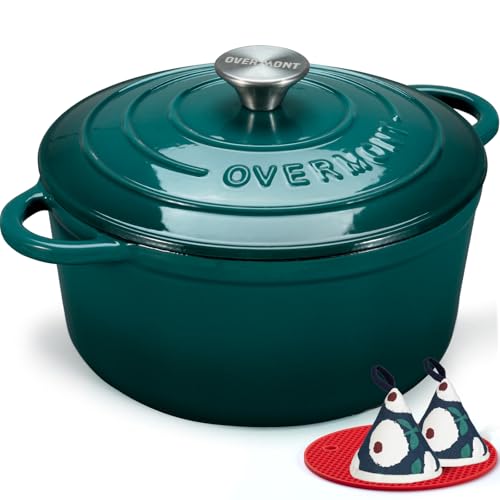
Umite Chef 7QT Enameled Cast Iron Dutch Oven, Emerald
Badge: Best True Batch Size
Strengths
- Seven quarts is the only true batch capacity in this guide — double stews, whole birds with vegetables, big loaves.
- Cotton potholders are included, matching the handling demands of the heaviest pot here.
- Emerald finish hides the marks of high-volume cooking.
Trade-offs
- Full, it is a serious two-handed lift; plan moves and landing spots.
- Needs generous storage and oven shelf clearance with the lid on.
- The title states no heat figure; confirm heat details on the current listing if needed.
Mini spec box
- Material: enameled cast iron
- Capacity: 7QT
- Includes: lid and cotton potholders (per listing title)
- Colour: Emerald
- Listed uses: bread baking, braising, stews, marinating
Seven quarts is where large stops being a label and becomes a capability. The Umite Chef holds the double batch in a single cook, roasts the whole chicken with its vegetables in one uncrowded layer, and bakes the oversized loaf that smaller pots press against their lids. Its listing describes heavy-duty cookware for bread baking, braising, stews and marinating, and includes cotton potholders — an inclusion that reads as self-knowledge, because a full seven-quart cast iron pot is among the heaviest objects in a home kitchen and should always travel in two protected hands. For households that entertain, batch cook for the freezer, or feed a table that keeps growing, this headroom is not indulgence; it is the difference between cooking the meal you planned and splitting it across vessels and timings.
It suits hosts, large families and freezer-fillers. Its limitations are the honest costs of scale: weight, footprint, slower heating for small meals, and the storage it demands. A household of two will use it monthly and curse it weekly; a household of six will wonder how it cooked without it. If that second household is yours, this is the first choice in the guide, and the oven-and-heat discussion at Best Oven Proof Dutch Ovens is worth reading alongside for the high-temperature side of big-pot cooking.
Best for: batch cooking, entertaining and whole-bird roasts / Not suited for: small households or cooks who struggle with heavy lifts
Check on Amazon to see the current listing for the Umite Chef 7QT in Emerald.
Umite Chef 5QT Enameled Cast Iron Dutch Oven, Cream White
Badge: Everyday Mid-Size (Prose-Only)
Strengths
- A well-judged everyday size for one to four people, with cotton potholders included in its listing.
- Cream White finish and a pale interior that shows fond and sauces clearly.
- Covers bread baking, braising, stews and roasting at household scale, per its listing.
Trade-offs
- Five quarts is a full quart below the large line — it is not a large pot, and this guide will not call it one.
- Crowds quickly when browning family-sized batches.
- Reviewed prose-only here: no purchase link, by the size rule.
Mini spec box
- Material: enameled cast iron
- Capacity: 5QT
- Includes: lid and cotton potholders (per listing title)
- Colour: Cream White
- Status in this guide: prose-only — below the large threshold
The Cream White Umite Chef five-quart is, on its own terms, one of the most sensible pots in this entire series: right-sized for smaller households, bundled with potholders, and aimed by its listing at the bread-baking, braising, stewing and roasting repertoire most people cook weekly. It appears in this guide as a measuring stick. If your household is one to four people and your recipes are single-batch, this pot — not a seven-quart vessel — is probably your correct purchase, and seeing it reviewed beside the large picks lets you make that call with the size difference in front of you rather than in a returns process.
It is prose-only here for one reason only: five is not six, and a guide to large pots that linked it would be breaking its own promise. Buyers who decide the mid-size fits their life will find it recommended and linked in the general shortlists elsewhere in this series, including the shape-and-size discussion linked from this guide’s introduction.
Best for: smaller households honestly reassessing whether they need large at all / Not suited for: anyone whose cooking fills six quarts or more
Umite Chef 5QT Enameled Cast Iron Dutch Oven, Red
Badge: Classic Mid-Size (Prose-Only)
Strengths
- The same everyday five-quart format as the Cream White version, in the category’s classic red.
- Red enamel conceals sauce and spice staining far better than pale finishes.
- Cotton potholders included in the listing.
Trade-offs
- Identical capacity and design to the Cream White prose-only pick — a finish variant, nothing more.
- Still a mid-size pot in a large-pot guide, with the same crowding limits.
- Reviewed prose-only here: no purchase link, by the size rule.
Mini spec box
- Material: enameled cast iron
- Capacity: 5QT
- Includes: lid and cotton potholders (per listing title)
- Colour: Red
- Status in this guide: prose-only — below the large threshold
The red five-quart Umite Chef completes the comparison set, and its role is the same as its cream sibling’s: an honest mid-size option for readers whose kitchens, households or arms argue against the large tier. Under the finish it is the same pot — same capacity, same included potholders, same stated repertoire of bread baking, braising, stews and roasting — wearing the colour that hides a sauce-heavy cooking history best. If the step-down decision lands on this model, the red is the pragmatic finish for cooks whose food is rich in tomatoes, paprika and wine.
Like the other prose-only reviews, this one carries no link and no image, deliberately: the guide’s links are its promise that a pot meets the keyword, and this pot, however likeable, does not meet the large one. Readers who choose it anyway should do so as informed mid-size buyers, not as large-pot buyers who were quietly undersold.
Best for: smaller households who want the mid-size pot in a forgiving finish / Not suited for: any genuinely large-capacity need
Comparison Table
| Pick | Capacity | Large? | Named feature or extras | Link |
|---|---|---|---|---|
| Mueller DuraCast Dutch Oven | 6 Quart | Yes | Oven-safe figure and induction stated in listing | Check on Amazon |
| Lodge Essential Dutch Oven | 6 Quart | Yes | Moisture-sealing lid, dual handles | Check on Amazon |
| Le Creuset Round Dutch Oven | 5.5 qt. | No — mid-size | Premium benchmark name | Prose-only in this guide |
| Umite Chef Dutch Oven | 7QT | Yes | Cotton potholders included | Check on Amazon |
| Umite Chef Dutch Oven | 5QT | No — mid-size | Cotton potholders included | Prose-only in this guide |
| Umite Chef Dutch Oven | 5QT | No — mid-size | Cotton potholders included | Prose-only in this guide |
How to Choose a Large Dutch Oven: The Capacity Maths
Work backwards from people and portions. A stew or soup serving is roughly a generous cup and a half to two cups per person once vegetables and liquid are counted, and a Dutch oven should be filled to no more than about two-thirds for simmering dishes so it can bubble without climbing the walls. That makes a six-quart pot a four-quart working vessel — comfortable for five to six servings with the headroom browning and stirring demand — and a seven-quart pot a four-and-a-half to five-quart worker, feeding seven or eight or doubling a family recipe for the freezer. Browning imposes its own maths: meat needs surface contact and air, so a large pot’s wider batch capacity is measured in fewer rounds, not just more volume. If your typical cook is four people with leftovers, six quarts is your size and seven is a luxury; if it is six people with leftovers, or any regular double batch, seven quarts is the honest buy.
Then check the physical fits that large pots punish when ignored. Oven clearance with the lid on, shelf to shelf. A burner that suits the base, so the pot heats evenly instead of scorching in a ring. Storage that is low and strong, because a full seven-quart pot is not a high-cupboard object and an empty one is not much kinder. And your own lifting comfort: fill a comparable vessel with water to the weight you are contemplating and carry it across the kitchen before you commit. None of these checks appears on a listing, and all of them decide whether a large pot becomes a workhorse or a monument. Finally, weigh the named extras at this scale: potholders stop being optional, a sealing lid earns its keep across longer braises, and stated specifications — the Mueller’s written oven and induction confirmations — are worth real peace of mind on a purchase this size.
How to Cook in a Large Dutch Oven: Batches, Braises and Big Loaves
Large-pot technique is mostly about resisting the urge to fill the advantage away. Brown in batches that leave space between pieces even in a seven-quart pot; the headroom is for steam to escape, and a single overcrowded batch will steam in any vessel ever made. Use the capacity for layering instead: sear the meat, soften a double quantity of aromatics in the fat, deglaze thoroughly, and return everything with liquid to the two-thirds line. In the oven, large braises hold temperature beautifully — the thermal mass of pot plus contents smooths the oven’s cycling — but they also take longer to come up to a simmer, so start the pot on the hob until the liquid moves, then transfer. For big loaves, preheat the pot with the oven, give the dough parchment and room, and bake covered for steam before uncovering to finish.
Care scales with size. Let the pot cool before washing, soak rather than scour, and dry it fully before storage — a large pot put away damp under a tight lid is its own weather system. Move it empty when you can and full only with two protected hands and a cleared path.
Troubleshooting, in brief. Problem: a big stew tastes diluted → it was filled past the working line and could not reduce; finish with the lid ajar, or cook the next batch at seven quarts’ two-thirds instead of its rim. Problem: the bottom scorches during a long braise → the hob phase ran too hot before the oven; bring large pots to a simmer gently, since their mass keeps heating after the burner drops. Problem: a whole chicken browns unevenly → the pot was too small for the bird or the bird was wet; dry the skin, and give it the seven-quart space this guide recommends.
Large Round Pots and the Oval Question
Every linked pick in this guide is a round-format pot in the listings available to us, and large round pots suit most large cooking — stews, soups, batches and round loaves — while sitting evenly on round burners. The case for oval at this scale is specific: whole chickens and elongated joints lie flatter, and a long pot can straddle two burners on some hobs. If that is your cooking, treat shape as a second filter after capacity and read the dedicated treatment at Best Oval Dutch Ovens, checking each listing’s stated shape rather than assuming it, because several pots in this category are confirmed round in their titles and others state no shape at all. Size first, shape second, features third — that order keeps a large purchase honest.
The Weight Question, Answered Honestly
Every large-pot review eventually arrives at weight, and most handle it with a shrug. Let us instead make it a decision tool. An empty enameled cast iron pot in this size class is already a two-handed object for most people; filled with stew it becomes a load that deserves respect, a cleared path and a landing trivet. That is not a reason to avoid large pots — it is a reason to buy the right large pot once. If your wrists, shoulders or grip are considerations, the six-quart tier gives you large capacity with meaningfully less full-weight than the seven-quart, and dual handles — named on the Lodge listing — spread the load across both arms. Handles and included potholders stop being bullet points at this scale and become the safety system, which is why the Umite Chef’s bundled potholders and the Lodge’s dual handles earn their emphasis in the reviews above.
There is also a division-of-labour answer many households discover: the large pot cooks, but it does not have to travel. Serve from the pot on a trivet at the stove or the table, ladle portions rather than pouring from a full vessel, and let leftovers cool in place before the pot is lifted to the sink or the fridge containers come to it. Cooked that way, even the seven-quart pick is manageable for most adults, because the heaviest version of the pot — full, hot, mid-carry — simply never happens. Design your routine around the weight and the weight stops deciding your menu.
One Large Pot or Two? Building the Pairing
Readers who cook a lot often end up asking whether one large pot is the whole answer. Usually it is the centre of the answer. The classic kitchen that emerges from this category pairs a large Dutch oven — six or seven quarts — with one smaller everyday vessel for sauces, reheats and side dishes, so the big pot is not heated for two cups of soup. Within this guide’s own pool, the prose-only mid-size pots illustrate the pairing partners: a five-quart pot for daily work beside a seven-quart pot for scale is a combination many households run happily for years. Buy the large pot first if large cooking is your pain point today, because it removes the hard limit; add the smaller partner when the daily friction of oversizing small meals annoys you into it. Bought in that order, each pot earns its place by use rather than by symmetry on a shelf.
The pairing logic also rescues the step-down dilemma this guide raises. Choosing a mid-size pot now is not a failed large purchase if your cooking later grows — it is the first half of the classic pairing, and the large pot joins it when the household or the batch habit does. What this guide objects to is only the confusion of the two decisions: calling a mid-size pot large, or buying a large pot for a household that will fill it twice a year. Decide which purchase you are making, and both this guide and the general shortlists elsewhere in the series will serve you well.
Common Buying Mistakes
- Letting a famous name shrink your pot. A premium 5.5-quart pot is still a mid-size pot. If you need large, buy large.
- Filling to the rim. Two-thirds is the working line for braises and soups; the headline capacity includes headroom you should not cook in.
- Skipping the oven and cupboard measurements. Large pots fail kitchens physically before they fail recipes. Measure shelf clearance and storage first.
- Underestimating the full-pot lift. Test the weight with water at home. Potholders and two hands are the system, not a suggestion.
- Buying seven quarts for a household of two. Oversize pots heat slowly for small meals and get used less. Fit the household, not the fantasy feast.
- Crowding the browning batch anyway. Capacity buys fewer batches, not infinite ones. Space is what browns.
Serving From a Large Pot: The Table Ritual
One pleasure of the large format deserves its own paragraph, because it changes how meals feel as well as how they cook. A six- or seven-quart enameled pot is a serving vessel by design: it holds heat through a long table conversation, it presents a braise or stew at the centre of the table with a generosity no transfer bowl matches, and it returns to the stove for seconds without a reheat. The finishes in this guide — Emerald, Island Spice Red — were chosen by their makers for exactly that journey from oven to table. Practically, set the pot on a substantial trivet, warn the table that the vessel is hot, and ladle rather than pour. The ritual is part of why cooks keep these pots for decades: the same object that seared, braised and roasted now presides over the eating, and the meal coheres around it. A large pot earns its storage space in the cooking; it earns its place in the household at the table.
What Large Capacity Unlocks: A Menu Tour
It helps to name the meals that change when the pot grows, because they are the true return on the purchase. A whole chicken roasted on a bed of vegetables, in one layer, with the skin browning instead of steaming against its neighbours. A double batch of chili or ragù that fills the freezer and turns future weeknights into reheats. A pork shoulder braised with room for the liquid to circulate and the onions to melt around it rather than stack on top. A soup built generously — the kind where the extra carrots and the last of the beans go in because there is space, and the pot rewards generosity instead of punishing it. A loaf sized for a gathering, baked under a lid that the dough never meets. None of these meals is impossible in a mid-size pot; all of them are compromised versions of themselves — split, crowded, or scaled down. The large pot removes the compromise, which is why households that cook this way describe the purchase as a change in what they cook, not just in what they cook it in. If that menu sounds like your ambitions, the capacity line this guide draws is the right one to shop above.
Final Recommendation
For genuine large-capacity cooking, the Umite Chef 7QT is this guide’s first choice: it is the only pick with true batch headroom, and its included potholders suit the weight that comes with it. Families entering the large tier at six quarts should choose between the Lodge — for its moisture-sealing lid and braising focus — and the Mueller — for its stated oven-safe figure and written induction confirmation. The three prose-only pots are reviewed above so that the step-down decision, if your household honestly points that way, is an informed one rather than a listing accident. Large is a number before it is a feeling; buy the number your cooking fills.
One closing thought for the undecided: capacity regret runs in one direction. Cooks rarely wish a large pot were smaller — they reach for a saucepan for the small jobs and keep the big pot for its purpose — but cooks who undersized a purchase meet the limit at the exact moment a meal matters. If your cooking genuinely lives at family-and-batch scale, trust that evidence and buy above the line.
If you want a fast answer, start with one of these three linked picks and read its detailed review above: Umite Chef 7QT Enameled Cast Iron Dutch Oven, Emerald, Lodge Essential Enamel Cast Iron Dutch Oven, 6 Quart, Island Spice Red, Mueller DuraCast 6 Quart Enameled Cast Iron Dutch Oven, Emerald. Together they cover batch, braising and documented-specification cases at true large sizes.
Frequently Asked Questions
What size counts as a large Dutch oven?
This guide draws the line at six quarts, the size where whole birds, double batches and family braises stop requiring workarounds. Five to five and a half quarts is the versatile middle of the category — excellent cookware, honestly labelled mid-size here — and seven quarts is the batch-and-entertaining tier.
Why are three picks in this guide not linked?
Because their capacities — 5.5 and 5 quarts — fall below the large threshold, and this guide’s links are its promise that a pot meets the keyword. They are reviewed in full, without links or images, so you can judge the step-down trade openly. The same pots are recommended and linked in general shortlists where size is not the defining promise.
Is a 7-quart Dutch oven too big for everyday use?
For households of one to three, usually yes: it heats slowly for small meals, washes heavily and stores awkwardly. For households of five or more, batch cooks and regular hosts, it becomes the everyday pot and smaller vessels feel cramped. Let your last month of cooking, not your largest annual gathering, decide.
How much food does a 6-quart Dutch oven actually hold?
Plan on roughly four quarts of food at the sensible two-thirds working line — enough stew or soup for about five to six servings, a whole chicken with vegetables, or a double batch of most family recipes. The remaining volume is headroom that prevents boil-overs and lets browning steam escape.
Can a large Dutch oven replace a stockpot?
For soups and stews at family scale, largely yes, and with better browning before the liquid goes in. For very large volumes of pasta water or stock, a tall stockpot still wins on volume and straining. Many kitchens run a large Dutch oven as the daily vessel and keep a plain stockpot for the biggest liquid jobs.
Should I buy the biggest pot if the price gap is small?
Only if your cooking will fill it. The true cost of the extra quart is not the purchase difference but the daily one: more weight, more storage, slower heating for small meals. Buy the size your routine fills weekly, and let the gathering-sized cooking borrow a stockpot or a roasting tray on its rare days.
How do I store a large Dutch oven?
Low, strong and near the stove: a deep drawer rated for the weight, a low cupboard shelf, or a permanent place on the hob for daily cooks. Never a high shelf — lifting cast iron down from above shoulder height is how accidents happen. Line the interior with a cloth if you nest other pans inside, and store the lid with a small gap in humid kitchens.
Does a large Dutch oven use more energy?
Heating more iron and more food takes more energy than heating less, but the comparison that matters is per meal: one large batch cooked once is generally more efficient than the same food cooked in two successive batches, and a full pot retains heat so well that long braises run at gentle settings. The wasteful pattern is heating a seven-quart pot for a two-person soup — another reason to fit capacity to routine.
Can I cook small meals in a large pot occasionally?
Yes. A half-filled large pot still braises, simmers and bakes perfectly well; you simply use a lower fill line and accept slightly more evaporation across the wider surface. Many owners cook small in the big pot on busy days rather than washing two vessels. The pot does not mind — the guidance in this guide is about your dominant routine, not about forbidding exceptions.
What should I check before ordering a large pot?
Oven shelf clearance with the lid on, a burner that suits the base, low and strong storage, and your comfort lifting the pot full — test with water in a comparable vessel. Then confirm capacity and any specifications you depend on in the current listing, because the quart figure in the title is the contract this guide has ranked by.