Disclosure: topratedkitchenware.com is reader-supported. When you buy through links on our site, we may earn an affiliate commission from Amazon and other retailers, at no extra cost to you.
Where to buy
The six machines below are the strongest candidates in our research pool for shoppers comparing the best meat bone grinders — the heavy-duty electric models a bone-grinding buyer should be weighing. One honesty point comes first, because it shapes this whole guide: none of these six Amazon listings states a bone-grinding capacity in its title. What the listings do state are the strength indicators that matter for heavy work — power class, head size, gear and motor construction, certifications — and this guide judges the picks on exactly those stated facts, while explaining plainly what you must confirm with the manufacturer before any bone goes into any machine.
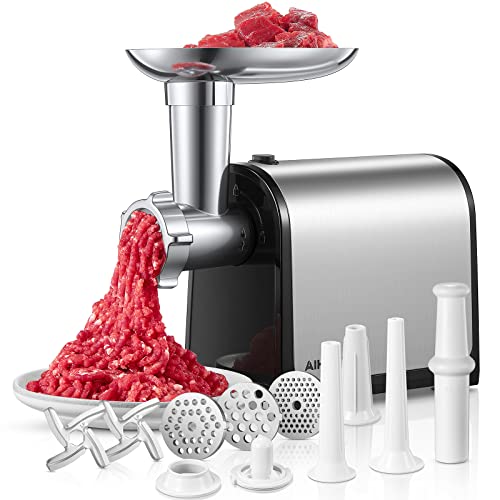
- Aiheal Electric Meat Grinder (Black) — Check on Amazon
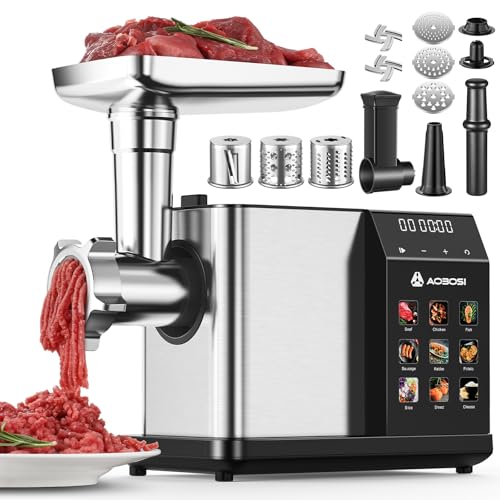
- AAOBOSI Electric Meat Grinder with 3-Speed Touch Screen
- AAOBOSI Multifunctional Digital Meat Grinder
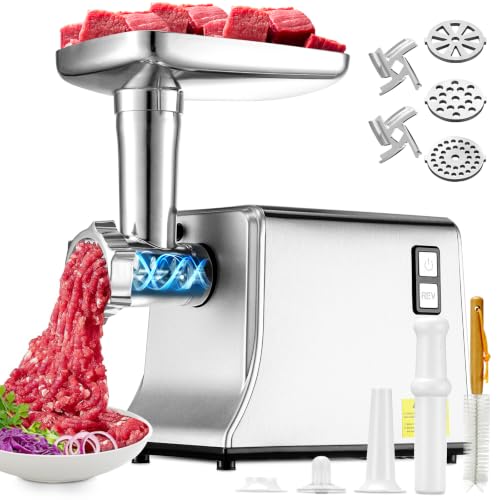
- VEVOR #12 Electric Meat Grinder, 750W / 1 HP
- CHEFFANO Meat Grinder, ETL Approved
- Sinyder Electric Meat Grinder with Metal Gears
Read the full guide ↓ for the strength-by-strength breakdown, the bone-safety briefing every buyer in this category needs, and complete grinding and cleaning instructions.
People searching for the best meat bone grinders usually have a specific job in mind: raw pet food made at home, where bone is part of the nutritional point, or whole-animal processing where trim, cartilage-heavy cuts and the occasional small bone enter the workflow. It is a search that attracts more exaggeration than almost any other in the grinder category, because “powerful” is easy to print and bone capability is hard to prove. So this guide takes a stricter line than most. It starts from what each manufacturer’s listing actually states — motor figures, head size, gear material, kit, certifications — and treats everything else, especially bones, as a question to be settled with the manufacturer before purchase, not as a promise to be implied by a big wattage number.
That discipline still leaves a genuinely useful shortlist, because the qualities that make a grinder strong for meat are the same qualities that determine whether it has any business near bone at all: torque delivered through a drivetrain built for shock loads, a head format with some mass and standardisation behind it, plates and blades in proper steel, and controls that let you stop, reverse and recover instead of forcing a stall. The six picks below were chosen as the strongest expressions of those qualities in the pool — the same pool surveyed in our general Best Meat Grinders guide — and the sections after the reviews explain, in plain terms, which bones are even candidates for home grinding, which are never candidates, and how to verify a specific machine before you trust it.
Key Takeaways
- No listing in this pool states a bone-grinding capacity. Treat every pick here as a strong meat grinder whose bone use must be confirmed with its manufacturer — in writing — before you attempt it.
- The strength indicators that matter are stated ones: the VEVOR’s #12 head and 750W / 1 HP motor, the Sinyder’s metal gears and pure copper motor, and the 2800W–3200W Max classes of the home picks.
- The AAOBOSI touch model is the only pick whose listing explicitly names raw pet food among its roles, which makes it the most directly relevant pick for raw-diet households.
- Bone type matters more than machine marketing: soft, small bones from small animals are a different physical problem from dense weight-bearing bones, which no home grinder in this class should ever be fed.
- Auto-reverse, fitted to the AAOBOSI digital model, is a genuinely protective feature when grinding cartilage-heavy, stall-prone material.
- Plates and blades are consumables under hard use; a standardised head format makes replacements a routine purchase instead of a research project.
- Decide your raw-feeding workflow first — boneless, pre-ground bone, or whole small carcasses — because only one of the three truly requires a bone-specified machine.
In this guide
Quick Picks
| Pick | Badge | Strength evidence stated in its listing | Link |
|---|---|---|---|
| Aiheal Electric | Best Overall | 3200W Max, stainless steel, 2 blades, 3 plates, 3 sausage tubes | Check on Amazon |
| AAOBOSI Touch Screen | Best for Raw Pet Food | 3000W Max, 4 lbs/min, built-in storage, 3-in-1 including raw pet food, LFGB approval stated | Check on Amazon |
| AAOBOSI Digital | Best Jam Recovery | 3000W Max, 9 presets, auto-reverse, built-in storage | Check on Amazon |
| VEVOR #12 | Strongest Stated Format | #12 head, 750W / 1 HP, stated 552 lbs/H, ETL listing | Check on Amazon |
| CHEFFANO | Best Certified | 2800W Max, ETL approved, 2 blades, 3 plates, kubbe kit | Check on Amazon |
| Sinyder | Best Stated Construction | 3000W Max, pure copper motor, metal gears, stainless body | Check on Amazon |
How These Picks Were Chosen
The selection method for this guide was deliberately conservative. From the wider grinder pool, the six picks are the models whose listings state the most about strength: the highest power classes, the only #12 head, the only stated metal gear train, the only stated copper motor, the only stated raw-pet-food role, and the two stated safety certifications. Feature-led qualities — presets, storage, touch controls — counted only where they serve heavy work, which is why auto-reverse appears in the reasoning and a cheese-grating role does not. Anything a listing does not state was treated as unknown. In particular, and it bears repeating because the keyword invites the assumption: no pick was credited with bone capacity, bone-in throughput, or a bone-rated plate, because no listing claims any of those things.
This is a research-led guide, not a destructive-testing lab report, and that limitation matters most in exactly this category. The honest way to use it is as a shortlist plus a verification script: choose the two or three machines whose stated strength matches your workload, then put the bone question to each manufacturer directly — what bone types, what sizes, through which plate, and what the warranty says about it — and buy based on the answers you get in writing. The reviews below are written to make that shortlisting easy, and the bone briefing after them explains the physical reasoning you will need to judge the answers. Readers whose interest is specifically the pet-food workflow will also want the companion guide at Best Meat Grinders For Bones, which approaches the same machines from the raw-feeding side.
The 6 Best Meat Bone Grinders to Compare

Aiheal Electric Meat Grinder, Stainless Steel (Black)
Badge: Best Overall
Strengths
- Largest home power class in this list at 3200W Max, with stainless steel construction stated.
- Three plates and two blades let you dedicate a blade-and-plate pair to your heaviest work.
- Three sausage tubes make it a complete processing station beyond grinding alone.
Trade-offs
- Gear material is not stated, so drivetrain strength under shock loads is an open question for the manufacturer.
- No certification is stated in the listing title.
- No kubbe kit is named, unlike most rivals here.
Mini spec box (from the listing): Type: electric, home kitchen use · Rating: 3200W Max · Blades: 2 · Plates: 3 · Sausage tubes: 3 · Body: stainless steel, black finish.
The Aiheal leads this list on the balance a heavy-duty home user actually needs: the biggest stated power class among the home-format picks, stainless construction, and a kit deep enough to organise your work intelligently. That last point matters more in this category than in gentle burger duty. Hard, cartilage-heavy grinding is roughest on the blade-and-plate pair doing it; with three plates and two blades, you can keep one dedicated pair for your toughest routine — first passes, trim, pet-food batches — and preserve a fresher pair for the fine table grinding where cut quality shows. It is a small discipline that extends the life of the whole cutting set.
Who it suits: the raw-feeding or whole-animal household whose work is mostly meat and connective tissue, with bone questions still to be put to the manufacturer. The honest limitation is the unknown drivetrain. The listing states power and materials for the body, but not the gears, and gears are where a bone fragment’s shock load would land. If your plan involves any bone at all, this is the model where the pre-purchase question matters most — ask Aiheal directly, and let the answer, not the wattage badge, decide.
Best for: heavy home meat work with an organised plate system / Not suited for: buyers who need gear material or bone capacity guaranteed in the listing

AAOBOSI Electric Meat Grinder with 3-Speed Touch Screen Control
Badge: Best for Raw Pet Food
Strengths
- The only listing here that explicitly names raw pet food as a role, alongside sausage and burgers.
- Built-in storage keeps the cutting set together, clean and findable between frequent sessions.
- 3-speed control allows a slower, more controlled feed for dense material; LFGB approval and easy cleanup are stated.
Trade-offs
- Its stated 4 lbs/min rate is a home-scale figure — this is a routine machine, not a volume machine.
- Raw pet food in the listing is not a bone claim; bone capability remains a manufacturer question.
- Touch controls are awkward with wet hands mid-batch.
Mini spec box (from the listing): Type: electric · Rating: 3000W Max · Controls: 3-speed touch screen · Stated rate: 4 lbs/min · Storage: built-in · Approval stated: LFGB · Roles: sausage, burger, raw pet food.
Raw pet food is the most common reason shoppers land on this keyword, and this is the one pick whose maker says the quiet part out loud: the listing names raw pet food as a designed role of the machine. That does not answer the bone question — pet food can be, and very often is, boneless — but it does mean the machine was specified with this exact routine in mind: frequent batches, hygiene that matters, cleanup that has to be easy enough to sustain several times a week. The stated easy cleanup and built-in storage stop being conveniences in that routine and become the features that decide whether the habit survives contact with real life.
The 3-speed control earns its place here too. Dense, cold, cartilage-heavy material should be fed slowly and steadily, and a genuine low speed gives the auger time to bite without the operator forcing the pusher. Who it suits: raw feeders working at household scale, especially those whose current recipes are boneless or use pre-ground bone, and who may add whole soft-bone work only after confirming it with AAOBOSI. The honest limitation is scale and proof: the stated rate is modest, and the listing’s silence on bones must be respected exactly as written.
Best for: raw pet food routines at home scale / Not suited for: high-volume processing or assumed bone duty
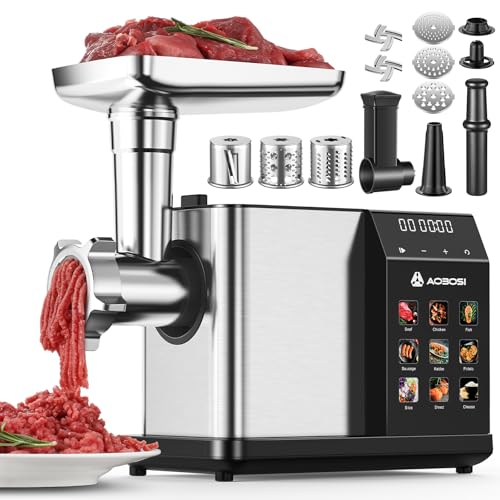
AAOBOSI Multifunctional Digital Meat Grinder
Badge: Best Jam Recovery
Strengths
- Auto-reverse backs stalls out without dismantling a loaded head — the single most protective feature for hard grinding.
- 9 presets give repeatable, gentle programs for repeat material.
- Built-in storage; stated roles include sausage and kibbe alongside grinding.
Trade-offs
- No throughput rate, head size or certification is stated in the listing title.
- Electronics are a long-term consideration on a machine doing the roughest work in the kitchen.
- Gear material is not stated.
Mini spec box (from the listing): Type: electric, digital · Rating: 3000W Max · Controls: touch screen, 9 presets · Feature: auto-reverse · Storage: built-in · Roles: grinding, sausage, kibbe, cheese grating.
Ask anyone who has ground cartilage-heavy trim what actually goes wrong, and the answer is rarely a dramatic failure — it is the stall. Sinew and connective tissue wrap the blade, the auger binds, and the operator faces a choice between forcing the machine (gears absorb the insult) or dismantling a head packed with cold meat (nobody enjoys this). The digital AAOBOSI is in this list because auto-reverse dissolves that choice: reverse the auger, let the wrap unwind, trim the offending piece, and continue with the drivetrain unharmed. For the stall-prone end of grinding, that is worth more than a larger wattage badge.
The presets play a supporting role: a repeatable gentle program for a repeat recipe means the machine behaves the same way on the fiftieth batch as the first, which is how routines get consistent. Who it suits: cooks whose material is trim-heavy — the thrifty whole-animal buyer, the pet-food maker using connective cuts — and who want recovery built in. The honest limitation is documentation: the listing does not state head size, rate or internals, so this pick’s case rests on its controls and its 3000W Max class. Pair it with disciplined feeding and it will forgive a great deal; it cannot forgive being treated as a bone crusher, and nothing in its listing asks to be.
Best for: stall-prone, cartilage-heavy grinding / Not suited for: buyers who want stated internals or a #12 format

VEVOR Meat Grinder, #12 Electric Meat Mincer, 750W / 1 HP
Badge: Strongest Stated Format
Strengths
- #12 head — the largest, most standardised format in this list — with a stated 552 lbs/H rate for kitchens or restaurants.
- Motor stated in continuous terms at 750W / 1 HP, the most meaningful power figure here.
- ETL listing stated; three stuffing tubes and a kibbe kit included.
Trade-offs
- Only two plates are included, and heavy work is hardest on plates — budget attention for replacements.
- Even at this format, the listing does not state bone capacity; the manufacturer question still applies.
- Largest footprint and weight class in the list.
Mini spec box (from the listing): Type: electric · Head: #12 · Motor: 750W / 1 HP · Stated rate: 552 lbs/H · Plates: 2 · Stuffing tubes: 3 · Kit: kibbe kit · Certification stated: ETL listing · Use: kitchens or restaurants.
If any machine in this pool has the physical format to discuss heavy work seriously, it is the VEVOR. The #12 head is a light-commercial standard: bigger plates, a bigger auger, more metal in the food path, and a sizing convention that makes replacement plates and blades a routine purchase rather than an archaeological dig — a real consideration when hard material shortens plate life. The 750W / 1 HP motor is stated the way continuous-duty motors are stated, and the 552 lbs/H figure is aimed at kitchens and restaurants, which tells you the duty cycle the maker had in mind.
Who it suits: the highest-volume home processors — hunting households, homesteaders, raw feeders making food for several large animals — and the small commercial kitchen. It is also the machine most discussed by readers of our Best Meat Grinders For Deer guide, where a season’s harvest arrives in a single weekend. The honest limitation must be stated without flinching: format is not permission. The listing does not claim bone capacity, and a #12 head fed a dense weight-bearing bone is a #12 head being destroyed at scale. Put the question to VEVOR, respect the answer, and this machine’s strength is entirely real for everything it is actually specified to do.
Best for: maximum stated format and volume / Not suited for: small kitchens, small batches, or assumed bone duty
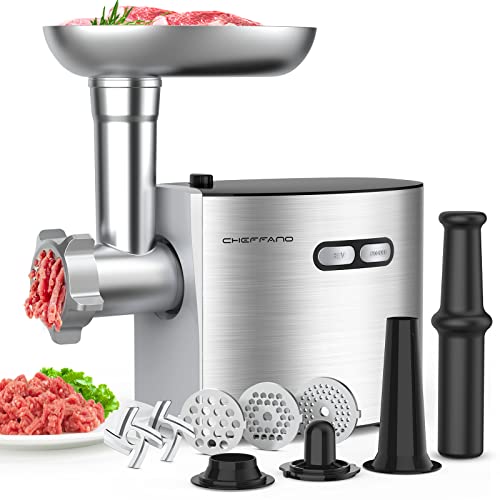
CHEFFANO Meat Grinder, ETL Approved Heavy Duty Meat Mincer
Badge: Best Certified
Strengths
- ETL approval stated — third-party evaluation of the electrical side you cannot inspect yourself.
- Three plates and two blades support a dedicated heavy-work cutting pair.
- Complete stuffing kit with sausage tubes and a kubbe kit.
Trade-offs
- No reverse function is stated, so stall recovery is manual.
- No throughput or head-size figure is stated in the listing title.
- Gear material is not stated.
Mini spec box (from the listing): Type: electric · Rating: 2800W Max · Certification stated: ETL approved · Blades: 2 · Plates: 3 · Kit: sausage stuffer tubes, kubbe kit · Use: home kitchen.
The CHEFFANO’s argument in this category is about verified basics. Heavy grinding sessions are long, wet-handed, high-draw work, and the ETL mark stated in its listing means the electrical design has been evaluated by a third-party laboratory — the one dimension of a grinder’s safety that no amount of listing-reading can assess. Around that verified core sits a sensible heavy-home specification: a 2800W Max class, three plates and two blades for an organised cutting rotation, and the full stuffing kit.
Who it suits: the safety-minded heavy home user whose work is meat, trim and connective tissue in serious quantities, and who wants the mainstream machine with its paperwork in order. The honest limitation is recovery and documentation depth: there is no stated reverse, so stalls are cleared by stopping and dismantling — slower, but mechanically gentle if done patiently — and the listing does not state internals or a rate. As with every pick here, its presence in a bone-grinder guide reflects stated strength for the surrounding work, not a bone claim, and Canadian shoppers comparing certifications and availability will find the notes in Best Meat Grinders Canada relevant.
Best for: certified, mainstream heavy home grinding / Not suited for: buyers wanting reverse, presets or stated gear material

Sinyder Electric Meat Grinder, Stainless Steel with Pure Copper Motor
Badge: Best Stated Construction
Strengths
- Metal gears stated — the drivetrain specification most relevant to shock loads and long service.
- Pure copper motor stated, suited to sustained high-torque work.
- Stainless steel body; full kit of 2 blades, 3 plates, stuffer tubes and kubbe kit.
Trade-offs
- Metal gears are a strength indicator, not a bone rating — the listing still states no bone capacity.
- No certification, reverse or throughput figure is stated.
- Materials are the manufacturer’s own claims, without a stated third-party mark.
Mini spec box (from the listing): Type: electric · Rating: 3000W Max · Motor: pure copper · Gears: metal · Body: stainless steel · Blades: 2 · Plates: 3 · Kit: sausage stuffer tubes, kubbe kit.
Shock load is the physics that governs this entire category. When a grinder meets something far harder than meat, the force spike travels from plate to blade to auger to gear train in a fraction of a second, and the gear train is where it does its damage. That is why the Sinyder’s listing is the most interesting document in this pool for a heavy-work buyer: it is the only one that states metal gears, and it pairs them with a pure copper motor — the winding material that tolerates sustained torque and heat best — inside a stainless steel body. No other pick puts its shock-relevant construction in writing at all.
Who it suits: the frequent, heavy grinder who wants the strongest stated internals in the list and is willing to do the verification legwork those internals deserve. And that legwork is the honest limitation, stated plainly: even here, with the best construction story in the pool, the listing claims no bone capacity, and metal gears are not a licence. If Sinyder confirms a bone envelope for this machine, its construction makes it the most plausible candidate in the list; if they do not, it remains an excellent heavy meat grinder. Buyers who cross-check claims as a habit — the mindset our Best Meat Grinders Fakespot guide teaches for reviews — will recognise that distinction as the whole game in this category.
Best for: strongest stated internals for heavy meat work / Not suited for: buyers who need a bone capacity stated in the listing itself
Comparison Table
| Pick | Stated rating / format | Strength evidence in listing | Bone stated? | Link |
|---|---|---|---|---|
| Aiheal | 3200W Max | Stainless body; 3 plates, 2 blades | No — confirm with maker | Check on Amazon |
| AAOBOSI Touch | 3000W Max, 4 lbs/min | Raw pet food role stated; LFGB approval stated | No — confirm with maker | Check on Amazon |
| AAOBOSI Digital | 3000W Max | Auto-reverse; 9 presets | No — confirm with maker | Check on Amazon |
| VEVOR #12 | #12, 750W / 1 HP, 552 lbs/H | Largest format; ETL listing stated | No — confirm with maker | Check on Amazon |
| CHEFFANO | 2800W Max | ETL approval stated; 3 plates, 2 blades | No — confirm with maker | Check on Amazon |
| Sinyder | 3000W Max | Metal gears; pure copper motor; stainless body | No — confirm with maker | Check on Amazon |
The Bone Briefing: What Home Grinders Can and Cannot Face
Before choosing among the six, understand the material. “Bone” is not one thing. At the soft end are the small, thin bones of small animals — rabbit, small poultry frames, fish frames — whose structure yields under pressure that meat grinders of real substance can sometimes be specified to handle, always subject to the manufacturer’s own statement. In the middle sit poultry necks, backs and wing joints, cartilage and gristle: tougher than meat, kinder than true bone, and the realistic heavy end of most home raw-feeding. At the hard end are the dense, weight-bearing bones of large animals — beef and pork femurs, marrow bones, knuckles. These are effectively stone in a food context. No machine in this guide, and no home grinder in this class generally, should ever be fed them, whatever a wattage badge seems to imply.
The failure mode explains why. A grinder cuts by shearing material between a rotating blade and a fixed plate. Meat shears; hard bone does not — it wedges, spikes the torque, and sends the shock into the gear train while the plate holes take point loads they were never shaped for. The results range from a stripped gear and a dead machine to a cracked plate, and they happen in a second. This is also why the verification script matters: ask the manufacturer which bone types and sizes, if any, the machine is specified for; which plate to use; and what the warranty says about bone damage. A maker with a real bone specification will answer precisely. Vagueness is an answer too, and it means no.
How to Choose a Grinder for Heavy and Bone-Adjacent Work
Work through four filters. First, workload honesty: how much material, how often, and of what kind? Meat and connective tissue in volume points to format (the VEVOR) or construction (the Sinyder). Frequent moderate batches point to routine-friendly design (the AAOBOSI pair, with storage and cleanup stated). Second, stated strength: rank listings by what they commit to — head size, continuous-style motor figures, gear and winding materials, certifications — and discount any ranking built on peak wattage alone. Third, recovery: heavy material stalls, so prefer auto-reverse where you can get it, and elsewhere commit to the discipline of stopping early rather than forcing. Fourth, consumables: plates and blades wear fastest in this category, so a standardised head and a multi-plate kit are long-term economy, not detail. Only after those four filters should the bone question be put to the surviving candidates’ manufacturers — and their written answers outrank everything in this guide, including this sentence. Independent-testing culture can help you weigh maker claims generally; our Best Meat Grinders Consumer Reports guide explains how to borrow that mindset without inventing results.
How to Grind Heavy Material Safely: Process and Care
- Verify first. Before any new material class — cartilage-heavy trim, poultry frames, anything with bone — confirm the manufacturer’s guidance for your exact model.
- Chill hard. Freeze the head assembly, and keep material at the coldest workable point; cold connective tissue cuts cleaner and loads the machine less erratically than warm, floppy material.
- Size the feed. Cut everything to pieces that drop freely down the tube. A grinder should never be asked to swallow a piece it must first crush to admit.
- Sort ruthlessly. Remove anything in the never category — dense weight-bearing bone, large joints — before it reaches the tray, not after it reaches the plate.
- Feed slowly, listen constantly. A change in pitch is the machine reporting load. Ease off, let it clear, and never answer a strain with pusher force.
- Use the coarse plate for first passes. Heavy material goes through coarse first; finer plates are for material already broken down.
- Stop at the first stall. Switch off, reverse if fitted, or dismantle and clear by hand. Every forced second is gear life spent.
- Clean and inspect. Wash, dry completely, and inspect the blade edge and plate holes after heavy sessions; early spotting of a nick or crack is cheap insurance.
Troubleshooting. Problem: the motor pitch drops and the auger slows on trim → connective tissue is wrapping the blade; stop, clear the wrap, trim more aggressively, and re-chill. Problem: output turns warm and smeared during a long session → the head has heated through friction; pause, re-chill the head and the remaining material, and shorten your sub-batches. Problem: a plate shows a crack or a blade an chipped edge after hard use → retire the part; a damaged plate under load can fail completely, and replacements in standard formats are inexpensive compared with a head or a motor.
Raw Feeding Workflows: Three Ways Bone Reaches the Bowl
Most people searching this keyword are building a raw diet for a dog or cat, and it helps to know that experienced raw feeders structure bone in three distinct ways — only one of which asks anything of a grinder. The first is boneless grinding plus a measured bone component: you grind meat and organs yourself, and the bone fraction arrives as commercially pre-ground bone or a prepared supplement. Every pick in this guide handles that workflow today, with no verification questions outstanding, and it is where most households should start. The second is grinding whole small carcasses or soft-boned portions — small poultry, rabbit — where the bones are thin and the animal is small. This is the workflow that lives or dies by the manufacturer’s written answer for your specific model, and by your discipline with plate choice and feed size. The third is feeding bones whole and unground, under whatever supervision philosophy you follow, in which case the grinder’s job is only the meat portion and its strength requirements drop back to ordinary heavy home duty.
Notice what this framework does to the buying decision. If your household is in the first or third workflow — which describes the majority of raw feeders — then the “bone grinder” question dissolves into the ordinary strong-grinder question, and the Aiheal’s plate system, the AAOBOSI touch model’s stated raw-pet-food role, or the CHEFFANO’s certification may matter more to your daily life than any theoretical bone envelope. Only the second workflow truly needs a bone-specified machine, and it needs the specification, not the implication. Decide your workflow before you shop, and you will either save yourself a verification project or conduct exactly one, properly.
Plates, Blades and Wear: The Consumables of Hard Work
Hard grinding spends cutting parts faster than gentle grinding, and the economics of this category are mostly the economics of plates and blades. A plate’s holes are its working edges; as they wear, output smears, temperature rises, the motor works harder for the same throughput, and the operator — feeling the machine labour — pushes harder, accelerating everything. The defence is rotation and inspection. Rotation: with two blades and three plates, as most of these kits provide, you can rest a pair, dedicate a pair to the hardest work, and keep one pair fresh for fine finishing. Inspection: hold a plate to the light and look for dished faces, burred holes and any crack radiating from the centre; run a fingernail across a blade’s edge and feel for nicks. Either fault retires the part.
This is where format quietly pays. Standardised heads — the #12 of the VEVOR, the #8 class represented elsewhere in the wider category — exist in a deep ecosystem of replacement plates in many hole sizes, which means a worn plate is a small, fast purchase and an experiment with a new texture is cheap. Proprietary home heads tie you to the maker’s parts list, which may be perfectly adequate — the kits in this pool are generous — but deserves a two-minute availability check before you commit a heavy routine to the machine. Budget your attention accordingly: in hard-work grinding, the machine is the durable asset and the cutting set is the subscription.
The Verification Script: Five Questions for the Manufacturer
When you contact a maker about bone, precision gets answers and vagueness gets brochures. Ask, in writing: (1) Is this model specified for grinding bone at all, and if so, which animals and which bones? (2) What is the largest piece size, and should bone be fed alone or mixed with meat? (3) Which plate should be used, and are specific plates excluded? (4) Is there a duty-cycle or rest guidance for hard material? (5) Does the warranty cover gear, blade or plate damage arising from bone? A manufacturer with a genuine specification will answer most of these directly, because they have answered them before. A manufacturer whose replies stay at the level of “powerful motor, can grind anything” has told you the specification does not exist. Keep the replies with your manual. If the day ever comes when a part fails, that correspondence — not a listing badge, and not this guide — is the document that matters.
Gristle, Cartilage and Sinew: The Everyday Heavy Work
It is worth pausing on the materials that sit between meat and bone, because they are what these machines will actually grind most. Cartilage — the glossy, rubbery tissue on joints and poultry frames — is tough but shearable; well-chilled, cut small and fed steadily, it passes through a coarse plate and enriches pet food and stocks’ worth of trim. Gristle behaves similarly, with more spring. Sinew is the awkward one: it does not shear so much as wind, wrapping the blade hub in tightening bands until the auger stalls, which is why trimming silverskin and heavy sinew before grinding is the oldest advice in this craft, and why auto-reverse, fitted to the digital AAOBOSI, is such a practical mercy. The through-line is temperature and size: connective tissue that is nearly frozen and cut to short lengths behaves like a solid and cuts; the same tissue warm and in long ribbons behaves like rope and binds. Manage those two variables and the whole “heavy” end of home grinding becomes routine work for any pick in this list — no bone required.
Common Buying Mistakes
- Reading wattage as bone permission. A peak-wattage badge says nothing about bone. Only a manufacturer’s explicit specification does.
- Feeding weight-bearing bones. Beef and pork leg bones destroy home grinders, full stop — and the damage is rarely covered.
- Skipping the verification question. Two emails to manufacturers will teach you more about bone capability than any review page, including this one.
- Buying the smallest machine for the hardest job. Heavy work in a light machine means heat, stalls and a short life; size to the workload.
- Ignoring plate supply. Hard work consumes plates; a format you cannot re-plate easily becomes a paperweight with a motor.
- Forcing stalls. The pusher is for guiding meat, not for overpowering physics. Stop, clear, trim, restart.
Final Recommendation
Choose by the work you can describe, not the work you can imagine. For the strongest stated format and true volume, the VEVOR #12 is the first conversation to have — Check on Amazon. Choose the Aiheal instead if you want the largest home power class with a three-plate system for organised heavy rotation. For the strongest stated internals, the Sinyder’s metal gears and copper motor make it the construction pick — Check on Amazon. Raw pet food households should start with the AAOBOSI touch model, the only listing that names their routine; stall-prone trim work suits the auto-reverse digital AAOBOSI; and the CHEFFANO serves buyers who want an ETL mark on a mainstream machine. Whichever you choose, put the bone question to its manufacturer in writing before the first bone — that single habit separates owners who grind for years from owners shopping for a replacement. And if the answer that comes back is narrower than your plans, believe it and adjust the plans rather than the truth: pre-ground bone, a boneless recipe structure, or whole-bone feeding are all respectable raw-feeding architectures, and every one of them lets a strong grinder from this list do excellent work for a very long time.
Frequently Asked Questions
Can any of these six grinders grind bones?
None of the six listings states a bone-grinding capacity, so this guide claims it for none of them. Some may have manufacturer guidance covering specific soft, small bones — that is exactly what you must confirm with the maker, in writing, for your model and your bone type, before attempting it. Until then, treat all six as meat grinders of varying strength.
Which bones are never safe in a home grinder?
Dense weight-bearing bones of large animals — beef or pork femurs, marrow bones, knuckle bones — are never suitable for home grinders in this class, regardless of stated wattage. They do not shear; they wedge and shock-load the drivetrain. Source your bone content for pet food as pre-ground bone or bone meal instead, and keep whole-bone work, if any, to the soft, small end and only with manufacturer confirmation.
Why do metal gears matter so much for heavy grinding?
Because the gear train is where shock loads land. Meat is forgiving; connective tissue and any hard inclusion are not. A stated metal gear train, like the Sinyder’s, signals a drivetrain built to absorb those spikes over years of service rather than a composite set designed as the sacrificial wear point. It is a durability indicator — still not a bone rating, but the most relevant construction fact in a listing for this category.
What plate should I use for cartilage-heavy material?
Start with the coarsest plate in your kit for any first pass over cartilage-heavy trim, and only move finer on material that has already been broken down and re-chilled. Fine plates multiply back-pressure and heat, which is why experienced processors treat plate sequence — coarse, chill, then finer — as a rule rather than a preference.
Does the AAOBOSI’s “raw pet food” role mean it grinds bones for pet food?
No. The listing states raw pet food as a role, and raw pet food is very commonly boneless or made with pre-ground bone. The statement tells you the machine was designed with that routine — frequent batches, hygiene, cleanup — in mind. It does not state bone capability, and this guide does not stretch it into one. Ask AAOBOSI directly if whole-bone grinding is part of your plan.
How will I know if I am overloading my grinder?
By ear and by temperature. A healthy grinder under load sounds steady; an overloaded one drops in pitch, labours in pulses and warms noticeably at the head. Output that turns smeared and warm is the material telling you the same thing. The correct response is always to stop, clear, trim smaller and re-chill — never to push harder on the feed pusher.
Is a bigger, more powerful grinder automatically safer for bone-adjacent work?
Safer for the surrounding work, yes — more format and more torque headroom mean less strain, less heat and fewer stalls on meat and connective tissue. Automatically cleared for bone, no. Power without a bone specification simply means a machine can damage itself more energetically when it meets something it was never designed to shear. That is why this guide ranks strength and bone permission as two separate questions, and why the verification script above is addressed to the manufacturer of the specific model you own or are about to buy.
Are replacement plates easy to find for these machines?
It depends on format, which is a real argument for the standardised sizes. A #12 head like the VEVOR’s follows a widely used convention, and #8 is similarly established in the wider category; proprietary home heads depend on the maker’s own parts channel. Before buying for heavy work, check that spare plates and blades for your chosen model are actually listed and available — that check takes two minutes and saves the machine’s working life later.