Disclosure: topratedkitchenware.com is reader-supported. When you buy through links on our site, we may earn an affiliate commission from Amazon and other retailers, at no extra cost to you.
Where to buy
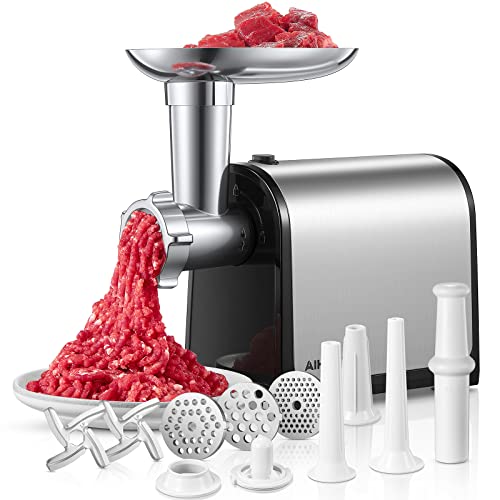
All six grinders below are sold through Amazon, where you can confirm the current plate set, head size, and included stuffer tubes before ordering — the details that matter when a deer is already hanging and the clock is running. The first machine on the list, the AAOBOSI Multifunctional Digital Meat Grinder, is a strong place to start — Check on Amazon — and the rest of the shortlist follows:
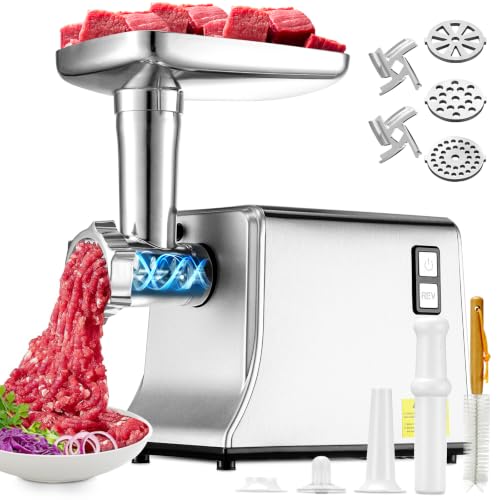
- VEVOR Meat Grinder, #12, 750W / 1 HP
- CHEFFANO Meat Grinder, 2800W Max, ETL Approved
- Sinyder Electric Meat Grinder, 3000W Max, Metal Gears
- CHEFFANO Life Electric Meat Grinder, 2000W Max
- LEM Products BigBite #8 Meat Grinder, 0.5 HP
Read the full guide ↓ for how each machine fits a real deer-processing day, from first trim to the last bag of burger.
The best meat grinders for deer are not chosen the way you choose a grinder for Saturday burgers. Deer processing is a once-or-twice-a-season marathon: an animal comes in from the field, and within a day or two you are facing a cooler full of trim that all needs grinding at once — burger meat, sausage meat, chili grind — while the clock and the temperature work against you. The best meat grinders for deer therefore earn their place on sustained behaviour, not first impressions: a motor that holds its pace in hour two, a head big enough to swallow well-trimmed chunks without constant re-cutting, plates coarse enough for a proper chili texture, and a build that shrugs off the sinew and silverskin that venison trim always contains. This guide shortlists six electric grinders against exactly those criteria.
Venison also differs from beef in ways that shape the choice. It is lean — very lean — so most processors blend in pork fat or beef fat as they grind, which means the machine must handle alternating loads of dense lean meat and soft fat without smearing. It arrives in bursts rather than a steady weekly rhythm, so a grinder for deer may sit in a cupboard for ten months and then be asked for the hardest weekend of its year; reliability after storage and simple, complete disassembly for washing matter more than touch-screen polish. And the trim is never perfectly clean: despite your best knife work, some silverskin and connective tissue reaches the plate, and the grinder’s job is to power through it or clear it quickly, not to stall the whole production line. Readers whose season also includes a bigger animal will find the companion shortlist of Best Meat Grinders For Elk useful, because elk volume is where the next size class starts to justify itself.
Key Takeaways
- Deer grinding is a marathon, not a sprint: sustained motor ratings and head size matter more than peak wattage claims.
- A #12 head (VEVOR) suits multi-deer households; a #8 head (LEM BigBite) is the classic one-deer-at-a-time size.
- Trim silverskin aggressively before grinding — no grinder cuts it well, and it wraps the blade and slows everything.
- Grind venison partially frozen, blend fat in during the grind, and use a coarse plate for chili and a medium plate for burger.
- Auto-reverse (AAOBOSI Digital) is the fastest answer to the sinew stall that every deer processor eventually meets.
- Every pick here includes sausage capability, because deer season usually ends with a sausage-making day.
In this guide
Quick Picks
| Pick | Badge | Standout detail from the listing | Link |
|---|---|---|---|
| AAOBOSI Multifunctional Digital Grinder | Best Jam Recovery | 3000W max, 9 touch presets, auto-reverse, built-in storage | Check on Amazon |
| VEVOR #12 Electric Meat Grinder | Best Overall for Deer Season | 750W / 1 HP motor, throughput quoted at 552 lbs/h, #12 head | Check on Amazon |
| CHEFFANO Meat Grinder | Best Value Workhorse | 2800W max, ETL approved, 2 blades, 3 plates | Check on Amazon |
| Sinyder Electric Meat Grinder | Best Metal-Gear Build | 3000W max, pure copper motor, metal gears, stainless body | Check on Amazon |
| CHEFFANO Life Electric Meat Grinder | Best for Smaller Batches | 2000W max, stainless steel, 2 blades, 3 plates | Check on Amazon |
| LEM Products BigBite #8 | Best Game-Processing Pedigree | 0.5 HP, #8 head, stainless steel, built for grinding and sausage stuffing | Check on Amazon |
How These Picks Were Chosen
This guide is research-led: we compared manufacturer listings and specifications across the current heavy-duty home grinder market and filtered for deer-season realities rather than headline numbers. Peak wattage — the big number on most boxes — describes a momentary maximum, so we weighted the listings that quote continuous-style figures (horsepower, throughput per hour, head size) more heavily, and treated peak-only listings as needing support from their construction details: gear material, motor type, plate and blade count, and certifications.
Four filters produced the final six. First, sustained pace: deer day means tens of pounds in one session, so throughput figures and horsepower ratings led the ranking. Second, head size: a #12 head reduces pre-cutting and keeps a two-person workflow (one cutting, one feeding) moving, while a #8 remains the proven one-deer size. Third, stall management: venison sinew wraps blades and chokes plates, so auto-reverse scored highly, and machines without it needed the accessory depth to make manual clearing quick. Fourth, the sausage pathway: stuffer tubes and kubbe kits in the box matter because a large share of every deer ends as sausage. We deliberately left out stand mixer attachments — their gearboxes are not built for a season’s worth of venison in a weekend — and manual grinders, which turn deer day into an endurance event. If your grinding is mostly weeknight family cooking rather than seasonal processing, the broader shortlist in our Best Meat Grinders For Home Use guide will fit better; this page keeps the deer-first filter.
The 6 Best Meat Grinders for Deer
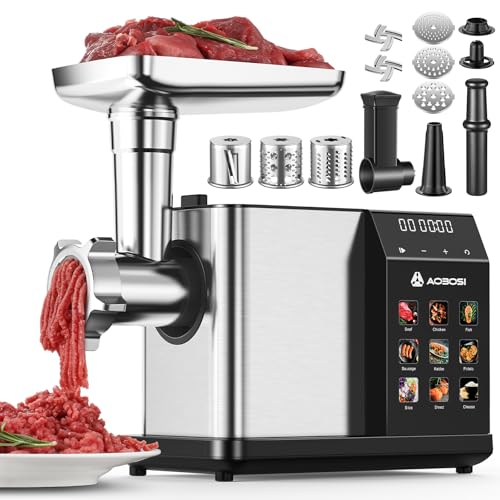
AAOBOSI Multifunctional Digital Meat Grinder
Badge: Best Jam Recovery
Strengths
- Auto-reverse clears the classic venison stall — sinew wound around the blade — without opening a loaded head.
- Nine touch presets let you save the settings that work for burger, chili grind, and sausage meat and return to them next season.
- Built-in storage keeps plates and blades with the machine through its long off-season in the cupboard.
Trade-offs
- 3000W is a maximum figure; its sustained pace is a class below the VEVOR’s horsepower-led rating.
- Touch electronics ask for more care at wash-down time than a simple switch machine.
- Presets help repeatability, but they do not add grinding capacity for a two-deer day.
Mini spec box: Power: 3000W max · Controls: digital touch screen, 9 presets · Reverse: auto-reverse · Storage: built-in · Roles: grinding, sausage, kibbe, cheese grating · Duty described: home use.
Every deer processor knows the moment: the grinder’s note changes, output slows to a dribble, and a rope of silverskin has wound itself around the blade hub. On most machines the fix is a full stop, a disassembly, and a slimy excavation. This AAOBOSI’s auto-reverse exists precisely for that moment — back the auger off, let the sinew release or pull it free at the plate, and carry on. Over a whole deer, with trim quality varying from one muscle group to the next, that feature can return half an hour to your day and a good deal of temper with it.
The presets earn their keep across a season rather than a single session. Dial in the pace that moves your burger blend — venison with its fat folded in — and the machine remembers the neighbourhood of that setting when the next animal arrives months later. The honest limitation is capacity class: this is a full-featured home grinder, not a light-commercial unit, so on a two-deer weekend you will work in shifts with rest breaks rather than one continuous run, and the VEVOR below is the better tool for that scale. For the one-deer household that values a calm, stall-resistant session — and for anyone whose trim work is honest rather than perfect — the digital AAOBOSI is the most forgiving machine in this six.
Best for: one-deer households whose trim includes some sinew and who want stalls solved by a button / Not suited for: multi-deer processing days that need continuous commercial-style running.

VEVOR Meat Grinder, #12 Electric Meat Mincer, 750W / 1 HP
Badge: Best Overall for Deer Season
Strengths
- A continuous-style 750W / 1 HP rating with throughput quoted at 552 lbs/h — the spec language of a machine built for session-length work.
- The #12 head accepts generous chunks of trim, keeping pace with a second person cutting.
- Positioned for kitchens or restaurants with an ETL listing noted, plus three stuffing tubes and a kibbe kit for sausage day.
Trade-offs
- Only two plates included, so coarse and medium work is covered but a fine grind needs an added plate.
- It is the biggest, heaviest footprint here — a consideration for small kitchens and camp processing.
- Its capacity is wasted on households that take a single small deer every few years.
Mini spec box: Motor: 750W / 1 HP · Head size: #12 · Throughput: 552 lbs/h (maker rating) · Plates: 2 · Stuffing tubes: 3 · Extras: kibbe kit · Certification noted: ETL listing · Settings: kitchens or restaurants.
Deer season rewards the grinder that behaves like equipment rather than an appliance, and the VEVOR is that machine in this guide. The 1 HP rating and the hourly throughput figure describe sustained output — the thing that decides whether the last twenty pounds of trim grind as briskly as the first twenty. The #12 head compounds the advantage: venison trim can go in as substantial strips and chunks instead of dice, so the person cutting can stay ahead of the person feeding, and the whole deer moves from cooler to freezer bags in one smooth session.
In practice, run it the way the how-to section below describes — trim cold and partially frozen, fat blended through the batch rather than dumped in one lump, coarse plate for chili meat and the second plate for burger. The VEVOR’s honest limitation is the two-plate bundle: if your household loves a fine-textured sausage grind, budget for an extra plate. Size is the other consideration; this is a machine that earns a permanent counter corner during season rather than living deep in a cupboard. Households processing for a wider circle of family and friends should also read our Best Meat Grinders For High Volume At Home guide, where this class is compared purely on throughput. For deer specifically, the VEVOR’s combination of honest power, head size, and session endurance makes it the benchmark pick.
Best for: hunters processing multiple deer, or one deer fast with a helper cutting / Not suited for: small kitchens or very occasional use.
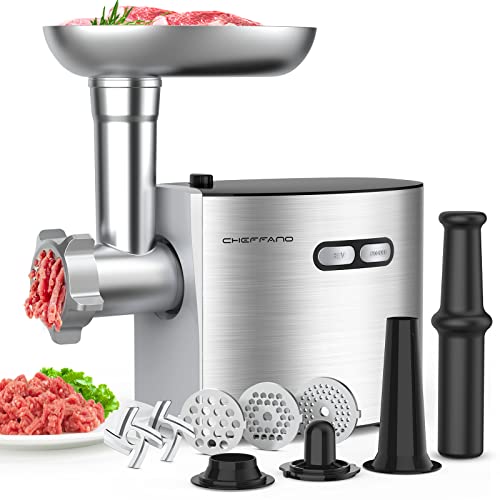
CHEFFANO Meat Grinder, 2800W Max, ETL Approved
Badge: Best Value Workhorse
Strengths
- ETL approval stated in the listing — a third-party safety mark that much of this category skips.
- Two blades and three plates cover the deer workflow: coarse chili pass, medium burger pass, and a spare blade for sausage day.
- Sausage stuffer tubes and a kubbe kit included, matching how a deer is actually used.
Trade-offs
- 2800W max is a peak figure, and the lowest in this six — feeding discipline matters.
- No reverse is listed, so sinew stalls are cleared by hand.
- No built-in storage or presets; it is a deliberately simple machine.
Mini spec box: Power: 2800W max · Certification noted: ETL approved · Blades: 2 · Plates: 3 · Extras: sausage stuffer tubes, kubbe kit · Duty described: heavy duty for home kitchen use.
The CHEFFANO is the deer grinder for the hunter who processes one or two animals a year and wants the money spent on grinding hardware rather than interface. Its three plates map neatly onto a deer’s destinations — coarse for chili, medium for burger, fine available when a sausage recipe asks for it — and the second blade means the edge that met the first deer is not the dull edge that meets the second. The ETL mark is worth pausing on: a grinder works hard, near water, with wet hands, for hours; third-party electrical approval is not a glamorous feature, but on deer day it is a relevant one.
The honest limitation is headroom. With the most modest power claim in this six and no reverse, the CHEFFANO asks its owner to do the things good processors do anyway: trim silverskin properly, keep the meat hard-chilled, cut pieces to a sensible size, and feed steadily instead of packing the tube. Do those things and it will work through a deer in a morning without complaint; skip them and you will spend the morning clearing the head. As the value workhorse of the guide — full plate set, real approval mark, sausage kit in the box — it is the pick we would hand to a first-time deer processor who intends to learn the craft properly.
Best for: first-time and one-or-two-deer processors who want a full plate set and ETL approval at a mid-tier position / Not suited for: high-volume days or anyone who wants reverse to handle sloppy trim.

Sinyder Electric Meat Grinder, 3000W Max, Stainless Steel
Badge: Best Metal-Gear Build
Strengths
- Metal gears stated in the listing — the component that seasonal, stop-start, heavy-load work stresses most.
- Pure copper motor and stainless steel body complete a durability-led specification.
- Two blades and three plates included, with sausage stuffer tubes and a kubbe kit.
Trade-offs
- No throughput figure is published, so its session pace is unproven on paper.
- No reverse is listed; stalls are manual clear-outs.
- Stainless construction usually means more weight to haul out each season.
Mini spec box: Power: 3000W max · Motor: pure copper · Gears: metal · Body: stainless steel · Blades: 2 · Plates: 3 · Extras: sausage stuffer tubes, kubbe kit.
A deer grinder lives an unusual life: ten months of cupboard, then the hardest weekend of its year, repeated for a decade. That duty cycle punishes exactly the parts the Sinyder specifies in metal. Gear teeth that sit idle and then meet a full load of near-frozen venison are where cheaper drivetrains quietly die, and a pure copper motor with metal gearing is the listing-level answer to that failure. The stainless body suits the other reality of deer day — a wet, bloody, wash-everything environment — better than painted or plastic housings.
Working a deer through it follows the standard rhythm: coarse pass for the chili portion, medium for burger, fat distributed through the batch, and everything kept cold enough to cut cleanly. The three plates and spare blade cover those jobs without extra purchases. The honest limitations are informational and functional: with no published throughput, you cannot plan a big day around a number, and with no reverse, a sinew wrap means stopping and opening the head. Hunters comparing the wider field should also see our Best Meat Grinders For Hunters guide, which weighs camp and garage practicality alongside kitchen specs. Within this six, the Sinyder is the longevity argument — the machine bought by someone who intends to process deer with it for many seasons and wants the drivetrain specified accordingly.
Best for: hunters who buy once and process every season, valuing metal drive parts over published pace figures / Not suited for: buyers who want a stated throughput or reverse-assisted clearing.

CHEFFANO Life Electric Meat Grinder, 2000W Max
Badge: Best for Smaller Batches
Strengths
- Stainless steel construction in the most accessible package in this six — a sensible first deer grinder.
- Two blades and three plates included, so the coarse-to-fine deer workflow is fully covered.
- Sausage tube and kubbe kit in the box for the end-of-season sausage batch.
Trade-offs
- 2000W max is the gentlest power claim here; a whole deer is a paced session, not a sprint.
- No reverse and no published throughput — plan the day with breaks built in.
- Heavy-duty positioning is for home use; it is not the multi-deer answer.
Mini spec box: Power: 2000W max · Construction: stainless steel · Blades: 2 · Plates: 3 · Extras: sausage tube, kubbe kit · Duty described: heavy duty for home use.
Not every deer hunter needs a #12 head. If your season is one deer, processed at kitchen pace over a relaxed day — grind a quarter, bag it, take a break, grind the next — the CHEFFANO Life is the honest fit. It carries the same useful accessory logic as its bigger sibling (two blades, three plates, sausage tube, kubbe kit) in a stainless machine positioned for home use, and for a single animal worked in batches, that is genuinely enough grinder.
The technique bargain is stricter here, and it is worth stating plainly: trim well, chill hard, cut modest pieces, and let the machine rest between batches. Venison is dense and lean, and a lighter motor rewards patience and punishes the packed feed tube. The honest limitation is ceiling — if next season brings a second deer, or a friend’s deer joins yours on the table, this is the machine you will outgrow first, and the step up is the VEVOR or the LEM below. But as a first deer grinder that covers burger, chili grind, and a sausage day without overspending on capacity you may never use, the CHEFFANO Life is a rational, well-equipped starting point.
Best for: one-deer households processing at a relaxed, batched pace / Not suited for: back-to-back multi-deer days.

LEM Products BigBite #8 Meat Grinder, 0.5 HP
Badge: Best Game-Processing Pedigree
Strengths
- A horsepower rating — 0.5 HP — instead of a peak wattage claim, from a brand whose name is built on game processing.
- The #8 head is the classic one-deer size: big enough for real trim, small enough for a kitchen counter.
- Stainless steel construction, designed for grinding and sausage stuffing as a single workflow.
Trade-offs
- Half a horsepower is honest but modest; a two-deer day is steady work rather than a quick one.
- The listing in this pool does not detail a plate-and-blade bundle, so confirm the included set before ordering.
- No electronic conveniences — no presets, no storage system, no touch controls.
Mini spec box: Motor: 0.5 HP · Head size: #8 · Construction: stainless steel · Roles: grinding and sausage stuffing · Duty described: home use, heavy-duty positioning.
LEM is the name deer processors say to each other, and the BigBite #8 is why: it is a grinder specified the old way, in horsepower, sized at the #8 head that has processed generations of whitetails. The BigBite name refers to its auger design philosophy — pulling meat in aggressively so the feed keeps moving — and in deer terms that translates to trim that feeds itself rather than needing constant pressure on the pusher. For the classic household pattern — one or two deer a year, ground carefully, much of it destined for sausage — this is the reference machine in the guide.
Its working style is unhurried competence. Keep the venison cold, trim with reasonable care, and the #8 head moves a deer at a pace that lets one person both cut and feed without a backlog. The honest limitations are scale and information: 0.5 HP is a truthful rating, not a large one, so elk-sized volume belongs to the bigger machines, and buyers should confirm exactly which plates and accessories the current listing includes, since the pool data does not enumerate them. If your season extends to dog food made from trim and organs, our Best Meat Grinders For Dog Food guide covers that branch of processing. As the pedigree pick — the grinder bought on the strength of a name earned in deer camps — the BigBite #8 closes this list with authority.
Best for: traditional deer processors who trust horsepower ratings and a game-processing brand / Not suited for: the largest volume days, or buyers who want digital features.
Comparison Table
| Grinder | Power as listed | Head | Plates / Blades | Standout for deer | Link |
|---|---|---|---|---|---|
| AAOBOSI Digital | 3000W max | Not stated | Not stated | Auto-reverse for sinew stalls | Check on Amazon |
| VEVOR | 750W / 1 HP, 552 lbs/h | #12 | 2 / not stated | Sustained throughput | Check on Amazon |
| CHEFFANO | 2800W max, ETL | Not stated | 3 / 2 | Full plate set, approval mark | Check on Amazon |
| Sinyder | 3000W max | Not stated | 3 / 2 | Metal gears, copper motor | Check on Amazon |
| CHEFFANO Life | 2000W max | Not stated | 3 / 2 | Accessible stainless starter | Check on Amazon |
| LEM BigBite | 0.5 HP | #8 | Not stated | Game-processing pedigree | Check on Amazon |
How to Choose a Meat Grinder for Deer
Count your deer first. One deer a year, processed in batches, is honest work for any machine in this guide. Two or more deer — yours, a partner’s, a teenager’s first — arriving in the same week is a different job, and it is the job the VEVOR’s #12 head and hourly throughput exist for. Buy for your real season, including the generous years, because upgrading mid-season helps no one.
Translate power claims. Peak wattage is a momentary figure. Horsepower and pounds-per-hour describe the working machine. A 0.5 HP #8 and a 1 HP #12 are honestly specified; a four-digit “max” wattage tells you the ceiling, not the cruise. For deer — long sessions, dense lean meat — cruise is what you are buying.
Decide your stall strategy. Venison sinew will wrap a blade eventually. Auto-reverse turns that into seconds; without it, you stop and clear by hand, which is fine if your trim is meticulous and your batches modest. Be honest about your knife discipline and choose accordingly.
Plan the fat blend. Venison is lean enough that most processors grind in pork or beef fat for burger that cooks properly. Your grinder must handle alternating lean and fat without smearing, which is mostly about temperature — everything near freezing — and partly about a plate and blade that cut rather than mash. Three-plate bundles give you the coarse pass that makes blending even.
Think about the other 51 weeks. A deer grinder that also stuffs sausage, grinds beef for burgers, and handles the Best Meat Grinders For Falafel night when someone wants a chickpea mixture, earns its storage space. Every pick here stuffs sausage; check that the rest of your year is covered before paying for the biggest head.
How to Grind a Deer, Step by Step
Step 1 — Trim like it matters. Remove silverskin, glands, bloody shot-damaged meat, and heavy sinew at the cutting table. Every minute of trimming saves three minutes of stall-clearing, and the finished grind tastes cleaner for it.
Step 2 — Cut and chill. Cut trim into strips or chunks sized for your head — smaller for a #8, more generous for a #12 — spread on trays, and chill until firm and frosty at the edges. Partially frozen venison cuts cleanly instead of smearing.
Step 3 — Stage the fat. Weigh out the pork or beef fat for your blend, cut it the same size, and chill it just as hard. Plan to alternate handfuls of lean and fat through the grinder so the blend distributes itself.
Step 4 — First pass, coarse. Run the portion destined for chili through the coarse plate, and give burger meat its first pass too if you prefer a two-pass texture. Keep the receiving bowl cold — set it over ice on a warm day.
Step 5 — Second pass, medium. For burger, pass the seasoned-or-plain grind through the medium plate once more. Mix gently by hand between passes rather than overworking, which keeps the texture open instead of pasty.
Step 6 — Portion and freeze promptly. Pack into freezer bags or vacuum packs in meal-sized portions, flatten for fast freezing and thawing, label with the date and blend, and get everything frozen the same day.
Step 7 — Wash everything. Disassemble the head fully, wash all food-contact parts in hot soapy water, scrub plate holes clear, dry completely, and store plates and blades where they will be found next season — built-in storage earns its keep here.
Troubleshooting. Problem: output turns grey and pasty → the meat warmed up; re-chill the batch and shorten each grinding run. Problem: the grinder keeps choking on white strands → silverskin reached the plate; stop, clear the blade hub, and trim the remaining meat harder. Problem: burger cooks up dry and crumbly → the blend is too lean; increase the fat share on the next batch and grind it through rather than stirring it in afterwards.
Setting Up a Deer-Day Workflow That Works
The grinder is only one station in a line, and deer day goes well when the line is designed. Work in this order: a cutting station with a big board and a sharp boning knife; a chilling station, which can be trays rotating through the freezer; the grinder station with bowls staged and the right plate fitted before the first piece of meat appears; and a packing station with bags, a scale, and a marker within arm’s reach. Two people make the line sing — one cutting and chilling, one feeding and packing — but a solo processor can run it as a batch loop: cut a tray, chill a tray, grind a tray, pack a tray.
Decide the deer’s destinations before the first cut. Burger, chili grind, sausage meat, and stew chunks each want different trim and different plates, and sorting at the table is faster than sorting at the grinder. Keep a “grind” tub and a “sausage” tub in the cooler and fill them as you break the animal down. By the time the grinder switches on, every decision is already made, and the machine’s job is simply to keep pace — which, if you chose from this guide with your season in mind, it will.
Venison Grind Textures: Burger, Chili, and Sausage
One deer becomes several different foods, and the grinder settings are where they diverge. Burger wants a medium, even grind with the fat fully integrated — the two-pass method, coarse then medium, gives patties that hold together on the grill without turning dense. The key moments are temperature and restraint: cold meat, sharp blade, and a gentle hand-mix between passes. Overworking ground venison, especially warm, squeezes it toward sausage texture whether you wanted sausage or not.
Chili grind is the opposite instinct: coarse plate, single pass, chunkier pieces that keep their identity through a long simmer. Many processors run the chili portion first, while the machine and meat are at their coldest and the coarse plate is already fitted, then swap plates for the burger batch. Sausage meat sits between the two — usually a medium grind, seasoned before or after depending on the recipe, and destined for the stuffer tubes that every pick in this guide includes. If sausage is a major destination in your house, weigh the stuffing workflow when you choose: tube sizes in the box, and a machine whose pace you can control, matter more there than headline power.
A practical sequencing tip that experienced processors swear by: grind in destination order, cleanest first. Burger meat — the portion most likely to be cooked simply and tasted plainly — goes through first. Chili meat follows. Sausage meat, which will be seasoned boldly, goes last. Trim of mixed quality, and any meat destined for the dogs, brings up the rear. The grinder does not care about the order, but your finished freezer will read like a menu instead of a mystery.
From Grinder to Freezer: Packaging Venison So It Keeps
Grinding well and storing badly is a wasted deer. Ground venison’s enemy is air: it oxidises flavour and freezer-burns surfaces, and ground meat presents far more surface than a roast does. Pack portions flat — in freezer bags with the air pressed out, or vacuum sealed if you own a sealer — because flat packs freeze faster, thaw faster, and stack like books instead of boulders. Meal-sized portions are the unit that matters; a household that eats a pound at a time should freeze a pound at a time, so nothing is thawed, half-used, and refrozen.
Label everything with more than a date: animal, blend, and destination (“burger, pork fat blend, Nov”) turns a winter of identical white packages into an organised larder. Freeze the day you grind, spread packs in a single layer until solid, then stack. Rotate honestly — oldest packs forward — and plan the year’s cooking so the last of last season’s venison is eaten as the new season approaches, not discovered after it. The grinder got the deer into the freezer in its best condition; packaging is how it stays that way until it reaches the pan.
Common Buying Mistakes
Buying a grinder in October. The week the season opens is when stock thins and prices harden. Buy in the off-season, test the machine on a beef roast, and arrive at deer day with a known tool.
Under-trimming to save time. Silverskin does not grind; it wraps, stalls, and ends up in the finished product as chewy white flecks. Trimming is not optional prep — it is half the job.
Grinding warm meat. A cooler of trim at room temperature produces smeared, grey burger and a miserable cleanup. Cold meat, cold fat, cold bowl — the rule has no exceptions worth making.
Choosing by peak wattage alone. The biggest number on the box is the least useful number for a three-hour session. Horsepower, throughput, head size, and gear material predict deer day; the peak figure predicts the brochure.
Forgetting sausage day. A large share of most deer becomes sausage. A grinder bought without stuffer tubes turns that day into a second purchase and a workaround.
Off-Season Care: Putting the Grinder Away Right
A deer grinder’s worst enemy is not deer season — it is the ten months afterwards, stored with a film of fat in the head or a plate put away damp. Before the machine goes back to the cupboard, wash every food-contact part, dry each one completely, and give carbon-steel plates and blades the lightest wipe of food-safe oil if the manufacturer allows it, so they come out in autumn bright instead of freckled with rust. Stainless parts, like those on several picks here, forgive more, but they still deserve to be stored dry.
Store the small parts together — this is where built-in storage, like the AAOBOSI models offer, quietly earns its price, because the plate you cannot find on the first morning of processing is effectively a plate you do not own. Keep the manual with the machine. And before the next season, run a short test grind with an inexpensive cut of beef: it confirms the machine survived storage, re-familiarises you with assembly while the stakes are low, and turns the first deer of the year into a routine instead of a rehearsal.
Grinding at Camp vs. Grinding at Home
Where you process changes what you should buy. Camp and garage processing favours the simpler, hardier machines — the Sinyder’s metal drivetrain, the CHEFFANO’s switch-and-go simplicity — because power may come from a generator, water for washing may be hauled rather than plumbed, and a touch screen under bloody gloves in a cold garage is nobody’s friend. Weight and bulk also matter when the grinder rides in a truck.
Home kitchen processing is where the feature-led machines shine: presets you can actually read, storage that keeps a kitchen drawer sane, and quieter manners around family life. Neither setting changes the fundamentals — cold meat, sharp steel, steady feeding — but matching the machine to the room it will work in prevents the common regret of owning the right grinder for the wrong building. If your deer are processed in both places across a season, the mid-list picks with full plate sets and no fragile extras are the compromise that travels best.
Final Recommendation
For most deer hunters, the VEVOR #12 Electric Meat Grinder is the first choice: its 1 HP rating, #12 head, and session-length throughput are built for the way deer actually arrive — all at once. Traditionalists processing one or two deer a year should look hard at the LEM BigBite #8, whose horsepower honesty and game-processing pedigree suit the classic workflow. If your trim is imperfect and your patience is finite, the AAOBOSI Digital’s auto-reverse is the quality-of-life pick. Choose by your season’s real volume, trim cold, grind colder, and any of these six will turn a deer into a freezer full of good food.
Frequently Asked Questions
What size grinder do I need for one deer?
A #8 head, like the LEM BigBite in this guide, is the classic one-deer size and handles a whole animal in a comfortable session. Smaller home grinders also manage one deer if you work in chilled batches with breaks. Step up to a #12 head when two or more deer arrive together or when a helper is cutting while you grind.
How much fat should I add to ground venison?
Venison is very lean, so most processors blend in pork or beef fat for burger that stays moist — the exact share is a matter of taste and recipe, commonly somewhere in the range of a tenth to a fifth of the batch by weight. Add the fat during grinding, alternating handfuls of lean and fat, rather than mixing it in afterwards, so the blend is even.
Why does my ground venison look grey and mushy?
Almost always temperature. Meat and fat that warm up during grinding smear instead of cutting, which greys the colour and ruins the texture. Chill everything until firm, grind in shorter runs, set the receiving bowl over ice, and make sure the blade and plate are sharp and correctly seated.
Can I grind deer bones in these machines?
Deer bones are weight-bearing bones from a large animal, and they are beyond home grinders — attempting them risks the gearbox. These machines are for boneless venison trim. If you also grind soft poultry bones for pet food, that is a different job covered by the bone-specific guidance elsewhere on this site.
What is the best plate for deer burger?
Most processors use a two-step approach: a coarse first pass to break the trim down evenly, then a medium plate for the finished burger texture. Chili meat often stays at the coarse pass for a chunkier result. A three-plate bundle, like several picks in this guide include, covers both without extra purchases.
How do I stop silverskin from clogging the grinder?
Prevention beats clearing: trim silverskin and heavy sinew at the table, keep meat partially frozen so strands cut instead of wrapping, and feed steadily. When a wrap does happen, a grinder with auto-reverse clears it fastest; on other machines, stop, unplug, and clear the blade hub by hand before it builds into a full stall.
Can I use the same grinder for deer and for everyday beef and pork?
Absolutely — every machine in this guide is a general-purpose home grinder that happens to be specified well enough for deer season. The same plates that take venison coarse for chili take beef for burgers, and the stuffer tubes work for any sausage. Just wash the head thoroughly between species sessions, and consider keeping the blade you use for sinew-heavy game trim separate from the one you use for clean beef, so your everyday grinding always meets a sharp edge.
Should I grind my deer the same day I harvest it?
Many processors prefer to chill or age the carcass or quarters first, conditions permitting, and grind once the meat is cold and firmed — it trims and grinds better. What matters for the grinder is that the meat goes through cold and partially frozen, whenever in that window you schedule the work.