Disclosure: topratedkitchenware.com is reader-supported. When you buy through links on our site, we may earn an affiliate commission from Amazon and other retailers, at no extra cost to you.
Where to buy
All six grinders in this guide are sold through Amazon, where you can confirm the current plate set, accessories, and dimensions before ordering. The first machine listed, the AAOBOSI Multifunctional Digital Meat Grinder, is where most households should start looking — Check on Amazon — and the rest of the shortlist follows:
- VEVOR Meat Grinder, #12, 750W / 1 HP
- CHEFFANO Meat Grinder, 2800W Max, ETL Approved
- Sinyder Electric Meat Grinder, 3000W Max, Metal Gears
- CHEFFANO Life Electric Meat Grinder, 2000W Max
- LEM Products BigBite #8 Meat Grinder, 0.5 HP
Read the full guide ↓ for which of these belongs in a normal kitchen — and which are more machine than a normal kitchen needs.
The best meat grinders for home use are not the biggest, fastest, or most powerful grinders you can buy. They are the ones that fit an ordinary kitchen and an ordinary week: burgers ground fresh on a Friday, a tray of meatballs on Sunday, the occasional sausage experiment, meatloaf mix that actually tastes of something. Home use rewards a particular balance — a machine strong enough to never feel strained by family-sized batches, simple enough that pulling it out of the cupboard is not a project, easy enough to wash that you do not quietly stop using it, and versatile enough to earn its shelf space across the year. The best meat grinders for home use are chosen on that balance, and this guide ranks six strong electric grinders by how well they strike it.
It is worth saying what home use is not, because the category is full of machines marketed past their purpose. Home use is not processing a deer in a weekend — though several picks here can help with that — and it is not running a side business from the kitchen counter. It is a few pounds at a time, a few times a month, by people who also have dinner to get on the table. That pattern punishes oversized equipment (which lives in the garage, unused) and underpowered novelties (which strain, smear, and get replaced). The six below span the sensible range: from a compact, accessible starter to a #12 machine for the genuinely big household, with the sweet spot — full-featured, standard-sized, honestly built — in the middle. If your grinding life includes hunting season, our Best Meat Grinders For Hunters guide covers the heavy end of the same family; this page keeps the kitchen-first filter.
Key Takeaways
- For home use, balance beats power: ease of washing, storage, and simple operation decide whether a grinder gets used weekly or never.
- The AAOBOSI Digital is our best overall home pick — presets, auto-reverse, and built-in storage suit real kitchens.
- Standard home grinders with two or three plates cover burgers, meatballs, sausage, and pet food without extra purchases.
- Peak wattage is marketing; look for plate sets, honest construction, and certifications like ETL instead.
- Buy one size up from your smallest need, not three: a #12 head is for big families and batch households, not couples.
- Every pick here stuffs sausage, because home grinding almost always grows into a sausage day eventually.
In this guide
Quick Picks
| Pick | Badge | Standout detail from the listing | Link |
|---|---|---|---|
| AAOBOSI Multifunctional Digital Grinder | Best Overall for Home Use | 3000W max, 9 touch presets, auto-reverse, built-in storage | Check on Amazon |
| VEVOR #12 Electric Meat Grinder | Best for Big Households | 750W / 1 HP, throughput quoted at 552 lbs/h, #12 head | Check on Amazon |
| CHEFFANO Meat Grinder | Best Value | 2800W max, ETL approved, 2 blades, 3 plates | Check on Amazon |
| Sinyder Electric Meat Grinder | Best Build Quality | 3000W max, pure copper motor, metal gears, stainless body | Check on Amazon |
| CHEFFANO Life Electric Meat Grinder | Best First Grinder | 2000W max, stainless steel, 2 blades, 3 plates | Check on Amazon |
| LEM Products BigBite #8 | Best for Enthusiasts | 0.5 HP, #8 head, stainless steel, game-processing pedigree | Check on Amazon |
How These Picks Were Chosen
This guide is research-led: we compared manufacturer listings and specifications across the home grinder market and scored them against the home-use pattern — small-to-medium batches, episodic use, domestic storage, family cooks of varying confidence. That scoring inverts some specialist priorities. A published throughput still counts, but it counts less than disassembly design, accessory completeness, and whether the machine’s controls make sense to someone who grinds twice a month rather than twice a week.
Four filters produced the six. First, completeness out of the box: home users should not need a second order to make burgers and a basic sausage, so plate sets, spare blades, and stuffer tubes in the box were scored as core value. Second, washability: every pick strips down fully, because the grinder that is annoying to wash is the grinder that stops being used. Third, honest construction signals: metal gears, copper motors, stainless food paths, and third-party approvals (ETL) were weighted over peak-wattage claims, which describe a momentary maximum and predict home satisfaction poorly. Fourth, size honesty: the list deliberately spans from a starter machine to a #12, with each review stating plainly who should stop at which size — the most common home-grinder mistake is buying capacity that turns a kitchen tool into a storage problem. Mixer attachments were excluded (a borrowed gearbox is nobody’s long-term plan) and manual grinders were excluded (home users abandon them). Readers with a dog on a homemade diet should cross-check our Best Meat Grinders For Raw Dog Food guide, where the hygiene bar is higher; this page is the generalist shortlist.
The 6 Best Meat Grinders for Home Use
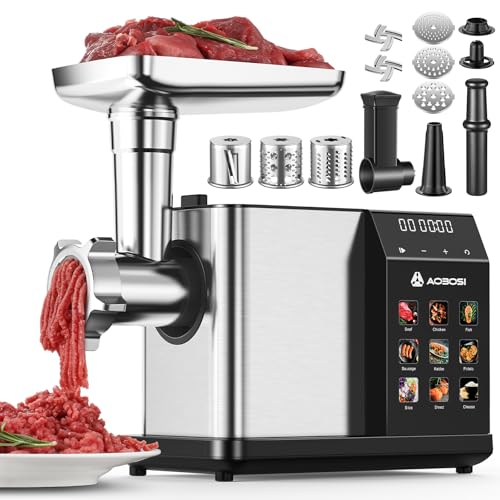
AAOBOSI Multifunctional Digital Meat Grinder
Badge: Best Overall for Home Use
Strengths
- Auto-reverse rescues the occasional stall without a teardown — the feature home users appreciate most and expect least.
- Nine presets turn your settings for burgers, meatballs, and sausage into one-touch routines the whole household can repeat.
- Built-in storage keeps plates and blades in the machine, solving the lost-parts problem that plagues episodic use.
Trade-offs
- 3000W is a maximum figure; it is a full-size home machine, not a light-commercial one.
- Touch controls need a wipe when hands are floury or wet, which in a home kitchen is often.
- It costs more than the simple switch-operated machines here, in exchange for its features.
Mini spec box: Power: 3000W max · Controls: digital touch screen, 9 presets · Reverse: auto-reverse · Storage: built-in · Roles: grinding, sausage, kibbe, cheese grating · Duty described: home use.
Home grinding succeeds or fails on friction — not the mechanical kind, but the human kind. Every small annoyance (a plate lost in a drawer, a stall that means dismantling a loaded head, a setting you have to rediscover each time) taxes the decision to grind at all, until the machine quietly becomes furniture. The AAOBOSI Digital is the best home grinder in this guide because it systematically removes those taxes. Its parts live inside it. Its presets remember what worked. Its auto-reverse forgives the over-enthusiastic handful of meat that stalls every beginner exactly once. What remains is the pleasant part: fresh-ground burgers in minutes, whenever the mood strikes.
Its listed repertoire — sausage, kibbe, even cheese grating — suits the way home grinders actually live, as general kitchen infrastructure rather than single-dish tools. The honest limitations are modest: peak-only power information, and electronics that ask for a wipe-down rather than a soak at the sink. Neither touches the core case. For the household that wants one grinder, full stop — capable on weeknights, forgiving of beginners, and organised enough to stay that way — this is the first choice, and the machine against which the rest of this list explains its differences.
Best for: most households, especially first-time grinder owners who want guidance built into the machine / Not suited for: buyers who distrust touch controls on principle.

VEVOR Meat Grinder, #12 Electric Meat Mincer, 750W / 1 HP
Badge: Best for Big Households
Strengths
- A 750W / 1 HP continuous-style rating with throughput quoted at 552 lbs/h — family-party batches become short work.
- The #12 head accepts big pieces, so prep is faster for the cook feeding many mouths.
- ETL listing noted, with three stuffing tubes and a kibbe kit for the full household repertoire.
Trade-offs
- Only two plates included; finer textures may need an added plate.
- It is a large, heavy presence in a home kitchen — counter and cupboard both feel it.
- For a couple grinding a pound at a time, it is simply too much machine.
Mini spec box: Motor: 750W / 1 HP · Head size: #12 · Throughput: 552 lbs/h (maker rating) · Plates: 2 · Stuffing tubes: 3 · Extras: kibbe kit · Certification noted: ETL listing · Settings: kitchens or restaurants.
Some homes are small restaurants in disguise: six or more mouths, weekend gatherings, a freezer that turns over like a stockroom. For those households the VEVOR is not overkill — it is the correctly sized tool, and its presence in a home-use guide is deliberate. The #12 head and hourly throughput mean the grinding for a family reunion’s worth of burgers happens inside the time it takes to season and shape them, and the machine’s restaurant-leaning build shrugs off the frequency that wears lighter appliances out.
The decision rule is honest self-assessment. If your typical grind is measured in pounds-per-week for a crowd, this is your pick, and you will never think about capacity again. If your typical grind is a kilo of beef for Friday burgers, the VEVOR’s size, wash-up, and two-plate bundle all argue for the smaller machines above and below it. Home use spans both realities; this guide’s job is to place the boundary clearly, and the VEVOR sits at the top of the home range, overlapping the batch world covered in our Best Meat Grinders For High Volume At Home guide.
Best for: large families, frequent entertainers, and batch-cooking households / Not suited for: small households or small kitchens.
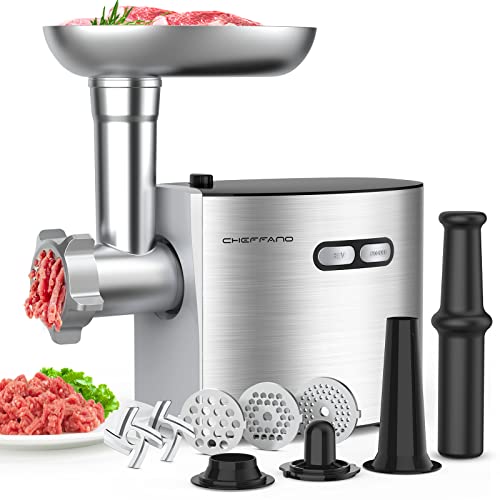
CHEFFANO Meat Grinder, 2800W Max, ETL Approved
Badge: Best Value
Strengths
- ETL approval stated in the listing — the credential most of this category skips, on a machine used near water weekly.
- Two blades and three plates: the complete home texture range plus a spare edge, in the box.
- Sausage stuffer tubes and a kubbe kit make it a full kitchen tool, not a single-task purchase.
Trade-offs
- 2800W max is a peak figure and the most modest here — family batches are comfortable, marathons are not its brief.
- No reverse; the occasional stall is cleared by hand.
- No storage system or presets — simplicity is the design, for better and worse.
Mini spec box: Power: 2800W max · Certification noted: ETL approved · Blades: 2 · Plates: 3 · Extras: sausage stuffer tubes, kubbe kit · Duty described: heavy duty for home kitchen use.
The CHEFFANO is the value centre of home grinding: everything a household actually does, nothing it does not, and a third-party safety mark as a bonus. Three plates cover the home repertoire properly — coarse for chili and meatballs with texture, medium for burgers, fine when a recipe asks — and the second blade means the machine’s performance does not decay unnoticed across a year of Fridays. Its controls are a switch, which a surprising number of home cooks actively prefer: any adult in the house can run it, lend it, or clean it without a manual.
Its honest ceiling is pace and polish. There is no reverse for the rare stall, no preset to remember a setting, and its power claim, while adequate for every normal home batch, is not the one to choose for a freezer-filling marathon. But value is not the absence of features — it is the presence of the right ones, and on the evidence of its listing the CHEFFANO has exactly the home set: plates, blades, tubes, approval, and a heavy-duty brief. For the household that grinds regularly and spends sensibly, this is the pick to beat.
Best for: value-focused families who grind weekly and want a full kit without feature pricing / Not suited for: batch marathons or anyone who wants reverse.

Sinyder Electric Meat Grinder, 3000W Max, Stainless Steel
Badge: Best Build Quality
Strengths
- Metal gears and a pure copper motor — the drivetrain specified for a decade of home service.
- Stainless steel body and food path shrug off the scratches and stains of family cooking.
- Two blades and three plates included, with sausage stuffer tubes and a kubbe kit.
Trade-offs
- No published throughput, head size, or reverse — the spec sheet sells construction, not numbers.
- Stainless build typically means more weight to lift down from a high shelf.
- No convenience features: no presets, no built-in storage mentioned.
Mini spec box: Power: 3000W max · Motor: pure copper · Gears: metal · Body: stainless steel · Blades: 2 · Plates: 3 · Extras: sausage stuffer tubes, kubbe kit.
Home appliances die quiet deaths — a gear here, a motor there — usually just after the household has come to depend on them. The Sinyder is the pick for the buyer who has buried enough kitchen equipment to shop for construction first. Metal gears where plastic usually hides, a copper-wound motor, a stainless body: the listing reads like a refusal to cut the corners that home users cannot see until year three. Its accessory set matches the value leaders (two blades, three plates, tubes, kubbe kit), so the durability premium does not cost you completeness.
Day to day it is a straightforward, capable home grinder — burgers, meatballs, sausage, the dog’s dinner if your household runs that way too (our Best Meat Grinders For Turkey Bones guide covers the poultry-bone corner of that world). The honest limitations are informational: with no published throughput or head size, you are trusting build over data, and with no reverse, the rare stall is a manual job. For the buy-once household, that trade is the entire point — this is the grinder bought to still be on the counter, unremarkable and working, long after trendier machines have been replaced.
Best for: buy-once households that prioritise drivetrain materials over features / Not suited for: buyers who want published pace figures or electronic help.

CHEFFANO Life Electric Meat Grinder, 2000W Max
Badge: Best First Grinder
Strengths
- The most accessible full grinder in this six, in stainless steel — a low-risk way to start grinding at home.
- Two blades and three plates included, so the first burger, meatball, and sausage experiments are all covered.
- Sausage tube and kubbe kit in the box keep the starter machine useful as skills grow.
Trade-offs
- 2000W max is the gentlest power claim here; big family batches want pacing and rests.
- No reverse and no published throughput.
- Households that catch the grinding bug seriously will eventually upgrade from it.
Mini spec box: Power: 2000W max · Construction: stainless steel · Blades: 2 · Plates: 3 · Extras: sausage tube, kubbe kit · Duty described: heavy duty for home use.
Every grinding household started somewhere, and the CHEFFANO Life is designed to be that somewhere. It makes the classic starter mistakes impossible to make expensively: the plates you need are included, a spare blade is included, the sausage tube that turns a grinding hobby into a sausage hobby is included — all in a stainless machine at the friendly end of the range. A new grinder owner can go from unboxing to fresh burgers in one evening, and from burgers to a first sausage day in one weekend, without a single additional purchase.
The honest limitation is headroom, and for a first grinder it barely counts as one. Its motor claim is the gentlest here, so the technique rules — cold meat, modest pieces, steady feeding — matter more, but those rules are the craft itself, and learning them on a forgiving budget is how good home grinders are made. If the household’s grinding grows into hunting seasons or freezer marathons, this machine becomes the capable second grinder or the gift that starts someone else. As the first step into home grinding, nothing in this six lowers the stakes better.
Best for: beginners and small households buying their first real grinder / Not suited for: large batches or buyers who already know they grind at volume.

LEM Products BigBite #8 Meat Grinder, 0.5 HP
Badge: Best for Enthusiasts
Strengths
- A 0.5 HP rating from a meat-processing name — honest specification in a category of inflated claims.
- The #8 head is the enthusiast’s size: bigger pieces, faster family batches, real sausage-day capacity.
- Stainless steel construction with grinding and sausage stuffing designed as one workflow.
Trade-offs
- The pool listing does not enumerate the included plates and blades — confirm the set before ordering.
- No digital conveniences; this is a traditional machine for people who like traditional machines.
- More grinder than a casual once-a-month household will use.
Mini spec box: Motor: 0.5 HP · Head size: #8 · Construction: stainless steel · Roles: grinding and sausage stuffing · Duty described: home use, heavy-duty positioning.
The LEM BigBite #8 is the home grinder for the cook who has opinions — about grind texture, about fat ratios, about why the supermarket mince is a compromise they are done making. LEM’s reputation comes from game processing, and the BigBite carries that seriousness into the kitchen: a horsepower rating instead of a marketing wattage, a #8 head that treats family batches as warm-ups, and a design centred on the grind-to-sausage workflow that enthusiasts actually follow. This is the machine most likely in this guide to still be grinding in fifteen years, in a kitchen that has been remodelled around it twice.
Its home manners are traditional rather than digital: no presets to learn, no panel to wipe, just a substantial stainless machine that does its work and washes up completely. The honest limitations are the unspecified accessory bundle in the pool data — check the listing — and a size-and-seriousness premium that casual users will not recoup. But for the enthusiast household, the one that buys whole cuts on purpose and plans sausage days on the calendar, the BigBite is the natural end point of the home-use range, and a fitting close to this list.
Best for: serious home cooks and sausage makers who buy on pedigree and horsepower / Not suited for: casual users or feature-seekers.
Comparison Table
| Grinder | Power as listed | Plates / Blades | Home-use character | Link |
|---|---|---|---|---|
| AAOBOSI Digital | 3000W max | Not stated | Features, storage, auto-reverse | Check on Amazon |
| VEVOR | 750W / 1 HP, 552 lbs/h | 2 / not stated | #12 capacity for big homes | Check on Amazon |
| CHEFFANO | 2800W max, ETL | 3 / 2 | Value with full kit | Check on Amazon |
| Sinyder | 3000W max | 3 / 2 | Metal-gear durability | Check on Amazon |
| CHEFFANO Life | 2000W max | 3 / 2 | Accessible starter | Check on Amazon |
| LEM BigBite | 0.5 HP | Not stated | #8 enthusiast pedigree | Check on Amazon |
How to Choose a Meat Grinder for Home Use
Start with your real batch. Picture the largest grind you will honestly do monthly. For most households it is two to five pounds — a burger night, a meatball tray, a meatloaf. Every machine here covers that; the differences appear at the edges. Buy for the monthly reality, and let the once-a-year event borrow patience (staged batches) rather than dictate a #12 purchase.
Weight the wash-up heavily. Home grinders live or die by cleanup. The head must strip completely, the parts must fit your sink and your patience, and storage must keep the small pieces findable. Built-in storage, like the AAOBOSI offers, is worth more to an episodic user than a hundred extra watts.
Read power claims in translation. Peak wattage is a momentary ceiling. For home batches, what matters is that the machine never feels strained on cold, well-cut meat — a quality better predicted by construction (gears, motor, head) than by the biggest number on the box. Horsepower ratings and approvals like ETL are the honest signals in this category.
Count the box, not the brochure. Three plates and a spare blade cover the home repertoire and its maintenance; stuffer tubes open the sausage chapter. A cheaper machine that needs two accessory orders is not cheaper. Compare complete, ready-to-cook kits.
Choose your control philosophy. Presets and touch screens suit households that value repeatability and shared use — anyone can press the burger setting. Simple switches suit cooks who value robustness and zero learning curve. Neither is wrong; buy the one your household will actually enjoy using, because enjoyment is what keeps a grinder in rotation.
Leave room to grow one step. Home grinding is habit-forming: burgers lead to sausage, sausage leads to a friend’s deer trim, and suddenly the calendar has a processing day. A mid-list machine with a full kit absorbs that growth; the smallest starter and the largest #12 both assume you already know your future. If you are unsure, the middle of this list is where uncertainty belongs.
How to Grind at Home, Step by Step
Step 1 — Choose and cut the meat. Pick well-marbled cuts for burgers, or blend lean and fatty cuts to your taste. Cut into strips or cubes that fit the feed tube comfortably, trimming any gristle you would not want to chew.
Step 2 — Chill everything. Spread the cut meat on a tray and chill until firm and frosty at the edges. Cold meat cuts cleanly at the blade; warm meat smears and greys. Chill the receiving bowl too on warm days.
Step 3 — Assemble and choose the plate. Fit the plate for the job — medium for burgers, coarse for chili and textured meatballs, fine for a smooth sausage mix — and make sure the blade sits correctly against it.
Step 4 — Grind steadily. Feed piece by piece, guiding with the pusher, letting the auger set the pace. For the most even texture, pass burger meat twice through the same plate, mixing gently by hand between passes.
Step 5 — Season after grinding. Salt and season the ground meat, not the chunks, and mix with a light hand — overworking ground meat makes dense burgers. Form patties with a dimple in the centre so they cook flat.
Step 6 — Cook or store promptly. Ground meat has a short fridge life; cook the same day where you can, or portion and freeze flat in labelled bags.
Step 7 — Wash immediately. Strip the head, wash all food-contact parts in hot soapy water, brush the plate holes clear, dry fully, and store the parts with the machine.
Troubleshooting. Problem: burgers come out dense → the meat was overmixed or ground warm; chill harder and handle less. Problem: the grind looks smeared and grey → the meat was too warm or the blade is dull; re-chill, and check the blade’s edge. Problem: the machine stalls on a tough piece → stop, clear the head (or use reverse), and trim gristle more carefully next time.
What Home Grinding Actually Changes in Your Cooking
The first thing home grinders notice is flavour: fresh-ground meat from a cut you chose tastes like the animal it came from, in a way pre-ground mince — oxidised, anonymous, days old — does not. The second is control: the fat ratio of your burgers, the coarseness of your chili meat, the seasoning inside your sausage rather than on it, all become decisions instead of defaults. The third is economics of a quiet kind: whole cuts bought well and ground at home convert directly into meals that would cost more assembled, though this guide makes no price claims — the point is that the machine pays its way in quality every single week it is used.
There is also a confidence effect. A household that grinds stops fearing recipes — meatballs, kofta, dumpling fillings, kibbe, homemade pet food — because the base ingredient is now an in-house capability. That is the real return on a home grinder, and it is why the ease features in this guide matter: the machine that gets used is the machine that changes the cooking.
Storing a Home Grinder So It Stays Ready
Home grinders fail socially before they fail mechanically: parts migrate to the back of drawers, the manual vanishes, and one day the machine is “incomplete” and stops being used. The defence is a storage ritual. Wash and dry everything, reassemble the head loosely or store the cutting set in a labelled container with the machine, and keep the whole kit in one place. Built-in storage models automate the ritual; for the others, a single dedicated box beside the machine achieves the same end.
Before a long idle stretch, make sure plates and blades are bone dry — a damp plate in a closed cupboard is how rust freckles appear — and run the machine once on a small batch when it returns to service, both to check it and to remind your hands how it goes together. A grinder stored ready is a grinder used often; a grinder used often is the whole point of buying one.
The Home Grinder Repertoire: What You Will Actually Make
A home grinder earns its shelf through a repertoire, and it is wider than burgers. Meatballs in three traditions — Italian with breadcrumbs and herbs, Swedish with warm spices, kofta with onion ground right through the meat. Meatloaf mixed from two meats ground together so the texture is even. Dumpling and empanada fillings, where a fine plate gives the smooth, cohesive texture hand-chopping cannot match. Kibbe, whose bulgur-and-meat shell mixture several of these machines are literally kitted for. Chilli built on a coarse grind that keeps its chew through a long simmer. And the quiet weekly workhorse: turning a whole chicken or a pork shoulder, bought as a whole cut, into the mince the week’s recipes need.
Notice what the repertoire has in common: none of it needs a commercial machine, all of it benefits from plate choice, and most of it happens in batches under five pounds. That is the factual basis of this guide’s rankings — the machines are scored against this list, not against a butcher’s output chart. When a sales page leads with a huge throughput figure, ask which item in your repertoire it improves. Usually the honest answer is none, and the money is better spent on the plate set and the spare blade.
Small-Batch Technique: Grinding for One or Two
Small households grind small, and small batches have their own technique. The temptation is speed — a pound of meat, one pass, done — but the quality rules do not scale down: the meat still needs to be properly cold, the plate still matched to the dish, the wash still immediate. What does change is the economics of the second pass. For a single burger batch, a second pass through the same plate noticeably improves bind and texture and costs ninety seconds; for a five-pound batch it is a real decision. Small-batch cooks should take the second pass every time — it is the cheapest quality available in home grinding.
Small batches also forgive equipment choices that volume punishes. A stall in a one-pound grind is a shrug; the same stall at pound thirty is a schedule problem. This is why the starter machines in this guide are genuinely sufficient for couples and small families, and why the upgrade conversation should be driven by your calendar — more mouths, more sausage days, a hunter joining the family — rather than by spec-sheet envy.
When to Upgrade — and When to Downsize
Upgrade when the machine, not the recipe, is setting your limits: when batches regularly exceed what staged sessions handle gracefully, when a second operator is standing idle waiting on the grinder, or when game season has joined the household’s year. The step pattern in this guide is deliberate — starter, full home machine, #8 enthusiast, #12 — and most households that upgrade move exactly one step.
Downsizing is the unspoken half of the same wisdom. The #12 bought for a big-family era does not become wrong when the family shrinks, but it does become heavy — to move, to wash, to justify. Passing it to a younger household and returning to a nimble full-size home machine is not a downgrade in any sense that matters at dinner. The best home grinder is always the one matched to the home that exists now, which is the principle this entire guide is built on.
Safety at Home: The Short, Complete List
Home grinders are safe tools used carelessly exactly as often as any other powerful kitchen equipment, so the rules deserve one clear statement. Always use the pusher the machine came with — never fingers, never a spoon handle that can splinter or slip. Unplug before opening the head, every time, including for “just a quick” clear-out; a stall is cleared with the machine dead, or with its reverse function, never with power connected and hands near the auger. Keep the cord and the motor body dry, wash only the parts designed to be washed, and let everything dry before reassembly.
Food safety is the other half: grind cold, refrigerate ground meat promptly, cook or freeze it the same day where possible, and wash every food-contact surface after raw meat — especially poultry — has passed through. None of this is burdensome; it is simply the routine, and households that build it in from the first batch never have to think about it again.
Common Buying Mistakes
Buying the biggest machine for the smallest kitchen. A #12 head in a two-person flat is not ambition; it is a storage problem that ends in disuse. Match the machine to the household’s real mouths.
Judging by peak wattage. The number predicts almost nothing about home satisfaction. Plates, blades, construction, and washability predict nearly all of it.
Skipping the stuffer tubes to save money. Sausage is where home grinding becomes a hobby; a machine without tubes turns that discovery into a second purchase.
Grinding warm meat. The smeared, grey first batch has discouraged more beginners than any machine flaw. The freezer is part of the recipe: chill the meat until firm, every time.
Letting the wash-up slide. A head left “soaking” overnight teaches the whole household to dread grinding day. Ten minutes, immediately, hot water — the habit that keeps the hobby alive.
Final Recommendation
For most households, the AAOBOSI Multifunctional Digital Meat Grinder is the best meat grinder for home use: its presets, auto-reverse, and built-in storage remove every friction that stops home grinders being used. Value hunters should take the CHEFFANO and its ETL-approved full kit; enthusiasts should take the LEM BigBite #8 and never look back. Whichever you choose, keep the meat cold, the blade sharp, and the wash-up immediate — and the machine will change how your kitchen eats.
A final word on expectations. A home grinder will not make supermarket meat cheaper cuts taste like a steakhouse, and it will not run a delicatessen. What it does — reliably, for years, for the price of a few restaurant burgers — is put the most-used ingredient in home cooking under your control: its freshness, its fat, its texture, its seasoning. Households rarely regret buying one; they regret buying the wrong size, which is why this guide spends so many words on fit. Choose the fit, and the recipes follow.
Frequently Asked Questions
What size meat grinder does a home actually need?
A standard full-size home grinder — the class of most picks in this guide — covers the overwhelming majority of households: burgers, meatballs, sausage, and pet food in family-sized batches. Step up to a #8 head if you are an enthusiast or process game, and to a #12 only if your household cooks for a crowd or batches for a chest freezer. Bigger is not better at home; matched is better.
Is grinding meat at home worth it?
For households that eat ground meat regularly, yes — on flavour, texture control, and ingredient choice alone. You select the cut and the fat ratio, grind it fresh, and season it as you like. The machine also opens sausage making, pet food, and a shelf of recipes built on ground mixtures. The value compounds with use, which is why this guide weights ease and washability so heavily. The honest caveat is frequency: a household that grinds twice a year should borrow a machine or buy mince; a household that grinds twice a month will wonder how it cooked without one.
How hard is a home grinder to clean?
Not hard, if done immediately: the head strips down in under a minute, parts wash in hot soapy water like any kitchen equipment, and a brush clears the plate holes. Ten unhurried minutes is a fair budget. What makes cleaning miserable is delay — dried residue — so the routine is: grind, eat later, wash now.
Can a home grinder make sausage as well as grind?
Yes — every pick in this guide includes stuffer tubes or a sausage kit, and stuffing with the grinder you already own is how most home sausage makers start. Grind the meat, season and mix it, then fit the tube and stuff at a steady pace. It is slower than a dedicated stuffer but entirely capable for household quantities.
What is the difference between plate sizes for home cooking?
Coarse plates give chunky textures for chili and rustic meatballs; medium plates are the burger and everyday standard; fine plates suit smooth sausage mixes and delicate fillings. A three-plate set, included with several picks here, covers the whole home repertoire — which is why plate count outranks wattage in our home-use scoring.
How do I stop home-ground burgers from being dense?
Keep everything cold, grind through the medium plate (twice if you like a finer bind), season after grinding, and mix with the lightest hand that distributes the salt. Form patties gently without compressing, and dimple the centre. Density is almost always a temperature-and-handling problem, not a machine problem.
Can I grind chicken and other poultry at home?
Yes — poultry grinds well in all of these machines, boneless for mince and soft bone-in pieces for pet food, following the same cold, steady routine. Keep poultry work scrupulously clean, wash everything immediately, and consider a dedicated plate-and-blade set if you grind poultry often. Turkey frames and bones have their own technique, covered in the poultry-bone guide in this cluster.
Can I grind frozen meat?
Partially frozen, yes — that is the ideal state: firm, frosty at the edges, yielding slightly to a knife. Fully frozen meat is too hard for home grinders and strains motors and blades; let it temper in the fridge until it reaches that firm-but-cuttable stage. The distinction matters because “grind it cold” is the best advice in this guide, while “grind it frozen solid” is how home machines get hurt.
Do I need a separate grinder for pet food?
No — the same machine serves both, and several picks here are used exactly that way in real households. Wash the head thoroughly between pet and family sessions, and if you want a bright line, dedicate a blade-and-plate set to pet food; multi-plate bundles make that easy. Households grinding raw pet food weekly should also read the dedicated pet-food guidance in this cluster for the stricter hygiene routine.
How long will a home grinder last?
Years to well over a decade, depending on construction and care. Metal drivetrains, like the Sinyder’s, are built for the long end of that range. The owner’s contribution is simple: keep blades sharp, never force a stall, wash and dry fully, and store the kit together. Most home grinders are retired by lost parts and neglect, not by mechanical death.