Disclosure: topratedkitchenware.com is reader-supported. When you buy through links on our site, we may earn an affiliate commission from Amazon and other retailers, at no extra cost to you.
Where to buy
Every grinder in this guide is sold through Amazon, where you can verify the current configuration — head size, plate set, motor description — before committing. The first machine listed, the Aiheal Electric Meat Grinder, 3200W Max, opens the shortlist — Check on Amazon — and the rest follow:
- AAOBOSI Electric Meat Grinder with 3-Speed Touch Screen
- AAOBOSI Multifunctional Digital Meat Grinder
- VEVOR Meat Grinder, #12, 750W / 1 HP
- CHEFFANO Meat Grinder, 2800W Max, ETL Approved
- Sinyder Electric Meat Grinder, 3000W Max, Metal Gears
Read the full guide ↓ for an honest account of what “high volume” can mean on a home counter — and which machines sustain it.
The best meat grinders for high volume at home exist for a specific kind of household: the one that buys meat in bulk when it is on offer, fills a chest freezer in planned sessions, processes a hunting season’s overflow, or cooks for a crowd often enough that grinding has become a production task rather than a recipe step. For that household, the ordinary grinder advice inverts. Convenience features fade, and three questions take over: how fast does the machine actually grind, how long can it keep that pace before heat and fatigue degrade the meat, and how gracefully does it handle the stalls and dull blades that long sessions guarantee? The best meat grinders for high volume at home are the ones that answer those questions with published numbers and honest construction, rather than with a large wattage printed on a box.
High volume at home also has a hard ceiling worth naming at the start. Truly continuous commercial output belongs to commercial equipment; what the strongest home machines offer is session volume — the ability to move a large batch in one sitting, at a steady clip, with planned rests, without the grind quality collapsing halfway through. That is a genuinely useful capability, and it is what this guide measures. The workflow matters as much as the machine: meat staged in chilled batches, a second pair of hands where possible, packaging keeping pace with grinding. Readers whose volume comes mainly from game should pair this guide with our Best Meat Grinders For Hunters coverage; readers whose volume is a dog’s monthly food supply will find the same throughput logic applied in our Best Meat Grinders For Raw Dog Food guide.
Key Takeaways
- Plan with published rates: the VEVOR quotes 552 lbs/h and the AAOBOSI touch model quotes 4 lbs/min — numbers you can schedule a session around.
- Peak wattage is not throughput. Horsepower, head size, and pounds-per-hour describe the working machine.
- Session discipline beats raw pace: chilled batches, rest breaks, and packaging that keeps up protect quality at volume.
- Long sessions dull blades and invite stalls — spare cutting sets and auto-reverse are production features, not accessories.
- A #12 head is the dividing line between “large home batches” and true high-volume home processing.
- Every pick here includes sausage capability, because volume households almost always end up stuffing as well as grinding.
In this guide
Quick Picks
| Pick | Badge | Standout detail from the listing | Link |
|---|---|---|---|
| Aiheal Electric Meat Grinder | Best Bundle for Batch Workflows | 3200W max, 2 blades, 3 plates, 3 sausage tubes | Check on Amazon |
| AAOBOSI 3-Speed Touch Screen Grinder | Best Published Home Throughput | 3000W max, throughput quoted at 4 lbs/min, built-in storage | Check on Amazon |
| AAOBOSI Multifunctional Digital Grinder | Best Jam Recovery for Long Sessions | 3000W max, 9 presets, auto-reverse | Check on Amazon |
| VEVOR #12 Electric Meat Grinder | Best Overall for High Volume | 750W / 1 HP, throughput quoted at 552 lbs/h, #12 head, ETL listing noted | Check on Amazon |
| CHEFFANO Meat Grinder | Best Value Volume Starter | 2800W max, ETL approved, 2 blades, 3 plates | Check on Amazon |
| Sinyder Electric Meat Grinder | Best Durability for Volume Work | 3000W max, pure copper motor, metal gears, stainless body | Check on Amazon |
How These Picks Were Chosen
This is a research-led guide built from manufacturer listings and specifications, re-ranked for sustained home production. The ranking currency was evidence of pace: published throughput first, then continuous-style power descriptions (horsepower, motor construction), then head size, then the supporting cast of plate bundles, spare blades, and jam-recovery features that long sessions consume. Peak wattage — a momentary ceiling — was treated as the weakest evidence on the page, useful only when the rest of the specification supported it.
Four filters shaped the six. First, a credible pace story: every pick either publishes a rate, publishes horsepower, or pairs a strong power claim with the construction (metal gears, copper windings, full plate sets) that sustains pace in practice. Second, session endurance features: reverse or auto-reverse for stalls, spare blades for the mid-session dull point, and heads that strip quickly for the inevitable mid-day wash on the biggest jobs. Third, the sausage pathway, because volume households stuff at volume too, and tubes in the box were treated as required equipment. Fourth, honest positioning: machines are described at the volume class their specifications actually support — several excellent picks here are “large batch” machines rather than true high-volume ones, and the reviews say so plainly instead of inflating them. Stand mixer attachments and manual grinders were excluded without discussion; neither survives contact with a fifty-pound session. For ordinary weeknight grinding, our Best Meat Grinders For Home Use guide is the calmer shortlist — this page is for the households that have outgrown it.
The 6 Best Meat Grinders for High Volume at Home

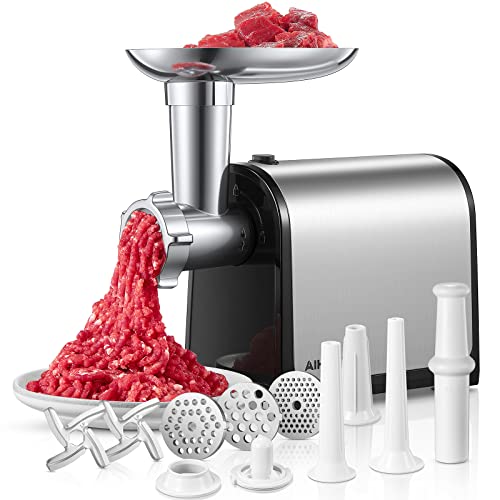
Aiheal Electric Meat Grinder, 3200W Max
Badge: Best Bundle for Batch Workflows
Strengths
- Two blades and three plates in the box — the spare blade is a volume feature, covering the mid-session dull point.
- Three sausage tubes match the stuffing day that usually follows a big grind.
- Stainless steel grinding components in a hard-wearing black finish.
Trade-offs
- 3200W is a maximum rating with no published throughput — pace must be learned, not planned from the spec sheet.
- No reverse is listed; stalls on long runs are manual clear-outs.
- Its honest class is large batches in staged sessions, not continuous production.
Mini spec box: Power: 3200W max · Blades: 2 · Plates: 3 · Sausage tubes: 3 · Body/components: stainless steel, black finish · Duty described: heavy duty for home kitchen use.
The Aiheal’s volume argument is completeness. High-volume work consumes accessories the way it consumes time: plates for each texture the batch plan calls for, a second blade for the moment the first one’s edge goes, tubes for the sausage fraction. This machine ships with all of it, which makes it the natural starter for a household building a batch workflow from nothing — the freezer-filling Saturday, the bulk-buy breakdown, the first hunting season processed at home.
Its working pattern is the staged session: grind a chilled batch, package it, rest the machine while the next batch firms up in the freezer. Run that way, the Aiheal handles serious home volume with dignity. Run as a continuous mill, it will show you the limits of a peak-rated home motor — the honest limitation of its class, shared by every non-#12 machine here. The absence of a published throughput figure means your first sessions are calibration: time a ten-pound batch, and you will know your machine’s real pace better than any brochure could tell you. For households whose volume is growing but not yet industrial, the Aiheal’s bundle makes it the practical foundation.
Best for: households building a batch routine who want every plate, blade, and tube in one box / Not suited for: continuous production or planners who need a published rate.

AAOBOSI Electric Meat Grinder with 3-Speed Touch Screen
Badge: Best Published Home Throughput
Strengths
- Throughput quoted at 4 lbs/min — the clearest pace promise in a standard home body, and a schedulable number.
- Three speeds let you match pace to load: low for dense and fatty mixes, higher for straightforward trim.
- Built-in storage keeps the plate set together between big sessions, and the design is pitched at easy cleanup.
Trade-offs
- The quoted rate describes cooperative meat; sinewy trim and fat blending will run slower.
- 3000W max is a peak claim behind the rate — the rate is the spec to trust.
- Touch controls need wiping during long, messy sessions.
Mini spec box: Power: 3000W max · Throughput: 4 lbs/min (maker rating) · Controls: 3-speed touch screen · Storage: built-in · Roles: 3-in-1 sausage, burger, raw pet food · Certification noted: LFGB approved · Cleanup: designed for easy cleanup.
Most home grinders make you guess their pace. This AAOBOSI publishes one — 4 lbs/min — and for a volume household that single number changes the purchase from a hope into a plan. A forty-pound session becomes a calculable block of the day; the freezer rotation, the packaging station, and the second pair of hands can all be scheduled around it. Even allowing a sensible discount for real-world trim, a published rate is the difference between a machine you organise around and a machine you discover.
The three speeds support the volume workflow more than they first appear to: run dense, fat-blended batches on the low setting where the auger pushes hardest, and straightforward lean trim faster. Built-in storage quietly matters at this usage level too, because big sessions are episodic — the machine must emerge from the cupboard complete, plates and all, on the morning the bulk buy arrives. The honest limitations are the class ones: the rate is a maker’s figure for meat, not a guarantee for your worst trim, and there is no reverse for the inevitable stall. As the planning-friendly volume pick in a home-sized body, it earns its badge outright.
Best for: organised batch households that schedule sessions around a published pace / Not suited for: the very largest game-season loads, which belong to the #12 machines.
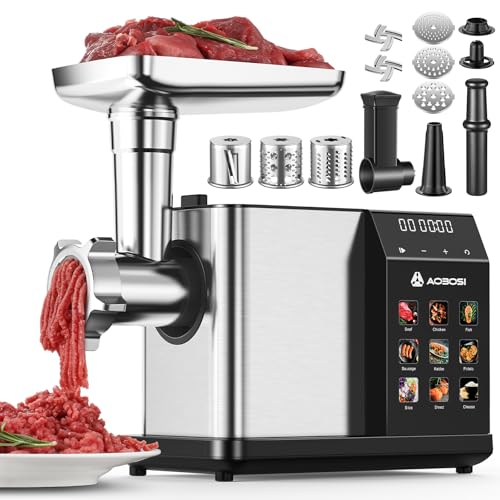
AAOBOSI Multifunctional Digital Meat Grinder
Badge: Best Jam Recovery for Long Sessions
Strengths
- Auto-reverse converts the long-session stall from a teardown into a ten-second recovery.
- Nine presets let each recurring batch type — burger, sausage meat, pet food — keep its own dialled-in setting.
- Built-in storage and kibbe and cheese-grating roles round out a hard-working household machine.
Trade-offs
- No throughput is published; its volume case rests on session management, not pace.
- 3000W max is a peak figure, shared with its sibling model.
- Electronics-forward design asks for a careful wash routine on big days.
Mini spec box: Power: 3000W max · Controls: digital touch screen, 9 presets · Reverse: auto-reverse · Storage: built-in · Roles: grinding, sausage, kibbe, cheese grating · Duty described: home use.
Ask volume grinders what actually costs them time and the answer is rarely the grinding — it is the interruptions. Sinew wraps the hub at pound thirty; a fatty batch packs the plate at pound twelve; each stall on a conventional machine means stopping, opening a loaded head, and losing both minutes and meat temperature. This AAOBOSI’s auto-reverse is the only feature in the six aimed at the true economics of a long session: stalls become button presses, the batch stays cold, and the operator stays calm. Across a fifty-pound day, that difference compounds into the session’s whole character.
The presets play a supporting role with real value in a volume household, where the same three or four jobs recur monthly: the burger setting, the sausage setting, the pet-food setting, each recalled rather than rediscovered. The honest limitation is pace evidence — no published rate means you cannot schedule around this machine the way you can around its touch-screen sibling or the VEVOR, and on the very largest days its home-class motor will still want staged rests. Buy it when your volume is substantial but your sessions are interruption-prone — mixed trim, varied recipes, one operator doing everything — and its jam recovery will quietly out-produce faster machines that keep stopping.
Best for: solo operators running long, varied sessions who lose more time to stalls than to pace / Not suited for: planners who need a published throughput figure.

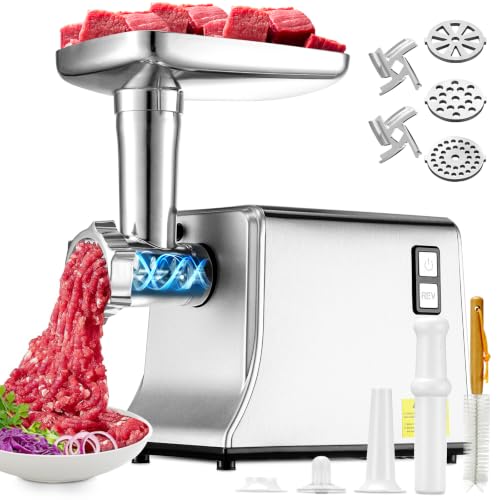
VEVOR Meat Grinder, #12 Electric Meat Mincer, 750W / 1 HP
Badge: Best Overall for High Volume
Strengths
- Throughput quoted at 552 lbs/h with a 750W / 1 HP continuous-style rating — the strongest pace evidence in this guide.
- The #12 head keeps a two-person line fed: the cutter can work at full speed without outrunning the grinder.
- ETL listing noted, three stuffing tubes and a kibbe kit included, positioned for kitchens or restaurants.
Trade-offs
- Only two plates included; a wider texture range needs an added plate.
- The biggest footprint and the biggest wash-up in this six.
- Its capacity is surplus for households whose “volume” is a large Sunday roast.
Mini spec box: Motor: 750W / 1 HP · Head size: #12 · Throughput: 552 lbs/h (maker rating) · Plates: 2 · Stuffing tubes: 3 · Extras: kibbe kit · Certification noted: ETL listing · Settings: kitchens or restaurants.
The VEVOR is the machine that makes “high volume at home” an honest phrase rather than a marketing one. Its specification speaks in the units of production — horsepower and pounds per hour — and its #12 head is the size class where home grinding stops being a recipe step and becomes a station in a line. With throughput quoted at 552 lbs/h, the practical limit on your session stops being the grinder and becomes everything around it: how fast you can cut, chill, and package. That is the correct bottleneck for a volume household to have.
Working at this pace changes the session’s feel. Meat spends less time waiting at room temperature because the queue keeps moving; two-person teams find their rhythm instead of their backlog; and a hunting season’s worth of trim, or a whole bulk-buy breakdown, fits inside one planned session with rests taken by choice rather than by motor distress. The honest limitations are the two-plate bundle — add a plate if your texture range demands it — and the simple fact of size: counter, cupboard, and sink all need to accommodate a #12 machine and its wash-up. For the household that genuinely processes at volume, those are the right problems to have, and the VEVOR is the best overall answer in this guide. Game-focused readers will meet the same machine at the top of our Best Meat Grinders For Wild Game comparisons, where the volume case is even stronger.
Best for: serious batch households, hunting families, and freezer-filling sessions / Not suited for: small kitchens or modest weekly grinding.
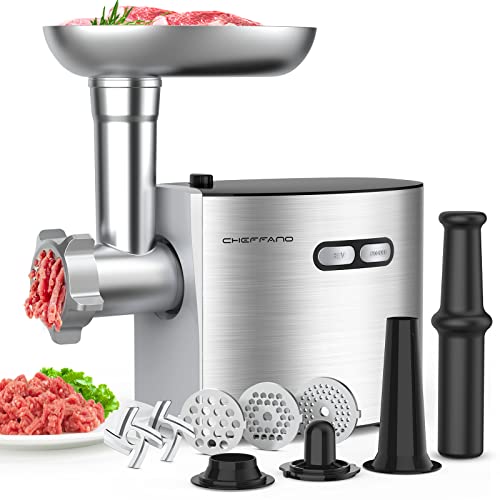
CHEFFANO Meat Grinder, 2800W Max, ETL Approved
Badge: Best Value Volume Starter
Strengths
- ETL approval stated in the listing — a real safety credential for an appliance that will run long sessions near water.
- Two blades and three plates support staged batch work and the mid-session blade swap.
- Sausage stuffer tubes and a kubbe kit cover the volume household’s second act.
Trade-offs
- 2800W max is the most modest peak claim here and no throughput is published.
- No reverse; long-session stalls are cleared by hand.
- Its volume class is staged batches — plan rests, not continuous running.
Mini spec box: Power: 2800W max · Certification noted: ETL approved · Blades: 2 · Plates: 3 · Extras: sausage stuffer tubes, kubbe kit · Duty described: heavy duty for home kitchen use.
The CHEFFANO is how a household starts doing volume without buying production equipment on spec. Its credentials are the quiet ones: a third-party approval, a full three-plate set, a spare blade, and heavy-duty home positioning. In a staged workflow — chilled batch, grind, package, rest — it moves a surprising amount of meat across a day, and its simplicity is itself a volume feature: nothing to configure, nothing to learn, an operator who can be relieved by any family member mid-session.
The honest framing matters here: this is a large-batch machine, not a high-throughput one. There is no published rate to schedule around, and its peak claim is the gentlest in the six, so the session plan must come from your own calibration — time the first batch and build the day around the measured pace. What you get in return is the lowest-friction entry into volume habits: trim cold, feed steady, swap the blade when the grind tells you to. Households that discover their volume is real and recurring can graduate to the VEVOR with the CHEFFANO as a capable second machine; households whose volume turns out to be a monthly freezer session will find they never needed more.
Best for: households starting batch processing who want ETL approval and a full plate set at the accessible end / Not suited for: continuous production or published-rate planning.

Sinyder Electric Meat Grinder, 3000W Max, Stainless Steel
Badge: Best Durability for Volume Work
Strengths
- Metal gears and a pure copper motor — the drivetrain specification that survives years of long sessions.
- Stainless steel body and grinding path suit the heavy wash-downs volume work generates.
- Two blades and three plates included, with sausage stuffer tubes and a kubbe kit.
Trade-offs
- No throughput is published, so session planning is by calibration, not by spec.
- No reverse is listed; stalls are manual clear-outs even mid-marathon.
- Fewer convenience features than the AAOBOSI pair — durability is the whole pitch.
Mini spec box: Power: 3000W max · Motor: pure copper · Gears: metal · Body: stainless steel · Blades: 2 · Plates: 3 · Extras: sausage stuffer tubes, kubbe kit.
Volume is a durability test conducted over years, and the Sinyder is the pick that treats it that way. The components that long sessions actually kill — gear teeth under repeated load, motor windings under repeated heat — are the components this listing specifies in metal and copper. A household grinding fifty pounds a month is not buying a season; it is buying a decade, and the Sinyder’s specification is the only one in this six that reads like it was written with that arithmetic in mind.
In session, it behaves as a strong staged-batch machine: cold meat, steady feeding, blade swapped when the texture says so, rests taken between batches. The honest limitations are informational — no published pace, no reverse — so the operator supplies the session management that the spec sheet leaves out. Households whose volume includes grinding poultry frames for the dogs will find the same drivetrain logic valued in our Best Meat Grinders For Turkey Bones guide, where shock loading is the whole question. As the buy-it-for-a-decade volume pick, the Sinyder closes the list on the argument that the fastest machine is the one that is still fast in year five.
Best for: high-frequency batch households buying for the long term / Not suited for: buyers who want a published rate or electronic jam recovery.
Comparison Table
| Grinder | Power as listed | Published pace | Plates / Blades | Volume character | Link |
|---|---|---|---|---|---|
| Aiheal | 3200W max | Not published | 3 / 2 | Complete batch bundle | Check on Amazon |
| AAOBOSI Touch | 3000W max | 4 lbs/min | Not stated | Schedulable home pace | Check on Amazon |
| AAOBOSI Digital | 3000W max | Not published | Not stated | Stall-proof sessions | Check on Amazon |
| VEVOR | 750W / 1 HP | 552 lbs/h | 2 / not stated | True home production | Check on Amazon |
| CHEFFANO | 2800W max, ETL | Not published | 3 / 2 | Value staged batches | Check on Amazon |
| Sinyder | 3000W max | Not published | 3 / 2 | Decade-grade drivetrain | Check on Amazon |
How to Choose a Meat Grinder for High Volume at Home
Define your volume in pounds per session. “High volume” means nothing until it is a number: the weight of your largest recurring session. Under twenty pounds, every machine here is comfortable in staged batches. Twenty to fifty is the contested middle, where published rates and spare blades start to matter. Beyond fifty in a sitting, the #12 head stops being a luxury and becomes the honest tool for the job.
Shop by rate, then by rating. A published throughput — pounds per minute or per hour — lets you schedule; horsepower lets you infer; peak wattage lets you hope. Rank your shortlist in that order of evidence, and treat any machine that offers only the third as an unknown to be calibrated in its first sessions.
Count the consumables. Volume eats blades and occupies plates. Bundles with spare blades and multiple plates are production equipment; a lone blade is a session waiting to be interrupted. If your chosen machine ships lean, add spares to the same order — the middle of a fifty-pound day is the wrong time to discover the need.
Decide your stall doctrine. Long sessions stall. Auto-reverse makes stalls cheap; manual clearing makes them a routine you must be willing to perform with a loaded head and warming meat. Solo operators should weight reverse heavily; two-person teams with a dedicated cutter can absorb manual clears more easily.
Match the machine to the room. Volume grinding is wet, loud, and sprawling. A #12 machine needs counter, sink, and storage that fit it, plus a packaging station beside it. The best volume setup is a line — cutting, chilling, grinding, packing — and the grinder is only its middle station. Buy the machine your room and your routine can actually run at pace.
How to Run a High-Volume Grinding Session, Step by Step
Step 1 — Plan the batch on paper. List the session’s destinations (burger, sausage meat, pet food, freezer mince), the weight for each, and the plate each needs. The plan decides the order of work and the fat staging before any meat leaves the fridge.
Step 2 — Cut everything before grinding anything. Cube the whole session’s meat first, in destination tubs, so the grinder never waits on the knife and the knife never rushes the trim. Trim sinew now, while it is visible.
Step 3 — Set the freezer rotation. Stage tubs so the working tub is always hard-chilled: one grinding, one chilling, one waiting. On a warm day, add a bowl of ice under the receiving bowl.
Step 4 — Grind in destination order, cleanest first. Plain burger meat first, seasoned and sausage batches next, pet food last. Between destinations, a handful of plain meat clears the head.
Step 5 — Work in runs with deliberate rests. Grind a tub, then package it while the machine rests and the next tub chills. The rhythm protects the motor, the meat, and the operator in equal measure.
Step 6 — Watch the grind, not the clock. Output texture is the session’s instrument panel: clean, distinct particles mean all is well; smearing and heat mean a dull blade, warming meat, or a pace problem — stop and fix the cause, not the symptom.
Step 7 — Package as you finish each batch. Portion, flatten, label, freeze in a single layer. Finished grind should never accumulate on the counter waiting for a packaging phase that comes “later”.
Step 8 — The full wash. Strip the head completely, wash everything in hot soapy water, brush plates clear, dry fully, and store the cutting sets together for the next session.
Troubleshooting. Problem: pace collapses halfway through the session → the blade has dulled or the meat has warmed; swap the blade set and re-chill the remaining tubs. Problem: repeated stalls on one tub → that tub’s trim is sinewy; clear, trim harder, and feed it in smaller handfuls. Problem: the motor housing runs hot → your runs are too long; shorten them and build the packaging pauses back into the rhythm.
The Cold Chain Is the Real Volume Skill
Every quality failure at volume — smeared fat, grey mince, soft texture, short freezer life — is a temperature failure wearing a disguise. Big batches create queues, and queues warm up. The households that grind well at volume are not the ones with the fastest machines; they are the ones whose choreography keeps meat cold while it waits: small tubs instead of one mountain, a freezer rotation with no idle gaps, packaging that removes finished grind from the room immediately. Buy the machine for pace, but build the routine for temperature, and the pace will take care of the quality.
Space is the cold chain’s silent partner. A session that spreads across every surface invites cross-contamination and confusion about which tub is which. Work in a defined line, label tubs before they are filled, and keep raw and finished product physically separated by the grinder itself — raw on one side, ground and packaged on the other. It is a small discipline that makes a long session feel professional instead of chaotic.
Duty Cycles, Heat, and Motor Honesty
The least discussed specification in home grinding is the duty cycle — how long a machine can run before it needs to cool. Manufacturers rarely publish it for home models, which is precisely why this guide keeps returning to session rhythm: the rest-built workflow is the owner’s substitute for a missing spec. Heat is the physical tax on volume. Every minute of grinding converts some energy into warmth at the motor and friction at the plate, and both the machine and the meat pay it. A session designed in runs — grind, package, rest — keeps the tax small enough that neither notices.
Learn your own machine’s signals in its first sessions. Note how long a run can be before the housing warms noticeably, how the sound changes as a batch progresses, and how pace responds to a blade swap. Those observations, written on the batch plan, become your personal duty-cycle data — more useful than any figure a listing could print, because they describe your machine, your meat, and your kitchen. Volume households that keep those notes stop having mysterious bad sessions; they can see them coming and schedule around them.
The Two-Person Line: Staffing a Volume Session
Beyond about thirty pounds, grinding becomes a team sport, and the team’s shape determines whether the machine’s pace is ever actually reached. The productive division is cutter-feeder and packager. The cutter-feeder owns everything upstream: trimming, cubing, the freezer rotation, and feeding the grinder at its natural rhythm. The packager owns everything downstream: receiving, portioning, flattening, labelling, and freezing, plus the running commentary on inventory that keeps the session’s plan honest. The grinder sits between them as a shared resource neither has to wait on.
Solo operators can borrow the same structure by batching ruthlessly — never letting two stations’ work pile up, and accepting the machine’s rests as the metronome of the whole line. What does not work, at any staffing level, is the heroic pattern: one person, one giant warm pile of meat, one machine run continuously while packaging waits for “later”. Every quality and safety problem in home volume grinding is present in that sentence. The line is the technology; the grinder is just its most expensive component.
Freezer Strategy: Turning Volume Into a System
Volume grinding exists to serve a freezer, and the freezer should be planned with the same care as the session. Freeze in the portions the household actually cooks — a volume session packaged in family-sized blocks that must be thawed whole and partially refrozen is a system defeating itself. Flatten every pack: flat packs freeze faster (better texture), thaw faster (better planning), and stack into an inventory you can read at a glance. Label with contents, blend, and date, and keep a simple running list on the freezer door.
Rotation is the discipline that makes volume pay across the year. Eat oldest first, plan purchases and hunting around what the inventory says is actually being used, and let last season’s data set this season’s batch plan — how much burger versus sausage, how much plain mince versus seasoned. Households that run this loop discover that the grinder session shrinks over time, not because they grind less, but because they grind exactly what the year will eat. That is the mature form of high-volume home processing: not the most meat, but the right meat, produced in calm, well-run sessions on a machine chosen for evidence rather than advertising.
Calibrating Your Machine: The First Three Sessions
Whatever the listing promised, your machine’s real specification is the one you measure. Use the first three sessions as calibration. In session one, grind a modest batch of inexpensive meat and simply observe: time it, note the texture, learn the assembly and the wash. In session two, run a realistic batch at your intended rhythm — tubs, rests, packaging — and time each stage separately, so you know whether the grinder, the knife, or the packaging is your true bottleneck. In session three, run your full session plan and write down the numbers: pounds per hour as actually achieved, run lengths before rests, the point where the blade wanted swapping.
Those three sessions convert advertising into knowledge. From then on, volume planning is arithmetic rather than optimism, and the machine’s maintenance — blade rotation, deep cleaning, storage — can be scheduled from evidence. Owners who skip calibration spend years vaguely dissatisfied with machines that were never the problem; the unmeasured workflow was.
Common Buying Mistakes
Equating peak wattage with volume. The largest “max” number in this guide sits on machines with no published throughput, while the volume benchmark publishes an hourly rate. Plan with rates.
Buying a #12 for twenty-pound sessions. Oversizing has real costs: counter space, wash-up, and price. Match the head to your largest honest session, not your largest imaginable one.
Running any home machine continuously. Home grinders are session tools. The operator who builds in rests gets a decade from a machine; the one who treats it as a mill gets a warranty story.
No spare blade in the building. At volume, a dull blade is not an inconvenience — it is the session’s end arriving early. Spares are part of the machine’s real cost.
Grinding faster than you can package. A fast grinder feeding a slow packaging station just moves the queue to the warmest possible place. Staff and equip the whole line.
Final Recommendation
For genuine high volume at home, the VEVOR #12 Electric Meat Grinder is the first choice: its 1 HP rating, #12 head, and published hourly throughput are the only specifications here that make a fifty-pound session a plan rather than a hope. If your volume is real but your sessions are interruption-prone, the AAOBOSI Digital’s auto-reverse may serve you better than raw pace, and if your horizon is a decade of monthly batches, the Sinyder’s metal drivetrain is the durability argument. Define your session in pounds, buy the machine whose evidence matches it, and run the cold, staged routine this guide describes.
One pattern worth copying from professional shops, scaled down: the session sheet. A single page per session — date, total pounds, destinations, plate sequence, blade set used, rests taken, anything that stalled or surprised — turns a year of grinding into a reference your future self will thank you for. When a session goes beautifully, the sheet says why; when one goes badly, the sheet says what changed. Volume households are, in effect, tiny production kitchens, and the ones that run well keep tiny production records. It takes ninety seconds per session and replaces a surprising amount of guesswork.
Frequently Asked Questions
How many pounds can a home grinder realistically handle in a session?
It depends on class. Strong home machines in staged batches handle twenty to forty pounds comfortably across a session with rests. A #12 machine with a published hourly throughput, like the VEVOR in this guide, extends that to the largest home sessions — game-season and bulk-buy scale. The binding constraint is usually not the motor but temperature: meat must stay cold, so the freezer rotation sets the true pace.
Is a higher wattage grinder always faster?
No. The wattage on most boxes is a peak figure — a momentary maximum — and two machines with similar peaks can grind at very different sustained paces. Throughput figures (pounds per minute or hour) and horsepower ratings describe working speed far better. When a listing publishes a rate, trust it over the wattage; when it does not, calibrate the machine yourself in its first sessions.
How do I keep meat cold during a long grinding session?
Work in small tubs, rotate them through the freezer so the working tub is always hard-chilled, set the receiving bowl over ice, and package each finished batch immediately rather than letting ground meat accumulate. Partially frozen meat also grinds more cleanly, so the cold chain improves texture at the same time as it protects quality.
When should I rest the grinder during a big session?
Build rests into the workflow rather than waiting for distress signals: grind a tub, then package it while the machine sits idle and the next tub chills. If the motor housing becomes hot to the touch or the machine’s note changes under the same load, stop sooner and lengthen the pause. Session tools reward rhythm; continuous forcing is how home motors die.
Do I need a #12 grinder for high volume?
Only at the top of the home range. If your largest sessions are game animals or fifty-plus pounds at a sitting, a #12 head with a real throughput figure is the honest tool. For twenty-to-forty-pound batch days, a strong standard machine with spare blades and disciplined staging does the job well — and washes up faster afterwards.
Why does grind quality drop halfway through a big batch?
Almost always one of three causes: the blade has dulled (swap in the spare set), the meat has warmed (re-chill the remaining tubs and shorten runs), or fat is smearing because the batch got warm at the plate (work colder and consider a coarser first pass). The fix is diagnostic, not forceful — pushing a struggling machine harder converts a quality problem into a repair bill.
What is the single best upgrade for a household outgrowing its grinder?
Honesty about the bottleneck. If sessions fail on pace, the upgrade is head size and a published rate — the #12 class. If they fail on interruptions, the upgrade is auto-reverse and spare cutting sets. If they fail on quality, the upgrade is usually not a machine at all but the cold-chain routine around the one you own. Diagnose first; the volume households that spend well are the ones that know which of the three problems they actually have.
Should I grind everything in one day or split the session?
Splitting is usually the smarter production plan. Meat keeps perfectly well refrigerated as whole cuts or cubes for a short window, while ground meat starts its freshness clock immediately — so grind across two days in destination batches rather than marathoning everything in one, especially on a standard home machine. The exception is a #12 session with a full crew, where one planned day with rests genuinely finishes the job while everything is at its coldest and freshest.
How loud is high-volume grinding, and does it matter?
Electric grinders under load are not quiet appliances, and volume sessions extend the exposure from minutes to an hour or more of intermittent running. It rarely decides a purchase, but it shapes scheduling: early-morning sessions in a sleeping household, or garage processing during hunting season, are worth planning around. Machines under sensible load with sharp blades run noticeably easier than forced machines with dull ones — one more reason the maintenance in this guide pays for itself.
Can a high-volume grinder also handle everyday small jobs?
Yes, though the big machines earn their keep at volume and feel oversized for a pound of burger mince. Many volume households keep the large grinder for sessions and use it happily for everything, accepting the bigger wash-up; others pair it with the family cooking they already do. Every pick in this guide includes sausage capability, so the same machine covers the stuffing day that usually follows the big grind.