Disclosure: topratedkitchenware.com is reader-supported. When you buy through links on our site, we may earn an affiliate commission from Amazon and other retailers, at no extra cost to you.
Where to buy
All six grinders in this guide are sold through Amazon, where you can confirm head size, plate sets, and included stuffer tubes before ordering — ideally in the off-season, not the week before opening day. The first machine listed, the CHEFFANO Meat Grinder, 2800W Max, opens the shortlist — Check on Amazon — and the rest follow:
- Sinyder Electric Meat Grinder, 3000W Max, Metal Gears
- CHEFFANO Life Electric Meat Grinder, 2000W Max
- LEM Products BigBite #8 Meat Grinder, 0.5 HP
- RVGMBO Electric Meat Grinder, 3500W, 3 Blade & Plate Sets
- FOHERE Electric Meat Grinder, #12 Head, 1 HP
Read the full guide ↓ for how each machine fits a hunter’s year — deer season, hog season, and everything between.
The best meat grinders for hunters are bought the way hunters buy everything that matters: as gear. A grinder for a hunting household is not a kitchen appliance that occasionally meets game; it is the final tool in a chain that starts in the field, and it is judged by field standards — reliability when the animal is already down, capacity matched to the season’s real harvest, construction that survives being hauled to camp and stored in a garage, and a workflow that turns a carcass into a freezer of labelled, honest food without drama. The best meat grinders for hunters also have to serve a multi-species year: whitetail in the autumn, hogs whenever they appear, waterfowl and small game in their turns, and the trim from all of them heading for burger, sausage, and the dog’s bowl.
That breadth changes the buying maths. A deer-only specialist can size a machine to one animal; a hunter’s grinder must flex — fine enough for duck and rabbit mixtures, strong enough for a hog’s shoulder trim, big enough for the best deer weekend of the decade, and simple enough to run on a tailgate or a camp table when processing happens where the animal fell. It must also tolerate the hunter’s calendar: long idle months, then the hardest weekends of the year, in buildings that may be cold, dusty, and powered by a generator. This guide filters six heavy-duty electric grinders through that calendar. Hunters focused on a single species will find deeper dives in our Best Meat Grinders For Venison coverage; this page takes the whole season as its subject.
Key Takeaways
- Hunters should buy for the season’s peak, not its average: the biggest weekend decides the size class.
- The FOHERE’s #12 head and published throughput make it the serious hunter’s benchmark; the LEM #8 is the classic camp-and-garage choice.
- Multi-species years need plate range more than raw power — fine work for small game, coarse work for chili and hog trim.
- Spare blades are field equipment: the RVGMBO’s three cutting sets exist for the animal that arrives when the shops are shut.
- Construction travels: metal gears, copper motors, and stainless bodies tolerate garages, camps, and generator power better than feature-led designs.
- Every pick stuffs sausage, because a hunter’s season is measured in sausage as much as in steaks.
In this guide
Quick Picks
| Pick | Badge | Standout detail from the listing | Link |
|---|---|---|---|
| CHEFFANO Meat Grinder | Best Value Hunter | 2800W max, ETL approved, 2 blades, 3 plates | Check on Amazon |
| Sinyder Electric Meat Grinder | Best Built for the Long Haul | 3000W max, pure copper motor, metal gears, stainless body | Check on Amazon |
| CHEFFANO Life Electric Meat Grinder | Best for Occasional Hunters | 2000W max, stainless steel, 2 blades, 3 plates | Check on Amazon |
| LEM Products BigBite #8 | Best Camp Classic | 0.5 HP, #8 head, stainless steel | Check on Amazon |
| RVGMBO Electric Meat Grinder | Best Spares for Remote Processing | 3500W motor claim, 3 sets of 304 stainless blades and plates | Check on Amazon |
| FOHERE Electric Meat Grinder | Best Overall for Serious Hunters | #12 head, 1 HP, 600W all-copper motor, 8.8 lbs/min maker rating | Check on Amazon |
How These Picks Were Chosen
This is a research-led guide built from manufacturer listings and specifications, filtered for the hunter’s pattern of use rather than the home cook’s. Peak wattage was discounted as a momentary figure; the ranking ran on continuous-style evidence (horsepower, throughput, head size), construction (gear material, motor windings, stainless food paths), and the logistics of seasonal work — spare blades, plate range, certifications, and how completely a machine strips for washing in a garage sink.
Four filters shaped the six. First, seasonal peak capacity: the list spans from an occasional hunter’s starter to a #12 production machine, with each review honest about the harvest size it truly serves. Second, multi-species flexibility: three-plate sets and fine-to-coarse range matter because a hunter’s year runs from rabbits to hogs. Third, field durability: machines specified in metal and copper, without dependence on delicate electronics, scored for hunters who process in camps and garages — while still including one value and one starter option for gentler patterns. Fourth, the sausage pathway: tubes and kits in the box were required, because sausage is where a large share of every season ends up. Mixer attachments and manual grinders were excluded; neither belongs in a hunting camp’s processing kit. Hunters whose grinding extends to feeding dogs from trim should also read our Best Meat Grinders For Raw Dog Food guide, where several of these machines reappear under a hygiene-first lens.
The 6 Best Meat Grinders for Hunters
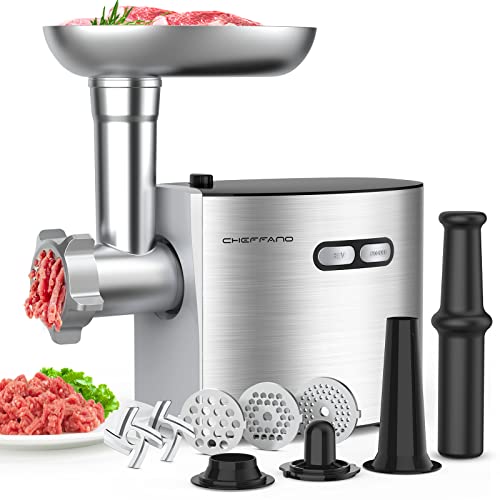
CHEFFANO Meat Grinder, 2800W Max, ETL Approved
Badge: Best Value Hunter
Strengths
- ETL approval stated in the listing — welcome in garages and camps where wiring is improvised and conditions are wet.
- Two blades and three plates cover a multi-species year, from fine small-game mixtures to coarse hog chili grind.
- Sausage stuffer tubes and a kubbe kit included, matching where a season’s trim actually goes.
Trade-offs
- 2800W max is a peak figure; the biggest weekends need staged batches and rests.
- No reverse is listed — sinew stalls are cleared by hand, wherever you are processing.
- No published throughput, so camp planning runs on your own calibration.
Mini spec box: Power: 2800W max · Certification noted: ETL approved · Blades: 2 · Plates: 3 · Extras: sausage stuffer tubes, kubbe kit · Duty described: heavy duty for home kitchen use.
The CHEFFANO is the hunter’s value proposition in its purest form: a complete, approved, heavy-duty grinder that leaves budget for the rest of the season’s gear. Its three plates are the multi-species argument — the same machine that takes deer trim coarse for chili takes duck and rabbit trim fine for sausage, and the spare blade covers the mid-season edge failure that otherwise ends a processing day. For the hunter who takes a deer or two and a few hogs in a year, processing at home at a sensible pace, this is genuinely all the grinder the season requires.
Its field manners are simplicity itself: a switch, a head that strips without ceremony, and no electronics to sulk in a cold garage. The honest limitations are pace and recovery — there is no reverse for the sinew wrap, and the biggest double-animal weekends will be staged affairs with the machine resting between tubs. Hunters who know their seasons are bigger than that should buy further down this list without regret; hunters whose seasons match the description above have found their machine, and the savings can go toward the vacuum sealer that finishes the job properly.
Best for: hunters taking a few animals a year who process at home and value a complete, approved kit / Not suited for: peak-weekend multi-animal processing.

Sinyder Electric Meat Grinder, 3000W Max, Stainless Steel
Badge: Best Built for the Long Haul
Strengths
- Metal gears stated in the listing — the drivetrain choice for a decade of seasons, storage, and shock loads.
- Pure copper motor and stainless steel body tolerate garage storage and aggressive wash-downs.
- Two blades and three plates included, with sausage stuffer tubes and a kubbe kit.
Trade-offs
- No throughput is published; peak-weekend planning is by experience, not by spec.
- No reverse is listed, so stalls are manual clear-outs even at camp.
- Stainless construction adds carrying weight between house, truck, and camp.
Mini spec box: Power: 3000W max · Motor: pure copper · Gears: metal · Body: stainless steel · Blades: 2 · Plates: 3 · Extras: sausage stuffer tubes, kubbe kit.
Hunters understand life-cycle cost better than most buyers — boots, optics, and rifles are all bought on the decade — and the Sinyder is the grinder that speaks that language. A hunting grinder’s life is brutal in a specific way: months of inactivity in a garage that freezes and bakes, then a weekend of maximum effort on sinewy, half-frozen game. That cycle attacks gearboxes and motors precisely where this listing specifies metal and copper. The stainless body completes the field kit: it washes in a utility sink, shrugs off blood and fat, and stores without cosmetic complaint.
Across a season it does the whole repertoire — deer burger, hog sausage meat, the fine grind for small-game mixtures — on its three plates, with the spare blade covering the inevitable dulling that game sinew accelerates. The honest limitations are the missing numbers and the missing reverse: you are buying construction and trusting it, and a stall at camp is a manual clear with cold hands. Hunters who also grind poultry frames for the kennel will find the same durability logic at the centre of our Best Meat Grinders That Grind Bones guidance. As the decade-grade hunter’s pick, the Sinyder is bought once and handed down.
Best for: hunters who buy gear for the decade and process in garages and camps / Not suited for: buyers who want published pace or reverse.

CHEFFANO Life Electric Meat Grinder, 2000W Max
Badge: Best for Occasional Hunters
Strengths
- The most accessible complete grinder in this six — a rational first machine for a new hunter.
- Stainless steel build with two blades, three plates, sausage tube, and kubbe kit: the full starter kit.
- Compact home positioning suits apartment and small-house hunters who process in the kitchen.
Trade-offs
- 2000W max is the gentlest claim here; a whole deer is a paced, batched project.
- No reverse and no published throughput.
- The hunter who starts taking multiple animals will outgrow it first.
Mini spec box: Power: 2000W max · Construction: stainless steel · Blades: 2 · Plates: 3 · Extras: sausage tube, kubbe kit · Duty described: heavy duty for home use.
Not every hunter fills every tag, and the sport’s honest majority — a deer in a good year, a hog when the chance comes, birds in season — needs a grinder matched to that reality rather than to a fantasy harvest. The CHEFFANO Life is that match: a stainless, fully kitted home grinder that processes an occasional animal in comfortable batches and spends the rest of the year as the household’s burger and sausage machine. For a new hunter equipping a first processing setup, it leaves budget for the knives, boards, and packaging that matter just as much.
The technique bargain is the strictest here, and stating it is a service: trim carefully, chill hard, grind in batches with rests, and never ask the machine to sprint a whole animal in one run. Kept to that bargain, it will process seasons of occasional harvests without complaint. The honest limitation is trajectory — if your hunting is clearly growing, buy one step up now (the CHEFFANO above, or the LEM below) and save the upgrade cycle. As the occasional hunter’s answer, though, the CHEFFANO Life is proportionate, complete, and sensibly priced in effort if not in claims.
Best for: new and occasional hunters processing an animal at a time in the kitchen / Not suited for: multi-animal weekends or fast-growing hunting households.

LEM Products BigBite #8 Meat Grinder, 0.5 HP
Badge: Best Camp Classic
Strengths
- A 0.5 HP rating from the name hunters already trust — specified like equipment, not like an appliance.
- The #8 head is the proven camp size: serious batches, kitchen-counter manners, one-animal authority.
- Stainless steel construction built around the grind-to-sausage workflow hunting seasons follow.
Trade-offs
- The pool listing does not enumerate included plates and blades — confirm the set before ordering.
- No electronic aids; hunters who want presets should look at feature-led home models instead.
- Half a horsepower is honest, not huge; two big animals in a day is steady work.
Mini spec box: Motor: 0.5 HP · Head size: #8 · Construction: stainless steel · Roles: grinding and sausage stuffing · Duty described: home use, heavy-duty positioning.
If hunting camps could vote, the BigBite #8 would win on name recognition alone — LEM built its reputation in exactly the rooms where hunters process, and this machine is the reason. The #8 head hits the camp sweet spot: large enough that a deer is a session rather than a saga, modest enough to live on a counter and travel in a truck without drama. The horsepower rating, in a field of four-digit wattage claims, signals a maker confident enough to specify the old way.
Its working character is unhurried reliability across the whole season — deer in the autumn, hogs in the spring, a fine grind for bird sausage whenever the freezer needs organising. It asks for the standard disciplines (cold meat, decent trimming) and repays them with the calmest processing days in this guide. The honest limitations are the unspecified accessory bundle in the pool data and the absence of modern conveniences; hunters who process Best Meat Grinders For Wild Game at true volume should step up to the FOHERE. For the classic one-to-three-animal season, the BigBite remains the reference hunter’s grinder — the one the other five are compared against in camps, whatever this guide’s rankings say.
Best for: traditional hunters processing a few animals a season who buy on pedigree / Not suited for: the largest volume weekends or feature-seekers.

RVGMBO Electric Meat Grinder, 3500W, 3 Blade & Plate Sets
Badge: Best Spares for Remote Processing
Strengths
- Three full sets of 304 stainless blades and plates — a dull or damaged set never ends a processing day.
- Sets can be staged by species and job: coarse game set, fine small-game set, sausage set.
- Kubbe and sausage kit included for the season’s sausage making.
Trade-offs
- The 3500W figure is a peak-style claim; sustained pace is not separately documented.
- No gear material, head size, or reverse is stated in the listing.
- Three sets of parts is a bigger wash at the end of a long processing day.
Mini spec box: Power: 3500W (maker’s “super motor” claim) · Blades and plates: 3 sets, 304 stainless steel · Extras: kubbe and sausage kit · Duty described: home use.
Remote processing has a logistics problem that kitchen grinding never meets: when a blade gives up at a camp two hours from the nearest shop, the hunt’s whole food chain waits on a spare part. The RVGMBO is the only machine in this guide that ships the solution in the box — three complete cutting sets, so the failure mode that ends processing days simply does not exist. Swap the set, keep grinding, deal with the dull steel later at home.
The sets enable a second, quieter advantage across a multi-species season: dedication. One set that lives as the coarse game set, one for fine work, one that stays pristine for the household’s ordinary cooking — an arrangement that keeps flavours, hygiene, and edges all sorted with zero extra purchases. The honest limitations are the unwritten parts of the spec: no published head size, gear material, or reverse, and a peak-style power claim. You are buying insurance and flexibility rather than documentation. For hunters whose processing happens far from resupply — the lease, the camp, the family farm — that insurance is the feature that matters most, and it earns the RVGMBO its place on a hunter’s list even ahead of better-documented machines.
Best for: hunters processing at camps and remote properties where a failed blade cannot be replaced / Not suited for: buyers who want a fully documented drivetrain.

FOHERE Electric Meat Grinder, #12 Head, 1 HP
Badge: Best Overall for Serious Hunters
Strengths
- A #12 head with throughput quoted at 8.8 lbs/min — peak weekends become scheduled sessions instead of ordeals.
- 600W all-copper motor with 1 HP positioning gives a continuous-duty story behind the 3600W peak figure.
- Stainless plates, sausage nozzle, and kubbe kit cover the full season from burger to sausage day.
Trade-offs
- The largest machine here — transport, counter space, and wash-up all scale up.
- No reverse is stated; at this power, stalls are rarer but still cleared by hand.
- Its case rests on volume; a one-deer hunter pays for capacity that sits idle.
Mini spec box: Motor: 600W all-copper, 1 HP positioning · Peak: 3600W · Head size: #12 · Throughput: 8.8 lbs/min (maker rating) · Plates: stainless · Extras: sausage nozzle, kubbe kit · Duty described: home use.
Serious hunters — the ones who process their own animals, their family’s animals, and the occasional friend’s, across deer and hog seasons — eventually hit the weekend that defines their equipment: multiple animals, a cold room full of quarters, and a freezer deadline. The FOHERE is built for that weekend. Its #12 head takes game trim in serious pieces, its all-copper motor holds a published pace that turns the grinding station into the fastest part of the line, and the whole day reorganises itself around cutting and packaging instead of waiting on the grinder.
The rest of the year justifies it too: hog shoulders, bulk sausage days, the Best Meat Grinders For Turkey Bones poultry work that fills the kennel’s freezer — a #12 machine absorbs a hunting household’s entire grinding life without ever being the bottleneck. The honest limitations are size and the manual stall clear; both are the known costs of the class. For the hunter whose seasons are measured in animals plural, the FOHERE is the best overall grinder in this guide, because it is the only one whose specification was written for their actual calendar.
Best for: high-harvest hunters and processing households handling multiple animals a season / Not suited for: occasional hunters or small kitchens.
Comparison Table
| Grinder | Power as listed | Head | Plates / Blades | Hunter character | Link |
|---|---|---|---|---|---|
| CHEFFANO | 2800W max, ETL | Not stated | 3 / 2 | Value, complete kit | Check on Amazon |
| Sinyder | 3000W max | Not stated | 3 / 2 | Metal drivetrain, decade build | Check on Amazon |
| CHEFFANO Life | 2000W max | Not stated | 3 / 2 | Occasional hunter’s starter | Check on Amazon |
| LEM BigBite | 0.5 HP | #8 | Not stated | Camp classic pedigree | Check on Amazon |
| RVGMBO | 3500W claim | Not stated | 3 sets / 3 sets | Spares for remote work | Check on Amazon |
| FOHERE | 600W copper / 1 HP, 8.8 lbs/min | #12 | Stainless / not stated | Serious-season throughput | Check on Amazon |
How to Choose a Meat Grinder for Hunting
Size for the peak weekend. Add up the best realistic weekend of your season — two deer, a hog, the birds — and buy the machine that processes it in staged sessions without distress. Average weekends will feel easy on that machine; a machine sized to the average will make the peak weekend a story you tell with feeling.
Count species, then plates. A multi-species year needs texture range more than it needs top-end power: fine plates for small game and bird sausage, medium for burger, coarse for chili and hog. Three-plate sets (or three full sets) are the flexibility specification; a single-plate machine is a single-species answer.
Shop construction for where you process. Kitchen processors can enjoy feature-led machines. Garage and camp processors should weight metal drivetrains, stainless bodies, simple controls that work with cold hands, and certifications that respect improvised power. Match the machine to the building it will work in.
Plan the spares like ammunition. Blades dull, and seasons do not wait for shipping. A spare blade in the box is minimum equipment; spare full sets are the remote-processing answer. Whatever machine you choose, order the spare cutting set the same day if it is not included.
Respect the calendar. Buy in the off-season, test on domestic meat, and arrive at opening day with a known machine, a sharpening plan, and a freezer with room in it. The hunters who process well are the ones who prepared in spring; the grinder is simply where that preparation becomes visible.
How a Hunter’s Processing Day Runs, Step by Step
Step 1 — Field care decides everything downstream. Cool the animal fast, keep it clean, and protect the meat from heat and contamination from the moment of the shot. No grinder repairs poor field care; good field care makes every later step easier.
Step 2 — Break down and sort. Quarter and bone the animal, sorting trim into labelled tubs by destination — burger, chili, sausage, stew, dog food — as the knife works. Trim silverskin and glands at the table.
Step 3 — Chill in rotation. Stage tubs through the coldest space available so the working tub is always hard-chilled. At camp, coolers and ice do the freezer’s job; plan the ice like you plan the ammunition.
Step 4 — Stage the fat. Game is lean; weigh and cube the pork or beef fat for each destination batch and chill it with the meat, feeding lean and fat in alternating handfuls.
Step 5 — Grind in destination order. Burger first, chili next, sausage meat last, with rests between tubs and a blade check at each change. Watch the output: clean particles good, smearing means stop and diagnose.
Step 6 — Sausage day discipline. Season in sub-batches, fry a test patty from each, adjust before stuffing, and keep the mixture cold from grinder to casing.
Step 7 — Package for the year. Portion honestly, flatten, label with species, blend, and date, and freeze in a single layer before stacking. The label is a promise to your future self.
Step 8 — Clean like the season depends on it. Strip the head, wash everything hot and soapy, brush plates clear, dry completely, and store the kit together — the next animal will not announce itself with time to hunt for parts.
Troubleshooting. Problem: the grinder wraps with sinew mid-animal → trim standards slipped; clear the hub and re-brief the knife. Problem: pace fades in hour two → blade is dull or the machine needs its rest; swap the set, take the break. Problem: sausage mixture turns pasty → it warmed during a long stuffing session; re-chill and work in smaller sub-batches.
Multi-Species Notes: One Grinder, a Whole Season
Deer sets the pattern — lean meat, fat blending, coarse-to-medium plates — but the rest of the season asks for variations the same machine handles with plate changes alone. Hogs bring fattier trim and tougher sinew: trim harder, expect more stall management, and lean on the coarse plate. Waterfowl and small game invert the job: small volumes, fine plates, and mixtures where the grinder is also the mixing tool for sausage-bound meat. Turkey and other large birds contribute frames that raw-feeding households grind for dogs — soft poultry bone technique, covered in the bone guides in this cluster — while their leg bones stay out of the grinder entirely, as all weight-bearing bones must.
The organising principle is that a hunter’s grinder is a texture instrument applied to whatever the season provides. Plate range, spare edges, and a washable, honest build are what let one machine cover that range; raw power only decides how fast the biggest day goes. Choose on the range first and the pace second, and the machine will still be right when the season surprises you — as seasons do.
The Camp Processing Kit: What Travels With the Grinder
A grinder alone is not a processing capability; it is the centre of a kit, and hunters who process away from home should pack the kit as deliberately as the rifle case. The essentials: two cutting boards (one for raw trim, one for finished product), a boning knife and a steel, tubs with lids sized to the grinder’s batches, a scale for fat ratios and portioning, bags and a marker, paper towels and a spray bottle for the constant small cleanups, and a headlamp — processing days end when they end, not when the light does. Add the grinder’s own spares (blade, plate, and the manual, photographed on your phone as a backup) and the kit is complete.
Pack it as one unit, in one tote, that lives with the grinder between seasons. The tote system is what makes camp processing calm: everything arrives together, everything is findable with cold hands, and the end-of-day wash-up has a defined inventory to check back in. Hunters who assemble the kit once, in the off-season, stop having the classic camp experience of improvising a missing board out of a cooler lid while a deer waits.
The Hunter’s Sausage Programme
Ask hunters what their grinder is really for and, after the first season, most give the same answer: sausage. Sausage is where trim becomes treasure — the destination that turns a deer’s awkward pounds and a hog’s shoulder into the food that gets requested by name. A hunter’s sausage programme deserves the same planning as the hunt itself: recipes chosen before the season, casings and seasonings bought in the off-season, fat sourced in advance, and a dedicated sausage day on the processing calendar rather than an afterthought at the end of it.
The grinder’s role is double — it grinds the meat and, with the tubes every pick here includes, it stuffs the casings. Technique transfers from the grinding sections above: cold mixture, sub-batches, a fried test patty before each stuffing run, and seasoning adjusted while adjustment is cheap. Keep a sausage log with the season’s notes — ratios, spice levels, what the family actually ate first — and the programme improves every year. It is not an exaggeration to say that for many hunting households, the sausage log is the most-consulted document in the kitchen by February.
The Off-Season: A Grinder’s Second Life
A hunter’s grinder that only works in the autumn is a poor investment of cupboard space, and the good news is that none of these machines needs to hibernate. The off-season repertoire is the household’s ordinary grinding — burgers from whole cuts, meatballs, the dog’s food, a falafel night on the machine that also does kibbe — plus one duty unique to hunting households: practice. A spring session on domestic meat keeps the operator’s hands fluent, tests the machine after storage, and confirms the spares inventory before it matters.
Storage is the other off-season duty. Wash and dry the head completely, store plates and blades with the machine (a labelled box in the tote, or built-in storage where fitted), and keep the whole kit somewhere dry rather than in the damp corner of the garage. Come the season, the machine should need nothing but meat. That readiness — unglamorous, achieved in April — is what separates the households that process their own animals every year from the ones that meant to.
Sharing the Work: Processing for Family and Friends
Success breeds requests, and the hunter with a good grinder becomes the neighbourhood’s processing department by the second season. There is real pleasure in it — a full table, many hands, an animal turned into food communally — and real risk: other people’s meat, other people’s field care, and your machine in the middle. Households that do this well set gentle rules early. Animals arrive properly cooled and reasonably clean, or the knife work doubles. The owner of the grinder runs the grinder; guests run the packaging station, where enthusiasm cannot hurt the equipment. And the day is scheduled, not improvised, because a processing favour that collides with your own animal helps no one.
There is also a fair division worth naming: guests bring bags, labels, ice, and food for the crew, and they take home a share of the wash-up. Put that way, communal processing becomes one of the season’s best days rather than its most exploited one — and it is the environment where a #12 machine, or a well-spares kit like the RVGMBO’s, quietly justifies every penny in front of an audience.
Common Buying Mistakes
Buying during the season. Stock thins and prices harden when every hunter in the state wants the same machine. The off-season is for equipment; the season is for hunting.
Sizing to the average weekend. The peak weekend is the one that matters — it is when meat, time, and temperature all press at once. Buy for it, or accept staged processing with open eyes.
No spare blade in camp. The dullest moment in hunting is a dead blade, a hanging animal, and a two-hour drive to anywhere. Spares are not accessories; they are insurance bought cheap.
Feature-led machines in field conditions. Touch panels and cold, bloody gloves are strangers. Camp processors should buy controls they can work half-asleep in a cold garage.
Forgetting the freezer. A season’s grind needs somewhere to go. Freezer space, bags, and labels are part of the grinder purchase, budgeted together or regretted together.
Final Recommendation
For the serious hunter, the FOHERE #12 Electric Meat Grinder is the first choice: its head size, all-copper motor, and published throughput are specified for peak weekends and multi-animal seasons. The traditional pick remains the LEM BigBite #8, whose pedigree and honest horsepower suit the classic camp workflow, and the value pick is the CHEFFANO with its approved, complete kit. Choose by your season’s true peak, keep spares like you keep ammunition, and any of these six will turn harvests into freezers full of food you are proud of.
A last piece of hunter’s realism to close the guide: the grinder is the easiest part of processing to get right. It asks only that you buy it early, size it to your peak, keep its edges sharp and its kit complete. The hard parts — field care, trimming patience, temperature discipline — are skills, and they are the same skills that make a good hunter in every other department. Master them alongside the machine and the season ends the way it should: with a full freezer, a clean garage, and food you are proud to serve to people who were not there for the hunt.
Frequently Asked Questions
What size grinder does a hunter actually need?
It scales with harvest. One or two deer a season: a strong standard home grinder or a #8 head handles it in staged sessions. Multiple animals across deer and hog seasons: a #8 is the working minimum and a #12 is the comfortable answer. Judge by your biggest weekend, not your average one, and remember that staging and rests extend any machine’s reach. If two hunters share one household’s equipment, size for the combined season — shared machines live harder lives than single-hunter ones, and the step up in class is cheaper than the mid-season replacement.
Can one grinder handle deer, hogs, and small game?
Yes — that is precisely the multi-species case this guide is built on. The variables are plates and technique, not the machine: coarse for hog chili grind, medium for deer burger, fine for small-game and bird sausage mixtures. A three-plate set covers the season; the grinder’s job is to be strong and washable enough to do all of it for years.
Is it safe to run a grinder on a generator at camp?
Generally yes, with ordinary care: use a generator sized comfortably above the machine’s draw, keep connections dry and off the ground, and let the machine start unloaded. Simpler, switch-controlled machines tolerate field power with the least fuss. As with any electrical equipment outdoors, water and improvised wiring deserve respect — one more reason an approval mark like ETL is worth having in this category.
How do I keep game meat cold when processing away from home?
Plan the cold chain like equipment: coolers with plenty of ice, tubs rotated through them so the working meat is always hard-chilled, shade for the processing table, and packaging that moves finished grind onto ice immediately. In cold weather the ambient air helps; in warm weather, shorten sessions and grind in the coolest hours. Temperature discipline is the difference between camp-processed meat that eats beautifully and meat that merely eats.
Should a hunter’s grinder live at camp or at home?
Wherever the processing actually happens — and for most hunters that is home, where water, power, and freezer space are certain. Camp-resident machines earn their place when animals are processed on site for transport or when the camp is a long-term lease with reliable power. A durable, stainless machine tolerates either life; the deciding factor is your own workflow, and a machine stored with its full kit in one box travels between the two without friction.
What grind is best for game burger?
Most hunters land on a two-stage answer: a coarse first pass to break the trim down evenly with the fat distributed, then a medium plate for the finished burger texture. Chili meat stops at the coarse pass. The exact plates matter less than the consistency — pick your house style, write it in the processing log, and repeat it every season so your burger tastes like your burger, year after year.
Can I grind frozen game meat straight from the freezer?
Partially frozen is the target, not rock solid. Let frozen trim temper in the refrigerator until it is firm and frosty but yields to a knife — that is the state that cuts cleanly, keeps the batch cold, and treats the machine kindly. Grinding fully frozen meat strains motors and chips edges; grinding thawed, warm meat smears and greys. The tempering window is one more thing to build into the processing plan, ideally the night before.
What parts should a hunter keep as spares?
At minimum, one spare blade-and-plate pair in the sizes you use most, stored with the machine. Remote processors should carry a full spare cutting set — the RVGMBO builds this in — plus the small consumables of processing day: bags, labels, and a marker. Spares feel redundant exactly until the moment they are the only thing between an animal and a wasted weekend.
How do I stop my hunting grinder from rusting in storage?
Wash it, then dry it like you mean it — completely, part by part, before anything is put away. Store the cutting set dry and together, in the machine’s storage or a labelled dry box, and keep the kit somewhere with moving air rather than a damp garage corner. Stainless machines forgive more, but the discipline is the same. A spring test batch on domestic meat confirms everything survived the off-season while there is still time to fix what did not.
Is processing my own game really cheaper than a butcher?
It can be, across several seasons, once the equipment is owned — but most hunters who process their own will tell you the saving is not the main reason. Control is: your trim standards, your fat blend, your sausage recipes, your labels, and meat that was handled by people who cared about it from field to freezer. The grinder is the enabling purchase for that control, and it should be judged as such rather than as a pure cost calculation.
Can these grinders handle wild hog?
Yes, with adjusted expectations: hog trim is fattier and its sinew is tougher than deer’s, so trim aggressively, keep everything very cold, start coarse, and expect to manage the blade hub more often. Boar meat should always be cooked thoroughly, as with any wild pork. The machines in this guide handle hog as part of the standard multi-species workload.