Disclosure: topratedkitchenware.com is reader-supported. When you buy through links on our site, we may earn an affiliate commission from Amazon and other retailers, at no extra cost to you.
Where to buy
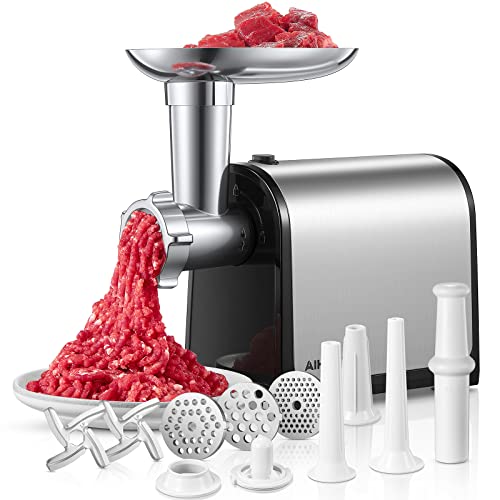
All six grinders in this guide are sold through Amazon, where you can verify plate sets, blade counts, and included kits before ordering. The first machine listed, the CHEFFANO Life Electric Meat Grinder, opens the shortlist — Check on Amazon — and the rest follow:
- LEM Products BigBite #8 Meat Grinder, 0.5 HP
- RVGMBO Electric Meat Grinder, 3500W, 3 Blade & Plate Sets
- FOHERE Electric Meat Grinder, #12 Head, 1 HP
- Aiheal Electric Meat Grinder, 3200W Max
- AAOBOSI Electric Meat Grinder with 3-Speed Touch Screen
Read the full guide ↓ for the raw-feeding specifics: soft bone technique, grind fineness, and the hygiene routine that raw food demands.
The best meat grinders for raw dog food carry a responsibility no other grinder in the kitchen carries: the food they produce will not be cooked. There is no kill step waiting in a pan to forgive a careless session, which means the grinder itself — its cleanliness, its grind quality, its ability to reduce soft bone to a safe, even meal — is the safety system. Raw feeding households grind a complete diet at home: muscle meat, organ meat, and soft bone, portioned and frozen in batches that may last a month. The best meat grinders for raw dog food are therefore judged on three things above all: whether they grind soft poultry bone thoroughly and evenly, whether they strip down completely for the rigorous washing raw work demands after every session, and whether their pace and durability match a raw feeder’s batch calendar, which is measured in years of Sundays.
The bone question deserves precision at the outset, because it is where raw feeding and equipment meet most consequentially. The bones in a ground raw diet are soft, raw, poultry-class bones — chicken and turkey frames, necks, wings — ground fine enough that no sharp fragment survives. That is a completely different substance from a whole raw bone handed to a dog, and a different universe from cooked bone, which is brittle and dangerous and must never be fed in any form. Weight-bearing bones from large animals are outside home grinding entirely. Within those boundaries, a strong grinder turns the whole carcass economy of poultry into nutrition; outside them, no machine in this guide should follow you. This page assumes a raw feeder who works within those boundaries and wants equipment worthy of the routine. Those whose dogs eat cooked homemade food will find the broader picture in the general dog-food coverage in this cluster; readers whose raw routine centres on whole-animal sourcing may also cross paths with our Best Meat Grinders For Venison guide, where trim discipline is taught by hunters.
Key Takeaways
- Raw means no kill step: the grinder’s cleanliness and grind quality are the safety system, so full disassembly and fine, even output lead the criteria.
- Only soft, raw poultry-class bones belong in these machines — frames, necks, wings — ground fine through a two-pass method; never cooked bone, never weight-bearing bone.
- The AAOBOSI touch model is the only listing here that names raw pet food outright, with a throughput quoted at 4 lbs/min.
- Dedicated cutting sets (the RVGMBO ships three) let raw dog food have its own steel, kept and washed as its own kit.
- Batch scale decides size: the FOHERE’s #12 head and 8.8 lbs/min maker rating serve multi-dog and monthly-prep households; standard machines serve one dog well.
- Grind, portion, and freeze in one session; thaw in the fridge and never refreeze raw portions.
In this guide
Quick Picks
| Pick | Badge | Standout detail from the listing | Link |
|---|---|---|---|
| CHEFFANO Life Electric Meat Grinder | Best Raw Starter for Small Dogs | 2000W max, stainless steel, 2 blades, 3 plates | Check on Amazon |
| LEM Products BigBite #8 | Best Trusted Raw Workhorse | 0.5 HP, #8 head, stainless steel | Check on Amazon |
| RVGMBO Electric Meat Grinder | Best Dedicated Cutting Sets | 3500W motor claim, 3 sets of 304 stainless blades and plates | Check on Amazon |
| FOHERE Electric Meat Grinder | Best Overall for Raw Batch Volume | #12 head, 1 HP, 600W all-copper motor, 8.8 lbs/min maker rating | Check on Amazon |
| Aiheal Electric Meat Grinder | Best Complete Bundle | 3200W max, 2 blades, 3 plates, 3 sausage tubes | Check on Amazon |
| AAOBOSI 3-Speed Touch Screen Grinder | Best Listed for Raw Pet Food | 3000W max, 4 lbs/min maker rating, raw pet food in the listing, built-in storage | Check on Amazon |
How These Picks Were Chosen
This is a research-led guide built from manufacturer listings and specifications, re-filtered for raw feeding’s stricter contract. Where ordinary dog-food grinding rewards convenience, raw grinding rewards three things in a specific order: grind quality on bone-in mixtures, hygiene architecture, and durability across a heavy recurring calendar. Peak wattage was discounted as a momentary figure throughout; continuous-style evidence (horsepower, throughput, head size) and construction (stainless food paths, gear and motor materials, spare cutting sets) carried the ranking.
Four filters produced the six. First, bone competence within the soft-bone boundary: machines whose power story and plate range support the coarse-then-fine two-pass method that makes ground bone safe. Second, strip-down design: every pick’s head disassembles completely, because raw residue in a crevice is a genuine hazard, not a cosmetic issue. Third, cutting-set depth: raw work dulls edges on bone and demands spares, so multi-blade bundles and the RVGMBO’s three full sets scored as safety features. Fourth, batch economics of effort: from a small dog’s weekly kilo to a multi-dog monthly marathon, the list spans the sizes raw feeders actually run, with each review honest about its ceiling. Mixer attachments and manual grinders were excluded — raw feeding is a years-long routine, and neither survives it. Readers comparing the wider raw landscape should also see our Best Meat Grinders Raw Feeders roundup, where the community’s own priorities are the organising principle.
The 6 Best Meat Grinders for Raw Dog Food

CHEFFANO Life Electric Meat Grinder, 2000W Max
Badge: Best Raw Starter for Small Dogs
Strengths
- The most accessible complete machine here — stainless, with two blades and three plates for the two-pass raw method.
- Right-sized for a small dog’s weekly batch: less machine to wash after every raw session.
- Sausage tube and kubbe kit keep it useful for the household’s own food too.
Trade-offs
- 2000W max is the gentlest claim in the six; bone-in mixes must be small, cold, and patiently fed.
- No reverse and no published throughput.
- A second or larger dog will outgrow it before any other pick here.
Mini spec box: Power: 2000W max · Construction: stainless steel · Blades: 2 · Plates: 3 · Extras: sausage tube, kubbe kit · Duty described: heavy duty for home use.
Raw feeding a small dog is a modest weekly ritual — a few pounds of meat, organs, and soft bone, ground fine, portioned into small containers — and it deserves a machine proportioned to it. The CHEFFANO Life is that machine: a stainless home grinder whose three plates cover the raw method (coarse pass for the bone fraction, finer pass to finish), whose spare blade covers the edge that bone work steadily dulls, and whose size makes the mandatory full wash-up a five-minute job rather than a project. For a raw-curious owner starting with one small dog, it lowers every barrier that matters.
The technique contract is strict, as it is for every machine here but tightest for the gentlest motor: bone pieces small and hard-chilled, fed one at a time, never forced; organs partially frozen so they cut instead of smearing; the finished grind checked by hand for any fragment that feels sharp before portioning. Follow that contract and this little machine produces raw food indistinguishable from a big machine’s. Break it — big pieces, warm meat, a packed tube — and you will find its limits quickly. Buy it for the dog you have; if the household’s raw ambitions grow, it becomes the dedicated small-batch machine beside a bigger sibling.
Best for: raw feeders with one small dog starting the routine / Not suited for: large dogs, multiple dogs, or heavy bone fractions.

LEM Products BigBite #8 Meat Grinder, 0.5 HP
Badge: Best Trusted Raw Workhorse
Strengths
- An honest 0.5 HP rating from a meat-processing name — sustained behaviour you can predict across years of raw batches.
- The #8 head handles bone-in poultry mixes in sensible pieces without the babying smaller heads need.
- Stainless construction that strips and washes completely — the raw routine’s core requirement.
Trade-offs
- The pool listing does not enumerate the included plates and blades — confirm the set, and budget a fine plate if it is absent.
- No electronic conveniences; a traditional machine in every sense.
- Monthly mega-batches for several large dogs belong to the #12 FOHERE.
Mini spec box: Motor: 0.5 HP · Head size: #8 · Construction: stainless steel · Roles: grinding and sausage stuffing · Duty described: home use, heavy-duty positioning.
Raw feeders are, by disposition, label-readers and sceptics — people who took feeding into their own hands because they wanted to know exactly what was in the bowl. The LEM BigBite speaks that language fluently: a horsepower rating instead of a marketing number, a #8 head sized for real batches, and a brand whose reputation was earned on exactly this class of work. In raw service it is the calm middle of this guide — strong enough for weekly bone-in grinding for a large dog, sized so the full strip-and-wash routine stays kitchen-scaled.
Its working style suits the raw calendar particularly well because it is predictable: the same pace in month one and month thirty, no electronics to age, a head that comes apart the same way every time. The honest notes are the unspecified accessory set in the pool data — verify the plates included, since raw work specifically needs a fine finishing plate — and the absence of reverse, which makes trimming and piece size the stall prevention. For the raw feeder who buys equipment the way they buy ingredients — on provenance — the BigBite is the natural centre of the home raw kitchen.
Best for: raw feeders with one large dog who buy on track record / Not suited for: multi-dog monthly mega-batches.

RVGMBO Electric Meat Grinder, 3500W, 3 Blade & Plate Sets
Badge: Best Dedicated Cutting Sets
Strengths
- Three full sets of 304 stainless blades and plates — one can live as the permanent raw-dog-food set.
- Fresh edges on demand across long bone-in sessions, where dulling is fastest.
- Kubbe and sausage kit included for the household side of the machine’s life.
Trade-offs
- The 3500W figure is a peak-style claim; sustained pace is undocumented.
- No gear material, head size, or reverse is stated in the listing.
- Three sets means a larger wash — though raw feeders wash everything anyway.
Mini spec box: Power: 3500W (maker’s “super motor” claim) · Blades and plates: 3 sets, 304 stainless steel · Extras: kubbe and sausage kit · Duty described: home use.
Raw feeding runs on separation and sharpness, and the RVGMBO is the only machine here that ships both in depth. Separation: with three complete cutting sets, one set becomes the dog-food set — used only for raw, washed as its own kit, stored apart — while the family’s food meets different steel. Raw feeders who share a grinder with the household table will recognise that as the cleanest possible arrangement. Sharpness: bone-in grinding is the most abrasive work a home grinder does, edges fade mid-marathon, and a fresh set is a thirty-second swap instead of a session compromised by a tearing blade — which matters doubly for raw, where a dull blade smears fat and leaves bone fragments coarser than intended.
The rest of the specification is quieter — a large peak claim, no published drivetrain details — and the review keeps that honest: this is a machine bought for its cutting-gear system and the hygiene architecture it enables, on a motor story you take partly on trust. In the raw context, that trade is unusually rational, because the parts that determine raw food quality and safety are precisely the parts this machine triples. Pair it with the strict routine in the how-to section and it is a genuinely distinctive raw-feeding tool.
Best for: raw feeders who share a grinder with the family table and want dedicated steel for the dog / Not suited for: buyers who want published drivetrain specifications.

FOHERE Electric Meat Grinder, #12 Head, 1 HP
Badge: Best Overall for Raw Batch Volume
Strengths
- A #12 head with throughput quoted at 8.8 lbs/min — a month of raw food for a large dog in one session.
- 600W all-copper motor with 1 HP positioning sustains pace through meat, organ, and soft-bone mixes.
- Stainless plates with sausage nozzle and kubbe kit included.
Trade-offs
- The biggest wash-up in this six — the price of batch scale in a hygiene-critical routine.
- No reverse is stated; bone stalls are cleared manually despite the volume focus.
- Far more machine than a single small dog’s diet requires.
Mini spec box: Motor: 600W all-copper, 1 HP positioning · Peak: 3600W · Head size: #12 · Throughput: 8.8 lbs/min (maker rating) · Plates: stainless · Extras: sausage nozzle, kubbe kit · Duty described: home use.
Raw feeding scales brutally. One large dog eating a bone-in raw diet turns a weekly session into a standing appointment, and a second dog turns it into a shift. The FOHERE is the machine that gives the time back: a #12 head that takes poultry frames in generous pieces, an all-copper motor with a published per-minute rate, and the sustained temperament to run a month’s food through in a single planned session — one setup, one wash-up, one freezer filling, instead of four of each. For multi-dog raw households, that consolidation is the difference between a routine and a burden.
Quality holds at its pace for the reason raw feeders care about: fast, cold grinding. A mixture that moves through quickly spends less time warming at the plate, and the two-pass bone method — coarse, then fine — completes while everything is still hard-chilled, producing the even, fine, fragment-free grind that safe raw feeding depends on. The honest costs are the big-machine ones: counter space, a serious sink session afterwards, and no reverse for the occasional frame that wedges. Households feeding game trim into the raw mix will find its capacity equally welcome during hunting season — see our Best Meat Grinders For Wild Game guide for that crossover. As the volume answer for raw, the FOHERE stands alone in this six.
Best for: multi-dog raw households and monthly bulk prep / Not suited for: one small dog or small kitchens.

Aiheal Electric Meat Grinder, 3200W Max
Badge: Best Complete Bundle
Strengths
- Two blades and three plates in the box — the raw two-pass method and a spare bone blade, covered from day one.
- Three sausage tubes included for the household’s own grinding.
- Stainless grinding components in a finish that hides a working life well.
Trade-offs
- 3200W is a maximum rating; bone-in pace is set by feeding discipline.
- No reverse is listed, so frame stalls mean opening the head.
- No published throughput or head size for batch planning.
Mini spec box: Power: 3200W max · Blades: 2 · Plates: 3 · Sausage tubes: 3 · Body/components: stainless steel, black finish · Duty described: heavy duty for home kitchen use.
The Aiheal is the raw starter kit for the mainstream case — one medium or large dog, a weekly or fortnightly batch, an owner who wants everything needed in a single order. The bundle maps onto the raw method with unusual neatness: the coarse plate and first blade become the bone set, the finer plates handle finishing, the second blade stays sharp for clean meat work, and the whole rotation is possible without a single accessory purchase. In a category where the routine is everything, arriving fully equipped is a genuine feature.
Its session character is the standard home one — steady feeding, hard-chilled ingredients, rests on long batches — and its limitations are the class’s: peak-only power information, no reverse, no published pace. Raw feeders whose batches outgrow it will step to the LEM or the FOHERE with the Aiheal as a capable second machine for organ-only or small midweek grinds. As the complete, one-box entry into raw grinding, it earns its badge by removing the most common beginner failure: discovering mid-recipe that the plate or blade the method needs is the one that was not in the box.
Best for: new raw feeders with one medium-to-large dog who want a complete kit in one order / Not suited for: high-volume multi-dog prep.

AAOBOSI Electric Meat Grinder with 3-Speed Touch Screen
Badge: Best Listed for Raw Pet Food
Strengths
- Raw pet food is named in the listing itself — the only pick here designed and described with this exact job in view.
- Throughput quoted at 4 lbs/min gives raw batch planning a real number.
- Built-in storage and an easy-cleanup design fit a routine where the wash-up is non-negotiable.
Trade-offs
- The quoted pace is for meat; bone-in raw mixes will run slower.
- 3000W max is a peak claim, and touch controls need wiping mid-session.
- No reverse is listed, despite the pet-food focus.
Mini spec box: Power: 3000W max · Throughput: 4 lbs/min (maker rating) · Controls: 3-speed touch screen · Storage: built-in · Roles: 3-in-1 sausage, burger, raw pet food · Certification noted: LFGB approved · Cleanup: designed for easy cleanup.
There is a particular comfort in buying the machine whose maker had your exact job in mind, and this AAOBOSI is the only grinder in the six whose listing says “raw pet food” in so many words. The design details line up with the routine behind the words: a published throughput so a raw feeder can plan a batch day honestly, speed control that lets bone-in mixes run low and steady where the torque is, built-in storage so the raw kit lives together, and a cleanup-led design for the wash that raw work makes mandatory.
In practice it is the planner’s raw machine: weigh the month’s ingredients, divide by a realistic pace — discounted from the quoted figure for bone — and the session has a shape before it starts. The honest limitations are the absence of reverse and the touch panel’s manners around wet hands; neither undermines the core case. Raw feeders in Britain comparing the same shortlist will find it in our Best Meat Grinders Uk coverage as well. For the raw household that wants its equipment to acknowledge its diet by name, this is the pick.
Best for: raw feeders who plan batches by the pound and want a machine designed with raw pet food in view / Not suited for: the largest multi-dog volumes, which belong to the #12.
Comparison Table
| Grinder | Power as listed | Head | Plates / Blades | Raw-feeding character | Link |
|---|---|---|---|---|---|
| CHEFFANO Life | 2000W max | Not stated | 3 / 2 | Small-dog raw starter | Check on Amazon |
| LEM BigBite | 0.5 HP | #8 | Not stated | Trusted weekly workhorse | Check on Amazon |
| RVGMBO | 3500W claim | Not stated | 3 sets / 3 sets | Dedicated raw steel | Check on Amazon |
| FOHERE | 600W copper / 1 HP, 8.8 lbs/min | #12 | Stainless / not stated | Monthly batch volume | Check on Amazon |
| Aiheal | 3200W max | Not stated | 3 / 2 | Complete one-box kit | Check on Amazon |
| AAOBOSI Touch | 3000W max, 4 lbs/min | Not stated | Not stated | Raw pet food by design | Check on Amazon |
How to Choose a Meat Grinder for Raw Dog Food
Put grind quality on bone first. Raw safety lives in the finished texture: soft bone reduced evenly and finely, with no sharp fragments. That outcome is produced by the coarse-then-fine two-pass method, a sharp blade, and a machine strong enough to keep the mixture moving cold. Any grinder you consider must have the plate range for two passes and the power story to run them on bone-in mixes.
Audit the wash-up before the wattage. You will strip and wash this machine after every session for the life of the dog. Heads that disassemble completely, with no sealed crevices, and parts that fit your sink are the raw feeder’s real specification. A machine that is annoying to wash will eventually be washed badly, and in raw feeding that is a health issue, not a housekeeping one.
Match size to the batch calendar. Weekly small batches favour compact machines with fast wash-ups; fortnightly and monthly prep for large or multiple dogs favours the #8 and #12 classes with published paces. Write down your dog’s weekly consumption in pounds — including bone and organs — and let that arithmetic, not ambition, choose the size.
Plan the cutting-set system. Raw work dulls blades faster than any other home grinding, and many raw households keep dog-food steel separate from family steel. Bundles with spare blades, or the RVGMBO’s full spare sets, build that system into the purchase. A lone blade is a raw routine waiting for its first compromised batch.
Be honest about the diet’s demands. Raw feeding is a commitment to sourcing, storage, and routine as much as to a grinder. The machine should be bought after the diet is decided with your veterinarian’s input, sized to the dog you have, and chosen for the years the routine will run — because in raw feeding, the grinder is not an appliance purchase; it is infrastructure.
How to Grind Raw Dog Food, Step by Step
Step 1 — Build the batch from the recipe. Weigh the components — muscle meat, organs, soft bone fraction — according to the diet plan you follow with your veterinarian’s guidance. The grinder executes ratios; it does not invent them.
Step 2 — Prep cold and small. Cube meats and organs; break poultry frames into small pieces; chill everything until firm, with organs partially frozen so they shear cleanly instead of smearing.
Step 3 — Bone fraction first, coarse plate. Grind the bone-in portion through the coarsest plate while the machine and ingredients are at their coldest. Feed one piece at a time and let the auger work.
Step 4 — Meat and organs through. Follow with the muscle meat, then the organs last and coldest, so they distribute through the batch rather than coating the head.
Step 5 — Second pass, fine plate. Mix the batch gently and pass it through the fine plate. This pass is the safety pass: it reduces any remaining bone particles to a fine, even meal.
Step 6 — Check by hand. Work a handful of the finished grind between your fingers. It should feel like coarse, even mince with no sharp points. Any fragment that feels sharp goes back for another pass — no exceptions.
Step 7 — Portion and freeze immediately. Pack daily portions, flatten, label with recipe and date, and freeze in a single layer the same session. Ground raw food’s fridge life is short; the freezer is its home.
Step 8 — The full raw wash. Strip the head completely, wash every food-contact part in hot soapy water, brush plate holes clear, rinse, dry fully, and store the dog-food set together. Then clean the surrounding surfaces the session touched.
Troubleshooting. Problem: sharp fragments in the finished grind → the bone pieces were too large or the fine pass was skipped; regrind the batch through the fine plate and cut smaller next time. Problem: the mix comes out warm and smeared → ingredients warmed or the blade is dull; re-chill and swap in a sharp set. Problem: the machine strains on frames → pieces are too big for the head; break frames down further and feed singly.
The Raw Hygiene Routine, In Full
Raw feeding households develop a liturgy, and it is worth writing out completely because partial versions are where risk lives. Work surfaces are cleaned before the session, not just after. Ingredients move from fridge to grinder to freezer in one continuous flow, with no ground raw food sitting at room temperature while other chores intervene. The dog’s bowls, the portioning containers, and the grinder’s kit are washed as one system. Hands are washed at every transition — after handling raw, before touching anything else, without exception.
Thawing completes the routine: portions thaw in the refrigerator, are served promptly, and are never refrozen; uneaten raw food is discarded rather than saved. Dogs are robust animals, but the household around them includes humans, children, and visitors whose exposure is part of the feeder’s responsibility. None of this is onerous once habitual — raw feeders consistently report that the routine becomes invisible within a month — but it must be habitual, and a grinder that strips and washes easily is what makes the habit sustainable for years. That, more than any power figure, is what “best for raw” means.
Sourcing for the Raw Grinder: Whole Birds, Cases, and Co-ops
Raw feeding at scale becomes a sourcing discipline as much as a grinding one. The economical pattern experienced raw feeders settle into is whole-animal buying: whole chickens and turkeys whose frames, necks, and organs are the diet’s backbone, bought by the case when prices soften and stored whole — whole birds keep better and longer in the freezer than parts, and they meet the grinder on prep day in perfect condition. Butchers, restaurant suppliers, and raw-feeding co-ops all serve this pattern; a standing relationship with one source beats a weekly improvisation across five.
Variety is sourced the same way — a case of this, a bulk bag of that, organ meats set aside by a butcher who knows your routine. Keep the sourcing log with the batch log: what went into each batch, from where, and how the dog did on it. Over a year, the combined logs become a precise picture of your dog’s nutrition and your grinder’s true workload, and they make the next equipment decision — a bigger head, a spare set, a second machine for a second dog — an evidence-based one rather than a guess.
Reading the Bowl: Adjusting the Grind Over Time
The finished product teaches you, if you watch it. A dog that eats eagerly and digests calmly is confirming the recipe and the grind; a dog that sorts the food, leaves the coarser fraction, or shows digestive protest is giving equipment feedback as much as dietary feedback. Puppies and seniors often need the grind taken finer. Dogs new to raw may need the bone fraction introduced at a gentler share and a finer texture while their systems adapt. Working dogs in hard training may need the batch rhythm shortened so food is always at its freshest.
Adjust one variable at a time — texture first, since it is the grinder’s own variable — and note the change in the batch log. This is the unglamorous heart of successful raw feeding: not a perfect first recipe, but a feedback loop between the bowl, the log, and the machine, run patiently across the dog’s life. The grinder’s contribution to that loop is consistency — the same plates, the same method, the same fineness — so that when something changes, you know it was the variable you intended.
The Monthly Raw Prep Day, Planned
Households that raw-feed for years tend to converge on a ritual prep day, and its shape is worth copying. The day before: inventory the freezer, finalise the batch list, and move ingredients to temper. The morning: surfaces cleaned, kit laid out in working order, containers and labels ready before the first bird is cut. The session itself runs in the order this guide’s how-to describes — bone fraction, meat, organs, fine pass, hand check — with portioning flowing directly from the grinder so raw food is never queued at room temperature. The close: everything washed as one system, the log written while memory is fresh, the freezer inventory updated.
Two habits separate sustainable prep days from heroic ones. First, the batch is sized to the crew: a solo feeder’s monthly marathon is better split into two fortnightly sessions, and there is no prize for refusing the split. Second, the day ends with the kitchen restored — not “soaking”, not “mostly done” — because the household that eats in that kitchen tonight is part of the raw system’s safety case. Build the ritual at your household’s true scale, and raw feeding stops being a project and becomes what it should be: simply how the dog is fed.
Common Buying Mistakes
Treating raw like cooked with extra steps. The hygiene and fineness standards are categorically stricter. A grinder bought casually for burgers needs its plate range and washability re-audited before it touches a raw bone-in batch.
Grinding the wrong bones. Soft, raw, poultry-class bones in small pieces are the category. Cooked bones and weight-bearing bones are not a technique problem to solve — they are exclusions, full stop.
Skipping the fine second pass. The coarse pass alone leaves bone particles at their largest and sharpest. The fine pass is the step that makes ground bone a food rather than a hazard.
Buying small for a growing dog. A puppy’s raw batch and an adult large breed’s raw batch are different sports. Buy for the adult, or knowingly buy a starter.
Letting the blade dull quietly. In raw work a dull blade does not just slow the session — it coarsens the bone fraction and smears the fat. Spare sets exist in this guide for a reason.
Final Recommendation
For most raw feeders, the FOHERE #12 is the first choice when batches are large, and the AAOBOSI touch model — the machine that names raw pet food in its own listing — is the first choice when they are planned and moderate. Hygiene purists who share a machine with the family table should take the RVGMBO’s dedicated cutting sets seriously. Whichever you choose, hold the raw feeder’s bargain: soft bone only, two passes always, everything cold, everything washed, every time.
One closing perspective for the household weighing all of this: raw feeding asks more of its equipment than any other home grinding, and it returns more, too — a dog fed on food you sourced, ground, and portioned yourself, on a routine you control completely. The grinder is where that control physically happens. Choose it by the raw criteria in this guide — fineness on bone, washability, cutting-set depth, honest pace — and it will disappear into the routine, which is the highest compliment feeding equipment can earn.
Frequently Asked Questions
Is ground raw bone safe for dogs?
Soft raw poultry bone, ground fine through a two-pass method until no sharp fragment remains, is the established form in which raw diets include bone — fundamentally different from feeding whole bones, and the opposite of cooked bone, which is brittle and must never be fed. The equipment’s job is the fineness and evenness of that grind; the diet’s design, including bone proportions, should be set with your veterinarian. The hand check in our how-to section is the household-level verification: if a fragment feels sharp between your fingers, the batch is not finished, whatever the clock says.
Which bones can I grind for a raw diet?
Poultry frames, necks, wings, and backs; rabbit; and small whole fish — the soft, hollow, or pliable bones. Turkey bones are larger and harder than chicken and deserve extra care and smaller pieces; our Best Meat Grinders For Turkey Bones guide works through turkey piece by piece. Never grind cooked bones or the weight-bearing bones of large animals.
How fine should raw dog food be ground?
Fine and even — the finished texture of coarse mince with no detectable sharp particles when rubbed between your fingers. Achieve it with the two-pass method: coarse plate for the bone fraction’s first pass, fine plate for the finishing pass over the whole mixed batch. Puppies and small dogs generally eat a finer grind; large dogs manage a slightly coarser one, but the no-sharp-fragments rule has no size exceptions.
Why does my raw mix come out warm and pasty?
Temperature and edge, as always: ingredients that were not cold enough, a session that ran too long without a pause, or a blade dulled by bone work. Re-chill the batch, swap in a sharp cutting set, and shorten the runs. Pasty raw mix is not merely unattractive — warm grinding is exactly what the raw hygiene routine exists to prevent.
Can I use the same grinder for raw dog food and family food?
Yes, with the full wash between uses — or, cleaner still, with a dedicated blade-and-plate set for the dog, which multi-set bundles like the RVGMBO’s make simple. Many raw households keep the entire dog kit — set, boards, containers — separate and stored together, so the boundary never depends on memory.
How much raw food should I grind at once?
As much as your freezer rotation and your dog’s consumption make sensible — commonly a week for small dogs on compact machines, up to a month for large or multi-dog households on a #12. Portion into daily amounts so thawing is exact, freeze flat the day you grind, and keep a simple inventory so batches rotate oldest-first. New raw feeders should start with small, frequent batches regardless of machine size: the routine is learned in repetitions, and a small batch forgives the mistakes that teach it, while a month-sized first batch multiplies them.
Do I need to add anything to ground raw meat for it to be complete?
A complete raw diet is more than ground meat: organ meats, the bone fraction, and other components in considered proportions are what make it complete, and those proportions are a nutritional question for your veterinarian or a qualified nutritionist — not an equipment question. The grinder’s role is to execute the recipe you have settled on, finely, evenly, and hygienically.
How long does home-ground raw dog food keep in the freezer?
Properly portioned, packed airtight, and frozen promptly, raw batches keep well for extended freezer storage — most raw households work on a one-to-three-month rotation so food is always relatively fresh. The practical limits are packaging quality and rotation discipline rather than the food itself: label every portion with recipe and date, freeze flat, and use oldest first, and the freezer becomes a reliable pantry instead of an archive of mysteries.
Can cats eat home-ground raw food from the same grinder?
Many raw-feeding households feed cats from the same machine, and cats raise the bar in two ways: they are obligate carnivores whose diets centre even more heavily on animal tissue, and they generally need a finer grind than dogs, with bone reduced very thoroughly. The two-pass method and a fine finishing plate suit them well. Formulate feline diets separately and carefully — cats have specific nutritional requirements, notably around taurine, that a veterinarian should help you meet — and consider a dedicated fine plate set for the cats’ batches.
What if my dog refuses ground raw food?
Start with texture and temperature before concluding anything about the diet. Food served fridge-cold straight from thawing is a common refusal cause; letting a portion take the chill off (briefly, safely, never re-chilled afterwards) helps many dogs. Others prefer a coarser or finer grind than the first batch offered — one more reason the batch log records texture alongside recipe. Persistent refusal is a conversation for your veterinarian, not a reason to force the issue or to sweeten raw food into something it is not.
How do I transition a dog to home-ground raw food?
Gradually, and under the same veterinary guidance as the diet itself: most transitions mix increasing shares of the new food into the old across a week or more, watching the individual dog’s digestion. From the equipment side, start with boneless batches while you and the dog both learn the routine, and introduce the bone fraction once your two-pass technique is consistent.