Disclosure: topratedkitchenware.com is reader-supported. When you buy through links on our site, we may earn an affiliate commission from Amazon and other retailers, at no extra cost to you.
Where to buy
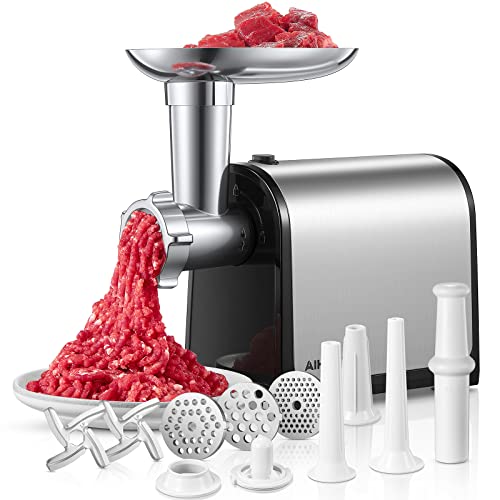
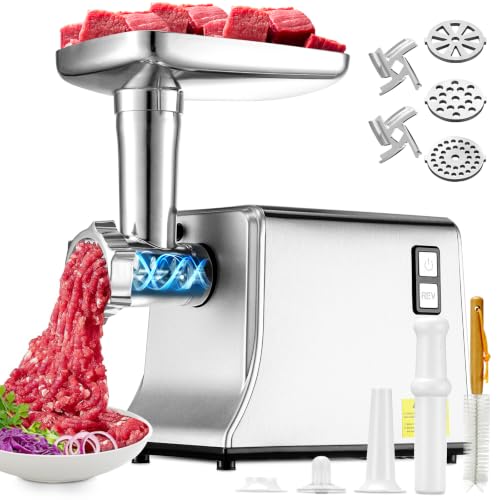
All six grinders in this guide are sold through Amazon, where you can check the current plate set, blade count, and included kits before ordering. The first machine listed, the RVGMBO Electric Meat Grinder, opens the shortlist — Check on Amazon — and the rest follow:
- FOHERE Electric Meat Grinder, #12 Head, 1 HP
- Aiheal Electric Meat Grinder, 3200W Max
- AAOBOSI Electric Meat Grinder with 3-Speed Touch Screen
- AAOBOSI Multifunctional Digital Meat Grinder
- VEVOR Meat Grinder, #12, 750W / 1 HP
Read the full guide ↓ for why falafel makers reach for a meat grinder at all — and which of these six handles soaked chickpeas best.
The best meat grinders for falafel sound like a category error until you have eaten falafel made with one. Falafel’s defining texture — crisp crust, fluffy green-flecked interior, a crumb that is coarse rather than pasty — comes from how the soaked chickpeas are broken down. A food processor, worked a second too long, shears them into hummus’s cousin: smooth, dense, and prone to falling apart or frying up heavy. A meat grinder does something different. It pushes the mixture through a plate in a single, even pass, cutting the chickpeas into uniform granules instead of pureeing them, and that granular texture is precisely what the best falafel shops guard as their secret. The best meat grinders for falafel are the ones that handle the load chickpeas present — and soaked chickpeas are a genuinely demanding load: dense, starchy, and unforgiving of weak drivetrains.
There are rules that make the whole thing work, and they start before the grinder is switched on. Falafel is made from dried chickpeas soaked overnight — never cooked, and never from a can, because canned chickpeas are too wet and too soft to hold the mixture together. The soaked peas are drained thoroughly, combined with onion, garlic, and a generous hand of fresh herbs, and ground — usually twice — so the herbs distribute and the texture sets. The mixture then rests, cold, before shaping and frying. Every stage of that process has implications for the machine: the grind must be even, the motor must not strain and heat the mixture, and the head must wash clean of starchy residue afterwards. Several machines in this guide also ship with kubbe (kibbe) kits — a related bulgur-and-meat mixture with similar grinding mechanics — which tells you something about how naturally this equipment family fits the falafel job. Readers equipping a general-purpose kitchen should also see our Best Meat Grinders For Home Use guide, where these same machines are judged on the family table rather than the falafel pan.
Key Takeaways
- A grinder beats a food processor for falafel because the plate produces even granules instead of paste — texture is the whole game.
- Use dried chickpeas soaked overnight, drained very well; canned or cooked chickpeas will not hold falafel together.
- Soaked chickpeas are a hard, dense load — drivetrain strength and a coarse first pass matter more than top speed.
- Grind twice: a coarse pass to break down, a medium pass to finish, with herbs in from the start so they distribute evenly.
- Auto-reverse (AAOBOSI Digital) is the fastest cure for the chickpea jam, the characteristic stall of this job.
- Rest the ground mixture cold before shaping; the texture sets and the falafel fry up fluffier for it.
In this guide
Quick Picks
| Pick | Badge | Standout detail from the listing | Link |
|---|---|---|---|
| RVGMBO Electric Meat Grinder | Best Spare Cutting Sets | 3500W motor claim, 3 sets of 304 stainless blades and plates | Check on Amazon |
| FOHERE Electric Meat Grinder | Best Raw Power | #12 head, 1 HP, 600W all-copper motor, 8.8 lbs/min maker rating | Check on Amazon |
| Aiheal Electric Meat Grinder | Best Accessory Bundle | 3200W max, 2 blades, 3 plates, 3 sausage tubes | Check on Amazon |
| AAOBOSI 3-Speed Touch Screen Grinder | Best Speed Control | 3000W max, 4 lbs/min maker rating, built-in storage | Check on Amazon |
| AAOBOSI Multifunctional Digital Grinder | Best Overall for Falafel | 3000W max, 9 presets, auto-reverse, kibbe capability listed | Check on Amazon |
| VEVOR #12 Electric Meat Grinder | Best for Serious Batches | 750W / 1 HP, throughput quoted at 552 lbs/h, #12 head | Check on Amazon |
How These Picks Were Chosen
This is a research-led guide: we compared manufacturer listings and specifications for heavy-duty electric grinders and re-filtered them for a job none of them advertises on the box — grinding soaked legumes. That re-filtering changes the ranking criteria. For falafel, the load is dense and dry-ish rather than soft and wet, the enemy is the stall and the overheated, gummy mixture, and the prize is an even granular texture. Peak wattage claims were discounted as usual; what counted was drivetrain evidence, plate range, jam recovery, and the pace figures that predict how a machine behaves across a double batch for a party.
Four filters produced the six. First, plate range: falafel technique is a two-pass method, coarse then medium, so machines with multiple plates — or multiple full cutting sets — led the list. Second, stall recovery: chickpeas pack and jam in a way meat rarely does, so auto-reverse scored as a headline feature rather than a luxury. Third, sustained torque at low speed: the auger must push a resistant, starchy load steadily without racing and heating it, which favoured machines with speed control or continuous-style power ratings. Fourth, cleanup: chickpea starch leaves a stubborn film, so heads that strip fully and wash completely were required. We excluded stand mixer attachments, whose gearboxes face a load their designers aimed at meat, and manual grinders, because a double batch of falafel mixture by hand crank is nobody’s idea of a good afternoon. The same machines serve meat-eating households the rest of the week — several are cross-referenced in our Best Meat Grinders For High Volume At Home guide — but this page judges them strictly as falafel tools.
The 6 Best Meat Grinders for Falafel

RVGMBO Electric Meat Grinder, 3500W, 3 Blade & Plate Sets
Badge: Best Spare Cutting Sets
Strengths
- Three full sets of 304 stainless blades and plates — plate changes for the two-pass falafel method become clean swaps, not wash-ups.
- A dedicated set can live as the falafel-and-kibbe set, keeping legume starch out of your meat grinding.
- Kubbe and sausage kit included, and kubbe mixture is falafel’s close mechanical cousin.
Trade-offs
- The 3500W figure is a peak-style claim; sustained chickpea pace is not separately published.
- No reverse, gear material, or head size is stated in the listing.
- Three sets of parts means a bigger wash after a starchy falafel session.
Mini spec box: Power: 3500W (maker’s “super motor” claim) · Blades and plates: 3 sets, 304 stainless steel · Extras: kubbe and sausage kit · Duty described: home use.
Falafel technique is plate choreography: coarse pass to crack the soaked chickpeas down, medium pass to bring the mixture together with the herbs evenly distributed. On a single-set machine, every plate change mid-recipe means washing starch off the first set before it dries into cement. The RVGMBO’s three complete cutting sets dissolve that friction — fit the coarse set, grind; swap to the medium set, grind again; wash everything once, at the end. It is the only machine in this guide whose bundle is, by itself, a falafel workflow improvement.
The second set discipline it enables matters to mixed households: one set that only ever touches legumes, herbs, and kibbe mixture, kept apart from the meat sets. Starchy residue and meat juices never share steel, flavours stay clean in both directions, and vegetarians in the house get a bright line they can trust. The honest limitations sit elsewhere in the spec sheet: a big peak claim without published drivetrain details, head size, or reverse, so chickpea jams are cleared by hand and the machine’s sustained pace is something you learn across your first batches. For the falafel maker who grinds often and values a frictionless two-pass routine, the cutting-set depth is the deciding feature, and nothing else here matches it.
Best for: frequent falafel makers who want plate swaps without mid-recipe washing / Not suited for: buyers who want published drivetrain specs or reverse.

FOHERE Electric Meat Grinder, #12 Head, 1 HP
Badge: Best Raw Power
Strengths
- A #12 head with throughput quoted at 8.8 lbs/min — party-sized falafel batches stop being an afternoon project.
- 600W all-copper motor with 1 HP positioning gives sustained push for a dense, starchy load.
- Stainless plates with sausage nozzle and kubbe kit included.
Trade-offs
- The biggest machine here; overkill for a couple’s weekly falafel night.
- No reverse is stated, despite the batch focus — jams are manual clear-outs.
- More machine to wash after a mixture that already leaves a stubborn film.
Mini spec box: Motor: 600W all-copper, 1 HP positioning · Peak: 3600W · Head size: #12 · Throughput: 8.8 lbs/min (maker rating) · Plates: stainless · Extras: sausage nozzle, kubbe kit · Duty described: home use.
Chickpeas test a grinder the way gravel tests a bicycle: the load is hard, granular, and relentless. The FOHERE answers with the strongest continuous specification in this guide — a #12 head, an all-copper motor, and a published per-minute throughput. Where smaller machines need coaxing through a double batch, the FOHERE simply maintains pace, and pace matters for falafel beyond convenience: a mixture that moves through quickly spends less time being worked and warmed by friction, and comes out with the dry, granular character that fries into a crisp crust.
Its natural home is the big-batch pattern — the family that fries falafel for a crowd, the home cook who freezes shaped patties for the month, the small caterer working from a home kitchen. Feed it soaked, well-drained chickpeas in a steady stream, alternate handfuls of the herb-and-onion mixture so distribution stays even, and take the two passes at the machine’s stride. The honest limitations are scale and the missing reverse: this is a lot of grinder to wash after a modest batch, and a packed jam still means opening the head. Buyers feeding hunting-season volumes through the same machine will recognise its appeal from our Best Meat Grinders For Venison coverage; for falafel-first buyers with real volume, the FOHERE is the power pick.
Best for: big-batch falafel — parties, freezer prep, small-scale catering / Not suited for: small households or anyone who hates washing large equipment.

Aiheal Electric Meat Grinder, 3200W Max
Badge: Best Accessory Bundle
Strengths
- Two blades and three plates cover the coarse-to-medium falafel progression in one box.
- Three sausage tubes included — the machine’s second career is covered too.
- Stainless steel grinding components suit the aggressive washing starchy residue demands.
Trade-offs
- 3200W is a maximum figure; chickpea pace is set by feeding discipline.
- No reverse is listed, so the characteristic chickpea jam is cleared manually.
- No published throughput or head size for batch planning.
Mini spec box: Power: 3200W max · Blades: 2 · Plates: 3 · Sausage tubes: 3 · Body/components: stainless steel, black finish · Duty described: heavy duty for home kitchen use.
The Aiheal is the sensible falafel starter: everything the two-pass method needs, in the box, at the accessible end of this guide. Three plates mean the coarse cracking pass and the medium finishing pass are both on hand from the first batch, and the second blade matters more for legumes than for meat — chickpea work is abrasive, edges tire, and a spare blade in the drawer converts a declining session into a thirty-second swap. The black-finished stainless build also shrugs off the turmeric-and-herb staining that falafel mixtures leave on lighter machines.
Technique carries this machine, as it does all the mid-list picks: chickpeas soaked overnight and drained until they no longer drip, onion and herbs mixed through before grinding so the auger distributes them, and a feed rate that lets the plate clear rather than pack. The honest limitation is jam handling — without reverse, when a dense wad of mixture stalls the head (and on your first batches, one will), the routine is stop, open, clear, and re-feed looser. Owners who know they will grind falafel weekly often graduate to the auto-reverse AAOBOSI below; owners who fry falafel monthly will find the Aiheal’s bundle everything the job requires.
Best for: falafel beginners and monthly makers who want the full plate range in one purchase / Not suited for: weekly makers who want reverse-assisted jam recovery.

AAOBOSI Electric Meat Grinder with 3-Speed Touch Screen
Badge: Best Speed Control
Strengths
- Three speeds let you run the chickpea load low and torquey — the correct temperament for a dense, starchy mixture.
- Throughput quoted at 4 lbs/min gives batch planning a real number.
- Built-in storage and an easy-cleanup design suit a weekly falafel routine.
Trade-offs
- 3000W max is a peak claim; the quoted pace is for meat, and chickpeas will run slower.
- Touch controls plus floury, herby hands means panel wipes mid-session.
- No reverse is listed; jams are cleared by hand.
Mini spec box: Power: 3000W max · Throughput: 4 lbs/min (maker rating) · Controls: 3-speed touch screen · Storage: built-in · Roles: 3-in-1 sausage, burger, raw pet food · Certification noted: LFGB approved · Cleanup: designed for easy cleanup.
Speed control sounds like a luxury until you grind chickpeas, when it becomes the point. A fast auger races, heats, and smears a starchy mixture; a slow auger pushes with authority and gives the plate time to clear. This AAOBOSI’s three speeds let you find the low, steady gait that falafel wants, then remember it for next week. The quoted throughput, while measured on meat, still anchors expectations better than the silence of most listings — plan your falafel batches at a sensible discount to it and the machine will meet the plan.
The supporting details fit the routine: built-in storage keeps the coarse and medium plates with the machine (the two plates falafel actually uses), and the cleanup-led design matters because chickpea starch, left to dry in a head, sets like grout. Wash promptly and the machine is ready for the sausage and burger work its listing describes — this is a genuinely dual-purpose kitchen tool, also appearing in our Best Meat Grinders For Raw Dog Food coverage for households whose grinding serves the dog as well. The honest limitations are the touch panel’s manners around messy hands and the absence of reverse. For the control-minded falafel maker, though, the speed range is the feature that shapes every batch for the better.
Best for: falafel makers who value a slow, torquey, repeatable grinding pace / Not suited for: buyers who want reverse, or who dislike touch panels.
AAOBOSI Multifunctional Digital Meat Grinder
Badge: Best Overall for Falafel
Strengths
- Auto-reverse answers the chickpea jam — the defining frustration of this job — in seconds.
- Kibbe capability is named in the listing, the closest any of these machines comes to advertising this mixture family.
- Nine presets let a dialled-in falafel setting become a one-touch routine, with built-in storage for the plates.
Trade-offs
- 3000W max is a peak claim, shared with its sibling; the falafel case rests on features, not extra power.
- Electronics-forward design asks for care at the sink after a starchy session.
- Presets serve repeatability; a first-time user still has to find the right setting once.
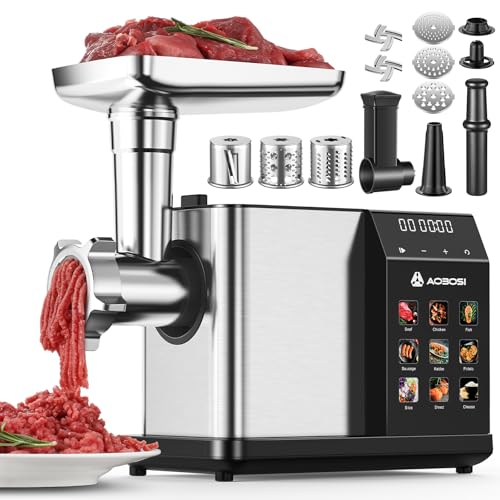
Mini spec box: Power: 3000W max · Controls: digital touch screen, 9 presets · Reverse: auto-reverse · Storage: built-in · Roles: grinding, sausage, kibbe, cheese grating · Duty described: home use.
Every falafel grinder eventually meets the jam: a dense wad of chickpea mixture packs against the plate, the auger loads up, and the session stops. On most machines that means a messy excavation of the head, mid-recipe, with herbs everywhere. This AAOBOSI’s auto-reverse is the only feature in this guide aimed squarely at that moment — back the mixture off the plate, loosen it, re-feed in smaller handfuls, and the batch continues with its texture and your temper intact. For a food whose whole method is two full passes through the machine, jam recovery is not a detail; it is half the ownership experience.
The rest of the specification supports the specialism. Kibbe — the bulgur mixture whose grinding mechanics mirror falafel’s — is named in the listing, which signals a design tested against grain-and-legume loads rather than meat alone. The nine presets turn your discovered falafel settings into a repeatable routine, and built-in storage keeps the two plates the method needs with the machine. The honest limitations are the class ones: peak-only power information, and electronics that want a wipe rather than a soak at cleanup. Weigh everything and this is the falafel pick we would buy first — the machine whose feature set reads like it was specified by someone who has actually stood over a stalled grinder full of chickpeas. Households also processing game can cross-check its meat manners in our Best Meat Grinders For Hunters guide.
Best for: regular falafel makers who want jam-proof, repeatable batches / Not suited for: buyers who prefer purely mechanical controls.

VEVOR Meat Grinder, #12 Electric Meat Mincer, 750W / 1 HP
Badge: Best for Serious Batches
Strengths
- A continuous-style 750W / 1 HP rating with throughput quoted at 552 lbs/h — falafel at catering rhythm.
- The #12 head takes the mixture in generous handfuls, keeping a frying station supplied.
- Positioned for kitchens or restaurants with an ETL listing noted; kibbe kit included.
Trade-offs
- Only two plates included, so the coarse-to-medium progression may need an added plate for finer finishes.
- The largest footprint here alongside the FOHERE — a serious machine for a legume.
- No reverse is listed; at this scale, a jam is rarer but still manual to clear.
Mini spec box: Motor: 750W / 1 HP · Head size: #12 · Throughput: 552 lbs/h (maker rating) · Plates: 2 · Stuffing tubes: 3 · Extras: kibbe kit · Certification noted: ETL listing · Settings: kitchens or restaurants.
The VEVOR is what falafel looks like when it grows up. A small restaurant, a food truck, a community kitchen, or the legendary home cook whose falafel feeds the street — all of them need the mixture produced at a pace that keeps a fryer fed, in a texture that never drifts as the batch grows. A 1 HP motor described in continuous terms, a #12 head, and an hourly throughput figure are the specifications of that world, and the kibbe kit in the box confirms the machine’s fluency in this mixture family.
Working method scales with it: soak chickpeas by the kilo, drain them in colanders until they stop dripping, and grind in two passes with the receiving bowl chilled so the mixture stays fry-ready. The honest limitations are the two-plate bundle — falafel purists chasing a specific fine finish may add a plate — and sheer size for home users making a dozen patties. But judged as the serious-batch falafel machine, the VEVOR has no rival in this six except the FOHERE, and it edges ahead on the strength of its hourly rating and restaurant positioning. If your falafel ambitions are commercial in everything but name, start here.
Best for: catering-scale falafel, community kitchens, and very large family batches / Not suited for: small weekly batches or small kitchens.
Comparison Table
| Grinder | Power as listed | Head | Plates / Blades | Standout for falafel | Link |
|---|---|---|---|---|---|
| RVGMBO | 3500W claim | Not stated | 3 sets / 3 sets | Plate swaps without washing | Check on Amazon |
| FOHERE | 600W copper / 1 HP, 8.8 lbs/min | #12 | Stainless / not stated | Raw batch pace | Check on Amazon |
| Aiheal | 3200W max | Not stated | 3 / 2 | Complete starter bundle | Check on Amazon |
| AAOBOSI Touch | 3000W max, 4 lbs/min | Not stated | Not stated | Low, torquey speed control | Check on Amazon |
| AAOBOSI Digital | 3000W max | Not stated | Not stated | Auto-reverse, kibbe listed | Check on Amazon |
| VEVOR | 750W / 1 HP, 552 lbs/h | #12 | 2 / not stated | Catering rhythm, ETL noted | Check on Amazon |
How to Choose a Meat Grinder for Falafel
Choose by batch size first. A weekly batch for two is a different purchase from a monthly freezer session or a party run. Small batches reward the bundled home machines (Aiheal, the AAOBOSI pair); freezer sessions reward cutting-set depth (RVGMBO); genuine volume rewards the #12 machines (FOHERE, VEVOR). Falafel mixture freezes well shaped, so many households grind bigger and less often than they first expect — buy for that pattern if it sounds like you.
Treat jam recovery as a core feature. Chickpea mixture packs against a plate in a way meat does not, and every falafel maker stalls a head eventually. Auto-reverse converts the stall into a shrug; without it, you are committing to the open-and-clear routine. Honest self-knowledge — how much do interruptions annoy you? — should drive this part of the choice.
Count plates, not watts. The falafel method is two passes through two plates. A machine with three plates, or three full sets, is equipped for the method; a machine with one plate is not, whatever its wattage claims. Peak power figures in this category describe a momentary maximum and predict falafel performance poorly; plate range and drivetrain steadiness predict it well.
Value low-speed torque over top speed. The mixture wants to be pushed, not whipped. Speed control that includes a genuinely low setting, or a continuous-rated motor that pulls steadily, produces the dry granular texture that fries correctly. A fast, light machine tends to smear the starch and heat the mixture — the two texture failures falafel cannot afford.
Plan the wash before the purchase. Chickpea starch dries into a stubborn film, and herb oils stain. Heads that strip completely and wash in a normal sink load are the ones that stay pleasant across years of falafel Fridays; sealed or fiddly designs quietly discourage the thorough cleaning this mixture demands.
How to Make Falafel in a Meat Grinder, Step by Step
Step 1 — Soak, never cook. Cover dried chickpeas in plenty of water and soak overnight until they have swelled and a cut pea shows no hard, chalky core. Do not cook them, and do not reach for canned chickpeas — both produce a mixture that will not hold together in the fryer.
Step 2 — Drain like it matters. Drain the soaked chickpeas thoroughly and let them sit in the colander until they stop dripping. Excess surface water is the most common cause of falafel that slumps and splits; the mixture should be moist, never wet.
Step 3 — Build the mixture. Combine the chickpeas with roughly chopped onion, garlic, and a generous quantity of fresh parsley and coriander, plus your spices and salt. Rough chopping is enough — the grinder does the fine work — but distribute the herbs through the peas now so the auger mixes as it grinds.
Step 4 — First pass, coarse plate. Feed the mixture steadily, in handfuls, letting the auger take each before adding the next. If the head packs and stalls, stop and clear it — or use reverse if your machine offers it — and re-feed looser. Collect the coarse grind in a chilled bowl.
Step 5 — Second pass, medium plate. Pass the mixture again through the medium plate. The texture should emerge as even, moist granules — like coarse wet sand that holds when squeezed. If it feels pasty, the chickpeas were too wet or the plate too fine; if it feels loose and dry, a tablespoon of the soaking liquid worked in by hand can rescue it.
Step 6 — Rest the mixture cold. Cover and refrigerate for at least half an hour. Resting hydrates the starch evenly, firms the mixture for shaping, and noticeably improves the fried texture.
Step 7 — Shape and fry promptly. Shape with damp hands or a scoop, fry in hot oil until deeply golden, and drain on a rack. Freeze any surplus mixture shaped and uncooked, on a tray, then bag — future falafel with no grinder session required.
Step 8 — Wash the head immediately. Starch waits for no one. Strip the head, wash every part in hot soapy water before residue dries, brush the plate holes clear, and dry fully.
Troubleshooting. Problem: falafel fall apart in the oil → the mixture is too wet or too coarse; drain chickpeas longer next time and make sure the second pass went through the medium plate. Problem: the grinder keeps jamming → feed smaller handfuls, check the chickpeas were soaked to the core (a hard centre resists the plate), and use the coarse plate first. Problem: falafel fry up dense and heavy → the mixture was over-worked or too fine; shorten the second pass, keep everything cold, and resist adding flour as a first resort.
Grinder vs. Food Processor: The Texture Argument, Settled
The food processor is the falafel tool most home cooks already own, which is why the grinder needs to justify itself. It does so on mechanism. A processor’s blade chops by impact, thousands of times, and the result depends entirely on the operator’s stopping point — a few pulses too few and the mixture is gravel; a few too many and it is paste. A grinder’s plate is a fixed standard: every granule that emerges has passed through the same holes, so the texture is uniform by construction, and it stays uniform across a double batch and across the months between batches.
That uniformity is not pedantry. Even granules fry at the same rate, bind with the same strength, and give falafel its signature contrast — shattering crust, fluffy middle. The processor remains fine for small, carefully watched batches, and plenty of good falafel has come out of one. But cooks who make falafel often, or in quantity, migrate to the grinder for the same reason professionals use it: the texture stops being a variable. Once you have eaten grinder falafel, processor falafel tastes like a near miss.
Falafel Variations the Grinder Handles
The same two-pass method adapts across the falafel family. Broad bean (fava) falafel, in the Egyptian style, grinds the same way from soaked split beans and rewards the coarse-then-medium progression with an even fluffier interior. Mixed chickpea-and-bean blends split the difference. Herb-heavy green falafel simply increases the herb share in the mixture before grinding — the auger distributes what a knife cannot. Spiced variations, from cumin-forward to chilli-laced, should be seasoned before the second pass so the spices grind through the mixture rather than sitting on its surface.
The method also extends to falafel’s neighbours: kibbe mixtures of bulgur and meat (the kits in several of these machines exist for them), vegetarian kofta blends built on lentils and chickpeas, and even coarse vegetable mixtures for burgers. In each case the principle is identical — a dense, granular mixture that a plate textures better than a blade. Buy the grinder for falafel, and you have quietly bought it for the whole family of foods that think like falafel.
Scaling Falafel for a Crowd Without Losing the Texture
The failure mode of party falafel is not flavour — it is drift. The first dozen patties are perfect; by the fortieth, the mixture has warmed, the texture has tightened, and the frying has become a salvage operation. The grinder is where crowd falafel is won, because a machine that holds its pace keeps the mixture’s temperature and texture constant from the first handful to the last. Grind the whole batch in one session, in two passes, and then hold the finished mixture refrigerated in shallow containers rather than one deep bowl — shallow layers stay cold, and you can fry from a fresh container each round.
Stage the work like a small kitchen line: one person grinding and shaping, one person frying, a tray of shaped patties resting in the fridge between them. Season the whole batch before the second pass so the spices are uniform, but salt with a light hand until a test patty has been fried and tasted — the only honest way to season a large batch. If the crowd is big enough that the mixture must wait, shaped-and-frozen patties made a day ahead are better than mixture held overnight, which darkens and loosens. This is the workflow the #12 machines in this guide were built to serve, and even on the smaller picks, the same discipline — cold, shallow, staged — scales a family recipe to a gathering without quality drift.
One Grinder, Two Diets: Sharing Equipment Between Meat and Falafel
Many households contain both a falafel devotee and a burger traditionalist, and the grinder will be asked to serve both — sometimes a vegetarian will ask that it serve only one. The practical answer starts with the wash: a fully stripped head, hot soapy water, a brush through the plate holes, and complete drying removes residue to any reasonable standard, and it is the routine these machines are designed around. For households that want a brighter line, the cutting set is the natural boundary — a dedicated blade-and-plate set for legume work, stored separately, gives vegetarians a guarantee that does not depend on anyone’s washing diligence. Multi-set bundles like the RVGMBO’s make that arrangement effortless.
Scheduling helps too: grind falafel before meat on a shared day, never after, and store the sets in labelled bags so the boundary survives a busy kitchen. None of this requires two machines. It requires the same thing every section of this guide has required — a routine, followed every time — and it turns one well-chosen grinder into shared infrastructure for the whole household’s way of eating.
Common Buying Mistakes
Buying the grinder before learning the chickpea rule. No machine fixes canned chickpeas. Owners who blame the grinder for collapsing falafel are usually grinding the wrong starting ingredient — dried, soaked, uncooked, every time.
Chasing peak wattage. Falafel performance is torque, plates, and jam recovery. The four-digit wattage on the box predicts none of them reliably.
Skipping the coarse pass. Straight to the medium or fine plate is how heads jam and mixtures smear. Two passes are the method, not a suggestion.
Grinding a wet mixture. Undrained chickpeas produce paste in any machine. The colander time is part of the recipe.
Letting the head sit dirty. Chickpea starch dries into one of the most stubborn films in the kitchen. The wash happens when the frying starts, not after dinner.
Final Recommendation
For most falafel makers, the AAOBOSI Multifunctional Digital Meat Grinder is the first choice: auto-reverse dissolves the chickpea jam, kibbe is in its listed repertoire, and its presets make your perfected setting a routine. If plate changes are your friction, the RVGMBO’s three cutting sets answer it; if volume is your story, the VEVOR and FOHERE #12 machines take falafel to catering scale. Whichever you choose, honour the method — dried chickpeas, soaked overnight, drained well, ground twice, rested cold — and the machine will repay you with falafel the way it is supposed to taste.
A closing thought for the cook deciding whether a “meat” grinder belongs in a falafel kitchen at all: the name on the category is a historical accident. What these machines really are is plate grinders — the oldest, most controllable way to turn firm ingredients into an even granular mixture — and falafel has been made on their ancestors in the Levant for generations. Judge the six above by the falafel criteria in this guide, and the one that fits your batch size and your patience for jams will make the category name irrelevant by the second batch.
Frequently Asked Questions
Why use a meat grinder for falafel instead of a food processor?
Because of texture. A grinder’s plate forces the mixture into uniform granules, while a processor’s blade produces a gradient from gravel to paste that depends on split-second timing. Uniform granules fry evenly, bind reliably, and give falafel its crisp-crust, fluffy-centre character. For occasional small batches a processor is workable; for repeatable falafel, the grinder is the professional’s tool. The difference shows most on the second and third batches: the processor’s results wander with your attention, while the plate produces the same texture every time, which is why cooks who fry falafel weekly eventually stop processing and start grinding.
Can I use canned chickpeas in a grinder for falafel?
No — canned chickpeas are cooked and waterlogged, and the mixture they produce will not bind; the falafel slump and disintegrate in the oil. Falafel requires dried chickpeas soaked overnight and used raw. This is an ingredient rule, not an equipment limitation, and no grinder or processor can work around it.
What plate size is best for falafel?
Use two: the coarse plate for the first pass, to crack the soaked chickpeas down evenly, and the medium plate for the second pass, which sets the final texture. The finished mixture should look like coarse, moist crumbs that hold together when squeezed. Machines with three plates — or the RVGMBO’s three full sets — make this progression effortless.
Why does my grinder jam on chickpeas?
Chickpea mixture is dense and starchy, and it packs against the plate if fed too fast, if the chickpeas were under-soaked (a hard core resists cutting), or if you started on too fine a plate. Feed in small handfuls, start coarse, and keep the mixture cold. A machine with auto-reverse, like the digital AAOBOSI in this guide, recovers from the occasional jam without a teardown.
Can the same grinder be used for meat and falafel?
Yes, with normal hygiene: wash the head thoroughly between uses and dry it fully. Owners who want a stricter separation can dedicate a blade-and-plate set to legume work — easy with multi-set bundles — while the machine itself serves both. Many of these grinders also grind for the family table and, in hunting households, for season’s game; the Best Meat Grinders For Turkey Bones guide shows the poultry end of that shared workload.
How fine should falafel mixture be ground?
Coarser than most beginners expect. The target is distinct granules — visible chickpea particles bound by their own starch — not a smooth puree. If the mixture looks like hummus, it has gone too far or the chickpeas were too wet; it will fry dense. When in doubt, stop the second pass early: you can pass a portion again, but you cannot un-grind a paste.
Can I make falafel from broad beans or other legumes in the same grinder?
Yes — the method transfers directly. Broad bean falafel in the Egyptian style starts from soaked split broad beans and follows the identical two-pass routine, producing an even fluffier interior. Lentil-based mixtures for kofta-style patties also grind well, though very soft legumes need less soaking and a watchful eye on moisture. The constant across all of them is the dried-legume rule: soaked, never cooked, drained thoroughly, and ground coarse first.
Do I need to add flour or breadcrumbs to grinder falafel?
Usually not, if the fundamentals are right. A mixture of properly soaked, well-drained chickpeas ground through two plates binds on its own starch, especially after a cold rest. Flour is a rescue for a mixture that came out too wet — a spoonful worked in by hand — not a standard ingredient. If your falafel repeatedly need flour to hold, audit the draining step and the plate sequence before blaming the recipe.
Can I freeze falafel mixture or shaped falafel?
Both freeze well. Shape the mixture into patties, freeze them solid on a tray, then bag them with the date; they can be fried from frozen with a little extra time, which makes the grinder’s big-batch economics real — one session, many falafel nights. Unshaped mixture also freezes, though shaped patties are more convenient and hold their texture better.