Disclosure: topratedkitchenware.com is reader-supported. When you buy through links on our site, we may earn an affiliate commission from Amazon and other retailers, at no extra cost to you.
Where to buy
All six grinders in this guide are sold through Amazon, where you can verify the current plate set, blade count, and included kits before ordering — important when the machine will be grinding for your dog every week of the year. The first machine listed, the CHEFFANO Meat Grinder, 2800W Max, is a sensible starting point — Check on Amazon — and the rest of the shortlist follows:
- Sinyder Electric Meat Grinder, 3000W Max, Metal Gears
- CHEFFANO Life Electric Meat Grinder, 2000W Max
- LEM Products BigBite #8 Meat Grinder, 0.5 HP
- RVGMBO Electric Meat Grinder, 3500W, 3 Blade & Plate Sets
- FOHERE Electric Meat Grinder, #12 Head, 1 HP
Read the full guide ↓ for how each machine handles the real dog-food workload: meat, organ meat, soft bone, and the weekly batch routine.
The best meat grinders for dog food are chosen by a different rhythm than almost any other grinder in the kitchen. This is not a seasonal tool or a weekend project appliance — it is a weekly workhorse. Whether you cook your dog’s food or prepare it raw, the pattern is the same: a recurring batch session where meat, organ meat, and often soft bone go through the machine together, portioned into containers, and frozen for the week or month ahead. The best meat grinders for dog food therefore win on reliability across hundreds of sessions, on how completely they come apart for the thorough washing raw ingredients demand, and on whether their pace matches the size of your dog — or dogs. A grinder that is perfect for a terrier’s modest weekly batch can be a slow penance for the owner of two large shepherds, and the reverse is true as well.
Dog food grinding also asks things of a machine that human food rarely does. Organ meats — liver above all — are slippery, soft, and prone to smearing if the meat is not cold and the blade is not sharp. Soft poultry bones, a common ingredient for their mineral content, add the shock loading and abrasion that punish gearboxes and dull plates. And because the food is often served raw, hygiene stops being a preference and becomes the point: every food-contact part must separate, wash, and dry completely, every single session. This guide filters six heavy-duty electric grinders through those realities. Owners whose dogs eat a fully raw diet should also read our companion guide to the Best Meat Grinders For Raw Dog Food, which leans harder into bone content and raw-handling routine; this page covers the broader homemade dog food picture, cooked and raw alike.
Key Takeaways
- Dog food grinding is a weekly routine, so durability and complete, easy disassembly for washing matter more than headline power.
- Match the machine to the dog: a #12 head and a throughput figure (FOHERE) suit large dogs and multi-dog homes; standard home grinders suit small dogs fine.
- Organ meats must go through very cold and partially frozen, or they smear instead of grinding.
- Soft poultry bones are grindable in this machine class; weight-bearing bones are not — for any dog, of any size.
- Grind texture matters: most dogs do best with a medium grind, and a two-pass method gives the most even result.
- Multiple blade and plate sets (RVGMBO includes three) let you keep a dedicated set for dog food and a sharp set in reserve.
- Portion and freeze the same day you grind; ground raw ingredients have a short fridge life.
In this guide
Quick Picks
| Pick | Badge | Standout detail from the listing | Link |
|---|---|---|---|
| CHEFFANO Meat Grinder | Best Value for Weekly Batches | 2800W max, ETL approved, 2 blades, 3 plates | Check on Amazon |
| Sinyder Electric Meat Grinder | Best Metal-Gear Build | 3000W max, pure copper motor, metal gears, stainless body | Check on Amazon |
| CHEFFANO Life Electric Meat Grinder | Best for Small Dogs | 2000W max, stainless steel, 2 blades, 3 plates | Check on Amazon |
| LEM Products BigBite #8 | Best Trusted Name | 0.5 HP, #8 head, stainless steel | Check on Amazon |
| RVGMBO Electric Meat Grinder | Best Blade and Plate Sets | 3500W motor claim, 3 sets of 304 stainless blades and plates | Check on Amazon |
| FOHERE Electric Meat Grinder | Best Overall for Batch Prep | #12 head, 1 HP, 600W all-copper motor, throughput quoted at 8.8 lbs/min | Check on Amazon |
How These Picks Were Chosen
This is a research-led guide built from manufacturer listings and specifications, filtered for the dog-food routine rather than for occasional human cooking. Peak wattage numbers were treated with the skepticism they deserve — they describe a momentary maximum — while continuous-style information (horsepower, head size, throughput per minute) and construction details (gear material, motor windings, stainless food paths) carried the ranking.
Four filters decided the six. First, hygiene architecture: dog food, especially raw dog food, demands a head that strips down completely — auger, blade, plates, tray, tubes — with no sealed crevices, so designs built around full disassembly scored highest. Second, drivetrain durability across a weekly cadence: metal gears and copper motors outrank plastic drivetrains when the machine faces hundreds of sessions, some of them bone-in. Third, pace matched to appetite: we included a spread from compact home machines for small dogs to a #12, 1 HP batch machine for large and multi-dog households, because “best” in this category is meaningless without asking how much dog you are feeding. Fourth, plate and blade depth: multiple plates enable the medium textures most dogs eat best, and spare blades matter because organ meat and bone dull edges steadily. We excluded stand mixer attachments (their gearboxes are not weekly-duty) and manual grinders (a weekly hand-crank routine is one most owners abandon by month two). If your interest is really the family table rather than the dog bowl, our Best Meat Grinders For Home Use guide is the better shortlist; this one stays dog-first.
The 6 Best Meat Grinders for Dog Food
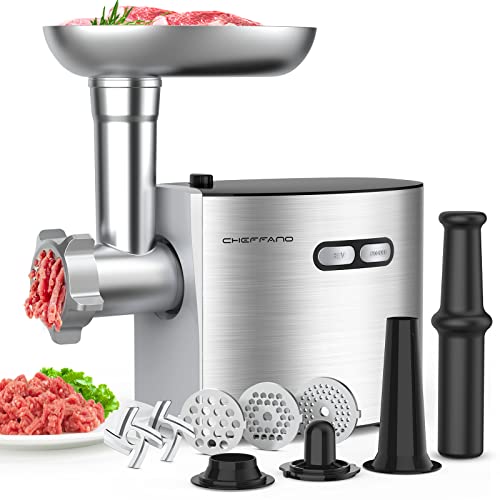
CHEFFANO Meat Grinder, 2800W Max, ETL Approved
Badge: Best Value for Weekly Batches
Strengths
- ETL approval stated in the listing — reassuring for an appliance that will run weekly, near water, for years.
- Two blades and three plates let you keep one set for dog food and still cover fine and coarse textures.
- Sausage stuffer tubes and a kubbe kit mean the machine also serves the human side of the kitchen.
Trade-offs
- 2800W max is a peak figure and the most modest in this six alongside its sibling — big-dog batches take pacing.
- No reverse is listed, so a bone or sinew stall means a manual clear-out.
- No published throughput, so session length is something you learn in the first weeks.
Mini spec box: Power: 2800W max · Certification noted: ETL approved · Blades: 2 · Plates: 3 · Extras: sausage stuffer tubes, kubbe kit · Duty described: heavy duty for home kitchen use.
The CHEFFANO is the dog-food grinder for the owner who wants the weekly routine covered properly without paying for capacity their dog will never eat. Its three plates span the textures dog food actually uses — coarse for a chunky cooked mince, medium for the everyday grind, fine when a recipe or a small dog asks for it — and the spare blade is a quiet blessing in a category where organ meat and soft bone steadily dull the working edge. When the dog-food blade starts to tear rather than cut, you swap in the sharp one and keep the session moving.
Day to day, it asks for the standard disciplines and rewards them: ingredients cubed and chilled until firm, liver and other soft organs fed partially frozen so they shear instead of smearing, and a steady feed rather than a packed tube. The honest limitation is scale. For one medium dog, a weekly session is a comfortable twenty minutes of work; for two large dogs eating a bone-in raw mix, you will feel the absence of a throughput rating and a bigger head, and the FOHERE at the end of this list is the machine built for that house. As the value anchor of the guide — real approval mark, full plate set, honest heavy-duty positioning — the CHEFFANO is where most dog owners should start their comparison.
Best for: owners of one small-to-medium dog grinding a weekly cooked or raw batch / Not suited for: multi-dog households grinding large bone-in volumes.

Sinyder Electric Meat Grinder, 3000W Max, Stainless Steel
Badge: Best Metal-Gear Build
Strengths
- Metal gears stated in the listing — the drivetrain choice that survives years of weekly, sometimes bone-in, sessions.
- Pure copper motor and stainless steel body suit a wash-every-session routine.
- Two blades and three plates included, with sausage stuffer tubes and a kubbe kit.
Trade-offs
- No throughput figure is published, so big-batch pace is unproven on paper.
- No reverse is listed; stalls are cleared by opening the head.
- Stainless construction typically means more weight to lift in and out of storage weekly.
Mini spec box: Power: 3000W max · Motor: pure copper · Gears: metal · Body: stainless steel · Blades: 2 · Plates: 3 · Extras: sausage stuffer tubes, kubbe kit.
Weekly grinding is a war of attrition, and the Sinyder is specified for attrition. The failure that ends most hard-working home grinders is not a burnt motor — it is a gearbox worn or stripped by thousands of small shocks, exactly the load profile of poultry frames and frozen organ meat arriving week after week. A listing that states metal gears and a pure copper motor is speaking directly to that failure, and the stainless body completes the thought: this is a machine meant to be washed aggressively, dried, and put back to work, indefinitely.
In the routine itself, the Sinyder behaves like the other full-size home machines here — cold ingredients, steady feeding, coarse-to-medium two-pass work when bone is in the mix. Where it earns its badge is the calendar: month six, month eighteen, when the novelty is gone and the dog still needs feeding. Owners who also process game trim into dog food will find crossover value here, and our Best Meat Grinders For Hunters guide covers that dual-use pattern from the hunting side. The honest limitations are the missing numbers — no throughput, no reverse — so you are buying construction and trusting it, rather than buying a published pace. For the owner whose first question is “what will still be grinding in five years,” that trade is the right one.
Best for: long-haul owners grinding weekly, including soft bone, who prioritise drivetrain durability / Not suited for: buyers who want a published throughput or reverse-assisted jam clearing.

CHEFFANO Life Electric Meat Grinder, 2000W Max
Badge: Best for Small Dogs
Strengths
- The most accessible package in this six, in stainless steel, sized for modest weekly batches.
- Two blades and three plates included — the full texture range a small dog’s food needs.
- Sausage tube and kubbe kit keep it useful for the household’s own cooking too.
Trade-offs
- 2000W max is the gentlest power claim here; bone-in mixes should be small and well chilled.
- No reverse and no published throughput.
- The household that adopts a second, larger dog will outgrow it first among these six.
Mini spec box: Power: 2000W max · Construction: stainless steel · Blades: 2 · Plates: 3 · Extras: sausage tube, kubbe kit · Duty described: heavy duty for home use.
Small dogs eat small batches, and there is no virtue in buying a #12 head to grind a few pounds a week. The CHEFFANO Life is the proportionate answer: a stainless home grinder with the same sensible accessory logic as the bigger machines — spare blade, three plates, stuffer tube — in a package sized and priced for the owner of a terrier, a toy breed, or a single cat-fed household that also grinds. Its weekly session is short, its cleanup is the same full strip-down the routine demands, and it stores without dominating a cupboard.
The technique bargain is the strictest in this guide, and it deserves plain words: keep pieces small, keep everything properly cold, let the machine rest if a bone-in batch runs long, and never pack the feed tube to “finish faster” — with the gentlest motor claim here, forcing is how sessions go wrong. Fed with that discipline, it handles the soft end of the dog-food repertoire — boneless meats, organs, and modest amounts of soft poultry bone — perfectly well. The honest limitation is headroom, stated earlier and worth repeating: this is the first machine in the six that a growing household outgrows. Buy it for the dog you have, and it is the right-sized, right-priced tool.
Best for: owners of small dogs or cats grinding modest weekly batches / Not suited for: large or multiple dogs, or heavy bone-in volumes.

LEM Products BigBite #8 Meat Grinder, 0.5 HP
Badge: Best Trusted Name
Strengths
- An honest 0.5 HP rating from a brand built on meat processing, instead of a four-digit peak claim.
- The #8 head is a proven middle size — enough for a large dog’s weekly batch without commercial bulk.
- Stainless steel construction designed around grinding and sausage stuffing as one workflow.
Trade-offs
- The pool listing does not enumerate the included plates and blades, so confirm the set before ordering.
- No electronic conveniences — no presets, no built-in storage, no touch controls.
- Half a horsepower is a truthful but moderate rating; the biggest raw batches belong to the FOHERE.
Mini spec box: Motor: 0.5 HP · Head size: #8 · Construction: stainless steel · Roles: grinding and sausage stuffing · Duty described: home use, heavy-duty positioning.
There is a type of buyer who has been burned by anonymous appliances and now shops by reputation, and for that buyer the LEM BigBite #8 is the dog-food pick. LEM’s name was made in game processing, where grinders are judged over seasons, and the BigBite line carries that DNA: a horsepower rating instead of a marketing wattage, a #8 head sized for real batches, and stainless construction throughout the food path. In dog-food terms, that translates to a machine that takes the weekly routine seriously — meat, organs, and soft bone in sensible pieces, ground at a steady, unflustered pace.
The #8 size deserves a word, because it is the sweet spot many large-dog owners land on after owning something smaller. It swallows bigger pieces than compact home heads, so prep is faster, yet it still strips down and washes like a kitchen appliance rather than a piece of shop equipment. The honest limitations are the unknowns and the ceiling: check the listing for the exact plate and accessory set included, and recognise that 0.5 HP, honestly rated, will not match a 1 HP #12 machine when the batch is a month’s food for two giant breeds. Households that also grind falafel mixtures and other non-meat loads can see how these machines cross over in our Best Meat Grinders For Falafel guide. For the reputation-first buyer feeding one large dog, the BigBite is the calm, proven choice.
Best for: owners of one large dog who buy on brand track record and honest ratings / Not suited for: the very largest multi-dog batches, or feature-seekers.

RVGMBO Electric Meat Grinder, 3500W, 3 Blade & Plate Sets
Badge: Best Blade and Plate Sets
Strengths
- Three full sets of 304 stainless steel blades and plates — the deepest cutting-gear bundle in this guide.
- Multiple sets let you dedicate one to dog food, keep one sharp in reserve, and never grind with a dull edge mid-session.
- Kubbe and sausage kit included, covering the household’s other grinding.
Trade-offs
- The 3500W figure is a peak-style claim (“super motor”) — treat sustained pace as unproven until the accessory set carries the day.
- No gear material, reverse function, or throughput is stated in the listing.
- Three sets of parts means three sets to wash, dry, and store after bone-in sessions.
Mini spec box: Power: 3500W (maker’s “super motor” claim) · Blades and plates: 3 sets, 304 stainless steel · Extras: kubbe and sausage kit · Duty described: home use.
The RVGMBO’s argument is written in steel: three complete sets of blades and plates in 304 stainless. Anyone who grinds dog food weekly understands why that matters. Blades dull — bone and organ work see to that — and the session where the grind turns to smear is usually a blade problem wearing a motor problem’s clothes. With three sets, the fix is a thirty-second swap, the dull set goes for sharpening or replacement in its own time, and the dog’s food is never hostage to a worn edge. The sets also enable the hygienic pattern raw feeders like: one set that only ever touches dog food, kept and washed as its own kit.
Beyond the cutting gear, the listing is quieter — no gear material, no reverse, no throughput — and the honest review says so. You are buying the strongest accessory proposition in this six and a large peak-power claim, on a machine whose long-term drivetrain story is unwritten in its own listing. For many dog owners that is still the right trade, because the parts that wear are the parts this machine multiplies. If your household’s volume is the dominant problem rather than wear, compare the FOHERE below, whose #12 head and stated throughput attack the other bottleneck; owners running genuinely big weekly volumes should also scan our Best Meat Grinders For High Volume At Home shortlist. As the wear-and-spares pick, the RVGMBO is genuinely distinctive.
Best for: weekly grinders tired of dull-blade sessions, and raw feeders who want a dedicated dog-food cutting set / Not suited for: buyers who want published drivetrain or throughput specifications.

FOHERE Electric Meat Grinder, #12 Head, 1 HP
Badge: Best Overall for Batch Prep
Strengths
- The only #12 head in this six, with throughput quoted at 8.8 lbs/min — batch sessions measured in minutes, not hours.
- A dual power story: 600W all-copper motor with 1 HP positioning and a 3600W peak figure.
- Stainless plates, sausage nozzle, and kubbe kit included for the full dog-food and household workflow.
Trade-offs
- The biggest machine here — counter space, storage, and washing-up all scale with it.
- Its capacity is more than a small dog’s weekly batch will ever need.
- No reverse function is stated in the listing despite the batch focus.
Mini spec box: Motor: 600W all-copper, 1 HP positioning · Peak: 3600W · Head size: #12 · Throughput: 8.8 lbs/min (maker rating) · Plates: stainless · Extras: sausage nozzle, kubbe kit · Duty described: home use.
The FOHERE is the answer to the dog-food problem nobody warns you about: success. You start with one dog and a modest grinder, the routine works, a second dog arrives, the batches double, and suddenly Sunday prep is an hour of feeding a small machine in shifts. A #12 head with throughput quoted at 8.8 lbs/min collapses that session. Bigger pieces go in, the all-copper motor holds its pace through meat, organ, and soft-bone mixes, and a month’s food for a large dog becomes a single efficient run followed by one wash-up instead of four.
The specification is unusually complete for this category — continuous motor figure, peak figure, head size, and a per-minute throughput — which makes planning a batch day straightforward. Technique still applies: everything cold, bone in small pieces through a coarse plate first, organs partially frozen so they cut cleanly. The honest limitations are size and surplus: this is a lot of machine to wash after a two-pound batch for a toy breed, and households at that scale should take the CHEFFANO Life instead. But for the multi-dog home, the raw-feeding household, or anyone whose prep day has quietly become a chore, the FOHERE is the best overall dog-food grinder in this guide — the one that gives you your Sundays back.
Best for: large dogs, multi-dog homes, and monthly bulk prep / Not suited for: small dogs and small kitchens.
Comparison Table
| Grinder | Power as listed | Head | Plates / Blades | Standout for dog food | Link |
|---|---|---|---|---|---|
| CHEFFANO | 2800W max, ETL | Not stated | 3 / 2 | Value with approval mark | Check on Amazon |
| Sinyder | 3000W max | Not stated | 3 / 2 | Metal gears, copper motor | Check on Amazon |
| CHEFFANO Life | 2000W max | Not stated | 3 / 2 | Right-sized for small dogs | Check on Amazon |
| LEM BigBite | 0.5 HP | #8 | Not stated | Brand pedigree, honest rating | Check on Amazon |
| RVGMBO | 3500W claim | Not stated | 3 sets / 3 sets | Deepest spares bundle | Check on Amazon |
| FOHERE | 600W copper / 1 HP, 8.8 lbs/min | #12 | Stainless / not stated | Batch throughput | Check on Amazon |
How to Choose a Meat Grinder for Dog Food
Start with the dog, honestly measured. Weekly food volume is the master variable. A small dog might eat its way through a few pounds of grind a week; a large, active dog can multiply that several times over, and a multi-dog home multiplies it again. Write down your real weekly pounds, including bone and organ fractions, and let that number choose the size class: compact home grinder for the small end, #8 for the middle, #12 with a throughput figure for the top end.
Interrogate the wash-up. You will disassemble this machine after every session for years. Before buying, picture the strip-down: does the head come fully apart, are the plates and blade easy to handle with wet hands, is there anywhere residue can hide? A grinder that is five minutes faster to wash will save you hours across a year of weekly sessions — and a grinder that is miserable to wash is a grinder whose hygiene quietly slips.
Weight the drivetrain for a weekly cadence. Occasional-use grinders can survive plastic gearing; weekly bone-in grinding is a different contract. Metal gears and copper motor windings, where a listing states them, are the durability signals that match this routine. Where they are not stated, a deep bundle of spare blades and plates — the parts that definitely wear — is the next-best insurance.
Plan plates around texture. Most dogs thrive on a medium grind; puppies, seniors, and small breeds may need finer; chunky cooked mixes use coarse. A three-plate set covers the whole map. If your recipe includes soft bone, reserve the coarsest plate and one blade as the bone set, and grind bone first, meat second, organs last and coldest.
Remember the machine’s second job. A dog-food grinder in most homes also grinds for people — burgers, sausage, the occasional Best Meat Grinders For Elk season overflow at a friend’s house is too much to ask, but weeknight family grinding is not. Every pick here includes sausage capability, which keeps the machine earning its place on both sides of the kitchen.
How to Grind Dog Food, Step by Step
Step 1 — Build the batch on paper first. Decide the week’s recipe — meat, organ share, bone share if your dog’s diet includes it, and any vegetables or supplements your veterinarian has approved — and weigh the components before anything is cut. The grinder executes the recipe; it does not design it.
Step 2 — Cut and chill everything. Cube meats and organs to feed-tube size and chill until firm; freeze organ meats partially, because liver at room temperature smears through a plate instead of grinding. Keep soft bones, if used, in small pieces and equally cold.
Step 3 — Grind in the right order. Bone fraction first, through the coarse plate, while the machine is coldest. Meat second. Organs last, straight from their partial freeze, so they cut cleanly and mix through the batch rather than coating the head.
Step 4 — Second pass for texture. For a medium, even finished grind, mix the batch gently and pass it once more through the medium plate. Cooked-diet owners who prefer a chunkier result can skip this pass for part of the batch.
Step 5 — Portion immediately. Pack into daily or per-meal containers, flatten freezer bags for fast freezing, label with the date and recipe, and freeze the same day. Ground raw ingredients should spend as little time in the fridge as your schedule allows.
Step 6 — Wash like a professional. Strip the head completely, wash every food-contact part in hot soapy water, brush plate holes clear, rinse, and dry fully before reassembly. Raw meat and organ residue is never a “soak it tomorrow” load.
Troubleshooting. Problem: the grind comes out pasty and grey → ingredients were too warm or the blade is dull; re-chill, and swap in a sharp blade set. Problem: liver coats everything and will not feed → it thawed too far; return it to the freezer until firm and feed it in smaller pieces, alternating with meat. Problem: the machine strains on the bone fraction → pieces are too large or the plate too fine for a first pass; cut smaller and start coarse.
Food Safety Rules for Home-Ground Dog Food
Grinding at home puts you in charge of a small raw-food operation, and it should run like one. Work with cold ingredients and a cold room where you can; grind, portion, and freeze in one continuous session rather than leaving ground meat standing. Keep the dog-food workflow separate in time from family food preparation, and wash boards, knives, bowls, and the grinder’s food-contact parts thoroughly between the two — many owners keep a dedicated set of boards and containers for pet food, and the RVGMBO’s spare cutting sets make the same pattern easy at the grinder itself.
Thawing deserves the same discipline: thaw portions in the refrigerator, use them promptly, and never refreeze a thawed raw portion. Dogs are robust, but they are not immune to the bacterial loads that careless handling grows, and the humans handling the food are part of the exposure chain too. None of this is complicated; it is simply the routine, done every time, that makes home grinding a safe way to feed a dog.
Cooked vs. Raw: How the Diet Changes the Grind
The grinder does not care whether dinner will be cooked, but the diet changes the details around it. Cooked-diet households grind for texture and mixing: the goal is an even mince where organ meat disappears into muscle meat, so a picky dog cannot eat around the nutritious parts. A medium two-pass grind is the workhorse texture, and the batch is often ground, cooked in bulk, and then portioned — which means the grinder session and the cooking session are one event, and a machine that washes up fast keeps the whole project pleasant.
Raw-diet households grind for composition as much as texture. Bone enters the recipe, which moves the coarse plate and a dedicated blade set to the centre of the routine, and the two-pass method becomes a safety technique as much as a texture one: the finished grind must contain no sharp fragments, which is achieved by small pieces, a coarse first pass, and a finer second pass rather than by hoping. Raw feeding also raises the hygiene stakes described in the safety section above — the food will not be cooked, so the cleanliness of the head, plates, and your hands is the only kill step there is. Owners moving from cooked to raw should read the Best Meat Grinders For Elk guide’s treatment of large-batch discipline as well if they plan to buy whole animals or bulk cases; the batch habits transfer directly.
Both diets benefit from the same prep-day pattern: one grinding session, immediate portioning, flat freezing, honest labelling. Whether the food meets a pan or goes straight to the bowl, the grinder’s contribution is identical — consistent texture, even mixing, and ingredients you chose yourself, at a pace your household can sustain every week of the dog’s life.
Buying Ingredients for the Grinder: What to Ask For
A dog-food grinder is only as good as its supply line, and a little shopping strategy makes the routine cheaper in effort even where we make no claims about money. Buy in the batch size you grind: whole muscles and bulk packs portion and freeze better than small retail cuts, and they cube more quickly at prep time. Ask the butcher counter what trim, hearts, and organ meats they can set aside — organs are the ingredient home grinders most often struggle to source consistently, and a standing arrangement beats a weekly hunt.
Rotate proteins across batches rather than grinding one meat forever, unless your veterinarian has directed otherwise; variety across the month is simpler than variety inside every batch, and the grinder handles rotation naturally since each session is its own recipe. Keep a simple log — date, recipe, batch size, how the dog did on it — in the freezer door. Within a few months the log becomes your household’s real expertise, worth more than any generic recipe, and it tells you exactly how many pounds your grinder actually processes, which is the number that should drive any future upgrade.
Signs Your Grinder Is Struggling — and What Each One Means
A weekly grinder talks to you, and learning its language prevents small problems from becoming dead machines. A rising motor note with slowing output usually means the load is winning: pieces too big, a plate too fine for a first pass, or meat fed faster than the auger can clear. Stop, let the head clear, and restart with smaller pieces rather than pushing through — motors die from being forced, not from being used.
Output that turns warm, grey, or pasty despite cold ingredients points at the cutting pair, not the motor. A dull blade tears and squeezes instead of slicing, and the friction shows up as heat and smear. Swap or sharpen the blade and plate as a pair, and note how many bone-in sessions the set has done — that count, kept in your batch log, predicts the next swap before quality drops. A new grinding noise — clicking, grinding, or a rhythmic knock — is a stop-now signal: unplug, open the head, and look for a bone fragment, a loose retaining ring, or a plate seated crookedly before running the machine again.
Finally, respect heat at the motor housing. Warm is normal in a long session; hot to the touch means the machine needs a rest, and batching the work — grind a bowl, portion a bowl — gives natural pauses. Owners who build those pauses into the routine, rather than treating the grinder as a continuous-duty mill, are the ones whose machines are still on the counter in year five.
Common Buying Mistakes
Buying for the puppy. A grinder sized for a ten-pound puppy meets a seventy-pound adult within the year. Buy for the adult dog you are actually getting, or accept that the first machine is a starter.
Ignoring the wash-up. Owners compare wattage and forget they will strip and wash this machine weekly for a decade. Disassembly design is a top-three feature in this category, not a footnote.
Grinding organs warm. The smeared, frustrating organ session is almost always a temperature failure. Partially frozen liver grinds; room-temperature liver paints.
Assuming any bone is fine. Soft poultry bone in small pieces is the grindable category. Weight-bearing bones from large animals will damage these machines and do not belong in the feed tube, whatever the dog’s size.
Skipping the spare blade. A dull blade turns grinding into smearing and gets misdiagnosed as a weak motor. Bundles with spare blades — or a spare bought on day one — prevent the most common dog-food grinder complaint.
Final Recommendation
For most dog owners, the FOHERE #12 Electric Meat Grinder is the first choice if your batches are large, and the CHEFFANO is the first choice if they are modest — between them they cover the realistic range of dog sizes. If wear is your worry, the Sinyder’s metal gears and copper motor make the durability argument, and if dull blades are your recurring frustration, the RVGMBO’s three cutting sets answer it directly. Match the machine to the dog, keep everything cold, wash everything every time, and the weekly routine becomes the easiest part of feeding your dog well.
One last piece of batch-day wisdom: grind at the same time each week if you can. A fixed routine — same day, same order of operations, same wash-up — is what turns a project into a habit, and habits are what a dog’s whole feeding life is built on. The owners who are still happily grinding in year three are rarely the ones with the most powerful machine; they are the ones whose routine fits their week so well that skipping it feels stranger than doing it. Choose the grinder that fits that routine, and the rest of this guide is just technique.
Frequently Asked Questions
Can I grind raw meat and bones for my dog in a home grinder?
Yes, with the right categories: boneless meats, organ meats, and soft poultry bones in small, well-chilled pieces are the established home-grinding repertoire, and every machine in this guide is specified for that class of work. Weight-bearing bones from large animals are not grindable at home. Follow your veterinarian’s guidance on the diet itself; this guide covers the equipment.
What grind texture is best for dog food?
A medium grind suits most dogs: fine enough to eat and digest comfortably, coarse enough to feel like food. Puppies, seniors, and very small breeds often do better finer, which a two-pass method — coarse, then fine — produces evenly. Chunkier coarse grinds work well for cooked diets where the mince will be broken up in the pan anyway.
Why does liver smear instead of grinding?
Liver is soft and slippery, and at room temperature it extrudes and coats rather than cutting. Chill it until partially frozen and firm, feed it in small pieces, and alternate with firmer meat so the auger keeps traction. A sharp blade matters more for organs than for any other ingredient.
How often should I replace or sharpen the blade?
There is no fixed calendar — the signal is performance. When output slows, texture turns smeared despite cold ingredients, or the machine works audibly harder, the blade-and-plate pair needs attention. Weekly bone-in grinding dulls edges faster than boneless work, which is why bundles with spare sets, like the RVGMBO’s three, are so practical in this category.
Is a #12 grinder overkill for one dog?
For one small or medium dog, yes — a compact or #8 machine matches the batch better and washes faster. For one large dog, or any multi-dog home, a #12 with a real throughput figure turns prep day from a shift into a task. Buy against your weekly pounds, not against the biggest machine you can afford.
How long does home-ground dog food keep?
Frozen portions keep well for extended storage when packed airtight and frozen promptly; refrigerated raw ground food should be used quickly — within a day or two — because grinding multiplies the surface area bacteria can colonise. Portion so that each container is one or two days of food, thaw in the fridge, and never refreeze thawed raw portions.
Should the grinder be used only for dog food, or can the family share it?
Sharing is normal and safe when the hygiene routine is followed: strip the head, wash every food-contact part thoroughly, and dry fully between uses, and the machine that ground the dog’s batch on Sunday can grind the family’s burgers on Friday. Owners who prefer a bright line can dedicate a blade-and-plate set to dog food — bundles with spare or multiple sets make that easy — while the machine itself serves both.
Can I cook the food I grind, or is grinding only for raw diets?
Grinding suits both. Many owners grind a meat-and-organ mix, then cook it gently before portioning — the grinder’s job is texture and even mixing, and it performs that job identically for cooked-diet households. The hygiene routine is the same either way, since the ingredients are raw when they meet the machine.