Disclosure: topratedkitchenware.com is reader-supported. When you buy through links on our site, we may earn an affiliate commission from Amazon and other retailers, at no extra cost to you.
Where to buy
This guide to the best features of bread making machines is organised differently from a normal roundup: the features come first, and the machines are the evidence. Each of the six verified models below is linked, and each is reviewed through the features its own listing states — programs, timers, dispensers, paddles, heaters, and loaf and crust controls — so you can see which features exist, which machines carry them, and which ones deserve your money.
- Cuisinart Compact Automatic Bread Maker, CBK-110 — 12 programs, 3 loaf sizes, 3 crust shades, paddle-removal alert; check the latest price on Amazon
- Zojirushi Home Bakery Maestro, BB-SSC10WZ — the premium minimalist of the pool; check the latest price on Amazon
- Zojirushi Home Bakery Supreme Bundle, BB-CEC20 — Home Made menus, sourdough, dual kneading blades; check the latest price on Amazon
- Neretva 15-in-1 Bread Maker — dual heaters, automatic nut dispenser, full touch panel; check the latest price on Amazon
- KITCHENARM 29-in-1 Smart Bread Machine — 29 programs, homemade cycle, three loaf sizes; check the latest price on Amazon
- Breville Custom Loaf Bread Maker, BBM800XL — collapsible paddle, custom crust settings, automatic dispenser; check the latest price on Amazon
Read the full guide ↓
People searching for the best features of bread making machines are usually asking a smarter question than “which machine should I buy?” They are asking what a bread machine can actually do — which features change the loaf, which change the routine, and which are decoration. That is the right order to shop in, because machines come and go but the feature list is the vocabulary every listing speaks. Learn the vocabulary and you can read any product page in the category with a critic’s eye. This guide teaches that vocabulary through six verified machines whose listings, between them, state nearly every feature worth knowing: multi-size loaf control, crust shades, delay timers, quick-bake modes, gluten-free and whole-wheat programs, homemade cycles, automatic dispensers, collapsible paddles, dual heaters, and keep-warm functions. If you want the brand-by-brand view afterwards, Best Hamilton Beach Bread Machines and our other brand guides apply the same feature lens to single makers.
A warning before the tour: feature counts are the most abused number in this category. A machine can list dozens of programs that differ only in timing, while a quieter machine with twelve well-chosen programs, three loaf sizes, and three crust shades gives you more real control. Throughout this guide, features are judged by what they change — the loaf, the schedule, or the labour — never by how long the list looks. Hold every listing you ever read to that standard and you will rarely be fooled.
It also helps to know where features come from. Nearly every one began as an answer to a complaint. Bakers complained about pale tops, and heaters multiplied. They complained about the paddle’s hole, and alerts and collapsible paddles appeared. They complained that fruit loaves tasted of dust, and dispensers were born. They complained that one loaf size fit nobody, and multi-size pans followed. Reading a feature list as a history of complaints is a surprisingly practical skill: it tells you which features answer problems you share, and which answer problems belonging to bakers whose lives look nothing like yours. The seeded-loaf family and the white-loaf bachelor do not need the same machine, and the feature list, read this way, says so plainly.
Key Takeaways
- The features that change the loaf are loaf-size selection, crust shade control, program fit for your flour, and kneading hardware; start your comparison there.
- The features that change the routine are the delay timer, quick-bake mode, keep-warm, and paddle solutions such as a removal alert or a collapsible paddle.
- Automatic fruit and nut dispensers, stated on the Neretva and the Breville here, remove the one moment of babysitting that add-in loaves demand.
- Dual heaters, stated on the Neretva, address the pale-top problem by baking from above as well as below.
- A homemade or custom cycle is the deepest feature in the category: the KITCHENARM states a homemade cycle, the Zojirushi bundle states Home Made menus, and the Breville states custom crust settings with full control as its pitch.
- One machine in this pool, the Zojirushi Maestro, states almost no features in its title — a reminder to read listings for stated evidence, not brand aura.
- Features cluster into three families — loaf-changing, routine-changing, and labour-changing — and a good shortlist has your needed family covered first.
- The five-minute listing drill in this guide — sizes, flour-matched programs, crust control, routine features, labour features — compares any two machines on stated evidence alone.
In this guide
Quick Picks
| Pick | Badge | Signature stated features | Best for |
|---|---|---|---|
| Cuisinart Compact CBK-110 | Best Feature Balance | 12 programs, 3 loaf sizes, 3 crust shades, paddle alert | Most homes, most loaves |
| Zojirushi Maestro BB-SSC10WZ | Best Premium Minimalist | Premium white finish; features sparsely stated | Brand loyalists who verify the full list |
| Zojirushi BB-CEC20 Bundle | Best Menu Depth | Home Made menus, sourdough, jam, dual blades | Experimenters and sourdough bakers |
| Neretva 15-in-1 | Best Automation Features | Dual heaters, auto nut dispenser, touch panel, keep warm | Hands-off variety baking at family scale |
| KITCHENARM 29-in-1 Smart | Best Program Library | 29 programs, homemade cycle, gluten-free, 3 loaf sizes | Bakers who want every option in one machine |
| Breville Custom Loaf BBM800XL | Best Feature Flagship | Collapsible paddle, custom crust, auto dispenser | Control-focused bakers who hate paddle holes |
How These Picks Were Chosen
The six machines here are the verified pool for this keyword, checked against Amazon listing data on 2026-11-20, and all six are linked because the keyword asks about the features of bread machines as a class — every pool machine is a genuine bread machine whose stated features (or, in one case, stated lack of them) teach part of the lesson. The reviews quote only what each title states. Where a listing is rich, the review is rich; where a listing is nearly silent, the review says so and treats the silence itself as information. That honesty matters more in a features guide than anywhere: a roundup about features that invented features would be worthless.
Features are grouped in this guide by the job they do. Loaf-changing features: programs matched to flour types, loaf sizes, crust shades, kneading blades, heaters, and custom cycles. Routine-changing features: delay timers, quick-bake, keep-warm, and displays and panels. Labour-changing features: dispensers that add ingredients for you, paddles that remove or collapse so the loaf comes out whole, and pan materials that clean easily. As you read the reviews, keep asking which group a feature belongs to and whether your baking actually needs it — that question, repeated, is the whole skill this page exists to teach. For the size-first version of the same conversation, see Best Compact Bread Machines.
The 6 Best Features of Bread Making Machines, Shown Through 6 Machines
Each review below leads with the features its listing states, then weighs them honestly — what they change, what they cost in complexity, and who should care.

Cuisinart Compact Automatic Bread Maker, CBK-110
Badge: Best Feature Balance
Strengths
- Twelve programs with three loaf sizes and three crust shades — control where bakers actually use it.
- A paddle-removal alert is stated, a small feature that fixes a daily annoyance.
- A 13-hour delay start covers the overnight routine completely.
Trade-offs
- No automatic dispenser is stated, so add-ins wait for your signal and your presence.
- No homemade cycle is stated; customisation is settings-level, not cycle-building.
- A compact body means its largest loaf still serves a modest table.
Mini spec box: Model CBK-110NAS; 12 programs; loaf sizes 1, 1.5, and 2 Lb; 3 crust shades; 13-hour delay start; paddle-removal alert.
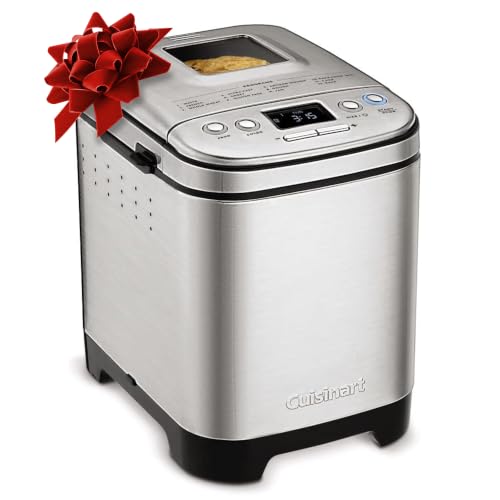
The Cuisinart is the features curriculum in one machine. Loaf sizes teach flexibility: one machine serves a couple on Tuesday and a family on Saturday. Crust shades teach finishing: the same recipe becomes a soft sandwich loaf or a deep-gold toast loaf at a button’s whim. The paddle-removal alert teaches the value of labour features — the machine beeps, you lift the paddle out, and the finished loaf has an intact base instead of the classic torn hole. None of these features is exotic. Together they are the set that most bakers use most weeks, which is why this machine anchors the guide: master its feature list and you understand eighty percent of the category. You can Check on Amazon for its current listing.
Best for: most households, as the balanced feature set to beat / Not suited for: bakers who want a dispenser or a build-your-own cycle

Zojirushi Home Bakery Maestro, BB-SSC10WZ
Badge: Best Premium Minimalist
Strengths
- A premium-tier Zojirushi, the brand whose baking quality benchmarks this category.
- A clean premium white finish for kitchens where the machine lives on display.
- The Home Bakery line’s reputation for even, reliable baking stands behind it.
Trade-offs
- Its verified title states no programs, no loaf size, no timer — the sparsest listing in this pool.
- A features shopper must open the full listing to learn what the machine actually does.
- Premium positioning without stated features asks trust where other listings give evidence.
Mini spec box: Model BB-SSC10WZ; line: Home Bakery Maestro; colour: premium white; features not stated in the verified title.
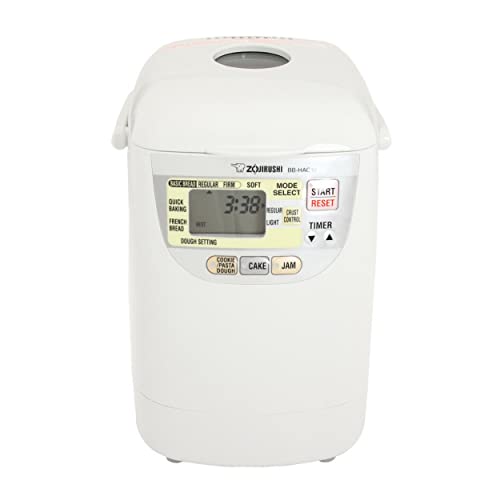
The Maestro is this guide’s most instructive review precisely because there is so little to quote. Its title offers a brand, a line, a model number, and a colour — and nothing else. In a features guide, that silence is the lesson: features are what a listing states, and a buyer comparing this machine against the Cuisinart’s enumerated control or the KITCHENARM’s twenty-nine programs must do the Maestro’s homework on its product page before any fair comparison can happen. It may hide a superb feature set; the verified title simply does not say. Treat it as the premium wildcard — shortlist it on brand trust if that is your style, verify its programs, loaf sizes, and timer on the listing, and only then judge it against the stated competition. You can Check on Amazon to read that full specification.
Best for: brand loyalists willing to verify the complete feature list / Not suited for: shoppers who want features stated up front

Zojirushi Home Bakery Supreme Bundle, BB-CEC20
Badge: Best Menu Depth
Strengths
- Home Made menus are stated — the deepest control feature in this guide.
- A sourdough menu is stated, giving starter bakers a designed starting point.
- Dual kneading blades and a 13-hour delay round out a serious specification.
Trade-offs
- Menu depth means a learning curve; your first custom cycles are experiments.
- A 2-pound bundle-format machine is a substantial counter commitment.
- No automatic dispenser is stated, so add-ins are still a manual moment.
Mini spec box: Model BB-CEC20; loaf size 2 Lb; dual kneading blades; 13-hour delay; menus stated: sourdough, jam, quick bake, Home Made.
Where the Cuisinart teaches settings, the BB-CEC20 teaches authorship. Home Made menus let you set the phases of the cycle yourself — the feature for doughs that presets mishandle — and the stated sourdough menu shows the same philosophy from the other side: a designed program for a dough famous for ignoring schedules. Dual kneading blades are the hardware half of the story, working a full 2-pound pan evenly so heavy, customised doughs mix completely. If the features that matter are the ones that hand you control, this machine’s stated list is the strongest in the pool, and the depth is explored further in Best Custom Bread Machines. You can Check on Amazon for the bundle’s current contents.
Best for: experimenters, sourdough bakers, and note-keepers / Not suited for: set-and-forget bakers or small counters
Neretva 15-in-1 Bread Maker with Auto Nut Dispenser
Badge: Best Automation Features
Strengths
- An automatic nut dispenser is stated — add-ins delivered mid-cycle without you.
- Dual heaters are stated, baking from above as well as below for even colour.
- A 15-hour timer and 1-hour keep warm extend the routine features usefully.
Trade-offs
- Fifteen programs are presets; no homemade cycle is stated.
- The 3.3-pound capacity is family scale, not small-batch friendly.
- A full touch panel is elegant but less forgiving of floury fingers than chunky buttons.
Mini spec box: Capacity 3.3 Lb; 15-in-1 programs; dual heaters; automatic nut dispenser; stainless steel body, nonstick ceramic pan; full touch panel; 15-hour timer; 1-hour keep warm.
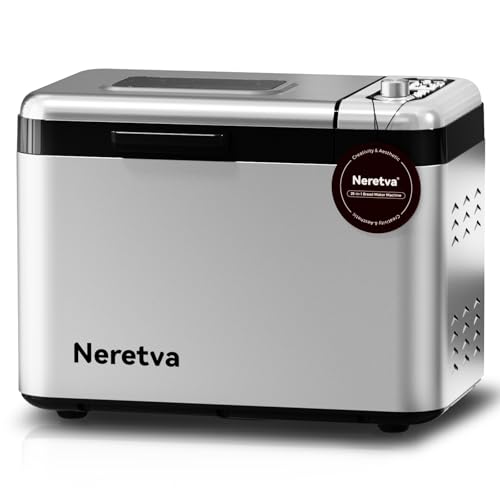
The Neretva teaches the automation family of features. The dispenser solves a real problem: nuts, seeds, and fruit added at the start get shredded by kneading, and added too late they never distribute — a dispenser drops them at the engineered moment, and your walnut loaf has walnuts in it rather than walnut dust. Dual heaters solve the pale top, the most common cosmetic complaint in the category, by radiating heat downward onto the crust. Keep-warm solves the school-run problem: the loaf finishes, life intervenes, and the machine holds it warm for an hour instead of letting it steam itself soggy in a cooling pan. None of these features changes a recipe; all of them change how the baking fits a life. You can Check on Amazon for its current listing.
Best for: busy families who bake add-in loaves and need the machine to cope alone / Not suited for: small households, or cycle-builders
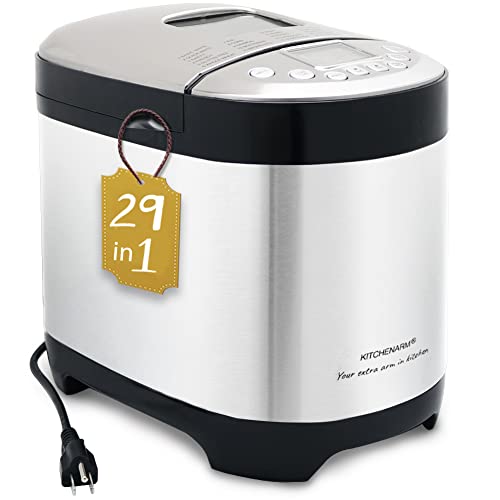
KITCHENARM 29-in-1 Smart Bread Machine
Badge: Best Program Library
Strengths
- Twenty-nine programs are stated — the deepest preset library in this pool.
- A homemade cycle is stated alongside them, bridging presets and authorship.
- Three loaf sizes and a gluten-free setting are stated, plus recipes included.
Trade-offs
- Twenty-nine programs guarantee option fatigue until you settle into your five.
- No dispenser or dual-heater feature is stated.
- A library this broad means some programs will simply never be used.
Mini spec box: 29-in-1 programs; homemade cycle; gluten-free setting; loaf sizes 2 Lb, 1.5 Lb, 1 Lb; stainless steel body; recipes included.
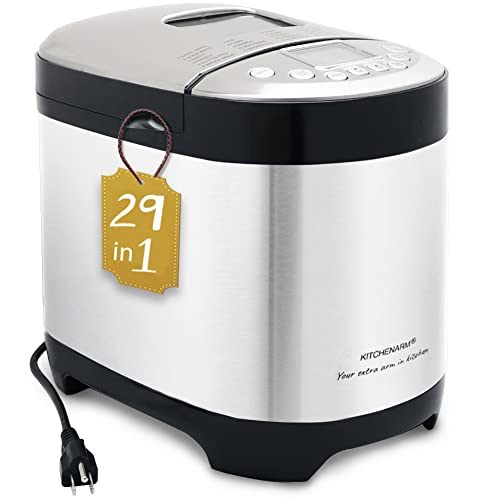
The KITCHENARM teaches abundance — and its limits. Twenty-nine programs cover territory from whole wheat to yogurt-adjacent specialties that smaller libraries skip, and the stated homemade cycle means the library is a floor, not a ceiling: when program thirty does not exist, you can build it. The three loaf sizes and gluten-free setting are the quietly essential inclusions, because a program library is only as useful as the sizes and diets it serves. The honest caution is human, not mechanical: most owners use a handful of programs weekly, so judge this machine by whether your handful is inside its twenty-nine — and by its homemade cycle, which will still be earning its keep when the novelty programs are forgotten. You can Check on Amazon for the full program list.
Best for: variety bakers and gluten-free households who want every option in one body / Not suited for: minimalists who want five buttons and no decisions

Breville Custom Loaf Bread Maker, BBM800XL
Badge: Best Feature Flagship
Strengths
- A collapsible kneading paddle is stated — it folds down before baking, preventing the paddle hole.
- Custom crust settings and an automatic fruit and nut dispenser are stated.
- The listing’s whole pitch is control: every detail adjustable, in brushed stainless steel.
Trade-offs
- A flagship feature set sits in a premium tier and a substantial body.
- Moving paddle mechanics are one more thing to clean carefully.
- Control this complete is wasted on a one-loaf repertoire.
Mini spec box: Model BBM800XL; collapsible kneading paddle; custom crust settings; automatic fruit and nut dispenser; brushed stainless steel; control-every-detail design.
The Breville teaches the flagship lesson: features as engineering rather than enumeration. The collapsible paddle is the category’s most elegant idea — it kneads vigorously, then folds flat so the bake proceeds without it, and the loaf emerges whole, with no hole and no torn base, solving by mechanism what the Cuisinart solves by alert. Add custom crust settings for the finish, a dispenser for the add-ins, and a stainless body built to live on the counter, and you have the feature set against which others are measured. Its cost is tier and size, and its demand is a baker who will use the control it offers. For that baker, it is the most complete statement of what bread machine features can be, and you can Check on Amazon for its current listing.
Best for: control-focused bakers who bake varied loaves weekly / Not suited for: budget-tier shoppers or one-loaf households
Comparison Table
| Pick | Programs stated | Loaf sizes stated | Signature feature | Timer stated | Listing |
|---|---|---|---|---|---|
| Cuisinart CBK-110 | 12 | 1, 1.5, 2 Lb | Paddle-removal alert, 3 crust shades | 13-hour delay | Check on Amazon |
| Zojirushi Maestro | Not stated | Not stated | Premium white finish | Not stated | Check on Amazon |
| Zojirushi BB-CEC20 | Menus incl. sourdough, jam, quick bake | 2 Lb | Home Made custom menus, dual blades | 13-hour delay | Check on Amazon |
| Neretva 15-in-1 | 15 | 3.3 Lb | Auto nut dispenser, dual heaters | 15-hour, 1-hour keep warm | Check on Amazon |
| KITCHENARM 29-in-1 | 29 | 1, 1.5, 2 Lb | Homemade cycle, gluten-free setting | Not stated | Check on Amazon |
| Breville Custom Loaf | Custom-focused | Not stated | Collapsible paddle, custom crust, dispenser | Not stated | Check on Amazon |
How to Choose: Ranking the Features That Matter
Rank features by your failures. Think of the last loaves that disappointed you and name the disappointment precisely. Pale, soft tops point at heaters and crust control. A torn base points at paddle solutions. A loaf too big and half wasted points at loaf-size selection. Add-ins shredded to dust point at a dispenser. A schedule that never fits your mornings points at the delay timer. Every feature in this guide exists because some baker had that exact disappointment often enough that engineers answered it — so let your disappointments, not a marketing list, rank the features for you.
Then apply the frequency test. A feature used every bake — loaf size, crust shade — outweighs a feature used monthly, which outweighs a feature used twice a year, however delightful. Dispensers fail this test for plain-loaf households and pass it gloriously for fruit-loaf households. Homemade cycles pass it for experimenters and fail it for the contented. Keep-warm passes it for chaotic households and is invisible to punctual ones. There is no universal ranking, and any guide that offers one is selling something. The ranking is yours; this page’s job is to make sure you know what each feature does before you rank it. Shoppers who already know their ranking and want the value view can continue to Best Inexpensive Bread Machines.
One more filter, often decisive: the household’s second baker. Many machines are bought by one enthusiast and used, eventually, by everyone in the house. A feature set that hides its basics behind deep menus will quietly exclude the less confident users, and the machine’s weekly value falls to whatever the enthusiast alone bakes. Prefer, where you can, a machine whose surface is simple — a clear program list, obvious size and crust controls — with its depth one layer down for those who go looking. The pool here spans that spectrum from the Cuisinart’s legible balance to the KITCHENARM’s maximal library, and the right point on it is the one your whole household can actually operate on a tired weekday evening.
How to Use, Clean, and Troubleshoot Feature-Rich Bread Machines
More features mean more first-week learning, so adopt a machine in stages. Week one, bake the basic loaf on the basic program, twice, changing nothing: this is your control loaf, the baseline every feature will be judged against. Week two, vary one feature at a time — the crust shade, then the loaf size, then the timer. By week three you will know which features are yours. This staged approach feels slow and is actually the fastest route to competence, because it prevents the classic failure of changing everything at once and learning nothing.
Feature-specific care is simple. Dispensers want a quick empty and wipe after each use, since yesterday’s raisins bake onto today’s mechanism. Collapsible and removable paddles want a soak and a careful clean around their moving parts, plus a drop of attention to the shaft seal. Touch panels want a dry wipe; flour dust plus moisture makes a paste that dulls both looks and response. Delay timers want correct ingredient layering — liquids, flour blanket, yeast dry on top — because a delayed start turns sloppy layering into a slow accident. Keep-warm wants restraint: an hour is a convenience, several hours is a slow drying, whatever the button allows.
Troubleshooting, in the pattern that solves most feature-related problems. Problem: add-ins are shredded or all at one end → they went in too early or too late; use the dispenser where one is fitted, or add at the machine’s add-in signal, never at the start. Problem: the top of the loaf is pale while the sides are deep gold → your machine bakes from below only, or the crust shade is set light; choose a darker shade, and value dual heaters in your next machine. Problem: the paddle tears the loaf’s base → remove it at the alert where offered, choose a collapsible-paddle design next time, and lightly oil the shaft before loading as a home remedy.
The Feature Families, Explained One by One
Programs are recipes encoded as timings: knead, rise, and bake phases tuned per flour and loaf type. The programs worth insisting on are the ones matched to your actual baking — a stated gluten-free setting if you bake gluten-free, because those batters behave nothing like wheat dough; a stated whole-wheat program if heavy flours are your staple, because bran doughs need longer rises; a quick-bake if weeknight bread matters, accepting its denser crumb as the price of speed. Beyond your staples, program counts are comfort, not capability.
Hardware features decide texture in ways programs cannot. Dual kneading blades mix a wide pan completely, which shows up as an even crumb in heavy loaves. Dual heaters colour the top crust, which shows up at the table. A ceramic or nonstick pan decides how the loaf releases and how the pan cleans, and a dispenser decides whether add-ins survive as themselves. Control features decide authorship: loaf sizes and crust shades bend a program; a homemade cycle replaces it. Routine features decide fit: the delay timer moves the work to the night, keep-warm forgives the morning, and a clear panel makes all of it legible to a tired human. When you read any listing after this guide, sort its claims into these families and ask which family your baking is starving in — that is the feature to pay for, and the rest is garnish. The performance-first view of the same machines appears in Best Kick Ass Bread Machines.
One Loaf, Every Feature Working: A Walk-Through
To see the feature families cooperate, follow one loaf — a seeded wholemeal, baked for a family breakfast — through a fully-featured machine. The night before, the delay timer is the first feature on duty: ingredients are layered into the pan, flour blanketing the liquid, yeast dry on top, and the timer is set so the cycle ends as the household wakes. Nothing has happened yet, and already two features have earned their keep — the timer, and the pan’s capacity, chosen because the machine offers a loaf size that matches the family’s morning appetite rather than forcing leftovers or a second bake.
When the cycle starts in the small hours, kneading hardware takes over. A heavy, seed-flecked dough is exactly the load that separates serious kneading from stirring: dual blades, where fitted, work the wide pan so no dry pocket survives in a corner, and the dough emerges smooth and evenly seeded. Then the dispenser fires at the engineered moment, adding the remaining seeds and any fruit after the dough can hold them as distinct pieces rather than grinding them into the crumb. The rise proceeds on the whole-wheat program’s longer schedule — a program feature, invisible and essential — and the bake finishes with heat from above as well as below where dual heaters are fitted, so the top crust colours to the shade the baker selected the night before. The paddle, collapsible or removed at its alert, leaves the base whole. Keep-warm holds the loaf while the household assembles, and breakfast is a loaf in which every feature in this guide did one quiet job. Remove any one of them and the loaf still exists — but it is a slightly lesser loaf, or a slightly harder morning, and the sum of those slight differences is what a feature set is.
Features for Special Loaves and Special Diets
Some features stop being luxuries the moment a household’s baking has a constraint. Gluten-free baking is the clearest case: those batters mix, rise, and bake on a different logic from wheat dough, and a stated gluten-free program or setting — the KITCHENARM states one in this pool — is the difference between a designed process and a hopeful adaptation. A homemade cycle serves the same households from the other direction, letting an experienced baker tune timings to a particular flour blend until the loaf behaves. If gluten-free bread is your weekly reality rather than an occasional experiment, weight these two features above every other line in any listing you read.
Sourdough households have their own feature logic: time and gentleness. A stated sourdough menu, like the one on the Zojirushi bundle here, gives a starter-based dough a designed schedule instead of a borrowed wheat cycle, and custom menus let you stretch fermentation as your starter’s mood and your kitchen’s temperature demand. Enriched and festive baking — brioche, panettone-style loaves, sweet breads — leans on crust control and guarded baking, because sugars brown fast and a shade setting is the simplest protection a machine can offer. Jam and cake settings, stated on several machines in this series of guides, turn the same appliance toward the preserving pan and the tea table. None of these are mainstream needs, and that is precisely the point of a features guide: your special loaf, whatever it is, defines which features are essential for you, and the mainstream ranking be ignored safely.
Reading a Listing Like a Critic: A Five-Minute Drill
Everything in this guide compresses into a drill you can run on any bread machine listing in about five minutes. First, find the loaf sizes. If the listing states them, note the range; if it does not, mark the machine unverified on capacity and move on with your eyes open. Second, find the programs that match your flours — whole wheat, gluten-free, quick — and ignore the rest of the count entirely. Third, find the crust control: shades, custom settings, or silence. Fourth, find the routine features: the delay timer’s length, keep-warm if any, and the paddle’s answer to the hole problem. Fifth, find the labour features: a dispenser, the pan’s material, and anything that claims to clean or release easily.
Now weigh what you found against the two machines in this pool that state their cases most completely — the Cuisinart’s enumerated balance and the Breville’s engineered flagship set — and against the one that states almost nothing. The drill’s power is that it makes listings comparable in their own words: stated versus stated, silence versus silence. A machine that survives the drill with your key features present is a machine you can buy on evidence. A machine that fails it may still be wonderful, but you would be buying the wonder on faith, and faith is a poor substitute when the evidence-based alternatives are sitting in the same price conversation. Run the drill on the six listings behind this guide and you will feel the skill settle: it takes five minutes here, and it will save you from the two most expensive sentences in appliance shopping — “I assumed it had” and “I never use that anyway.”
Features and Loaf Quality: What Actually Reaches the Table
It is worth closing the feature tour with a dose of proportion. Serve a blind slice from a mid-range machine with the right program and a flagship with every feature engaged, both baked from the same recipe, and most eaters will not reliably name the flagship. Features rarely transform bread; they refine it at the margins and, more importantly, they protect it from the common failures — the pale top, the torn base, the shredded walnuts, the mistimed morning. That protection is worth paying for in proportion to how often you bake. A household baking five loaves a week meets those failures five times as often as a household baking one, and should weight automation and paddle and heater features accordingly. A weekly baker can forgive a pale top in a way a daily baker cannot.
Features also protect motivation, which no specification sheet mentions and every long-term owner understands. The baker whose first ten loaves emerged whole, well-coloured, and on time is a baker still baking in year two. The baker whose early loaves tore, paled, and collided with the school run often owns a cupboard monument by Christmas. When you choose features, you are partly choosing how forgiving your first season will be — and forgiveness, in a new hobby, is the feature underneath all the others. That is the honest case for the balanced and flagship sets in this guide, and it is also the honest limit of the case: beyond a well-chosen set matched to your loaves, additional features refine a hobby you already love rather than creating one.
Common Buying Mistakes
The first mistake is buying the longest feature list rather than the right one — twenty-nine programs with no dispenser, bought by a fruit-loaf baker, is a worse purchase than twelve programs with one. The second is ignoring the paddle question until the first torn loaf teaches it. The third is treating the delay timer as a headline rather than a habit: it only pays if your routine actually loads the machine the night before. The fourth is paying for a homemade cycle you will never open, or — the mirror error — saving money on a preset-only machine while knowing you customise every recipe you touch.
Fifth, overlooking keep-warm and then letting finished loaves steam in closed pans while life happens. Sixth, assuming a premium badge guarantees a stated feature set; the Maestro in this very pool states almost nothing, and only its full listing can fill the gap. Seventh, forgetting that features interact with size: a dispenser and dual heaters in a 3.3-pound machine serve a family, and the same money in a compact machine serves a couple — match the feature set to the household, not to the brochure.
Final Recommendation
For most homes, start with the balanced set: the Cuisinart CBK-110, whose stated loaf sizes, crust shades, programs, and paddle alert cover the features used weekly. Step up to authorship with the Zojirushi BB-CEC20 and its Home Made menus if your doughs defeat presets, or to the Zojirushi Maestro only after verifying its full list on the listing itself. Choose automation — the Neretva’s dispenser and dual heaters — if your household bakes add-in loaves on chaotic schedules, the KITCHENARM if you want the deepest library plus a homemade cycle, and the Breville if the collapsible paddle and full control justify a flagship. Rank by your failures, buy the features that answer them, and ignore the rest with confidence.
If you leave this page with one sentence, let it be this: a feature is worth paying for exactly when it removes a failure you actually have, at a frequency you actually bake. Everything else — the long program counts, the gleaming panels, the features answering other bakers’ complaints — is decoration, and decoration is free to admire in a listing and expensive to store in a kitchen. Choose the set that fits your loaves and your mornings, and the machine will feel less like an appliance and more like a colleague.
Frequently Asked Questions
Which bread machine feature matters most?
For most bakers, program fit for your flour and loaf-size selection change the most loaves. If you bake one standard loaf, a good basic program and the right size are nearly everything. Features like dispensers and homemade cycles matter enormously to the bakers who need them and not at all to those who do not — which is why this guide ranks by your baking, not by a universal list.
Do more programs mean a better machine?
No. Programs are preset timings; beyond the ones matched to your flours and loaf types, extra programs add comfort, not capability. Judge a library by whether your weekly loaves are in it, and value a homemade cycle — where stated — above raw count, because it can become any program the library forgot.
What does a fruit and nut dispenser actually do?
It holds add-ins separately and drops them into the dough at the point in kneading when they will distribute without being shredded. Added at the start, nuts and fruit get ground into the dough; added by hand, they demand you be present at the right minute. A dispenser removes both problems, which is why add-in bakers prize it.
Why do some loaves have a hole in the bottom?
The kneading paddle bakes into the loaf and tears out a hole when removed. Machines answer this three ways: an alert telling you to remove the paddle before baking, as the Cuisinart states; a collapsible paddle that folds flat, as the Breville states; or your own habit of oiling the shaft and hooking the paddle out early.
Is a delay timer worth it?
If your household eats breakfast bread, very much so: load at night, wake to a finished loaf, and the machine’s hours stop competing with yours. Timers up to 13 and 15 hours are stated in this pool. Just keep perishable-rich doughs out of long warm delays, and layer ingredients so the yeast stays dry until the start.
What is the difference between dual heaters and dual kneading blades?
They solve different problems. Dual heaters bake from above as well as below, colouring the top crust evenly. Dual kneading blades mix the dough, working a wide pan so heavy doughs knead completely. One is about the bake, the other about the mix; a machine may state either, both, or neither, as the comparison table shows.
Do I need a bread machine with a viewing window or interior light?
They are comfort features, not baking features: the loaf does not care whether you watched it. A window satisfies the natural urge to peek without opening the lid and dumping heat and moisture, which does have a small real value in the final rise. Treat it as a pleasant extra, never as a reason to choose one machine over another with better programs or controls.
Are stainless steel bodies and ceramic pans worth paying for?
They are durability and care features rather than baking features. A stainless body shrugs off knocks and looks at home on an open counter; a ceramic-style nonstick pan releases loaves cleanly and washes easily, with the usual coating request for gentle utensils. Neither changes the crumb. Pay for them when the machine will live on display or when easy cleaning is the habit that keeps you baking — both legitimate reasons, honestly weighed.
Which features help gluten-free baking?
A stated gluten-free program or setting, because gluten-free batters need different mixing and rising from wheat dough; a homemade cycle also helps, since it lets you tune timings to a specific flour blend. The KITCHENARM states a gluten-free setting in this pool. Whatever the machine, expect gluten-free loaves to prefer their own dedicated program over adapted wheat cycles.