Disclosure: topratedkitchenware.com is reader-supported. When you buy through links on our site, we may earn an affiliate commission from Amazon and other retailers, at no extra cost to you.
Where to buy
The six models below are the picks for this guide to the best small toilets for small bathrooms. Linked picks go straight to their verified Amazon listings, where you can check the latest price on Amazon and confirm dimensions before ordering — especially worth doing if you are buying the same model for more than one room, because consistency across bathrooms is one of this guide’s main themes. One pick, the Thetford Aqua-Magic VI, is covered in prose only because it is an RV toilet rather than a household fixture; it appears without a link, and its review explains the category error it represents.
- PeacefulHues Round Front Two Piece Toilet, 15-Inch Seat Height — Check on Amazon
- WinZo Compact One Piece Toilet, 22.8-Inch Depth (WZ5079)
- DeerValley Compact One Piece Toilet, Standard Seat Height
- WinZo WZ5081 Elongated One Piece Toilet, Low Profile
- DeerValley Small One-Piece Toilet, 12-Inch Rough-In
- Thetford Aqua-Magic VI Low Profile — covered in prose only in this guide (see its review for why)
Read the full guide ↓ for the ranking logic, the honest limitations of every pick, and the multi-room strategy that separates a coherent house from a collection of plumbing accidents.
Some houses do not have a bathroom problem; they have a bathrooms problem. A family bathroom that is tight, an ensuite that is tighter, and a downstairs half-bath that seems to have been drawn as an afterthought — each one small, each one needing a toilet, and each one tempting its owner into three unrelated purchases made in three unrelated panics. This guide to the best small toilets for small bathrooms is written for that house. Its argument is simple: when several small bathrooms are being fitted at once, the winning strategy is rarely six different answers. It is a small family of well-matched answers — one dependable workhorse repeated where rooms are similar, and specialists deployed only where a room’s measurements genuinely demand one.
The six picks come from the compact end of the verified household pool, plus one RV toilet reviewed in prose only as a cautionary tale. The workhorse is a classic round front two-piece with a stated seat height and serviceable parts. The specialists are a short-depth one-piece for the room where the door barely clears, a skirted dual-flush compact for the main bathroom’s water bill, a low profile elongated model for the ensuite under the eaves, and a small one-piece made for powder rooms. Fitted together with intent, they make a house of small bathrooms feel designed rather than accumulated. Readers fitting just one room should start with the companion guide to Best Toilets For A Small Bathroom; this one assumes the plural.
Key Takeaways
- Across several small bathrooms, consistency is a feature: repeated models mean shared spare parts, one learning curve, and calmer repairs.
- The PeacefulHues round front two-piece is this guide’s workhorse — a stated 15-inch seat, a siphonic 1.28 GPF flush, and the easiest servicing of any pick.
- Specialists earn their place room by room: the WZ5079’s stated 22.8-inch depth, the DeerValley Compact’s dual flush, the WZ5081’s low profile, the DeerValley Small’s powder-room footprint.
- Every household pick is a 12-inch rough-in design; verify each room separately, because houses surprise you.
- The Thetford Aqua-Magic VI is an RV toilet — prose only here, and a reminder to check a fixture’s category before its dimensions.
- Buy for the house’s traffic pattern: the hardest-used bathroom deserves the water-saving dual flush, not the guest room.
In this guide
Quick Picks
| Pick | Badge | Role in the house | Why it stands out | Link |
|---|---|---|---|---|
| PeacefulHues Round Front Two Piece Toilet | Best Overall | The repeatable workhorse | Stated 15-inch seat, round front, siphonic flush, easy parts | Check on Amazon |
| WinZo WZ5079 Compact One Piece Toilet | Best for Tightest Depth | The shallow-room specialist | Stated 22.8-inch depth with dual flush | Check on Amazon |
| DeerValley Compact One Piece Toilet | Best Dual Flush | The main bathroom’s water saver | Dual flush 1.1/1.6 GPF in a skirted one-piece body | Check on Amazon |
| WinZo WZ5081 One Piece Toilet | Best Low Profile | The low-ceiling ensuite answer | Elongated comfort in a low profile body, soft close seat | Check on Amazon |
| DeerValley Small One-Piece Toilet | Best for Powder Rooms | The half-bath specialist | Compact design for tight spaces, soft closing seat included | Check on Amazon |
| Thetford Aqua-Magic VI | Best RV Low Profile (Prose Only) | Not a household pick at all | An RV toilet that haunts small-toilet searches; see its review | Covered in prose only |
Badges are used consistently through the detailed reviews below, so the pick that wins a badge here carries the same badge in its full review.
How These Picks Were Chosen
This is a research-led guide built from verified listings. We judged compact household toilets on the evidence their listings publish — stated seat heights and depths, bowl shapes, flush systems, rough-in, and construction — and then, because this keyword is plural, we judged them again as a set: which models could sensibly repeat across rooms, which solve one room’s specific geometry, and which parts and habits a household would be signing up for across several installations at once.
The Thetford judgement follows the rule used throughout this series: a pick whose core category contradicts the keyword’s use is covered in prose only. The Aqua-Magic VI’s title describes an RV toilet with a foot flush for a vehicle flange and black tank. It is compact, and it is not a household toilet, so it carries no link and no image here. The rest of the pool is household through and through, and the interesting work was ranking roles rather than rescuing mismatches: workhorse first, specialists after, each assigned to the room where its one great virtue matters most.
We made no hands-on claims. Flush systems are reported as their makers state them — dual flush volumes, a siphonic 1.28 GPF, a high-efficiency side flush — and dimensions are quoted only where a listing states them. Where a maker offers a class word instead of a number, the reviews say so, because a household buying three toilets deserves evidence labelled as carefully as a household buying one. The broader small-bathroom picture, including rooms beyond the house, is rounded out in Best Toilets For Small Bathrooms.
The 6 Best Small Toilets for Small Bathrooms
Each review follows the same pattern: what the verified listing actually states, where the design is strong, where it honestly falls short, the room in the house it belongs in, and who should buy it. Specs come only from the pool data — nothing is invented to fill a box.

PeacefulHues Round Front Two Piece Toilet, 15-Inch Seat Height
Badge: Best Overall
Strengths
- Round front bowl saves inches in every room it enters, and the stated 15-inch seat suits the widest range of users.
- Siphonic flush at 1.28 GPF with cUPC certification stated — modern performance in the most serviceable format there is.
- Two-piece parts are accessible and familiar, so one household can maintain several of these with a single small spares kit.
Trade-offs
- The tank joint and the ledge behind the bowl are the cleaning tax of the two-piece format, paid in every room.
- Round front seats are smaller than elongated seats.
- A traditional side-handle appearance that will not satisfy a design-led remodel.
Mini spec box
- Seat height: 15 inches (stated)
- Flush: 1.28 GPF siphonic, side handle
- Bowl: round front
- Rough-in: 12 inches
- Certification: cUPC (per the listing)
- Seat: soft close, included
Every multi-bathroom plan needs a default: the toilet you install wherever no special constraint argues otherwise, so that the house accumulates one set of habits instead of four. The PeacefulHues is built for that role. Its specification reads like a checklist of unglamorous virtues — a round front that respects small rooms, a stated standard seat height that children, guests, and shorter adults all manage, a certified siphonic flush at the current efficiency standard, and a soft close seat in the box so no room in the house slams.
The two-piece format is the strategic part. Tank components on a toilet like this are the most standardised objects in residential plumbing; a homeowner who learns to service one has learned to service all of them, and a single spare fill valve and flapper set covers the whole house. In a property with three small bathrooms, that commonality is worth more over a decade than any single design flourish. It is also the friendliest pick here for a phased project: buy one for the worst bathroom this year, and the identical model will still make sense for the next room next year.
Its limits are aesthetic and tactile rather than functional. The ledge behind a two-piece bowl collects what ledges collect, and design-conscious renovators will prefer the one-piece picks below for their main bathroom. Use this one as the backbone, and let the specialists be the exceptions.
Best for: the repeatable default across several small bathrooms, rentals, and phased remodels / Not suited for: the one showcase bathroom where design leads
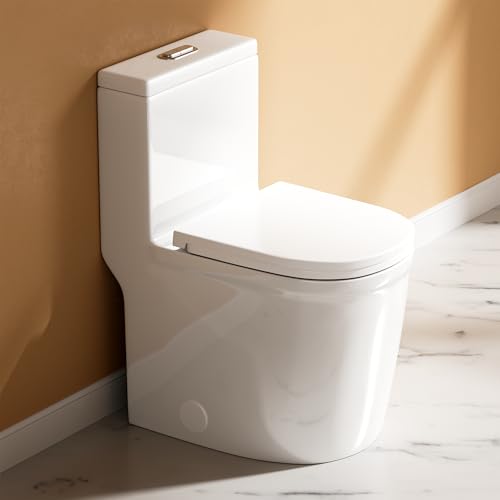
WinZo Compact One Piece Toilet, 22.8-Inch Depth (WZ5079)
Badge: Best for Tightest Depth
Strengths
- Stated 22.8-inch depth — the shortest household body in the guide, aimed by its maker at small, tiny, and mini bathrooms.
- Dual flush suits whichever room gets it, since shallow rooms are often high-traffic ones.
- One-piece construction removes the tank seam from the hardest room to clean.
Trade-offs
- The most compact seat here; not the pick to repeat into a primary bathroom for larger users.
- Its published strength is depth, not seat height.
- Tight bodies leave installers less room at the fixings — in the room with the least room, plan the install accordingly.
Mini spec box
- Depth: 22.8 inches (stated)
- Flush: dual flush
- Rough-in: 12 inches
- Design: compact one-piece, short design
- Model: WZ5079
In almost every house with several small bathrooms, one room is the problem room: the one where the door was hung by an optimist, where the vanity drawer and the toilet were promised the same six inches, where guests perform a small sidestep that regulars have stopped noticing. The WZ5079 exists for that room. Its stated depth is the shortest in this guide by a margin that matters, and its maker aims it at exactly the mini-bathroom end of the market.
Deploy it surgically. There is no need to accept its compact seat in rooms that have depth to spare; its value concentrates entirely in the room whose tape measure fails the other picks. The dual flush and one-piece body mean the problem room does not also become the problem child for water use or cleaning — a small but real mercy, since the tightest bathroom in a house is usually the downstairs one every visitor uses.
Measure that room twice before ordering: wall to door arc, wall to any drawer pull, and the rough-in, which must be the standard 12 inches this model is built for. When the numbers fit, this is the pick that turns an apologetic room into a finished one.
Best for: the single shallowest bathroom in the house / Not suited for: repeating into every room regardless of depth

DeerValley Compact One Piece Toilet, Standard Seat Height
Badge: Best Dual Flush
Strengths
- Dual flush at 1.1/1.6 GPF — put it in the house’s busiest bathroom and the savings compound daily.
- Skirted one-piece body: flat sides that wipe clean, in the rooms that are cleaned most often.
- Standard seat height and small-bathroom sizing make it an easy citizen in a mixed set of rooms.
Trade-offs
- Skirted installation asks for care with fixings and supply alignment.
- Dual flush mechanisms are model-specific when parts are eventually needed, unlike the PeacefulHues’ universal internals.
- The maker’s quiet-flush emphasis suits most homes, but the design will not lower a tall room’s silhouette as dramatically as the WZ5081.
Mini spec box
- Seat height class: standard
- Flush: dual flush 1.1/1.6 GPF
- Rough-in: 12 inches
- Design: one-piece, skirted
Water strategy in a multi-bathroom house is about placement, not just product. The bathroom that flushes thirty times a day and the bathroom that flushes twice should not necessarily hold the same mechanism, and this DeerValley is the one to give the busy room. Its dual flush splits liquid and solid volumes cleanly, and because the majority of any household’s flushes are liquid, the reduced 1.1 GPF side of the pairing does most of the work, every day, without a single behaviour change from anyone in the house.
The skirted body supports the same placement logic from the cleaning side. The busiest bathroom is cleaned most often and resented most when cleaning is fiddly; flat skirted sides and a one-piece silhouette cut that job to a wipe-down. The maker also emphasises a quiet flush, which in a family bathroom off a hallway of bedrooms is a quality-of-life feature disguised as a specification.
Keep its model details in the household file. Dual flush valves are not the universal parts-bin items that two-piece internals are, and the day a seal needs replacing, the household that can name its model is the household whose main bathroom is back in service by dinner.
Best for: the main family bathroom in a house of small bathrooms / Not suited for: owners who want every toilet in the house on universal parts
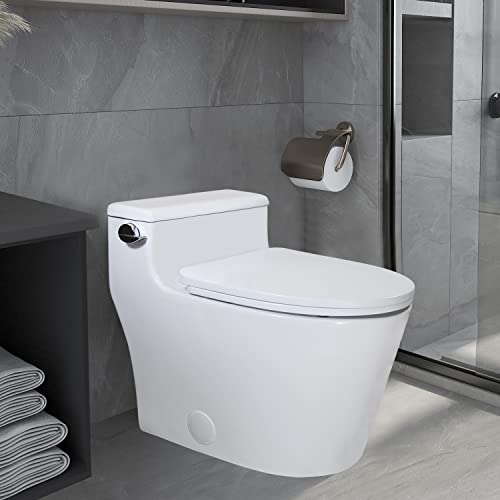
WinZo WZ5081 Elongated One Piece Toilet, Low Profile
Badge: Best Low Profile
Strengths
- Low profile body for the bathroom whose limit is vertical — under eaves, under windows, under shelves.
- Elongated bowl keeps adult comfort in a room category that usually trades it away.
- High-efficiency side flush at 1.28 GPF and a soft close seat suit an ensuite’s night-time use.
Trade-offs
- Elongated depth is the spend; shallow rooms should take the WZ5079 instead.
- Low profile is a design description, not a stated seat measurement.
- A single flush volume, with no reduced liquid option.
Mini spec box
- Profile: low profile
- Flush: side flush, 1.28 GPF
- Bowl: elongated
- Seat: soft close, included
- Design: one-piece
Most houses with several small bathrooms have one room whose problem is not floor area but air: the ensuite tucked under a roof slope, the bathroom whose window begins where a normal tank would end, the room where a tall toilet makes the ceiling feel lower than it is. The WZ5081 is the specialist for that room, and its specialism is the silhouette — a one-piece body kept deliberately low, carrying an elongated bowl so the room’s adults are not asked to pay for headroom with seat comfort.
The side flush placement cooperates with the same brief: where a shelf or a low sill crowds the tank top, a side control stays clear and reachable. At 1.28 GPF the flush meets the modern standard with a single simple mechanism, and the soft close seat is the right specification for a room used at night, inches from a sleeping partner.
Assign it deliberately. In a deep, tall bathroom its virtues are wasted and its elongated front is pure cost; in the low room it is the only pick that solves the actual problem. Multi-room buying rewards exactly this kind of honesty about which room gets what.
Best for: low-ceiling ensuites and under-window placements / Not suited for: the shallowest room in the house

DeerValley Small One-Piece Toilet, 12-Inch Rough-In
Badge: Best for Powder Rooms
Strengths
- Compact design made for tight spaces — the natural specification for half-baths and under-stairs rooms.
- One-piece body with no tank seam, in the room where every surface is within arm’s reach and on display.
- Soft closing seat included; standard 12-inch rough-in keeps the swap simple.
Trade-offs
- Compact seat dimensions suit a half-bath’s short visits better than a main bathroom’s long ones.
- The listing leads with compact intent rather than a headline measurement.
- White finish only, per the listing.
Mini spec box
- Design: small one-piece, compact
- Rough-in: 12 inches
- Seat: soft closing, included
- Finish: white
The powder room is the most judged bathroom in any house and usually the smallest, which makes it the room where a well-judged compact toilet earns disproportionate credit. This DeerValley is specified for tight spaces by its maker, and its one-piece body suits a room where guests see the fixture at conversational distance: no tank seam, no exposed trapway curves, nothing to apologise for. The soft closing seat completes the guest-room brief, because a powder room’s hard surfaces amplify every sound into the hallway and the dinner party beyond it.
Within a multi-room plan, this is the pick that lets the half-bath be deliberately different without being random. It shares its maker’s design language with the skirted DeerValley Compact in the main bathroom, so the house reads as a family of choices rather than a clearance sale — a small aesthetic dividend that costs nothing.
Do not promote it beyond its brief. A compact bowl in a powder room is perfectly judged; the same bowl as the main bathroom for a household of large adults would be a daily compromise. Specialists stay specialists, and this one’s specialism is the small room with short visits and high scrutiny.
Best for: powder rooms, half-baths, and under-stairs bathrooms / Not suited for: a main bathroom for larger users
Thetford Aqua-Magic VI Low Profile
Badge: Best RV Low Profile (Prose Only)
Strengths
- A genuinely space-saving low profile design with a foot flush — in a recreational vehicle.
- Residential-sized slow-close seat and a deep bowl, per the maker, lift it above basic RV fixtures.
- Easy installation, as its maker states, onto the flange an RV actually has.
Trade-offs
- It is built for an RV flange and a black-water tank; no household bathroom offers either.
- Its water connections assume a vehicle system, not a home supply line.
- It cannot solve any room in a house, however small that room is.
Mini spec box
- Profile: low profile, space-saving
- Flush: foot flush
- Seat: residential-sized slow-close
- Application: RV (per the listing)
In a guide about several small bathrooms, this pick’s role is to protect the whole project from one expensive misunderstanding. Multi-room renovations are often researched in a hurry, late at night, across dozens of tabs — and the Aqua-Magic VI surfaces in small-toilet searches with a low profile and a space-saving promise that looks, at a glance, like an answer for the tightest room in the house. It is an answer for a different building entirely: a motorhome or trailer, where its foot flush, vehicle flange, and black-tank discharge are exactly right.
Order it for a house and the failure is total and immediate — there is nothing to bolt it to and nowhere for it to empty. That is why it is reviewed here in prose only, without a link or an image: so that the warning travels with the name. Households whose small spaces genuinely include a vehicle should meet this toilet in its own category, alongside the other vehicle systems discussed in Best Toilets For Cabins and the trailer comparison in Best Toilets For Travel Trailers Cemacal Vs Compost. In the house, the five household picks above divide the rooms between them, and no room is left needing an RV toilet to complete it.
Best for: RV owners cross-shopping by mistake / Not suited for: any room in any house
Comparison Table
| Pick | Form | Flush | Assign it to | Link |
|---|---|---|---|---|
| PeacefulHues Round Front | Two-piece, round front | 1.28 GPF siphonic | Every standard small bathroom | Check on Amazon |
| WinZo WZ5079 | One-piece, compact | Dual flush | The shallowest room (22.8-inch depth) | Check on Amazon |
| DeerValley Compact | One-piece, skirted | Dual 1.1/1.6 GPF | The busiest bathroom | Check on Amazon |
| WinZo WZ5081 | One-piece, elongated | 1.28 GPF side flush | The lowest-ceiling room | Check on Amazon |
| DeerValley Small | One-piece, compact | Not headlined in listing | The powder room | Check on Amazon |
| Thetford Aqua-Magic VI | RV toilet | Foot flush, RV system | A vehicle, never a room | Covered in prose only |
How to Choose Toilets for Several Small Bathrooms
Work from a room-by-room survey, not from a shopping cart. For each bathroom, record four facts: the rough-in (measure it in every room — a house that surprises you once will surprise you twice), the usable depth from wall to door arc or obstruction, the headroom and any window or shelf line above the tank position, and the room’s traffic — main, family, guest, or powder. With that survey in hand, the assignments in this guide mostly make themselves: standard rooms take the workhorse, the shallow room takes the short-depth specialist, the busy room takes the dual flush, the low room takes the low profile, and the powder room takes the compact.
Resist two opposite temptations. The first is uniformity for its own sake: the same toilet in every room is simple to buy and simple to service, but it forces the problem room to accept a fixture its measurements reject. The second is novelty for its own sake: a different design experiment in every room multiplies parts, habits, and cleaning routines across the house for no benefit anyone can name. The middle path — one workhorse, a few deliberate specialists — is where multi-room value actually lives, and it is the pattern the picks above were chosen to support. Homeowners extending the same thinking to a second property or a cabin will find a kindred approach in Best Toilets For Cabins.
Sequence the purchases by pain, not by room order. Replace the worst bathroom first — the one that leaks, rocks, or embarrasses — and live with the choice for a few weeks before committing the same family of fixtures to the remaining rooms. A toilet is a decade-long decision wearing a weekend’s installation; a short pilot in one room is the cheapest research a household can do. Finally, standardise the invisible things even where models differ: the same seat style where possible, the same supply fittings, and a household file with every model number, so future-you inherits a system rather than an archaeology project. The bidet question, if it arises for one of the rooms, is handled as its own category in Best Toilets Bidet.
How to Install Toilets Across Multiple Bathrooms
Batching installations across rooms rewards a rhythm: survey everything, order once, install room by room, and never leave the house without a working toilet overnight.
- Survey every room first: rough-in, depth envelope, headroom, supply stop position, and floor condition under each existing toilet. Photograph everything.
- Order the fixtures, fresh seals for every room, new supply lines, and one shared spares kit sized to the models you chose.
- Start with the least-used bathroom, so your technique — and your mistakes — happen where they cost least, and the household keeps a working room throughout.
- For each toilet: shut off, drain, and remove the old fixture; inspect the flange and repair it now if it is cracked or sitting below floor level; dry-fit the new toilet and check door swing and clearances before any seal is committed.
- Fit the new seal, set the toilet in one straight movement, tighten mounting nuts evenly and gently, connect the supply, and fill while checking every joint dry.
- Flush repeatedly, sit to settle, fit the soft close seat, and record the model and install date in the household file before moving to the next room.
- Keep one complete toilet functional at all times; if a room fights back — a rotten flange, a surprise rough-in — stop, make it safe, and let that room wait for parts rather than improvising.
Troubleshooting across a batch is pattern recognition. Problem: one toilet rocks while its twins sit solid → that room’s floor or flange is the outlier; shim and level it rather than blaming the model. Problem: a flush feels weaker in one room than another → check that room’s supply stop is fully open and its fill level is set correctly before suspecting the fixture. Problem: a door now grazes a bowl it cleared in your survey → re-measure; the survey was taken with the old fixture’s depth in mind, and the shallow-room specialist exists for exactly this discovery.
Standardise or Specialise? The Economics of Several Small Bathrooms
The money argument for standardising is quieter than the purchase price and larger over time. Identical toilets share spare parts, so one small kit covers the house; identical mechanisms mean one repair skill learned once; identical seats mean one replacement fits everywhere. Against that, specialising buys fit: the shallow room gets its door back, the low room gets its shelf, the busy room gets its water savings. The error is to price only the fixtures. Price the decade instead — parts, water, cleaning time, and the probability that a mismatched toilet in the problem room gets replaced early, which is the most expensive outcome of all.
A practical compromise used by many landlords and large households is two models, not one and not five: a workhorse for the standard rooms and a single specialist shared by the problem rooms where their geometry allows. This guide’s set supports that pattern directly — the PeacefulHues as the standard, with the WZ5079 or the WZ5081 as the one specialist, covers most real houses. Whichever pattern you choose, write it down; the next person to repair a toilet in your house, possibly you in nine years, will be grateful for the map.
Small Bathrooms, Different Generations: Fitting a House for Everyone
Several small bathrooms usually means several kinds of users under one roof, and the plural in this keyword is an opportunity: different rooms can be tuned to different bodies in a way a single bathroom never can. A standard 15-inch seat in the children’s bathroom supports independence years earlier than a tall bowl would. The main bathroom can carry the dual-flush skirted model whose quiet flush respects sleeping household members. A guest bathroom can stay with the most familiar, conventional fixture in the set, so visitors never meet an unfamiliar mechanism at midnight.
Where an older relative lives in the house or visits for long stretches, give one bathroom — ideally the one nearest their room — a specification checked against their actual legs and habits, using the chair test from the single-room guide, rather than assuming the house standard suits them. The freedom to differentiate is the plural keyword’s gift; use it room by room, and a house of small bathrooms becomes a house that fits its people unusually well.
Phasing, Budgeting, and Ordering for More Than One Bathroom
A multi-bathroom project fails financially in predictable ways, and most of them happen before a single toilet is unboxed. The first is pricing fixtures and forgetting installations: every room needs its own seal, supply line, and often a flange repair, and older houses add a contingency per room that younger houses do not. Budget per bathroom as a complete job — fixture, seat if it is not included, seal, line, and a modest allowance for the floor and flange surprises that small old bathrooms specialise in — and the project stops generating emergency purchases.
The second failure is ordering everything at once for a project that will be installed over months. Toilets are bulky, fragile, and miserable to store; a phased order matched to a phased installation keeps porcelain out of hallways and garages where it gets chipped by life. Order the pilot bathroom’s fixture first, install it, live with it, and only then commit the remaining rooms — ideally to the same workhorse model, whose continued availability is part of why a mainstream two-piece makes such a good standard. When you do order multiples, inspect every unit on arrival rather than on installation day; a hairline crack discovered at delivery is a return, while the same crack discovered with the old toilet already removed is a crisis.
The third failure is subtler: spending the entire budget on fixtures and nothing on the system around them. A shared spares kit, a household file with model numbers, a decent set of seals and lines bought in advance — these unglamorous purchases are what convert three toilet installations into a maintainable household system. They are also cheap precisely when bought calmly, in advance, rather than at emergency prices on a Sunday.
Keeping Several Small Bathrooms Clean and Working
Maintenance across multiple bathrooms is a logistics problem disguised as a cleaning problem. Small bathrooms are individually quick to clean — that is their one housekeeping virtue — but a house with three of them will quietly let the least-used room slide, and toilets that sit unflushed for weeks develop dry seals, stale trap water, and odours that greet the next guest before the host can. A simple rotation solves it: every bathroom gets flushed and wiped on a schedule whether it was used or not, with the guest room’s turn deliberately placed before, not after, guests arrive.
Standardisation pays its dividend here. One cleaning routine fits every room when the fixtures share a family resemblance: one-piece and skirted bodies wipe down in a single pass, two-piece ledges get their extra ten seconds, and the same checklist — tank, seat, bowl, base, floor edge — works everywhere. Keep a small kit in or near each bathroom rather than one heroic kit carried around the house; supplies that live in the room get used in the room. Once a season, walk the whole set with a homeowner’s eye: run a fingertip around each base for damp, lift each lid and watch a flush for a lazy fill or a running seal, and check each supply connection for the green-white crust that announces a slow seep. Ten minutes per bathroom, four times a year, is the entire preventive programme — and it is only feasible because the fixtures were chosen as a set, with shared parts and shared habits, in the first place.
When Small Bathrooms Belong to a Rental or a Sale
Two situations change the calculus of a multi-bathroom house: letting it, and selling it. In a rental, every argument in this guide sharpens. Tenants do not report slow seeps, children in rentals are exactly as hard on seats as children anywhere, and the landlord’s repair costs are dominated by call-outs, not parts. That is the environment the workhorse pattern was born for: one serviceable model everywhere, a spares kit on the shelf, and seats and seals a caretaker can swap without a plumber. Delicate specialists still have their place — a genuinely shallow room needs its short-depth toilet whoever lives there — but in a rental the burden of proof sits on anything that is not the standard.
Before a sale, the logic inverts toward appearance. Buyers read small bathrooms quickly and judge them as a set: three rooms with coherent, modern, obviously well-kept toilets read as a maintained house, while one renovated showcase and two tired originals read as a warning about everything else. If a full refit is not in the budget, consistency of the visible details — matching seats, sound flushes, clean bases, no rocking, no running — buys more confidence per unit of money than one dramatic fixture. In both cases, the plural discipline is the same: treat the bathrooms as one system with one standard, and the house, let or sold, is easier to hand over.
Common Buying Mistakes
- Ordering three different toilets on three different whims, then maintaining three different parts lists for a decade.
- Assuming every room shares the same rough-in because the house was built in one year.
- Giving the water-saving dual flush to the guest bathroom while the family bathroom flushes thirty times a day on a single-volume design.
- Forcing the workhorse model into the problem room, where its depth or height was the problem all along.
- Installing every bathroom in one weekend push and leaving the house without a working toilet when one flange turns out to be rotten.
- Almost ordering an RV toilet for the tightest room, misled by a low profile listing.
Final Recommendation
Build the house around the PeacefulHues Round Front Two Piece Toilet as the repeatable standard — stated seat height, round front economy of space, and parts any household can keep — and deploy the WinZo WZ5079 wherever depth is the binding constraint. Give the busiest room the DeerValley Compact’s dual flush, the lowest room the WZ5081’s profile, and the powder room the DeerValley Small. Survey every room, pilot one installation, and keep the Thetford in the vehicle it was made for. A house of small bathrooms fitted this way stops feeling like a compromise repeated three times and starts feeling like a plan. Keep the household file current as the years pass — model numbers, install dates, the seal type each room took — and every future repair in every room starts one step ahead. That small habit, more than any single fixture, is what separates a house whose bathrooms were chosen from a house whose bathrooms merely happened.
Frequently Asked Questions
Should I buy the same toilet for every small bathroom?
Mostly, with deliberate exceptions. A repeated workhorse model simplifies parts, repairs, and habits across the house. But a room whose depth, headroom, or traffic is genuinely different deserves its specialist — the pattern this guide recommends is one standard model plus targeted exceptions, not uniformity at any cost.
How do I know which bathroom gets the dual flush toilet?
Give it to the bathroom with the highest daily flush count — usually the main family bathroom. Dual flush saves water in proportion to use, because most flushes are for liquid waste and use the reduced volume. In a rarely used guest bathroom, the same mechanism saves almost nothing.
Do all my bathrooms have the same rough-in?
Do not assume so. Rough-in is set room by room during construction and can vary with additions and past remodels. Measure each bathroom from its finished wall to its flange bolt centres before ordering; every household pick in this guide is built for the standard 12 inches, and a room that differs needs a different plan.
What is the best toilet for a powder room among these picks?
The DeerValley Small One-Piece, whose compact design is made for tight spaces and whose soft closing seat suits a guest-facing room with hard, echoing surfaces. A powder room’s visits are short and its scrutiny is high, which is exactly the brief this model is built for.
Can I phase a multi-bathroom replacement over time?
Yes, and it is often wise. Replace the worst bathroom first, live with the model for a few weeks, and then extend the same family of fixtures to the remaining rooms. Choosing a widely available workhorse model makes phasing safer, because the next room’s purchase stays consistent with the pilot.
Why does an RV toilet appear in a guide to household bathrooms?
Because it appears in every small-toilet search, and households deserve the warning before the purchase rather than after. The Thetford Aqua-Magic VI is a good RV toilet that cannot connect to a household rough-in or sewer. It is covered in prose only, with no link, so the explanation travels with the name.
How many spare parts should a multi-bathroom house keep?
At minimum, one full set of wear parts for your workhorse model — fill valve, flush seal or flapper, and a seat hinge kit — plus a wax ring. If your specialists use model-specific dual flush valves, note their model numbers in the household file so a repair starts with identification rather than archaeology. Add a spare soft close seat if your household includes children, because seats are the one component that fails by enthusiasm rather than by age, and a house with a spare seat never has a bathroom out of service over a cracked hinge.


