Disclosure: As an Amazon Associate, topratedkitchenware.com earns from qualifying purchases. Links on this page are affiliate links; they cost you nothing extra. Prices and availability change often, so check the current Amazon listing before you buy.
Weighing up bakeware set pros and cons is the fastest way to decide whether a boxed set belongs in your kitchen at all, and if so, which kind. Sets promise convenience and coherence, but they also ask you to accept someone else’s idea of what you need. This article lays out the genuine advantages and the honest drawbacks of owning a bakeware set, explains what the trade-offs mean for different bakers, and shows how smart buying and simple care shrink most of the cons.
Bakeware Set Pros and Cons: Quick Verdict and Key Takeaways
Quick verdict: a bakeware set suits bakers who want a coherent, ready-to-work cupboard and who bake across several shapes regularly. It suits less well the specialist who only ever uses two pans, or the perfectionist who wants the single best example of each shape regardless of brand. Key takeaways: sets win on coherence, value per pan and instant readiness; they lose on compromise pieces, shared lifespans and storage bulk. Most cons can be managed by choosing the right size of set and caring for it properly.
In this guide
The Pros
One Decision Equips the Whole Kitchen
The clearest advantage of a set is completeness without homework. A new cook, a new household, or anyone replacing a chaotic inherited cupboard gets every core shape at once, in matching sizes that work with standard recipes. There is no discovering mid-recipe that you own nothing suitable for a loaf or a layer cake. For people setting up a kitchen from zero, that single-decision convenience is worth a great deal, and it is why sets dominate gift registries and first-apartment purchases.
Coherent Baking Behaviour
When every pan shares a material and finish, your instincts transfer from piece to piece. You learn one browning speed, one greasing habit and one washing routine, and recipes behave predictably across the whole cupboard. Mixed collections assembled over years can bake beautifully, but each pan has a personality to memorise. Coherence is an underrated form of quality, because predictability is what turns occasional bakers into confident ones.
Better Value Per Pan
Sets are priced to move as bundles, so the cost per pan is usually lower than buying the same pieces individually from the same line. That saving is real when the set’s piece list matches your habits. It evaporates only when half the box goes unused, which is an argument for honest self-assessment before buying, not an argument against sets themselves. A well-matched set is one of the most economical ways to equip a kitchen.
Consistent Sizing for Recipes
Published recipes assume standard pan sizes and depths. Sets are designed around those standards, so batters fill correctly, layers stack evenly and timings land close to the printed guidance. Bakers who follow recipes closely benefit quietly from this conformity every single bake, while owners of eccentric individual pans constantly adjust fill levels and times.
A Single Care Routine
One material family means one set of rules. You learn whether your pans want parchment, how they wash, and how they stack, and the whole cupboard follows the same discipline. That simplicity protects the pans, because care mistakes usually happen when a coated pan is treated like an uncoated one in a mixed drawer. Uniformity makes good habits easy to keep.
Storage That Stacks by Design
Sets are engineered to nest. Straight sides, graduated sizes and shared rim designs mean a whole set can occupy one cupboard shelf in a tidy stack, where a random collection of pans wastes space and scratches itself. In small kitchens, that designed stackability is not a minor perk; it can be the difference between bakeware that lives accessibly and bakeware that migrates to a garage.
The Cons
Compromise Pieces You Did Not Choose
Every set contains someone else’s priorities. There will likely be a shape you rarely use, and occasionally a core piece that is thinner or smaller than you would have chosen alone. The bundle that saves money overall can still frustrate daily if the compromise lands on your most-used pan. Reading piece lists critically, rather than counts, is the only defence.
Shared Lifespan Problems
Coated sets age as a family. When the coating on your most-used pans fades, the whole set starts to feel tired even though half of it is barely used, and replacing one matching piece may be impossible if the line changes. Uncoated sets dodge this problem almost entirely, which is a genuine argument for bare metal if longevity is your top priority.
Storage Bulk Arrives All at Once
A set needs its cupboard space on day one, not gradually. In a tiny kitchen, a large set can overwhelm storage, end up stacked badly, and suffer the scratches that bad storage causes. Bakers with limited space should choose compact sets deliberately, because a small set stored well outlasts a large set stored in a grinding pile.
One Material Must Do Every Job
A single-material set forces compromises: the metal that browns cookies beautifully is not the glass dish you want for a table-ready casserole, and the coated pan that releases cakes should not face a broiler. Set owners often end up adding one or two individual pieces in other materials anyway, which slightly undermines the one-decision promise.
Quality Is Averaged Across the Box
Manufacturers design sets to a total price, which can mean the flagship piece is excellent while secondary pieces are thinner. Judging a set by its best pan is a mistake; judge it by its worst core piece, because that is the one that will warp, stick or frustrate first. Heavier sets with consistent construction across every piece cost more and are usually worth it.
Duplicates Waste Money and Space
If you already own two good pans, a set that duplicates them charges you again for shapes you did not need. The larger the set, the more likely duplication becomes for anyone who is not starting from zero. In that situation, targeted individual purchases beat bundle economics, however attractive the boxed price looks.
What Bakeware Materials Actually Do to Your Baking
Material is the single decision that shapes everything else about a bakeware set, because material decides how heat moves. A pan is not a passive container. It absorbs heat from the oven air, stores some of it, and passes it into the batter or dough touching its surface. Fast, responsive materials give you quick browning and quick cooling. Slow, heavy materials give you gentle, buffered heat and longer carryover cooking after the pan leaves the oven. Neither is universally better. The right choice depends on whether you bake delicate sponges, crusty breads, sticky traybakes, or weeknight roasted vegetables in the same pans.
Aluminum and Aluminized Steel
Plain aluminum is the baker’s classic for good reason. It conducts heat quickly and evenly, it is light enough to move confidently when full, and it does not rust. Its weakness is reactivity: acidic batters can pick up a metallic taste and grey discolouration during long contact, which is why experienced bakers line aluminum pans for tomato-based or citrus-heavy recipes. Aluminized steel takes a steel core and coats it with an aluminum-silicone alloy, combining steel’s strength and warp resistance with a surface that resists rust. Most serious mid-range and professional-style sets use one of these two metals as their foundation.
Carbon Steel and Nonstick Coatings
Carbon steel is strong, relatively thin, and an excellent conductor, which is why so much nonstick bakeware is built on it. The coating does the releasing while the steel does the heating. The partnership works well until the coating ages, because every nonstick surface is ultimately a consumable layer with a lifespan measured in years of careful use rather than decades. Heat discipline matters here: moderate oven temperatures, no empty preheating under a broiler, no aerosol spray oils whose additives bake into a sticky film, and no metal spatulas carving portions out of the pan.
Silicone, Glass and Ceramic
Silicone bakeware releases beautifully and stores in tiny spaces, but it flexes, which makes moving a full muffin tray a two-handed balancing act, and it browns far less than metal. Glass conducts slowly and then holds heat for a long time, so it suits casseroles and pies that benefit from gentle, sustained heat, while demanding a temperature adjustment and care with sudden temperature changes. Stoneware and ceramic sit in the same family: beautiful from oven to table, excellent for gratins and fruit crisps, slower to brown cookie bottoms. Most complete kitchens end up mixing families rather than marrying one, using metal for sheets and cakes and glass or ceramic for baked dishes that go straight to the table.
What the Trade-Offs Mean for You
For the new baker, the pros dominate: completeness and coherence build confidence, and the cons are mostly theoretical. For the experienced specialist, the cons sharpen: if you bake sourdough weekly and cakes never, a set’s cake pans are dead weight and its loaf pan may not be the pullman shape you want. For families, value and easy care usually outweigh compromise pieces, because the pans are used constantly across many shapes. For small kitchens, the deciding factor is storage honesty: choose the set that fits the cupboard you have, not the kitchen you imagine.
How Sets Compare With the Alternatives
Against buying individual pans, a set trades peak quality per piece for coherence and bundle value. Against open-stock collections built slowly, a set trades patience for immediacy. Against premium single-material systems, an everyday set trades longevity for accessibility. The profiles below show how three representative lines embody these trade-offs in practice, from uncoated longevity to coated convenience.
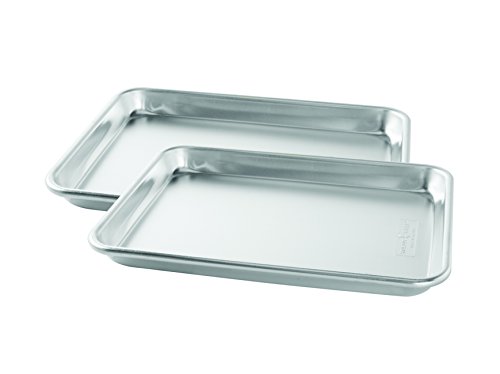
Nordic Ware Naturals
The Naturals line is built around plain, uncoated aluminum with rolled rims, and it behaves like the sheet pans used in working bakeries: light in the hand, quick to heat, quick to cool, and completely indifferent to metal utensils. There is no coating to protect, so the pans darken and pick up marks over the years without losing performance. Bakers who grew up with this style tend to trust it because what you see is exactly what you get, season after season.
Strengths
- Uncoated surface cannot peel, blister or wear through, so the pans age gracefully for many years
- Aluminum heats evenly and cools fast, which helps stop carryover browning on cookies
- Rolled rims resist warping and give you a secure grip with oven mitts
Trade-offs
- Bare aluminum can react with acidic foods and discolour with tomato or citrus batters
- Shiny surface browns more gently, which some bakers find slow for crisp edges
- Needs parchment or greasing for sticky bakes because nothing is nonstick by design
Best for: Bakers who bake weekly, prefer parchment, and want pans that outlast coatings. Not suited for: Anyone who wants effortless release for sticky cakes without liners. This is a mid-tier option; check price on Amazon when you are ready to compare current listings.

USA Pan Bakeware
USA Pan builds its bakeware from aluminized steel with a corrugated surface texture and a silicone-based nonstick coating. The ridges are not decoration: they increase surface area, encourage air flow under food, and help baked goods release with very little greasing. The pans feel noticeably substantial, with a heft that signals thick material and careful finishing, and the fluted texture gives cookies and roasted vegetables an unusually even bottom colour.
Strengths
- Corrugated surface promotes even browning and remarkably easy release
- Heavy aluminized steel resists warping through repeated high-heat cycles
- Coating is applied without the older chemistries many buyers now avoid
Trade-offs
- The textured surface needs a soft brush to clean crumbs out of the ridges
- Premium positioning means replacing a single pan costs more than basic lines
- Coating still has a lifespan, so metal utensils and harsh scouring shorten it
Best for: Regular bakers who want nonstick convenience with a more durable, professional feel. Not suited for: Bakers who prefer completely uncoated pans they can scrub without thinking. This is a premium-leaning mid-tier option; check price on Amazon when you are ready to compare current listings.

Calphalon Nonstick Bakeware
Calphalon approaches bakeware the way it approaches cookware: heavier-gauge steel cores with layered nonstick surfaces and a slightly more engineered feel than entry-level lines. The pans have rolled edges, a reassuring weight, and coatings designed to release cakes cleanly and survive years of regular use when they are treated properly. It sits in the middle of the market on purpose, aimed at bakers who found basic sets flimsy but do not need professional equipment.
Strengths
- Heavier steel core browns evenly and resists the warping that plagues thin pans
- Layered nonstick releases cakes and muffins cleanly with minimal greasing
- Rolled edges and solid finishing make the pans comfortable to handle hot
Trade-offs
- Weight that helps browning makes full pans heavier to lift from a low oven
- Coating care rules still apply: no metal edges, no harsh pads, gentle washing
- Sets are curated, so the piece mix may not match every baker’s habits
Best for: Committed home bakers who bake most weeks and want a step up in durability. Not suited for: Anyone shopping purely on the lowest possible outlay for a rarely used set. This is a mid-tier option; check price on Amazon when you are ready to compare current listings.
Thinking About Value Over Years, Not at the Till
Bakeware value is a cost-per-year question disguised as a price question. A coating that fails in two years of weekly baking makes a cheap set expensive, while a heavier set that serves for a decade spreads its cost so thinly that the purchase barely registers. This is why experienced bakers talk about cost per bake rather than cost per box, and why the middle of the market, where materials thicken and coatings improve without collector pricing, so often represents the sensible money.
Value also hides in what a set prevents. Pans that warp cause burnt edges and raw centres, which waste ingredients that cost far more over a year than the difference between set tiers. Pans that release badly tear cakes that took an hour to make. Pans that are miserable to wash get used less, which quietly pushes a household toward takeaway food and packaged snacks. None of these costs appear on a receipt, and all of them are real.
The counterweight is honesty about use. A magnificent set bought for a baking habit that does not exist is poor value at any price, because value lives in use. If you bake twice a month, a solid entry or mid-range set, cared for properly, will serve you for years and the premium tier buys you little you will notice. If you bake daily, the calculation inverts: durability, flatness and release become working tools, and paying for them is not indulgence but maintenance of a hobby you actually practise.
Common Mistakes That Make Good Sets Seem Bad
The most common bakeware mistake is buying by piece count. A large number on the box often includes lids, racks, utensils and duplicate shapes, while the four pans you actually need may be thinner than the same money spent on a smaller set. The second mistake is ignoring your cupboard and oven measurements. A set whose largest pan crowds the oven walls blocks hot air circulation and bakes unevenly, and pans that cannot nest or stack in your storage will end up scattered, scratched and resented.
Heat mistakes follow. Preheating an empty nonstick pan, roasting at the top of a pan’s tolerance every night, and broiling under coatings never designed for it all shorten coating life dramatically. So does thermal shock: hot pan, cold tap, permanent twist. Another quiet killer is the dishwasher habit. Even pans labelled dishwasher safe lose coating performance faster with detergent and high heat, and uncoated aluminum can emerge grey and chalky. Hand washing takes minutes and is the cheapest longevity upgrade available.
Finally, bakers blame pans for recipe problems that are really calibration problems. A new dark pan will brown the same cookies faster; that is physics, not a defect. A glass dish will keep a casserole bubbling long after it leaves the oven; that is stored heat, not overcooking by the recipe. Judge a new set over five or six familiar bakes, adjusting temperature and timing as you learn its character, before deciding it underperforms. Sets returned or discarded in week one are often perfectly good pans that never got a fair calibration period.
How to Buy Smart
Buy the smallest set that covers your weekly baking, in the heaviest construction your budget allows, from a line whose individual pieces remain available for future duplicates. Read the piece list, measure your oven and cupboards, and decide in advance how you will store the stack. If half your baking is one shape, consider a compact set plus one excellent individual pan for that shape; that hybrid captures most set advantages while removing the compromise where it would hurt most.
Care, Cleaning and Storage That Double a Set’s Life
Most bakeware does not die in the oven. It dies at the sink and in the cupboard. Coatings are scratched by stacked pans grinding against each other, by metal utensils, by scouring pads, and by the slow chemical assault of dishwasher detergent. Uncoated pans survive more abuse but stain, and bakers who attack stains aggressively with harsh pads trade appearance for a rougher surface that food clings to. A gentle routine protects both families.
Wash pans warm rather than cold, because a hot pan plunged into cold water is the classic warping scenario, especially for thinner steel. Soak stuck-on food instead of chiselling it. Use soft sponges and brushes, and keep a paste of baking soda for the browned polymerised oil that builds up on sheet pans; that patina is harmless and even mildly nonstick, so there is no need to restore a pan to showroom brightness. Dry pans fully before stacking, and place a cloth, a paper towel or a pan protector between coated surfaces. Stored this way, a mid-range set routinely outlasts the same set treated carelessly by many years.
Oven habits matter too. Never cut food in the pan. Never use a coated pan under a broiler unless the maker explicitly allows it. Avoid aerosol sprays on nonstick surfaces, because their propellant additives bake into a varnish that makes the coating seem to fail when the pan is actually just glazed. Grease with butter, oil on a paper towel, or a liner instead. Finally, rotate your sheet pans if you own two, because the pan that does every roast and every cookie batch will age twice as fast as its twin for no benefit.
Bottom Line
The bakeware set pros and cons resolve into a simple rule: sets reward bakers whose habits are broad and regular, and punish only those who buy counts instead of pieces or sizes that ignore their storage. Choose a set that matches your real week of cooking, care for it with one simple routine, and the pros compound for years while most cons never appear.
Putting the Ledger to Work: A Week With the Bakeware set
Treat this diary as the practical sequel to the ledger above: for one ordinary week, note each time the bakeware set delights you and each time it irritates you, in the moment rather than from memory at the end. Record the jobs where the advantages felt largest, because a strength that only appears on tasks you rarely do is worth less than the summary tables suggest. Record the irritations with equal honesty, and mark whether each one came from the product itself, from your space, or from a habit you could change once and forget. Pay attention to the setup and put-away minutes, since trade-offs that look trivial on paper become the deciding factor when they repeat twice a day for years.
Note who else used the bakeware set during the week and what they struggled with, because a drawback that only affects the most patient person in the house is easy to underestimate. Watch for the workaround you invent by day three, and judge it fairly: a painless workaround retires a con, while a fiddly one confirms it. Where a shortlist names specific examples, such as Nordic Ware Naturals, run these same checks against that listing line by line rather than assuming the general verdict transfers unchanged. Apply the identical test to USA Pan Bakeware as well, on the same day and under the same conditions, because a fair comparison needs one ruler rather than two moods.
- Log delights and irritations as they happen
- Time the setup and the put-away honestly
- Test the worst job, not the easiest one
- Note the workaround you invent by day three
- Ask a second user for their verdict
- Write the sentence you would tell a friend
If Calphalon Nonstick Bakeware is also in contention, give it the same worksheet and let the three sets of answers sit side by side before anyone reaches for a checkout button. Test the loudest, messiest, or slowest mode at the time of day you would actually use it, not at a forgiving hour chosen to make the product look good. Check the cleaning burden after the worst realistic job rather than the easiest one, since the honest version of that chore is the one you will live with. Notice whether the headline strength survives ordinary ingredients, ordinary timing, and an ordinary tired evening, because strengths that need perfect conditions are narrower than they appear.
Write down any benefit you had not expected, since unlisted advantages discovered in use are often the ones that keep a product in the house for a decade. Write down any drawback that no review mentioned, and consider whether it is specific to your space, your water, your power supply, or your household size. Compare the week against the tool or appliance the bakeware set replaced, task by task, instead of against an idealised version of what ownership would feel like. Ask whether the cons cluster at the start of each session, in the middle of the work, or in the cleanup, because that pattern tells you whether habit can fix them.
Decide which single con you would pay to remove and which single pro you would refuse to give up, since that pair of answers is the real verdict of the week. If the diary shows the balance tilting on one recurring job, re-read the sections above with that job in mind rather than averaging your impressions across everything. Finish the week by writing the sentence you would say to a friend who asked about the bakeware set, and check whether it sounds like the summary you believed before the diary began. Keep the diary somewhere you will find it before a future replacement decision, because your own recorded week outweighs any general verdict, including the ones in this guide.
Notice, too, whether your standards moved during the week: some apparent cons are simply the feeling of a new routine replacing an old one, and they fade on their own. Mark the moment you stopped thinking about the trade-offs and just got on with the task at hand, because that moment is when the balance quietly settled itself. If no such moment arrived, that absence is data as well, and it usually points at one specific friction worth naming precisely rather than blaming the whole product. Whatever the category, photograph your intended spot with the neighbouring items in place, because a picture exposes crowding that measurements alone politely ignore.
Keep every measurement, tally, and note from these checks in one place, ideally with the receipt, so the next decision in this category starts from your evidence rather than from scratch. Involve the household early where the product is shared, since a decision everyone helped measure is a decision nobody relitigates at the first inconvenience. Prefer the option that fits your existing routine with the fewest new habits, because each new habit is a small tax collected every single day. Be wary of solving a storage problem by creating a carrying problem, since distance between storage and use is where good equipment goes to be forgotten.
Frequently Asked Questions
Is it better to buy a bakeware set or individual pans?
It depends on your starting point and habits. Starting from zero, or baking across many shapes, a set gives coherence and better value per pan. If you already own good core pans or bake mainly one thing, individual purchases let you choose the best example of each shape. Many experienced bakers end up with a set as the foundation plus a few favourite individual pieces.
What is the biggest disadvantage of a bakeware set?
The compromise piece. Sets bundle shapes chosen by the manufacturer, so one or two pans may be thinner, smaller or simply unused in your kitchen. The defence is to read the actual piece list, judge the set by its weakest core pan, and choose the smallest set that covers what you bake weekly rather than the largest count on offer.
Do bakeware sets last as long as individual pans?
Construction decides lifespan more than bundling does. An uncoated set from a quality line can last decades, just like individual pans. Coated sets age together, so heavy use of a few pieces can make the whole set feel tired sooner. Buying from lines that sell pieces individually lets you replace or duplicate the hardest-working pans and extends the set’s useful life.
Are large bakeware sets better value?
Only if you use the extra pieces. A large count often includes lids, utensils and duplicate shapes, so the cost per pan you actually use can be worse than a compact set. Calculate value by the pans you will reach for monthly. For most households, a focused set of core shapes delivers the best value per bake over the years.
Can I mix a set with pans in other materials?
Yes, and most bakers should. A metal set covers sheets, cakes and loaves, while one glass or ceramic dish handles casseroles that go to the table, and a silicone mould or two can serve sticky or shaped bakes. Mixing deliberately, for defined jobs, keeps the coherence benefits of a set while removing the one-material compromise.
How do I stop a set’s coating wearing out early?
Hand wash with soft tools, never cut food in the pan, avoid aerosol sprays whose additives bake into a film, keep coated pans away from broiler heat, and store pieces separated by cloth or protectors. Most coating failure is a storage and washing story rather than an oven story, so these habits routinely double the useful life of a coated set.
Related Guides
bakeware set buying guide bakeware set review bakeware set reviews how to choose a bakeware set is a bakeware set worth it
Related reading: the best bakeware sets we have tested, our guide to nonstick bakeware sets, glass bakeware sets compared, ceramic bakeware sets compared.
Parchment paper deserves a place in any discussion of bakeware, because it changes what a pan needs to do. With a liner, release becomes the paper’s job and the pan only has to deliver even heat, which is why many professionals happily use plain uncoated pans for everything. Silicone mats do similar work for cookies and roasted items, though they slightly soften bottom browning. Choosing to bake with liners is not cheating; it is a system decision that lets simpler, longer-lasting pans perform like premium ones.
Oven thermometers expose an uncomfortable truth: many home ovens run hotter or cooler than their dials claim, and they cycle around the target rather than holding it. Before blaming a new set for pale or dark results, confirm what temperature your oven actually delivers. A pan cannot compensate for an oven that is significantly off, and recalibrating your expectations, or the oven itself, often transforms results more than any purchase could.
Greasing technique matters more than greasing quantity. A thin, complete film of butter or oil, worked into corners with a brush or paper towel, releases better than a thick, uneven layer that pools and fries into patches. Flouring a greased cake pan adds insurance for delicate sponges, while cocoa powder does the same job for chocolate cakes without leaving pale marks. These small habits make mid-range pans perform like expensive ones.
Cooling is a stage of baking, not an afterthought. Cakes need a short rest in the pan so their structure firms enough to turn out without tearing, but a long rest traps steam and sogs the crust. Cookies firm up on the hot sheet for a few minutes before they can move without breaking, then finish cooling on a rack where air reaches their bottoms. A set that includes a rack, or a cupboard that has one, completes the system.
Rotation is the simplest uneven-baking fix ever devised. Home ovens have hot spots, usually toward the back and near the elements, and turning a pan halfway through baking averages them out. Two pans swapped between shelves benefit even more. If your bakes brown unevenly, rotate faithfully for a month before shopping for new pans; the problem is as often the oven’s personality as the pan’s quality.
Batch size changes pan choice. A recipe doubled into a deeper pan does not simply take a little longer; the centre may still be liquid when the edges are overdone, because heat travels slowly through batter. Two shallower pans almost always beat one deep one for even results. This is a quiet argument for sets with duplicate core pieces, and for owning two sheet pans rather than one heroic oversized tray.
Frozen and chilled doughs are a useful stress test for any pan. Cookie dough baked from frozen spends longer in the oven, which exaggerates differences in browning between dark and light finishes. If your household freezes dough for fresh-baked cookies on demand, favour lighter finishes and heavier gauges, and note the adjusted timing on the recipe after the first successful batch.
Acidic foods and bare metal need a truce. Tomato sauces, rhubarb, citrus curds and vinegar-based glazes can react with uncoated aluminum during long contact, picking up flavour and colour you did not invite. Line the pan, choose a coated or enamelled surface, or move the food promptly after baking. Short bakes rarely cause trouble; it is the slow casserole and the overnight marinade that need planning.
The sound of a pan tells you things. A sharp bang a few minutes into roasting is a pan flexing as it heats, which usually means thin material expanding unevenly. Occasional flexing in a light pan is common and not dangerous, but it spills juices and signals a pan that will eventually take a permanent twist. Heavy pans heat silently, which is one of those small quality signals you only appreciate after living with both kinds.
Lids are the most misunderstood part of set value. A lid that fits a rectangular pan turns it into a transport container and a marinating dish, and helps keep casseroles moist. Yet lids are also how modest sets inflate their piece counts. Judge a set by its pans first and treat lids as a genuine bonus only when they fit pieces you will actually use weekly.
Handedness and height sound trivial until you lift a full, hot rectangular pan from a low oven while wearing mitts. Wide rims give your thumbs a landing place. Silicone grips help if your mitts are thin. Low, flimsy rims force a fingertip grip that nobody trusts with a bubbling casserole. When comparing sets in person or in photographs, look at the rims first; they are where daily confidence is built.
Second-hand bakeware can be excellent value, with one caution: coatings. Uncoated aluminum and steel pans from quality makers survive decades and can be scrubbed back to honest working condition. Coated pans with scratches, bubbles or flaking should be passed over, because their best years are behind them and damaged coatings only deteriorate faster. Buy the uncoated classics used; buy coatings new.
A note on colour: dark pans are not a defect and light pans are not old-fashioned. They are different tools. Dark finishes suit foods that want aggressive bottom browning, like pizza-style flatbreads and roasted potatoes. Light finishes protect pale cakes, shortbread and meringue-based bakes. A thoughtful set, or a thoughtful baker mixing pieces, uses each where it shines instead of declaring one universally superior.
Stacking order protects coatings better than any spray or treatment. Heaviest pans at the bottom, coated pans separated by cloth or protectors, and nothing with sharp feet or rough bases resting inside a nonstick surface. Cupboards undo more coatings than ovens do, simply because pans are stored three hundred days a year and baked on perhaps fifty.
If you bake for people with different needs, pans quietly help. A muffin pan portions batter evenly for lunchboxes. A loaf pan turns a standard recipe into neat, freezable slices. Sheet pans let you roast vegetables on one side and proteins on the other for households cooking two versions of dinner at once. The right shapes reduce friction in ways that have nothing to do with browning curves.
Cleaning roasted pans is easier warm. Once a sheet pan has cooled enough to handle but still holds warmth, a soak in hot soapy water loosens most residue without a fight. Leave it overnight and the same residue sets like varnish. Bakers who wash promptly can use gentler tools, which keeps surfaces smoother, which makes the next wash easier still. Good pans and good habits compound together.
Recipe language assumes standard pans. When a recipe says a batter fits a particular pan, it assumes typical depth and dimensions, and substituting a much deeper or shallower piece changes the bake even if the volume matches. A coherent set, whose pieces follow standard sizing, makes recipes behave as written. That predictability is worth real money to bakers who follow published recipes closely.
Finally, remember that pans are among the longest-lived objects in a kitchen. Appliances are replaced, knives are replaced, but a well-chosen sheet pan can serve for decades. That longevity argues for buying the best-constructed set your actual baking habits justify, choosing classic shapes over fashionable ones, and favouring makers whose individual pieces remain available when you eventually want a duplicate.
Seasonal baking changes what a set must do. Autumn brings pies and gratins that sit heavily in dishes and travel to other houses. Winter brings cookie batches in rotation, where a second sheet pan doubles your output and a reliable rack becomes essential furniture. Spring brings lighter cakes that expose release problems, and summer brings fruit crisps that bubble over and test how easily a pan washes. A set that survives all four seasons without a weak chapter is a set chosen well.
Travelling bakes deserve a thought when choosing pans. A rectangular pan with a secure lid becomes a carrier for school events and potlucks, while loose cakes on plates are an anxiety with a crust. If your baking regularly leaves the house, favour sets whose core pans have lids available or whose rims accept foil tightly, and practise the journey once with something forgiving before trusting it with a showpiece.
Children change bakeware priorities in ways catalogues never mention. Pans need to be light enough for supervised young helpers, cool quickly enough to reduce lingering danger on counters, and wash easily enough that baking together does not end with an adult scrubbing alone. Silicone grips and moderate sizes earn their place in family kitchens for reasons that have nothing to do with browning curves and everything to do with Tuesday evenings.
Small ovens and countertop ovens impose their own geometry. A set designed for a full-size range may include a sheet that simply cannot enter a compact oven, leaving the owner with a flagship pan that lives elsewhere. Measure before buying, and if your oven is compact, build around smaller sheets and standard cake and loaf sizes, which fit almost everywhere and still cover the great majority of recipes.
Altitude and humidity quietly alter baking, and pans interact with both. At altitude, batters rise faster and set slower, so pan depth and fill level matter more, and dark pans can over-brown before centres set. In humid climates, crispness fades quickly, making racks and prompt cooling more important. None of this changes which set to buy, but it changes which pieces you will lean on hardest.
There is a particular pleasure in a pan that has history. Uncoated pans develop a patina that records years of roasts and bakes, and many bakers find that seasoned surface releases better with age. Coated pans move in the opposite direction, starting perfect and declining gently. Knowing which direction your set travels helps you interpret its performance honestly instead of mistaking seasoning for damage or wear for failure.
Recipe scaling is where standard sets quietly shine. Doubling a brownie recipe into the next standard pan size is a known manoeuvre with predictable timing, while eccentric pans demand guesswork. Bakers who cook for crowds, bake sales or freezer stocking benefit from that predictability every time they scale, and it is a genuine argument for boring, standard sizing over novelty shapes.
Noise is an unglamorous quality signal. A cupboard where pans nest silently is a cupboard where coatings are not grinding together at every retrieval. If your storage forces pans to clash, add protectors or hang the most-used sheet where it can be reached without excavating a stack. The cheapest coating preservation programme ever devised is a few squares of cloth and a moment of care.
Gift buying follows different rules from self buying. A set given to a new household should favour forgiveness: coated surfaces, standard sizes, easy washing and nothing that demands specialist knowledge. A set given to an experienced baker should favour construction, because they will judge the sheet pan in the first ten seconds and the coating in the second year. When in doubt, gift the set you would want to inherit.
Freezer use expands a set’s job description. Muffin pans freeze portions of stock, sauces and baby food into tidy pucks. Loaf pans shape terrines and ice-cream cakes. Sheet pans freeze berries and dumplings in a single layer before bagging. Metal sets handle this double duty without complaint, though lining helps release and protects finishes from freezer moisture during long storage.
Finally, trust your own calibration notes over generic advice, including this guide’s. Your oven, your recipes and your hands form a system no reviewer can replicate. A set that suits your system, at a construction level your budget supports, chosen for the shapes you truly use, will outperform a theoretically superior set bought for someone else’s kitchen. That is the principle underneath every section here.
Consider how a set behaves with your favourite recipes specifically, not baking in the abstract. If your signature bake is a sticky caramel traybake, release and washing dominate your life and coatings earn their keep daily. If it is a crusty loaf, pan depth and material dominate. Bring one signature recipe mentally through every candidate set and ask where it would struggle; that small exercise predicts satisfaction better than any feature comparison.
Oven gloves and mitts are part of the bakeware system too. Bulky mitts need generous rims to grip; slim gloves can manage sleeker pans. If you have ever nearly tipped a full casserole because the rim offered nothing to hold, you already know this matters. When choosing between otherwise equal sets, pick the rim design your hands and mitts handle with confidence at a hot oven door.
There is a quiet economics to duplicates. A second sheet pan costs little compared with the set, yet it transforms batch baking, letting one tray cool while another bakes and doubling cookie output without doubling time. If a set tempts you mainly because it includes two sheets, that instinct is sound. Duplicates of your hardest-working shape are rarely wasted money, unlike duplicates of shapes you use twice a year.
Washing technology has changed what care means. Modern detergents are effective at lower temperatures, which is kinder to coatings, and long soaking is safer than aggressive scrubbing for almost every finish. The bakers whose pans look best after five years are rarely the ones who scrub hardest; they are the ones who soak patiently, wash gently and dry completely, every time, as a rhythm rather than a project.
Think about who else uses your kitchen. A set shared with housemates, teenagers or enthusiastic beginners will face metal utensils and dishwashers whatever the house rules say. In shared kitchens, uncoated pans are not just a preference but a peace treaty, because they forgive the treatment they will inevitably receive. Buying for the kitchen you share beats buying for the kitchen you wish you had.
Presentation pans occupy a small but real niche. A beautiful ceramic dish that carries a crumble from oven to table saves a transfer, holds heat through a meal and earns compliments a steel pan never will. Most metal sets will not cover this job, which is why so many set owners add one presentable dish later. Planning that addition from the start prevents the false feeling that the set failed at a job it never claimed.
Weight cuts both ways and deserves honest thought. Heavy pans bake evenly and resist warping, but a heavy rectangular pan full of lasagne is a serious lift from a low oven, especially for bakers with limited wrist or shoulder strength. If lifting is a concern, moderate weight with good rims and grips is the wiser specification, and there is no prize for owning the heaviest pan in the neighbourhood.
Lastly, give any new set a fair season before judging it. The first bakes in unfamiliar pans include calibration errors that belong to the baker, not the bakeware. By the tenth bake, timings are instinctive, greasing is calibrated and the pans have either become invisible equipment, which is the highest praise kitchen tools earn, or revealed a genuine flaw you can name precisely. Both outcomes are useful knowledge.


