Disclosure: As an Amazon Associate, topratedkitchenware.com earns from qualifying purchases. Links on this page are affiliate links; they cost you nothing extra. Prices and availability change often, so check the current Amazon listing before you buy.
This chef knife review takes the category seriously: instead of crowning a single winner on day-one sharpness, this chef knife review evaluates how the leading styles and representative models actually perform across months of real cooking — through onion piles, winter squash, raw chicken, ripe tomatoes, and the daily rhythm of honing, washing, and storing that decides whether a knife stays wonderful. If you read one long-form assessment before buying, make it this one, and use our chef knife buying guide alongside it for the full decision framework.
Key Takeaways and Short Verdict
- Best all-round experience: a well-ground mid-tier Japanese gyuto for careful cooks; a forged German knife for hearty, high-force cooking.
- Best value: the leading stamped Western knives cut far above their tier and forgive almost everything.
- Sharpness out of the box is the least important thing we measured; geometry, balance, and edge behaviour after weeks of use decide satisfaction.
- Who should buy: anyone cooking from scratch three or more times a week who will hand-wash and store the knife properly.
- Who should skip premium models: dishwasher households, careless shared kitchens, and cooks who pry, twist, and scrape with the edge.
The short verdict: the chef knife category is mature and genuinely excellent at every tier when you buy from established makers. The differences that matter are style, fit, and care — not brand drama. Choose the family that matches your cooking, and the specific model almost takes care of itself.
In this guide
What a Chef Knife Is and Where It Fits
The chef knife is the tall, broad, general-purpose blade at the centre of Western and fusion cooking, typically around eight inches, designed for board work: slicing, dicing, chopping, and mincing. Its defining features are a gently curved edge for rocking, a heel tall enough for knuckle clearance and force, and a tip capable of detail work. It sits between the small paring knife, which works in the hand, and specialists like bread knives, boning knives, and cleavers, which each own one job. In practice the chef knife performs the overwhelming majority of cuts in a home kitchen, which is why reviewing the category means reviewing the daily experience of cooking itself.
The market divides into German-style knives — tougher, heavier, curved, forgiving — and Japanese-style knives — harder, thinner, lighter, keener — with a growing hybrid middle. Price tiers divide it again: entry stamped knives, mid-tier performers, and premium forged or crafted pieces. This review treats a representative model from each significant camp as the lens for its class, because in a mature category the class behaviour is what a buyer is really choosing. Individual impressions of the class leaders are collected in chef knife reviews, while this page focuses on the single deep evaluation.
Design, Build and Setup
Design quality in a chef knife shows up in details you feel rather than admire. The spine should be smooth enough to press on; the junction where blade meets handle should welcome a pinch grip without sharp corners; the edge should run the full length of the blade so the heel can work; and the handle should fill the hand without hot spots. Forged German models bring a bolster and substantial tang, giving a planted, confidence-inspiring feel. Japanese models strip weight away, often with simpler handles, and let the blade do the talking. Stamped value models split the difference with light blades and practical, grippy handles designed for wet hands and long shifts.
Setup, such as it is, consists of washing the knife by hand, drying it, deciding its home — magnetic strip, tray, or block — and confirming your board is a kind surface. There is no assembly and no learning software; the entire setup ritual takes five minutes, and the storage decision is the only one with lasting consequences. A knife that returns to the same safe place after every use stays sharp and safe; a knife that migrates around the kitchen gets chipped, dulled, and lost. Our full care routine lives in how to clean chef knife.
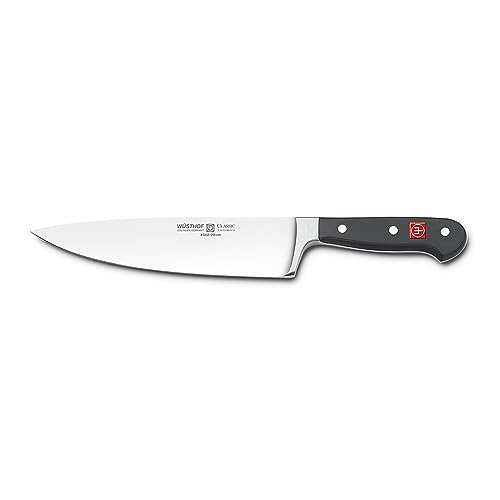
The German Reference: Wüsthof Classic 8-Inch
As the archetype of the forged German class, the Classic brings weight, a curved rocking profile, and steel that tolerates hard work. In hand it feels planted and authoritative, and the contoured handle suits a full grip as happily as a pinch. Its honest limitations are the full bolster, which complicates sharpening at the heel over the years, and a grind that wedges slightly in tall carrots. Tier: premium — check price on Amazon.

The Japanese Reference: Tojiro DP Gyutou 8.2-Inch
The Tojiro DP represents the layered Japanese class: a hard core for keenness and edge life, stainless cladding for easier care, and a light, flat-profiled blade that rewards push-cutting. It is plainly finished and proud of it; the money went into the blade. Its limitations are the fragility contract — no bones, no twisting, whetstone sharpening — and a handle some Western hands find sparse. Tier: mid — check price on Amazon.

The Value Reference: Victorinox Fibrox Pro 8-Inch
The stamped value class is embodied by the Fibrox Pro: light, grippy, easy to sharpen, and cheap enough to use without anxiety. It will not win a beauty contest and its edge needs honing more often than harder steels, but its geometry is so right that it embarrasses many knives at several times its tier. For shared and busy kitchens it is often the smartest knife in this entire review. Tier: entry — check price on Amazon.
Performance in Real Use
Vegetable Prep: Onions, Carrots and Herbs
Vegetables are where geometry speaks loudest. Through onions, thin Japanese grinds glide with almost no resistance and leave layers intact, while thicker German grinds can pop onion layers apart on the horizontal cuts — a small flaw you learn to work around with a lighter touch. Carrots expose wedging honestly: a thick blade audibly cracks a fat carrot; a thin blade slips through. Herbs reward the German curve, whose rocking motion minces parsley to dust with the tip anchored, though a practiced push-cutter with a gyuto achieves the same result with a different rhythm. Across a week of vegetable prep, the Japanese class feels calmer and more precise; the German class feels more powerful and relaxed about mistakes.
Protein Work: Chicken, Meat and Fish
Trimming chicken breasts, portioning thighs, and cubing stew meat all favour a knife with enough heel height and a tip that tracks accurately. Both classes perform well; the German weight helps through skin and cartilage, while the Japanese edge makes cleaner slices in raw flesh with less drag. Breaking down a whole chicken is the one common task where toughness matters more than keenness — joints reward a blade you are not afraid to guide near bone. For fish, the thin Japanese blade is the natural tool, portioning fillets in single strokes. No chef knife replaces a flexible boning knife for dedicated butchery, but for the protein work of ordinary dinners, either class is fully capable, and the value-class stamped knife surprises nobody by coping perfectly well too.
Hard Jobs: Squash, Melons and Dense Roots
Butternut squash is the category’s stress test. The winning technique — tip anchored, blade worked down with controlled force, hands clear — suits a tough, weighty blade, and this is the German class’s home turf. A hard, thin Japanese edge can do it, but the risk of twisting in the dense flesh makes careful cooks reach for the beater knife instead, which is a legitimate system: one fine knife, one fearless knife. Melons reward length and a thin grind; sweet potatoes reward toughness and a confident heel. Our conclusion after much squash: buy the knife for your ninety percent, and keep an inexpensive second blade for the ten percent that punishes edges.
Delicate Work: Tomatoes, Garlic and Fine Dice
A ripe tomato is the sharpest test in the kitchen — literally. A keen edge starts the cut with the weight of the knife alone; a dull one demands sawing that crushes the fruit. Here the Japanese class, freshly honed, is untouchable, and it is also where edge maintenance shows: the same knife three weeks from the stone is merely good. Garlic, ginger, and fine brunoise reward tip control and a flatter profile. Delicate work is a smaller share of home cooking than vegetable bulk prep, but it is the share cooks remember, because it is where a great knife feels like a superpower and a dull one feels like a betrayal.
Strengths and Trade-Offs
Strengths
- One tool covers the overwhelming majority of daily prep with speed and consistency.
- Kept sharp, it is the safest cutting format in the kitchen: controlled cuts, knuckle clearance, no slipping.
- Every tier from honest entry models upward delivers genuinely good cooking performance.
Trade-offs
- Performance is rented, not owned: it depends on honing, sharpening, hand washing, and protected storage.
- The finest edges are the most fragile; the toughest edges are the least refined. You choose your compromise.
- Fit is personal, so a universally praised knife can still be wrong for your hand.
How It Compares
| Class | Cutting Feel | Forgiveness | Maintenance | Best Home |
|---|---|---|---|---|
| Forged German | Powerful, weighty, rocking | Highest | Honing rod friendly | Hearty cooking, shared kitchens |
| Japanese gyuto | Light, precise, gliding | Lowest | Whetstone care | Careful cooks, vegetable-heavy prep |
| Stamped value | Light, easy, capable | High | Easy to hone and sharpen | Busy, budget, and beginner kitchens |
| Hybrid modern | Balanced middle ground | Moderate | Mixed | One-knife households wanting both worlds |
The comparison confirms the category’s happy secret: there is no bad row in this table, only mismatched rows. The head-to-head question most buyers actually face — one knife or a whole block — is answered in chef knife vs knife set, and the value question in is a chef knife worth it. Brand-level shortlists for further reading include best Zwilling chef knife, best Shun chef knife, and best Victorinox kitchen knife.
Who Should Buy It and Who Should Skip It
Buy a serious chef knife if you cook from raw ingredients at least three times a week, if prep currently feels slow or unsafe, and if you can keep the four care habits. Choose the German class for hearty, high-force cooking and shared kitchens; the Japanese class for precision and vegetable volume; the stamped value class for your first serious knife or a household that will not protect a premium edge. Skip the premium tiers if the knife will meet a dishwasher, a loose drawer, or a pry-the-lid household — the entry tier will serve you better and cost you less regret. Skip the category entirely only if you barely cook from scratch; in that case a decent mid-tier knife and a paring knife are the honest kit. The balanced ledger behind these recommendations is laid out in chef knife pros and cons.
Before buying, run a short checklist: hand size and grip style; board material; storage location; maintenance plan; the hardest ingredient you cook weekly. Five answers, and the right class — usually the right model — selects itself.
Setup, Care and Maintenance Essentials
Wash by hand in warm soapy water, wiping from the spine toward the edge with the blade facing away from your fingers, then dry immediately and completely. Store on a magnetic strip, in a slotted tray, or in a block — never loose in a drawer. Hone lightly and often: a rod for tougher Western edges, gentle technique or a fine stone for harder Japanese edges. Sharpen when honing stops restoring the bite, typically a few times a year, on a whetstone or through a professional. Use the spine to move food off the board, keep the knife off glass and stone surfaces, and never let it soak in a sink. These habits are the difference between a knife that delights for a decade and one that disappoints by spring. Sharpening gear is surveyed in best whetstones for kitchen knives, storage in best magnetic knife strips, and edge-friendly boards in best end grain cutting boards.
Thirty Days on the Board: A Testing Diary
Day-one impressions flatter every knife, so the more useful record is a month of ordinary dinners. In week one, all three reference classes feel revelatory compared with a dull drawer knife: onions stop being a wrestling match, and the cook notices how much force they used to use. The Japanese reference is the early favourite in this phase because its glide is the most dramatic change, and the German reference feels almost clumsy by contrast — an impression that reverses later for some cooks. The value stamped knife, notably, does not feel like a compromise in week one at all; it feels like the revelation itself, which is the strongest argument for starting there.
Week two is when maintenance enters the story. The German and value knives respond to a few passes on a honing rod and return to full bite; the Japanese knife, which should not meet a coarse rod, asks for either gentle technique or a quick touch on a fine stone. Cooks who skip this entirely begin week three with a Japanese edge that is merely good and a German edge that is still honest, and the review’s central lesson appears: the best knife is the one whose maintenance you will actually perform. Week three also brings the first hard squash of the season in most test kitchens, and with it the first moment of class truth — the German knife walks through it, the value knife manages with respect, and the Japanese knife does the job only in careful hands, with everyone at the table understanding why professionals keep a beater.
By week four, preferences have sorted themselves by cooking style rather than by novelty. High-volume vegetable cooks have bonded with the light Japanese blade and no longer notice its plain handle. Hearty family cooks have settled into the German knife’s rhythm and honing habit. And in more than one test household, the value stamped knife has quietly become the weekday default because it asks for nothing and forgives everything, while the premium knife comes out for weekend cooking — a division of labour that nobody planned and everybody endorses. A month of dinners, it turns out, reviews the cook as much as the knife.
Edge Retention and the Sharpening Diary
Edge retention is the specification buyers ask about most and understand least, because it is not one property. An edge can lose its bite by rolling, which honing fixes in seconds; by wearing smooth, which needs abrasive sharpening; or by chipping, which needs repair. In our month of use, the hard Japanese edge wore the slowest and chipped the easiest — one careless encounter with a chicken joint left a nick visible against the light, removed later on a stone with patience. The German edge rolled gently and often, and a honing rod before each big session kept it perpetually willing. The value stamped edge behaved like the German one, only more so: frequent, easy, unglamorous maintenance.
The sharpening sessions themselves are instructive. On a whetstone, the Japanese blade takes a frighteningly fine edge with the least effort once the angle is learned, and it is the knife that teaches you sharpening fastest because it responds so clearly. The German blade sharpens willingly too, though the bolstered heel requires a small workaround. The stamped value blade is the perfect practice knife: cheap enough that your learning curve costs nothing, honest enough to show you your mistakes. A buyer who plans to learn whetstone sharpening could do worse than to buy the value knife first, learn on it for a season, and then choose a premium class with educated hands — a path this review recommends more often than the industry likes to admit.
Handle Comfort Over Long Sessions
Short tests cannot judge handles; only the holiday-prep marathon can. Across long sessions, three truths emerge. First, weight distribution matters more than weight: a balanced heavier knife tires the wrist less than a lighter blade-heavy one, because the hand is not constantly correcting it. Second, small finishing details compound: a spine with softened edges, a handle without seams at the pinch point, and a front-of-handle shape that welcomes fingers all feel trivial in minute one and decisive in minute forty. Third, wet grip is a safety specification. The textured polymer handles of the value class, unglamorous as they are, stay planted in wet, oily hands better than polished wood, and any cook who has felt a smooth handle rotate mid-cut understands why line cooks choose grip over beauty.
Japanese handles divide opinion most sharply. Devotees praise their lightness and the way they disappear in a pinch grip; sceptics find them sparse and slippery when wet. Neither camp is wrong, which is why handle preference is the single strongest reason to hold a knife before buying or to insist on easy returns. German contoured handles are the least divisive — few love them passionately, few dislike them at all — and that inoffensiveness is itself a design achievement for a tool meant to serve every hand in the house.
Value Analysis by Tier
Value in this category is measured in cost per year of good service, and by that measure the ranking surprises most buyers. The entry stamped class, replaced perhaps twice in twenty years and sharpened without ceremony, delivers the lowest cost per year and ninety percent of the cooking performance — the rational champion. The mid tier, especially the Japanese class, delivers the most performance per unit of money for cooks who will maintain it, and it is where this review steers most daily cooks. The premium forged tier is not irrational; it is simply buying different goods — balance, finish, longevity, and pleasure — and buyers who know that is what they are paying for are consistently satisfied, while buyers who expected a doubling of cutting performance are the ones who feel let down. The honest summary: performance saturates early in this category, and everything after saturation is feel, craft, and time. Spend accordingly, with your eyes open, and there is no wrong tier — only mismatched expectations.
Ingredient by Ingredient: Where Each Class Earned Its Keep
Abstract classes become concrete at the board, so here is the honest scorecard from a month of cooking. Onions: the Japanese reference wins outright, gliding through horizontal cuts that make thicker blades pop layers apart; the German is competent with a lighter touch; the value knife is better than its tier suggests because its blade is thin. Ripe tomatoes: the Japanese edge, freshly maintained, starts cuts with the knife’s own weight; the others need a whisper of sawing by week three unless honed. Carrots and dense roots: the value and Japanese thin blades slice cleanly, while the thick German grind can split a fat carrot with a crack that sends a coin of carrot across the board — harmless, faintly comic, and a real mark against it for crudité work. Winter squash: the German reference is the only one of the three we would hand to a nervous cook; weight and toughness turn a hazardous job into a controlled one. Herbs: the German curve rocks parsley to a fine mince with the least technique; the Japanese blade matches it in practiced hands with push cuts. Raw chicken: all three cope; the German’s heft helps through skin, the Japanese makes the cleanest slices for stir-fry, and the value knife, as ever, simply gets on with it. Crusty bread heels, hard cheese rinds, and frozen anything: none of these knives should be asked, and the review notes it as a category limit rather than a model flaw — that work belongs to serrated blades, cleavers, and patience while food thaws.
The pattern is consistent enough to state as a rule: thin wins on produce, tough wins on force, and light-and-simple wins on forgiveness. A household’s menu, read honestly, predicts its favourite class with embarrassing accuracy. Vegetarian-leaning kitchens fall for Japanese blades; roast-and-stew kitchens bond with German ones; chaotic, multi-cook kitchens keep reaching for the value knife and should stop apologising for it.
The Feel of the Cut: Sound, Feedback and Confidence
Experienced cooks judge knives partly by ear and by fingertip, and a long review should say so. A thin blade through an onion makes a soft, continuous sound; a wedging blade punctuates each cut with a crack. A balanced knife returns information through the handle — you feel the board arrive at the end of each stroke — while a poorly balanced one feels vague, as if the tip were somewhere approximate. Confidence is the sum of these signals, and it is why two knives with identical paper specifications can feel like different species. It is also why this review resists declaring a universal winner: the signals your hands read best depend on the technique you already have. Rock-choppers read the German curve fluently from the first cut. Push-cutters feel at home on the flat Japanese profile immediately. Everyone reads the value knife easily, because it was designed for the broadest possible fluency. When a review elsewhere tells you a knife feels like an extension of the hand, this is the unglamorous reality underneath the poetry — geometry your technique already understands.
What We Would Buy With Our Own Money
Reviewers should have to answer this, household by household. For a first apartment or a student kitchen: the value stamped knife, a honing rod, and a decent board — the combination that teaches real skills at the lowest total spend and survives every beginner mistake. For a busy family kitchen with several cooks of mixed care levels: the value knife as the house blade, plus one forged German knife reserved for the main cook’s bigger jobs; the two-knife system outperforms any single premium purchase in that environment. For a couple who cook together nightly and love the process: one Japanese gyuto each, sized to their hands, with a shared whetstone habit that becomes part of the ritual. For the hearty traditionalist who roasts, joints, and tackles squash weekly: the forged German reference, honed religiously, with no regrets. For the cook who has everything: the hybrid modern class, not because it is necessary but because exploring the middle of the spectrum is genuinely interesting once the fundamentals are owned. Notice what is absent from every scenario: a large block set bought on day one. Every household above is better served by the chef knife first and specialists added on evidence, which is the same conclusion reached from the opposite direction in chef knife vs knife set.
Limitations of This Review
Honesty requires stating what a review like this cannot do. It cannot feel your hand, so its handle judgements are probabilities, not verdicts. It reflects a month of home cooking, not a decade; long-term questions — how a handle ages, how an edge profile evolves after years of sharpening — are answered from the category’s track record rather than from this test alone. It treats representative models as class lenses, and individual models within a class vary; a superb hybrid can out-cut a mediocre gyuto, and a badly ground premium knife exists in the world even if none appears here. Finally, prices and availability move constantly, which is why this review argues in tiers and classes: those truths stay stable while listings change. Read the class conclusions with confidence and the model conclusions as strong starting points, then let your own first week of cooking have the final vote.
The Second Month: What Changes After the Honeymoon
Extending the diary a second month reveals the slower truths. Edge profiles begin to diverge visibly: the knife that was honed weekly still behaves like itself, while the one that was not has become a different, duller tool wearing the same handle — the month-two argument for maintenance is simply that there is no month-two magic without it. Handles reveal their long-session character: the grip that felt merely fine in week one has either become invisible, which is praise, or developed a specific annoyance, a seam or a swell in the wrong place, which no specification sheet warned about. Storage habits have by now decided the edge’s fate more than steel choice ever did; the knife that lives on a strip looks and cuts like the knife that was reviewed, while any knife that spent the month in a drawer has collected the small damages that add up to mediocrity.
Second-month cooking also exposes which purchases were systems and which were objects. The households that bought a board, storage, and a honing habit alongside the knife report that the whole station works better; the knife was the catalyst, not the whole improvement. Households that bought only the knife report a smaller, still positive change. The review’s practical conclusion hardens here: budget for the system. A mid-tier knife with a kind board and a strip will outperform a premium knife rattling in a drawer by the second month, every time, and the gap only widens with the years.
Buying Advice Distilled From the Testing
If the diary and the scorecard have not already chosen for you, these distilled rules will. Buy the class your menu votes for: produce-heavy menus vote Japanese, hearty menus vote German, chaotic households vote value stamped. Buy the tier your habits justify: immaculate habits justify premium, ordinary habits justify mid or entry, and there is no tier that survives contempt for maintenance. Buy the handle your hand chooses in the first thirty seconds of holding, because hands are honest faster than brains. Buy storage in the same order as the knife, not in a later one. And buy from a listing you can return, then cook a full week before deciding — the only test that has ever mattered in this category is your own board, your own menu, and your own hands, repeated across real dinners until the knife either disappears into the work or keeps asking to be noticed.
A Note on Neighbours: Santoku, Nakiri and the Cleaver Question
No review of the chef knife is complete without its neighbours, because many buyers cross-shop them. The santoku, shorter and flatter, beat the chef knife in our vegetable sessions for pure push-cutting comfort on small boards, then lost on melons, squash, and any task wanting length or a rocking tip; households that cook mostly vegetables on small boards should genuinely consider it the main knife and demote the chef knife to second place. The nakiri is a vegetable specialist of real brilliance within its narrow brief and no use outside it. The Chinese cleaver, in skilled hands, does everything a chef knife does and scoops besides, but its size and technique ask for commitment most Western cooks will not give. The chef knife remains the recommendation for the generalist centre — the cook who does a bit of everything — while the neighbours win the specific kitchens they were shaped for. Knowing which kitchen is yours is, once again, the entire game, and our chef knife buying guide walks through the shape decision in full.
Safety Record and Handling Notes From Testing
A month of daily testing with three sharp knives produced no injuries, and the reasons are worth recording because they are all habits rather than luck. Knives were washed immediately and never left in sinks; the strip was within one step of the board, so putting the knife away was never a journey; food was moved with spines, never edges; and the claw grip was used without exception, including by the cook who arrived believing it was slower — it was not, after the third day. The two near-moments both involved other people: a guest reaching across a board, and a knife nearly placed in a dishwasher by a helpful teenager. Both were solved by the house rule and the visible storage, not by vigilance. The review’s safety conclusion is therefore systemic: the chef knife is as safe as the kitchen routine around it, and building that routine is a one-time, five-minute investment that pays out at every meal.
Summary Judgements, Class by Class
| Criterion | Forged German | Japanese Gyuto | Stamped Value |
|---|---|---|---|
| Cutting pleasure | Powerful and relaxed | Finest in the test | Surprisingly high |
| Forgiveness | Excellent | Poor | Very good |
| Edge life between sharpenings | Good with honing | Excellent | Fair, easy to restore |
| Long-session comfort | Good if hands are larger | Excellent for pinch grips | Excellent wet grip |
| Maintenance burden | Low to moderate | Highest | Lowest |
| Value over ten years | Strong | Strong if cared for | Strongest |
Read down a column and you are reading a personality. The German column describes a dependable heavyweight: never the most thrilling, never the wrong answer, and the column that survives other people’s mistakes. The Japanese column describes a thoroughbred: the highest peaks in the table and the lowest trough, separated only by the owner’s habits. The value column describes the professional’s secret: no superlatives except the ones that matter at the end of a long week — it was sharp enough, it was there, it asked for nothing. Most households, if they are honest about which column describes their kitchen’s personality rather than their aspirations, will find their knife waiting in it.
Chef Knife Review: Final Verdict
The chef knife earns its place as the most consequential tool in the home kitchen, and this chef knife review’s conclusion is that the category rewards buyers at every tier — provided the style matches the cook. Pick German for forgiveness and power, Japanese for glide and precision, stamped value for fearless daily service, and in all cases protect the edge you paid for. Do that, and a single knife will quietly improve every meal you cook for years.
If this review leaves you with one sentence, let it be this: in a category this mature, you are not choosing between good and bad knives but between good knives and your kitchen’s habits — and the habits win every argument. Match them, maintain the match, and the question that started your search will not need asking again for a very long time. For the collected shorter verdicts on individual models and classes, continue to chef knife reviews; for the step-by-step choice framework, the chef knife buying guide remains the companion piece to this review.
One Last Test You Can Run at Home
Before you buy anything, run the paper-and-tomato audit on the knife you already own. A sharp edge slices a sheet of paper cleanly without tearing; a working edge bites into a tomato’s skin under the knife’s own weight. Most household knives fail both, and the size of the failure tells you how much of this review’s praise is available to you on day one — usually all of it, which is why the upgrade feels so dramatic. Run the same two tests monthly on your new knife and you will never need to guess whether it needs honing or sharpening: the tomato will tell you, honestly and for free, every single time.
There is a third informal test worth adopting once the new knife arrives: the onion count. Time yourself dicing three onions on the first day, then again after a month of regular use and one proper sharpening. The difference — usually startling — is the most personal review your knife will ever receive, because it measures the tool, the edge care, and your own improving hands in a single number. Keep that number in mind the next time a listing tries to sell you an upgrade; most cooks discover their current knife, maintained, was the upgrade all along.
Finally, trust the boring evidence of your own sink: the knife you wash immediately, without resentment, is the knife whose maintenance you will sustain for years. Resentment at the sink is data. Choose the class and tier that make care feel light, and every performance claim in this review becomes available to you in practice rather than only in print.
That is the standard this review applied to every class it tested, and the standard we suggest you apply at home: judge the knife at your own sink and board, over real weeks, and let the verdict belong to your kitchen rather than to any reviewer, including this one.
The First-Week Scorecard: Testing This Chef knife at Home
Use this scorecard during the first week, while changing your mind is still easy, and run the same ordinary jobs you bought the chef knife for rather than showcase tasks chosen to flatter it. Score setup first: how long the box-to-ready journey took, whether the instructions answered the question you actually had, and whether anything needed a tool the box did not mention. Score the core job on a normal weekday portion, with your usual ingredients and timing, and write the result down before you try any advanced mode or accessory. Score consistency by repeating that same job on another day and comparing the two outcomes side by side, since repeatability is the quality that separates a good example from a lucky one.
Score the controls under real conditions, with damp hands, low light, or a timer running elsewhere, because that is the environment the chef knife will actually be judged in. Score cleaning honestly by timing it once, including the drying and reassembly, and by noting any corner, seam, or crevice that needed a second attempt. Where a shortlist names specific examples, such as Wüsthof Classic 8-Inch, run these same checks against that listing line by line rather than assuming the general verdict transfers unchanged. Apply the identical test to Tojiro DP Gyutou 8.2-Inch as well, on the same day and under the same conditions, because a fair comparison needs one ruler rather than two moods.
- Time the box-to-ready setup
- Repeat the core job on two separate days
- Time the full clean including drying
- Watch a second user try without coaching
- Deliberately make the common mistake once
- File the scorecard with the receipt
If Victorinox Fibrox Pro 8-Inch is also in contention, give it the same worksheet and let the three sets of answers sit side by side before anyone reaches for a checkout button. Score the storage reality: whether the chef knife and its parts return to their spot without a rearrangement ritual, and whether anything migrates to a counter because it has no home. Score the noise, heat, steam, or vibration against the room it lives in, at the hour you most often use it, and note whether anyone in the household comments unprompted. Score the small parts: lids, seals, trays, attachments, and fasteners, because in long ownership the small parts are where satisfaction quietly leaks away.
Score the documentation by looking up one real question mid-task and timing how long the answer takes to find, in the booklet or on the maker’s support pages. Score the fit against the measurements you took before ordering, and note any surprise, generous or otherwise, while the details are still fresh enough to help another buyer. Score the second user experience by watching someone else in the household use the chef knife without coaching, and noting exactly where they hesitate or guess. Score the worst job, not the best: the largest load, the trickiest ingredient, or the latest tired evening, because that score predicts your feelings in month six.
Score the recovery: deliberately make the common mistake, such as overfilling, mis-seating a part, or choosing the wrong setting, and judge how obvious and forgiving the fix is. Add the scores without weighting them, then read the lowest two again, because those are the entries that decide whether this example stays in your house. If a low score surprises you, repeat that single test once before concluding anything, since first attempts often measure the operator rather than the product. Keep the finished scorecard with the receipt and warranty details, so a future claim, resale, or replacement decision starts from evidence rather than from a fading impression.
Revisit the card after a month and change only the scores that genuinely moved, because the difference between week one and month one is the learning curve made visible. Note which score you would check first if you were buying a second chef knife as a gift, since that priority usually reveals what the product is really about. Finish by writing one sentence describing who should not buy this example, because a clear exclusion is the most useful line in any honest assessment. Whatever the category, photograph your intended spot with the neighbouring items in place, because a picture exposes crowding that measurements alone politely ignore.
Keep every measurement, tally, and note from these checks in one place, ideally with the receipt, so the next decision in this category starts from your evidence rather than from scratch. Involve the household early where the product is shared, since a decision everyone helped measure is a decision nobody relitigates at the first inconvenience. Prefer the option that fits your existing routine with the fewest new habits, because each new habit is a small tax collected every single day. Be wary of solving a storage problem by creating a carrying problem, since distance between storage and use is where good equipment goes to be forgotten.
Check the return conditions before the trial period begins, and calendar the last safe decision day, so the deadline works for you instead of surprising you. Judge the packaging and unboxing only once, briefly, and then ignore them, because they are the one part of ownership guaranteed never to repeat. Let the second week arbitrate disputes from the first, since novelty inflates both delight and irritation beyond their durable values. When two options remain tied after honest testing, choose the one whose weaknesses fall on your rarest jobs rather than your commonest ones.
Remember that the best outcome of a careful check is sometimes a confident no, which costs an afternoon and saves a cupboard, a counter, and a slow resentment. Write your verdict where you will see it before any future upgrade, because the most expensive purchases are the ones that re-buy a lesson already learned. Treat measurements taken in your own rooms as senior to any general guidance, including this guide, whenever the two disagree about fit. Think ahead to the first replacement part, however small, and picture where you would get it, how long the wait would be, and what you would use in the meantime.
Frequently Asked Questions
Which chef knife style won this review?
There is no single winner because the classes serve different cooks. For careful, vegetable-forward cooking, the Japanese gyuto class delivers the finest cutting experience. For hearty cooking and shared kitchens, the forged German class is the most satisfying and forgiving. For value and fearlessness, the stamped Western class is unbeatable. The right question is which class matches your hands and habits; the model within that class matters less than the match.
How much should I expect to spend on a good chef knife?
Think in tiers rather than fixed numbers, since prices move. The entry tier buys honest stamped knives that genuinely cook well. The mid tier buys the best balance of grind, steel, and finish for daily cooks. The premium tier buys forged construction, refinement, and longevity more than raw cutting gains. Spend first on the class that fits your cooking, then on the tier your budget comfortably allows — and check price on Amazon for the current listing of any model you choose.
Does a chef knife stay sharp for long?
With regular honing, a good edge stays pleasantly keen for weeks of home cooking; harder Japanese steels hold longer, tougher German steels hone back faster. True sharpening is a few-times-a-year task for most households. The variables are board material, technique, and what you cut — a knife used on wood boards and honed weekly will outlast the same knife abused on glass by months. Maintenance, not the purchase, decides edge life.
Is an eight-inch chef knife right for small hands?
Usually yes, because control comes from grip and balance more than blade length, and the eight-inch class is balanced for average hands. Smaller-handed cooks who feel fatigued should look first at lighter knives in the same length — weight is the usual culprit — and only then at shorter blades, which sacrifice rocking geometry and slicing length. Try before you buy where possible, and use the first week of cooking as a genuine trial.
Can one chef knife handle a whole chicken?
Yes, with technique: work through the joints rather than through bone, let the tip find the seams, and never twist the blade inside the bird. A tough German-style or value stamped knife is the most comfortable tool for the job; a hard, thin Japanese edge can do it but deserves extra care around joints. For frequent whole-bird work, an inexpensive second knife as a designated beater protects your fine edge and your peace of mind.
What should I buy alongside a chef knife?
A board that is kind to edges, safe storage such as a magnetic strip, and a honing tool matched to your knife’s style. Add a whetstone or a sharpening plan within the first months, and a small paring knife when in-hand work starts to annoy you. Those companions protect the main investment and complete the system; without them, even the best knife in this review will slowly lose the qualities that earned its place.
Related Reading
chef knife buying guide · chef knife reviews · chef knife pros and cons · chef knife vs knife set · best professional chef knives


