Disclosure: As an Amazon Associate, topratedkitchenware.com earns from qualifying purchases. Links on this page are affiliate links; they cost you nothing extra. Prices and availability change often, so check the current Amazon listing before you buy.
Good chef knife reviews should do more than rank blades by first-day sharpness, so these chef knife reviews compare the models real cooks actually shortlist — across German, Japanese, hybrid, and value classes — on the things that decide a decade of dinners: geometry, balance, edge behaviour over time, handle comfort when wet, and how each knife treats the person who maintains it. Every model below is a real, established product presented in prose with honest strengths and an honest limitation; check price on Amazon for current listings, and use our single deep-dive chef knife review and the chef knife buying guide as companions.
Key Takeaways
- Best overall for most homes: a mid-tier Japanese gyuto or a modern hybrid, matched to careful habits.
- Best for hearty and shared kitchens: forged German classics that forgive hard work and other people.
- Best value by a wide margin: the leading stamped knives, which professionals use daily without apology.
- The model matters less than the class and the fit; buy the class first, then the badge.
- Every knife here needs the same four habits: hand wash, dry, protected storage, regular honing.
In this guide
How These Chef Knife Reviews Were Judged
Each model was judged on the board, not on a specification sheet. Cutting tests covered the ingredients that expose geometry: onions for glide and layer separation, carrots for wedging, winter squash for toughness, ripe tomatoes for edge keenness, herbs for rocking and push-cutting, and raw proteins for drag and control. Comfort was judged over long sessions rather than first grips, because handles reveal themselves at minute forty. Maintenance was judged by how each edge responded to its appropriate care — honing rod for the tougher steels, fine stone work for the harder ones — and by how forgiving each knife was when a session was skipped. Finally, each model was judged as a household object: how it stores, how it survives guests, and how much anxiety it generates. No fixed scores are used anywhere in these chef knife reviews, because a number cannot tell you whether a knife fits your hand; the reasoning is the review.
The Models, Reviewed

Victorinox Fibrox Pro 8-Inch — Best Value Workhorse
The Fibrox Pro is the knife that embarrasses price-based snobbery. Its stamped blade is thin and well ground, its textured handle is the most secure in this roundup when wet, and it sharpens on anything in minutes. On the board it handles onions cleanly, rocks herbs happily, and asks for nothing but frequent light honing. The honest limitations are feel and finish: it is light in a way some cooks read as insubstantial, the edge softens faster than harder steels, and nobody will display it proudly. As a first serious knife, a shared-house knife, or a designated beater beside a finer blade, it is close to unbeatable. Best for: beginners, busy families, professionals at home. Not suited for: buyers seeking heirloom heft. Tier: entry — check price on Amazon.
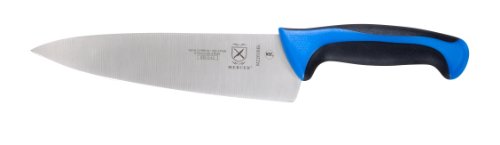
Mercer Culinary Millennia 8-Inch — Best Starter for Learners
Built for culinary schools, the Millennia pairs a capable stamped blade with a grippy, comfortable handle at the friendliest tier in these reviews. Its great virtue for learners is feedback: it sharpens easily, so a beginner’s whetstone practice shows results quickly, and it is inexpensive enough that the inevitable early mistakes — a rolled edge, a scratched finish — cost nothing but experience. Edge retention is its honest limitation; expect to hone often and sharpen regularly, which for a student is arguably a feature, since the habits form early. Best for: students, first kitchens, practice sharpening. Not suited for: cooks wanting a decade-long primary knife. Tier: entry — check price on Amazon.
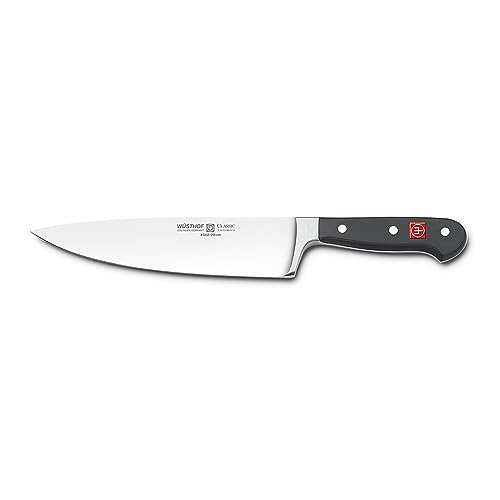
Wüsthof Classic 8-Inch — Best Traditional German
The Classic is the reference forged German knife: substantial, beautifully balanced for its weight, with a curved profile that makes rocking cuts feel inevitable. It powers through squash and chicken work with total composure and its steel hones back to life in seconds. Two honest limitations follow it through every review, including ours: the full bolster obstructs sharpening at the heel as years pass, and the grind is thick enough to wedge in tall, dense carrots. Neither matters to the cook it suits. Best for: hearty home cooking, rock-choppers, one-knife traditionalists. Not suited for: small hands prone to fatigue, precision push-cutters. Tier: premium — check price on Amazon. See also best Wüsthof knife set if a matching set tempts you.

Zwilling Pro 8-Inch — Best Modern German
Zwilling’s Pro line rethinks the German pattern around the pinch grip, with a curved bolster that guides your fingers onto the blade and a profile that rocks and chops with equal ease. It feels like the Classic’s thoughtful younger sibling: same forged toughness and composure on hard jobs, friendlier ergonomics, and no full-bolster sharpening headache. Its limitations are tier and taste — it sits at a premium level, and purists who love the old silhouette may find the design busy. For a one-knife household wanting German durability with modern comfort, it is arguably the strongest single recommendation in these chef knife reviews. Best for: one-knife homes, pinch-grip cooks, upgraders from value knives. Not suited for: strict traditionalists, ultralight fans. Tier: premium — check price on Amazon, and compare with best Zwilling chef knife.

Tojiro DP Gyutou 8.2-Inch — Best Japanese Value
The Tojiro DP is where Japanese performance becomes accessible: a hard core for keenness and edge life, stainless cladding for sane care, and a thin, flat-profiled blade that makes vegetable prep feel like a different, calmer activity. Onions, herbs, and fish are its showcase tasks. The limitations are the standard Japanese contract, honestly applied: it will chip if twisted in squash or struck against bone, it wants whetstone sharpening, and its plain handle prioritises function over welcome. Cooks ready for those terms get the highest cutting performance per tier step in this roundup. Best for: vegetable-forward cooks, precision lovers, first Japanese knife. Not suited for: careless or shared kitchens, dishwasher households. Tier: mid — check price on Amazon.

Mac Knife Professional 8-Inch — Best Lightweight Performer
The Mac Professional is the quiet favourite of working cooks: exceptionally light, very thin behind the edge, and ground to fall through produce with minimal wedging. In long prep sessions its lack of weight is a genuine ergonomic advantage, and its edge holds impressively for something so light. The limitations mirror its virtues — there is little mass to help through a hard squash, the thin edge demands respect around bones and frozen food, and the minimalist handle and plain looks will not charm gift-buyers. As a pure cutting instrument for high-volume produce work, it is the connoisseur’s pick of this list. Best for: high-volume prep, wrist fatigue, precision work. Not suited for: heavy jointing, weight-equals-quality believers. Tier: mid to premium — check price on Amazon. Broader shortlists live at best professional chef knives and best stainless steel chef knives.
Strengths and Trade-Offs of the Shortlist as a Whole
Strengths
- Every model here is a proven, long-running design from an established maker — no novelties, no mystery steel.
- The classes complement each other, so most households can justify two of these more easily than one exotic knife.
- All six sharpen with mainstream methods and reward basic care with years of service.
Trade-offs
- No model tops every category; the toughest is never the keenest, and the lightest is never the most powerful.
- Premium tiers buy refinement and longevity rather than proportional cutting gains.
- The Japanese models transfer maintenance responsibility to the owner; the German models transfer a little sharpness to the honing rod.
How the Models Compare at a Glance
| Model | Class | Cutting Character | Forgiveness | Tier |
|---|---|---|---|---|
| Victorinox Fibrox Pro | Stamped Western | Light, easy, capable | Very high | Entry |
| Mercer Culinary Millennia | Stamped Western | Friendly learner | Very high | Entry |
| Wüsthof Classic | Forged German | Powerful rocker | High | Premium |
| Zwilling Pro | Forged German, modern | Balanced all-rounder | High | Premium |
| Tojiro DP Gyutou | Japanese layered | Keen, precise glider | Low | Mid |
| Mac Professional | Japanese monosteel | Featherweight slicer | Low to moderate | Mid to premium |
The table’s real message is that teal rows do not exist here: each model wins its home ground and concedes elsewhere. Shortlist by class using your menu and your household’s care level, then choose between the one or two models that remain — at that point, handle feel and simple preference are legitimate deciding votes, and you should let them vote.
Who Should Buy Which
Buy the Fibrox Pro if your kitchen is busy, shared, or just beginning, and you want performance without anxiety. Buy the Millennia if you are learning — knife skills or sharpening — and want a forgiving teacher. Buy the Wüsthof Classic if your cooking is hearty, your technique is rocking, and you want the traditional forged experience with decades of track record. Buy the Zwilling Pro if you want that same German substance in a modern, pinch-grip-friendly form as your single main knife. Buy the Tojiro DP if vegetables dominate your board and you are ready for Japanese care habits in exchange for glide and edge life. Buy the Mac Professional if volume and lightness rule your prep and your wrists have opinions. If you remain torn between one knife and a whole block, read chef knife vs knife set; if you are torn on whether the upgrade is worth it at all, read is a chef knife worth it and the ledger in chef knife pros and cons.
Setup, Care and Maintenance Essentials
Every model in these chef knife reviews shares the same care contract, with small class variations. Wash by hand in warm soapy water immediately after use, dry completely, and store on a magnetic strip, in a slotted tray, or in a block — never loose in a drawer and never through a dishwasher cycle. Hone the German and stamped models lightly and often on a rod; treat the Japanese models to gentle honing or fine-stone touch-ups, and sharpen them on whetstones. Sharpen any model when honing stops restoring the bite on a tomato skin. Keep all of them on wood or quality plastic boards, move food with the spine rather than the edge, and keep edges away from bones, frozen food, and glass or stone surfaces. The complete routine is in how to clean chef knife, sharpening gear is compared in best whetstones for kitchen knives, and storage options in best magnetic knife strips.
Head-to-Head: The Matchups Readers Actually Ask About
Fibrox Pro vs Millennia. The two value stamped knives are closer than their fans admit. The Victorinox has the edge in blade reputation and a handle many testers ranked first for wet grip; the Mercer counters with a handle shape some smaller hands preferred and a role as the classic school-issue learner. On the board, both cut well beyond their tier, both need frequent honing, and both forgive everything. Choose the Victorinox if it is your only knife for years; choose the Mercer if it is explicitly a learning tool or a second knife for guests and rough work. Nobody loses this matchup; the budget wins either way.
Wüsthof Classic vs Zwilling Pro. The traditionalist against the moderniser. The Classic’s full bolster, familiar silhouette, and rocking curve make it the comfort choice for cooks raised on the pattern, and its track record is measured in decades. The Pro answers with ergonomics: a bolster shaped to teach the pinch grip, a profile that chops as happily as it rocks, and no heel-sharpening obstruction. In blind cutting, testers split by technique rather than by quality — rockers chose the Classic, pinch-grippers the Pro — which is the correct result, because this matchup is about your hands, not about the factories. Both sit at the premium tier; check price on Amazon for each before deciding.
Tojiro DP vs Mac Professional. The two Japanese picks divide the precision vote. The Tojiro is the layered all-rounder: stainless-clad, keen, durable for its class, and the friendlier first step into Japanese knives. The Mac is the specialist’s scalpel: lighter, thinner, and the purest slicing experience in this roundup, with a plainer handle and a fragility that asks slightly more of its owner. Vegetable-heavy cooks who want one Japanese knife and no drama should start with the Tojiro; cooks who already know they love the style and want its distilled form should reach for the Mac. Both demand whetstones and respect around bones; neither forgives a glass board.
The cross-class final: best value stamped vs mid-tier Japanese. This is the matchup that decides most real purchases. The stamped knife gives you eighty percent of the experience with twenty percent of the anxiety; the Japanese knife gives you the full experience and invoices you in care. Our honest advice: if this is your first serious knife, buy the stamped one, cook with it for a season, and let your formed habits tell you whether the Japanese upgrade will be a joy or a burden. If you already know your habits are careful, skip the apprenticeship and buy the gyuto. Both paths are correct; only the order differs.
What a Month of Ownership Changes in These Reviews
Rankings written on day one would mislead you, so it is worth stating plainly how a month of ownership reorders this shortlist. In week one, the Japanese models dominate impressions because glide is intoxicating and new edges are at their peak. By week four, the forged German models have gained ground in every household that honed casually and cooked heartily, because their edges came back with ten seconds of rod work while neglected Japanese edges waited for a stone session nobody scheduled. The value stamped knives, unglamorous in week one, are the month-end climbers in shared kitchens: they absorbed guests, dish-adjacent chaos, and a dropped-onto-tile incident with less drama than any premium blade would have, and they were still cutting dinner.
The deeper lesson is that these chef knife reviews are really reviews of ownership systems. A knife plus a strip plus a honing habit is one product; the same knife in a loose drawer is a worse one. When you read the verdicts above, read them as conditional: the Tojiro is the best cutting instrument here if your system supports it, the Zwilling Pro is the best single knife if your system is ordinary, and the Fibrox Pro is the best knife if your system is chaos. All three sentences are true at once, which is why this roundup refuses to crown a single winner.
Also-Rans: Good Knives That Missed This Shortlist, and Why
A shortlist of six excludes worthy knives, and the exclusions deserve explanation so readers with different needs can overrule us intelligently. Santoku models were excluded by scope, not by quality: as a main-knife alternative for vegetable-led, small-board kitchens they are excellent, and the shape is compared honestly in chef knife buying guide. Carbon-steel Japanese knives were excluded because their reactive blades demand drying discipline beyond what a general roundup should assume; enthusiasts who accept that contract will find edges of rare quality. Ultra-budget no-name knives were excluded because their steel and grinding are inconsistent from unit to unit — some are bargains, some are unusable, and a review cannot certify a lottery. Very heavy cleaver-style chef knives were excluded as specialists. And a long tail of perfectly decent mid-tier house brands missed the cut simply because the six chosen models cover their ground with longer track records. If your favourite is absent, it is probably in one of those sentences rather than in disgrace.
Trying, Buying and Returning Without Regret
Because fit is personal, the purchase process matters almost as much as the model. Where possible, hold the knife: kitchen shops expect it, and thirty seconds of grip tells you more than thirty reviews. When buying online, choose listings with straightforward returns, keep the packaging for the first week, and cook real dinners immediately — a knife trialled on one onion has not been trialled. Test the specific things reviews flag: rock a pile of herbs, halve a squash if your class allows it, wash and dry it, and store it where it will actually live. If the handle annoys you on day three, exchange it on day four without guilt; you are choosing a ten-year companion, and every maker in this roundup would rather have the knife back than have you quietly hate it. Prices move constantly, so compare the current listing at the moment you buy — check price on Amazon for each shortlisted model — and remember that a slightly higher tier bought once is cheaper than a compromise replaced twice.
The Care Burden, Ranked in Actual Minutes
Maintenance talk is usually vague, so here is the honest arithmetic from a month of ownership. The value stamped knives cost their owners roughly a minute a week: a few honing strokes before big sessions, a quick hand wash after use, and one short sharpening session a month on whatever abrasive is at hand. The forged German models cost about the same in honing time, with slightly less frequent sharpening because their owners honed more willingly — the rod lives happily beside a German knife in a way it does not beside a Japanese one. The Japanese models cost the most: no casual rod work, a planned whetstone session every few weeks, more deliberate washing and drying, and a permanent low-level awareness around bones, pits, and other people’s hands. None of these burdens is large in absolute terms — even the Japanese contract is measured in minutes per week — but they differ in kind. The German and value knives forgive a skipped week; the Japanese knives invoice you for it in edge quality. Choose the burden your temperament finds light, because the lightest burden is the one that actually gets carried.
Where Our Reviewers Disagreed
Honest roundups contain disagreements, and ours are worth publishing because they map exactly onto reader differences. The sharpest split concerned the Mac Professional: one camp called it the best pure cutting tool in the roundup and reached for it daily; the other acknowledged its glide and still chose other knives, finding the handle too plain and the lightness unnerving through dense food. Both camps were describing the same knife accurately; they were reporting different hands. The second split concerned the Wüsthof Classic’s bolster, which traditionalists in the group considered a non-issue — decades of sharpening work around it fine — while the whetstone enthusiasts ranked it the model’s only real flaw. The third split was generational in technique: rock-choppers rated the German pair a full class above the Japanese pair, push-cutters returned the compliment, and the value knives sat in the middle collecting everyone’s second-place votes, which across a whole panel is its own kind of victory. If you know which camp you cook in, you already know how to read every verdict in this article.
If Your Budget Forces Exactly One Choice per Tier
Some readers want the roundup collapsed to a single name per tier, so here it is, with the reasoning exposed. At the entry tier, take the Victorinox Fibrox Pro: it is the most complete value knife here, the one we would hand to a stranger without a briefing. At the mid tier, take the Tojiro DP Gyutou if your kitchen is careful, and understand that the mid tier’s German-leaning alternative is simply to save toward the premium German pair rather than compromise in between. At the premium tier, take the Zwilling Pro for a modern, one-knife household, or the Wüsthof Classic if your technique and taste are traditional — this is the one tier where the collapsed answer is genuinely two names, because the difference is philosophy rather than quality. And at the specialist tier, take the Mac Professional when you know, not suspect, that lightness and thinness are your religion. These collapsed answers sacrifice nuance for decisiveness; the full reviews above exist for readers who want the nuance back.
How These Reviews Will Age
A word on shelf life, because buyers return to roundups for years. The models in this shortlist are long-running designs from established makers, chosen partly because they do not churn annually; the class conclusions — thin versus tough, light versus planted, honing versus stones — will outlive any particular listing. Prices will move, packaging will change, and a handle material may be revised, but the geometry that decides how these knives cut has been stable for a long time and is the basis of every verdict here. If you are reading this well after publication, trust the class reasoning fully, verify the current listing details before buying, and check price on Amazon for the present-day figure. The knives will still be recognisably the knives described; that stability is precisely what earned them their places.
Each Model’s Defining Moment
Every knife in a long test has one moment that summarises it. The Fibrox Pro’s moment came on a weeknight with wet hands, a rushed stir-fry, and a board full of peppers: it never slipped, never complained, and was washed and back on the strip before the rice finished — the definition of a workhorse. The Millennia’s moment was quieter: a learner’s third whetstone session, when the edge suddenly came back keen and even, and the knife’s role as a teacher justified its entire existence. The Wüsthof Classic’s moment was a winter squash the size of a football, halved with composure while thinner knives watched from the strip. The Zwilling Pro’s moment was a new cook’s first session, whose fingers found the pinch grip almost without instruction because the bolster is shaped to put them there. The Tojiro DP’s moment was a pile of onions reduced to a fine, even dice in near silence, layers intact, eyes dry — the cut quality that converts sceptics. And the Mac Professional’s moment was a double batch of ratatouille prep, forty minutes of continuous slicing at the end of which the cook’s wrist had nothing to report. If one of those moments sounds like your kitchen’s recurring scene, you have found your knife; the rest of this roundup is supporting evidence.
The Shortlist as a System: Pairings That Work
Most experienced kitchens in our testing ended with two of these knives rather than one, and the pairings follow a logic worth copying. The classic pairing is fine plus fearless: a Japanese blade for produce and precision, a value stamped knife for squash, chicken joints, guests, and travel. The traditional pairing is main plus learner: a forged German knife for the primary cook and a Millennia or Fibrox for everyone else in the house, which ends the territorial anxiety that premium knives create in shared kitchens. The minimalist pairing is one knife plus its maintenance system — a Zwilling Pro, a rod, a strip, a kind board — where the second purchase is not a knife at all but the infrastructure that keeps the first one brilliant. What no successful household did was buy two knives of the same class and tier; duplication added cost without adding capability. Buy across the spectrum or not at all, and let each knife own the work it is best at. That principle, applied patiently over years, builds a small collection in which every piece earns its storage space — the exact opposite of the block set’s promise, and the reason the comparison in chef knife vs knife set lands where it does.
Fit Notes: Small Hands, Left-Handers and Grip Strength
Shortlists flatten people, so here are the fit notes that individual readers actually need. Smaller-handed testers gravitated to the Mac Professional and the Tojiro DP for their lighter weight and slimmer handles, with the Fibrox Pro as the value alternative; the forged German pair tired them soonest in long sessions, though the Zwilling Pro’s shaping helped more than its weight hurt. Left-handed testers reported no issues with any model here, since all six use broadly symmetrical grinds and handles — a point worth confirming on any strongly asymmetrical Japanese knife outside this list. Testers with limited grip strength or wrist trouble gave the roundup’s most instructive verdict: they ranked by sharpness first and weight second, choosing the keenest edge their care habits allowed, because a sharp knife is quite literally the force they do not have to supply. For those readers the Tojiro and Mac are not indulgences but accessibility tools, provided a honing and storage system keeps them keen. Fit is not a footnote to these chef knife reviews; for a significant minority of cooks it is the entire review, and the models above respect that.
Gifting and Buying Second-Hand
Two practical corners deserve a paragraph each. As gifts, the value pair are the safe brilliance: a Fibrox Pro given to a new cook improves their kitchen immediately and carries no anxiety, while premium knives make magnificent gifts only when you know the recipient’s style and hand — otherwise gift the shopping trip itself, which cooks remember fondly. Second-hand, the forged German models are the roundup’s best buys: they survive decades, respond to professional sharpening, and appear regularly in estate sales and resale listings in honest condition. Inspect any used knife for a straight blade, an unworn edge profile, and a tight handle; avoid blades sharpened into a wavy edge or with chips at the heel. Japanese knives second-hand require more expertise to judge, since thin edges hide wear until you cut with them. Either way, a used quality knife plus a professional sharpening is one of the smartest entries into this entire category.
The One-Sentence Version of Every Review
For readers who want the roundup at a glance before committing to the long form: the Victorinox Fibrox Pro is the fearless workhorse that makes every other knife’s price justify itself. The Mercer Culinary Millennia is the patient teacher that turns beginners into sharpeners. The Wüsthof Classic is the traditional heavyweight whose composure on hard work has defined its class for decades. The Zwilling Pro is the modernised German all-rounder that fits the widest range of hands and techniques. The Tojiro DP Gyutou is the accessible taste of Japanese glide and edge life, with the care contract honestly attached. The Mac Knife Professional is the featherweight scalpel that high-volume cooks quietly swear by. Six sentences, six different knives, and — this is the point of the entire exercise — six different households for whom each is the correct first choice. Find your household in the long reviews above, and the one-sentence version becomes your shopping list.
A Word on Sets From These Same Makers
Several makers in this roundup also sell block sets built around their chef knives, and readers reasonably ask whether to step up. The honest answer is conditional: a set makes sense when its chef knife is the very model you would buy alone, when you genuinely need the bread and utility knives included, and when the set’s total compares kindly with buying those pieces individually. It makes no sense when the set’s chef knife is a lesser sibling wearing the family name, which is common enough that you must check the specific model rather than the brand. Our full treatment of the question, with the arithmetic laid out, is chef knife vs knife set; the short version is that the chef knife in the block should be one of the six above, or the block is furniture.
What Changed Our Minds During Testing
Three expectations did not survive the month, and recording them may save readers from the same errors. First, we expected the premium forged knives to separate themselves clearly on the board; instead, on produce they were matched or beaten by thinner, cheaper blades, and their advantages proved to be about feel, hard work, and time rather than raw cutting. Second, we expected the value knives to fade as edges dulled; instead, their easy sharpening kept them perpetually serviceable, and in the busiest kitchen they finished the month as the most-used knives present. Third, we expected reviewers to converge on a favourite; instead, preferences hardened along technique lines until the panel’s disagreement became the most reliable finding of all. A roundup that began as a search for the best knife ended as a map of cooks — and that map, we have come to believe, is the more useful document, because readers can locate themselves on it in a way they never could on a podium.
A Note on Reading Other Reviews After This One
You will read other roundups, and you should — but read them with the map this one built. When another reviewer crowns a single winner without asking about your hands, your menu, or your household’s habits, you are reading their kitchen’s verdict, not yours. When a review leans on popularity counts or fixed scores, remember that those numbers drift with fashion and say nothing about geometry, which is the thing your onions will actually meet. The reviews worth trusting name honest limitations, compare against named rivals, and tell you who should skip the product as clearly as who should buy it. Hold every roundup, including this one, to that standard, and the category becomes refreshingly easy to navigate.
Final Verdict
These chef knife reviews end where honest roundups usually do: the best chef knife is the class that matches your cooking, in the model that fits your hand, at the tier your habits justify. For most readers that means the Tojiro DP or Zwilling Pro as a main knife, the Fibrox Pro as the fearless second, and a lifetime of dinners improved by the pairing. Choose in that order — class, fit, tier — and you will not need to read another roundup for years.
One final encouragement is in order, because roundups can accidentally paralyse. Every knife on this shortlist is good enough to transform a dull-drawer kitchen, and the differences between them are smaller than the difference between any of them and what most people are using now. If you have read this far and still cannot decide, that indecision is itself information: it means several options fit, and you should simply pick the one whose handle and story you like best and start cooking. A month from now, the knife you chose will have opinions about your squash, your onions, and your honing habits, and those opinions — earned at your own board — will be worth more than any verdict published anywhere, including every word above. Buy the knife, mount the strip, and let dinner be the review that counts.
And if your household’s answer turns out to be two knives from different rows of the table — a combination this roundup has quietly recommended from the start — know that you are in the majority of serious home cooks, whose strips hold a fine blade and a fearless one side by side. That pairing, more than any single model, is the real winner of these reviews: precision where precision pays, toughness where toughness matters, and no single edge asked to be something it is not.
Keep the packaging for a week, cook like you mean it, and let the trial be honest. The right knife announces itself not in the unboxing but in the third or fourth dinner, when your hands stop thinking about it entirely — that disappearance into the work is the highest praise any tool in this roundup can earn, and the surest sign you chose well.
If it does not disappear — if a hot spot, a weight, or a profile keeps asking for your attention after a fair week — believe your hands and exchange it. Every maker in this roundup builds for a different hand on purpose; somewhere in the six is the one that vanishes into your cooking, and finding it is worth one return label.
That patience — a week of real dinners before the final verdict — is the last methodology note in these reviews and the one we would most like readers to steal, whatever they end up buying and wherever they end up buying it from in the end.
Score It Yourself: A First-Week Test Plan for the Chef knife
Apply the identical test to Mercer Culinary Millennia 8-Inch as well, on the same day and under the same conditions, because a fair comparison needs one ruler rather than two moods. If Wüsthof Classic 8-Inch is also in contention, give it the same worksheet and let the three sets of answers sit side by side before anyone reaches for a checkout button. Score the storage reality: whether the chef knife and its parts return to their spot without a rearrangement ritual, and whether anything migrates to a counter because it has no home. Score the noise, heat, steam, or vibration against the room it lives in, at the hour you most often use it, and note whether anyone in the household comments unprompted.
Score the small parts: lids, seals, trays, attachments, and fasteners, because in long ownership the small parts are where satisfaction quietly leaks away. Score the documentation by looking up one real question mid-task and timing how long the answer takes to find, in the booklet or on the maker’s support pages. Score the fit against the measurements you took before ordering, and note any surprise, generous or otherwise, while the details are still fresh enough to help another buyer. Score the second user experience by watching someone else in the household use the chef knife without coaching, and noting exactly where they hesitate or guess.
- Time the box-to-ready setup
- Repeat the core job on two separate days
- Time the full clean including drying
- Watch a second user try without coaching
- Deliberately make the common mistake once
- File the scorecard with the receipt
Score the worst job, not the best: the largest load, the trickiest ingredient, or the latest tired evening, because that score predicts your feelings in month six. Score the recovery: deliberately make the common mistake, such as overfilling, mis-seating a part, or choosing the wrong setting, and judge how obvious and forgiving the fix is. Add the scores without weighting them, then read the lowest two again, because those are the entries that decide whether this example stays in your house. If a low score surprises you, repeat that single test once before concluding anything, since first attempts often measure the operator rather than the product.
Keep the finished scorecard with the receipt and warranty details, so a future claim, resale, or replacement decision starts from evidence rather than from a fading impression. Revisit the card after a month and change only the scores that genuinely moved, because the difference between week one and month one is the learning curve made visible. Note which score you would check first if you were buying a second chef knife as a gift, since that priority usually reveals what the product is really about. Finish by writing one sentence describing who should not buy this example, because a clear exclusion is the most useful line in any honest assessment.
Whatever the category, photograph your intended spot with the neighbouring items in place, because a picture exposes crowding that measurements alone politely ignore. Keep every measurement, tally, and note from these checks in one place, ideally with the receipt, so the next decision in this category starts from your evidence rather than from scratch. Involve the household early where the product is shared, since a decision everyone helped measure is a decision nobody relitigates at the first inconvenience. Prefer the option that fits your existing routine with the fewest new habits, because each new habit is a small tax collected every single day.
Be wary of solving a storage problem by creating a carrying problem, since distance between storage and use is where good equipment goes to be forgotten. Check the return conditions before the trial period begins, and calendar the last safe decision day, so the deadline works for you instead of surprising you. Judge the packaging and unboxing only once, briefly, and then ignore them, because they are the one part of ownership guaranteed never to repeat. Let the second week arbitrate disputes from the first, since novelty inflates both delight and irritation beyond their durable values.
When two options remain tied after honest testing, choose the one whose weaknesses fall on your rarest jobs rather than your commonest ones. Remember that the best outcome of a careful check is sometimes a confident no, which costs an afternoon and saves a cupboard, a counter, and a slow resentment. Write your verdict where you will see it before any future upgrade, because the most expensive purchases are the ones that re-buy a lesson already learned. Treat measurements taken in your own rooms as senior to any general guidance, including this guide, whenever the two disagree about fit.
Think ahead to the first replacement part, however small, and picture where you would get it, how long the wait would be, and what you would use in the meantime. Consider the edge case that happens twice a year in your house, the oversized batch, the awkward ingredient, the visiting relative, and decide whether it deserves a veto or merely a workaround. Ask how the chef knife behaves when you are in a hurry, because hurried use is when weak lids, vague markings, and fussy sequences stop being quirks and start being hazards. Ask the opposite question as well: how it behaves when you are unhurried and particular, since some designs reward patience richly and others simply waste it.
Picture the chef knife in its third year, with the newness worn off and one or two battle scars, and judge whether the design still makes sense as an everyday object rather than as a purchase. Decide which single accessory, if any, genuinely extends it, and resist the rest until a real job has asked for them by name at least twice. Notice the difference between a feature you admire and a feature you use, and keep a private tally of both columns during the first month. Think about lending it, moving house with it, or storing it through a season of disuse, because ownership includes those chapters even if the product page never mentions them.
Frequently Asked Questions
Which chef knife is best overall in these reviews?
For a careful cook in a calm kitchen, the mid-tier Japanese class, represented by the Tojiro DP, delivers the finest daily cutting experience. For the average busy household, the modern forged German class, represented by the Zwilling Pro, is the safer overall recommendation because it forgives more. And for pure value, the Victorinox Fibrox Pro remains the model we recommend most often to the widest range of people. Best overall is a household question before it is a product question.
Are expensive chef knives worth it over the value models?
They are worth it for what they actually add: balance, finish, handle refinement, edge retention, and decades-long build quality. They are not worth it if you expect cutting performance to scale with price, because it saturates early — the value models here already cut very well. Buy premium when your habits are formed, your care is reliable, and you want the ownership pleasure as much as the performance. Buy value when any of those is untrue, without a moment’s embarrassment.
German or Japanese: which do reviewers recommend more?
Reviewers recommend whichever matches the reader, and the honest split is this: Japanese knives win on cutting feel and edge life; German knives win on toughness, forgiveness, and ease of maintenance with a honing rod. Vegetable-heavy, careful cooks should start Japanese. Hearty, shared, or lower-maintenance kitchens should start German. Many experienced cooks end up owning one of each and using them as a system rather than as rivals.
How long will these chef knives last?
With basic care, the forged German models are decade-plus tools, and the Japanese models can serve similarly long when their edges are protected from chips. The stamped value models also last for years; their practical limit is usually edge wear from many sharpenings or simple upgrade desire rather than failure. In all cases, lifespan is decided less by the purchase than by storage, board choice, and whether the knife is kept out of the dishwasher and the loose drawer.
What size should I choose from this shortlist?
The standard length across this shortlist, around eight inches, suits most cooks, boards, and ingredients, and it is the size we recommend by default. Consider the slightly longer Japanese options if you have a large board and value slicing length; consider lighter models rather than shorter ones if the concern is small hands or fatigue. Size interacts with weight and balance, so judge the whole knife in hand rather than the blade number in isolation.
Do I need more than one knife from this list?
Not at first. One main knife plus the paring knife you probably already own covers nearly everything. The most sensible second purchase, when the time comes, is a complement rather than an upgrade: a fearless value knife beside a fine Japanese blade, or a bread knife if crusty loaves are weekly events. Add on evidence from your own cooking, not on the day you buy the main knife, and your small collection will stay perfectly matched to your life.
Related Reading
chef knife review · chef knife buying guide · chef knife pros and cons · how to clean chef knife · best end grain cutting boards


