Disclosure: As an Amazon Associate, topratedkitchenware.com earns from qualifying purchases. Links on this page are affiliate links; they cost you nothing extra. Prices and availability change often, so check the current Amazon listing before you buy.
This copper cookware set buying guide exists because the phrase copper cookware set covers three genuinely different products that happen to share a colour in photographs. One is real copper: a pan body, core, or cladding layer of the metal itself, lined with tin or stainless steel. One is copper-core: real copper sealed inside stainless steel, invisible and maintenance-free. And one is copper-coloured: an ordinary aluminium or steel pan wearing a copper-toned nonstick finish, with no working copper in it at all. All three can be the right buy — for three different cooks. This guide separates them honestly, explains what each construction does at the stove, and ends with a shortlist organised by tier so the set you order is the set you thought you were ordering.
Read the next section first if you only have two minutes: it is the whole guide in miniature. After that, the guide walks through the main types one by one, puts the shortlist on the table early, then works through the questions that actually decide satisfaction — how responsive you need the pans to be, which lining suits your food, whether your hob will even work with copper, how you feel about polishing, and which pieces your cooking really uses. It closes with care essentials, the mistakes that send sets back, and answers to the questions buyers ask most.
Copper Cookware Set Buying Guide: Key Takeaways
- Three families share one name: traditional copper (lined with tin or steel), copper-core sealed in stainless, and copper-coloured nonstick with no working copper in it.
- Real copper’s gift is responsiveness — even heat that rises and falls with the burner — and you can only get it from copper that is actually in the pan.
- The lining is half the product: tin cooks gently and needs periodic renewal, stainless steel lining is tougher and asks nothing, nonstick forgives everything and ages fastest.
- Pure copper does not work on induction unless the design adds a magnetic base; check the exact set, piece by piece, before buying.
- Exposed copper tarnishes. That is cosmetic, reversible with simple polishing, and entirely avoided by copper-core construction.
- Buy the piece list, not the piece count: lids and utensils inflate the number while the pans you use daily decide your satisfaction.
The short version of the verdict: cooks who sauce, sear, and simmer with attention, and who accept a little care, should buy real copper and will taste why it costs what it costs. Cooks who want that responsiveness without rituals should buy copper-core. Cooks who want easy eggs, easy cleanup, and a warm colour at an entry tier should buy copper-coloured nonstick — knowingly, as nonstick, judged by nonstick standards. Every disappointment in this category comes from crossing those wires.
In this guide
What a Copper Cookware Set Does and the Main Types
Copper conducts heat faster and more evenly than any other metal commonly used in a pan, and that single physical fact explains almost everything else in this category. Heat applied at one point under a copper base spreads sideways quickly, so the whole cooking surface arrives at a similar temperature instead of developing a fierce hotspot over the burner ring and cooler corners elsewhere. Just as usefully, copper gives heat back quickly: lift the pan or turn the flame down and the surface temperature follows within moments, which is why sauce makers and candy makers have prized the metal for generations. A pan that answers the controls immediately forgives small mistakes and rewards attention, because the gap between what you intend and what the food experiences stays narrow.
Traditional copper, lined with tin or stainless steel
The traditional form is a pan whose body is copper, thick enough to cook with authority, with the cooking surface lined in another metal because acidic food should not sit against bare copper. Tin is the historical lining and still the connoisseur’s choice for its gentle release; stainless steel is the modern lining and the lower-maintenance one. These are the pans in professional sauce stations and in the windows of French cookware shops, and they ask the most of their owners: hand-washing, drying, occasional polishing, and — for tin — eventual re-lining. In exchange they offer the full copper experience and a service life measured in decades. Our deeper look at the traditional end of the market is here: the best tin-lined copper cookware.
Copper-core: real copper, sealed away
How much the tarnish cycle matters depends on where the copper sits in the construction. On a traditional pan with a copper exterior, the whole outside of every piece is a surface that will change colour and ask for occasional attention. On a copper-core design, the copper is sealed inside stainless steel, invisible in daily use, and the exterior behaves exactly like stainless — no polishing, no patina, no drama. On a copper-coloured nonstick set there is no copper to tarnish at all, though the coloured finish can fade or discolour with heat and dishwasher cycles in its own way. Three families, three completely different relationships with the same word.
Copper-core construction folds a layer of copper into a multi-ply build, typically between aluminium and stainless steel, so the copper contributes its responsiveness while stainless forms both the cooking surface and the exterior. You give up the visible metal and a measure of the traditional pan’s sheer copper quantity; you gain a set that behaves like premium stainless in every chore — no polishing, no lining renewals, utensils of any material — while cooking noticeably more evenly and responsively than plain stainless. For many serious home cooks this is the sweet spot of the whole category, and it is examined on its own terms here: stainless steel cookware with a copper core.
Copper-coloured nonstick: the look, as a finish
A large share of what is sold under the copper banner is not copper cookware in any functional sense. These are aluminium or steel pans finished in a copper colour, most often with a ceramic-based nonstick cooking surface marketed with words like copper-infused or copper-toned. The cooking experience they offer is the experience of that nonstick surface and that base metal, not of copper: heat moves the way aluminium moves it, food releases the way the coating releases it, and the warm colour is decoration. None of that makes such a set dishonest value — many are pleasant, affordable everyday pans — but it does mean a buyer shopping for copper’s responsiveness and buying colour instead has purchased a different product wearing the right costume.
Ceramic-style nonstick in a copper colour has genuine virtues, and a fair guide should name them before criticising the category. Eggs slide, cleanup is a wipe, the pans are light, and the warm metallic tone is undeniably handsome on a stove. The limits are equally real: nonstick surfaces of this type gradually lose release over years of use, dislike sustained high heat and metal utensils, and eventually become a replacement purchase rather than a lifetime one. A traditional copper pan is almost the mirror image — demanding to look after, indifferent to high heat, and capable of lasting decades with its lining renewed when needed. Choosing between them is choosing a relationship with your cookware, not just a colour for it.
Top Picks at a Glance
The shortlist below is organised by family and tier rather than by a single winner, because a single winner is exactly the fiction this guide exists to retire. Every pick is presented prose-only while its listing verification is pending, so check construction, lining, and hob compatibility on the current listing before ordering, and check the price on Amazon at the same time.
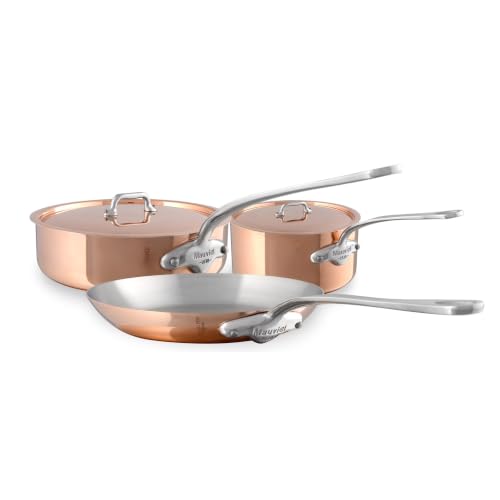
Mauviel copper set
Position in this guide: premium tier. In plain terms, this is heritage French copper in the traditional form: a real copper body with a stainless steel lining, made by a maker whose name is close to synonymous with the category. In this guide it stands as the reference point for traditional copper: the set against which claims of heritage and thickness elsewhere should be measured.
Best for: serious cooks who sauce, sear, and simmer daily, who accept polishing and hand-washing as part of ownership, and who are buying for decades. Not suited for: induction kitchens without a verified magnetic base, dishwasher households, and anyone who wants nonstick forgiveness for eggs and fish. Because this pick is presented prose-only while its listing verification is pending, treat it as a researched recommendation to check against the current listing — construction, lining, and hob compatibility especially — rather than as a linked product, and check the price on Amazon when you are ready to compare it against the rest of the shortlist.
All-Clad Copper Core set
Position in this guide: premium tier. In plain terms, this is the copper-core archetype: a band of real copper sealed inside a multi-ply stainless construction, so the copper works invisibly and the surfaces you touch are stainless steel. Here it represents the copper-core family at its most developed, the choice for cooks who want the physics without the polishing cloth.
Best for: cooks who want genuine copper responsiveness with stainless durability, no polishing, no re-lining, and a set that behaves like the stainless they already know. Not suited for: buyers who want to see and display copper, traditionalists who prefer a tin lining’s cooking feel, and anyone whose budget points to the entry tier. Because this pick is presented prose-only while its listing verification is pending, treat it as a researched recommendation to check against the current listing — construction, lining, and hob compatibility especially — rather than as a linked product, and check the price on Amazon when you are ready to compare it against the rest of the shortlist.

Lagostina copper set
Position in this guide: mid tier. In plain terms, this is a clad set from a long-established Italian maker that builds copper into a layered construction, sitting between the coloured nonstick family and the premium heritage makers. It occupies the middle ground of this shortlist, the clad step-up for buyers leaving basic nonstick behind.
Best for: buyers who want a step up from basic nonstick into clad-metal cooking without going straight to the top tier, and who will confirm the exact construction and hob compatibility of the specific set before ordering. Not suited for: purists seeking thick traditional copper with a hand-finished lining, and induction households that have not verified the base of the exact model. Because this pick is presented prose-only while its listing verification is pending, treat it as a researched recommendation to check against the current listing — construction, lining, and hob compatibility especially — rather than as a linked product, and check the price on Amazon when you are ready to compare it against the rest of the shortlist.

Gotham Steel copper set
Position in this guide: entry tier. In plain terms, this is the best-known name in the copper-coloured family: an aluminium set with a ceramic-style nonstick surface in a copper tone. It anchors the copper-coloured family in this guide: judged as nonstick, it is a coherent entry-tier proposition.
Best for: households that want easy-release everyday cooking and the copper look on an entry budget, and who understand they are buying nonstick convenience rather than copper performance. Not suited for: anyone shopping for real copper responsiveness, induction certainty, or a set expected to serve for decades. Because this pick is presented prose-only while its listing verification is pending, treat it as a researched recommendation to check against the current listing — construction, lining, and hob compatibility especially — rather than as a linked product, and check the price on Amazon when you are ready to compare it against the rest of the shortlist.

Copper Chef set
Position in this guide: entry tier. In plain terms, this is a copper-coloured nonstick set built around a deep-sided pan concept that tries to cover several jobs with fewer pieces. It is the alternative shape within the coloured family, worth a look if a deep, versatile centrepiece pan suits your cooking better than a conventional spread of pieces.
Best for: small kitchens and casual cooks who like the idea of one versatile deep pan handling frying and stovetop work with nonstick ease. Not suited for: cooks who sear seriously, work at sustained high heat, or want the even, responsive base that only real copper construction provides. Because this pick is presented prose-only while its listing verification is pending, treat it as a researched recommendation to check against the current listing — construction, lining, and hob compatibility especially — rather than as a linked product, and check the price on Amazon when you are ready to compare it against the rest of the shortlist.
How Much Responsiveness Do You Actually Need?
The case for copper starts with responsiveness, a word worth defining plainly. A responsive pan heats quickly, cools quickly, and spreads heat evenly while it does both, and copper does all three better than aluminium or stainless steel alone. In practical terms that means a pan sauce stops simmering soon after you pull it off the heat instead of coasting upward and breaking, a sugar syrup holds at the stage you chose rather than drifting darker, and delicate fish cooks on a surface that is the same temperature at the edges as at the centre. None of this makes copper magic; it makes it honest. The metal simply shortens the delay between your decision and the food, and experienced cooks feel that difference within the first week of use.
Sauce work is copper’s ancestral home ground, and the reason is control at the gentle end rather than power at the fierce end. A reduction that needs to hold just below a simmer, a custard that must thicken without scrambling, a caramel that has to stop at amber the moment it arrives — these are tasks where a pan that overshoots punishes instantly. Copper’s quick cooling when heat is cut turns near-misses into saves: the custard comes off the burner and actually stops cooking, the caramel halts where the cold cream hits it. Cooks who make sauces weekly feel this as calm; cooks who make them twice a year feel it as insurance on the occasions that tend to be celebrations, when failure is most expensive.
Be honest about your weeknight cooking here. If most of your stove work is pasta water, soup, and reheating, responsiveness is a luxury you will rarely taste, and the money is better spent on one responsive pan for the jobs that need it. If your cooking lives at the stove — sauces finished to order, fish cooked à la minute, sugar work at holidays — responsiveness is the difference between a pan that collaborates and a pan that lags, and it justifies the category’s premium on its own.
Which Lining Suits the Food You Cook?
What lines a copper pan matters as much as the copper itself, because the lining is the surface your food actually touches. The traditional lining is tin, applied over the copper interior: naturally low-stick for a metal surface, superb for eggs and sauces, and gentle in the way it releases food. Tin’s limits are its softness and its sensitivity to heat — it dislikes an empty pan on high heat, metal utensils can score it, and after years of use it wears thin and needs renewing by a specialist, a service known as re-tinning. A tin lining is therefore a commitment with a maintenance cycle, closer to owning a good knife that needs professional sharpening than to owning an appliance.
The modern alternative lining is stainless steel, bonded to the copper so the interior behaves like the stainless pans most cooks already know. Steel is harder than tin, shrugs off metal utensils and high heat, never needs re-lining, and asks nothing beyond normal washing. Its costs are subtle rather than obvious: food sticks more readily than on tin, eggs and fish demand better heat management, and the bond between steel and copper, done well, is part of why steel-lined copper sits in the premium tier. For most contemporary home kitchens, steel lining is the pragmatic default and tin is the enthusiast’s choice — chosen knowingly, for the cooking feel, with the renewal cycle accepted as part of the pleasure of ownership.
Delicate foods draw a fair map of the lining question. Fish fillets and eggs in a steel-lined copper pan demand a properly heated surface, a film of fat, and confidence; in tin, they forgive a degree or two of error; on copper-coloured nonstick, they forgive almost everything but give back less browning and a different texture. None of these is the correct answer in isolation. The cook who fries eggs daily for children and the cook who plates delicate fish for guests are shopping in the same category for opposite reasons, and the honest guide’s job is to route each of them to the construction that matches the food they actually cook, not the food in the photograph.
Will It Work on Your Hob?
Induction compatibility is the question that quietly decides this category for a growing share of kitchens, because copper on its own does not work on an induction hob. Induction needs a magnetic layer to couple with the cooktop’s field, and pure copper — like pure aluminium — is not magnetic. Traditional copper pans and copper-core pans alike will sit unrecognised on an induction surface unless the design adds a magnetic stainless base or the maker has engineered the bottom layer for induction, which some modern lines do and many do not. The only reliable test is the maker’s own statement for that specific set, checked piece by piece, because within one set the large stockpot and the small saucepan occasionally differ.
If your kitchen runs on induction, or might within the life of a set you intend to keep for decades, this single check outranks every other feature in the category. A magnet held against the base of a pan you already own demonstrates the principle: if it does not cling firmly, an induction hob will not heat the pan. For new purchases, look for an explicit induction statement and, ideally, a description of a magnetic base layer in the construction. Gas and radiant electric cooks face no such gate — copper in any construction performs beautifully on both — which is why so much traditional copper advice, written in gas-stove eras, never mentions the subject at all.
While you are checking the hob, check the glass-top warning if it applies: heavy pans should be lifted, not dragged, across glass and ceramic surfaces. And if induction is in your future rather than your present, weigh that in the decision — a set bought for decades should survive a kitchen renovation. Buyers whose kitchens are already induction-first may also want our dedicated reading on induction cookware sets alongside this guide.
How Much Care Are You Honestly Willing to Do?
Copper tarnishes, and any guide that treats that as a footnote is setting buyers up for disappointment. Exposed copper reacts with air, moisture, heat, and the acids in food splashes, moving through bright salmon-pink to brown and amber, and eventually to a soft patina. The change is purely cosmetic — a tarnished pan cooks exactly like a polished one — but it is unavoidable on any set where real copper meets the air, and it begins quickly. Kitchens that cook with copper daily usually settle into one of two camps: those who polish back to a shine on a rhythm, and those who let the pans wear a working patina and consider it the honest uniform of tools that earn their keep.
A sensible polishing rhythm follows your cooking rather than the calendar. Many home cooks polish only the pieces that hang on display, let the daily workhorses carry a soft patina, and do one full brightening before occasions when the pans will be seen by guests. That rhythm keeps the total effort small and honest. What does not work is the middle path of neglect punctuated by aggression: months of buildup attacked with hard pads and harsh compounds, which thins the shine unevenly and can wear decorative finishes. If the thought of any polishing at all genuinely irritates you, that is useful self-knowledge — it points you toward copper-core construction, where the copper does its work sealed away and the surfaces you touch are stainless steel.
Daily care for real copper is a short routine with a long memory. Wash in warm soapy water, avoid the dishwasher — its detergents are harsh on copper and tin alike and can discolour finishes — dry immediately and completely, and store dry. Keep empty pans off high heat, which protects tin linings and prevents the dark scorching that polishing struggles to lift. Salt deserves a specific mention: add it to liquids once they are moving rather than leaving crystals sitting on a damp lining, a habit that protects steel interiors from pitting and tin from staining. None of this is difficult; all of it is habitual, and the cooks who thrive with copper are the ones who find the habits soothing rather than the ones who perform them resentfully.
How to Prioritise by Use Case
The sauce-and-fish cook
Your cooking is decided in the last thirty seconds at the stove, so responsiveness and lining come first and everything else is negotiable. Traditional copper with the lining that suits your confidence — tin if you want forgiveness, steel if you want durability — is your natural home, in a set weighted toward saucepans, a saucier if you can find one, and a wide sauté pan. The heritage end of the market, including the French saucepan tradition, is surveyed here: French copper saucepan sets.
The serious cook who hates rituals
You want the physics and none of the polishing cloth. Copper-core is designed for you: real responsiveness, stainless surfaces, dishwasher-adjacent indifference to utensils, and no renewal cycle. Spend the premium here rather than on traditional copper you will resent, and choose the set whose piece list matches your cooking rather than the longest list.
The easy-weeknight household
Eggs without drama, cleanup without soaking, pans light enough for anyone in the house to handle: that is a nonstick brief, and copper-coloured sets answer it at an entry tier with genuine charm. Buy them as consumables with a service life, keep metal utensils and fierce heat away from them, and replace without guilt when the release fades. The mistake is only ever believing the colour was the metal.
The display kitchen
Some buyers want the pans to be seen, hanging or shelved where the warm metal does decorative work. That is a legitimate brief — kitchens are rooms, not laboratories — and it points to traditional copper with a polishing rhythm you actually enjoy. Let the pieces earn their display by being cooked with often; a polished pan that never cooks is a ornament with a handle, and ornaments are cheaper.
First Setup and Care Essentials
Utensil choice follows the lining. Tin asks for wood, silicone, or nylon and a general gentleness; stainless linings tolerate metal utensils, though even they accumulate scratches that make sticking worse over time. Copper-coloured nonstick asks for the full nonstick discipline — no metal, no aerosol sprays that bake onto the coating, and no stacking without protection. Across all three families, one rule is shared: thermal shock helps nobody. A pan straight off high heat plunged under cold water can warp a base over time, and a warped base rocks on the hob, pools oil to one side, and quietly ruins the evenness you paid for. Let pans cool a little before washing and they will stay flat for years.
Polishing copper is simpler than its reputation suggests, and the kitchen already contains most of what it takes. A paste of lemon juice or vinegar with salt, or a halved lemon dipped in salt used as the applicator, lifts ordinary tarnish in a minute or two of gentle rubbing; commercial copper creams do the same job with less improvisation. The rules that matter are to work gently, rinse thoroughly, and dry completely, because a polished pan put away damp will spot before the week is out. Abrasive scouring pads have no place here — they scratch the soft surface and give future tarnish more texture to cling to. Done occasionally rather than obsessively, polishing is a few quiet minutes per pan, closer to sharpening a knife than to a household chore.
Before the first use of any set in this category, wash each piece in warm soapy water, dry it fully, and cook something forgiving first — a pot of soup, a pan of sautéed vegetables — while you learn how your new metal answers your burners. Every construction has a learning curve of a few sessions: copper’s speed surprises almost everyone at first, and the common beginner’s error is cooking at the settings the old pans needed. Start lower than habit suggests and let the pan show you how little heat it requires.
Mistakes to Avoid
The most common buying mistake in this category is paying for colour and believing you have paid for metal. It happens because listings are written to blur exactly that line, with copper in the headline and the construction details — aluminium body, ceramic surface — further down the page. The defence is a two-question habit: what is the pan made of, in layers, and what lines the cooking surface? Any listing that answers both clearly is probably honest; any listing that answers neither is telling you what it is selling. The second most common mistake is the mirror image: buying demanding traditional copper for a household that will not polish, will use the dishwasher, and will resent both within a month.
Sizing mistakes run in both directions. Some buyers choose the largest set on the page and discover that half the pieces duplicate pans they already own, while the wide sauté pan they needed was never in the box. Others, charmed by a small set’s gentle price tier, end up with saucepans too small for their pasta habits and a frying pan that crowds four chicken thighs into steaming each other. Crowding is a cooking error a set can bake in: meat needs space around it to brown, and a pan that is technically excellent but too small for the household’s portions will disappoint nightly. Count your usual portions, look at the diameters that handle them, and let that arithmetic outrank the piece count.
A quieter mistake is ignoring the hob. Buyers fall for a traditional set, then discover an induction cooktop will not recognise a single piece, or bring copper home to a glass-top hob whose maker warns against heavy pans dragged across the surface. Copper is dense and a full copper pan is heavy; that weight is part of its cooking quality and part of its handling reality. Check the hob first, check your own comfort lifting a full pan one-handed second, and check storage third — a set that lives in a precarious stack on a high shelf will be cooked with less and dreaded more than its performance deserves.
The Bottom Line of This Buying Guide
It is worth being honest about how much of copper’s benefit a given household will actually taste. A kitchen that mostly boils, steams, reheats, and oven-finishes will notice the looks and the weight more than the responsiveness, because those methods forgive everything. A kitchen that makes pan sauces, cooks fish and eggs on the stove, works with sugar, or simply enjoys the feedback loop of a pan that answers instantly will taste the difference weekly. The premium for real copper is large enough that buying it for the first kitchen is mostly buying jewellery for the stove — beautiful jewellery, but the honest guide should say so, and point that buyer toward one excellent responsive pan instead of a full set.
Choose the family first — traditional, copper-core, or copper-coloured — using your hob, your food, and your honest appetite for care as the three votes. Then choose the set inside that family by its piece list and its handles, not its headline count. Do those two things and this category stops being a minefield of lookalike listings and becomes what it should be: one of the most satisfying purchases a cook can make. When you are ready to compare the surviving candidates side by side, our companion pieces walk through the head-to-head against stainless steel, the balanced pros and cons, and the worth-it question in full.
Reading a Listing Like an Inspector
Before the shortlist above earns your money, run one listing through the inspector’s routine this guide has been building toward, because the routine is the real deliverable. Start at the construction description and write down the layers in order, outside to inside. If you cannot complete that list from the page, the listing has failed its first duty and you should move on, however beautiful the photography. Next, find the lining named in words — tin, stainless steel, or a coating — and match it against the food you cook most. Next, find the hob statement, and treat a missing statement as a negative answer for induction. Finally, list the pieces as pans, ignoring the headline count, and compare that list against your week of cooking.
Notice what the routine never consults: the colour in the photographs, the word copper in the headline, the promises about release or durability written in marketing voice. Those are the elements designed to blur the three families into one warm glow, and they are precisely the elements that carry no information about how the pan will cook in year three. A listing from a serious maker reads almost boringly by comparison — layers, lining, compatibility, care — because the maker is describing a tool to a buyer who will check. Let boring be your quality signal in this category. The sets that survive the routine are few, comparable, and genuinely different from one another, which is exactly the position a buyer wants to be in: choosing between honest options rather than decoding disguised ones.
One last inspector’s habit concerns the care page, which makers publish and almost nobody reads before purchase. Read it now, while the decision is still reversible. It will tell you, in the maker’s own words, whether you are buying a hand-wash-and-dry relationship or a dishwasher-tolerant one, whether polishing is expected or optional, and whether the lining has a service future. The care page is the contract; the product page is the advertisement. Sign contracts, not advertisements, and this category’s famous disappointments mostly evaporate before they can happen.
A Worked Budget of Attention: Where the Money and Minutes Go
Close the guide with an accounting most buying guides skip: not the price of the set, which the listing will tell you and which changes too often to print, but the budget of attention each family draws on your life. Traditional copper spends your attention at the sink and the polishing cloth — call it a small daily amount and a modest monthly one — and repays it at the stove every time you cook something that cares about temperature. Copper-core spends almost no attention anywhere and repays slightly less at the stove. The coloured family spends its attention in a different currency entirely: none at the sink, none at the cloth, and a full replacement purchase some years out when the coating retires.
Framed that way, the buying decision becomes a question about which currency your household holds in surplus. Time-rich, cash-careful cooks have thrived with demanding tools for centuries, because attention is the budget they can spend. Time-poor households rationally buy convenience and replace it, because attention is the budget they cannot. Neither is a lesser cook; they are different economies sharing a category. The only genuinely bad purchase in this guide is the one made in the wrong currency — the busy household that buys the ritual, the ritual-loving household that buys the disposable — because both end up resenting a set that was honestly described all along. Choose your currency first, and the families, linings, and piece lists in this guide will do the rest of the work for you.
One Final Distinction: Copper for Cooking, Copper for Keeping
Some buyers in this category are, without quite admitting it, shopping for an heirloom — an object bought once, used for decades, and handed on with stories attached. Copper is one of the very few kitchen categories where that ambition is realistic rather than sentimental, because the material is repairable and the makers at the traditional end build accordingly. If that is your errand, weight the heritage end of this guide more heavily, choose the lining you can maintain for the long term, and keep the maker’s details and your purchase records with the pans. An heirloom is just a tool whose paperwork survived, and copper, alone among common cookware, rewards the intention.
The Measurement Worksheet: Sizing the Copper cookware set to Your Own Space
Start this worksheet with the space, not the product page: measure the exact spot where the copper cookware set will live, including the clearance above it, the swing or reach you need in front of it, and the route you will take to move it for cleaning. Write down the largest item you realistically expect to use with it, because that single measurement settles more sizing arguments than any capacity figure printed in a listing headline. Check the nearest outlet and be honest about whether a cord will cross a walkway, a sink edge, or another appliance that also needs that socket on busy mornings. Count the people the copper cookware set must serve on an ordinary weekday, then count again for the busiest gathering you host in a typical year, and notice whether those two numbers point to the same size.
List the three jobs you will ask of it every week and the one job you will ask only a few times a year, because the weekly jobs should drive the decision and the rare job should not. Decide where the accessories, attachments, and spare parts will be stored before you order, since a copper cookware set whose extras live in a distant cupboard quietly becomes a copper cookware set with fewer features. Where a shortlist names specific examples, such as Mauviel copper set, run these same checks against that listing line by line rather than assuming the general verdict transfers unchanged. Apply the identical test to All-Clad Copper Core set as well, on the same day and under the same conditions, because a fair comparison needs one ruler rather than two moods.
- Measure the working spot and the clearance around it
- Count weekday servings and the biggest gathering
- List the three weekly jobs in writing
- Decide storage for every accessory in advance
- Name the one compromise you accept knowingly
- Set the return deadline in your calendar
If Lagostina copper set is also in contention, give it the same worksheet and let the three sets of answers sit side by side before anyone reaches for a checkout button. Think about who else in the household will use it, including anyone shorter, anyone with less grip strength, and anyone who will clean it without reading the manual first. Note the surfaces it will touch in normal use and whether heat, moisture, weight, or vibration from the copper cookware set could mark, stain, or stress those surfaces over months of daily contact. Plan the cleaning position as carefully as the working position, because a copper cookware set that is awkward to carry to the sink or to open fully will be cleaned less often than it should be.
Write the three questions you still cannot answer from listings and guides, and treat those unanswered questions as your shortlist filter rather than as details to discover after delivery. Compare the footprint against the appliance or tool it replaces, and decide in advance what leaves the room if the new arrival is larger than the old one. Consider the noise, steam, heat, or light it produces in use and whether that output lands in a room where someone sleeps, works, or studies at the same hours. Check how it behaves at the smallest task, not only the largest, because many households abandon oversized gear that feels clumsy for the quick everyday job.
Think through the second week of ownership, when the novelty has faded, and ask which features you will still touch daily and which were only interesting in the showroom sense. Decide what good enough looks like in writing: the result you would accept without complaint, the result that would delight you, and the result that would send the box back. Look at the controls with fresh eyes and imagine using them with wet hands, greasy hands, or gloves, depending on the work, because small controls punish exactly those moments. Ask how the copper cookware set fails gracefully: whether a worn part, a lost attachment, or a single broken control ends its usefulness or merely removes one mode you rarely used.
Check whether replacement parts and consumables are ordinary, widely stocked items or proprietary pieces tied to one maker, since that difference compounds over years of ownership. Measure the storage shelf, drawer, or cupboard you intend to use with the door closed and other contents in place, not the optimistic empty version of that space. Think about guests and helpers who will meet the copper cookware set without your habits, and whether its safe, correct use is obvious to a newcomer within a minute of looking at it. Write down the one compromise you are consciously accepting, so that when it shows up in daily use it reads as a chosen trade rather than a nasty surprise.
Frequently Asked Questions
Is a copper cookware set actually better than stainless steel?
For responsiveness and evenness, yes — copper moves heat faster and more evenly than stainless steel alone, and cooks who make sauces, cook fish, or work with sugar feel the difference in control. For durability, utensil freedom, and zero maintenance, stainless is better, and copper-core construction exists precisely to blend the two. Better therefore depends on the job: choose copper for control, stainless for indifference, and copper-core when you want most of the control with most of the indifference.
What is the difference between copper and copper-coloured cookware?
Copper cookware contains the metal as a working part of the pan — a body, core, or cladding layer thick enough to change how the pan heats and responds. Copper-coloured cookware is an ordinary aluminium or steel pan with a copper-toned finish, usually over a ceramic-style nonstick surface, and it cooks exactly like the nonstick pan it is. The test is the construction description: layers and lining named plainly mean real copper; colour words and release claims without construction details mean a finish.
Does copper cookware work on induction hobs?
Not by itself. Copper is not magnetic, so a traditional copper pan will not heat on induction unless the design adds a magnetic base layer, which some modern lines do and many do not. Copper-core sets vary the same way. The only safe approach is to check the maker’s statement for the exact set — ideally piece by piece — before buying, and to treat any listing that is silent on induction as a no. A magnet clinging firmly to the base is the physical sign you are looking for.
How do I stop copper pans from tarnishing?
You cannot stop tarnish entirely on exposed copper, because it is the metal’s natural reaction to air and moisture — but you can manage it easily. Dry every piece completely after washing, since most visible dullness is water spotting over light tarnish, and polish occasionally with lemon and salt or a copper cream to restore the shine. If the whole subject irritates you, choose copper-core construction, where the copper is sealed inside stainless steel and there is nothing exposed to tarnish at all.
Tin lining or stainless steel lining — which should I choose?
Choose tin if you value the gentlest cooking surface metal can offer: it releases eggs and fish kindly, suits sauce work beautifully, and you accept that it is soft, dislikes empty-pan high heat and metal utensils, and will eventually need professional re-tinning. Choose stainless steel lining if you want the copper experience with ordinary modern habits — any utensils, high heat, no renewal cycle — and you are willing to manage sticking with proper preheating and fat. Most home kitchens are happier with steel; enthusiasts choose tin knowingly.
How long does a copper cookware set last?
The families age differently. A traditional copper set can serve for decades: the copper body does not wear out, a steel lining asks nothing, and a tin lining can be renewed by a specialist when it thins. Copper-core sets likewise last for many years of daily use. Copper-coloured nonstick sets are consumables by comparison — the coating’s release fades over years of use until replacement is the sensible move. Match your expectation to the family and none of these lifespans should surprise you.
Related Guides and Next Steps
Keep reading with these companion pieces from the same kitchen: copper cookware set review copper cookware set versus stainless steel how to choose a copper cookware set how to clean a copper cookware set the best Mauviel copper cookware the best tri-ply cookware sets. Each one takes a single question from this page and gives it the full treatment, so you can go deeper exactly where your own decision is still open.


