Disclosure: As an Amazon Associate, topratedkitchenware.com earns from qualifying purchases. Links on this page are affiliate links; they cost you nothing extra. Prices and availability change often, so check the current Amazon listing before you buy.
Learning how to choose a copper cookware set starts with unlearning the shelf: the sets sharing that name include traditional copper lined with tin or steel, copper-core sealed inside stainless, and copper-coloured nonstick with no working copper in it at all. This guide on how to choose a copper cookware set walks through the decision in steps — construction first, lining second, hob third, then pieces, weight, and care — so that by the end you can read any listing in the category and know within a minute whether it is the product you mean to buy. Worked examples at the end show the steps deciding real households’ purchases, including the households the steps advise not to buy copper at all.
How to Choose a Copper Cookware Set: Key Takeaways
- Step zero is the family: traditional copper, copper-core, or copper-coloured nonstick. Every later step assumes you know which one you are shopping for.
- The deciding criteria, in order: construction, lining, hob compatibility, piece list, weight in your hand, and the care contract.
- Responsiveness is copper’s gift and it scales with how much copper is actually in the pan and where it sits.
- Tin lining is the enthusiast’s surface, stainless lining the pragmatist’s, and an unnamed lining in a listing is a stop sign.
- Pure copper fails on induction without a magnetic base — verify the exact set, in writing, before paying.
- The right set is the one whose cons you have already accepted: tarnish, weight, care, or a coating’s lifespan.
The short answer version: decide the family from your hob and your temperament, decide the lining from your food, decide the set from its piece list, and verify all three against the maker’s own description rather than the marketplace headline. The steps below expand each of those into a check you can actually perform.
In this guide
What You Need to Know Before Comparing
The case for copper starts with responsiveness, a word worth defining plainly. A responsive pan heats quickly, cools quickly, and spreads heat evenly while it does both, and copper does all three better than aluminium or stainless steel alone. In practical terms that means a pan sauce stops simmering soon after you pull it off the heat instead of coasting upward and breaking, a sugar syrup holds at the stage you chose rather than drifting darker, and delicate fish cooks on a surface that is the same temperature at the edges as at the centre. None of this makes copper magic; it makes it honest. The metal simply shortens the delay between your decision and the food, and experienced cooks feel that difference within the first week of use.
The phrase copper-coloured deserves a permanent place in your shopping vocabulary, because it separates two families that share shelf space and search results. In the first family, copper is a working material: a core, a cladding layer, or the body of the pan itself, present in enough quantity to change how the pan cooks. In the second family, copper is a finish: a tint in a coating or a coloured exterior over an ordinary base, present in exactly the quantity needed to photograph well. The second family is usually built around a nonstick surface and an entry price tier, and it should be judged as nonstick cookware — on coating durability, base flatness, and handle quality — rather than as a cheaper route to copper performance, which it is not.
One more piece of groundwork: vocabulary for construction. A pan described as copper with a lining is a copper body whose cooking surface is another metal. A pan described as copper-core or copper-clad has copper as one layer among several, usually with stainless surfaces. A pan described as copper-coloured, copper-tone, or copper-infused is describing a finish or a marketing blend, and the base metal will be named somewhere as aluminium or steel. Makers of real copper are proud of the layers and list them; treat the layer list as the product’s passport and refuse to travel without it.
How to Choose a Copper Cookware Set in Seven Steps
Step 1: Choose the family — traditional, copper-core, or copper-coloured
Every later step is family-specific, so settle this first, using two honest inputs: your hob and your temperament. Gas or radiant electric plus a tolerance for rituals opens the traditional family. Any hob plus a refusal of rituals points to copper-core. A brief that is really about easy eggs, light pans, and gentle tiers points to the coloured family, bought as nonstick. Induction without a verified magnetic base closes the traditional family entirely. There is no prestige order here — there is only fit — and choosing the family deliberately converts the rest of the shopping from a fog of lookalike listings into a short, comparable list.
Step 2: Read the construction, layer by layer
Reading a product page for lining information is a small skill worth acquiring before you spend anything in this category. Look for explicit words: tin-lined, stainless steel lining, or a construction description naming the interior surface. If the interior is described only as nonstick, ceramic, or easy-release, you are looking at the copper-coloured family regardless of how the headline is written. If no lining is mentioned at all, treat the omission as an answer. Serious copper makers state the lining proudly because it is half the product; the silence of a listing on this point tells you the copper story is happening on the outside of the pan, or in the photograph, rather than in the cooking.
Within real copper, quantity and placement matter. A copper body or a substantial copper layer running across the base and up the walls delivers the full responsiveness story; a thin copper wash or a copper band at the rim delivers the photograph. Makers who use meaningful copper say so in the construction description, because it is their costliest ingredient. If the description is vague about where the copper is and how the pan is built, assume the copper is decorative until proven otherwise — and remember that in the coloured family it is decorative by definition, whatever the headline font size suggests.
Step 3: Choose the lining for the food you cook
What lines a copper pan matters as much as the copper itself, because the lining is the surface your food actually touches. The traditional lining is tin, applied over the copper interior: naturally low-stick for a metal surface, superb for eggs and sauces, and gentle in the way it releases food. Tin’s limits are its softness and its sensitivity to heat — it dislikes an empty pan on high heat, metal utensils can score it, and after years of use it wears thin and needs renewing by a specialist, a service known as re-tinning. A tin lining is therefore a commitment with a maintenance cycle, closer to owning a good knife that needs professional sharpening than to owning an appliance.
The modern alternative lining is stainless steel, bonded to the copper so the interior behaves like the stainless pans most cooks already know. Steel is harder than tin, shrugs off metal utensils and high heat, never needs re-lining, and asks nothing beyond normal washing. Its costs are subtle rather than obvious: food sticks more readily than on tin, eggs and fish demand better heat management, and the bond between steel and copper, done well, is part of why steel-lined copper sits in the premium tier. For most contemporary home kitchens, steel lining is the pragmatic default and tin is the enthusiast’s choice — chosen knowingly, for the cooking feel, with the renewal cycle accepted as part of the pleasure of ownership.
Step 4: Verify your hob, piece by piece
Induction compatibility is the question that quietly decides this category for a growing share of kitchens, because copper on its own does not work on an induction hob. Induction needs a magnetic layer to couple with the cooktop’s field, and pure copper — like pure aluminium — is not magnetic. Traditional copper pans and copper-core pans alike will sit unrecognised on an induction surface unless the design adds a magnetic stainless base or the maker has engineered the bottom layer for induction, which some modern lines do and many do not. The only reliable test is the maker’s own statement for that specific set, checked piece by piece, because within one set the large stockpot and the small saucepan occasionally differ.
If your kitchen runs on induction, or might within the life of a set you intend to keep for decades, this single check outranks every other feature in the category. A magnet held against the base of a pan you already own demonstrates the principle: if it does not cling firmly, an induction hob will not heat the pan. For new purchases, look for an explicit induction statement and, ideally, a description of a magnetic base layer in the construction. Gas and radiant electric cooks face no such gate — copper in any construction performs beautifully on both — which is why so much traditional copper advice, written in gas-stove eras, never mentions the subject at all.
Step 5: Buy the piece list, not the piece count
Set composition deserves more suspicion than it usually gets, because piece counts are marketing arithmetic as much as kitchen information. Lids count as pieces, utensils sometimes count as pieces, and a headline number can describe a box in which the genuinely useful pans are a minority. Read any set as a list, not a number: the frying pans and the saucepan sizes, whether there is a sauté pan with a lid, whether the stockpot is large enough for your pasta habits, and whether the pieces duplicate shapes you already own and love. Two similar small saucepans help nobody; a missing wide sauté pan is felt weekly. The best set for a household is the one whose list matches its cooking, which is why the same set can be generous for one kitchen and padded for another.
Think about the core of any set as five jobs: frying and searing, sauce work, boiling and pasta, wide shallow braising, and gentle reheating. Copper earns its place most clearly in the first two jobs, where responsiveness is tasted in the food, and least clearly in the boiling job, where water is forgiving and any sound pot succeeds. That hierarchy suggests a heretical but practical strategy some cooks adopt: fewer copper pieces, chosen for the responsive jobs, supported by plainer pots for boiling and bulk work. A full matching set has its own pleasures — storage, appearance, one care routine — but nobody’s dinner guests have ever praised the responsiveness of the pasta water.
Step 6: Lift it, hold it, imagine it full
Weight is the step shoppers skip because it cannot be done from a photograph, and it is the step that decides whether a set gets used daily or avoided quietly. Copper’s density is functional — it is the material quantity that evens the heat — but a wide sauté pan full of braise is a serious lift, and a saucepan of sauce poured one-handed over a plated dish is a skill not everyone wants to practise. If a shop visit is possible, lift the largest piece full of water. If not, compare the set’s stated weights against pans you already own and be honest about the difference. Copper-core and smaller traditional pieces moderate the load; nobody moderates it for you after purchase.
Step 7: Sign the care contract with your eyes open
Copper tarnishes, and any guide that treats that as a footnote is setting buyers up for disappointment. Exposed copper reacts with air, moisture, heat, and the acids in food splashes, moving through bright salmon-pink to brown and amber, and eventually to a soft patina. The change is purely cosmetic — a tarnished pan cooks exactly like a polished one — but it is unavoidable on any set where real copper meets the air, and it begins quickly. Kitchens that cook with copper daily usually settle into one of two camps: those who polish back to a shine on a rhythm, and those who let the pans wear a working patina and consider it the honest uniform of tools that earn their keep.
A sensible polishing rhythm follows your cooking rather than the calendar. Many home cooks polish only the pieces that hang on display, let the daily workhorses carry a soft patina, and do one full brightening before occasions when the pans will be seen by guests. That rhythm keeps the total effort small and honest. What does not work is the middle path of neglect punctuated by aggression: months of buildup attacked with hard pads and harsh compounds, which thins the shine unevenly and can wear decorative finishes. If the thought of any polishing at all genuinely irritates you, that is useful self-knowledge — it points you toward copper-core construction, where the copper does its work sealed away and the surfaces you touch are stainless steel.
Decide, before paying, which owner you will be: the polisher, the patina accepter, or the copper-core owner who opted out of the question. All three are respectable; the only failure mode is buying exposed copper while intending to be the third. The same honesty applies to tin’s renewal cycle and to the coloured family’s replacement cycle — every family has a long-term appointment written into it, and step seven is simply reading yours aloud before you agree to keep it.
Gear for This Guide: The Shortlist the Steps Produce
Run through the steps, most kitchens land on one of these four reference points. Each is presented prose-only while its listing verification is pending, so use the steps on the current listing itself before ordering, and check the price on Amazon as the final comparison.
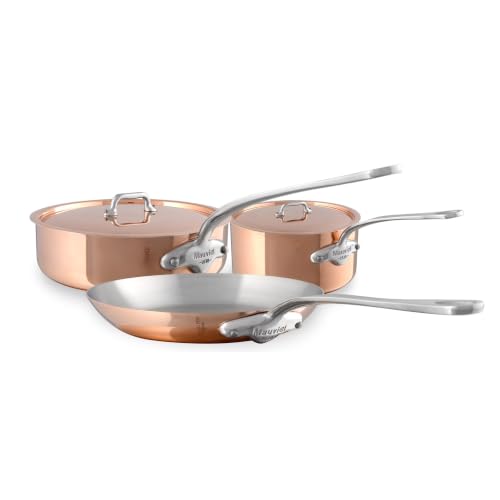
Mauviel copper set
Position in this guide: premium tier. In plain terms, this is heritage French copper in the traditional form: a real copper body with a stainless steel lining, made by a maker whose name is close to synonymous with the category. The steps land here when the answers are: gas or verified base, sauce-led cooking, rituals welcomed, decades intended — the traditional destination.
Best for: serious cooks who sauce, sear, and simmer daily, who accept polishing and hand-washing as part of ownership, and who are buying for decades. Not suited for: induction kitchens without a verified magnetic base, dishwasher households, and anyone who wants nonstick forgiveness for eggs and fish. Because this pick is presented prose-only while its listing verification is pending, treat it as a researched recommendation to check against the current listing — construction, lining, and hob compatibility especially — rather than as a linked product, and check the price on Amazon when you are ready to compare it against the rest of the shortlist.
All-Clad Copper Core set
Position in this guide: premium tier. In plain terms, this is the copper-core archetype: a band of real copper sealed inside a multi-ply stainless construction, so the copper works invisibly and the surfaces you touch are stainless steel. The steps land here when the cooking answers say copper and the temperament answers say stainless — the bridge destination, and the most common one for serious home cooks.
Best for: cooks who want genuine copper responsiveness with stainless durability, no polishing, no re-lining, and a set that behaves like the stainless they already know. Not suited for: buyers who want to see and display copper, traditionalists who prefer a tin lining’s cooking feel, and anyone whose budget points to the entry tier. Because this pick is presented prose-only while its listing verification is pending, treat it as a researched recommendation to check against the current listing — construction, lining, and hob compatibility especially — rather than as a linked product, and check the price on Amazon when you are ready to compare it against the rest of the shortlist.

Lagostina copper set
Position in this guide: mid tier. In plain terms, this is a clad set from a long-established Italian maker that builds copper into a layered construction, sitting between the coloured nonstick family and the premium heritage makers. The steps land here for the step-up buyer: metal cooking, copper in the construction, mid tier, with step two — read the exact construction — doing more work than usual.
Best for: buyers who want a step up from basic nonstick into clad-metal cooking without going straight to the top tier, and who will confirm the exact construction and hob compatibility of the specific set before ordering. Not suited for: purists seeking thick traditional copper with a hand-finished lining, and induction households that have not verified the base of the exact model. Because this pick is presented prose-only while its listing verification is pending, treat it as a researched recommendation to check against the current listing — construction, lining, and hob compatibility especially — rather than as a linked product, and check the price on Amazon when you are ready to compare it against the rest of the shortlist.

Gotham Steel copper set
Position in this guide: entry tier. In plain terms, this is the best-known name in the copper-coloured family: an aluminium set with a ceramic-style nonstick surface in a copper tone. The steps land here when step one’s honest answer is that the brief was nonstick all along: forgiveness, lightness, and a warm colour, bought as a consumable with a service life.
Best for: households that want easy-release everyday cooking and the copper look on an entry budget, and who understand they are buying nonstick convenience rather than copper performance. Not suited for: anyone shopping for real copper responsiveness, induction certainty, or a set expected to serve for decades. Because this pick is presented prose-only while its listing verification is pending, treat it as a researched recommendation to check against the current listing — construction, lining, and hob compatibility especially — rather than as a linked product, and check the price on Amazon when you are ready to compare it against the rest of the shortlist.
Common Mistakes
The most common buying mistake in this category is paying for colour and believing you have paid for metal. It happens because listings are written to blur exactly that line, with copper in the headline and the construction details — aluminium body, ceramic surface — further down the page. The defence is a two-question habit: what is the pan made of, in layers, and what lines the cooking surface? Any listing that answers both clearly is probably honest; any listing that answers neither is telling you what it is selling. The second most common mistake is the mirror image: buying demanding traditional copper for a household that will not polish, will use the dishwasher, and will resent both within a month.
Sizing mistakes run in both directions. Some buyers choose the largest set on the page and discover that half the pieces duplicate pans they already own, while the wide sauté pan they needed was never in the box. Others, charmed by a small set’s gentle price tier, end up with saucepans too small for their pasta habits and a frying pan that crowds four chicken thighs into steaming each other. Crowding is a cooking error a set can bake in: meat needs space around it to brown, and a pan that is technically excellent but too small for the household’s portions will disappoint nightly. Count your usual portions, look at the diameters that handle them, and let that arithmetic outrank the piece count.
A quieter mistake is ignoring the hob. Buyers fall for a traditional set, then discover an induction cooktop will not recognise a single piece, or bring copper home to a glass-top hob whose maker warns against heavy pans dragged across the surface. Copper is dense and a full copper pan is heavy; that weight is part of its cooking quality and part of its handling reality. Check the hob first, check your own comfort lifting a full pan one-handed second, and check storage third — a set that lives in a precarious stack on a high shelf will be cooked with less and dreaded more than its performance deserves.
Pro Tips
Three habits separate satisfied copper owners from the rest. First, buy the saucepan shapes with the same care as the frying pans: copper’s advantage concentrates in saucepans, sauciers, and sauté pans, so a set strong there beats a set strong in skillets. The French tradition understood this, as our survey of French copper saucepan sets shows in detail. Second, photograph your pans when they arrive and note the lining’s appearance; that baseline makes later wear checks — especially tin thinning — a comparison instead of a guess. Third, learn your burners again on the new metal with three forgiving dishes before attempting the custard for guests; every responsive pan has a first-week learning curve, and scheduling it is the difference between a delight and a dinner-party incident.
A fourth tip for the research phase itself: read the maker’s own care instructions before buying, not after. They are the most honest document in the category — a maker expecting you to hand-wash, dry, and polish says so plainly, and a maker whose care page is two lines long is selling a different relationship. The care page, the layer list, and the hob statement are the three documents that tell the truth in this category; headlines and hero photographs are under no such obligation. Our guide to cleaning a copper cookware set shows the full routine the traditional family’s care page is describing.
Worked Examples
The Sunday sauce maker
Cooks ragù, béchamel, and holiday caramel; gas hob; enjoys maintaining good tools; buying for the long term. The steps run: traditional family, tin or steel lining by confidence — this cook chooses steel for utensil freedom and accepts the preheating discipline — a set weighted toward saucepans and a wide sauté pan, polishing filed under ritual. Destination: the heritage traditional set, with the saucepan tradition explored first in our tin-lined copper cookware guide in case tin’s kindness wins on reflection.
The induction family kitchen
Weeknight cooking for four, induction hob, dishwasher is non-negotiable, one parent cooks with a child underfoot. The steps run: induction closes traditional copper at step four; care honesty at step seven closes anything ritual-based; the surviving answers are a verified magnetic copper-core set if the tier stretches, or quality stainless if it does not. Destination: copper-core, verified piece by piece — or a graceful exit from the category, which the steps exist to permit. Our induction cookware sets guide covers the exit route properly.
The first flat, small budget, big breakfasts
Eggs and pancakes daily, toast-level other cooking, minimal storage, gentle tier. The steps run: step one’s honest answer is that the brief is forgiveness and lightness; the coloured family fits it exactly, bought knowingly as nonstick with a coating’s lifespan. Destination: a copper-coloured set, enjoyed without illusion — and with the money saved banked toward the kitchen this cook will have in five years, when the steps may answer differently.
A Shorter Path Through the Same Steps
If seven steps feel like homework, compress them into three questions and accept their answers. What is my hob? What do I actually cook at the stove each week? What chores will I still be doing cheerfully in year three? Hob, food, temperament: the family falls out of the first two, the lining out of the second, and the specific set out of all three. What the full steps add is verification — the layer list, the written hob statement, the piece list — and in a category whose marketing profits from blur, verification is not pedantry. It is the whole skill this guide exists to teach.
Step 8: Interrogate the Warranty and the Maker
Add a final step the original seven assumed: judge the maker as well as the metal. Serious copper makers publish their construction plainly, answer compatibility questions specifically, offer care guidance that sounds like experience, and stand behind bonding and workmanship with a real warranty. Makers of coloured sets compete on presentation and breadth of bundle. Neither is automatically disreputable, but the signals sort the shelf quickly: the maker who tells you how the pan will age is selling you a tool, and the maker who only tells you how it will photograph is selling you a season. When two sets survive the first seven steps, let the maker’s candour break the tie — it predicts your year-three experience better than any feature list.
A Note on Buying Pieces Instead of a Set
The steps in this guide choose sets because the keyword on the door says set, but intellectual honesty requires a footnote with its own heading: for many kitchens the correct output of these steps is not a set at all. If step five’s piece-list analysis shows that your cooking uses three shapes intensely and the rest rarely, buy those three shapes in the best construction your tier allows and let boiling and bulk work stay with the pans you own. The steps do not mind; they were designed to match purchases to cooking, and a three-piece answer that fits is a better outcome than a ten-piece answer that approximates. Revisit the set question when the kitchen or the cooking changes — the steps will still be here, and they do not expire.
Checking a Specific Set Before You Pay: A Worked Routine
Put the whole guide into one five-minute routine and run it on any candidate. Minute one: find the layers, outside to inside, and say them aloud; if you cannot, stop. Minute two: find the lining named in words and match it to your food. Minute three: find the hob statement; for induction, find it per piece or walk away. Minute four: list the pans, ignore the piece count, and mark which of your weekly dishes each pan serves; unmarked pans are cost without benefit. Minute five: read the care page and say the routine aloud — hand-wash, dry, polish or patina, renew a lining someday — and check that the sentence sounds like your life. A set that survives all five minutes has been chosen, not merely bought, and that distinction is the entire subject of this guide.
How the Steps Handle the Hard Cases
Guides are tested by their edge cases, so run three difficult shoppers through the steps. The first cooks beautifully, sauces weekly, and has just moved into a flat with an induction hob and no renovation budget: the steps close traditional copper at the hob check, and the honest destination is a verified magnetic copper-core set or excellent stainless — the guide loses a copper sale and keeps its credibility, which is the correct trade. The second has a generous budget, a gas range, and a partner who puts everything in the dishwasher: the steps surface the conflict at the care step rather than after purchase, and the destination is copper-core, whose contract the whole household can actually keep. The third wants copper purely because it photographs beautifully for a food blog: the steps take the brief seriously — display is a legitimate use — and route it to traditional copper with a polishing rhythm, while noting that a few open pieces may serve the camera better than a full set. In each case the steps did not merely rank products; they protected the buyer from a mismatch, which is the actual job of choosing well.
After You Choose: The First Fortnight Plan
Choosing ends at the order; succeeding begins at the unboxing, and a short plan protects the purchase. Days one to three: wash, dry, and cook forgiving things — soups, sautéed vegetables, a simple tomato sauce — at lower burner settings than habit suggests, learning the pan’s speed without stakes. Week one: attempt your signature sauce or your usual fish, and notice where the control helps; adjust one habit at a time, usually preheating longer and heating less fiercely than the old pans taught you. Week two: run the care routine once end to end — wash, dry, inspect, polish if that is your lane — so the maintenance stops being a theory and becomes a timed, known quantity. By the end of the fortnight the set is either integrating into your cooking, in which case the choosing worked, or revealing a mismatch early enough to act on, in which case the choosing still worked, because it included a way to find out.
Choosing When Two Cooks Disagree
Most guides assume a single decision-maker; most kitchens have two, and their steps diverge most often at care and weight. The cook who sauces wants traditional copper; the cook who washes up wants stainless manners; both are describing the same household budget of effort from different ends of the meal. The steps resolve this more often than couples expect, because copper-core was engineered for exactly this disagreement — one partner’s cooking, the other partner’s sink. Where the disagreement is about money rather than chores, the split purchase arbitrates: copper where the sauce cook works, plainer metal everywhere else, and the shared pieces chosen together. What the steps forbid is the silent compromise in which one partner buys the other’s resentment at a premium tier. Run the steps aloud, together, and let each partner answer the care and hob questions for themselves; a set chosen by both cooks is used by both cooks, and use, as every page of this programme insists, is where the value lives.
And when the steps are done and the set is chosen, write down why. A single line in a notebook — family, lining, hob verified, pieces matched to the cooking — becomes valuable years later when a piece needs replacing, a lining needs renewing, or a second kitchen needs equipping. Choosing well is a skill; recording the choice is how the skill compounds. Future you, standing in a shop or reading a listing at midnight, will be grateful that present you treated the decision as worth documenting. That small habit is the true final step of this guide, and it costs less than a minute.
Choosing the Retailer and the Moment
The steps have governed what to buy; a short coda governs where and when, because both affect what you actually receive. Buy from a seller whose listing carries the maker’s full construction description and whose returns policy tolerates a change of heart after the pans are in your hands — the weight check in step six sometimes delivers its verdict only at your own stove, and a humane returns window is the insurance on that step. Specialist cookware retailers earn their place here by answering lining and compatibility questions specifically; marketplaces earn theirs on tier and convenience, provided the listing is the maker’s own and not a paraphrase. As for timing, sets in this category are durable goods with long model lives, so there is no season in which last year’s copper is obsolete; buy when the kitchen and the budget are ready rather than chasing a promotional calendar, and let the steps, not the sale banner, make the decision.
One last choosing skill deserves a paragraph because it protects every other step: photograph the listing. Save the construction description, the lining statement, and the hob compatibility claim as they stood on the day you paid. If the set that arrives contradicts them — a different base, an unnamed lining, a construction that does not match the passport you were shown — the photographs are your evidence and your returns conversation becomes short. Makers of real copper rarely trigger this precaution, but the category’s blurrier corners are exactly where a buyer needs it, and it costs nothing but a screenshot. Choose the family, the lining, the pieces, and the moment with the steps above, document the promise, and you have done everything a buyer in this category can reasonably do.
The Guide in One Breath
If everything above had to survive in a single paragraph, it would be this one. Decide the family first, from your hob and your temperament: traditional copper for control with rituals, copper-core for control without them, copper-coloured only when the honest brief is nonstick. Read the construction in layers and the lining in words, and refuse any listing that will not provide both. Verify the hob for the exact set, ideally piece by piece. Buy the piece list your cooking actually uses, lift the largest pan full if you possibly can, and read the care page as the contract it is. Do those things and the choosing is done — not approximately, but completely — and what remains is the pleasure the whole exercise was for: cooking on metal that answers.
Keep the receipt of your reasoning, too, in the most literal sense: the maker’s name, the construction, and the date, filed where the household keeps such things. Decades-long tools generate decades-later questions — a lining to renew, a piece to match, a warranty to invoke — and the buyer who can answer them from a folder rather than from memory owns the set more completely. Choosing well ends at the purchase; owning well begins with the paperwork, and both are part of the craft this guide exists to teach.
The Copper cookware set Worksheet: Measurements, Counts, and Honest Answers
Start this worksheet with the space, not the product page: measure the exact spot where the copper cookware set will live, including the clearance above it, the swing or reach you need in front of it, and the route you will take to move it for cleaning. Write down the largest item you realistically expect to use with it, because that single measurement settles more sizing arguments than any capacity figure printed in a listing headline. Check the nearest outlet and be honest about whether a cord will cross a walkway, a sink edge, or another appliance that also needs that socket on busy mornings. Count the people the copper cookware set must serve on an ordinary weekday, then count again for the busiest gathering you host in a typical year, and notice whether those two numbers point to the same size.
List the three jobs you will ask of it every week and the one job you will ask only a few times a year, because the weekly jobs should drive the decision and the rare job should not. Decide where the accessories, attachments, and spare parts will be stored before you order, since a copper cookware set whose extras live in a distant cupboard quietly becomes a copper cookware set with fewer features. Where a shortlist names specific examples, such as Mauviel copper set, run these same checks against that listing line by line rather than assuming the general verdict transfers unchanged. Apply the identical test to All-Clad Copper Core set as well, on the same day and under the same conditions, because a fair comparison needs one ruler rather than two moods.
- Measure the working spot and the clearance around it
- Count weekday servings and the biggest gathering
- List the three weekly jobs in writing
- Decide storage for every accessory in advance
- Name the one compromise you accept knowingly
- Set the return deadline in your calendar
If Lagostina copper set is also in contention, give it the same worksheet and let the three sets of answers sit side by side before anyone reaches for a checkout button. Think about who else in the household will use it, including anyone shorter, anyone with less grip strength, and anyone who will clean it without reading the manual first. Note the surfaces it will touch in normal use and whether heat, moisture, weight, or vibration from the copper cookware set could mark, stain, or stress those surfaces over months of daily contact. Plan the cleaning position as carefully as the working position, because a copper cookware set that is awkward to carry to the sink or to open fully will be cleaned less often than it should be.
Write the three questions you still cannot answer from listings and guides, and treat those unanswered questions as your shortlist filter rather than as details to discover after delivery. Compare the footprint against the appliance or tool it replaces, and decide in advance what leaves the room if the new arrival is larger than the old one. Consider the noise, steam, heat, or light it produces in use and whether that output lands in a room where someone sleeps, works, or studies at the same hours. Check how it behaves at the smallest task, not only the largest, because many households abandon oversized gear that feels clumsy for the quick everyday job.
Think through the second week of ownership, when the novelty has faded, and ask which features you will still touch daily and which were only interesting in the showroom sense. Decide what good enough looks like in writing: the result you would accept without complaint, the result that would delight you, and the result that would send the box back. Look at the controls with fresh eyes and imagine using them with wet hands, greasy hands, or gloves, depending on the work, because small controls punish exactly those moments. Ask how the copper cookware set fails gracefully: whether a worn part, a lost attachment, or a single broken control ends its usefulness or merely removes one mode you rarely used.
Check whether replacement parts and consumables are ordinary, widely stocked items or proprietary pieces tied to one maker, since that difference compounds over years of ownership. Measure the storage shelf, drawer, or cupboard you intend to use with the door closed and other contents in place, not the optimistic empty version of that space. Think about guests and helpers who will meet the copper cookware set without your habits, and whether its safe, correct use is obvious to a newcomer within a minute of looking at it. Write down the one compromise you are consciously accepting, so that when it shows up in daily use it reads as a chosen trade rather than a nasty surprise.
Frequently Asked Questions
What is the most important thing to check when choosing a copper cookware set?
That the copper is real and working: a body, core, or cladding layer named plainly in the construction, with the lining stated just as plainly. Everything else — pieces, handles, tier — is preference, but this check separates three different products that share a name. After it, the most important check is hob compatibility, since copper without a magnetic base will not work on induction at all. A listing that answers both questions clearly is a listing you can shop from with confidence.
Is thicker copper always better?
Within traditional copper, a substantial body is what delivers the famous evenness and responsiveness, and very thin copper-clad pieces give back some of that advantage. But thicker also means heavier and a higher tier, and beyond the point where the pan cooks evenly, extra copper buys diminishing returns for most home cooking. Judge by construction and reputation rather than by chasing a number, and remember that copper-core sets achieve their results with a thinner copper layer used efficiently inside a multi-ply build.
Should I choose tin-lined or stainless-lined copper?
Choose tin for the kindest cooking surface — eggs, fish, and sauces release gently and forgive small errors — if you accept gentle utensils, no empty-pan high heat, and professional re-lining after years of wear. Choose stainless lining for durability and freedom: any utensils, fierce heat, no renewal cycle, with a preheating learning curve for delicate foods. Most households are happier with steel; cooks who sauce daily and love the traditional craft often choose tin deliberately.
How many pieces should a copper cookware set have?
As many as your cooking uses and no more. Count pans, not pieces: lids and utensils inflate the headline number. A strong core is two frying or sauté shapes, two saucepans in genuinely different sizes, a lidded wide pan for braising, and a stockpot matched to your pasta habits. Duplicated small saucepans and novelty shapes add cost without adding dinners. If a set’s list matches your weekly cooking, its count is correct whatever the number says; if it does not, no discount fixes the mismatch.
Can I choose copper cookware for an induction hob?
Yes, but only by choosing specific sets engineered with a magnetic base layer, which you must verify from the maker’s statement for that exact set — ideally piece by piece, since lines occasionally mix bases. Traditional copper without that layer will not heat on induction at all. Copper-core and modern clad lines are the most promising places to look. If verification fails or the tier does not stretch, quality induction-ready stainless is the honest alternative rather than converter discs.
Is a copper-coloured set ever the right choice?
Yes — when the actual brief is nonstick: forgiving eggs, light pans, wipe-clean evenings, and an entry tier, in a kitchen that will treat the coating gently and replace the set when its release fades. It is the wrong choice only when bought as copper, expecting responsiveness, longevity, or high-heat freedom it cannot offer. Chosen knowingly, it is a sensible purchase; the category’s problem is labelling, not the pans themselves.
Related Guides and Next Steps
Keep reading with these companion pieces from the same kitchen: copper cookware set buying guide copper cookware set vs stainless steel copper cookware set pros and cons the best Mauviel copper cookware stainless cookware with a copper core the best induction cookware sets. Each one takes a single question from this page and gives it the full treatment, so you can go deeper exactly where your own decision is still open.


