Disclosure: As an Amazon Associate, topratedkitchenware.com earns from qualifying purchases. Links on this page are affiliate links; they cost you nothing extra. Prices and availability change often, so check the current Amazon listing before you buy.
Asking is an enameled dutch oven worth it is really asking whether slow, covered, hob-to-oven cooking sits near the centre of your kitchen life — because the pot itself is not in doubt. It braises, bakes, simmers and serves superbly, lasts for many years, and asks in return for money, cupboard space, two-handed lifting and a short list of care rules. Worth it if that exchange matches your cooking; not worth it if your meals are fast, your storage is tight, or your lifting is limited. This article prices the exchange honestly in everything except money — time, space, effort and habit — and ends with a checklist that turns the question into a decision.
Is an Enameled Dutch Oven Worth It: Short Answer and Key Takeaways
Worth it if you cook braises, soups, beans, sauces or bread weekly, enjoy food that takes its time, and can lift a heavy pot safely. Not worth it if weeknight speed rules your cooking, if the pot would be your household’s most resented object to move, or if it would be bought for occasions that happen twice a year.
- The value is consolidation: one vessel replaces several for slow cooking, and improves most of it.
- The true costs are weight, space, slow response and care rules — paid daily, not once.
- Frequency decides everything: weekly use makes even premium tiers sensible; rare use makes even entry tiers questionable.
- Alternatives cover parts of the job more cheaply or lightly, but none covers the whole job.
- If you buy, value is maximised by sizing honestly and building the care habits from day one.
In this guide
What You Actually Get
Braising is the home ground of the enameled Dutch oven. Tough, flavourful cuts soften slowly in a shallow bath of liquid, the heavy walls even out the heat so nothing catches at the base, and the lid keeps the environment moist and steady for hours. Tomato, wine and vinegar — the ingredients that make braises taste alive — are exactly the ingredients bare seasoned iron dislikes and enamel ignores, so the full repertoire of wine-braised beef, tomato-rich chicken and vinegar-finished beans is open without a second thought. Keep the simmer gentle rather than rolling, check occasionally that the liquid still laps at the food, and rest the finished dish in the pot, where the iron holds warmth while flavours settle. A pot that braises this well changes weekly cooking: the cheapest cuts become the most requested dinners, and leftovers improve overnight in the same vessel that cooked them.
Bread bakers adopted this pot for a physical reason: a preheated, lidded iron pot is the closest a home oven comes to a professional steam oven. The dough goes into the hot pot, the lid seals in the moisture the dough itself releases, and the loaf expands and sets its crust in that steamy chamber before the lid comes off to finish the colour. Enamel helps here in two ways — it releases the finished loaf cleanly, and it wipes clean afterwards without the seasoning worries of bare iron. Handle this routine with extra respect for heat: the pot, the lid and the knob are all fiercely hot, gloves are mandatory, and the loaf should be lowered in on its parchment rather than dropped. Let the pot cool gradually afterwards instead of rinsing it hot. Bakers who bake weekly often find the bread alone justifies the purchase; occasional bakers should be honest that a pot bought only for bread must still earn its storage space.
For soups, beans and sauces, the virtues are steadiness and forgiveness. Thick walls spread heat so a tomato sauce can murmur for an afternoon without scorching at the base, and a pot of beans holds a gentle simmer that keeps them intact instead of battering them apart. Enamel matters here more than anywhere: long, acidic simmers that would strip seasoning from bare iron and pick up metallic notes simply cook cleanly, and the pot can go from hob to table to fridge without decanting into a second container. That fridge habit comes with one caution — let the pot cool before it goes in, and let it lose its chill before it goes back on the heat, so the enamel never faces a sudden temperature swing. Big-batch cooks should think about the full weight of a pot of soup before choosing the largest size, because the moment of lifting it off the hob is the moment size stops being abstract.
Searing is where enameled iron earns much of its reputation. The mass of the pot holds heat when cold meat lands in it, so pieces brown instead of steaming in their own juices, and the enamel surface releases that fond willingly when liquid arrives. Work in batches rather than crowding the base, let each piece sit undisturbed long enough to take colour, and watch the fond rather than the clock — on a light interior you can see it deepen from gold to mahogany, while on a dark interior you judge more by smell and by how the surface feels under a wooden spoon. Deglaze with wine, stock or water and scrape gently with wood or silicone, never metal, and every bit of that flavour joins the sauce. Because the same pot then goes on to braise what it seared, nothing is lost between pans, which is the quiet efficiency at the heart of this style of cooking.
The Real Costs Beyond Money
Weight deserves its own honest paragraph in any discussion of this pot, because it shapes every single use. An enameled Dutch oven is heavy empty and very heavy full of stew, and pretending otherwise helps nobody. The safe technique never changes: clear the route from hob to counter or table before you lift, put on proper oven gloves even for a short move, take a handle in each hand, keep the pot level and close to your body, and set it down on a trivet or board rather than a cold or wet surface. Never try to carry a full pot one-handed, never let a helper grab one handle while you take the other without agreeing the move first, and never leave a child to wrestle a lid that weighs more than they expect. If your wrists, shoulders or grip make that routine sound difficult, believe that feeling now rather than after the purchase — a smaller pot you lift confidently will cook far more meals than a large one you dread moving.
Storage sounds trivial until a heavy pot meets a crowded cupboard. Keep the pot somewhere you can lift it from safely with two hands — a low, sturdy shelf beats a high one, and the hob itself is where many owners happily leave it, since a handsome enameled pot earns its place on display and stays within easy reach. Protect the enamel in storage: do not nest other pans inside it without a cloth or felt between them, keep the lid seated or store it with a cloth protecting the rim, and never drag the pot across a glass hob or a stone counter. If you stack cookware, the Dutch oven goes at the bottom as the foundation, never balanced on top of lighter pans. A pot stored where it is easy to reach gets used; a pot buried behind rarely used equipment quietly becomes the expensive object this guide is trying to help you avoid buying.
Then there is the learning curve, which is real but short. Heavy iron heats slowly and holds heat stubbornly, so the first weeks involve overshooting simmers and learning to turn the heat down early. The care rules — soft tools, gradual temperatures, gentle washing, thorough drying — are individually trivial and collectively permanent. And there is the opportunity cost of the cupboard: a pot this size displaces other equipment, which is a fair trade only if the displaced items were earning less than this one will. None of these costs is hidden, and a buyer who accepts them knowingly almost never regrets the purchase; regret belongs to buyers who discovered them afterwards.
Thermal shock is the one enemy enamel cannot argue with. The coating is a glass-like layer bonded to iron, and the two materials react to sudden temperature change at different rates, which is how crazing and cracks begin. The habits that protect it are simple and absolute. Warm the pot gradually rather than blasting it on a fierce heat from cold, and never leave it heating empty for a long stretch, because an empty pot climbs in temperature far faster than a full one and stresses the enamel. Add oil or liquid before serious heat, let a pot from the fridge come closer to room temperature before it meets a hot oven, and at the end of cooking let it cool on the hob or a board before any water touches it. Above all, never pour cold water into a hot pot and never plunge a hot pot into a sink of water — that single impatient moment is responsible for more ruined enamel than years of ordinary cooking.
Who It Pays Off For
The Weekly Slow Cook
If a braise, soup or pot of beans happens most weeks, the arithmetic is not close. The pot improves the food, simplifies the washing, consolidates the equipment and spreads its cost across hundreds of meals. For this cook the question answers itself, and the only remaining decision is tier — with weekly use making a genuine case for the refinement of the upper end.
The Bread Baker
A baker producing a weekly loaf gets a second appliance’s worth of value from the same object: the lidded, preheated pot is the home baker’s steam chamber, and crust quality jumps in a way few other purchases deliver. If bread alone is weekly and stews join it even monthly, the pot has effectively paid its way twice.
The Host Who Cooks From One Pot
Guests reveal the truth about cookware. Nobody comments on a stockpot, but a handsome enameled pot arriving at the table starts conversations, and the cook who braises in it tends to cook for people more often. That social dimension is not frivolous: tools that make hosting easier get used, and tools that get used justify themselves. If your cooking life includes feeding friends from one big pot, the enameled Dutch oven is close to purpose-built for it. If your cooking is mostly quick solo meals on weeknights, be honest that the pot’s greatest strengths — slow, generous, shared food — point away from your routine rather than towards it.
Who Should Skip It
The Fast Weeknight Cook
Quick, reactive, high-heat cooking is a legitimate style and this pot serves it badly. If most dinners are fifteen-minute affairs built on speed and response, the Dutch oven will be admired and unused, and an unused pot is never worth it at any tier. Buy the light, fast tools your cooking actually calls for.
The Cook Who Cannot Lift It Happily
Weight deserves its own honest paragraph in any discussion of this pot, because it shapes every single use. An enameled Dutch oven is heavy empty and very heavy full of stew, and pretending otherwise helps nobody. The safe technique never changes: clear the route from hob to counter or table before you lift, put on proper oven gloves even for a short move, take a handle in each hand, keep the pot level and close to your body, and set it down on a trivet or board rather than a cold or wet surface. Never try to carry a full pot one-handed, never let a helper grab one handle while you take the other without agreeing the move first, and never leave a child to wrestle a lid that weighs more than they expect. If your wrists, shoulders or grip make that routine sound difficult, believe that feeling now rather than after the purchase — a smaller pot you lift confidently will cook far more meals than a large one you dread moving.
The Twice-a-Year Slow Cook
If braises happen at holidays and bread is a rare project, the honest tools are a borrowed pot, a lighter casserole, or an entry-tier purchase made with open eyes. The category’s value compounds with use; without use, it is simply a beautiful weight occupying your best cupboard.
Strengths and Trade-Offs of Owning One
- Strength: the widest slow-cooking repertoire of any single vessel, from sear to table.
- Strength: freedom with acidic food and no seasoning, forever.
- Strength: longevity measured in many years, spreading cost thin across constant use.
- Trade-off: permanent weight and two-handed handling, empty and especially full.
- Trade-off: enamel rules — no metal, no shock, no abrasion — for the pot’s whole life.
- Trade-off: space and slow response, paid in small instalments every day.
Alternatives to Consider
The honest alternatives deserve a fair hearing. A bare cast iron Dutch oven costs less commitment in enamel care and shrugs off metal tools and fierce preheats, but asks for seasoning discipline and sulks with acidic food. A stainless steel stockpot is dramatically lighter and excellent for pasta water and big soups, but cannot hold a sear or a braise in the same way and gives bread nothing like the same crust. A slow cooker braises conveniently and unattended, yet cannot sear, bake or go to the table with the same presence. A ceramic or glass casserole suits gentle oven dishes but not hob searing. None of these is a failed product; each simply trades away part of what the enameled pot combines in one vessel. The enameled Dutch oven earns its place when you want that combination — sear, braise, bake, simmer and serve — often enough that one heavy pot replaces several lighter compromises.
The Enameled Options, If the Alternatives Fall Short
If the alternatives each give up something you care about, these are the enameled reference points at each tier — the same decision, priced by frequency of use rather than by novelty.
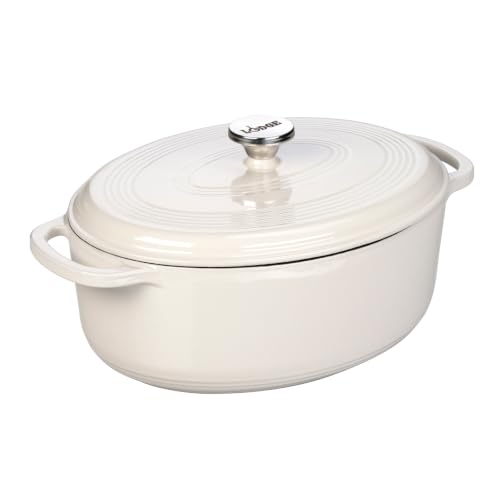
Lodge Enameled Cast Iron Dutch Oven
Entry tier positioning. the practical starting point in this category. It covers the core jobs — braising, simmering, baking and roasting — in a straightforward design that puts function ahead of decoration, with wide loop handles that are easier to grip with thick oven gloves than smaller handles tend to be. The enamel interior is light in tone…
Best for: the cook described above. Not suited for: priorities pointing the other way. Check price on Amazon for linked listings when they appear at publication; this prose-first draft claims no unverified link.
Le Creuset Signature Enameled Cast Iron Dutch Oven
Premium tier positioning. the refined benchmark many shoppers measure the category against. The enamel finish is notably smooth, the light interior makes browning easy to judge, and the larger handles and considered lid fit give it a composed feel in daily use. It suits a cook who plans to keep one pot for a very long time, cooks…
Best for: the cook described above. Not suited for: priorities pointing the other way. Check price on Amazon for linked listings when they appear at publication; this prose-first draft claims no unverified link.
Staub Enameled Cast Iron Cocotte
Premium tier positioning. the cocotte takes a slightly different path, with a dark interior that hides staining gracefully and a lid designed to encourage moisture to rain back over the food as it braises. Cooks who braise often tend to praise that self-basting character, and the dark cooking surface shows less discolouration over time than pale enamel does.…
Best for: the cook described above. Not suited for: priorities pointing the other way. Check price on Amazon for linked listings when they appear at publication; this prose-first draft claims no unverified link.

Tramontina Enameled Cast Iron Dutch Oven
Entry-to-mid tier positioning. a value-minded option that has introduced many households to enameled cooking. The formula is familiar — heavy iron, glossy enamel, a light interior on common versions and handles sized for gloved hands — delivered without premium positioning. It suits a family cook who wants a dependable braising and soup pot, a second pot for big-batch…
Best for: the cook described above. Not suited for: priorities pointing the other way. Check price on Amazon for linked listings when they appear at publication; this prose-first draft claims no unverified link.
How to Get the Most Value If You Buy
Value is protected by behaviour. Size the pot to your real meals so it is used constantly rather than impressively. Build the habits in the first month — gloves and two hands for every lift, gradual heat, wooden tools kept nearest the hob, brief warm soaks and thorough drying — while motivation is high, because habits formed early become invisible. Cook the pot’s greatest hits on rotation so it never drifts to the back of the cupboard: a weekly soup, a fortnightly braise, bread when the mood takes you. And keep it where you can see it; a handsome pot left on the hob is both storage and advertisement for its own next use.
Everyday cleaning of enamel is deliberately unexciting, and that is the point. Let the pot cool until it is warm rather than hot, then wash it in warm water with a soft sponge or cloth and ordinary washing-up liquid. Food releases far more easily after a short soak in warm water — a soak measured in minutes while you eat, not hours left overnight, because prolonged soaking is unkind to the exposed iron rim and pointless for the enamel itself. For stuck patches, simmer a little water in the cooled-then-rewarmed pot and loosen the residue with a wooden spoon or a soft scraper, and for stubborn staining a gentle paste of bicarbonate of soda and water, applied with a soft cloth, does most of what you need. Never reach for metal scourers, steel wool or aggressive abrasive pads: they scratch and dull the enamel, and scratched enamel stains faster and cleans harder forever after. Dry the pot thoroughly, pay attention to the bare rim, and store it fully dry.
The Decision Checklist
Answer honestly, out loud if necessary. Do I cook a slow, covered dish at least most weeks? Do acidic sauces, beans or bread feature in my real repertoire? Can I lift a heavy full pot with two gloved hands, confidently, today and in ten years? Do I have storage I can lift it from safely, and an oven and sink it fits? Will my household respect soft tools and gradual temperatures? Is there a lighter tool I would honestly use more? Five or six answers pointing the same way settle it: mostly yes means buy, at the tier your frequency justifies; mostly no means the pot is a lovely object for someone else’s kitchen, and there is no shame in that verdict — only in ignoring it.
Judging value in this category means thinking in cost per year of service rather than cost on the day. These are among the longest-lived objects in a kitchen: the iron does not wear out, the enamel asks only for protection from shock and metal, and a well-kept pot is measured in decades. Against that lifespan, the gap between an entry pot and a premium one spreads into something small per year — but only if the pot is actually used, which returns the whole question to size, weight and fit with your cooking. The expensive mistake is not buying premium; it is buying any tier of pot that sits unused because it is too heavy, too large or wrong for the food you make. The cheap mistake is buying purely on price and then fighting a thin-feeling lid or a finish you dislike every week for years. Value lives where the tier, the size and your habits meet, and this category rewards buyers who are honest about all three.
Practical Notes From Everyday Cooking
One pot also changes how a small kitchen works. When a single vessel sears, braises, bakes, simmers and serves, several other pans stop earning their cupboard space, and the cook who owns less but uses all of it tends to cook more, not less. That consolidation is a real argument for spending properly on the one pot: the budget of two or three mediocre pans gathered into a single good Dutch oven usually produces the better kitchen. The counter-argument is equally real — a household that rarely braises or bakes gains nothing by consolidating around a pot it will not use.
Guests reveal the truth about cookware. Nobody comments on a stockpot, but a handsome enameled pot arriving at the table starts conversations, and the cook who braises in it tends to cook for people more often. That social dimension is not frivolous: tools that make hosting easier get used, and tools that get used justify themselves. If your cooking life includes feeding friends from one big pot, the enameled Dutch oven is close to purpose-built for it. If your cooking is mostly quick solo meals on weeknights, be honest that the pot’s greatest strengths — slow, generous, shared food — point away from your routine rather than towards it.
Practical Notes From Everyday Cooking
Seasonal cooking flatters this pot in every quarter. Winter is its obvious season — stews, beans, braises and bread — but spring soups, summer tomato sauces cooked low and slow, and autumn roasts all sit naturally in it. The oven work warms the kitchen, which is a pleasure in January and a consideration in August; summer cooks tend to keep the pot on the hob for sauces and beans instead. A buyer weighing the purchase should picture their cooking across the whole year rather than in the mood of the month they happen to shop in, because the pot’s value is the sum of all four seasons.
There is a rhythm to cooking in heavy iron that lighter pans never teach. You learn to start earlier and rush less: the pot comes up to heat gradually, the sear is given its time, the braise is left alone for long stretches, and the finished dish rests in the vessel while you set the table. Cooks who enjoy that rhythm find the pot almost meditative; cooks who want instant response from a pan often find it ponderous, and neither reaction is wrong. Knowing which cook you are is worth more than any single feature comparison, because the pot will ask for that patience every time you use it, and reward it every time you give it.
Leftovers behave differently in iron. A braise cooled and refrigerated in its pot, then gently rewarmed in the same vessel the next day, often tastes better than it did fresh, because the flavours have had a night to settle and the reheating is even and unhurried. Respect the temperature rules on that journey — cool before chilling, warm gradually when reheating, and never take the pot straight from fridge to fierce heat. Decanting into storage containers is kinder to the pot’s rim over the long term if the food will sit for days, but for the classic next-day stew, the pot itself is part of the recipe.
Practical Notes From Everyday Cooking
Guests reveal the truth about cookware. Nobody comments on a stockpot, but a handsome enameled pot arriving at the table starts conversations, and the cook who braises in it tends to cook for people more often. That social dimension is not frivolous: tools that make hosting easier get used, and tools that get used justify themselves. If your cooking life includes feeding friends from one big pot, the enameled Dutch oven is close to purpose-built for it. If your cooking is mostly quick solo meals on weeknights, be honest that the pot’s greatest strengths — slow, generous, shared food — point away from your routine rather than towards it.
Table service is an underrated part of the case for enamel. The pot that cooked the meal carries it to the table looking like it belongs there, keeps second helpings warm without a return to the hob, and turns an ordinary stew into something that feels hosted. That is also why colour and finish matter more in this category than in most cookware: the pot lives in public. Choose a colour you will still enjoy when it is no longer new, remember that pale interiors show the evening’s work while dark ones hide it, and accept that a pot used at the table will gather the small marks of gatherings. Most owners come to read those marks fondly.
One pot also changes how a small kitchen works. When a single vessel sears, braises, bakes, simmers and serves, several other pans stop earning their cupboard space, and the cook who owns less but uses all of it tends to cook more, not less. That consolidation is a real argument for spending properly on the one pot: the budget of two or three mediocre pans gathered into a single good Dutch oven usually produces the better kitchen. The counter-argument is equally real — a household that rarely braises or bakes gains nothing by consolidating around a pot it will not use.
Practical Notes From Everyday Cooking
There is a rhythm to cooking in heavy iron that lighter pans never teach. You learn to start earlier and rush less: the pot comes up to heat gradually, the sear is given its time, the braise is left alone for long stretches, and the finished dish rests in the vessel while you set the table. Cooks who enjoy that rhythm find the pot almost meditative; cooks who want instant response from a pan often find it ponderous, and neither reaction is wrong. Knowing which cook you are is worth more than any single feature comparison, because the pot will ask for that patience every time you use it, and reward it every time you give it.
Leftovers behave differently in iron. A braise cooled and refrigerated in its pot, then gently rewarmed in the same vessel the next day, often tastes better than it did fresh, because the flavours have had a night to settle and the reheating is even and unhurried. Respect the temperature rules on that journey — cool before chilling, warm gradually when reheating, and never take the pot straight from fridge to fierce heat. Decanting into storage containers is kinder to the pot’s rim over the long term if the food will sit for days, but for the classic next-day stew, the pot itself is part of the recipe.
Seasonal cooking flatters this pot in every quarter. Winter is its obvious season — stews, beans, braises and bread — but spring soups, summer tomato sauces cooked low and slow, and autumn roasts all sit naturally in it. The oven work warms the kitchen, which is a pleasure in January and a consideration in August; summer cooks tend to keep the pot on the hob for sauces and beans instead. A buyer weighing the purchase should picture their cooking across the whole year rather than in the mood of the month they happen to shop in, because the pot’s value is the sum of all four seasons.
Practical Notes From Everyday Cooking
Table service is an underrated part of the case for enamel. The pot that cooked the meal carries it to the table looking like it belongs there, keeps second helpings warm without a return to the hob, and turns an ordinary stew into something that feels hosted. That is also why colour and finish matter more in this category than in most cookware: the pot lives in public. Choose a colour you will still enjoy when it is no longer new, remember that pale interiors show the evening’s work while dark ones hide it, and accept that a pot used at the table will gather the small marks of gatherings. Most owners come to read those marks fondly.
One pot also changes how a small kitchen works. When a single vessel sears, braises, bakes, simmers and serves, several other pans stop earning their cupboard space, and the cook who owns less but uses all of it tends to cook more, not less. That consolidation is a real argument for spending properly on the one pot: the budget of two or three mediocre pans gathered into a single good Dutch oven usually produces the better kitchen. The counter-argument is equally real — a household that rarely braises or bakes gains nothing by consolidating around a pot it will not use.
Guests reveal the truth about cookware. Nobody comments on a stockpot, but a handsome enameled pot arriving at the table starts conversations, and the cook who braises in it tends to cook for people more often. That social dimension is not frivolous: tools that make hosting easier get used, and tools that get used justify themselves. If your cooking life includes feeding friends from one big pot, the enameled Dutch oven is close to purpose-built for it. If your cooking is mostly quick solo meals on weeknights, be honest that the pot’s greatest strengths — slow, generous, shared food — point away from your routine rather than towards it.
Practical Notes From Everyday Cooking
Leftovers behave differently in iron. A braise cooled and refrigerated in its pot, then gently rewarmed in the same vessel the next day, often tastes better than it did fresh, because the flavours have had a night to settle and the reheating is even and unhurried. Respect the temperature rules on that journey — cool before chilling, warm gradually when reheating, and never take the pot straight from fridge to fierce heat. Decanting into storage containers is kinder to the pot’s rim over the long term if the food will sit for days, but for the classic next-day stew, the pot itself is part of the recipe.
Seasonal cooking flatters this pot in every quarter. Winter is its obvious season — stews, beans, braises and bread — but spring soups, summer tomato sauces cooked low and slow, and autumn roasts all sit naturally in it. The oven work warms the kitchen, which is a pleasure in January and a consideration in August; summer cooks tend to keep the pot on the hob for sauces and beans instead. A buyer weighing the purchase should picture their cooking across the whole year rather than in the mood of the month they happen to shop in, because the pot’s value is the sum of all four seasons.
There is a rhythm to cooking in heavy iron that lighter pans never teach. You learn to start earlier and rush less: the pot comes up to heat gradually, the sear is given its time, the braise is left alone for long stretches, and the finished dish rests in the vessel while you set the table. Cooks who enjoy that rhythm find the pot almost meditative; cooks who want instant response from a pan often find it ponderous, and neither reaction is wrong. Knowing which cook you are is worth more than any single feature comparison, because the pot will ask for that patience every time you use it, and reward it every time you give it.
Practical Notes From Everyday Cooking
One pot also changes how a small kitchen works. When a single vessel sears, braises, bakes, simmers and serves, several other pans stop earning their cupboard space, and the cook who owns less but uses all of it tends to cook more, not less. That consolidation is a real argument for spending properly on the one pot: the budget of two or three mediocre pans gathered into a single good Dutch oven usually produces the better kitchen. The counter-argument is equally real — a household that rarely braises or bakes gains nothing by consolidating around a pot it will not use.
Guests reveal the truth about cookware. Nobody comments on a stockpot, but a handsome enameled pot arriving at the table starts conversations, and the cook who braises in it tends to cook for people more often. That social dimension is not frivolous: tools that make hosting easier get used, and tools that get used justify themselves. If your cooking life includes feeding friends from one big pot, the enameled Dutch oven is close to purpose-built for it. If your cooking is mostly quick solo meals on weeknights, be honest that the pot’s greatest strengths — slow, generous, shared food — point away from your routine rather than towards it.
Table service is an underrated part of the case for enamel. The pot that cooked the meal carries it to the table looking like it belongs there, keeps second helpings warm without a return to the hob, and turns an ordinary stew into something that feels hosted. That is also why colour and finish matter more in this category than in most cookware: the pot lives in public. Choose a colour you will still enjoy when it is no longer new, remember that pale interiors show the evening’s work while dark ones hide it, and accept that a pot used at the table will gather the small marks of gatherings. Most owners come to read those marks fondly.
Practical Notes From Everyday Cooking
Seasonal cooking flatters this pot in every quarter. Winter is its obvious season — stews, beans, braises and bread — but spring soups, summer tomato sauces cooked low and slow, and autumn roasts all sit naturally in it. The oven work warms the kitchen, which is a pleasure in January and a consideration in August; summer cooks tend to keep the pot on the hob for sauces and beans instead. A buyer weighing the purchase should picture their cooking across the whole year rather than in the mood of the month they happen to shop in, because the pot’s value is the sum of all four seasons.
There is a rhythm to cooking in heavy iron that lighter pans never teach. You learn to start earlier and rush less: the pot comes up to heat gradually, the sear is given its time, the braise is left alone for long stretches, and the finished dish rests in the vessel while you set the table. Cooks who enjoy that rhythm find the pot almost meditative; cooks who want instant response from a pan often find it ponderous, and neither reaction is wrong. Knowing which cook you are is worth more than any single feature comparison, because the pot will ask for that patience every time you use it, and reward it every time you give it.
Leftovers behave differently in iron. A braise cooled and refrigerated in its pot, then gently rewarmed in the same vessel the next day, often tastes better than it did fresh, because the flavours have had a night to settle and the reheating is even and unhurried. Respect the temperature rules on that journey — cool before chilling, warm gradually when reheating, and never take the pot straight from fridge to fierce heat. Decanting into storage containers is kinder to the pot’s rim over the long term if the food will sit for days, but for the classic next-day stew, the pot itself is part of the recipe.
The Fridge-Door Tally: Testing the Case Before You Buy
Borrow, rent, or simulate before you commit if you possibly can, and run the enameled dutch oven through your real week rather than an imagined improved version of it. Keep a plain tally of uses for a month, on paper on the fridge if necessary, because the honest count of actual uses is the number every value judgement secretly depends on. Note what each use replaced: a purchase, a chore done by hand, another appliance’s time, or nothing at all because the job would simply not have happened. Record the minutes the enameled dutch oven saves or costs across a whole session, including setup and cleaning, since value lives in the full cycle and not in the headline moment.
Write down the uses that felt like genuine pleasure rather than mere efficiency, because enjoyment is a legitimate return and pretending otherwise distorts the arithmetic. Ask who else in the household benefits and who merely tolerates the storage, the noise, or the counter space, and count those votes without weighting your own twice. Where a shortlist names specific examples, such as Lodge Enameled Cast Iron Dutch Oven, run these same checks against that listing line by line rather than assuming the general verdict transfers unchanged. Apply the identical test to Le Creuset Signature Enameled Cast Iron Dutch Oven as well, on the same day and under the same conditions, because a fair comparison needs one ruler rather than two moods.
- Tally real uses for one full month
- Log what each use actually replaced
- Count full-cycle minutes including cleaning
- Give the space a vote in the decision
- Imagine a breakdown in year two
- Set a decision deadline with a default
If Staub Enameled Cast Iron Cocotte is also in contention, give it the same worksheet and let the three sets of answers sit side by side before anyone reaches for a checkout button. Consider the space as a cost with a rent of its own: a enameled dutch oven that earns its footprint weekly is a different proposition from one that squats on it monthly. Think about the season ticket question: whether your interest is a durable habit or a project-shaped enthusiasm that will fade when the project ends. Compare against the honest alternative, which is usually doing the job with what you already own, slowly and imperfectly, rather than against doing it not at all.
Imagine the enameled dutch oven breaking in year two and ask whether you would replace it immediately, eventually, or never, since that imagined answer is the cleanest verdict available before buying. Factor in the learning period without resenting it, but do not let a promise of future ease excuse a present that your tally says is not working. Notice whether you keep finding new jobs for it or keep finding excuses to use it, because the difference between those two patterns is the difference between value and clutter. Give the decision a deadline and a default: if the tally has not persuaded you by that date, the answer is no for now, and no is a complete decision rather than a failure.
Revisit the question if your household, space, or routine changes materially, because worth is a property of a match between product and life, not of the product alone. Write the sentence that would make it worth it, in advance and in numbers you can check, so the verdict comes from evidence you gathered rather than from mood at the checkout. Count the accessories you would genuinely buy alongside it as part of the commitment, since a product that only works with extras is really the bundle, sized as such. Ask whether the same money and space spent on your current setup, on better ingredients, storage, or a repair, would beat the improvement the enameled dutch oven promises.
Frequently Asked Questions
Is an enameled Dutch oven worth it for a small household?
Often yes, in a modest size. Two-person households that cook soups, braises and bread weekly get the same consolidation and quality benefits as larger families, with leftovers as a bonus. The key is sizing down honestly and confirming the full-pot lift is comfortable — a smaller pot used constantly is worth far more than a large one used rarely.
How long does it take for the pot to pay for itself?
There is no single answer, because the return is meals rather than money: better braises, bakery-style bread at home, one-pot washing and equipment that lasts for many years. Weekly users typically feel the purchase justified within the first season of cooking; twice-a-year users may never feel it, which is why frequency is the whole question.
Is a premium tier worth it over an entry tier?
Only through use. Premium buys smoother enamel, refined handles and lid fit, finish and support — pleasures felt on every use, which weekly cooks notice and occasional cooks do not. If the pot will live on your hob and work weekly for years, the step up can be worth it; if you are testing the category, it is not.
What if I only want it for bread?
Weekly bread alone can justify the pot for a committed baker, because the lidded iron produces crusts home ovens otherwise struggle to match. Occasional bread cannot — the pot must also earn its space the rest of the month. Be honest about which baker you are, and size the purchase to that truth rather than to an aspiration.
Can it replace a slow cooker and a stockpot?
It replaces a slow cooker’s food quality with better searing and oven work, though not its unattended convenience, and it covers most stockpot duties except very large volumes of pasta water, where a lighter pot is kinder to lift. Many owners retire both; households that entertain at scale often keep the stockpot for volume.
What is the biggest reason owners regret buying one?
Mismatch, not quality: the wrong size for the household, a pot too heavy for the cook, or slow-cooking habits that never materialised. Owners who sized honestly, lifted honestly and already cooked this food rarely regret the purchase — which is why this article keeps returning the question to your actual cooking life.
Related Guides and Next Steps
Continue with the companion guides in this series and the closest live guides on the same shelf: Enameled Dutch oven buying guide Enameled Dutch oven pros and cons How to choose an enameled Dutch oven Enameled Dutch oven reviews Best enameled cast iron Dutch ovens Best Dutch ovens for bread baking Best stockpots, for lighter big-batch cooking Best Dutch oven for bread and soups Best cast iron Dutch oven, the bare-iron alternative
Read the companion pieces before you buy if you are still torn — each one approaches the same pot from a different angle, and the overlap is deliberate: the decision improves every time you test it against a new question.


