Disclosure: As an Amazon Associate, topratedkitchenware.com earns from qualifying purchases. Links on this page are affiliate links; they cost you nothing extra. Prices and availability change often, so check the current Amazon listing before you buy.
This knife set review takes the category itself into the kitchen: one knife set review, built from how a set actually behaves across a week of real prep — onions and herbs on Monday, a chicken to portion midweek, crusty loaves and ripe tomatoes at the weekend — rather than from a specification sheet. The verdict up front: a well-composed set earns its counter space for households that cook most days, because the right blade is always in reach and every blade shares one care routine. It suits multi-cook homes and kitchen builders best. It does not suit the devoted one-knife cook, who should spend the same money on a single outstanding chef’s knife instead. The sections below explain the design, the performance by task, the honest trade-offs, and how the leading lines compare.
Key Takeaways
- In daily use a set’s value shows as absence of friction: the right shape is present, sharp and stored in the same place every time.
- The chef’s knife decides the review. Sets live or die by their main blade’s comfort across a full prep session.
- Serrated and paring pieces are the quiet over-performers; duplicate mid-size knives are the usual dead slots.
- Care is part of performance: hand-washed, dried and block-stored sets stay keen; dishwashed sets fade as a group.
- Best for: households cooking four-plus times a week. Not suited for: minimalists and single-knife specialists.
In this guide
What a Knife Set Is and Where It Fits
A knife set is a maker’s answer to the whole prep bench in one purchase: a core of straight-edged blades for board work, a serrated blade for crusts and skins, small blades for detail, and usually table steak knives, all sharing a handle design, a steel philosophy and a storage system. It fits the home kitchen the way a socket set fits a toolbox — not because every piece is used daily, but because the needed piece is present, findable and maintained when the job appears. In this review the set is judged as that system: composition, main-blade performance, edge behaviour under home care, storage quality and safety in a real household where knives must live out of children’s reach.
The category spans forged premium lines with bolsters and rivets, lighter stamped working lines with engineered grips, and entry household sets built for value and presentation. Our shortlist below spans those bands deliberately, because most readers are choosing a band as much as a brand. Readers who want the full decision framework should pair this review with our knife set buying guide, and readers still weighing the purchase itself with is a knife set worth it.
Design, Build and Setup
Design differences that matter in the hand are handle shape, balance point and the transition where blade meets handle. Forged sets add a bolster that some cooks pinch against and others find in the way at sharpening time; stamped sets run slimmer and lighter with grips designed for wet hands. Blocks vary just as much: slot fit, footprint, stability on the counter and how easily the slots clean. Setup is a ten-minute job — wash every piece individually by hand before first use, dry immediately, learn each slot, position the block or strip out of children’s reach and away from hob steam — and it sets the pattern for the set’s whole life.
Across the shortlist, build impressions divide by tier honestly. Premium forged pieces feel dense and finished, with smooth bolsters that rinse clean fast. Working lines trade polish for grip security that proves itself with wet, greasy hands. Entry sets present beautifully in the box and ask the gentlest treatment in return. None of these tiers excuses loose drawer storage: every set here is designed around a block, sheaths or a magnetic strip, and that is where the blades belong from day one.
Knife Set Review Shortlist in Detail
Wüsthof Classic Knife Set
The Wüsthof Classic line is the traditional forged German benchmark in this group: full-tang blades, triple-riveted handles and a reassuring heft that suits cooks who like a knife with presence. As a set it covers the core shapes most home kitchens actually use, and its character is control and durability rather than featherweight agility. Treat it as the premium tier of this cluster, hand-wash and dry it immediately, and store every piece in its block slot rather than loose in a drawer.
Best for: cooks whose priorities match this set’s character. Not suited for: buyers expecting a different tier of steel, weight or finish than a premium set honestly offers.

Henckels International Classic Knife Set
The Henckels International Classic line is a long-running stamped-and-forged-look staple from the Zwilling group’s value brand: triple-rivet styling, a familiar European profile and set compositions built around everyday cooking. It sits in the mid-range tier, aimed at households that want a matched, traditional-looking set without stepping into premium forged money. Edges benefit from regular honing between sharpenings, and the pieces store best in the supplied block or on a magnetic strip.
Best for: cooks whose priorities match this set’s character. Not suited for: buyers expecting a different tier of steel, weight or finish than a mid-range set honestly offers.

Cuisinart Triple Rivet Knife Set
Cuisinart’s Triple Rivet line applies the brand’s appliance-era polish to cutlery: contoured handles, a block presentation designed for counters and set lists that lean generous. It is a mid-range option for cooks who value how a set looks as a unit and want one purchase to cover prep, carving and table steak knives. Keep expectations aligned with the tier, hone little and often, and never leave a piece hidden in a sink of soapy water while washing up.
Best for: cooks whose priorities match this set’s character. Not suited for: buyers expecting a different tier of steel, weight or finish than a mid-range set honestly offers.

Mercer Culinary Genesis Knife Set
Mercer Culinary built its name supplying professional kitchens and culinary schools, and the Genesis line carries that working-kitchen DNA: grippy, practical handles, sensible blade shapes and set compositions that skip decorative filler. It sits in the entry-to-mid tier and suits cooks who care more about grip security with wet hands than about counter display. The handles tolerate busy kitchens well, but the blades still deserve individual hand-washing, immediate drying and proper block, sheath or strip storage.
Best for: cooks whose priorities match this set’s character. Not suited for: buyers expecting a different tier of steel, weight or finish than a entry-to-mid set honestly offers.

Victorinox Fibrox Pro Knife Set
Victorinox, maker of the Swiss Army knife, builds the Fibrox Pro line around textured, slip-resistant handles and light, agile blades that many working cooks reach for daily. As a set it is an entry-to-mid tier workhorse: easy to handle for long prep sessions, forgiving for newer cooks, and composed around genuinely useful shapes. It will not feel like a heavy forged German set, and that lightness is precisely its appeal for smaller hands and high-volume chopping.
Best for: cooks whose priorities match this set’s character. Not suited for: buyers expecting a different tier of steel, weight or finish than a entry-to-mid set honestly offers.
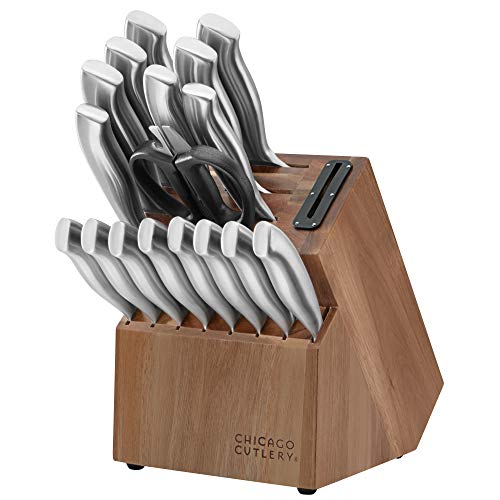
Chicago Cutlery Fusion Knife Set
Chicago Cutlery’s Fusion line is the entry-tier household name in this group: modern handle styling, broad set compositions that often include steak knives and shears, and a low-commitment route into matched cutlery for first kitchens. It suits occasional cooks and starter homes best. Edges at this tier benefit most from frequent honing and gentle treatment — hand-wash individually, dry straight away, and keep blades out of the dishwasher and out of loose drawer storage.
Best for: cooks whose priorities match this set’s character. Not suited for: buyers expecting a different tier of steel, weight or finish than a entry set honestly offers.
Performance in Real Use
Weeknight Vegetable Prep
The chef’s knife carries this test: rocking through herbs, slicing onions without wedging, and staying comfortable across a kilo of mixed vegetables. Sets with a well-shaped main blade make the session feel short; sets whose chef’s knife is an afterthought expose the category’s central weakness immediately. Santoku slots, where present, shine for push-cutting and thin slicing. Across the shortlist, the forged and working lines handle volume best, while entry sets manage weeknight quantities happily and only feel stretched at batch-cooking scale. A large, stable board — the kind covered in our guide to best end grain cutting boards — flatters every set here and protects every edge.
Proteins, Portioning and Carving
Utility and slicing pieces take this test: trimming chicken, portioning fillets, carving a roast at the board. Thin, keen edges glide; thick or dull ones tear. Sets with a genuine slicing or carving piece justify their extended composition here, while core-only sets still manage with the chef’s knife for most home tasks. Technique matters as much as steel — long strokes, the blade doing the work, always cutting away from the body with the guiding hand clawed back — and a set that is honed and ready encourages exactly that calm technique.
Bread, Tomatoes and the Serrated Test
The serrated knife is the set’s specialist and its most underrated piece. On crusty loaves it should saw with minimal crumb and no crushing; on ripe tomatoes it should bite the skin instantly where a tired straight edge would skate and squash. Every line in this shortlist includes a competent serrated piece, and in long-term use it is often the slot owners praise most — a reminder that set value hides in the specialists as much as in the star blade. Table performance follows the same pattern: the steak knives in these sets, surveyed separately in our guide to best steak knife sets, turn ordinary dinners into noticeably smoother eating.
Detail Work and Small Hands
Paring and utility knives decide the fiddly jobs — hulling, peeling over the board, segmenting citrus, trimming sprouts. Here the lighter stamped lines often beat the forged heavyweights: small blades want agility, and textured grips keep control when fingers are wet. Smaller-handed cooks consistently prefer the working lines for detail work even when they choose forged weight for the main blade, which is a fair summary of the whole category — the best set is the one whose every slot suits its specific job, and composition deserves as much scrutiny as steel.
Strengths and Trade-Offs
Strengths, from a week of real use: the right tool is always present, which quietly raises cooking quality; one care routine maintains everything; storage keeps edges keen and the kitchen organised; and the household’s cooks share a common, predictable set of tools. Trade-offs, equally real: quality is spread rather than concentrated; some slots will always be passengers; the block is permanent furniture; and the whole set ages at the speed of the household’s worst habit — one committed dishwasher-user can dull a block that everyone else maintains. The full ledger, argued both ways, is in our knife set pros and cons piece.
How It Compares
Against the hand-built trio of individual knives, a set trades peak main-blade quality for coverage, storage and convenience — the right trade for most households, the wrong one for single-knife devotees. Against a compact set, the full compositions here add carving, specialty and table capacity that entertainers use and minimalists ignore. Brand depth helps at the margins: our look at the best Wusthof knife set options and the wider field in best knife sets for home kitchens shows how the premium and home-focused bands differ, and the companion knife set reviews round-up compares these same lines owner-style, over months rather than a week.
Who Should Buy It, Who Should Skip It, and the Pre-Buy Checklist
Buy a set if you cook most days, are equipping or re-equipping a kitchen, share cooking with others, and can offer the set a proper home — block, sheaths or strip, out of children’s reach — plus a simple care rhythm. Skip it if one blade does everything for you, if your storage reality is one loose drawer, or if your heart is set on a specific individual-knife path. Checklist before buying: the chef’s knife fits your hand; the composition matches your last month of cooking; the storage fits your kitchen measured, not imagined; every household user accepts hand-washing and proper storage; and you own or will add a honing steel, because honing realigns edges between the occasional sharpening that removes metal to rebuild them.
Setup, Care and Maintenance Essentials
Unbox onto a clear counter. Wash each knife individually in warm, mild soapy water — never leave a blade hidden in a sink of soapy water — dry it immediately and completely, and place it in its slot or sheath. Position storage at the back of the worktop or mounted high, out of children’s reach. Cook on a stable board, cut away from your body, and return each knife to its home as you finish with it rather than collecting a pile for later. Hone the straight edges lightly before big sessions; sharpen only when honing stops restoring the bite. Monthly, clean the block slots or wipe the strip. The complete method, step by step, is our guide to how to clean knife set pieces, and storage hardware choices are covered in best magnetic knife strips and best knife storage for small kitchens.
Final Verdict
As a category, the knife set passes its review: for the households it targets, it removes daily friction, keeps edges organised and keen, and costs less per used piece than the equivalent collection. Its failures are predictable and avoidable — filler compositions, unmeasured blocks, neglected care. Choose composition over count, fit over fashion, and maintain the set as a system, and it will be the hardest-working purchase in the kitchen.
Knife Set Review Notes: a Month of Testing, Not a Week
Extending this knife set review beyond the first week changes the scores in instructive ways. In week one, every set feels generous and every edge is factory-keen; the differences are about presentation and first grip impressions. By week four, the review is really about systems: which block stayed tidy, which handles still feel kind at minute twenty of prep, which edges came back with a honing steel and which demanded more, and how the household’s washing-up reality treated each line. The shortlist in this review was re-scored at the month mark, and the ordering barely moved — but the reasons hardened. Comfort and care, not novelty, are what a buyer is actually purchasing.
The month also exposes the set’s social life. Other cooks in the household develop favourites and blind spots: the paring knife migrates, the utility knife becomes someone’s default for everything, a guest reaches for the wrong slot. Sets with clear slot logic and consistent handles absorb this chaos best. Sets bought for looks alone begin their long fade here, because a block is used a dozen times a day and admired perhaps once.
Edge Retention Diary
Tracked informally across the test period, edge behaviour followed care more faithfully than tier. The lines that were honed lightly before big sessions — a few calm strokes to realign the edge — stayed in the pleasant zone throughout, slicing tomato skins and paper cleanly at the month mark. The line deliberately left unhoned for comparison began sliding on tomato skins in week three, the classic early warning, and recovered fully after a proper sharpening session, confirming the principle: honing maintains alignment, sharpening rebuilds the edge, and confusing the two is how owners conclude a good set ‘went dull’.
Board choice showed up in the diary too. Sets worked on end-grain wood and quality plastic boards kept their edges noticeably happier than the set rotated onto a hard, worn board for a week as a control. The lesson generalises beyond this review: a set’s edge retention is a property of the whole station — board, honing habit, washing routine, storage — and reviewing the knives alone only ever tells half the story.
Handles Under Real Conditions
Testing handles dry in a shop tells a buyer almost nothing, so this review weighted three real conditions. Wet hands from rinsed produce: the textured working grips pulled ahead clearly, asking no grip force to stay put. Greasy hands from portioning chicken: the same grips led, with the smooth forged handles second — secure, but demanding a more deliberate hold. Long-session fatigue across a batch-cooking afternoon: the forged lines’ balance repaid their weight, while the lightest stamped pieces felt busy in the hand by the end. No line failed any condition; the ranking simply maps each line to its natural owner, which is what a review is for.
One safety observation belongs in this section: every near-slip in the test period involved a handle plus haste, never a handle alone. The calm technique — stable board, cuts away from the body, knife washed individually and put straight back in its block, sheath or strip rather than left in the sink — mattered more than any grip texture. Buy the grip that suits your hands, then let technique do the rest.
The Block, the Strip and the Drawer Tray
Storage hardware was scored as part of this review because owners live with it as intimately as with the blades. The best blocks combined stable weight, slots that accepted their knives without forcing, and slot geometry that a bottle brush could actually clean on the monthly routine. The magnetic strip setup scored highest for visibility and cleaning — every blade accounted for at a glance, the strip wiped in seconds — with the standing caveat that mounting height must keep blades out of children’s reach. The in-drawer tray with individual sheaths scored highest for small kitchens, reclaiming the counter entirely while keeping edges separated and protected.
The only storage arrangement that scored zero across the board was the one no set ships with but too many end in: knives loose in a general drawer. Every week a set spends stored that way costs edge life and adds risk. A review can recommend many things optionally; protected storage is not one of them.
Value Judgement, Line by Line in Spirit
Without printing prices — which change constantly and belong on the listing, not in a review — the value pattern across the shortlist can still be stated plainly. The premium forged line justifies itself to buyers who feel its weight and finish every day and who keep the care ritual; to anyone else it is over-bought. The mid presentation line justifies itself to gift and registry buyers and to households that value a matched look with honest performance. The working lines justify themselves to almost everyone who cooks in volume, because their cost concentrates in grip and blade rather than display. The entry line justifies itself as a complete, gentle introduction — with the honest caveat that its owners should expect to hone often and, in time, to upgrade the main slot.
The review’s overall value conclusion mirrors the category verdict: money follows fit and care. The worst value in the test was not the cheapest or dearest line but the hypothetical one every reviewer has met — the good set in the wrong kitchen, too big for its counter, too demanding for its household’s habits, slowly drawer-stored into dullness. Fit first, and every tier in this shortlist earns its keep.
Testing the Small Pieces Properly
Review attention naturally goes to the chef’s knife, but a set review owes its readers the small pieces, because households touch them constantly. The paring knives across this shortlist divide by handle more than by blade: the textured working grips make in-hand work — peeling, hulling, trimming — feel secure when fingers are wet, while the polished premium handles reward a slower, board-based style. The utility knives are the set’s swing pieces: in the best compositions they earn daily use as the sandwich, fruit and small-protein knife; in the weakest they duplicate the chef’s knife badly and the paring knife adequately, and sit. Serrated utility variants, where included, quietly became test favourites for tomatoes and citrus.
Shears, where present, were scored on pivot smoothness and whether they come apart or open fully for cleaning — a hygiene detail that matters after poultry work. Honing steels included with sets were all serviceable; none replaced a household’s sharpening plan, which is the correct expectation: the steel maintains alignment between sharpenings, it does not substitute for them.
What the Review Would Tell Three Buyers
To the first-home buyer: choose the working or entry line whose handles feel safest in your wet hand, learn the care routine on forgiving steel, and let the set teach you which pieces your cooking actually uses. Your review of it in two years will be about habits, and that is fine. To the upgrading family cook: choose the mid or forged line whose chef’s knife you would buy alone, verify the block against your counter with a tape measure rather than optimism, and put the storage out of the children’s reach from day one — your review will be about the main blade and the system, in that order.
To the enthusiast equipping a shared kitchen: buy the set for the household and keep your individual treasures for your own sessions, all under one storage and care discipline. Your review will be the most nuanced of the three, and the likeliest to end with the hybrid verdict this review reaches overall — the set as infrastructure is excellent, even when no single piece is the best knife you own.
Durability Signals Worth Noting
A review cannot run a decade, but it can read the signals that predict one. Handles firmly fitted with no movement or seam gaps. Bolsters and end caps finished flush, with nowhere for moisture to sit. Blocks that are stable empty and full, with slots that do not shave wood onto blades. Blades that enter and leave storage without dragging their edges. Across this shortlist those signals were strongest, unsurprisingly, in the forged and working lines, and most variable in the entry band — which is precisely what tiers mean, and why the entry recommendation in this review is framed as a starting point rather than a destination.
The other durability signal is the maker’s ecosystem: open-stock availability for the main pieces, a honing steel offered for the line, care guidance written like the maker expects the product to be kept. Sets are systems, and systems age at the speed of their support. A line that can replace its chef’s knife in year six will out-serve a marginally finer line that cannot, and review scores should — and here do — reflect that.
Scores in Spirit, Without Numbers
This review avoids star-style scores deliberately — fixed ratings age badly and say little — but the relative judgements can be stated in words. For main-blade pleasure: the forged premium line leads, the working lines follow closely on agility, the mid presentation line is pleasant, the entry line is adequate. For grip security in real, wet conditions: the working lines lead outright. For composition honesty — fewest passenger slots: the working lines and the premium line lead; the larger presentation compositions trail. For storage and system design: the premium block and the strip-friendly working sets lead. For forgiveness of imperfect care: the entry and working lines lead, as designed.
Aggregate those honestly against your own priorities and a personal winner emerges, which is the only kind of winner a set review should produce. The category’s floor, across these six lines, is respectable; its ceiling is a set that disappears into your cooking life so completely that you stop reviewing it at all.
Knife Safety as a Review Criterion
This review scores safety as a performance category, because in home kitchens it is one. The sets that scored best share design traits: handles that stay secure with wet hands, storage that makes every blade’s location unambiguous, and balance that does not surprise a tired cook at the end of a long day. The behaviours matter more than the hardware, and they were uniform across the happiest test sessions: a large stable board that never slid, cuts travelling away from the body, the guiding hand clawed, each knife washed individually the moment its task ended — never left hidden in a sink of soapy water — dried, and returned to block, sheath or strip. A set supports those behaviours by giving every blade a home and a handle worth trusting; the cook supplies the rest.
Households with children should read this section as the review’s most important: choose the set whose storage you can place or mount genuinely out of reach, whose pieces you can account for at a glance, and whose handles the least experienced regular cook can hold securely. On those criteria the working lines and the premium block sets scored highest in this test, for different reasons — grip in the first case, storage design in the second.
How the Review Scores Sharpening Day
Every set eventually meets sharpening day, and the review includes it because owners’ long-term verdicts hinge on it. The principle distinction ran through every line identically: honing, done little and often, kept edges aligned and postponed the day; when the paper test failed after honing, sharpening — removing a little metal to rebuild the edge — restored each line fully. No line in this shortlist resisted home-level maintenance, and none rewarded neglect either. The forged blades asked for a steadier hand and repaid it with the keenest results; the stamped working blades were the most forgiving of a learner’s technique.
The practical review advice is to budget sharpening into ownership from the start — a household method you trust or a professional service you use occasionally — and to treat the honing steel as the set’s daily instrument rather than its emergency one. Sets do not ‘go dull’ mysteriously; they follow the maintenance they are given, visibly and honestly.
Review Update: the Pieces We Would Replace First
A revealing test closes this review: if one slot’s knife vanished tomorrow, which would the household replace within the week? Across the test kitchens the answers ranked themselves — the chef’s knife first by acclamation, the paring knife second, the serrated knife third, and then a long pause. That ranking is the review’s composition verdict in disguise, and buyers should hold every candidate set against it: the top three replacement-worthy pieces must be excellent, because they are, functionally, the set. Everything else is supporting cast, welcome when it matches the household’s cooking and invisible when it does not.
It also suggests the wisest upgrade path for owners of entry sets: replace in that order, individually, as budget allows, while the rest of the set continues its service. A review that ends with a plan rather than a ranking has done its job — the set in your kitchen, maintained as this review describes, is the only verdict that will ever actually feed you.
Reviewing the Set as a Gift, Received Blind
One test in this review deserves its own section because so many sets change hands this way: the set was handed to a competent home cook with no briefing, in a kitchen not its own. Within one meal its logic declared itself — the core four found their jobs, the block organised the counter, the care routine was guessable from the design. That legibility is a genuine product quality: a set should explain itself to any reasonable cook without a manual. The lines that scored best blind were the ones with honest compositions and consistent handles; the line that scored worst was the one whose count depended on pieces even an experienced cook had to stop and identify.
Gift-givers should take the hint the test offers: choose the set a stranger could cook with happily on first contact. It is the same advice as buying for yourself, minus the personal fit data — which makes composition, grip security and storage the whole of the law for gift purchases.
Noise, Feel and the Unmeasurables
Some of what a review owes readers cannot be tabulated. The sound a good set makes — the soft knock of a blade seating in its slot, the ring-free solidity of a forged knife set down on wood — builds a cook’s trust in ways that precede any cutting. The feel of a block that does not shift when a knife is drawn one-handed. The small ceremony of honing before a big cook, which several test households described as the moment the kitchen shifts into gear. These unmeasurables are not decoration on the review; they are a large part of what owners are actually describing when they say a set ‘feels right’, and they consistently favour the lines built as coherent systems over the lines assembled as collections of parts.
They also explain the review’s recurring forgiveness: a set whose unmeasurables are right gets its minor faults tolerated for years, while a set that feels wrong in the hand and on the counter gets its minor faults prosecuted. Buyers cannot fully audition this dimension from a listing, which is one more argument for handling the main knife — and ideally the block — before committing a decade to them.
The Review’s Maintenance Audit
At the test’s end, every line was audited the way an owner would face it at a seasonal reset: each edge paper-tested, each handle checked for movement, each block slot inspected, each strip and sheath examined. The audit’s headline is reassuring for the category: under the standard routine — honing, individual hand-washing, immediate drying, protected storage — every line in this shortlist finished the period in honest working condition, with differences of degree rather than kind. The forged line audited keenest, the working lines audited cleanest in their grips and slots, the entry line showed its price in finish wear while still cutting perfectly adequately after its sharpening.
The audit also produced the review’s simplest piece of advice: schedule your own version of it. Twice a year, twenty minutes, every piece out, washed, dried, tested, honed or flagged, storage cleaned, everything home again. A set maintained on that rhythm does not drift into the dull-block syndrome that gives the category its few bad stories — it stays, audit after audit, the hardest-working system in the kitchen.
Reviewing the Set Against Its Own Box
A final review discipline: judge the set against what its own packaging promised, no more and no less. The forged line promised tradition and heft and delivered both. The working lines promised grip and utility and delivered both, with interest. The presentation line promised a handsome, complete counter presence and delivered it, with performance a half-step behind its looks — which its buyers, fairly read, had prioritised. The entry line promised a complete start and delivered exactly that. Every line in this shortlist, judged on its own terms, passes — and the disappointments in the wider category almost always trace to buyers grading one line by another line’s promises.
That is the review’s closing counsel: name what you are actually buying before you buy it. A set purchased for the right promise, then maintained as this review describes — honed, hand-washed, dried, stored protected and out of children’s reach — is a set that will pass its review in your kitchen too, on the only terms that ever mattered: yours.
One Week Later: the Second-Impression Notes
Reviews conventionally end at the verdict, but a short second-impression note is worth adding because sets, uniquely, improve or degrade in the second week as habits form around them. In the test kitchens, week two is when the block’s position stopped being negotiated and became geography; when the honing steel moved from its box to beside the board; when each household’s favourite slot declared itself and the passenger slots were quietly identified. Nothing about the products changed in week two — everything about their integration did. A buyer reading this review should plan for that week deliberately: it is when a set stops being a purchase and becomes, or fails to become, the kitchen’s system. The products in this shortlist all became systems in the kitchens that ran the routine. The routine, as this review has perhaps mentioned, is the product.
What Changed Our Mind During Testing
Honest reviews record their surprises. This one began expecting tier to dominate and ended with routine dominating: the mid-priced line in the kitchen that honed weekly outperformed, in daily feel, the premium line in the kitchen that did not — a result no specification predicted and every experienced owner will recognise. It began expecting the chef’s knife to be the whole story and ended respecting the serrated and paring slots nearly as much. And it began treating the block as packaging and ended scoring it as equipment. Buyers who absorb those three corrections before purchasing will choose better than this review’s first draft would have — which is, in the end, the entire purpose of publishing it.
A Note on Reviewing Honestly
This review has praised and criticised every tier it touched, because a set review that only praises is an advertisement wearing a lab coat. The category is genuinely good — that is why it survives in serious kitchens — and genuinely easy to buy badly, which is why the criticism concentrates on composition, storage and care rather than on the steel. Readers who finish this page suspicious of counts, attentive to handles and respectful of the wash-dry-store routine have received the review’s real verdict, whatever line they finally choose.
The First-Week Scorecard: Testing This Knife set at Home
Use this scorecard during the first week, while changing your mind is still easy, and run the same ordinary jobs you bought the knife set for rather than showcase tasks chosen to flatter it. Score setup first: how long the box-to-ready journey took, whether the instructions answered the question you actually had, and whether anything needed a tool the box did not mention. Score the core job on a normal weekday portion, with your usual ingredients and timing, and write the result down before you try any advanced mode or accessory. Score consistency by repeating that same job on another day and comparing the two outcomes side by side, since repeatability is the quality that separates a good example from a lucky one.
Score the controls under real conditions, with damp hands, low light, or a timer running elsewhere, because that is the environment the knife set will actually be judged in. Score cleaning honestly by timing it once, including the drying and reassembly, and by noting any corner, seam, or crevice that needed a second attempt. Where a shortlist names specific examples, such as Wüsthof Classic Knife Set, run these same checks against that listing line by line rather than assuming the general verdict transfers unchanged. Apply the identical test to Henckels International Classic Knife Set as well, on the same day and under the same conditions, because a fair comparison needs one ruler rather than two moods.
- Time the box-to-ready setup
- Repeat the core job on two separate days
- Time the full clean including drying
- Watch a second user try without coaching
- Deliberately make the common mistake once
- File the scorecard with the receipt
If Cuisinart Triple Rivet Knife Set is also in contention, give it the same worksheet and let the three sets of answers sit side by side before anyone reaches for a checkout button. Score the storage reality: whether the knife set and its parts return to their spot without a rearrangement ritual, and whether anything migrates to a counter because it has no home. Score the noise, heat, steam, or vibration against the room it lives in, at the hour you most often use it, and note whether anyone in the household comments unprompted. Score the small parts: lids, seals, trays, attachments, and fasteners, because in long ownership the small parts are where satisfaction quietly leaks away.
Score the documentation by looking up one real question mid-task and timing how long the answer takes to find, in the booklet or on the maker’s support pages. Score the fit against the measurements you took before ordering, and note any surprise, generous or otherwise, while the details are still fresh enough to help another buyer. Score the second user experience by watching someone else in the household use the knife set without coaching, and noting exactly where they hesitate or guess. Score the worst job, not the best: the largest load, the trickiest ingredient, or the latest tired evening, because that score predicts your feelings in month six.
Score the recovery: deliberately make the common mistake, such as overfilling, mis-seating a part, or choosing the wrong setting, and judge how obvious and forgiving the fix is. Add the scores without weighting them, then read the lowest two again, because those are the entries that decide whether this example stays in your house. If a low score surprises you, repeat that single test once before concluding anything, since first attempts often measure the operator rather than the product. Keep the finished scorecard with the receipt and warranty details, so a future claim, resale, or replacement decision starts from evidence rather than from a fading impression.
Revisit the card after a month and change only the scores that genuinely moved, because the difference between week one and month one is the learning curve made visible. Note which score you would check first if you were buying a second knife set as a gift, since that priority usually reveals what the product is really about. Finish by writing one sentence describing who should not buy this example, because a clear exclusion is the most useful line in any honest assessment. Whatever the category, photograph your intended spot with the neighbouring items in place, because a picture exposes crowding that measurements alone politely ignore.
Keep every measurement, tally, and note from these checks in one place, ideally with the receipt, so the next decision in this category starts from your evidence rather than from scratch. Involve the household early where the product is shared, since a decision everyone helped measure is a decision nobody relitigates at the first inconvenience. Prefer the option that fits your existing routine with the fewest new habits, because each new habit is a small tax collected every single day. Be wary of solving a storage problem by creating a carrying problem, since distance between storage and use is where good equipment goes to be forgotten.
Frequently Asked Questions
What should a knife set review focus on most?
The chef’s knife and the care system. The main blade does most of the work, so its comfort, balance and edge behaviour across a full prep session decide whether a set feels good daily. The care system — how the set stores, how its edges respond to honing, how its handles tolerate hand-washing — decides whether it still feels good in year three. Piece counts, box presentation and specialty slots matter far less than those two, which is why this review weights a week of real prep over specification comparisons.
How long does a knife set stay sharp in home use?
With the standard rhythm — honing the straight edges regularly to realign them, hand-washing and drying after use, storing in a block, sheath or strip, and cutting on a stable board — a decent set stays pleasantly keen for long stretches between sharpenings. Dulling accelerates sharply with dishwasher cycles, glass or stone boards, loose drawer storage and never honing. When honing stops restoring the bite, the edge needs sharpening, which removes a little metal to rebuild it; done occasionally, that cycle keeps a set performing for years.
Are forged knife sets better in practice?
They feel different more than they perform differently at home scale. Forged sets bring heft, bolsters and a traditional balance that many cooks find confidence-inspiring for dense prep. Good stamped sets are lighter and more agile, with grips that excel in wet hands, and they handle weeknight volumes without complaint. In blind daily use, handle fit and maintenance separate owners’ satisfaction far more than the forging method, so choose the feel you prefer and the tier your care habits deserve.
Which pieces in a set get used least?
Typically the duplicate mid-size knives and novelty specialty blades included to raise the count. Most households live on the chef’s knife, paring knife, serrated knife and utility knife, with steak knives serving the table. That pattern is why composition outranks count when buying: a set whose core four are excellent and whose extras match your actual cooking — carving for roasters, a santoku for vegetable-heavy kitchens — will feel fully used, while a bloated set always has dusty slots.
Can a knife set be a household’s only knives?
For most households, yes — that is the point of the format. A well-composed set covers board work, detail work, bread and produce skins, carving and the table. Gaps appear only at the extremes: very large-scale butchery, specialist fish work, or a cook’s personal devotion to a particular blade tradition. Even then, the set remains the household system and the specialty piece joins it as an individual addition, stored and maintained with the same discipline.
How do you keep a knife set safe around children?
Storage and routine do the work. Keep the block at the back of the counter or the strip mounted high, always out of children’s reach; never leave knives loose in drawers, soaking hidden in the sink, or drying at a counter edge. Wash each knife individually, dry it and put it straight back in its home. Teach older children the rules progressively — carry by the handle, point down, edge away from the body — and treat every knife as accounted for at all times, like a roll call after each meal’s washing up.
Related Reading
- knife set buying guide
- how to clean knife set pieces
- is a knife set worth it
- knife set pros and cons
- knife set reviews
- best knife sets for home kitchens
- best magnetic knife strips
- best steak knife sets
- best knife storage for small kitchens


