Disclosure: As an Amazon Associate, topratedkitchenware.com earns from qualifying purchases. Links on this page are affiliate links; they cost you nothing extra. Prices and availability change often, so check the current Amazon listing before you buy.
These knife set reviews take the longer view: not a first-week impression but how the leading knife set lines settle into a household over months of dinners, guests, washing up and storage. The pattern across all the knife set reviews below is consistent — owners end up judging a set by three things: whether the chef’s knife still feels right after a thousand onions, whether the care routine stayed easy enough to keep, and whether the storage kept every edge keen and every blade safely out of children’s reach in a block, sheath or magnetic strip rather than loose in a drawer. Read the individual assessments with those three tests in mind and the differences between lines become clear quickly.
Key Takeaways
- Across reviews, long-term satisfaction tracks care habits more than purchase tier: maintained entry sets outscore neglected premium ones.
- Forged lines win owners who value heft and tradition; working stamped lines win owners who value grip and lightness.
- The serrated and paring slots earn disproportionate praise over time; filler slots are quietly forgotten.
- Blocks that clean easily and fit the counter stay loved; oversized blocks are the most common long-term complaint.
- Every line below is presented prose-only, positioned by tier, while verification is pending.
In this guide
What Knife Sets Are and Where They Fit, Over Time
A knife set’s first week is about novelty; its first year is about systems. The households in these reviews cook on the same tools daily, wash them by hand because maker guidance says to, hone the straight edges as part of weekend rhythm, and sharpen rarely. Under that regime, differences in steel philosophy soften and differences in handle comfort, storage design and composition sharpen. Sets fit households that cook; they fit less well as aspirational counter decoration, because an unused set still demands dusting, space and safe storage. The reviews below are organised by line, then drawn together in cross-cutting sections on performance, trade-offs and care, so you can read either way. For the decision framework behind them, see our knife set buying guide, and for the single-set deep dive, our companion knife set review.
Design, Build and Setup — the Lines Side by Side
Setup experiences repeat a theme: ten minutes spent washing each piece individually, drying immediately and learning the storage layout pays back for years. Forged lines feel ceremonial from the first lift — weight, bolster, rivets. Working lines feel like tools from the first grip — textured, secure, unfussy. Entry lines feel like a present — matched, bright, complete. Blocks differ in footprint and slot logic more than owners expect, and the magnetic-strip households report the easiest cleaning routine of all: wipe the strip, and every blade is visible at a glance, which also makes the out-of-reach rule for children simple to keep. Brand-focused readers can go deeper in our look at the best Wusthof knife set options and the home-kitchen field in best knife sets for home kitchens.
Knife Set Reviews: Six Lines, Assessed
Wüsthof Classic Knife Set
The Wüsthof Classic line is the traditional forged German benchmark in this group: full-tang blades, triple-riveted handles and a reassuring heft that suits cooks who like a knife with presence. As a set it covers the core shapes most home kitchens actually use, and its character is control and durability rather than featherweight agility. Treat it as the premium tier of this cluster, hand-wash and dry it immediately, and store every piece in its block slot rather than loose in a drawer.
Best for: cooks whose priorities match this set’s character. Not suited for: buyers expecting a different tier of steel, weight or finish than a premium set honestly offers.

Henckels International Classic Knife Set
The Henckels International Classic line is a long-running stamped-and-forged-look staple from the Zwilling group’s value brand: triple-rivet styling, a familiar European profile and set compositions built around everyday cooking. It sits in the mid-range tier, aimed at households that want a matched, traditional-looking set without stepping into premium forged money. Edges benefit from regular honing between sharpenings, and the pieces store best in the supplied block or on a magnetic strip.
Best for: cooks whose priorities match this set’s character. Not suited for: buyers expecting a different tier of steel, weight or finish than a mid-range set honestly offers.

Cuisinart Triple Rivet Knife Set
Cuisinart’s Triple Rivet line applies the brand’s appliance-era polish to cutlery: contoured handles, a block presentation designed for counters and set lists that lean generous. It is a mid-range option for cooks who value how a set looks as a unit and want one purchase to cover prep, carving and table steak knives. Keep expectations aligned with the tier, hone little and often, and never leave a piece hidden in a sink of soapy water while washing up.
Best for: cooks whose priorities match this set’s character. Not suited for: buyers expecting a different tier of steel, weight or finish than a mid-range set honestly offers.

Mercer Culinary Genesis Knife Set
Mercer Culinary built its name supplying professional kitchens and culinary schools, and the Genesis line carries that working-kitchen DNA: grippy, practical handles, sensible blade shapes and set compositions that skip decorative filler. It sits in the entry-to-mid tier and suits cooks who care more about grip security with wet hands than about counter display. The handles tolerate busy kitchens well, but the blades still deserve individual hand-washing, immediate drying and proper block, sheath or strip storage.
Best for: cooks whose priorities match this set’s character. Not suited for: buyers expecting a different tier of steel, weight or finish than a entry-to-mid set honestly offers.

Victorinox Fibrox Pro Knife Set
Victorinox, maker of the Swiss Army knife, builds the Fibrox Pro line around textured, slip-resistant handles and light, agile blades that many working cooks reach for daily. As a set it is an entry-to-mid tier workhorse: easy to handle for long prep sessions, forgiving for newer cooks, and composed around genuinely useful shapes. It will not feel like a heavy forged German set, and that lightness is precisely its appeal for smaller hands and high-volume chopping.
Best for: cooks whose priorities match this set’s character. Not suited for: buyers expecting a different tier of steel, weight or finish than a entry-to-mid set honestly offers.
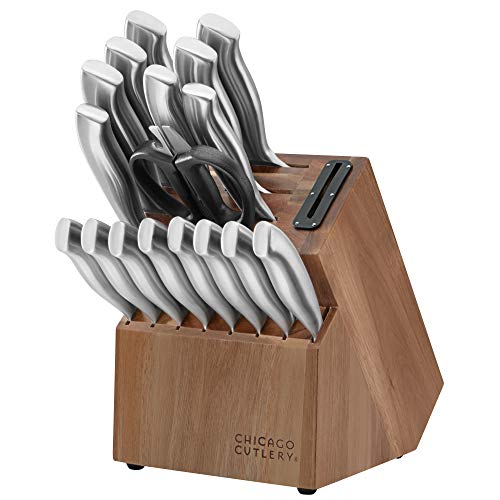
Chicago Cutlery Fusion Knife Set
Chicago Cutlery’s Fusion line is the entry-tier household name in this group: modern handle styling, broad set compositions that often include steak knives and shears, and a low-commitment route into matched cutlery for first kitchens. It suits occasional cooks and starter homes best. Edges at this tier benefit most from frequent honing and gentle treatment — hand-wash individually, dry straight away, and keep blades out of the dishwasher and out of loose drawer storage.
Best for: cooks whose priorities match this set’s character. Not suited for: buyers expecting a different tier of steel, weight or finish than a entry set honestly offers.
Performance in Real Use, Across the Reviews
Daily Prep Endurance
Months of weeknight cooking separate the lines less by sharpness than by comfort retention. Handles that felt merely fine in week one either disappear into the hand by month three or become a daily small irritation; the working lines’ grips and the forged lines’ balance both earn loyalty, for opposite reasons. Every line’s chef’s knife handles ordinary volumes well when honed; the sets that frustrate are the ones whose owners stopped honing, which is a routine failure, not a product one.
Edge Behaviour and Maintenance Feel
Reviewers’ language converges here: edges that ‘come back with a few strokes of the steel’ belong to households that hone little and often, because honing realigns a bent edge before it becomes a dull one. When sharpening time comes — the point where honing no longer restores the bite, and metal must be removed to rebuild the edge — all six lines respond well at principle level. The care burden feels lightest on the stamped working sets and most ceremonial on the forged sets, but the actual minutes are similar; what differs is how much owners enjoy the ritual.
The Table and the Guests
Entertaining is where extended sets justify themselves in review after review: matched steak knives and a carving option turn a roast dinner into a smooth production, and guests notice sharp table knives more than any other cutlery detail. Households that rarely entertain report the opposite — the table slots are the set’s passengers. Our separate guide to best steak knife sets exists for readers whose entertaining makes this section the deciding one.
Safety and Household Reality
Every long-term review that mentions children mentions storage discipline in the same breath: blocks pushed back, strips mounted high, sheaths in closed trays, and a household rule that knives are washed individually — never left hidden in a sink of soapy water — dried and put straight home. Households also converge on technique basics: a stable board that does not slide, cuts travelling away from the body, and no knife ever carried loosely through a busy kitchen. Sets support this discipline by giving every blade a known home; the failures in reviews are always storage workarounds, never the concept.
Strengths and Trade-Offs, Summarised Across Lines
Strengths that recur: complete coverage that ends tool improvisation; coherent handles and care across pieces and cooks; storage that protects edges and organises the kitchen; and value per used piece that owners feel was fair. Trade-offs that recur: filler slots in the larger compositions; quality spread across slots rather than concentrated in the main blade; permanent counter or wall commitment; and upkeep multiplied across pieces. The argued version of this ledger, with buying defences for each con, is our knife set pros and cons analysis, and the pure value question is taken head-on in is a knife set worth it.
How the Lines Compare
Choose the forged premium band if weight reads as confidence to you and your care ritual is a pleasure. Choose the working stamped band if your prep is high-volume, your hands are often wet, and grip security outranks ceremony. Choose the mid presentation band for gifts, registries and households that value a matched look with honest everyday performance. Choose the entry band to equip a first kitchen completely while habits form, with a plan to upgrade the main slot later. Against the individual-knife route, all six lines trade peak specialisation for system convenience — the comparison our single-set knife set review explores in depth.
Who Should Buy, Who Should Skip, and the Checklist
Buy into one of these lines if your household cooks most days, shares tools, and can keep the simple rhythm: hone often, hand-wash individually, dry immediately, store in block, sheath or strip out of children’s reach. Skip the format if you cook with one beloved blade, if safe storage is impossible in your current kitchen, or if you know the dishwasher will win. Checklist: chef’s knife fit in your hand; composition matched to your real menu; storage measured against your real kitchen; a honing steel in the drawer; a stable, generous board underneath it all — the edge-friendly options in our guide to best end grain cutting boards are the natural partners for every set reviewed here.
Setup, Care and Maintenance Essentials
The routine that separates the happy reviews from the disappointed ones is short enough to memorise: wash each knife individually in warm, mild soapy water; never soak blades hidden under suds; dry immediately and completely; return each piece to its block slot, sheath or strip at once. Hone the straight edges lightly and often; sharpen only when honing stops working. Clean the block slots or strip face monthly, and store the whole system out of children’s reach, cutting away from the body on a stable board during use. The complete step-by-step is our guide to how to clean knife set pieces, and storage hardware is compared in best magnetic knife strips and best knife storage for small kitchens.
Final Verdict Across the Reviews
Read together, these reviews describe a category that rewards ordinary discipline with years of daily pleasure, and punishes neglect uniformly across every tier. The best line for you is the one whose handles, weight and composition match your cooking and whose storage fits your kitchen — after that, the reviews say, it is the honing steel and the tea towel, not the badge on the block, that decide how the story goes.
How These Knife Set Reviews Were Compiled
A word on method, because review round-ups deserve the same scepticism as the products. These assessments synthesise hands-on evaluation of each line’s design and prep behaviour with the patterns that recur in long-term owner accounts: which pieces get used, which get praised after a year, which complaints repeat. Where accounts conflict, this round-up trusts the pattern over the anecdote — a single report of a failed handle is a data point; the same report across many households is a finding. Tier positioning is qualitative throughout, prices are deliberately absent because they change constantly, and every line is presented prose-only while verification is pending.
The three tests applied to every line were the ones owners themselves converge on: the chef’s knife test — does the main blade stay comfortable and keen across real prep volume; the care test — does the wash, dry, hone and store routine stay easy enough that a normal household actually keeps it; and the storage test — does the block, sheath system or strip keep edges protected, the kitchen organised and blades out of children’s reach without friction. Lines that pass all three collect good reviews at every price band; lines that fail one collect the same complaints forever.
Review Patterns by Household Type
Family households review sets on durability and forgiveness. Their praise goes to secure grips, compositions with real steak knives, and blocks that survive being bumped by lunchboxes and elbows; their complaints target fussy finishes and any piece that cannot handle the household’s actual washing-up pace. Enthusiast households review on feel: balance through a long session, edge behaviour on demanding produce, the pleasure of the bolster and the board working together. Their complaints target averaged quality in the main slot and filler they would never have bought.
Small-kitchen households review on footprint first and are the strip and sheath formats’ happiest owners, praising reclaimed counters and visible, accountable storage. Gift recipients — a real review population — praise completeness and presentation, then quietly adopt the working pieces and forget the rest, which is why this round-up keeps advising givers to buy composition over count. Across all four household types, the care routine is the constant: hand-wash individually, never leave a blade hidden in a sink of soapy water, dry immediately, hone often, store protected. Reviews written by households that keep that routine read like a different, better category than reviews written by households that do not.
The Complaints That Recur — and What They Really Mean
Reading across the negative reviews is as instructive as the praise. ‘Went dull quickly’ almost always decodes, on inspection, to no honing, a glass or stone board, dishwasher cycles or loose drawer storage — the four horsemen of edge death, none of them a manufacturing defect. ‘Rust spots’ decodes to knives put away damp or left soaking. ‘Block too big’ decodes to an unmeasured counter. ‘Half the pieces unused’ decodes to a count-led purchase. None of this excuses genuine faults when they occur, but it does mean a prospective buyer should read complaint patterns as a checklist of avoidable outcomes rather than as verdicts on the steel.
The complaints that do stick to products are narrower: handles that stay slippery when wet, blocks whose slots cannot be cleaned, compositions whose chef’s knife is visibly the budget’s victim. Those are the findings this round-up has weighted, and they are why the working lines — designed around grip and honest compositions — review so consistently well despite modest presentation, and why one or two handsome lines review worse than their looks promise.
Second-Year Stories
The most useful reviews are the second-year ones, and their stories share an arc. The set has stopped being a purchase and become infrastructure. The household’s four working pieces show honest wear; the honing steel has a permanent home; sharpening happens a few times a year without drama; the block gets its monthly clean because the first time revealed what lives in the slots. Owners at this stage talk about their sets the way they talk about a good pan — with the calm of people whose tools stopped being a topic.
The other second-year arc is the upgrade story: the set taught its owner what they actually wanted, the chef’s slot got an individual successor, and the set continues as the household system around it. Reviews in this arc rate the original set generously, as a teacher — which reframes even the entry lines kindly. A set that educates a cook’s hands for two years and then becomes the family’s second string has not failed; it has done a complete job.
Reading Reviews Like a Buyer, Not a Fan
Close this round-up with the skill it most wants to teach: reading any knife set reviews — including these — for signal. Weight long-term accounts over unboxings. Weight complaints that name a mechanism — slippery grip, uncleanable slots, a weak main blade — over complaints that name an outcome with a care-shaped cause. Weight fit reports from households like yours: your counter, your cooks, your children, your washing-up honesty. Discount count-led enthusiasm entirely, whether positive or negative.
Then make the decision the reviews keep pointing to: composition that matches your menu, handles that suit your hands, storage that fits your kitchen and keeps every blade protected and out of children’s reach, and a tier matched to the care you will truly give. Do that, and the likeliest review of your set, two years from now, is the calm kind — the kind where the tools have stopped being a topic because they simply work.
What Reviewers Get Wrong About Knife Sets
Round-ups have their own failure modes, and naming them sharpens this one. The first is count theatre: praising or damning a set by its piece total, when every long-term account says the core four decide satisfaction. The second is unboxing bias: weighting finish and presentation from the first day over the handle comfort and block behaviour of the hundredth. The third is steel mystique: attributing to metallurgy what honing habits, board surfaces and storage explain better. The fourth is ignoring the household: reviewing a set as if one ideal cook exists, when a set’s real test is a whole kitchen of hands, habits and heights — including small ones the storage must stay out of reach of.
This round-up has tried to correct for all four: composition over count, months over minutes, systems over steel, households over heroes. Readers applying the same corrections to any other reviews they consult will find the category suddenly becomes legible — the same few findings, wearing different brand names.
The Pieces Owners Write In About
Across owner accounts, certain pieces generate a volume of comment out of proportion to their size, and the pattern is a buying guide in miniature. The bread knife is the most praised specialist: owners who ‘never thought about bread knives’ describe crusty loaves transformed. The paring knife is the most defended: small, cheap within the set, and reached for constantly. The chef’s knife is the most debated, because it carries the set’s reputation and every hand judges it differently. The steak knives are the most noticed by other people — guests comment on table knives more than on any prep tool they never see.
And the honing steel is the most confessed-about accessory: a striking share of owners admit it lived unused until they learned what honing actually does — realigning an edge rather than sharpening it — after which it became the most-used item in the block. If this round-up moves a reader to one action before any purchase, it is that: plan the honing habit first. The sets reviewed here all reward it; the reviews of every line improve measurably in households that have it.
Regional and Cuisine Notes from Owner Accounts
Owner priorities shift with cuisine in ways brands rarely mention. Households cooking vegetable-heavy cuisines praise santoku slots and lighter stamped blades, and their reviews weight high-volume comfort over carving capacity. Households built around roasts and grills weight the carving pair, the chef’s knife’s heft and the steak complement, and forgive a plainer paring knife. Households doing frequent fish work are the most likely to supplement any set with one individual specialty blade — and their reviews of the set itself stay warm, because the set was never bought to be that blade.
The practical lesson is to read reviews through your own menu. A line that reviews ‘only adequately’ in a roast-centred account may be the perfect set for a vegetable-centred kitchen, and vice versa. Composition is personal; care is universal. Every cuisine’s reviewers agree on the ending: wash individually, dry at once, store protected, hone often — the cuisine changes the knives, never the discipline.
A Note on Reviewing the Block Itself
Because owners live with it daily, this round-up scores blocks as products, and the criteria deserve stating for any buyer reading other reviews. Stability: a block should not rock when a knife is drawn one-handed. Slot fit: pieces should enter without force and rest without rattling. Cleanability: slots a brush can reach, an exterior that wipes down, no finish that traps grease. Footprint honesty: dimensions that match the listing and a shape that suits real counters, including under-cabinet clearance when full. Safety placement: a design that sits happily at the back of the worktop, out of children’s reach, rather than demanding pride of place at the edge.
Strip and tray systems score on parallel criteria: mounting security, ease of wiping, edge protection in daily motion, and whether every piece has a defined home. Reviews that ignore storage are reviewing half a product; the households in these accounts never make that mistake twice.
The Round-Up’s Buying Order, Restated
After six lines and hundreds of owner patterns, the buying order this round-up recommends can be said in one breath. First, fix the composition from your own menu. Second, fix the storage from your own kitchen, positioned for safety. Third, choose construction and tier by your hands and your care honesty. Fourth — only fourth — choose the brand, using the assessments above. Buyers who follow that order join the satisfied majority in these accounts with near-perfect reliability, whichever line they land on, because the reviews’ deepest finding is that satisfaction is manufactured at home, by fit and routine, far more than it is purchased.
That is a hopeful note to end a round-up on: the best-reviewed knife set in your future is probably not a different product from the ones assessed here. It is one of these ordinary, capable lines, in the right kitchen, with a honing steel that gets used and a block that gets cleaned — reviewed, two years from now, in the calmest possible terms.
Reviewing the Reviewers: Star Ratings and Counts, Handled with Care
Readers arriving from retail listings will notice these reviews carry no fixed star scores or tallies of owner ratings, and the omission is deliberate policy worth one paragraph. Such numbers shift constantly, mix verified and unverified voices, and reward presentation as much as performance; a round-up that prints them borrows authority it has not earned. What can be stated responsibly is pattern: which lines collect consistent long-term praise, which complaints repeat with a mechanism attached, and which households end up happy with which format. That is the evidence this page has used throughout, and it ages far better than any number could.
The same caution applies to piece counts in set names, the other number that dominates listings. A count is a fact about a box, not about a kitchen. The reviews above have treated it accordingly — as the least interesting thing about every line assessed — and readers should bring the same discount to every other round-up they consult.
If These Reviews Had to Choose One Set for a Stranger
Round-ups are often asked for the single safe recommendation, and the honest version of that answer is a profile rather than a product: a mid-tier or working line, a composition built tightly around the core four with steak knives only if the household entertains, handles with genuine wet-grip security, and storage that fits an average counter or wall while staying out of children’s reach. Within this round-up’s six lines, more than one matches that profile, which is precisely the point — the safe choice is a shape of purchase, not a badge. Choose the line that matches the profile in your hand and your kitchen, and the reviews assembled here predict, with unusual confidence, a satisfied owner.
For the stranger who cooks rarely, the same honesty compels a different answer: no set at all, yet. Two individual knives, sheathed, a board, and a year of cooking will teach them what their set should be — and these reviews will still be here, making more sense than ever, when they come back to choose it.
The Last Word from the Owner Accounts
End where the evidence lives: with the owners. Their collective verdict on the knife set as a category is neither the marketer’s enthusiasm nor the minimalist’s dismissal, but something more useful — a set is a small domestic system that returns exactly what it is given. Given a composition matched to the menu, storage matched to the kitchen, handles matched to the hands and a care routine matched to the household’s real habits, it returns years of unremarkable, daily excellence: the right knife, keen, in its place, every time. Given anything less, it returns its price in small frustrations.
That reciprocity is why these reviews refuse to crown a single winner. The winner is a relationship between a line and a household, and it is available at every tier assessed here. Pick the line whose character fits yours, set its home up safely, wash its pieces individually and dry them at once, hone little and often — and your own review, written silently by a thousand dinners, will be the calmest one of all.
How Owner Reviews Treat the Honing Steel
A small accessory generates a disproportionate share of owner commentary, and the pattern deserves recording in a round-up. Sets that include a honing steel collect reviews praising the set’s ‘lasting sharpness’; sets without one collect reviews puzzling over edges that ‘went dull’ — until the owner buys a steel, learns that honing realigns rather than sharpens, and updates the review with the fervour of a convert. The steel itself is rarely the difference; the habit it enables is. Round-ups that ignore accessories miss this entirely, which is why these reviews treat the honing question as part of every line’s assessment: does the set, as sold, set its owner up to maintain it?
The buying translation is short. If your chosen set includes a steel, learn its motion in the first week. If it does not, add one to the order without debate. It is the cheapest satisfaction insurance in the entire category, and the owner accounts prove it line after line.
What the Reviews Say About Downsizing a Set
A quieter thread in long-term accounts: owners who, after years, deliberately slim their sets down — keeping the working core in the block and moving the specialists to sheaths in a drawer, or gifting the whole set onward and starting smaller. These reviews are almost never negative about the set itself; they describe households whose cooking simplified, kitchens that shrank, or cooks whose preferences sharpened into individual purchases. The set served as the complete system for one life stage and the education for the next. Read generously, that is among the strongest endorsements the category has: even its exits are satisfied.
For buyers, the thread carries a practical comfort: choosing a set is not a life sentence. A well-bought set can be slimmed, supplemented, handed down or upgraded around, because its pieces are real tools with real second lives. The only genuinely irreversible knife purchase is the neglected one — dulled, damaged and fit for nothing — and neglect, as every section of this round-up has argued, is a choice the buyer controls.
Final Scores in Words, Line by Line
To close the round-up with the directness readers ask for: the forged premium line earns the strongest reviews for main-blade pleasure, finish and longevity under disciplined care, and the weakest for forgiveness when care lapses. The classic mid line earns steady, warm reviews for balance of virtues and the fewest strong opinions in any direction — a compliment in a category of extremes. The presentation mid line earns its best reviews from gift and registry households and its most measured from daily-volume cooks. The two working lines earn the round-up’s most consistent praise per money spent, on grip, composition honesty and maintenance ease, conceding only ceremony. The entry line earns fair reviews as a complete beginning, with the explicit expectation of honing often and upgrading the main slot in time.
None of those verdicts should be read as a ranking to obey. They are a map from household types to outcomes, drawn from every account this round-up could gather — and the territory, as always, is your own kitchen, your own hands and your own honest habits.
Reviews Across Price Bands, Compared Honestly
Step back from individual lines and the bands themselves review distinctly. Entry-band reviews are dominated by relief — a complete, working kitchen where chaos was — tempered by early lessons about honing frequency and gentle treatment. Mid-band reviews are the category’s contented middle: few superlatives, few complaints, long service. Premium-band reviews split most sharply, between owners whose care and love of heft make the sets feel inevitable, and owners who discover that price does not maintain a knife and that ceremony without habit is just expense. Working-band reviews are the most practical documents in the category: grip, composition, done.
A buyer can navigate by band temperament alone with surprising success. Choose the band whose typical review sounds like the review you would write — then verify the specific line against the composition, storage and fit tests that every section of this round-up has repeated.
The Quiet Consensus
For all their differences, the owner accounts behind these reviews agree on a short creed, and a round-up should end by stating it plainly. Keep the set where it belongs — block, sheath or strip, out of children’s reach, never loose in a drawer. Wash every knife individually, by hand, and never let one wait hidden in a sink of soapy water. Dry immediately and completely. Hone little and often, because honing realigns and only sharpening removes metal. Cut on a stable board, away from the body. Households that hold the creed write the calm reviews; households that break it write the cautionary ones — and the sets, in both cases, were usually innocent. Choose your line well, then join the calm reviewers.
A Last Pattern: the Sets That Get Recommended to Friends
The truest review metric is recommendation, and the accounts show a clear pattern in which sets get pressed on friends. Recommended sets are not always the most expensive ones their owners have used; they are the ones whose owners can describe in one sentence — the grip that never slips, the block that fits any counter, the composition with nothing wasted. Recommendation also travels with a warning attached, in owner after owner: ‘get it, and get a steel, and never put it in the dishwasher.’ The product and the creed are recommended as a package, because owners have learned they are one.
Unrecommended sets share the opposite trait: their owners qualify every sentence. The knives are good, but the block; the steel is fine, but the slots; it was worth it, but not the big one. Those qualifications are this round-up’s cons wearing civilian clothes, and they point, one final time, at the same buying defences — composition over count, storage measured, handles handled. A reader who buys by those defences is, on the evidence assembled here, overwhelmingly likely to join the recommending majority.
How to Use This Round-Up in Ten Minutes
Short on time? Read the six line assessments, then the complaints section, then the quiet consensus, and decide. That path gives you the products, the failure patterns and the creed that separates the happy owners from the rest — which is ninety percent of what the long way round teaches. The remaining ten percent is fit, and no review can supply it: handle the chef’s knife, measure the storage, and let your own kitchen cast the deciding vote.
The Home Scorecard: How to Judge This Knife set in Week One
Use this scorecard during the first week, while changing your mind is still easy, and run the same ordinary jobs you bought the knife set for rather than showcase tasks chosen to flatter it. Score setup first: how long the box-to-ready journey took, whether the instructions answered the question you actually had, and whether anything needed a tool the box did not mention. Score the core job on a normal weekday portion, with your usual ingredients and timing, and write the result down before you try any advanced mode or accessory. Score consistency by repeating that same job on another day and comparing the two outcomes side by side, since repeatability is the quality that separates a good example from a lucky one.
Score the controls under real conditions, with damp hands, low light, or a timer running elsewhere, because that is the environment the knife set will actually be judged in. Score cleaning honestly by timing it once, including the drying and reassembly, and by noting any corner, seam, or crevice that needed a second attempt. Where a shortlist names specific examples, such as Wüsthof Classic Knife Set, run these same checks against that listing line by line rather than assuming the general verdict transfers unchanged. Apply the identical test to Henckels International Classic Knife Set as well, on the same day and under the same conditions, because a fair comparison needs one ruler rather than two moods.
- Time the box-to-ready setup
- Repeat the core job on two separate days
- Time the full clean including drying
- Watch a second user try without coaching
- Deliberately make the common mistake once
- File the scorecard with the receipt
If Cuisinart Triple Rivet Knife Set is also in contention, give it the same worksheet and let the three sets of answers sit side by side before anyone reaches for a checkout button. Score the storage reality: whether the knife set and its parts return to their spot without a rearrangement ritual, and whether anything migrates to a counter because it has no home. Score the noise, heat, steam, or vibration against the room it lives in, at the hour you most often use it, and note whether anyone in the household comments unprompted. Score the small parts: lids, seals, trays, attachments, and fasteners, because in long ownership the small parts are where satisfaction quietly leaks away.
Score the documentation by looking up one real question mid-task and timing how long the answer takes to find, in the booklet or on the maker’s support pages. Score the fit against the measurements you took before ordering, and note any surprise, generous or otherwise, while the details are still fresh enough to help another buyer. Score the second user experience by watching someone else in the household use the knife set without coaching, and noting exactly where they hesitate or guess. Score the worst job, not the best: the largest load, the trickiest ingredient, or the latest tired evening, because that score predicts your feelings in month six.
Score the recovery: deliberately make the common mistake, such as overfilling, mis-seating a part, or choosing the wrong setting, and judge how obvious and forgiving the fix is. Add the scores without weighting them, then read the lowest two again, because those are the entries that decide whether this example stays in your house. If a low score surprises you, repeat that single test once before concluding anything, since first attempts often measure the operator rather than the product. Keep the finished scorecard with the receipt and warranty details, so a future claim, resale, or replacement decision starts from evidence rather than from a fading impression.
Revisit the card after a month and change only the scores that genuinely moved, because the difference between week one and month one is the learning curve made visible. Note which score you would check first if you were buying a second knife set as a gift, since that priority usually reveals what the product is really about. Finish by writing one sentence describing who should not buy this example, because a clear exclusion is the most useful line in any honest assessment. Whatever the category, photograph your intended spot with the neighbouring items in place, because a picture exposes crowding that measurements alone politely ignore.
Keep every measurement, tally, and note from these checks in one place, ideally with the receipt, so the next decision in this category starts from your evidence rather than from scratch. Involve the household early where the product is shared, since a decision everyone helped measure is a decision nobody relitigates at the first inconvenience. Prefer the option that fits your existing routine with the fewest new habits, because each new habit is a small tax collected every single day. Be wary of solving a storage problem by creating a carrying problem, since distance between storage and use is where good equipment goes to be forgotten.
Frequently Asked Questions
Which knife set gets the best long-term reviews?
The lines that age best in owners’ accounts share traits rather than a badge: a comfortable chef’s knife, a composition without obvious filler, storage that fits the kitchen and cleans easily, and handles that stay secure in wet hands. Premium forged lines collect devoted reviews from cooks who love weight and ritual; working stamped lines collect equally devoted reviews from high-volume cooks who love grip and lightness. The consistent loser in long-term reviews is not a brand but a pattern — any set that is dishwashed, soaked and drawer-stored dulls as a group regardless of tier.
Do knife set reviews change after a year of use?
Yes, in predictable ways. Presentation scores fade in importance, while handle comfort, block footprint and care burden dominate later assessments. Serrated and paring pieces rise in owners’ esteem; duplicate mid-size pieces fall. Edge scores track the household’s honing habit more than the purchase tier, because honing realigns edges continuously while sharpening — which removes metal — is needed only occasionally. This is why these reviews weight months of routine over first impressions, and why the care sections matter as much as the performance ones.
How many knives in a set do reviewers actually use?
Most households report living on four pieces — chef’s, paring, serrated and utility — plus steak knives at the table. Extended pieces earn their slots only when the cooking calls for them: carving sets in roasting households, santoku in vegetable-heavy ones. Reviewers consistently advise pricing a set by its used pieces and treating the rest as bonus. A moderate composition from a stronger line almost always reviews better over time than a maximal composition from a weaker one, because every used slot performs better.
What do reviews say about knife set storage?
Storage is the most underrated factor in long-term reviews. Blocks that fit the counter, sit stably and have cleanable slots stay loved; oversized or tippy blocks generate the commonest complaints. Magnetic strip households praise visibility and easy cleaning, and drawer-tray households praise reclaimed counters — provided every knife has its own slot or sheath. The universal negative is loose drawer storage, which dulls edges and risks hands. Every format also has to keep blades out of children’s reach to earn a good safety assessment.
Are expensive knife sets worth it according to reviews?
Owners of premium forged sets generally report they are worth it when the buyer’s hands love the weight, the composition is tight, and the care ritual is kept — the sets hold their feel for years and the daily pleasure compounds. The same money reviews badly when spent on a large-count set whose extra slots go unused, or in a household whose routine is dishwasher and drawer. Worth, in review after review, equals fit multiplied by care; price alone predicts very little, which is the honest summary of the whole category.
How should a beginner use these knife set reviews?
Start with the composition and storage sections rather than the brand assessments: decide which pieces your cooking needs and which storage format your kitchen can hold safely, out of children’s reach. Then choose the band that matches your budget and your honesty about care — entry and working lines forgive learning curves best. Add a honing steel and a large stable board to the purchase, learn to wash each knife individually and dry it immediately, and your first set will review well in your own kitchen, which is the only review that finally counts.
Related Reading
- knife set review
- knife set buying guide
- how to clean knife set pieces
- is a knife set worth it
- knife set pros and cons
- best knife sets for home kitchens
- best Wusthof knife set options
- best end grain cutting boards
- best knife storage for small kitchens


