Disclosure: As an Amazon Associate, topratedkitchenware.com earns from qualifying purchases. Links on this page are affiliate links; they cost you nothing extra. Prices and availability change often, so check the current Amazon listing before you buy.
Is a loaf pan worth it? For anyone who bakes bread, quick breads, or loaf cakes even occasionally, the honest answer is yes — and this article will show its working rather than ask you to take it on faith. Is a loaf pan worth it for a kitchen that never bakes and buys every loaf sliced and bagged? Probably not, and this article will say that plainly too. Between those poles sits most households, and for them the question deserves a proper audit: what a loaf pan actually gives you, what it quietly costs beyond its purchase, whose cooking it transforms, whose it would merely clutter, what else could do the job instead, and how to extract full value if you do buy one. By the end you will have a decision checklist you can answer in two minutes and a verdict you can trust because you watched it being built.
Is a Loaf Pan Worth It: The Short Answer and Key Takeaways
Worth it if: you bake, or genuinely intend to bake, loaf-shaped things at least a few times a year; you enjoy banana bread, sandwich loaves, pound cake, lemon drizzle, meatloaf, or any of the wide family of bakes that need a deep, narrow vessel; you want home baking to look and slice like the real thing rather than a muffin-top improvisation; or you already own the neighbouring equipment — an oven, a mixing bowl, a recipe you love — and lack only the vessel that makes the shape. Not worth it if: your oven is decorative, your household’s bread arrives from a bakery you adore and would not change, you have baked from scratch twice in a decade and disliked the washing up both times, or your kitchen storage is so tight that every new object evicts an old one. Neither answer is a judgement; both are simply fit.
Key takeaways. A loaf pan is among the cheapest, longest-lived, and most shape-defining tools in baking: unlike a gadget, it has no motor to fail and no fashion to date, and a sound pan bought once can serve for decades. Its value compounds with use, because every loaf it shapes is a loaf that would otherwise have been bought, improvised badly, or not baked at all. Its costs are real but modest: a little storage, a little washing, a little learning about preparation and timing. Its alternatives — muffin tins, casserole dishes, Dutch ovens, bread machines — each cover part of its territory and none covers all of it. And its worth is ultimately personal arithmetic: frequency of use multiplied by pleasure per use, divided by a very small price in money and space. Few kitchen purchases survive that arithmetic as comfortably as this one does.
In this guide
What You Actually Get When You Buy a Loaf Pan
You get, first, a shape that no other common vessel produces. The loaf form — tall, narrow, sliceable — is not a cosmetic preference. Slices from a loaf toast evenly, pack neatly, sandwich properly, and portion fairly, which is why the shape has survived centuries of baking fashion. A batter baked in a round tin or a shallow dish may taste identical and still fail at the table, because it cannot be sliced into the uniform pieces that breakfasts, lunchboxes, and tea trays are built around. The pan’s deep walls are what force a rising batter upward into that useful geometry, supporting yeast doughs into a proper crown and quick breads into the domed top that bakers prize. When you buy a loaf pan, you are buying geometry that your oven alone cannot give you.
You get, second, a whole repertoire unlocked at once. Banana bread is the famous resident, but the same pan turns out lemon and orange drizzle loaves, spiced fruit breads, zucchini and carrot loaves in their seasons, marble cakes, pound cakes, gingerbread, and the endless family of tea breads that fill the gap between cake and bread. On the savoury side it shapes meatloaf evenly so it cooks through without drying at the edges, forms terrines and pâtés for anyone who entertains, sets chilled and frozen loaf desserts, and even organises a layered ice-cream cake better than any improvised container. Few single purchases open that many doors. A stand mixer improves bakes you already make; a loaf pan makes entire categories of bake possible that were previously closed to you, and that distinction is the heart of its value case.
You get, third, consistency — the underrated pleasure of repeatable results. Baking in the same vessel, bake after bake, removes a variable that quietly sabotages home bakers who improvise containers: the batter depth changes, the timing shifts, the crust behaves differently, and the recipe gets blamed. In a known pan, your banana bread takes the time it takes, browns the way it browns, and releases the way it releases, so improvements you make are real improvements rather than luck. That repeatability is what turns occasional bakers into confident ones, and confident bakers bake more, which is how a modest pan ends up at the centre of a household’s baking life rather than at the back of its cupboard.
You get, fourth, economy that is easy to underrate because it arrives loaf by loaf. Home-baked loaves, made from store-cupboard ingredients, generally cost a household less than their bought equivalents of similar quality, and they rescue ingredients — the blackening bananas, the surplus zucchini, the end of a bag of nuts — that would otherwise be wasted. Gift loaves deserve a mention in the same ledger: a wrapped home-baked loaf is a present with a perceived value entirely out of proportion to its ingredient cost, and it travels, freezes, and keeps better than most edible gifts. None of this requires the pan to be premium; the economy belongs to the shape itself, and it starts repaying from the first month of regular use.
You get, finally, a tool with an almost absurd lifespan-to-cost ratio. A loaf pan has no moving parts, no electronics, no seals to perish. Bare metal and stoneware versions can outlast the oven they bake in; even coated pans, treated kindly, give years of service. Spread across that lifespan, the cost per bake of even a premium pan falls to something close to negligible, which is why the worth-it question for this category is so rarely about money and so often about habit. The pan will be ready whenever you are, for as long as you bake; the only real question is whether you will ask it to work often enough to matter.
The Real Costs Beyond Money
Honesty requires the other ledger. The first cost is storage, though it is among the smallest in bakeware: loaf pans are compact, they stack and nest well, and a single pan asks for less room than a casserole or a roasting tin. Still, in a genuinely tiny kitchen, small is not nothing, and a pan that must live on the counter will be resented in a way a pan in a drawer never is. The second cost is washing: a deep, narrow pan has corners where batter bakes on, and while a soak makes short work of them, the pan is not a flat sheet that wipes clean in seconds. Coated pans wash easiest and demand the gentlest handling; bare metal tolerates a firm scrub; stoneware and glass sit between, easy to clean but heavy in the sink.
The third cost is the learning curve, which is short but real. A loaf pan teaches its owner a few lessons in the first bakes: grease and line properly or a sticky batter will humble you; do not overfill, or the oven floor will teach you why; learn your pan’s browning personality, because a dark coated pan and a pale metal one treat the same batter differently; rest the loaf briefly before turning it out, and turn it out rather than leaving it to steam. None of these lessons is hard, all of them are learned once, and the companion guide how to choose a loaf pan, step by step exists to shorten the curve further. But a buyer who expects the first loaf to be perfect without any of this may be briefly disappointed, and it is fairer to say so now.
The fourth cost is companions: a loaf pan invites a small supporting cast. Baking parchment for slings, proper oven gloves for the hot lift — a full pan is heavy and awkward, and it should always be lifted with both gloved hands onto a clear, dry surface, never with a folded towel — a serrated knife for clean slices, and somewhere sensible to cool loaves. Most kitchens own most of these already, and none is a major purchase, but the pan is the start of a small system rather than a wholly solitary object. The fifth cost is subtler: a loaf pan creates an expectation. Once a household has tasted home-baked banana bread, requests follow, and the baker who bought a pan for an occasional experiment may find themselves with a standing weekly order. Most owners file that under benefits. It is listed here, in the spirit of full disclosure, as the cost people most enjoy paying.
Who It Pays Off For: Three Households
First, the regular home baker — the person who already makes muffins, traybakes, or the occasional cake and feels the absence of the loaf shape as a genuine gap. For this household the verdict is not close: the pan completes a repertoire, it will be used monthly at worst and weekly at best, and every argument in this article lands in its favour. If that baker also owns capable mixing equipment — the kind surveyed in stand mixers for home bakers — the loaf pan is the inexpensive keystone that turns that equipment’s output into finished, sliceable bakes.
Second, the family feeder: the household that runs on packed lunches, after-school slices, and weekend breakfasts. A sandwich loaf baked at home, a banana bread that stretches across days of snacks, a meatloaf that anchors one dinner and fills the next day’s sandwiches — this is the pan’s natural habitat, and its value here is measured in routines made easier and small food bills made smaller. Families also inherit the gift economy of the loaf: the spare loaf for a neighbour, the bake-sale contribution, the freezer loaf that rescues a chaotic weeknight. For this household, the only real question is size and whether two pans beat one, and that question is answered in the complete loaf pan buying guide.
Third, the reluctant or returning baker: someone who baked years ago, or who cooks savoury food confidently and suspects baking is fussier than it is. For this person the loaf pan is the friendliest possible re-entry, because loaf bakes are the most forgiving branch of baking — no creaming to a precise ribbon, no pastry to chill, no layers to level. A batter stirred in one bowl, baked in one pan, sliced on one board: if baking is going to win this person back, it will look like that. The pan’s low cost makes the experiment painless, and its forgiving repertoire makes the experiment likely to succeed, which is the combination that rebuilds a habit.
Who Should Skip It: Three Honest Cases
First, the committed non-baker whose household genuinely prefers bought bread and cake, has a good bakery, and feels no itch to change. A loaf pan bought to satisfy an abstract idea of domestic virtue will bake twice and store forever, and the honest advice is to spend the money at the bakery instead and enjoy it. Second, the bread-machine or Dutch-oven devotee whose entire loaf life is already covered: if your crusty boules come from a pot and your sandwich bread from a machine you love, a loaf pan adds only the quick-bread and loaf-cake repertoire — which may still tempt you, but go in knowing it is a repertoire purchase, not a bread purchase. Third, the kitchen at absolute capacity, where storage is a zero-sum war and something loved would have to leave to make room. In that kitchen, borrow a pan for the one recipe a year that needs it, or bake that batter as muffins, and revisit the question if the kitchen changes. Skipping a purchase for clear reasons is as much a success of a worth-it analysis as buying with confidence.
The Strengths and Trade-Offs of Owning One
Strengths. It unlocks an entire repertoire — breads, quick breads, loaf cakes, meatloaf, terrines — with a single inexpensive object. It produces the sliceable geometry that breakfasts, sandwiches, and lunchboxes are built on, which no improvised vessel matches. And it is built to last: with no moving parts and no fragile technology, a sound pan repays its cost across years or decades of bakes, making its cost per use vanishingly small for anyone who bakes regularly.
Trade-offs. It asks for a little storage, a little corner-scrubbing washing, and a short learning curve about greasing, lining, fill levels, and your individual pan’s browning habits. It covers loaf-shaped baking only — it will not make your layer cakes, pies, or sheet bakes — so it complements rather than replaces a bakeware collection. And its very success creates demand: households that discover home-baked loaves tend to request them on a schedule the baker did not originally plan for.
Alternatives to Consider Before You Decide
The muffin tin is the closest understudy: most quick-bread batters bake happily as muffins, with faster baking and built-in portions, and for a household that only wants banana bread occasionally, muffins may honestly be enough. What you lose is the loaf itself — the slice, the toast, the sandwich, the gift-wrapped whole — and for many bakers that loss is the whole argument. The casserole or baking dish covers meatloaf and terrines respectably and already lives in most kitchens, but its wide, shallow geometry spreads batters thin, dries edges, and cannot give a bread its rise or a quick bread its dome. The Dutch oven, celebrated in Dutch ovens for bread baking, is the champion of the crusty round loaf and a superb tool, but it bakes rounds, not slices, and leaves quick breads and loaf cakes unserved. The bread machine automates sandwich loaves for households that value convenience over involvement, at the cost of counter space, a single fixed shape, and no quick-bread repertoire at all. Each alternative is a reasonable answer to a narrower question; the loaf pan remains the only one that answers the whole loaf question — which is why, in the head-to-head assessments collected in loaf pan reviews across materials, it keeps its place in kitchens that own several of its rivals.
How to Get the Most Value If You Buy
Value from a loaf pan is mostly a matter of rhythm. Put the pan on a gentle rotation: a bake every week or two keeps the habit alive, the repertoire growing, and the cost per use falling, without turning baking into an obligation. Build a small personal canon — five or six loaves you can make from memory or near it, spanning a sandwich bread, two quick breads, a loaf cake, and a savoury option — and the pan becomes infrastructure rather than equipment. Freeze in slices with paper between them, and a single bake becomes a week of toast; bake double when the oven is already hot for another dish, and the second loaf costs you almost no energy at all. Keep a parchment sling habit for sticky batters, rest loaves briefly before turning them out, and always lift the hot pan with proper gloves onto a prepared surface; these small disciplines are what separate pans that serve for decades from pans that disappoint in a year. If you are choosing which pan to buy, the detailed trade-offs in loaf pan pros and cons, honestly listed will steer you to the material your habits will treat best — and a pan matched to its owner is where the value in this category truly lives.
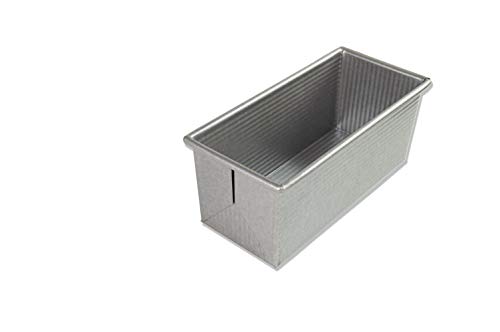
USA Pan Bakeware Loaf Pan — Worth It for Sticky-Batter Regulars
If your rotation is quick breads and loaf cakes, this coated mid-tier pan is the version of the purchase that pays back fastest, because its whole design is aimed at clean release and even colour for exactly those batters. Best for: weekly banana bread and zucchini loaf bakers who will wash it gently. Not suited for: rough-and-tumble shared kitchens where a coating will be scoured.

Nordic Ware Natural Aluminum Loaf Pan — Worth It for Buy-Once Bakers
The bare-metal classic makes the strongest lifespan argument in the category: an entry-to-mid tier pan with nothing to peel, chip, or wear out, which a parchment sling makes nearly as obliging as a coated pan. Best for: yeast bakers and anyone who wants the cost-per-bake figure to fall for decades. Not suited for: bakers who dislike greasing and lining on principle.
Le Creuset Stoneware Loaf Pan — Worth It for Baker-Hosts
The premium stoneware case rests on double duty: it bakes steadily and then serves at the table and stores the leftovers, replacing a baking pan and a serving dish in one heavy, handsome object — lifted always with both gloved hands, and spared sudden temperature shocks. Best for: hosts and gift bakers. Not suited for: anyone who wants the lightest lift or the lowest tier.

Pyrex Basics Glass Loaf Pan — Worth It for Multi-Taskers
The entry-tier glass pan spreads its value across sweet and savoury work — loaves, meatloaf, terrines, frozen desserts — and lets you watch browning as it happens, provided you turn loaves out promptly and avoid sudden temperature changes that glass dislikes. Best for: versatile small kitchens. Not suited for: bakers who leave loaves resting in the pan indefinitely.
The Decision Checklist
Answer yes or no, honestly and quickly. Do you bake, or realistically intend to bake, something loaf-shaped at least a few times a year? Do you eat sliced bread, quick bread, or loaf cake often enough that making your own appeals? Is there one recipe — banana bread, a sandwich loaf, a family meatloaf — that you already wish you could make properly? Do you have a drawer or shelf corner the pan can live in? Will you enjoy, rather than resent, ten minutes of stirring a batter and a pan to wash afterwards? Do you own, or plan to own, the simple companions — parchment, gloves, a serrated knife — that loaf baking uses? Is there someone in your life — a child learning to cook, a neighbour who trades in kindnesses, a household that gathers around a table — who would be glad of the loaves this pan makes possible? That last question is not decoration: a striking share of this pan’s lifetime value is delivered to other people, one wrapped loaf at a time, and households that count that in find the decision easier than the pure arithmetic suggests. If you answered yes to the first question and to most of the rest, the arithmetic of this article says buy the pan, at the tier your baking frequency justifies, and start with your most-wanted recipe. If the first answer was no, or the yeses were thin and dutiful, skip it without guilt and spend the money where your kitchen actually lives. A worth-it question answered honestly is valuable either way; the only bad outcome is the pan bought on a maybe and stored on a never.
The Economics, in Plain Language
It is worth slowing down on the money, because the loaf pan’s economic case is unusual: it does not depend on the pan being cheap in any dramatic sense, or on home baking being free. Home baking uses ingredients, energy, and time, and any honest accounting includes all three. The case rests instead on comparison. A household that buys good sliced bread, the occasional bakery banana bread, and a celebration loaf cake across a year spends, on those items alone, a sum against which a one-time pan purchase — at any tier — is a minor line. The ingredients for the home versions are mostly store-cupboard staples bought in quantities that serve many bakes, and the energy for a loaf shares an oven that is frequently hot for other reasons. Even valuing the baker’s time generously, the recurring pattern of home loaf baking comes out ahead for households that actually eat loaves — and that is before assigning any value to freshness, ingredient control, or the simple pleasure of a house that smells of baking, which owners consistently rank as the real return.
The subtler economic point is waste. Loaf pans are rescue equipment. Bananas pass their eating prime in every household; a loaf pan converts them from compost to breakfast. Zucchini gluts, a surfeit of carrots, the last apples in the bowl, leftover roast meat that becomes tomorrow’s meatloaf mixture — the pan is the tool that turns the fridge’s small failures into the week’s small triumphs, and over a year those rescues add up to a real, if unglamorous, saving. Add the freezer habit — a sliced loaf frozen in portions is a standing breakfast reserve that prevents expensive emergency bakery runs — and the pan begins to look less like bakeware and more like a small piece of household logistics. Tools that reduce waste and improvisation at once are rare at any price; that this one also produces cake is almost a bonus.
A Year With a Loaf Pan: How the Value Actually Arrives
Imagine the purchase across a single ordinary year, because that is how its worth is truly delivered — not in one triumphant bake but in a rhythm. In the cold months it is banana bread on a Sunday, a spiced loaf for a neighbour, a meatloaf that makes Monday feel provided for. In spring it is lemon drizzle for the first garden tea and a sandwich loaf for picnics that deserve better than bought bread. Summer brings the zucchini glut and turns it into loaves for the freezer, plus a terrine or a frozen loaf dessert when friends come to eat outside. Autumn is the pan’s high season: fruit loaves, gingerbread, the first bake-sale contribution of the school year, a pound cake for a birthday that wanted something plain and perfect. None of these bakes is heroic. Together they are dozens of uses, each one small, each one either saving a purchase, rescuing an ingredient, feeding someone well, or giving something away — and at the end of that year the pan has not aged a day, and the same rhythm is available again, indefinitely. That is what buying a loaf pan actually buys: not an object, but a standing capability that a household draws on in every season.
Contrast the counterfactual year, the one where the pan was judged not worth it by a household that does, in fact, bake and eat loaves. That year contains the same bananas and the same birthdays, met with muffin-tin improvisations that nobody slices for toast, a casserole meatloaf with dried edges, bought loaves whose quality nobody chose, and at least one moment — there is always one — where a recipe was abandoned mid-read at the words loaf pan required. The saving from not buying is real but tiny and it happens once; the small frictions recur all year. Worth-it questions are usually decided by exactly this asymmetry: a one-time cost weighed against a recurring convenience, and households that run the honest counterfactual rarely regret the pan.
What Long-Term Owners Value Most
Ask people who have owned a loaf pan for years what it gives them, and the answers are rarely about the pan at all. They talk about a signature loaf — the one recipe that became theirs, requested by name, carried to every gathering. They talk about children who learned to bake on banana bread because the method forgives beginners, and about slices in lunchboxes that started as a Sunday habit. They talk about the freezer shelf of sliced loaves that makes weekday breakfasts feel looked-after, and about the neighbour relationship that runs, in both directions, on wrapped loaves. The pan itself is mentioned almost as an afterthought: still flat, still releasing, still the same. That is the deepest sense in which the purchase proves worth it — the object disappears, and a set of small, repeated kindnesses and competences remains. Kitchen tools that achieve that invisibility are the ones worth owning, and the loaf pan, for any household that bakes at all, is reliably one of them. Readers who want the choosing mechanics next should go to how to choose a loaf pan in seven steps, and those who want the category surveyed before deciding should read our loaf pan review of the category.
The Health and Ingredient-Control Argument
One strand of the worth-it case deserves its own space, because for many households it is the deciding one: control. A loaf baked at home contains what you put in it and nothing else — the flour you chose, the sweetening you judged, the salt level your household prefers, and none of the extenders, improvers, and preservative systems that commercial loaves use to survive distribution. For families managing preferences or sensitivities, that control is not a luxury; it is the difference between bread as a worry and bread as a pleasure. The same control runs in the indulgent direction too: the home baker can make the banana bread richer, the lemon loaf sharper, the sandwich loaf softer, tuning a recipe across bakes until it is exactly the loaf the household loves, a process no bakery can perform for you. A loaf pan is the small enabling tool for all of it, and households that bake for ingredient reasons consistently rate it among their most valuable equipment — a judgement echoed by the many bakers who pair it with precise measuring habits and tools like kitchen scales for baking accuracy.
The Skill Argument: A Pan That Teaches Baking
There is also a case from competence. Loaf baking is the most forgiving school in the baking world: batters that tolerate imperfect technique, doughs that ask only for time and a warm corner, results that are delicious across a wide band of execution. A new baker with a loaf pan accumulates wins quickly, and wins are what turn a tentative experiment into a durable skill. Within a season, the owner of a loaf pan typically understands fermentation or batter chemistry, oven behaviour, and doneness judgement better than they did — knowledge that transfers to every other corner of cooking. Few purchases teach while they feed. If there is a young cook in the household, or an adult who has always meant to become someone who bakes, the loaf pan is the lowest-risk, highest-success place to start, and its worth includes the baker it quietly creates. When that baker is ready to widen the repertoire, the natural next reads are the loaf pan buying guide for a second, specialised pan and the wider bakeware surveys such as USA Pan bakeware across the range.
Edge Cases: Small Ovens, Big Households, and Shared Kitchens
Three situations bend the general verdict and deserve direct answers. The small-oven household — a compact flat, a countertop oven doing full duty — should check fit before anything else, because a pan that crowds the oven walls bakes unevenly and turns a good purchase into a frustrating one; measured carefully, though, the standard loaf pan is among the most compact-oven-friendly shapes in baking, and mini loaves extend the repertoire further when space is truly tight. The big household runs the opposite calculation: a single standard loaf disappears in a day, which argues not against the pan but for a pair of them, or for treating the standard pan as the quick-bread tool while batch bread happens in larger vessels. Doubling is cheap, the pans stack, and the rhythm of two loaves — one to eat, one to freeze — is how large families have always made the economics sing.
The shared or rented kitchen is the third case: cooks whose equipment lives communally, students in house shares, anyone whose pans will be borrowed, scrubbed by strangers, and stored by committee. Here the worth-it answer survives but the buying advice changes — choose the forgiving materials, bare metal or glass, that tolerate communal life, at a tier whose loss would sting least, and let the delicate coated pan wait for a kitchen of your own. The repertoire, the economics, and the pleasure are all still available; only the specification bends. That adaptability is itself part of the category’s worth: there is a version of this purchase that makes sense in almost every kitchen that bakes at all, from the first student house to the retirement cottage, which is more than can be said for most equipment that promises to change your cooking.
Regret, Resale, and the Low Cost of Being Wrong
One final consideration tilts borderline cases toward buying: the cost of being wrong is unusually low. A loaf pan is small, durable, and universally understood, which makes it one of the easiest kitchen objects to pass on — to a friend who bakes, a young relative setting up a kitchen, a charity shop that will place it in a new home within the week. If the experiment fails, little money is stranded and no counter is permanently occupied. Compare that asymmetry with the cost of being wrong in the other direction: the household that talks itself out of the pan and spends years improvising around the absence, muffin-tinning its banana bread and casserole-dishing its meatloaf, pays its small toll indefinitely. When a purchase is cheap, durable, pass-on-able, and answers a recurring need, the burden of proof sits with not buying — and in this article’s judgement, for any household that bakes even a little, that burden is not met. Buy the pan, bake the loaf you have been imagining while reading, and let the first slice cast the deciding vote.
Is a Second Loaf Pan Worth It?
For households that answer the first purchase with enthusiasm, a second question follows within the year, and it has its own arithmetic. A second pan in the same size is worth it the moment back-to-back baking becomes a pattern — the freezer restock, the bake-sale weekend, the two-loaf household rhythm — because it doubles output for the price of one modest pan and zero new skills. A second pan in a different material is worth it when your repertoire splits cleanly in two, sticky sweet bakes pulling one way and lean yeast loaves the other, and each pan can then be the specialist its bakes deserve. A smaller companion pan is worth it for gift bakers and small households, turning half batches and leftovers of batter into neat, fast-baking loaves instead of awkward underfilled bakes. What is not worth it is the second pan bought to fix a first pan that was simply wrong for you; diagnose the mismatch first — size, material, or coating, using the step-by-step choosing method — and replace rather than accumulate. Baking cupboards fill with good intentions; the households that get the most from this category are the ones whose every pan has a named job.
Loaf Pan: The Break-Even Test: When the Purchase Pays Off
Start with how often a {p} must actually be used before it earns its counter or cupboard space. Most coverage of a loaf pan concentrates on the first week of ownership, yet the decisions that matter most tend to surface later, once the loaf pan has to earn its place in an ordinary weekday routine rather than a carefully staged first attempt. Write down the three jobs you expect it to do most often, in the order you actually do them, and judge every claim you read against that short personal list instead of against a generic ideal.
Work through a realistic scenario, not a best case. Picture the busiest version of the job: more people to serve, less time than planned, ingredients or materials that are slightly out of the ordinary, and a clean-up waiting at the end. Ask how the loaf pan behaves at that upper edge, because a model that only shines on a small, simple load will disappoint precisely when you need it most. If the honest answer is that you would split the job into batches or fall back on an older method, factor that into the decision now rather than discovering it later.
Troubleshooting is easier when you expect the usual failure points. With any loaf pan, the recurring problems tend to cluster in the same places: uneven results from overloading or poor arrangement, wear showing first on the parts handled most often, and small annoyances with lids, seals, handles, controls or fittings that only appear after repeated use. Before buying, look for whether those wear parts can be cleaned properly, replaced or worked around, and whether the instructions address them directly rather than pretending they never happen.
Maintenance decides how long the good results last. Set a simple rhythm: a quick wipe or rinse after each use, a deeper clean on a fixed day, and a periodic check of the parts that move, seal or bear weight. A loaf pan that needs fiddly disassembly for basic care will be cleaned less often, and performance drifts long before anything actually breaks. Prefer designs where the parts that get dirtiest are the parts that are easiest to reach, and be honest with yourself about which cleaning steps you will genuinely keep up.
Finally, plan the first fortnight deliberately. Use the loaf pan for one familiar job first, so you have a baseline you trust, then introduce the harder cases one at a time and note what changes. Small adjustments to arrangement, timing, quantity or preparation usually close most of the gap between disappointing first results and the performance the design is capable of. That short learning period is also the fairest test of the break-even calculation: if the routine has not settled by the end of it, the mismatch is real, and it is better to know while returning or exchanging is still straightforward.
Use a short decision checklist to finish. One, does it fit the space and the storage you really have. Two, does it handle your three most common jobs without a workaround. Three, do the edge cases you listed stay manageable. Four, can every wear part be cleaned or replaced without drama. Five, would you still choose it if a friend described the same drawbacks in their own kitchen. A loaf pan that passes all five is a sound buy; one that fails two or more is a compromise you are choosing with open eyes, which is a very different thing from being surprised later.
Edge cases deserve a deliberate pass. Think about the odd shapes, the thicker or thinner than usual loads, the leftovers, the second helping and the guest with different preferences. A well-chosen loaf pan handles the exceptions gracefully, or at least predictably, while a poor match turns every exception into a workaround. List your two or three most common exceptions in advance and check, from the manual or the listing details, that nothing about them is ruled out by size, shape, material or care requirements.
When you check listings such as USA Pan Bakeware Loaf Pan, Nordic Ware Natural Aluminum Loaf Pan and Le Creuset Stoneware Loaf Pan, use them as worked examples: run through the same checks below on each one in turn, so the comparison stays honest and like for like rather than based on whichever listing happens to shout loudest.
Measure before you commit. Note the footprint, the clearance above and behind the spot where the loaf pan will live, and the route you will carry it by when it is hot, full or awkward. A loaf pan that technically fits but blocks a cupboard door, crowds a neighbouring appliance or has to be dragged across a worktop every time will quietly fall out of use, whatever its merits on paper. In the Kitchen Cookware category especially, a few centimetres of clearance and a sensible storage plan separate a daily tool from a bulky regret.
One more check worth doing with any loaf pan is to read the care and safety instructions in full before the first use, not after the first problem. The manual for a loaf pan usually states plainly which materials, loads and cleaning methods are off limits, and most early disappointments trace back to a line in those pages that was skimmed. Five minutes with the instructions is the cheapest performance upgrade available in the whole Kitchen Cookware category.
Frequently Asked Questions
How often do I need to bake for a loaf pan to be worth it?
Less often than most people assume. Because a sound pan lasts for years and costs little in money and space, even a bake every month or two repays it comfortably across its life, especially once gift loaves and rescued ingredients are counted. Weekly bakers get spectacular value; seasonal bakers — the Christmas fruit loaf, the summer zucchini glut — still come out ahead. The pan only fails the test when the honest frequency is never.
Is a premium loaf pan worth more than a basic one?
Only if your baking will notice the differences, which are real but specific: heavier construction that resists warping, coatings that release better and last longer, stoneware that doubles as serving ware. A weekly baker feels those differences constantly and a premium tier can be justified; an occasional baker gets nearly all the category’s value from a sound basic pan. Buy the tier that matches your frequency, not your aspirations.
Can I just bake loaf batters in a muffin tin instead?
You can, and for occasional quick breads it is a fair substitute: the batter is the same, the portions are neat, and the baking is faster. What you give up is everything the loaf shape itself provides — even slices for toast and sandwiches, the domed presentation loaf, the gift loaf, the meatloaf and terrine repertoire. If those matter to you even a few times a year, the pan earns its drawer; if they genuinely do not, muffins are your answer.
Does a loaf pan earn its place in a very small kitchen?
Usually yes, because it is one of the most space-efficient tools in baking: compact, stackable, and covering breads, cakes, and savoury loaves in a single object. The exception is the kitchen where even one more object displaces something used weekly — there, borrow or improvise until the space changes. Measure your storage honestly; if the pan has a home, its small footprint stops being an argument against it.
What is the first loaf I should bake to test the decision?
Choose the loaf you most wanted when you considered buying the pan — for most households that is banana bread, and it is a kind first test: forgiving batter, clear signals of success, and a result the whole household will judge enthusiastically. Bake it in your new pan exactly as the recipe directs, note how the pan browned and released, and you will know within one afternoon whether the purchase fits your kitchen. It almost always does.
How long will a loaf pan last if I use it weekly?
Bare metal and stoneware pans, treated sensibly, are measured in decades rather than years — there is essentially nothing in them to wear out, and a weekly rhythm is well within their design life. Quality coated pans give long service too, provided they are kept away from metal utensils and harsh scrubbing, though a coating is ultimately a surface with a lifespan. In every material, the pan is very unlikely to be the thing that ends your baking habit.
Related reading: the full loaf pan buying guide, our in-depth loaf pan review, and non-stick bakeware sets compared.
A closing thought for the still-undecided. Most kitchen purchases are bets on a future self — the juicer for the person you hope to become, the pasta machine for a life you imagine. The loaf pan is a rarer and safer thing: a bet on the household you already are, eating the breakfasts it already eats, rescuing the bananas already blackening on its counter. If that household bakes at all, or wishes it did a little more, the bet is a good one, and the first warm slice — cut thick, eaten standing up in the kitchen while the rest cools — tends to settle the question more eloquently than any article can. This one has made its case; the oven, as always, gets the final word. And it usually says yes, warmly, within the hour, in a kitchen that suddenly smells like somewhere worth being.


