Disclosure: topratedkitchenware.com is reader-supported. When you buy through links on our site, we may earn an affiliate commission from Amazon and other retailers, at no extra cost to you.
Where to buy
The six machines below are the verified picks in this guide to the best combination coffee makers with pot and one cup, for readers torn between a shared pot and a personal cup. Each name links to its Amazon listing, where you can check the latest price on Amazon and confirm the current configuration. Read the introduction first: it is honest about the difference between a true carafe brewer and the reservoir machines ranked here.
- Keurig K-Express (Mint)
- Hamilton Beach FlexBrew Advanced 4-in-1
- Ninja Single Serve Coffee Maker PB051
- Keurig K-Elite
- Keurig K-Express (Black)
- Keurig K-Express (Warm Stone)
Read the full guide ↓ for the reasoning behind the order, the honest limitations of every pick, and the checks that matter more than any headline claim.
The wish behind the best combination coffee makers with pot and one cup is a weekday-weekend split: a single cup, fast, on a Tuesday morning when only one person is awake, and a full pot on a Sunday when the table is full and nobody wants to play barista. True dual brewers exist for exactly that life, pairing a carafe side with a single-serve side in one body. This guide needs to be honest from the first paragraph: the verified pool ranked here contains no true carafe machine. Every pick is a single-serve brewer, and pretending otherwise would waste your money.
What the pool does contain is the other half of the answer, in several strong forms. Reservoir machines like the Ninja PB051 and the Keurig K-Express line serve cup after cup without refilling, which covers more real-world pot occasions than buyers expect — most shared coffee is actually a sequence of individual cups, not a pot poured at once. The Ninja adds 24 oz brews and a 56 oz reservoir, the closest any single-serve design gets to pot service. This guide ranks the six on how gracefully each handles both ends of your week, and explains how to cover the genuine pot occasions — the brunch table, the meeting — without one.
If a true carafe is non-negotiable, treat this guide as the case for the alternative and weigh it fairly; many households discover the pot was a habit rather than a need. Readers whose shared occasions are really about volume should also read the Best Combination Multi Cup And Single Serve Coffee Makers guide, which attacks the same problem from the capacity side, and the Best Combination Ice Coffee Makers roundup if summer drinks are part of the household mix.
Key Takeaways
- No pick in this verified pool brews a true carafe; all six are single-serve machines, and the guide says so rather than dressing them up.
- The Ninja PB051 comes closest to pot service: a 56 oz reservoir and cups up to 24 oz cover a table of drinkers in sequence.
- Most real pot occasions are actually back-to-back single cups, which reservoir machines handle without any compromise.
- The K-Express models bring a 42 oz reservoir and three brew sizes to the shared-morning job in three finishes.
- For the rare true-pot occasion, a simple separate carafe brewer or a thermal jug filled by sequential brews covers it honestly.
In this guide
Quick Picks
The six verified picks below are ordered by how well each serves both a solo cup and a shared occasion. Badges stay consistent across the Quick Picks, the detailed reviews and the comparison table.
| Pick | Badge | Best for | Link |
|---|---|---|---|
| Keurig K-Express (Mint) | Best Light Finish | Pod households whose shared occasions are two or three cups in sequence | Check on Amazon |
| Hamilton Beach FlexBrew Advanced 4-in-1 | Best for Households | Families whose pot occasions are really rounds of different drinks | Check on Amazon |
| Ninja Single Serve Coffee Maker PB051 | Best Overall | Households wanting the closest single-serve answer to pot service | Check on Amazon |
| Keurig K-Elite | Best Premium Pod Pick | Design-led households whose sharing is a second cup, not a pot | Check on Amazon |
| Keurig K-Express (Black) | Best Pod All-Rounder | Pod households wanting reservoir rhythm for weekday and weekend alike | Check on Amazon |
| Keurig K-Express (Warm Stone) | Best for Style-Led Kitchens | K-Express buyers who want the shared-morning rhythm in a softer finish | Check on Amazon |
How These Picks Were Chosen
Selection for this brief began with a disclosure test: does the machine brew into a carafe? None of the verified pool does, so the ranking criterion became the honest substitute — how well does each machine serve a group when a group arrives? That was judged on reservoir capacity, maximum brew size, format flexibility and brewing pace, all taken from the verified listings. A machine that holds 56 oz and brews 24 oz cups answers a shared occasion very differently from a fill-per-cup mini, and the order below reflects that gradient.
The guide is research-led, and its central claim is deliberately modest: sequential single cups are not a pot, but they are what most households actually drink. Where the difference genuinely matters — coffee that must sit ready for an hour, a table that pours together — the relevant sections say so and offer the workaround or the alternative purchase. No specification in the boxes is invented; the K-Elite, whose listing confirms the least, is described with corresponding care.
The 6 Best Combination Coffee Makers With Pot and One Cup Duties

Keurig K-Express (Mint)
Badge: Best Light Finish
The Mint K-Express brings the standard K-Express formula — 42 oz removable reservoir, three brew sizes, Strong Brew button, travel mug friendly, works with all K-Cup pods — in a pale mint finish that suits retro-leaning and pastel kitchens. Functionally nothing separates it from its black, Warm Stone and Evergreen siblings, so the honest advice is to choose it for the colour and enjoy the same routine: several cups per reservoir fill, a bolder option when a pod tastes weak, and clearance for the travel mug on workday mornings. The pale finish does ask for a little more wiping, because coffee drips and grounds dust show against mint more readily than against black or green. In exchange, the machine brightens a counter corner instead of darkening it. For a renter, a student house or anyone furnishing a small kitchen with some personality, Mint is the K-Express that does not take itself too seriously.
Mint’s contribution to the pot question is the K-Express reservoir rhythm in a pale finish: 42 oz of water ready to become cup after cup, so a couple and a guest are served in minutes without anyone refilling between brews. What it cannot do is hand the table a pot, and for the households this machine suits — two regular drinkers, occasional guests — that absence rarely registers, because their shared coffee was always sequential anyway. The mint finish asks for a wipe after a busy shared morning, when splashes multiply. In exchange, the machine that handles the household’s ordinary togetherness looks like part of the kitchen rather than an office appliance on loan.
Strengths
- Full K-Express feature set in a light, retro-leaning mint finish
- 42 oz removable reservoir is easy to carry to the tap
- Three brew sizes plus Strong Brew cover most single-cup needs
Trade-offs
- Pale finish shows coffee splashes and needs wiping more often
- Pods only in normal use, with pod cost per cup to budget for
- No dedicated iced or cold-brew programme
Key specifications
- Format: Single-serve K-Cup pod coffee maker
- Brew sizes: 3 brew sizes
- Reservoir: 42 oz, removable
- Feature: Strong Brew button
- Mug fit: Travel mug friendly
- Finish: Mint
Best for: Pod households whose shared occasions are two or three cups in sequence / Not suited for: Anyone who needs a carafe that stays hot on the table

Hamilton Beach FlexBrew Advanced 4-in-1
Badge: Best for Households
The Hamilton Beach FlexBrew Advanced 4-in-1 is the pool member that tries to end arguments. It brews hot and iced coffee, it accepts both pod packs and ground coffee, and it carries a removable 45 oz reservoir — the largest water capacity in this guide alongside genuinely fast brewing. That combination means a household split between pod loyalists and grounds drinkers can share one machine, and a drinker who wants iced coffee in summer and hot coffee in winter is not maintaining two appliances. The reservoir changes the morning maths: several cups can be brewed back to back before anyone visits the tap, which is exactly when single-serve machines usually show their limits. It remains a single-serve design, so there is no carafe for a brunch table, and its broader brief takes more counter space than the minis. As a one-machine answer to mixed household tastes, though, it is the most complete package here.
The FlexBrew reframes the pot problem in the way that suits families best: the shared occasion is rarely six identical coffees, it is a round of different drinks — a strong hot cup, a mild one, an iced coffee for the teenager — and a carafe cannot do that at all. With pods and grounds, hot and iced modes, a 45 oz reservoir and fast brewing, the FlexBrew serves the round a family actually orders. It is the strongest argument in this guide that the pot was a proxy for togetherness rather than the thing itself. Where the thing itself is truly wanted — a lazy brunch where the pot sits and pours — no single-serve machine substitutes, and the how-to section below covers that case separately.
Strengths
- Largest reservoir here paired with hot and iced modes
- Takes both pod packs and grounds, so no format lock-in
- Fast brewing suits back-to-back morning cups
Trade-offs
- Bigger brief than the minis, so it needs real counter space
- Still a single-serve machine: no carafe for a table of guests
- More modes means more settings for a household to learn
Key specifications
- Format: 4-in-1 single-serve coffee maker
- Modes: Hot and iced coffee
- Reservoir: 45 oz, removable
- Inputs: Pod packs and ground coffee
- Brewing: Fast brewing
- Finish: Black
Best for: Families whose pot occasions are really rounds of different drinks / Not suited for: Hosts who want one carafe poured at the table

Ninja Single Serve Coffee Maker PB051
Badge: Best Overall
The Ninja PB051 is the heavyweight of this pool: a single-serve combo machine that takes both K-Cup pods and ground coffee, offers four styles of brewing, brews cup sizes up to 24 oz and carries a 56 oz removable reservoir — the largest water capacity and the largest single cup in this guide. Those numbers translate into a specific kind of freedom. The reservoir covers a full morning of household cups, the 24 oz ceiling means the biggest travel mug is filled in one brew rather than two, and the pod-plus-grounds format means a new bag of beans and a box of pods can coexist without a second machine. Four brew styles let the same coffee land differently in the cup, from an everyday mug to a more concentrated style for milk drinks or iced coffee. The costs are counter space and a modest learning curve. For households that brew often and in quantity, the PB051 is built exactly for that life.
The Ninja is the pick that makes this guide’s argument concrete. A 56 oz reservoir is pot-sized water by any measure, and 24 oz brews mean a large mug — or two small cups poured from one brew — arrives in a single pass rather than a queue of little ones. Add pods and grounds with four brew styles, and a shared morning becomes a sequence the machine absorbs without refilling, re-dosing or drama. It still does not brew a carafe, and a host who dreams in brunches should keep reading the workarounds section. But measured by drinks served per unit of effort, the Ninja covers more of the pot-and-cup brief than anything else verified for this guide.
Strengths
- Biggest reservoir in the pool at 56 oz, removable
- Pods and grounds in one machine, with four brew styles
- Brews up to 24 oz, covering large travel mugs in one pass
Trade-offs
- The largest brief here, so small counters should measure first
- Four styles add a learning curve for guests and family
- Still single-serve: big cups, but no carafe
Key specifications
- Format: Single-serve combo machine for K-Cup pods and grounds
- Brew styles: 4 styles of brewing
- Cup sizes: Up to 24 oz
- Reservoir: 56 oz, removable
- Model: PB051
- Finish: Black
Best for: Households wanting the closest single-serve answer to pot service / Not suited for: Small counters and true carafe traditionalists

Keurig K-Elite
Badge: Best Premium Pod Pick
The Keurig K-Elite in brushed silver is the premium-leaning pod machine in this pool: a single-serve K-Cup brewer whose metal-toned finish is designed to be seen rather than hidden. Where the K-Express models compete on reservoir size and brew-size lists, the K-Elite competes on presence — it is the machine for a counter that is part of the room, in an open-plan kitchen or a smart office kitchenette where a plastic-looking appliance would jar. The coffee routine is the familiar Keurig one: a pod, a button, a cup, with the entire K-Cup range available to choose from. Buyers should note honestly that the verified listing for this model confirms fewer headline specifications than its K-Express siblings, so the decision here rests on finish, format and brand tier rather than on a longer feature list. If those are your criteria, the K-Elite is the pool member aimed at you.
The K-Elite serves the pot-and-cup household at the intimate end: the couple whose shared occasion is two good cups, made one at a time, in a kitchen where the machine is part of the view. Its brushed silver finish is the reason it is here, and this guide will not inflate its group credentials beyond what a single-serve pod machine can claim. For a household that occasionally hosts, it pairs sensibly with the thermal-jug workaround in the how-to section — brew sequentially into a pre-warmed jug and carry the jug to the table. Judged as a premium solo-and-duo machine with an honest sideline in small-scale hosting, it earns its place.
Strengths
- Brushed silver finish suits visible, design-led counters
- Single-serve K-Cup format gives access to the full pod range
- A step-up Keurig nameplate for buyers who want the premium tier of pod machines
Trade-offs
- Listing confirms fewer headline specs than the K-Express models
- Pods only, so grounds drinkers are not served
- Premium positioning without a carafe or second format
Key specifications
- Format: Single-serve K-Cup pod coffee maker
- Finish: Brushed Silver
Best for: Design-led households whose sharing is a second cup, not a pot / Not suited for: Anyone buying primarily for group capacity

Keurig K-Express (Black)
Badge: Best Pod All-Rounder
The Keurig K-Express in black is the straightforward centre of the K-Cup world: a single-serve pod machine with a 42 oz removable reservoir, three brew sizes and a Strong Brew button for a bolder extraction from the same pod. The reservoir is the detail that shapes daily life with it, because it turns brewing into a rhythm of several cups between refills instead of a fill for every single mug. It is travel mug friendly, so a commuter cup slides under the spout without decanting from a smaller mug first. Because it works with all K-Cup pods, the coffee choice is as wide as the pod aisle itself, from dark roasts to flavoured blends to tea and cocoa pods. Operation is deliberately plain: insert a pod, choose a size, press brew. There is no carafe, no grinder and no milk system, and that simplicity is the point. For a household that wants predictable pod coffee with the fewest possible steps, this is the reference design the rest of this guide is measured against.
The black K-Express is the workhorse answer to this brief: a 42 oz reservoir that turns shared mornings into a sequence of quick pod brews, three sizes that cover the small cup and the travel mug, and a Strong Brew button for the drinker who takes theirs serious. Most households that think they need a pot discover, living with a machine like this, that what they needed was coffee that keeps coming without effort — and that is precisely the K-Express design brief. The honest remainder is the sit-down occasion, handled by the jug method below. As the default pod machine for a household of mixed solo and shared drinking, it is the safest recommendation in the pool.
Strengths
- 42 oz removable reservoir means several cups between refills
- Strong Brew button gives a bolder cup from the same pod
- Three brew sizes cover a small cup through a travel mug
Trade-offs
- Pods only in normal use, so grounds need a separate routine
- No dedicated iced or cold-brew programme
- Black finish shows dust and scale marks readily
Key specifications
- Format: Single-serve K-Cup pod coffee maker
- Brew sizes: 3 brew sizes
- Reservoir: 42 oz, removable
- Feature: Strong Brew button
- Mug fit: Travel mug friendly
- Finish: Black
Best for: Pod households wanting reservoir rhythm for weekday and weekend alike / Not suited for: True carafe devotees
Keurig K-Express (Warm Stone)
Badge: Best for Style-Led Kitchens
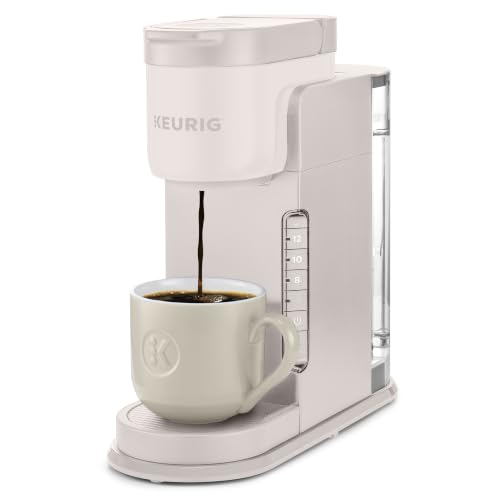
The Warm Stone K-Express is the same machine as the black K-Express — 42 oz removable reservoir, three brew sizes, Strong Brew button, travel mug friendly, compatible with all K-Cup pods — wearing a softer, stone-toned finish. That makes the choice between them a kitchen-design decision rather than a coffee decision, and there is no shame in that: a machine that lives on the counter every day should look like it belongs there. The warm neutral tone sits comfortably beside pale wood, stone worktops and stainless appliances, and it is more forgiving of the light dusting of coffee grounds and water spots that accumulate around any brewer. Everything said about the K-Express routine applies here unchanged: pod in, size chosen, cup brewed, with several cups available before the reservoir needs attention. If your household has already decided the K-Express feature set is right, Warm Stone is simply the version for kitchens where black reads too stark.
Warm Stone performs the same shared-morning service as the black K-Express — same reservoir, same sizes, same strong option — in the finish that hides the evidence of a busy household best. Shared occasions are splashy occasions: more cups, more drips, more grounds dust, and a warm neutral finish forgives all of it between wipes. That is a small virtue with daily compounding interest. Choose it when the K-Express has won on function and the kitchen votes against black. Nothing about the pot question changes with the colour, and this guide respects you enough to say so in the review rather than inventing a distinction.
Strengths
- Same 42 oz reservoir and three brew sizes as the black version
- Warm Stone finish hides everyday marks better than gloss black
- Strong Brew button for a more intense cup when wanted
Trade-offs
- Functionally identical to the other K-Express colours
- Pods only in normal use, with no grounds basket in the box story
- No dedicated iced or cold-brew programme
Key specifications
- Format: Single-serve K-Cup pod coffee maker
- Brew sizes: 3 brew sizes
- Reservoir: 42 oz, removable
- Feature: Strong Brew button
- Mug fit: Travel mug friendly
- Finish: Warm Stone
Best for: K-Express buyers who want the shared-morning rhythm in a softer finish / Not suited for: Anyone expecting different capacity from the other K-Express colours
The ranking above is, in effect, a ranking of group grace: how elegantly each machine handles the moment a second, third or sixth drinker appears. The Ninja and FlexBrew absorb that moment; the K-Express models manage it; the K-Elite charms through it at small scale. None of them pours a pot, and the table that follows keeps that fact visible in every row, because a household choosing between these machines and a true dual brewer deserves the comparison stated in numbers rather than adjectives.
Comparison Table
The comparison that matters here is drinks-in-sequence capacity: how much water each machine holds, what goes in, and the trait that defines its answer to the shared occasion. None of these rows is a carafe — the table does not pretend otherwise.
| Pick | Format | Water capacity | Standout trait | Link |
|---|---|---|---|---|
| Keurig K-Express (Mint) | K-Cup pods | 42 oz reservoir | Mint finish, full K-Express feature set | Check on Amazon |
| Hamilton Beach FlexBrew Advanced 4-in-1 | Pod packs and grounds | 45 oz reservoir | Hot and iced modes with fast brewing | Check on Amazon |
| Ninja Single Serve Coffee Maker PB051 | K-Cup pods and grounds | 56 oz reservoir | Four brew styles, cups up to 24 oz | Check on Amazon |
| Keurig K-Elite | K-Cup pods | Reservoir format, size not confirmed in listing | Brushed silver premium finish | Check on Amazon |
| Keurig K-Express (Black) | K-Cup pods | 42 oz reservoir | Strong Brew button for concentrated cups | Check on Amazon |
| Keurig K-Express (Warm Stone) | K-Cup pods | 42 oz reservoir | Warm Stone finish, full K-Express feature set | Check on Amazon |
How to Choose Between a Pot Habit and a Single-Cup Machine
Interrogate the pot occasions honestly. Write down the last five times a pot was actually brewed in your house and what happened to the coffee. If most pots were drunk as a sequence of individual cups within half an hour, a reservoir single-serve machine covers your real life, and the carafe was ceremony. If the pot regularly sat for an hour while people topped up between tasks, the carafe is doing thermal work a single-serve machine cannot, and you should either buy a true dual brewer or plan the thermal-jug workaround with open eyes.
Then do the reservoir maths, which is where this pool separates. A 56 oz reservoir with 24 oz brews, as in the Ninja, serves a table in a handful of passes. A 42 to 45 oz reservoir serves a family morning. A fill-per-cup machine — none is recommended for this brief, and the minis from neighbouring guides are absent here for that reason — turns every shared occasion into a queue. Capacity is not a luxury specification for this keyword; it is the keyword, translated into ounces.
Format decides the flavour of the shared round. A carafe makes one coffee for everyone; a pod or dual-format machine makes everyone’s own coffee, which modern households increasingly prefer — the decaf drinker, the strong drinker and the iced drinker at one table are the FlexBrew’s home ground. Readers whose households lean that way may find the Best Combo Coffee And Espresso Makers guide a useful next step, while offices facing the same question at larger scale should jump to the Best Commercial Coffee Makers For Home Use conversation’s bigger sibling in the office guide.
How to Cover Pot Occasions With a Single-Serve Machine
The core technique is the thermal jug method. Pre-warm a good thermal carafe or jug with hot water and empty it. Brew sequentially at the size and strength each drinker wants — or at a common strength for a shared jug — pouring each brew straight into the jug, then carry the jug to the table and serve from it. Coffee held this way, in a pre-warmed sealed jug, stays pleasant far longer than coffee on a hot plate, and every cup was brewed fresh rather than stewed. For a round of six, a reservoir machine completes the job in the time a carafe brewer takes to brew its pot.
For the weekday-weekend rhythm, set the machine up for both lives. Keep the reservoir filled and the pod supply stocked for weekday speed. At the weekend, slow the ritual down deliberately: grounds in the dual-format machines, the strong setting for the drinker who wants it, the jug on the table. Households that treat the weekend round as a small ceremony find the single-serve machine stops feeling like a compromise and starts feeling like a café counter that happens to live in their kitchen.
Problem: the last cup of a shared round tastes weaker than the first → the reservoir ran low or a small size was stretched; refill before the round and brew each cup at its honest size. Problem: coffee in the jug cools too fast → the jug was not pre-warmed, or it is a thin-walled jug; pre-warm every time and choose a jug that seals. Problem: guests queue awkwardly around the machine → set up a self-serve station with pods, mugs and the jug laid out, so guests brew their own second cups without asking, which is the single-serve machine’s hidden hosting superpower.
Keep the machine ready for the double life with basic care: descale on schedule so brew pace does not sag during a round, keep both format paths clean on dual-format models, and never let the reservoir sit full through a holiday week. A machine that serves one person beautifully and six people gracefully is a machine that is maintained before it is needed.
What a Carafe Does That a Reservoir Cannot
A carafe is a thermal and social device, not just a container. It holds coffee at drinking temperature away from the machine, it pours for everyone at once, and it turns coffee into a table centrepiece that people help themselves to without a queue or a button. A reservoir, by contrast, holds water, not coffee: every cup is brewed on demand, which wins on freshness and variety and loses on simultaneity and ceremony. Neither is better in the abstract; they optimise different mornings.
The freshness point deserves emphasis, because it is the single-serve side’s strongest card. Carafe coffee begins changing the moment it is brewed, and coffee held hot for an hour is a shadow of its first cup. Sequential brewing means the last drinker’s cup is as fresh as the first drinker’s — a quality argument no pot can answer. Households that care most about the taste in the final cup should weight that heavily; households that care most about the table ritual should weight the carafe.
When to Buy a True Dual Brewer Instead
There are households this guide should honestly send elsewhere. If a pot is brewed daily and held for hours — a farmhouse kitchen, a small workplace, a home where shifts overlap — a true dual brewer with a carafe side is the right tool, and no reservoir arithmetic changes that. The same is true if the table ritual itself is the point: some Sunday brunches are about the pot in the middle, and a machine should serve the ritual, not argue with it.
For everyone else — the large middle of households whose pots were really sequences — the machines here are not a compromise but a correction. Readers who recognise themselves in that middle, and who also host in summer, will find the overlap with the Best Combination Ice Coffee Makers shortlist useful, since the FlexBrew and Ninja appear in both conversations for good reason.
The Sunday Table Test: A Worked Example
Put the theory to a concrete test. Six people, Sunday, eleven o’clock. With a carafe brewer, one pot is brewed, poured, and — by the fourth cup — has been sitting long enough to taste it; the decaf drinker waits for a second, smaller pot or goes without; the strong drinker accepts the table’s strength. With the Ninja or a K-Express and a pre-warmed jug, the round takes a similar span of minutes, but each cup is the drinker’s own: the decaf is decaf, the strong cup is strong, and the last cup poured was brewed minutes ago, not half an hour. The jug carries the round to the table and the ceremony survives intact.
Now the Tuesday test. One person, half awake, one cup. The carafe brewer brews a pot nobody drinks, or a sad partial pot that tastes like it; the single-serve machine brews exactly one cup in about the time the kettle boils. A household’s week contains five Tuesdays for every Sunday, which is why this guide ranks the single-serve answers seriously rather than treating the pot as the default and the cup as the compromise. The pot occasion is real, but it is the minority occasion in modern kitchens.
The households that should still buy the true dual brewer are the ones whose Sundays outnumber their Tuesdays in spirit: daily shared pots, long held coffee, a table that is the centre of the home’s day. For them the carafe side of a dual machine will be used daily and loved. Everyone else is buying a pot for a life they remember rather than the one they live, and the machines above are the correction.
Hosting Without a Carafe: A Host’s Playbook
Hosting with a single-serve machine is a small performance, and like all performances it rewards preparation over improvisation. Set the station before guests arrive: reservoir filled, pods or grounds laid out visibly, mugs that match the machine’s clearance, the thermal jug pre-warmed and waiting, milk and sweeteners grouped where a guest can find them without asking. A guest who can see the whole system can operate the whole system, and the host is freed from the machine at exactly the moment hosting demands attention elsewhere.
Sequence the round like a café would. Take the orders together, brew the longest drinks first — the large cups and the strong settings — and pour each straight into the jug or the waiting mug. Announce nothing; simply let coffee appear. Guests judge a coffee round by whether it felt effortless, and effortlessness is a production value the host creates in advance. The second round runs itself, because by then the station has taught the guests, and self-service second cups are the single-serve machine’s party trick that no carafe can match: everyone’s second cup is, again, exactly their own.
Afterwards, notice what the round taught you. If the reservoir emptied, your next machine needs more water; if the jug was never used, your household’s pot occasions were always sequential and the question is settled; if guests queued and chatted happily around the machine, you have discovered that the queue was never the problem. Hosting data, honestly read, is the best buying research there is — and it is free with every Sunday.
It is also worth naming the emotional side of this purchase, because the pot is rarely just a pot. For many households the carafe carries memory: parents’ kitchens, holiday mornings, the particular sound of a pot being set down on a table where everyone is already sitting. A buying guide that treats that as mere habit misses why the decision feels hard. The honest position of this guide is respect for the ritual and clarity about the mechanics: if the ritual is the point, buy the machine that serves the ritual, and let the weekday cup be its second job. If the ritual turns out, on inspection, to be a memory of togetherness rather than of the vessel, then the togetherness is portable — it moves happily to a jug, a station and a round of individually perfect cups, and the memory loses nothing in the move.
There is a budget-shaped version of the same honesty. A true dual brewer asks a household to pay for two brewing systems in one body, including a carafe side that may be used weekly or monthly depending on the household it lands in. A reservoir single-serve machine concentrates the entire spend on the system used daily, and covers the minority occasion with a jug the household may already own. Neither allocation is wrong; they are answers to different calendars. The calendar, once again, is the specification that decides this keyword — and it is the one specification no listing can print for you.
Common Buying Mistakes
The biggest mistake is buying a single-serve machine while secretly expecting a carafe, then blaming the machine at the first brunch. The verified listings in this guide are explicit about format; read the format line before the feature list, and let the introduction’s honesty do its work before money moves.
The second mistake is under-sizing the reservoir for the shared occasions that motivated the purchase. A household that hosts six on Sundays and buys a fill-per-cup machine has optimised for the wrong day. Shop for the heavy day; the light days take care of themselves.
Third, do not keep a dying carafe machine alive alongside the new single-serve one, one for each job, unless the carafe genuinely earns its counter space monthly. Two half-used machines is the outcome this category exists to prevent.
Finally, avoid judging the shared round by the first cup. Judge it by the last: how long the round took, whether the final cup tasted fresh, and whether anyone had to refill anything mid-round. That is the test these machines were ranked by, and it is the test your household will apply every weekend.
Final Recommendation
The closest thing to a pot-and-cup answer in this verified pool is the Ninja Single Serve Coffee Maker PB051: pot-scale water, the largest cups, both formats and four styles, absorbing solo mornings and shared rounds with the same calm. Families whose shared rounds are really rounds of different drinks should choose the Hamilton Beach FlexBrew Advanced 4-in-1 for its hot, iced, pod and grounds flexibility.
Pod households with gentler sharing needs are well served by the Keurig K-Express (Black) and its colour siblings, using the thermal-jug method for the rare true-pot occasion. Buy for the household you actually host, be honest about the carafe, and the machine you choose will still feel right on both the Tuesday and the Sunday of your week.
Related guides
- Best One Or Two Cup Coffee Makers
- Best Pod One Cup Small Coffee Makers
- Best One Cup Coffee Makers For Home
- Best One Cup Drip Coffee Makers
Frequently Asked Questions
Do any of these machines brew a real pot of coffee?
No, and this guide says so plainly. All six verified picks are single-serve machines. What the larger ones offer is pot-scale water capacity and fast sequential brewing, which covers most real shared occasions. A true carafe requires a dual brewer with a carafe side, which is a different product.
How many cups can the Ninja PB051 serve before refilling?
Its reservoir holds 56 oz, so the count depends on cup size: several ordinary cups, or a couple of its largest 24 oz brews. For a shared round it is the strongest capacity in this pool, and the reservoir is removable for easy refilling at the tap.
What is the thermal jug method?
Brew each cup fresh and pour it straight into a pre-warmed thermal jug, then serve the table from the jug. Every cup is freshly brewed, the jug keeps the round hot, and nobody queues at the machine. It is the standard workaround this guide recommends for true-pot occasions.
Is sequential brewing slower than a carafe for six people?
It is comparable. A carafe brewer spends several minutes brewing its pot; a fast single-serve machine spends a similar span making six individual cups, with the advantage that each cup is the drinker’s own choice of coffee and strength.
Which pick is best for a couple who occasionally host?
The Keurig K-Express models are the natural fit: a 42 oz reservoir covers the couple’s week and a small shared round, in a choice of finishes. The FlexBrew is the step up if guests regularly want different drinks, including iced.
Should I keep my old carafe machine as well?
Only if a held pot is a weekly reality in your house. If the carafe comes out twice a year, the thermal jug method covers those occasions and the counter space is better returned to the kitchen.
Can I brew into a carafe placed under a single-serve machine?
Only small vessels that fit the machine’s clearance, and only one brew at a time — which is simply the thermal jug method done in place. It works for a couple of cups, but a pre-warmed jug filled by sequential brews and carried to the table is the more practical route for a full round.


