Disclosure: topratedkitchenware.com is reader-supported. When you buy through links on our site, we may earn an affiliate commission from Amazon and other retailers, at no extra cost to you.
Where to buy
Every linked pick for best deep cycle battery for 24 volt trolling motor below was checked against its verified listing title on 2026-11-20. Picks that failed this keyword’s core gate are still reviewed in full, but as prose-only entries with no purchase link, so the difference is impossible to miss. Start with the shortlist here, then read the detailed reviews before deciding.
- dumfume 24V 100Ah LiFePO4 — Badge: Best Overall
- Qwenoer 22.2V-24V 10Ah Lithium Pack — Badge: Prose-Only: Not a Deep-Cycle Battery (prose-only in this guide, no purchase link)
- Xeanerol 24V 5Ah Lithium Pack — Badge: Prose-Only: Not a Deep-Cycle Battery (prose-only in this guide, no purchase link)
- yeagulch 24V 100Ah LiFePO4 — Badge: Best Documented Trolling Fit
- Dyness 24V 100Ah LiFePO4 — Badge: Best for Expanding Systems
- yeagulch 24V 314Ah LiFePO4 — Badge: Best for Longest Days
Read the full guide ↓
A 24 volt trolling motor is where battery marketing goes to be found out. The motor draws hard, continuously, for hours, and it grades every claim on the battery’s title in a single day on the water. The search for the best deep cycle battery for 24 volt trolling motor therefore reduces to three documented questions. Is the battery natively 24 volts, so the wiring stays simple and balanced? Is it a genuine deep-cycle design with the capacity to matter, 100Ah class or beyond? And does its management system carry enough current for a motor at full working thrust, with headroom for the days when wind and current join the other team?
Four of the six assigned picks answer all three questions and are linked, including one whose title names trolling motors outright and a 314Ah flagship that turns a day boat into a weekend boat. The two prose-only picks fail the duty question completely: they are small Li-ion project packs of 10Ah and 5Ah, built for ride-on toys, RC cars and cameras, and no voltage resemblance makes them propulsion batteries. They are reviewed openly so the size classes cannot be confused at a glance. After the reviews, the guide works the runtime arithmetic by speed setting, because that, and not the badge, is what decides how long you fish.
Readers comparing neighbouring questions often start from Best Dry Cell 12 Volt Battery and Best Golf Cart Batteries 12 Volt; those guides apply the same title-evidence rules to their own pools, so the judgements can be compared like with like.
Key Takeaways
- Four native 24 volt deep-cycle picks are linked; both small project packs are prose-only on duty class.
- One linked pick names trolling motors in its title; the 314Ah flagship stores 8038.4Wh for the longest days.
- Runtime follows the speed settings you actually use; high thrust multiplies draw and divides hours.
- A 100A BMS is the working class for 24 volt motors; check maximum draw with headroom.
- Low-temperature cutoffs on two linked picks protect winter charging, not winter thrust.
In this guide
Quick Picks
Six picks, ranked for 24 volt trolling motor fishing. Linked picks carry a purchase link; prose-only picks are labelled and carry none.
| Pick | Badge | Voltage | Capacity stated in title | Link |
|---|---|---|---|---|
| dumfume 24V 100Ah LiFePO4 | Best Overall | 24V | 100Ah / 2560Wh, as stated in the title | Check on Amazon |
| Qwenoer 22.2V-24V 10Ah Lithium Pack | Prose-Only: Not a Deep-Cycle Battery | 22.2V-24V range, as stated in the title | 10Ah, as stated in the title | See review (prose-only) |
| Xeanerol 24V 5Ah Lithium Pack | Prose-Only: Not a Deep-Cycle Battery | 24V | 5Ah, as stated in the title | See review (prose-only) |
| yeagulch 24V 100Ah LiFePO4 | Best Documented Trolling Fit | 24V | 100Ah / 2560Wh, as stated in the title | Check on Amazon |
| Dyness 24V 100Ah LiFePO4 | Best for Expanding Systems | 24V | 100Ah / 2560Wh, as stated in the title | Check on Amazon |
| yeagulch 24V 314Ah LiFePO4 | Best for Longest Days | 24V | 314Ah / 8038.4Wh, as stated in the title | Check on Amazon |
How These Picks Were Chosen
This guide was built by research, not by bench testing, and it says so plainly: no battery here was installed in our own trailer or boat for a season. What was done instead is the work a careful buyer would do at greater length. Every candidate comes from a verified pool for this product group, with its Amazon listing title checked through the Creators API on 2026-11-20. The title is treated as the specification document: voltage, capacity, chemistry, BMS rating, cycle claims and cold-weather features are credited only where the title states them, and gaps are reported as gaps.
The hard gate for this keyword is a native 24 volt deep-cycle battery fit for propulsion duty, because the keyword specifies a 24 volt trolling motor; small non-deep-cycle project packs fail the duty gate even at a matching voltage. Picks that fail the gate are not quietly dropped; they are reviewed in full as prose-only entries, with no Amazon link and no product image, so you can see exactly what was excluded and why. That transparency matters, because a battery of the wrong voltage or duty class is not a bargain at any quality level, and a guide that links everything it lists is asking you to do its filtering for it.
Within the gate, picks were ranked on documented application fit first, then on the completeness of the title specification: stated watt-hours, stated expansion schemes, stated certifications and stated cold features all count, because a maker who documents a feature in the headline is making a checkable promise. Badges were assigned on that evidence and are used identically in the quick picks and the detailed reviews, so the summary you skim is the same judgement you can audit below.
Two neighbouring guides worth reading alongside this one are Best Golf Cart Batteries 12 Volt Deep Cycle and Best Lithium 12 Volt Battery, which cover adjacent system questions with the same evidence standard.
The 6 Picks for best deep cycle battery for 24 volt trolling motor in Detail

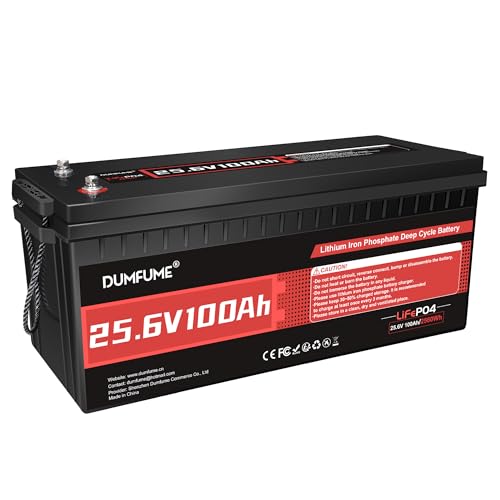
dumfume 24V 100Ah LiFePO4
Badge: Best Overall
Strengths
- Native 24V output delivers 2560Wh from a single case, with no series wiring needed
- Title states Low-Temp Cutoff Protection, so the BMS is documented to intervene against cold charging
- IP65 enclosure and UN38.3 / UL1973 certifications are stated in the title, which suits exposed marine and outdoor mounting
Trade-offs
- It is a 24 volt battery: it cannot serve a 12 volt system without a complete system redesign
- The title does not state a self-heating function, so cutoff protection is a safeguard, not cold-weather charging freedom
- Single-battery capacity is fixed at 2560Wh; larger banks need parallel planning the title does not detail
| Nominal voltage | 24V |
|---|---|
| Capacity | 100Ah / 2560Wh, as stated in the title |
| Chemistry | LiFePO4 (lithium iron phosphate) |
| BMS | 100A built-in BMS |
| Cycle life stated in title | 15000 deep cycles |
| Certifications stated in title | UN38.3, UL1973 |
| Enclosure stated in title | IP65 waterproof |
| Cold feature stated in title | Low-Temp Cutoff Protection |
The dumfume 24V 100Ah is a native 24 volt LiFePO4 battery, and that single fact shapes everything about it. One case delivers 2560Wh, the energy of two 12 volt 100Ah batteries wired in series, but without the balance drift that series pairs can develop over time. The built-in 100A BMS, the UN38.3 and UL1973 certifications named in the title, and an IP65 enclosure rating make it a tidy fit for boats, RVs and off-grid cabinets where the system voltage is genuinely 24 volts and space or wiring simplicity matters.
Its title also states Low-Temp Cutoff Protection. Read that the way an engineer would: the management system is documented to cut charging off when cell temperature falls too low, which is exactly the protection LiFePO4 chemistry needs, because charging below freezing is what damages these cells. It is not a heater and the title does not claim one, so in hard cold you still plan around warming the battery or waiting for the day to warm. As a documented safeguard on a correctly specified 24 volt system, though, it is a meaningful box ticked.
For 24 volt trolling motor fishing, the practical reading of that specification is straightforward: this is a battery whose documented strengths line up with the work, provided the system around it, charger, cabling and mounting, is specified with the same care.
Best for: buyers whose system matches this battery’s documented voltage, class and capacity. / Not suited for: anyone whose core requirement falls outside what its title states.
Qwenoer 22.2V-24V 10Ah Lithium Pack
Badge: Prose-Only: Not a Deep-Cycle Battery
Why prose-only: Prose-only: 10Ah Li-ion project pack for ride-on cars and DIY; its title states no deep-cycle design and no trolling or marine propulsion use.
Strengths
- Comes with its own matched charger, which simplifies small DIY and hobby builds
- Bare leads and a cable connector make it easy to wire into custom projects
- Compact 10Ah size suits ride-on toys, LED strips and camera power, the uses its title actually lists
Trade-offs
- The title does not describe a deep-cycle battery at all; it is a small Li-ion project pack
- 10Ah is far too little capacity for house, trolling or storage duty
- Li-ion chemistry and hobby connectors are a different class from a BMS-managed deep-cycle bank battery
| Nominal voltage | 22.2V-24V range, as stated in the title |
|---|---|
| Capacity | 10Ah, as stated in the title |
| Chemistry | Li-ion (not LiFePO4, per the title) |
| Included in title | 25.2V 2A charger, bare leads wire, cable connector |
| Deep-cycle rating in title | Not stated in the title |
The Qwenoer pack is a small rechargeable Li-ion battery in the 22.2 to 24 volt range, sold with a matched 25.2V 2A charger, bare leads and a cable connector. Its title is refreshingly specific about what it is for: kids ride-on cars, DIY projects, solar panels in the small-project sense, LED light strips and CCTV cameras. For those jobs it is a sensible, self-contained little power source, and the included charger removes the guesswork that project packs often leave behind.
What it is not, by its own title, is a deep-cycle battery. There is no deep-cycle claim, no house-bank capacity and no propulsion duty in the listing: 10Ah of hobby-pack energy is roughly a twenty-fifth of what a 24 volt 100Ah deep-cycle battery stores. In any guide about deep-cycle or high-draw 24 volt work, this pack belongs in the conversation only as a contrast, an example of why the words on the title matter more than a voltage number that looks close at a glance.
In the context of 24 volt trolling motor fishing, weigh the stated figures against your hardest day rather than your average one, because a battery that only just covers the average has already failed the day that matters.
Best for: the different job its title actually describes. / Not suited for: this keyword’s job, for the reason stated above.
Xeanerol 24V 5Ah Lithium Pack
Badge: Prose-Only: Not a Deep-Cycle Battery
Why prose-only: Prose-only: 5Ah Li-ion project pack for RC and CCTV use; not a deep-cycle battery and far below propulsion capacity.
Strengths
- Includes a 2A charger and cable connector, ready for small projects out of the box
- Very compact and light for RC, LED and camera applications
- 24 volt output matches the small devices its title names
Trade-offs
- 5Ah is a hobby capacity, roughly one twentieth of a 100Ah deep-cycle battery
- The title states no deep-cycle design, no BMS rating for bank duty and no propulsion use
- Li-ion project packs are not a substitute for LiFePO4 deep-cycle storage
| Nominal voltage | 24V |
|---|---|
| Capacity | 5Ah, as stated in the title |
| Chemistry | Li-ion (per the title) |
| Included in title | 2A fast charger, cable connector |
| Deep-cycle rating in title | Not stated in the title |
The Xeanerol is a 24 volt, 5Ah rechargeable Li-ion pack with a 2A charger and cable connector in the box, aimed squarely at DIY projects, RC cars, LED light strips and CCTV cameras. For powering a camera through the night or a lighting strip in a small installation, that is a complete and convenient kit, and its small size is the entire point.
Set beside deep-cycle batteries, the gap is not a matter of brand preference but of category. Five amp-hours at 24 volts stores about 120Wh, while a single 24 volt 100Ah deep-cycle battery stores 2560Wh, more than twenty times as much, and is built with a management system and cycle design for daily deep discharge. Nobody should buy this pack to do a deep-cycle job, and no honest roundup should link it as though it could. It appears in these guides as a clearly labelled contrast so the size classes are impossible to confuse.
For 24 volt trolling motor fishing, the honest limitation to plan around is the one named in the trade-offs above; none of them disqualify the battery, but each of them belongs in the installation and charging plan from the start.
Best for: the different job its title actually describes. / Not suited for: this keyword’s job, for the reason stated above.
yeagulch 24V 100Ah LiFePO4
Badge: Best Documented Trolling Fit
Strengths
- Title explicitly names trolling motors, off-grid, solar, RV and marine use, so the application fit is documented
- Native 24V with 2560Wh in one case simplifies wiring compared with a series pair
- Low-temperature cutoff and UN38.3 / UL1973 certifications are stated in the title
Trade-offs
- 24 volt only: useless for a 12 volt system without redesigning the whole system
- Cutoff protection is not self-heating; charging still needs a battery above freezing
- The title does not state an ingress-protection rating for exposed mounting
| Nominal voltage | 24V |
|---|---|
| Capacity | 100Ah / 2560Wh, as stated in the title |
| Chemistry | LiFePO4 (lithium iron phosphate) |
| BMS | 100A built-in BMS |
| Cycle life stated in title | 15000+ deep cycles |
| Certifications stated in title | UN38.3, UL1973 |
| Cold feature stated in title | Low-Tem Cut Off (low-temperature cutoff) |
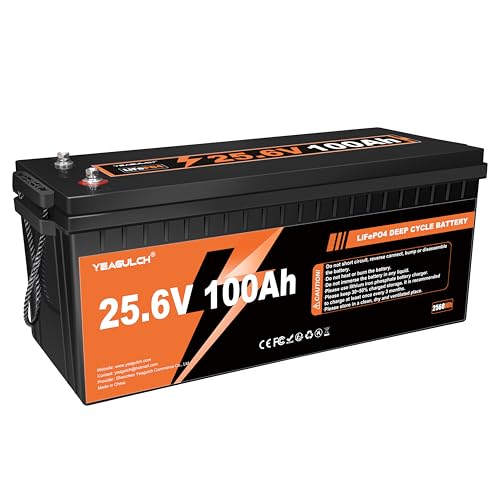
This yeagulch 24 volt battery is one of the clearest application matches in the pool: its title names trolling motors, off-grid storage, solar, RV and marine use outright, and backs the claim with 100Ah of LiFePO4 capacity, 2560Wh of energy, a built-in 100A BMS and a stated cycle life of 15000+ deep cycles. For a 24 volt trolling motor, that combination means long, steady thrust without the voltage sag that makes lead-acid banks feel tired by midday, and for a 24 volt house or solar system it means one case instead of a series pair to balance.
The title also states a low-temperature cutoff and lists UN38.3 and UL1973 certifications. The cutoff is a protective intervention against charging cold cells, not a heating system, so winter users should still treat it as a guardrail rather than a licence. Within its documented envelope, though, this is a purpose-stated 24 volt deep-cycle battery rather than a generic pack pressed into service, and that distinction is exactly what careful buyers should pay attention to.
Judged for 24 volt trolling motor fishing, the question this battery answers is whether its documented class, capacity and protection match the duty; where the title is silent, this guide has said so rather than filling the silence with optimism.
Best for: buyers whose system matches this battery’s documented voltage, class and capacity. / Not suited for: anyone whose core requirement falls outside what its title states.

Dyness 24V 100Ah LiFePO4
Badge: Best for Expanding Systems
Strengths
- Title documents expansion headroom: 4P2S connection up to 20.48kWh for growing systems
- Smart 100A BMS and an explicit deep-cycle, marine, RV and solar application list
- 2560Wh in a single native 24V case keeps wiring and balancing simple
Trade-offs
- The stated 4000+ cycle figure is lower than the 15000-class claims on some rival titles; compare like with like
- The title states no low-temperature cutoff or heating, so cold charging behaviour is undocumented in the title
- Expansion to the maximum system size requires buying multiple units and following the connection scheme exactly
| Nominal voltage | 24V |
|---|---|
| Capacity | 100Ah / 2560Wh, as stated in the title |
| Chemistry | LiFePO4 (lithium iron phosphate) |
| BMS | Smart 100A BMS |
| Cycle life stated in title | 4000+ deep cycles |
| Expansion stated in title | 4P2S connection, up to 20.48kWh |
| Lifetime stated in title | 10-year lifetime |
The Dyness 24V 100Ah is a native 24 volt deep-cycle LiFePO4 battery whose title leads with marine, RV and solar duty and a 2560Wh capacity. Its distinguishing feature is documented expandability: the title states a 4P2S connection scheme reaching up to 20.48kWh, which is the kind of headroom that matters for off-grid cabins, larger boats and solar storage that grows panel by panel. A smart 100A BMS supervises the pack, and the title states 4000+ deep cycles and a 10-year lifetime.
That cycle figure is worth a moment of honesty. Some rival titles claim 15000 cycles, usually at a shallower depth of discharge, while this title claims fewer. Cycle claims are only comparable when the test depth matches, and buyers should treat all of them as maker-condition figures rather than guarantees. What is not in this title is any low-temperature protection claim, so cold-climate charging needs external management. On specification transparency and expansion, though, the Dyness makes a strong, well-documented case.
For 24 volt trolling motor fishing, installation discipline will decide as much as specification: a well-mounted, correctly charged example of this battery will out-serve a neglected example of a nominally better one.
Best for: buyers whose system matches this battery’s documented voltage, class and capacity. / Not suited for: anyone whose core requirement falls outside what its title states.

yeagulch 24V 314Ah LiFePO4
Badge: Best for Longest Days
Strengths
- 8038.4Wh in a single case is the largest capacity in this pool by a wide margin
- A 200A BMS supports heavier continuous loads than 100A-class batteries
- Title names trolling motors, RV, marine, solar, backup and off-grid use, with low-temp protection stated
Trade-offs
- A battery this size is heavy and needs a planned mounting location, not an afterthought
- Capacity this large is wasted on small systems; the charger and cabling must be sized to match
- Low-temp protection is stated without a heating claim, so it should be read as protective cutoff behaviour
| Nominal voltage | 24V |
|---|---|
| Capacity | 314Ah / 8038.4Wh, as stated in the title |
| Chemistry | LiFePO4 (lithium iron phosphate) |
| BMS | 200A built-in BMS |
| Cycle life stated in title | 15000+ deep cycles |
| Certifications stated in title | UL 1973, UN38.3 |
| Cold feature stated in title | Low-Temp Protection |
The yeagulch 24V 314Ah is the heavyweight of this pool in the literal sense: 8038.4Wh of LiFePO4 storage in one case, supervised by a 200A BMS. That is more than three times the energy of a 24 volt 100Ah battery, which changes what a system can do. A 24 volt trolling motor can run for days of typical use between charges, an off-grid cabin can ride through dull weather, and a backup system can carry serious loads through an outage without a generator starting at midnight.
The title supports the big-battery brief with UL 1973 and UN38.3 certifications, a stated 15000+ deep-cycle life and low-temperature protection, and it names trolling motors, RV, marine, solar, backup power and off-grid use directly. The responsibilities that come with it are practical rather than electrical: plan the lift, plan the mounting, and size the charger so that refilling eight kilowatt-hours does not take longer than the weather window you have. For the right 24 volt system, though, nothing else in this pool is in its class.
In 24 volt trolling motor fishing service, treat the title figures as the contract: use what is stated, verify what is not, and let the first season’s commissioning notes confirm whether the match is as good in practice as it is on paper.
Best for: buyers whose system matches this battery’s documented voltage, class and capacity. / Not suited for: anyone whose core requirement falls outside what its title states.
Comparison Table
Only figures stated in the listing titles are compared. Where a title states nothing, the table says so rather than guessing.
| Pick | Voltage | BMS | Cold feature stated in title | Link |
|---|---|---|---|---|
| dumfume 24V 100Ah LiFePO4 | 24V | 100A built-in BMS | Low-Temp Cutoff Protection | Check on Amazon |
| Qwenoer 22.2V-24V 10Ah Lithium Pack | 22.2V-24V range, as stated in the title | Not stated in the title | Not stated in the title | — |
| Xeanerol 24V 5Ah Lithium Pack | 24V | Not stated in the title | Not stated in the title | — |
| yeagulch 24V 100Ah LiFePO4 | 24V | 100A built-in BMS | Low-Tem Cut Off (low-temperature cutoff) | Check on Amazon |
| Dyness 24V 100Ah LiFePO4 | 24V | Smart 100A BMS | Not stated in the title | Check on Amazon |
| yeagulch 24V 314Ah LiFePO4 | 24V | 200A built-in BMS | Low-Temp Protection | Check on Amazon |
For a wider view of the same product family, see Best Lithium Battery For 24 Volt Trolling Motor and Best Marine 12 Volt Battery.
How to Choose: best deep cycle battery for 24 volt trolling motor
Trolling Motor Runtime, Estimated Honestly
Trolling motor questions are runtime questions, and runtime is arithmetic, not folklore. A motor’s draw rises steeply with speed setting: gentle positioning power might sip current, while fighting wind and current at high settings can pull several times as much. The honest way to estimate a day is to take the draw at the settings you actually use, multiply by the hours at each setting, and compare the total amp-hours with the battery’s capacity, remembering that LiFePO4 lets you plan on using most of its stated capacity while lead-acid planning should stay near half.
Voltage is the first gate: a 24 volt motor needs a 24 volt supply, delivered either by a native 24 volt battery or by a documented series pair of 12 volt batteries. Thrust class is the second gate, because bigger motors on bigger boats draw more at every setting. The third gate is the BMS: a motor is a continuous load with start-up surges, and the battery’s BMS rating must cover the motor’s maximum draw with headroom, or the protection will end your day at the worst moment.
Where the titles in this pool name trolling motors explicitly, this guide treats that as documented application fit. Where a title names only marine or general use, the battery may still be entirely suitable on voltage, capacity and BMS grounds, but the guide says plainly that the application is inferred from specification rather than stated. That distinction, stated versus inferred, is the difference between a buying guide and a sales page.
Voltage Architecture: Why 12 and 24 Are Not Interchangeable
Nominal voltage is the architecture of the whole system, not a detail of one battery. Chargers, inverters, solar controllers, trolling motors and DC appliances are all built for a system voltage, and a battery of the wrong nominal voltage does not merely underperform in that system, it does not belong in it at all. A 24 volt battery cannot run 12 volt house loads directly, and a 12 volt battery cannot feed a 24 volt trolling motor. This is why this guide treats voltage as a hard gate and moves wrong-voltage picks to prose-only discussion instead of linking them as alternatives.
There are exactly two legitimate bridges between the classes. The first is building a bank: two matched 12 volt batteries in series make a 24 volt bank, and two in parallel make a larger 12 volt bank, but only where the maker documents series or parallel support, and only with matched units of the same age and specification. The second is conversion hardware: a DC-DC converter can step 24 volts down for a small 12 volt load, which is a deliberate engineering choice with its own cost and losses, not a shortcut around buying the right battery.
If you are designing fresh, the choice between 12 and 24 volts turns on load size and cable runs. Higher voltage halves the current for the same power, which means thinner cables, less voltage drop and happier high-draw equipment. Lower voltage wins on appliance availability and simplicity for small systems. Either choice is defensible; mixing them by accident is not.
How to Set Up and Look After the System
The steps below apply to any battery shortlisted for 24 volt trolling motor fishing. They are written in the order that prevents the common failures: audit before purchase, charger before blame, and a written baseline before the first season ends.
- Measure and audit first. Confirm the system voltage with the equipment the battery must serve, list every load with its draw and daily hours, and measure the battery space including cable bend room. This audit decides capacity, BMS size and case size before any product is chosen, and it takes less than an hour with a notebook and a tape measure.
- Choose the battery and charger together. Select the battery against the audit, then verify the charger: a lithium profile for LiFePO4, a suitable converter or solar controller setting, and enough charging current to refill the bank inside your real window. Ordering the battery before checking the charger is the classic way to build a disappointing system.
- Prepare the mounting. Secure the battery against movement, protect terminals from accidental contact, and plan cable routes away from chafe, heat and water. For heavy single batteries, prepare the lifting route and help in advance. Fit the correctly rated fuse close to the battery before the system is energised, not after the first fault.
- Connect in the right order. Connect the charger and loads with the system off, positive and negative leads landed cleanly and torqued, and bank interconnects, where used, equal in length. Bring the battery to a full charge before its first real duty, so the first cycle starts from a known state and any monitoring baseline is honest.
- Commission with a known load. Run a familiar load, a lighting circuit, a pump, a motor at a working setting, and watch behaviour: runtime against your estimate, charging behaviour, and any protection events. Write the results down in the battery compartment. This baseline is the reference that makes every future troubleshooting conversation factual instead of nostalgic.
- Maintain on a calendar, not on memory. Inspect terminals, mounts and cabling each season, keep the compartment dry, and follow the storage routine for the chemistry through the off-season. Tie the check to an event you never skip, such as winterising or the first trip of spring, because batteries are most often killed by being forgotten, not by being used.
Maintenance, Storage and Troubleshooting
Lithium deep-cycle batteries ask for less maintenance than lead-acid, but less is not none. Terminals should stay clean and tight, the battery and its compartment should be inspected for damage, swelling or water intrusion each season, and firmware-dependent features, where the maker provides them, should be kept current. AGM batteries skip watering by design but still need terminal care and, above all, prompt recharging after use, because lead-acid stored in a discharged state sulfates and loses capacity permanently.
Storage rules differ by chemistry and are worth writing on the compartment wall. Lithium batteries store best partially charged rather than brim-full, in a cool dry place, with a periodic check across a long off-season. AGM batteries store best fully charged, with a maintenance charge across the winter, because self-discharge, stated at 3% in the Renogy title, quietly empties an unattended battery into the damage zone. The most common storage failure in both chemistries is simple forgetting, so tie the battery check to an event you never skip.
When something misbehaves, work the pattern before replacing parts. Problem: the battery stops accepting charge on a cold morning and recovers later in the day. That is a low-temperature cutoff behaving as designed; warm the battery or wait for the compartment to warm, and do not bypass the protection. Problem: runtime has collapsed on a bank that used to last the weekend. Check for a new or faulty load first, then verify the charger is completing its profile, then suspect capacity loss. Problem: a BMS disconnects under motor start or inverter surge. The load is asking for more than the BMS rating; reduce the load or step up to a battery whose title states a higher BMS current.
What the BMS Does, and What the Numbers Mean
Every lithium battery in this pool carries a built-in battery management system, and the amp figure attached to it is one of the most useful numbers in each title. The BMS watches cell voltages, current and temperature, and it disconnects the battery when limits are exceeded. Its continuous current rating sets the ceiling for what the battery can power: a 100A BMS on a 12 volt battery supports roughly 1200W of continuous load before protection intervenes, while a 200A unit doubles that working envelope for larger inverters and heavier motors.
This is why small packs cannot substitute for bank batteries even when their voltage looks right. A 10A or 20A BMS is correctly sized for fish finders, lights and cameras, and it will disconnect, by design, long before a house load or a trolling motor is satisfied. The disconnection is not a fault; it is the protection doing its job. Matching the BMS rating to the largest continuous load, with headroom for motor starts and inverter surges, is as important as matching capacity to the day’s energy.
Smart BMS variants add monitoring and, on the one self-heating model in this pool, app-based visibility of the battery’s state. Monitoring does not change the underlying limits, but it changes how early you see a problem: a battery you can observe is a battery you stop abusing by accident. Whatever the label, treat the BMS as a safety system with opinions, and design the system so those opinions are rarely tested.
Installation, Mounting and Wiring Discipline
Good batteries die early in bad installations. Start with location: the battery should be secured against movement, protected from direct water and road spray beyond its stated rating, ventilated as its chemistry requires, and placed so terminals cannot be shorted by a sliding tool or a loose strap. Only one battery in this pool states an ingress rating in its title, an IP65 claim on a 24 volt model, and even that is splash protection, not permission to mount the battery in a bilge or a wheel well.
Weight planning is part of installation, especially with the large-capacity units. A 300Ah or 314Ah battery is a serious single lift: plan the route, the help and the mounting surface before the battery arrives, and confirm the surface and hold-downs can carry the load in a moving trailer or a pitching boat, not just on a still driveway. Terminal hardware should match the battery, cables should be sized for the BMS current and the run length, and a correctly rated fuse near the battery is not optional decoration.
Finish with a commissioning routine. Charge the bank fully before first real use, run a known load and watch how the system behaves, and record the baseline: runtime, charging time and any protection events. That baseline is what turns a vague feeling that the battery is worse than it was into an actual diagnosis two seasons later. Documentation you write yourself, on paper, in the battery compartment, outperforms memory every time.
Common Buying Mistakes
Buying on voltage alone. A battery that matches your system voltage can still be wrong in capacity, BMS current and duty class. The small packs in this pool prove the point: several carry a plausible voltage in their titles and are built for cameras and toys. Read the whole title, match every core attribute, and only then compare the nice-to-haves.
Sizing for the brochure day. Systems are sized by their hardest honest day: the cold night, the dull solar day, the long trolling session against the wind. A bank chosen for average conditions fails exactly when it is needed most. Build the load list from your worst realistic day, add margin, and let average days be easy.
Running a BMS at its limit. A BMS rating is a ceiling, not a cruising altitude. Systems that draw near the rated current continuously will meet the protection disconnect during a surge, usually at the least convenient moment. Leave headroom, especially with motors and inverters, and treat any unexplained disconnect as the battery correctly reporting an overload.
Believing every number is comparable. Cycle claims, capacity figures and protection labels are stated under maker conditions that differ between brands. A figure missing from a title is not a zero, and a bigger figure is not automatically a better battery. Compare what is actually stated, note what is not, and let documented application fit carry real weight in the decision.
Skipping the tape measure. Group sizes, tray dimensions and terminal positions are unglamorous and decisive. A battery that does not fit the box does not fit the system, whatever its specifications promise. Measure first, including the space the cables need to bend, and check the lift route for the heavy units before the delivery arrives.
Final Recommendation
Start with the first linked pick that matches your system exactly: the dumfume 24V 100Ah LiFePO4. It leads the linked field for 24 volt trolling motor fishing on documented application fit and the completeness of what its title states. If its case size, capacity or protection set does not match your audit, move down the linked list rather than sideways into a prose-only pick, because every prose-only entry in this guide failed a core requirement of the keyword, however good it is at its own job.
Shortlist check: dumfume 24V 100Ah LiFePO4 — Best Overall.
Whichever linked pick you choose, spend the remaining effort on the unglamorous half of the system: the charger profile, the cabling, the mounting and the written commissioning baseline. Batteries in this class rarely fail because their titles lied; they fail because the system around them was never finished. Finish the system, and the battery you bought on evidence will behave like it.
Frequently Asked Questions
How long will a 24 volt 100Ah battery run a trolling motor?
It depends on the speed settings you actually use, because trolling motor draw rises steeply with thrust. At gentle positioning settings the draw can be modest and a 2560Wh battery lasts a very long day; at high settings fighting wind and current, the same battery may give only a few hours. Estimate with your real settings: multiply the draw at each setting by the hours spent there, total the amp-hours, and compare with capacity. Lithium’s usable share makes the arithmetic kinder than the lead-acid estimates many anglers grew up with.
How do I know if a battery’s BMS is big enough for my loads?
Add up the continuous current of everything that can run at once, then check it against the BMS figure in the title with headroom to spare. A 100A BMS on a 12 volt battery supports roughly 1200W of continuous load; motors and inverters also draw start-up surges, so a system that cruises near the limit will trip protection at the worst moments. Small packs with 10A or 20A BMS units are built for electronics, not house loads. If your honest total is anywhere near the rating, step up a class.
Can two 12 volt batteries run a 24 volt system?
Yes, if they are wired in series and the maker documents series connection for that model. Series wiring adds the voltages while capacity in amp-hours stays the same, so two matched 12 volt 100Ah batteries become a 24 volt 100Ah bank. The batteries should be the same model, age and state of charge when connected, which is why matched 2 packs exist. Never improvise series wiring with mismatched units, and never connect a single 12 volt battery to a 24 volt load and hope for the best.
Can you charge a LiFePO4 battery below freezing?
Not safely, and the better batteries in this guide are designed to stop you trying. Charging lithium iron phosphate cells below freezing can plate metallic lithium onto the cells and permanently reduce capacity. That is why titles here state low-temperature cutoff protection: the BMS refuses the charge until the cells warm. A self-heating battery goes one step further and warms its own cells first. If your battery has neither feature stated, treat freezing charging as off limits and warm the battery before charging.
How long will a 100Ah battery run my loads?
Divide and conquer. A 100Ah battery in the 12 volt class stores about 1280Wh where the title states it. Add your loads in watts: lights, pump, electronics and fans in a modest setup might total 80 to 150W at any moment, which arithmetic turns into roughly eight to sixteen hours of continuous equivalent use, and real evenings use loads intermittently. Lithium lets you plan on using most of the stated energy; AGM planning should stay near half the nominal figure. Your load list, not a brochure, gives the real answer.
How should a deep-cycle battery be stored over winter?
By chemistry. Lithium batteries store best partially charged, in a cool dry place, checked occasionally across the off-season. AGM batteries store best fully charged with a maintenance charge, because self-discharge, stated at 3% in the Renogy title, will otherwise walk an unattended battery down into permanent damage. Both chemistries suffer most from simple neglect. Write the storage state and date on a label on the battery itself; future you, standing in a cold compartment in spring, will be grateful.