Disclosure: topratedkitchenware.com is reader-supported. When you buy through links on our site, we may earn an affiliate commission from Amazon and other retailers, at no extra cost to you.
Where to buy
The best handheld can openers are the ones that live in a drawer and work anywhere: no base, no cord, no countertop claimed. In the verified pool for this guide, three picks are true handheld designs — cordless or battery powered rim-riders that you place on the can by hand — and they are linked below. The other three are capable countertop appliances, profiled in prose as the stationary alternative, because a guide to handheld tools should only link tools you can actually hold in your hand.
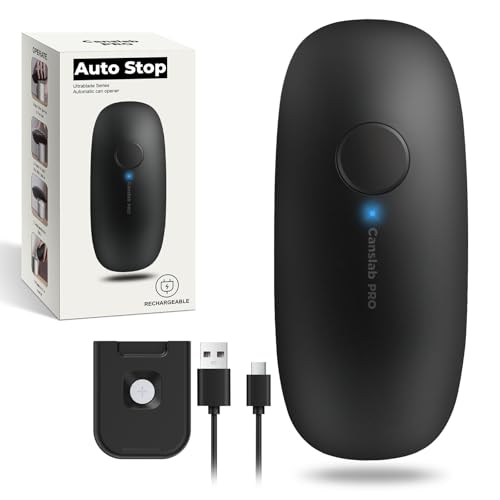
- Canslab Ultrablade PRO Electric Can Opener, USB Rechargeable, Cordless — Check on Amazon
- Kitchen Mama Auto Electric Can Opener, Battery Operated, Red
- KITCHENMUH One Touch Electric Can Opener, Battery Operated, Fits All Can Sizes
- Amazon Basics 3-In-1 Electric Can Opener — profiled in prose below (corded countertop appliance)
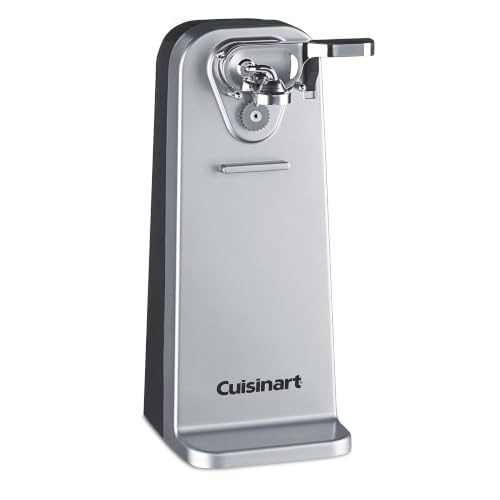
- Cuisinart Deluxe Electric Automatic Can Opener, CCO-50BKN — profiled in prose below (countertop appliance)
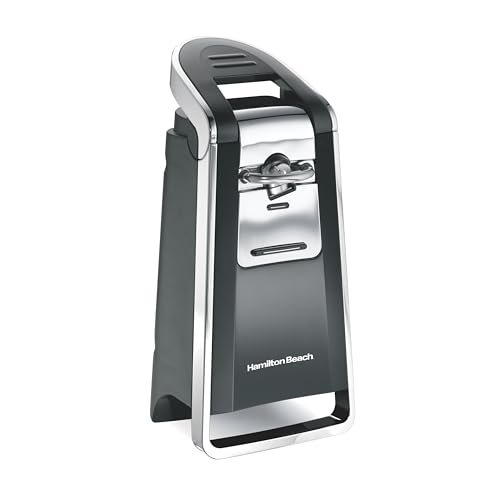
- Hamilton Beach Smooth Touch Electric Can Opener, 76606AG — profiled in prose below (countertop appliance)
Read the full guide ↓ for the head-to-head between the three handheld designs, the case for the countertop stations, and the technique that keeps a handheld cut clean.
The best handheld can openers solve a problem of place, not of power. A can opener bolted by its cord to one corner of the kitchen decides where every can in the house gets opened: at that corner, whether the cook is there or not, whether the bowl is there or not, whether the pet’s dish is anywhere near it or not. A handheld opener dissolves that geography. It lives in a drawer, comes out in one hand, sits on the can wherever the can is standing — pantry, island, feeding corner, picnic table, caravan — and goes back in the drawer when the lid is off. The counter stays clear, the outlet stays free, and the tool never becomes the thing guests have to work around when they are helping in your kitchen.
This guide compares the three verified handheld electric openers in the pool — the rechargeable Canslab Ultrablade PRO, the battery powered Kitchen Mama, and the battery powered KITCHENMUH — and profiles the three countertop models in prose, fairly, because for a fixed-station kitchen they may be the better buy. Along the way it covers the choice between charging and batteries, what a handheld listing does and does not promise, the cleaning routine that keeps rim-riding wheels honest, and the mistakes that turn a good handheld tool into a drawer disappointment. If effort rather than place is your main concern, Best Handicap Can Openers ranks this same design family by ease alone, and Best Inexpensive Battery Operated Can Openers takes the running-cost view.
Key Takeaways
- Handheld means cordless and base-free: in this pool, the Canslab (USB rechargeable, cordless, wall mountable), the Kitchen Mama (battery operated), and the KITCHENMUH (battery operated) qualify; the corded and standing models are profiled in prose.
- All three linked picks also state a smooth edge, so portability and finger-safe lids come together in this shortlist.
- The real choice among the three is the power routine: USB recharging, or replaceable batteries with spares in the drawer.
- Handheld openers ask two things in return: a reasonably intact rim to ride, and wheels kept clean.
- A countertop station still wins for long batch runs at one fixed place; choose the format your kitchen geography demands.
In this guide
Quick Picks
| Pick | Badge | Handheld? | Link |
|---|---|---|---|
| Canslab Ultrablade PRO Electric Can Opener | Best Overall Handheld | Yes — USB rechargeable, cordless, handsfree side cut with smooth edge, wall mountable | Check on Amazon |
| Kitchen Mama Auto Electric Can Opener, Red | Best Handheld for Simplicity | Yes — battery operated, automatic, hands free, smooth edge, food-safe | Check on Amazon |
| KITCHENMUH One Touch Electric Can Opener | Best Handheld for All Sizes | Yes — battery operated, one touch, smooth edge, fits all can sizes, for seniors with arthritis | Check on Amazon |
| Amazon Basics 3-In-1 Electric Can Opener | Prose-Only: Multi-Tool Station | No — corded 50W countertop appliance with bottle opener and knife sharpener | Profiled in prose |
| Cuisinart Deluxe CCO-50BKN | Prose-Only: Washable-Lever Station | No — standing countertop appliance, single-touch, removable lever | Profiled in prose |
| Hamilton Beach Smooth Touch 76606AG | Prose-Only: Big-Lever Station | No — standing countertop appliance, push down lever, standard to extra-tall cans | Profiled in prose |
Notice what the badges reward: not cutting drama, but fit. The best handheld opener is the one whose power routine, storage habit, and stated fit claims match the household that will use it twice a day. The profiles below are written to expose exactly those matches and mismatches, including the honest cases where the right answer is one of the stationary machines.
How These Picks Were Chosen
This guide is research-led, built from verified Amazon listing data rather than hands-on lab testing. A pick qualified as handheld only if its listing title evidences the format: a battery or rechargeable power source, cordless or hands free rim-riding operation, and no standing base or corded wattage. The Canslab states USB rechargeable, cordless, and wall mountable; the Kitchen Mama states battery operated and hands free; the KITCHENMUH states battery operated and one touch. The Amazon Basics states a corded wattage, and the Cuisinart and Hamilton Beach listings describe standing countertop appliances with levers — all three are therefore profiled in prose, without links or images, however strong their other merits.
Within the handheld three, ranking weighs the daily ritual in order: seating and starting effort, the stated edge and what it does to the lid, the stated size fit, and the power routine. Every specification in the mini spec boxes comes from the listing titles alone, and where a title is silent — about auto stop, about lid magnets — the review says so. No prices and no fixed ratings appear anywhere in this guide; both change too often to print honestly, and the listing carries the current figure.
The 3 Best Handheld Can Openers — and 3 Countertop Stations Profiled in Prose

Canslab Ultrablade PRO Electric Can Opener, USB Rechargeable
Badge: Best Overall Handheld
Strengths
- Cordless and USB rechargeable per the listing: the fullest expression of the handheld format here.
- Handsfree side cut with a stated smooth edge, plus a stated smart auto stop for clean endings.
- Wall mountable, a storage option no drawer-only rival in this list can claim.
Trade-offs
- No magnetic lid hold is stated, so the cut lid rests in place until you lift it by its face.
- Side cutting reads the rim’s outer wall and can refuse a badly crushed can.
- Rechargeable discipline applies: a unit stored flat is a unit that fails on cue.
Mini spec box
- Type: Electric can opener, handheld
- Power: USB rechargeable, cordless
- Cut: Side cut, smooth edge, handsfree
- Stop: Smart auto stop
- Storage: Wall mountable
- Colour: Black
The Canslab Ultrablade PRO is the handheld format with every box ticked in its own listing: cordless power over USB, a handsfree side cut, a stated smooth edge, a smart auto stop, and even a wall mount for kitchens that store vertically. In the hand it is a tool you carry to the work. Seat it on the rim, start it, and it walks the circuit while your hands stay free — to hold the bowl, steady a light can, or simply rest. The auto stop is the detail that grows on you: handheld cuts end quickly, especially on small cans, and a tool that recognises completion and stops itself never chews a rim or strains against a finished seam. The smooth side cut leaves a lid that lifts off as a blunt disc and can be set back on the can as a cover, which makes the fridge routine noticeably tidier.
The listing also positions the Canslab for seniors with arthritis, and in handheld terms that positioning makes sense: there is no grip-and-turn anywhere in its operation, no lever to hold down, and no can to lift to a machine. Who it suits: households that want the most complete handheld feature set, cooks who re-cover cans, and anyone whose storage is a wall rather than a drawer. The honest limitation is rim dependence, shared by every side-cut design, plus the absence of a stated lid magnet — the lid stays put after the cut, which is tidy, but it is your fingers that lift it. For the effort-first view of this same model, see Best Handicap Can Openers.
Best for: the complete handheld package — cordless, auto stop, smooth edge / Not suited for: crushed rims or buyers who want a stated lid magnet

Kitchen Mama Auto Electric Can Opener, Battery Operated, Red
Badge: Best Handheld for Simplicity
Strengths
- Battery operated and hands free per the listing: the shortest ritual in the category — place, press, lift.
- Smooth edge stated, so the portable format does not cost you the finger-safe lid.
- Food-safe positioning stated, and the red body is easy to find in a crowded drawer.
Trade-offs
- Replaceable batteries are the running cost; the tool is only as ready as its spares drawer.
- No auto stop and no size-range claim are stated in the listing title.
- Power fades gradually with battery age, so late-cycle cuts on old cells can feel tired.
Mini spec box
- Type: Auto electric can opener, handheld
- Power: Battery operated
- Edge: Smooth edge
- Operation: Automatic, hands free
- Colour: Red
The Kitchen Mama is the handheld opener for people who do not want to think about their can opener. Its listing promises an automatic, hands free, smooth-edge cut from battery power, and the lived experience matches the brevity: the tool comes out of the drawer, sits on the can, walks the rim, and the blunt lid lifts away. There is no cable to coil, no mount to install, no station to wipe down. In a rental, a caravan, a student’s first kitchen, or a grandparent’s drawer, that absence of infrastructure is the feature. The red finish, easy to dismiss as decoration, is practical in a utensil drawer: the tool you can see is the tool you use.
Who it suits: low-frequency and medium-frequency openers, gift buyers, and anyone equipping a kitchen from scratch who wants the can problem solved in one purchase. The honest limitation is the battery economy in its plainest form. Batteries fade gradually rather than failing suddenly, which means the tool’s worst cuts happen in the weeks before you finally swap the set; disciplined households swap on a schedule or at the first sign of slowing, and keep the spares where the tool lives. The running-cost arithmetic of that habit is laid out in Best Inexpensive Battery Operated Can Openers, which treats batteries as the budget line they are.
Best for: the simplest possible handheld ritual / Not suited for: high-volume daily opening or battery-free households

KITCHENMUH One Touch Electric Can Opener, Battery Operated
Badge: Best Handheld for All Sizes
Strengths
- The broadest stated fit in the handheld set: fits all can sizes, per the listing.
- One touch start and a stated smooth edge, positioned explicitly for seniors with arthritis.
- Battery operated and food safe per the listing, in a neutral black and grey finish.
Trade-offs
- Shares the battery routine and its spares habit with the Kitchen Mama.
- No auto stop and no magnetic lid hold are stated in the listing title.
- One-touch buttons can be pressed accidentally if the tool is stored loose and jostled.
Mini spec box
- Type: Electric can opener, handheld
- Power: Battery operated
- Edge: Smooth edge
- Operation: One touch, automatic
- Fit: Fits all can sizes
- Colour: Black and grey
The KITCHENMUH’s listing is a small masterpiece of saying the quiet parts out loud: one touch, all can sizes, smooth edge, food safe, and an intended audience of seniors with arthritis. For a handheld tool, the all-sizes claim is the one that decides whether it can be the household’s only opener. Handheld tools earn their drawer by replacing the station, and a station-replacement that balks at the big Sunday tin has failed at its one job. This one’s stated fit says it will not balk. The one-touch start removes the last grip task from the sequence, and the smooth edge removes the sharp lid from the hands least able to manage one — a pairing that is not a coincidence but a design brief, aimed at exactly the users who benefit most from the handheld format.
Who it suits: mixed-size households standardising on one portable tool, buyers shopping for arthritic hands, and anyone who reads stated claims as the contract they are. The honest limitations mirror its battery sibling: no stated auto stop, no stated lid magnet, and a dependence on battery freshness that a spares habit solves. Store it with the button protected — a pouch, a box corner, or simply button-up in the drawer — and the accidental-start quirk disappears. Buyers comparing domestic and heritage brands in this space sometimes start from Best Made American Made Can Openers; the honest note is that none of the listings in this pool makes an origin claim, so this guide ranks them on stated function alone.
Best for: one handheld tool for every can size, arthritis-friendly / Not suited for: buyers who want auto stop or a stated lid magnet
Amazon Basics 3-In-1 Electric Can Opener — Profiled in Prose
Badge: Prose-Only: Multi-Tool Station
Strengths
- Three stated functions — can opener, bottle opener, knife sharpener — in one corded body.
- Stainless steel blade and magnetic lid holder stated in the listing.
- Stated 50W corded power that performs identically on every can of a long run.
Trade-offs
- Corded and countertop-bound: the definition of not handheld.
- No smooth-edge claim is stated in the listing title.
- Its bulk must be justified by use; an occasional opener will not justify it.
Mini spec box
- Type: 3-in-1 electric can opener, bottle opener, knife sharpener
- Blade: Stainless steel
- Lid: Magnetic lid holder
- Power: 50W, corded
- Colour: Black
Every format debate needs its strongest opposing example, and in this pool the Amazon Basics 3-In-1 is it. It does three jobs, does them on unlimited corded power, holds the lid magnetically, and asks only for a permanent home and an outlet. A batch-cooking household that opens a dozen cans at one station, sharpens the knives it cooks with, and opens bottles at the same counter will find it more useful than any handheld tool in this guide — and should buy it without a flicker of doubt. It is profiled in prose for one reason: this article’s title promises handheld openers, and a corded block of an appliance is not one, whatever its virtues. Honest guides keep their titles honest; the product loses nothing by being described as what it is.
Best for: fixed-station batch work with bonus tools / Not suited for: the handheld brief itself
Cuisinart Deluxe Electric Automatic Can Opener, CCO-50BKN — Profiled in Prose
Badge: Prose-Only: Washable-Lever Station
Strengths
- Single-touch automatic operation and a stated magnetic lid holder.
- Removable activation lever stated — the cutting head lifts off for a proper wash.
- Positioned for seniors in its listing, reflecting calm, low-effort operation.
Trade-offs
- A standing countertop appliance; cans travel to it, not the other way round.
- No smooth-edge claim is stated in the listing title.
- Light cans want a steadying hand while the cutter bites.
Mini spec box
- Type: Electric automatic can opener, countertop
- Operation: Single-touch
- Lid: Magnetic lid holder
- Lever: Removable activation lever
- Colour: Black
The CCO-50BKN is the station for people who think about hygiene: its removable activation lever means the part that touches every can can be washed like a utensil, and its single-touch operation with a magnetic lid holder makes the opening itself nearly effortless. In a settled kitchen where cans are opened at one counter by one routine, it is a deeply civilised tool. Its presence in the prose section is purely taxonomic — it stands, therefore it is not handheld — and readers whose kitchens are settled should treat this profile as a recommendation wearing a label, not a rejection. The label exists so that readers whose kitchens are not settled are not misled into a format their lives will fight.
Best for: a washable, low-effort fixed station / Not suited for: the handheld brief itself
Hamilton Beach Smooth Touch Electric Can Opener, 76606AG — Profiled in Prose
Badge: Prose-Only: Big-Lever Station
Strengths
- Easy push down lever stated: the most forgiving control in this pool, worked by palm pressure.
- States coverage of all standard, extra-tall and pop-top cans — the widest size claim here.
- A planted, substantial body that suits long, repetitive sessions at one station.
Trade-offs
- A standing countertop appliance with the largest footprint in this pool.
- No smooth-edge claim and no magnetic lid holder are stated in the listing title.
- Its size talents point at standard and tall cans, not at portability or small tins.
Mini spec box
- Type: Electric can opener, countertop
- Operation: Easy push down lever
- Can range stated: All standard, extra-tall and pop-top cans
- Finish: Black and chrome
- Model: 76606AG
The Hamilton Beach closes the prose profiles as the station’s station: a big-levered, black-and-chrome appliance whose stated business is range — standard cans, extra-tall cans, pop-top cans — handled from one planted position. Households feeding a crowd, stocking a pantry with catering tins, or running a small café counter will recognise it as the right shape of tool. It is also the clearest illustration of why this guide separates format from quality: nothing about its prose status is a criticism. It is a good answer to “what should stand on my counter,” filed honestly inside an article answering “what should I hold in my hand.” Readers whose real question is the first one have their answer here; readers whose question is the second have the three linked picks above.
Best for: wide can range at a fixed, high-volume station / Not suited for: the handheld brief itself
Comparison Table
| Pick | Format | Power | Edge stated | Status here | Link |
|---|---|---|---|---|---|
| Canslab Ultrablade PRO | Handheld, wall mountable | USB rechargeable, cordless | Side cut, smooth edge | Linked | Check on Amazon |
| Kitchen Mama Auto | Handheld | Battery operated | Smooth edge | Linked | Check on Amazon |
| KITCHENMUH One Touch | Handheld | Battery operated | Smooth edge | Linked | Check on Amazon |
| Amazon Basics 3-In-1 | Countertop | 50W corded | Not stated | Prose only | — |
| Cuisinart CCO-50BKN | Countertop | Electric, single-touch | Not stated | Prose only | — |
| Hamilton Beach 76606AG | Countertop | Electric, push down lever | Not stated | Prose only | — |
Read the format column first, and read it as a description of your own kitchen rather than of the products, because the column only becomes useful when it is matched against the places your cans actually get opened each week.
Read the format column first. In this category, format is destiny: it decides where the tool lives, where the cans get opened, and whether the counter stays clear. The other columns refine a decision the format column has already made.
How to Choose a Handheld Can Opener
Map your opening locations before you look at a single product. If cans are opened in one place, at one counter, beside one outlet, the stationary profiles in this guide are legitimate finalists and the handheld premium buys you nothing. If cans are opened in two or more places — or if the counter is too small to surrender — the handheld three are your shortlist and the only remaining questions are about power and fit.
The power question is a household-routine question. USB recharging, as on the Canslab, suits homes that already maintain a charging corner and dislike consumables; it also pairs with wall mounting for a tool that is always in the same visible place, charged by habit. Replaceable batteries, as on the Kitchen Mama and KITCHENMUH, suit homes that would rather restore a tool instantly at any hour than remember a cable; the price of that forgiveness is a spares habit and a gradual fade as cells age. Be honest about which household you are. The wrong routine, faithfully resented, is the main reason good handheld tools end up abandoned in drawers.
The fit question is about stated claims. The KITCHENMUH states all can sizes; the Canslab and Kitchen Mama make no size claim in their titles, which does not make them small-can tools — rim-riders are largely indifferent to can height — but if your household opens genuinely varied cans and wants the promise in writing, the stated claim is the tiebreaker. The edge question, happily, answers itself in this pool: all three linked picks state a smooth edge, so the handheld choice here never costs you the finger-safe lid. Finally, the rim question: every handheld in this guide rides the rim, so a household whose cans arrive chronically dented should keep a top-cut backup and let the handheld tool handle the round majority.
One last piece of choosing advice: buy the handheld for the hands that will use it most, not the hands that visit. If the daily opener in the house is a grandparent, a partner with grip pain, or a teenager, their comfort with the start control and the weight of the tool in the hand outranks every other preference in the house, including yours. The linked three all start with a touch rather than a squeeze, which is why they serve mixed households well; the deciding test is simply which ritual the daily user finds calmest.
How to Use a Handheld Can Opener: Technique, Cleaning, and Troubleshooting
The technique is a calm five-beat ritual. Give the can a flat, dry place to stand. Wipe a wet or oily rim. Seat the tool squarely on the rim — this is the beat that decides the cut, because a tilted start makes the wheel ride above the seam and wander. Press the control once, and then let the tool walk the circuit alone, cupping a light can loosely so it does not rotate with the tool. When the circuit completes, lift the lid by its face; on a side-cut model like the Canslab, the lid can go straight back on as a cover if the can is headed for the fridge.
- Stand the can on a dry, flat surface and wipe the rim.
- Seat the tool squarely on the rim before starting; never start tilted and correct mid-cut.
- Press once and let the tool travel without steering or pushing.
- Support light cans loosely from the side during the first moments.
- Lift the lid by its face, wipe the wheels, and return the tool to its drawer or mount.
- Keep the power routine attached to the storage spot: spares in the drawer, or the mount near the charging cable.
Cleaning is the handheld format’s only real chore, and it is a small one. The cutting and traction wheels grip the rim under pressure; dried residue from tomato, tuna, or pet food changes that grip and is the hidden cause of most wandering cuts and stalls. Wipe both wheels with a damp cloth after messy cans, use a soft brush weekly in daily use, and never immerse a powered unit or run it under a tap. Let the tool dry before it goes back in the drawer. Battery contacts benefit from an occasional glance, and a rechargeable unit stored with some charge in it will age far more gracefully than one stored flat.
Troubleshooting, in the pattern that covers most handheld problems:
- Problem: the tool travels but the lid stays attached → the start was tilted and the wheel rode above the seam. Reseat squarely on a clean arc and run a fresh circuit rather than retracing the old track.
- Problem: the cut stalls at the same point every time → a dent in the rim at that point, or fading power. Rotate the can so the dent falls at the end of the cut, and fit fresh batteries or a charge before blaming the tool.
- Problem: the can spins with the tool → a wet base or a very light can. Dry the surface, stand the can on a cloth for grip, and cup it loosely as the cut starts.
The Handheld Drawer: Storage, Travel, and Second Kitchens
A handheld opener changes the kitchen’s storage map. The countertop it frees is the obvious win, but the subtler one is that the tool stops living in the splash zone. A drawer-kept opener sits in the clean and the dark, emerging only for the minutes it works, and its body ages accordingly. The Canslab’s stated wall mountability offers the other storage philosophy — visible, vertical, always in the same place — which suits households whose drawers are already at war. Either way, attach the power routine to the storage: the drawer that holds a battery tool should hold its spares, and the mount that holds a rechargeable tool should live within reach of its cable.
Travel is where the format stops being a preference and becomes a capability. A handheld opener works in a caravan, a boat galley, a holiday rental, a festival catering tent, and a relative’s kitchen, with no installation and no outlet negotiation. For people who cook away from home regularly — carers, caterers, adult children who cook at a parent’s house — carrying the familiar tool is carrying the familiar routine, including its low effort and its smooth lids. No countertop appliance in the prose profiles can make that trip, and for some households that single fact settles the format debate before features are even compared. The value side of equipping a second kitchen cheaply and well is the territory of Best Inexpensive Can Openers.
Handheld Openers When Someone Else Does the Cooking
There is a household pattern this format serves better than any other, and it rarely appears in product marketing: the kitchen where cooking is shared, deputised, or done by someone visiting. The adult child who cooks Sunday lunch at a parent’s house, the carer who prepares meals in three different homes a week, the partner whose own kitchen is a studio but who does most of the cooking at the family home — all of them face the same low-grade friction of unfamiliar tools in unfamiliar drawers. A handheld opener carried in a bag ends that friction for one whole category of task. It is the same tool, with the same ritual, in every kitchen; it needs no outlet, no permission to rearrange a counter, and no learning curve at each new house.
The same logic applies inside one home when the household changes shape: a teenager learning to cook, a grandparent moving in, a lodger joining. A drawer tool is easy to teach — seat it, press, let it walk, lift the blunt lid — and its smooth-edge output is forgiving of beginners’ hands in a way that a top-cut station’s sharp lid is not. Households that standardise on one handheld opener often find the standardisation itself is the benefit: one tool, one ritual, one place it lives, understood by everyone who cooks. That is a quieter virtue than any single feature in the spec boxes, and for busy shared kitchens it is frequently the deciding one.
What Handheld Openers Cannot Do
Honesty about a format includes its hard edges, and handheld openers have three. The first is the crushed rim, already covered in the troubleshooting section: a rim-riding tool reads the rim, and a rim that has been folded by a fall or a transit accident gives it nothing true to read. The second is volume with variety: a long session of mixed cans — some round, some tired, some with labels glued over the rim — is simply smoother at a top-cut station, whose blade bites through the top regardless of what the rim’s outer wall looks like. The third is institutional forgetfulness: a handheld tool’s power is a routine, and a household that cannot keep any routine will experience the format as unreliable, when in fact it is the routine that failed, not the tool.
None of these is an argument against the format; they are the boundaries inside which it is excellent. The mature way to equip a kitchen is to let the handheld tool own the ninety percent of cans that arrive round and ordinary, and to keep some humble backup — a basic manual opener in the back of the drawer costs almost nothing and asks nothing — for the crushed, the torn-labelled, and the day the batteries and the charge both run out together. Kitchens equipped that way stop thinking about can opening entirely, which is the highest praise any of these tools, in any format, can earn. Readers researching the manual backup itself will find the retail-side comparison in Best Manual Can Openers At Bed Bath And Beyond useful for what to look for on a shelf.
Equipping Two Kitchens: The Second-Home Problem
A surprising number of handheld buyers are really solving a duplication problem. The main kitchen already has an opener that works; what they need is the second one — for the caravan, the cabin, the boat, the office kitchenette, the parent’s house, the rental they manage. Duplicating a countertop station means duplicating its costs in space and installation, and the second kitchen rarely has either to spare. Duplicating with a handheld tool means a drawer slot and a power routine, which is why the format dominates second kitchens even among households that prefer a station at home. The two linked battery models suit the rarely used second kitchen particularly well if the batteries are stored separately and fitted on arrival, since a tool that sits for months is kinder to fresh cells than to a charge it was left holding.
The second-kitchen lens also clarifies the fit question. Away from home, can sizes are whatever the nearest shop stocks, and the cook has no backup tool in the next drawer. A stated all-sizes fit, like the KITCHENMUH’s, is worth more in a caravan than in a settled kitchen, and a smooth edge is worth more in a boat galley or a festival tent, where the bin is a bag and the first aid kit is in another vehicle, than it is beside a domestic sink. Judge the second-kitchen tool by the cost of failure away from home, not by the standards of the kitchen that has everything.
There is one more handheld virtue that only appears after months of ownership: the tool decouples can opening from the kitchen’s busiest square metre. At a crowded hob, with pans moving and people reaching across, the can that needs opening always seems to be needed at the worst moment and in the worst place. A handheld opener lets that can be opened at the quiet end of the counter, at the table, or in the pantry doorway, out of the traffic entirely. Cooks who entertain feel this first; parents cooking with children underfoot feel it daily. It is a small freedom, but it is the kind that gets used every single day, which is more than can be said for most headline features.
Common Buying Mistakes
- Confusing compact with handheld. A small countertop appliance still has a base and a cord; handheld means cordless, base-free, and held in the hand.
- Choosing the power routine you wish you kept. Buy for the household you are: chargers should buy rechargeable, battery-drawer households should buy swappable.
- Steering the tool mid-cut. Rim-riders are built to walk alone; helping hands cause the ragged cuts they are trying to prevent.
- Ignoring rim condition. Chronically dented cans defeat rim-riding designs; keep a top-cut backup for them instead of blaming the daily tool.
- Storing the tool dirty. Residue on the wheels is the hidden cause of stalls and wandering cuts; the wipe takes seconds.
- Expecting unstated features. If auto stop or a lid magnet matters to you, buy a listing that states it — in this pool, only the Canslab states an auto stop, and none of the handheld three states a lid magnet.
Final Recommendation
For the handheld brief in full, start with the Canslab Ultrablade PRO (Check on Amazon): cordless USB power, a handsfree side cut with a stated smooth edge, a smart auto stop, and wall-mountable storage make it the most complete handheld design in this pool. If your household runs on replaceable batteries and wants the broadest stated fit, choose the KITCHENMUH One Touch (Check on Amazon), and if you want the simplest ritual of all, the Kitchen Mama is the drawer tool that asks for nothing but a press. Choose a prose-profiled station instead only if your kitchen geography is genuinely fixed — and then choose it gladly, because format honesty, not format fashion, is what this guide has been arguing for throughout.
Frequently Asked Questions
What makes a can opener handheld rather than countertop?
Three things: it is held in the hand and placed on the can, it has no standing base, and it carries its power with it — batteries or a rechargeable cell — instead of a cord. If a listing states a wattage, describes a lever on a standing body, or needs an outlet, the tool is a countertop appliance however compact it looks in photographs.
Are handheld electric openers as strong as countertop models?
Can opening is light work, and the handheld motors in this guide are built for exactly it; in daily use the limiting factor is almost never strength but rim condition and wheel cleanliness. Where countertop models genuinely pull ahead is endurance across very long batch runs, because corded power never fades — a workload most households simply do not have.
Do handheld openers work on large cans?
Rim-riding designs are largely indifferent to can height, since the tool rides the rim rather than accommodating the can’s body — one of the format’s quiet advantages. The KITCHENMUH in this guide states it fits all can sizes. Very wide cans still need a stable surface and a loose supporting hand, but height alone is no obstacle.
How do I keep a handheld opener cutting cleanly?
Keep the wheels clean and the power fresh; those two habits cover nearly everything. Wipe the cutting and traction wheels after messy cans, brush them weekly in daily use, and swap batteries or top up the charge at the first sign of slowing rather than the first failure. A tool that starts every cut clean and fully powered rarely wanders or stalls.
Can a handheld opener open a dented can?
A minor dent on an otherwise round rim is usually manageable: start on a clean arc and let the dent fall at the end of the circuit. A crushed or folded rim gives the wheels nothing true to read, and that can belongs to a top-cut station or a manual opener. Most households find such cans rare enough to treat as exceptions rather than buying criteria.
Is a handheld opener a sensible buy for a keen batch cook?
As the only opener, usually not; as the second opener, often yes. Batch cooking concentrates opening into long runs at one station, which is corded countertop work, and a handheld tool in that session is a guest star. But the same cook’s ordinary weeks — a tin here, a pet can there, a can at the caravan — are handheld work, and owning both formats, each where it belongs, is the arrangement serious home cooks tend to settle into. Buy the station for the marathon and the handheld for the everyday, in whichever order your calendar demands.
Where do handheld openers get stored?
Either in a drawer near where cans are opened, or — for designs that state it, like the Canslab — on a wall mount. The principle is to store the power routine with the tool: spare batteries in the same drawer, or the mount within reach of the charging cable. Stored clean, dry, and powered, a handheld opener is ready in the seconds its format promises.