Disclosure: topratedkitchenware.com is reader-supported. When you buy through links on our site, we may earn an affiliate commission from Amazon and other retailers, at no extra cost to you.
Where to buy
This guide to the best high end 30 gas cooktops starts with an honest warning that shapes everything below: of the six products in the verified research pool for this keyword, exactly one is actually a 30-inch gas cooktop. The other five are capable products in their own categories — four portable induction burners and one 36-inch gas cooktop — but they do not match the core promise of this search, so they are reviewed in full as prose-only entries with no sales link and no product photo. That way you can see what the market actually offers, understand why the mismatches matter, and avoid buying the wrong fuel type or the wrong width by accident.
- VEVOR Gas Cooktop 30 Inch 5 Burners — Best Overall and the only true 30-inch gas match in this pool. Built in, five burners, natural gas and LPG convertible.
- ThermoMate Heavy 36 Inch Gas Cooktop — Best 36-Inch Alternative (prose-only: a genuine gas cooktop, but 36 inches wide, not 30).
- Nuwave Pro Chef Induction Cooktop — Best Precision Portable Alternative (prose-only: induction, not gas, and a single portable burner).
- ISILER 1800W Portable Induction Cooktop — Best Compact Portable Alternative (prose-only: induction, not gas).
- Duxtop 1800W Portable Induction Cooktop Gold 8100MC — Best Established Portable Alternative (prose-only: induction, not gas).
- Duxtop Portable Induction Cooktop Silver 9600LS — Best Touch-Control Portable Alternative (prose-only: induction, not gas).
Read the full guide ↓ for the detailed reviews, the comparison table, and the sizing and gas-safety guidance that matters far more than any badge.
A 30-inch gas cooktop is the workhorse format of the American kitchen. It fits the standard cabinet opening found in most homes, it gives you four or five burners without demanding the wider cutout and deeper budget of a 36-inch model, and gas still offers the immediate, visible, infinitely adjustable flame that many serious home cooks refuse to give up. When people search for the best high end 30 gas cooktops, they usually want three things at once: burners that can both sear hard and hold a gentle simmer, a build that feels substantial rather than tinny, and controls that respond the instant you turn a knob. This guide works through those priorities in order, and it is frank about a problem you will meet across the whole category: search results for gas cooktops are heavily polluted with portable induction burners, which are electric, single-burner, countertop appliances. They can be excellent tools, but they are not gas cooktops, and no honest guide should present them as if they were.
Key Takeaways
- Only one of the six researched products — the VEVOR 30-inch five-burner — actually matches the keyword’s core attributes of 30 inches, gas fuel and built-in format, so it is the only linked recommendation in this guide.
- Width is a hard constraint, not a preference: a 36-inch cooktop such as the ThermoMate will not fit a 30-inch cutout, and no trim kit changes that safely.
- Fuel type is equally hard: every induction model in this pool is electric and portable, needs induction-compatible pans, and offers a completely different cooking feel from flame.
- For a genuine high-end 30-inch gas brief, judge burner layout, simmer quality, grate material and ignition reliability before cosmetic finishes.
- Convertible natural gas / LPG designs add flexibility for homes that may move between mains gas and bottled propane.
- Measure your existing cutout, not the old cooktop’s top surface, before ordering any replacement.
In this guide
Quick Picks
| Pick | Badge | Format | Fuel | Link |
|---|---|---|---|---|
| VEVOR Gas Cooktop 30 Inch 5 Burners | Best Overall — True 30-Inch Gas Match | 30-inch built-in, 5 burners | Gas, NG/LPG convertible | Check on Amazon |
| ThermoMate Heavy 36 Inch Gas Cooktop | Best 36-Inch Alternative | 36-inch built-in, 5 burners | Gas, NG/LPG convertible | Prose-only — no link |
| Nuwave Pro Chef Induction Cooktop | Best Precision Portable Alternative | Portable single burner | Induction (electric) | Prose-only — no link |
| ISILER 1800W Portable Induction Cooktop | Best Compact Portable Alternative | Portable single burner | Induction (electric) | Prose-only — no link |
| Duxtop Gold 8100MC Induction Cooktop | Best Established Portable Alternative | Portable single burner | Induction (electric) | Prose-only — no link |
| Duxtop Silver 9600LS Induction Cooktop | Best Touch-Control Portable Alternative | Portable single burner | Induction (electric) | Prose-only — no link |
The table above is deliberately blunt. If your kitchen is plumbed for gas and your cutout is 30 inches, the shortlist is one product long in this pool, and the rest of this guide explains both why that product earns its place and what to look for if you widen your search beyond it. Readers who are still deciding between fuel types may also want to compare the thinking in our guide to Best Highend Electric Cooktops, because the honest answer for some households is that a built-in induction cooktop — not a portable one — is the real alternative to gas.
How These Picks Were Chosen
These picks were chosen by research, not by hands-on testing, and this guide will not pretend otherwise. Each product in the pool was verified through the Creators API listing data available at the time of research: the exact product title, brand, fuel type, size and format were checked against the core attributes of the keyword — 30 inches wide, gas fuel, built-in cooktop format, and a burner count suitable for a family kitchen. Any pick that failed a core attribute was demoted to prose-only status, however good it might be in its own category. That is why four portable induction burners, which fail on fuel, format and burner count simultaneously, carry no link here, and why the ThermoMate, which passes on fuel and format but fails on width, is also prose-only.
Beyond the core-attribute screen, the comparison weighed the qualities that separate a high-end gas cooktop from a basic one: how the burners are distributed across the surface, whether the total output is sensibly shared, whether the unit converts between natural gas and LPG, what safety provision such as thermocouple protection is named in the verified listing, and how the surface material will cope with daily cleaning. Where a specification was not present in the verified listing data, it was left out rather than guessed. Prices and ratings were not used as selection evidence at all, because both change constantly and neither tells you whether a cooktop fits your cutout or your gas line.
One more methodological note matters for this keyword. The phrase “high end” has no technical definition, so this guide treats it as a bundle of expectations — substantial materials, capable burners, reliable ignition, safety protection and a finish that survives scrubbing — rather than as a price band. Judged that way, a well-specified convertible five-burner can serve a household better than a prettier four-burner with weak simmer control, whatever either one costs on the day you shop.
The 6 Best High End 30 Gas Cooktops, Reviewed in Detail
VEVOR Gas Cooktop 30 Inch 5 Burners
Badge: Best Overall — True 30-Inch Gas Match
Strengths
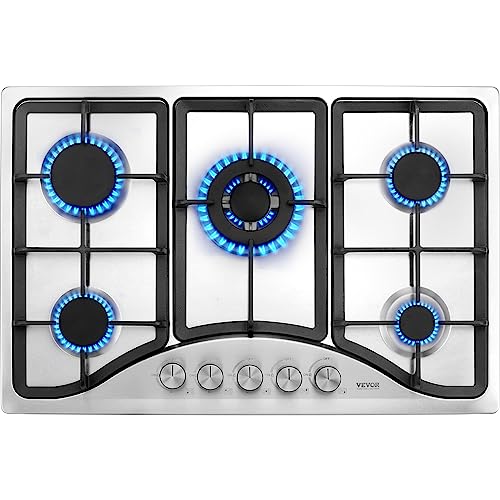
- It is the genuine article for this keyword: a 30-inch, built-in, five-burner gas cooktop, matching the size, fuel and format the search asks for.
- Natural gas and LPG convertible, so the same unit can serve a mains-gas kitchen now and a propane setup later with the appropriate conversion.
- Thermocouple protection is named in the verified listing, a meaningful safety feature that cuts the gas supply if a flame goes out.
Trade-offs
- Five burners in a 30-inch frame means tight spacing when several large pans are in play at once.
- Stainless steel shows fingerprints and water marks and needs a wipe-down habit to keep its looks.
- Built-in gas installation is professional work for most households, not a casual weekend swap.
Mini spec box
- Format: 30-inch built-in gas cooktop
- Burners: 5
- Total output stated in listing: 12250 BTU
- Fuel: Natural gas / LPG convertible
- Surface: Stainless steel
- Safety: Thermocouple protection
- Listing also positions it for: Camping, RV and apartment use contexts
The VEVOR earns the top badge here the straightforward way: it is the product this keyword actually describes. Five burners across a 30-inch surface gives a household the layout that makes weeknight cooking calm — a main burner for the large skillet, supporting burners for a saucepan and a vegetable pan, and room to keep a kettle or a resting pot off the heat. The stated total output is shared across those five burners, which is the normal arrangement in this class; what matters in daily use is less the headline figure than whether one burner can push a wok or a cast-iron pan hard while another holds a sauce at a bare simmer, and a five-burner layout at least gives you the positions to attempt both at once.
The convertible fuel design deserves emphasis, because it quietly solves a real problem. Homes on natural gas sometimes move, convert a garage or outdoor kitchen, or set up a secondary cooking space on bottled propane, and a cooktop that converts between NG and LPG avoids buying twice. Conversion must be done correctly — jets and regulator settings differ between the gases — and the safety guidance later in this guide covers why that job belongs to a qualified installer unless you are genuinely competent with gas fittings. The thermocouple protection named in the listing is the other grown-up feature: if a gust or a boil-over kills a flame, the thermocouple cools and shuts off the gas, rather than letting unburned gas accumulate in your kitchen.
Who does it suit? A household replacing a tired 30-inch gas cooktop, a landlord fitting out a rental kitchen that may run on either gas type, or a keen cook who wants five burners without reworking cabinetry for a 36-inch unit. Its honest limitation is crowding: five burners on 30 inches is a layout of compromises, and a cook who routinely uses two very large pans side by side will feel the squeeze and might genuinely be happier reworking the kitchen for the wider format discussed in Best High End 36 Cooktops. But within the 30-inch brief, this is the pick that respects the brief.
Best for: households that need a true 30-inch, five-burner gas cooktop with NG/LPG flexibility / Not suited for: cooks who need wide spacing for oversized pans or who have no gas supply
ThermoMate Heavy 36 Inch Gas Cooktop
Badge: Best 36-Inch Alternative
Strengths
- A genuine built-in gas cooktop with five Italy Sabaf power burners, a burner maker with a real reputation in the industry.
- 304 stainless steel construction and CSA certification are both named in the verified listing.
- NG/LPG convertible with thermocouple protection, matching the safety and flexibility expectations of this guide.
Trade-offs
- It is 36 inches wide. It does not fit a 30-inch cutout, full stop — that is why it is prose-only here.
- The extra width demands more counter and cabinet space than many standard kitchens can give up.
- Choosing it means a kitchen alteration project, not a like-for-like replacement.
Mini spec box
- Format: 36-inch built-in gas cooktop
- Burners: 5 Italy Sabaf power burners
- Fuel: Natural gas / LPG convertible
- Material: 304 stainless steel
- Safety: Thermocouple protection
- Certification named in listing: CSA Certified
The ThermoMate is included in full because many shoppers who start with a 30-inch search end up asking whether they should go wider, and this is a fair example of what wider buys you. Five burners spread across 36 inches breathe in a way five burners across 30 inches cannot: a large stockpot stops crowding its neighbours, a griddle can sit over two burners without stealing the whole surface, and two cooks can work at the same hob with far less elbow negotiation. The Sabaf burner name matters to people who research components, and 304 stainless is the grade you want to see named rather than a vague “stainless finish.”
None of that changes the ruling. This guide’s keyword promises 30 inches, and a buyer who orders a 36-inch cooktop for a 30-inch opening faces return shipping on a heavy appliance and a kitchen project they did not plan. If your renovation genuinely has room to grow, the wider format is covered properly in Best High End 36 Inch Gas Cooktops, where this class of product is judged against its true peers. Here, the ThermoMate serves as the reference point that defines the boundary of the brief — and as a reminder that the best product on the wrong measurement is still the wrong product.
Its honest limitation, beyond width, is the same as any big stainless built-in: installation, gas connection and any cabinet modification are real costs in time and money on top of the appliance, and the generous surface is one more expanse of steel to keep clean. For a household already committed to a remodel with a 36-inch opening, it is a credible direction. For the 30-inch shopper this guide serves, it is a well-made detour.
Best for: renovators with a true 36-inch opening who want Sabaf burners and 304 stainless / Not suited for: anyone replacing a 30-inch cooktop without changing cabinetry
Nuwave Pro Chef Induction Cooktop
Badge: Best Precision Portable Alternative
Strengths
- Exceptional temperature granularity is named in the listing: 94 temperature settings across a 100°F to 575°F range in fine 5°F steps.
- Commercial-grade positioning, a large 8-inch heating coil and a shatter-proof ceramic glass surface suggest a serious portable tool.
- Powerful 1800W output matches the ceiling of a standard household circuit for a single burner.
Trade-offs
- It is induction — electric, not gas — so it fails the core fuel attribute of this keyword and is prose-only.
- It is a single portable burner, not a built-in multi-burner cooktop.
- It only works with induction-compatible cookware; aluminium and many stainless pans without a magnetic base will not register.
Mini spec box
- Format: Portable countertop single burner
- Fuel: Induction (electric)
- Power: 1800W
- Heating coil: Large 8-inch
- Temperature: 94 settings, 100°F–575°F in 5°F increments
- Surface: Shatter-proof ceramic glass
Why review an induction burner at length in a gas cooktop guide? Because it is the product search engines will keep showing you, and you deserve a clear account of what it is and is not. As a portable precision burner, the Pro Chef concept is genuinely appealing: fine temperature steps are exactly what you want for holding chocolate, poaching, or keeping a delicate sauce at a controlled warmth, and a flat ceramic glass surface wipes clean in seconds. Caterers, demonstrators and people cooking in temporary spaces love this class of appliance for good reasons.
But it cannot do the job this keyword describes. It gives you one burner where a family cooktop gives you five. It needs a wall socket where a gas cooktop needs a gas line. It heats the pan directly through magnetism, which is fast and efficient, but it offers no flame to read at a glance, no tolerance for warped or non-magnetic pans, and no service at all during a power cut. Presenting it as a gas cooktop alternative without those caveats would be a disservice, which is precisely why it appears here with no link and no photo, labelled for what it is.
If, after reading this, you realise your real need is a precision portable burner to sit alongside your existing stove — for sauces, for a dorm, for an outdoor counter with power — then this category is worth exploring on its own terms through guides written for it, such as Best Inductin Cooktops. As a candidate for best high end 30 gas cooktops, it simply is not one, and its honest limitation is total: wrong fuel, wrong format, wrong burner count for the brief.
Best for: cooks wanting a precise portable extra burner for sauces and controlled low heat / Not suited for: anyone shopping for a built-in gas cooktop
ISILER 1800W Portable Induction Cooktop
Badge: Best Compact Portable Alternative
Strengths
- Simple, legible control scheme in the listing: 10 power settings and 10 temperature settings with touch control.
- Seven cooking presets, a timer and a safety lock cover the everyday needs of a small-space cook.
- Compact portable design and an 8-inch heating plate suit apartments, dorms and single-pan meals.
Trade-offs
- Induction, not gas — the core fuel mismatch that makes it prose-only in this guide.
- A single burner cannot run a multi-pot meal the way a five-burner cooktop can.
- Preset-driven cooking gives less fine control than the step-by-step temperature adjustment of more specialised portables.
Mini spec box
- Format: Portable countertop single burner
- Fuel: Induction (electric)
- Power: 1800W
- Heating plate: 8 inch
- Controls: Touch control, 10 power and 10 temperature settings
- Extras named in listing: 7 cooking presets, timer, safety lock
The ISILER represents the friendly end of the portable induction market: presets for common jobs, a lock to stop curious fingers or a stray elbow changing your settings, and a footprint that disappears into a cupboard when the meal is done. For a studio apartment with no stove at all, or a student kitchenette, that package makes real sense, and the even-heating claim in the listing speaks to the usual induction advantage of consistent pan contact across a flat plate.
In the context of this keyword, though, the distance is unbridgeable. A household shopping for a high-end 30-inch gas cooktop is planning a permanent installation, multi-burner cooking, and flame control; a compact single induction plate answers none of those needs. There is also a cookware audit hiding in any induction purchase: hold a magnet to the base of every pan you own, and any pan the magnet ignores is a pan this burner ignores too. That audit is painless for one portable burner bought knowingly; it is a nasty surprise for someone who thought they were buying a gas appliance.
So the ISILER is reviewed here as a clearly labelled alternative for a different problem — small-space, single-pan, plug-in cooking — and it carries no link in a gas cooktop guide on principle. Its honest limitation for family cooking is capacity: one burner, one pan, one dish at a time, with everything else kept warm by planning rather than by hardware.
Best for: small apartments, dorms and one-pan cooking where a portable plug-in burner is the actual goal / Not suited for: replacing or substituting a built-in 30-inch gas cooktop
Duxtop 1800W Portable Induction Cooktop Gold 8100MC
Badge: Best Established Portable Alternative
Strengths
- Duxtop is one of the longest-established names in portable induction, and the 8100MC is a long-running model in that line.
- Full 1800W single-burner power in a countertop format that stores easily.
- The gold finish distinguishes it visually from the sea of black glass portables.
Trade-offs
- Induction and portable: it fails this keyword on fuel, format and burner count, so it is prose-only.
- A single countertop burner occupies worktop space a built-in cooktop would leave free.
- Like all induction, it demands magnetic-base cookware.
Mini spec box
- Format: Portable countertop single burner
- Fuel: Induction (electric)
- Power: 1800W
- Model: 8100MC / BT-180G3
- Finish: Gold
There is a reason the Duxtop name keeps appearing in portable induction roundups year after year: the company sells little else, the designs are workmanlike, and the category basics — responsive power changes, a surface that wipes clean, a unit light enough to move with one hand — are handled competently. The 8100MC in gold is the slightly dressier sibling in that family, the one people choose when the burner will live visibly on the counter rather than in a cupboard.
None of those virtues move it closer to this keyword. It remains an electric single burner. A gas cooktop shopper who bought it by mistake would discover the error the moment they looked for a gas connection that does not exist, and would then discover the second error when half their pans refused to heat. Guides exist to prevent exactly that purchase, which is why this review exists but its link does not.
Where the 8100MC does belong is in the conversation about supplementing a stove: an extra burner for holiday cooking, a precise low-heat station for candy or sauces, a cooking option for a workshop, studio or RV with shore power. Judged as that appliance, it is a sensible, established choice. Judged as one of the best high end 30 gas cooktops, it is a category error, and its honest limitation is that no accessory or adapter can turn a portable induction plate into a built-in gas hob.
Best for: an established portable induction burner for extra capacity beside an existing stove / Not suited for: any gas cooktop installation
Duxtop Portable Induction Cooktop Silver 9600LS
Badge: Best Touch-Control Portable Alternative
Strengths
- LCD sensor touch controls, named in the listing, give a flat, wipe-clean control surface with no knobs to trap grease.
- Full 1800W power and the same established Duxtop portable platform as its gold sibling.
- Silver finish offers a lighter look for bright kitchens where black glass feels heavy.
Trade-offs
- Prose-only for the same core reasons: induction fuel, portable format, single burner.
- Touch controls can be less intuitive with wet or floury hands than a physical gas knob.
- Sensor panels and cooking steam are uneasy partners; splashes can register as touches on some designs.
Mini spec box
- Format: Portable countertop single burner
- Fuel: Induction (electric)
- Power: 1800W
- Controls: LCD sensor touch
- Model: 9600LS / BT-200DZ
- Finish: Silver
The 9600LS is the touch-control expression of Duxtop’s portable line. If you have ever scrubbed around the knobs of a hard-used stove, the appeal of a completely flat panel is immediate: one wipe, no crevices, nothing to remove and soak. The LCD display approach also suits cooks who like to set a level numerically and return to exactly that level tomorrow, rather than judging a flame or a knob angle by eye.
That control philosophy is, of course, the opposite of the gas experience this keyword’s shoppers are seeking. Gas cooking is analog and visual: you see the flame crown under the pan and adjust by instinct built over years. Neither approach is wrong, but they are different crafts, and a guide that blurred them would fail both audiences. The 9600LS is therefore the sixth and final prose-only entry here, reviewed honestly and linked nowhere.
Its best use mirrors its sibling’s: supplementary burner, small-space primary burner for one-pan cooks, or a tidy unit for a rental where installing anything is out of the question. Its honest limitation, beyond the category mismatch, is the touch interface itself under real cooking conditions — wet hands, steam and splatter are the daily weather of a busy hob, and physical controls forgive them more readily.
Best for: cooks who prefer flat touch controls and an established portable induction design / Not suited for: gas installations, multi-burner cooking, or anyone who cooks with wet hands and big pans
Comparison Table
| Pick | Width / Format | Fuel | Burners | Standout verified feature | Link |
|---|---|---|---|---|---|
| VEVOR Gas Cooktop | 30-inch built-in | Gas NG/LPG | 5 | Thermocouple protection | Check on Amazon |
| ThermoMate Gas Cooktop | 36-inch built-in | Gas NG/LPG | 5 Sabaf | 304 stainless, CSA certified | Prose-only |
| Nuwave Pro Chef | Portable | Induction | 1 | 94 temp settings, 5°F steps | Prose-only |
| ISILER Portable | Portable | Induction | 1 | 7 presets, safety lock | Prose-only |
| Duxtop Gold 8100MC | Portable | Induction | 1 | Established 1800W design | Prose-only |
| Duxtop Silver 9600LS | Portable | Induction | 1 | LCD sensor touch | Prose-only |
Read the table by columns, not rows. The fuel and width columns eliminate five of the six entries for this keyword before any feature comparison begins — a useful discipline for appliance shopping generally, and one the wider discussion in Best Highend Cooktops applies across the whole cooktop category.
How to Choose a 30-Inch Gas Cooktop
Start with the tape measure, because width is destiny. A “30-inch” cooktop sits in a cutout that is smaller than 30 inches, and cutouts vary between manufacturers and between the decades in which kitchens were built. Measure the opening in the counter itself — length, depth, and the clearance beneath it — and compare those numbers with the new unit’s stated cutout requirements, not its overall top dimensions. Allow for the gas line position and any drawer or oven beneath. More replacement projects go wrong on this step than on any feature decision, and the fix after the fact is either carpentry or a return.
Next, think in burners, not in totals. A five-burner layout in 30 inches trades individual burner elbow room for positional flexibility: typically a stronger central or rear burner for boiling and searing, mid burners for everyday pans, and a gentler burner for simmering. Ask how you actually cook. A household that lives on one-pan meals may never use the fifth burner, while a household that runs a sauce, a grain, a protein and a vegetable at once will use all five weekly. Check the grate design too: continuous grates that let you slide a heavy pot from burner to burner without lifting are a genuine high-end convenience, and heavy cast-iron-style grates retain heat and stability better than thin enamelled steel.
Simmer quality is the quiet separator of good gas cooktops. Almost any burner can roar; holding a delicate sauce below a boil without scorching or constantly relighting is harder. Look for burners described with low, stable flames and for controls that move smoothly through the low range rather than jumping from medium to off. If you make custards, risotto or slow braises on the hob, weight this factor heavily — it is the one you will feel every single day.
Fuel flexibility deserves a place on the checklist even if you never plan to move. An NG/LPG convertible design, like the linked pick in this guide, widens your options for outbuildings, future homes and resale, and it usually signals a manufacturer comfortable serving varied installations. Confirm what conversion involves for any model you shortlist and who is expected to perform it. Relatedly, treat safety features as core specification, not garnish: thermocouple flame-failure protection, reliable electronic ignition, and stable pan supports are the features that protect a household on the one bad day they are needed.
Finally, judge the surface as a cleaning commitment. Stainless steel looks professional and shrugs off heat, but shows every fingerprint; enamelled surfaces hide marks better but can chip if a heavy pan lands badly; burner caps and grates that lift off easily will actually get cleaned, while fiddly assemblies quietly accumulate grease. The best high-end choice is the one whose daily upkeep you will genuinely perform. If your research widens beyond gas, the propane-specific considerations in Best Home Propane Cooktops are worth reading before you commit to a fuel.
How to Install, Use and Maintain a Gas Cooktop Safely
Installation first, and plainly: connecting a gas appliance involves your home’s gas supply, and in many jurisdictions it must be done or at least checked by a licensed professional. The sequence a competent installer follows is consistent — shut off the gas at the supply, confirm the cooktop is configured for your gas type (natural gas and LPG use different jetting and pressures, and a convertible unit must be set up for the one you actually have), connect with approved fittings, test every joint for leaks with an appropriate solution, verify ignition on every burner, and check that flames burn blue and steady rather than yellow and lazy. Ventilation is part of the same conversation: gas combustion produces moisture and combustion by-products, so a working extractor that vents outside is a genuine companion requirement, not an aesthetic extra.
Daily use is mostly habit. Light burners with the pan ready rather than letting gas run unlit; keep the flame under the pan base instead of licking up its sides, which wastes energy and overheats handles; and never leave a lit burner unattended with oil heating, because oil reaches smoking and then ignition faster than intuition suggests. If a flame blows out, turn the knob off, ventilate the room, wait for gas to disperse, and only then relight — the thermocouple protection on modern units reduces this risk but does not license carelessness.
Maintenance is simple and mostly about the burner heads. Spilled food carbonises on caps and ports and shows up later as uneven, sputtering flames. Lift off grates and caps regularly, wash them in hot soapy water, clear any blocked ports gently with a soft brush or a wooden pick — never a metal pin that can enlarge the opening — and dry everything fully before refitting, because a damp cap is a common cause of clicking, reluctant ignition. Wipe the stainless surface with the grain, avoid abrasive pads that scar the finish, and keep the area around igniters clean and dry.
Troubleshooting follows the same calm pattern. Problem: a burner clicks but will not light → check that the cap is seated squarely and dry, and that its ports are clear; moisture and misalignment cause most cases. Problem: flames are uneven or yellow-tipped → the burner head likely needs cleaning, and if yellow flames persist after cleaning, stop and call a professional, because combustion is not right. Problem: you smell gas with all knobs off → do not touch switches or flames; ventilate, leave, and contact your gas supplier or emergency service from outside the house. That last rule outranks every other sentence in this section.
Gas Versus Induction: The Honest Comparison Behind This Keyword
This keyword’s research pool accidentally stages the defining cooktop debate of the decade, so it is worth having properly. Gas offers visible, immediate heat that works with every pan you own, keeps working in a power cut, and gives experienced cooks an intuitive feel that many describe as control. Its costs are real: combustion in the kitchen, harder cleaning around grates and caps, less precise low-temperature holding, and installation tied to a gas supply.
Induction counters with speed, efficiency and a flat surface that cleans in one wipe, plus temperature holding so steady it can melt chocolate without a bain-marie. Its costs are the cookware audit, dependence on electricity, and a learning curve for cooks raised on flame. Built-in induction cooktops — the true counterpart to the gas units in this guide — are a mature, premium category. Portable single burners, like the four prose-only entries here, are a different product for a different job, and conflating the two is how shoppers end up disappointed. Choose your fuel as a household decision first; only then compare models within it.
What “High End” Should Actually Mean in a 30-Inch Gas Cooktop
Strip away marketing and a high-end gas cooktop is a short list of unglamorous virtues: burners that light first time, every time, for years; a low flame that stays lit and even; grates that do not rock under a full stockpot; knobs with a smooth, weighted action that does not develop play; a surface that survives a decade of scrubbing without looking tired; and safety protection that works silently in the background. Notice that none of these can be judged from a photograph, and several cannot be judged from a specification sheet either — which is why verified listing facts, component names and certifications carry more weight in this guide than adjectives.
It is also why this guide refuses to inflate a modest pool into a grand ranking. One product here matches the full brief; the honest service is to say so, explain the standard the brief implies, and equip you to judge any other 30-inch gas cooktop you find against it. A shorter honest list beats a longer padded one, every time.
Common Buying Mistakes
The first mistake is buying by overall width instead of cutout size, and discovering the difference with the old cooktop already removed. The second is ordering the wrong fuel variant or assuming a convertible unit arrives already set for your gas — conversion is a configuration step, not a factory default you can presume. The third is being seduced by a headline total output figure without asking how it is distributed; five burners sharing a modest total can each be weaker than expected. The fourth is ignoring the pans you own: very small pans on large burners and oversized pans crowding a 30-inch layout both waste the design. The fifth, and the one this guide was built to prevent, is clicking a search result for a “gas cooktop” and ordering a portable induction burner because the listing photograph looked sleek and the fuel type went unread. Read the fuel line. Always read the fuel line.
Final Recommendation
For the household this keyword describes, the recommendation is direct: start with the VEVOR Gas Cooktop 30 Inch 5 Burners (Check on Amazon), the one product in this researched pool that is genuinely 30 inches, genuinely gas and genuinely built in, with five burners, NG/LPG conversion and thermocouple protection. If your renovation can stretch to a wider opening, the 36-inch class offers real breathing room and is worth exploring before you buy (Check on Amazon is still the right first click for the 30-inch brief itself). And if reading this guide has convinced you that your household is actually an induction household, make that switch deliberately toward a built-in model rather than drifting into a portable (Check on Amazon). Measure the cutout, confirm the gas type, and buy once.
Frequently Asked Questions
Will a 36-inch gas cooktop fit my 30-inch opening if I trim the counter?
Sometimes, but it is a renovation decision, not a fitting trick. Widening a cutout can compromise counter strength, cabinet clearance and the required distances from combustible surfaces, and in stone counters it means professional cutting. If you love the wider format, plan it as a project with the clearances checked first; do not order the appliance and improvise.
What does NG/LPG convertible actually mean?
It means the cooktop can be configured to burn either natural gas from a mains supply or liquefied petroleum gas — propane — from bottles or a tank. The gases run at different pressures and need different injector jets, so conversion is a physical setup step performed at installation. A convertible model gives you flexibility between homes and setups, but it must be set correctly for the gas you connect.
Why were the induction burners in this guide not linked?
Because they do not match the keyword. They are electric, portable, single-burner appliances, while the search asks for a built-in gas cooktop. They were reviewed in full so you can recognise them in search results and judge them fairly for other purposes, but linking them as gas cooktop recommendations would mislead buyers, so they appear as prose-only entries with no link and no image.
How many burners do I really need on a 30-inch cooktop?
Count the pans in your most complex regular meal. Most households use two burners daily and three on ambitious nights; the fourth and fifth earn their keep for entertaining, batch cooking and keeping dishes warm. Five burners in 30 inches adds flexibility but crowds large pans, so keen cooks with big cookware sometimes prefer four well-spaced burners. There is no universal answer — there is your menu, measured honestly.
Is thermocouple protection worth looking for?
Yes. A thermocouple senses the burner’s flame, and if the flame goes out it shuts off the gas supply to that burner. It protects against the exact scenario — a boil-over or draught killing a flame while gas keeps flowing — that makes gas safety more than a slogan. On a modern cooktop it should be considered standard equipment rather than a premium extra.
Can I install a gas cooktop myself?
In many places, gas work is legally restricted to licensed professionals, and everywhere it carries real risk if done badly. Even where self-installation is permitted, the connection must be leak-tested and the burner configuration verified for your gas type. The cost of a professional installation is small next to the cost of a leak. Treat this as professional work by default.
What should I check before ordering any replacement cooktop?
Four things, in order: the cutout dimensions in your counter, the fuel type and supply already in your kitchen, the electrical requirement for ignition if any, and the clearance beneath the unit for drawers, an oven or pipework. Then, and only then, compare burners and finishes. Most returns and most disappointment trace back to one of those four checks being skipped.