Disclosure: topratedkitchenware.com is reader-supported. When you buy through links on our site, we may earn an affiliate commission from Amazon and other retailers, at no extra cost to you.
Where to buy
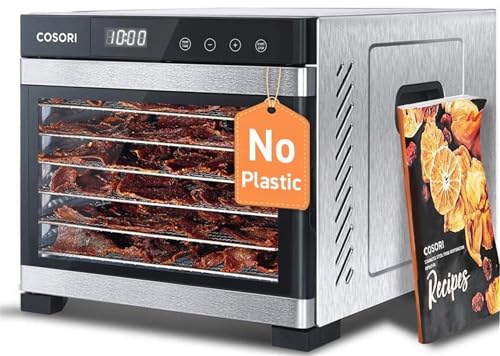
The six models below are the verified picks for this guide to the best low cost food dehydrators. Each name links to its Amazon listing, where you can check the latest price on Amazon and confirm the current tray count and configuration before you decide. Low cost in this guide is a positioning lens, not a printed figure: prices move, so this page judges each machine by what it gives you per tray, per feature, and per year of likely use instead of quoting numbers that would be stale within weeks.
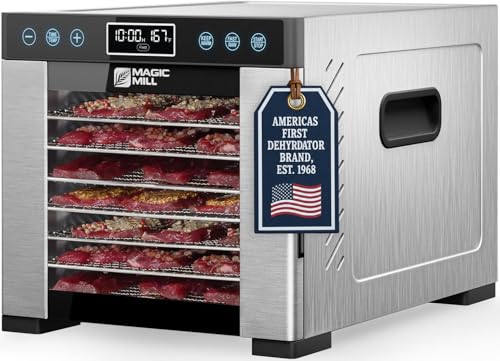
- Magic Mill Food Dehydrator Machine, 5 Stainless Steel Trays — Best Overall Low-Cost Pick
- FOHERE Food Dehydrator, 5 BPA-Free Trays — Best Compact Budget Starter
- Elite Gourmet 5-Tray Food Dehydrator EFD319 — Best Simple Dial-Style Starter
- HOPERAN 16 Tray Food Dehydrator Machine — Best Low Cost per Tray for Big Batches
- Magic Mill Premium Food Dehydrator Machine, 15 Trays — Best for Large Harvests
- Magic Mill Pro Food Dehydrator Machine, 10 Trays — Best Mid-Size Step Up
Read the full guide ↓ for the ranking logic, the honest limitations of every pick, and the checks that separate a genuine bargain from a cheap machine you will replace by next season.
Finding the best low cost food dehydrators is really a question about value over time, because a dehydrator is one of the simplest appliances in the kitchen: a heating element, a fan, trays, and time. There is very little to go expensively wrong, which means a well-chosen inexpensive machine can dry jerky, fruit, herbs, and dog treats for years, while a poorly chosen one wastes money in quieter ways — trays that warp, a timer that forces you to babysit overnight batches, or a capacity so small that a single orchard trip takes four loads. This guide compares six verified machines across the low-cost end of the market and judges them the way a careful budget shopper should: drying space you actually get, control you actually need, materials that survive repeated washing, and the cost-per-batch logic that only appears after you have run the machine a dozen times.
The line-up deliberately spans the whole budget landscape. At one end sit two compact five-tray machines and a simple adjustable-temperature starter model, the kind of dehydrator a first-time buyer can learn on without commitment. At the other end sit two genuinely large machines — fifteen and sixteen trays — whose low-cost claim rests on cost per tray rather than a small ticket, plus a ten-tray mid-size model with a keep-warm function that punches above its tier. If your real question is which end of that landscape fits your kitchen, the buying guide and comparison sections below will answer it more honestly than any single ranking. Readers weighing the next tier up often cross-check this list against Best Quality Food Dehydrators, and jerky-first buyers should also read Best Food Dehydrators For Jerky before deciding.
One more framing note before the rankings: low cost is not the same as lowest specification. Every pick here has adjustable temperature control, because a fixed-temperature bargain is a false economy — herbs scorch, fruit case-hardens, and jerky becomes a guessing game. Every pick also holds at least five trays, because below that threshold batches shrink to samples. Within those floors, the differences that matter are tray material, timer length, stated temperature range, and honest capacity, and the reviews below score each machine on exactly those terms so you can see where each bargain spends and where it saves.
Key Takeaways
- Low cost should be measured per usable tray and per batch, not by the ticket alone: the sixteen-tray pick can be the cheapest way to dry a harvest even though it is the largest machine here.
- Five good trays beat ten awkward ones for most households; match tray count to the amount you realistically dry in one sitting.
- A 48-hour timer and adjustable temperature, both present on most picks here, matter more to results than extra presets.
- Stainless steel trays wash easier and resist staining over years of tomato and jerky work; BPA-free plastic trays keep the two smallest picks light and simple.
- Check the latest price on Amazon for each pick before deciding, because low-cost rankings shuffle whenever listings change.
- Budget for the accessories you will actually use — mesh screens for small items and a fruit roll tray — instead of paying for bundles you will store forever.
In this guide
Quick Picks
| Pick | Badge | Why it earns its place | Listing |
|---|---|---|---|
| Magic Mill Food Dehydrator Machine, 5 Stainless Steel Trays | Best Overall Low-Cost Pick | Stainless trays, digital timer and temperature control in the smallest sensible footprint. | Check on Amazon |
| FOHERE Food Dehydrator, 5 BPA-Free Trays | Best Compact Budget Starter | A 400W stackable five-tray design with a stated 95–158°F range for gentle work. | Check on Amazon |
| Elite Gourmet 5-Tray Food Dehydrator EFD319 | Best Simple Dial-Style Starter | Straightforward adjustable temperature and five BPA-free trays with nothing to learn. | Check on Amazon |
| HOPERAN 16 Tray Food Dehydrator Machine | Best Low Cost per Tray for Big Batches | Sixteen stainless trays, two fans, and included mesh and fruit roll accessories. | Check on Amazon |
| Magic Mill Premium Food Dehydrator Machine, 15 Trays | Best for Large Harvests | Fifteen extra-large stainless trays and a 95°–167° range for serious seasonal loads. | Check on Amazon |
| Magic Mill Pro Food Dehydrator Machine, 10 Trays | Best Mid-Size Step Up | Ten stainless trays plus a keep-warm function, with ETL approval listed. | Check on Amazon |
How These Picks Were Chosen
This is a research-led guide, not a hands-on laboratory test, and it is honest about that distinction. Each pick was verified against its current Amazon listing data — brand, tray count, tray material, stated temperature range, timer length, wattage where the listing states it, and included accessories — and only models whose listing details could be confirmed were allowed a link in this guide. The low-cost lens was then applied as a set of value questions rather than a price cutoff. How much drying space does the machine provide for its tier? Does it include the timer and temperature control that prevent wasted batches? Are the trays made of a material that will still be pleasant to use in three years? Does the bundle include the small accessories — mesh screens, a fruit roll sheet — that budget buyers otherwise buy separately within the first month?
Ranking weighed everyday usefulness over headline size. The five-tray Magic Mill leads because it pairs stainless trays and full digital control at the accessible end of the range, which is the combination most first-time and returning buyers actually need. The two giant machines rank in the middle rather than the top, deliberately: they are superb value per tray, but only for households that genuinely dry in bulk, and recommending them to a casual buyer would be the opposite of low-cost thinking. Models were also compared on stated noise where the listing gives it, on fan layout where stated, and on safety or certification notes where the listing includes them. Where a listing is silent on a detail, this guide says so instead of filling the gap with a guess, and the detailed reviews below flag every such silence that matters.
The 6 Best Low Cost Food Dehydrators
Magic Mill Food Dehydrator Machine, 5 Stainless Steel Trays
Badge: Best Overall Low-Cost Pick
Strengths
- Five stackable stainless steel trays that resist staining and wash clean after jerky and tomato batches.
- Digital adjustable timer running to 48 hours, so overnight and two-day projects need no supervision.
- Temperature control up to 167°, covering delicate herbs at the low end and jerky at the high end.
Trade-offs
- Five trays fill quickly when a whole garden harvest arrives at once.
- The listing does not state wattage, so power draw cannot be compared from listing data alone.
- Stackable designs need tray rotation on uneven loads for the most even finish.
Mini spec box (from listing data)
- Trays: 5, stackable, stainless steel
- Timer: digital, up to 48 hours
- Temperature: adjustable, up to 167°
- Listing highlights: jerky, fruit, dog treats and general preserving
This is the machine most budget shoppers should start with, because it spends its money in the right places. Stainless trays are the single upgrade that keeps paying off: they do not hold onto the smell of last month’s jerky marinade, they tolerate a proper scrub, and they will not craze or discolour the way long-used plastic can. The 48-hour digital timer sounds like a luxury until your first batch of thick-cut fruit runs long — with a timer this generous, you set the machine in the evening and collect finished food the next day instead of setting phone alarms. Temperature control reaching 167° covers the jerky end of the craft, while the adjustable low end handles herbs without cooking them.
Who it suits: a household drying weekly or seasonally in moderate amounts — a tray of apple rings, a batch of beef jerky, herbs from a windowsill garden. The honest limitation is throughput. Five trays is a sensible everyday capacity, but a neighbour’s plum tree or a hunting-season jerky project will have you running consecutive loads while the two big machines below finish in one pass. That is a limitation of size, not quality, and for most kitchens it is the right trade.
Best for: most households wanting stainless trays and full digital control at the accessible end of the market / Not suited for: bulk harvest drying in a single load

FOHERE Food Dehydrator, 5 BPA-Free Trays
Badge: Best Compact Budget Starter
Strengths
- A clearly stated 95–158°F temperature range, gentle enough for herbs and fruit leather.
- 400W power draw is modest, suiting long, slow, low-temperature runs.
- Stackable 11.42-inch trays store compactly between uses.
Trade-offs
- The 158°F ceiling is lower than the jerky-focused picks here, so check your recipe’s required temperature before committing.
- BPA-free plastic trays need gentler washing than stainless over the long term.
- Five trays of this diameter are a starter capacity, not a harvest capacity.
Mini spec box (from listing data)
- Trays: 5, BPA-free, 11.42-inch, stackable
- Temperature: 95–158°F
- Timer: up to 48 hours
- Power: 400W
The FOHERE earns its place by being honest about what it is: a compact, gentle, starter-grade dehydrator for fruit, herbs, vegetables, and modest jerky batches. Its stated range starting at 95°F is genuinely useful — that is the territory where herbs keep their colour and fruit dries without case-hardening — and the 48-hour timer means even its slowest work can run unattended. At 400W it sips power compared with the big machines in this guide, which matters when a batch runs for a day and a half; low cost includes the electricity, not just the purchase.
Who it suits: apartment kitchens, first-time dehydrator owners, and anyone whose drying is mostly herbs, fruit snacks for kids, and dog treats. The honest limitation is the top of its range. Many jerky methods call for an initial high-heat phase at or above the ceiling this machine states, so dedicated jerky makers should choose the Magic Mill above or the larger machines below and treat the FOHERE as the gentle-work specialist it is.
Best for: compact kitchens, herbs, fruit, and gentle low-temperature drying / Not suited for: high-heat jerky methods or bulk loads
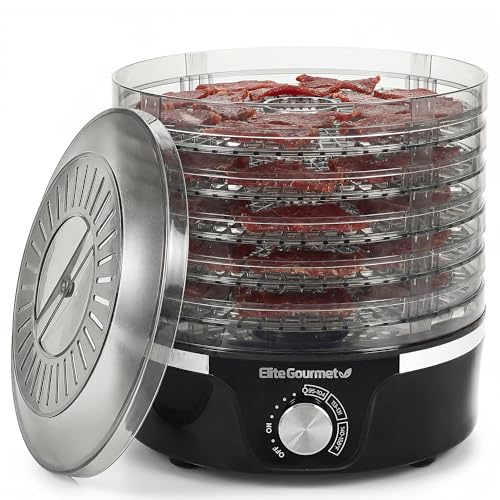
Elite Gourmet 5-Tray Food Dehydrator EFD319
Badge: Best Simple Dial-Style Starter
Strengths
- Adjustable temperature with a deliberately simple control approach — nothing to programme, nothing to learn.
- Five BPA-free 11.4-inch trays suit jerky, fruit, herbs, and vegetables in starter quantities.
- A familiar appliance brand with a straightforward black countertop design (model EFD319).
Trade-offs
- The listing does not state a digital timer, so long batches need your own timing routine.
- No wattage or exact temperature range is stated in the listing title data.
- Plastic trays and a simple feature set mark this as a learn-the-craft machine, not a lifetime one.
Mini spec box (from listing data)
- Trays: 5, BPA-free, 11.4-inch
- Temperature: adjustable (range not stated in listing title)
- Model: EFD319, black
- Listing highlights: jerky, fruit, herbs and vegetables
Some buyers do not want a control panel; they want a knob and a result. The Elite Gourmet is the pick for that reader. Adjustable temperature covers the core requirement — different foods genuinely need different heat — and the five-tray stack handles the classic starter repertoire without ceremony. There is a real argument that a simple machine gets used more: no menus, no presets to decode, just slice, load, set, and walk away. For a teenager learning to make jerky or a grandparent drying garden herbs, that simplicity is the feature.
Who it suits: beginners, gift buyers, and occasional users whose batches are small and supervised anyway. The honest limitation is unattended running. Without a stated built-in long timer in the listing data, this is a machine for daytime batches you check yourself, not a set-and-forget weekend harvest tool. Buyers who know they will dry weekly should step up to the leading Magic Mill; buyers testing whether dehydrating fits their life at all should start exactly here — a point the team also makes in Best Recommended Food Dehydrators.
Best for: beginners and occasional, supervised batches / Not suited for: long unattended runs or frequent weekly drying

HOPERAN 16 Tray Food Dehydrator Machine
Badge: Best Low Cost per Tray for Big Batches
Strengths
- Sixteen stainless steel trays — the largest capacity in this guide — spread the machine’s cost across more drying space than any rival here.
- Two fans and 800W aim at even drying across that big stack.
- Bundle includes 2 mesh screens and 1 fruit roll tray, accessories budget buyers otherwise purchase separately.
Trade-offs
- A sixteen-tray machine needs real counter and storage space; measure before ordering.
- The listing states quiet operation under 48dB but does not state an exact temperature range in its title data.
- Capacity this large is wasted money and space if your batches are small.
Mini spec box (from listing data)
- Trays: 16, stainless steel
- Fans / power: 2 fans, 800W
- Controls: digital temperature and timer
- Noise: listed as quiet, under 48dB
- Included: 2 mesh screens, 1 fruit roll tray
The HOPERAN is the low-cost argument turned on its head: judged per tray and per finished batch, a big machine can be the thriftiest purchase in the room. Sixteen trays dry a whole orchard run, a full jerky marinade batch, or a season of dog treats in one cycle instead of three, and every avoided cycle is electricity, time, and washing-up saved. The included mesh screens matter more than they sound — small items like peas, herbs, and berries fall through standard trays, and buying screens later is exactly the kind of second purchase that erodes a budget buy. The fruit roll tray likewise turns overripe fruit into snacks instead of waste from day one.
Who it suits: gardeners, hunters, dog owners making treats in quantity, and anyone who preserves seasonally in bulk. The honest limitation is footprint and commitment. This is a machine you house, not a machine you tuck away, and its digital controls still require you to confirm the exact temperature range on the listing, since the title data emphasises capacity and noise over the range figure. If your kitchen and your harvest are both large, the per-tray maths is unbeatable in this line-up — the same logic that drives many picks in Best Food Dehydrators For Jerkey For Sale listings, where bulk jerky capacity dominates.
Best for: bulk seasonal drying, jerky in quantity, lowest cost per tray / Not suited for: small kitchens or occasional small batches

Magic Mill Premium Food Dehydrator Machine, 15 Extra-Large Trays
Badge: Best for Large Harvests
Strengths
- Fifteen extra-large stainless steel trays for the biggest single-load capacity from a familiar dehydrator brand.
- A fully stated 95°–167° temperature range covers delicate and high-heat work alike.
- 800W with a 48-hour digital timer matches the capacity with real control.
Trade-offs
- Extra-large trays need a sink and storage space to match; apartment buyers should measure twice.
- Heavier and more committed than the five-tray picks — a seasonal appliance, not a casual one.
- The listing title does not name included mesh or fruit roll accessories.
Mini spec box (from listing data)
- Trays: 15, extra-large, stainless steel
- Temperature: 95°–167°
- Timer: 48-hour digital
- Power: 800W
Where the HOPERAN wins on tray count and bundle, the Magic Mill Premium wins on stated range and tray size. Extra-large trays change what a batch looks like: full jerky strips lie flat without trimming, tomato halves and peach slices keep their shape, and fifteen of those trays swallow a farmers-market haul in a single load. The 95° low end is low enough for herbs and for the gentle start that fruit leather wants, and the 167° top end covers jerky work, so one machine honestly spans the whole craft. As a low-cost proposition it follows the same per-tray logic — a large, durable, stainless machine bought once instead of a small machine outgrown twice.
Who it suits: serious home preservers, large families, and anyone whose dehydrating peaks hard in harvest season. The honest limitation is everyday convenience. Dragging out a fifteen-tray machine to dry one banana’s worth of chips is friction you will avoid, and owners of big machines often end up wanting a small one too. Buy this as your harvest engine, not your snack toy, and it is excellent value; the raw-food crowd should also compare its stated low end against Best Raw Food Dehydrators, where the low-temperature question gets its own full treatment.
Best for: harvest-scale batches, jerky strips, one-load preserving / Not suited for: tiny batches or minimal storage

Magic Mill Pro Food Dehydrator Machine, 10 Stainless Steel Trays
Badge: Best Mid-Size Step Up
Strengths
- Ten stainless steel trays double the starter capacity without reaching the giant machines’ footprint class.
- A keep-warm function holds finished food safely until you are ready to unload it.
- Digital timer and temperature control, with ETL approval noted in the listing.
Trade-offs
- The listing title does not state an exact temperature range or wattage.
- Ten trays is a middle size that bulk preservers may still outgrow.
- No mesh or fruit roll accessories are named in the title data.
Mini spec box (from listing data)
- Trays: 10, stainless steel
- Controls: digital timer and temperature control
- Extra: keep-warm function
- Certification: ETL approved (per listing)
The ten-tray Magic Mill Pro is the step-up pick for the buyer who has done the maths and knows five trays are not enough. Its most underrated feature is keep warm: real life interrupts unloading, and a function that holds finished jerky or fruit at a safe warmth until you return prevents the quiet spoilage of a batch left sitting in a cooling machine. Ten stainless trays handle a family jerky batch or a serious herb harvest in one run, and the ETL note gives certification-conscious buyers something concrete to point to.
Who it suits: households between starter and bulk — weekly dryers, jerky regulars, and families. The honest limitation is specification silence: confirm the exact temperature range and wattage on the listing before ordering, because the title data does not state them, and a buyer with a strict low-temperature or high-heat requirement needs that figure in writing. Within the low-cost frame, this is the balanced middle: capacity, control, and a genuinely useful extra, without paying the size tax of the two giants.
Best for: weekly family drying and jerky regulars who outgrew five trays / Not suited for: buyers who need a stated exact range before purchase, or true bulk preservers
Comparison Table
| Pick | Badge | Trays | Stated temperature | Listing |
|---|---|---|---|---|
| Magic Mill 5-Tray | Best Overall Low-Cost Pick | 5 stainless, stackable | Adjustable, up to 167°; 48H timer | Check on Amazon |
| FOHERE 5-Tray | Best Compact Budget Starter | 5 BPA-free, 11.42-inch | 95–158°F; 400W; 48H timer | Check on Amazon |
| Elite Gourmet EFD319 | Best Simple Dial-Style Starter | 5 BPA-free, 11.4-inch | Adjustable; range not stated in title | Check on Amazon |
| HOPERAN 16-Tray | Best Low Cost per Tray | 16 stainless | Digital control; range not stated in title | Check on Amazon |
| Magic Mill Premium 15-Tray | Best for Large Harvests | 15 extra-large stainless | 95°–167°; 800W; 48H timer | Check on Amazon |
| Magic Mill Pro 10-Tray | Best Mid-Size Step Up | 10 stainless | Digital control; range not stated in title | Check on Amazon |
How to Choose a Low Cost Food Dehydrator Without Buying Twice
The most expensive dehydrator is the one you replace, so choose on the five factors that decide whether a budget machine survives your actual routine. First, capacity in trays and tray size. Count your realistic batch: a family jerky session, a basket of apples, a herb garden’s monthly cut. Five trays serve that scale well; seasonal harvests measured in crates need ten or more. Second, temperature range and honesty about it. Herbs and raw-leaning recipes want a low end near 95°F; jerky methods often want the 160s. A stated range beats an unstated one, because you can match it to your recipes before money changes hands. Third, the timer. Anything you dry takes hours, and thick or wet foods take a day or more; a 48-hour timer converts dehydrating from a supervised chore into background infrastructure.
Fourth, tray material. Stainless steel costs more inside any given tier and returns it in cleaning speed, stain resistance, and lifespan; BPA-free plastic keeps the smallest machines light and simple and is perfectly serviceable for fruit and herbs. Fifth, the true cost of ownership: electricity per batch (a 400W compact running long and slow versus an 800W giant finishing in one pass), the accessories you will buy later if they are not included, and the counter or cupboard space the machine consumes all year to earn its keep a few weekends a season. Run those five checks and the right tier usually names itself. If two machines still tie, choose the one whose limitation bothers you less — you will live with the limitation weekly and the advantage only occasionally.
How to Use a Food Dehydrator: Setup, Drying, Cleaning, and Troubleshooting
Setup is five minutes of placement and patience. Put the machine on a heat-safe, level surface with clearance around the vents, wash new trays before first use, and run the empty machine briefly if the manual suggests a burn-in. Slice food evenly — uniform thickness matters more than any setting, because drying is governed by the thickest piece on the tray. Leave small gaps between pieces; air must move around every slice. Load wetter, heavier items where your machine’s airflow is strongest if the manual identifies such a zone, and set temperature by food type: gentle heat for herbs, mid-range for fruit and vegetables, the high end for jerky following your recipe’s safety steps.
During the run, rotate or restack trays partway through if your design dries unevenly, and start checking for doneness before the recipe’s earliest time: fruit should bend without breaking or weeping, jerky should crack when bent without snapping, herbs should crumble. Cool finished food before sealing it, then condition fruit in a jar for several days, shaking daily, so residual moisture equalises instead of moulding one hidden piece. Clean trays promptly — dried-on marinade is tomorrow’s hour of soaking — and wipe the interior while it is still slightly warm.
Troubleshooting follows a short pattern. Problem: the outside of slices is dry and leathery while the centre stays wet → the temperature is too high and case-hardening the surface; lower the heat, slice thinner, and allow more time. Problem: one tray finishes hours before another → airflow is uneven across the stack; rotate trays on a schedule and avoid overloading any single tray. Problem: finished fruit moulds in storage → it was sealed warm or under-dried; condition before storing, and when in doubt dry longer, because slightly over-dry food keeps and slightly under-dry food does not.
What Low Cost Really Costs: The Per-Batch Maths
Budget shoppers often compare tickets when they should compare batches. A compact machine that needs three runs to clear a harvest spends three afternoons of your attention and three rounds of tray washing; a large machine clears it in one. Electricity cuts both ways: the big machines draw more watts but finish sooner, while the 400W compact draws little per hour across many hours. The honest way to judge is by your pattern. If you dry small amounts often, the compact’s low draw and small footprint win and the big machine’s capacity is dead weight. If you dry rarely but hugely, cost per tray and single-load capacity dominate, and the giants in this guide are the low-cost picks in every sense that matters. Accessories belong in the same maths: mesh screens and a fruit roll tray included in the box are worth real money to a buyer who would otherwise order them within the month, and worth nothing to a jerky-only household. Buy the bundle that matches your food, not the longest bundle list.
Drying on a Budget: Foods That Pay the Machine Back Fastest
A dehydrator earns its keep fastest on foods that are expensive bought dried and cheap bought fresh. Herbs top the list: a garden glut or a marked-down bunch becomes a jar of seasoning for pennies of electricity. Fruit follows — apple rings, banana chips, and mango from a bulk buy replace packaged snacks at a fraction of the ongoing cost, and fruit leather rescues produce that would otherwise be composted. Jerky is the classic payback food for meat-eating households, turning modest cuts into a premium-priced snack, and dog treats made from sweet potato or plain meat strips undercut boutique pet snacks dramatically. Gardeners add tomatoes, peppers, and soup vegetables, which store in jars instead of freezer space. The pattern is consistent: the machine pays back through avoided purchases, so the best low-cost dehydrator is ultimately the one matched to the foods your household already buys dried.
Stackable Trays or a Shelf-Style Cabinet: Airflow Layouts at the Budget End
Budget dehydrators move air in one of two broad ways, and the layout quietly shapes your routine. Stackable designs — the format of the five-tray Magic Mill, the FOHERE, and the Elite Gourmet in this guide — build upward in layers. They store small, expand by adding trays on some systems, and suit kitchens where the machine is put away between uses. Their known habit is unevenness across a tall stack: the trays nearest the moving air finish first, which is why the how-to section above builds tray rotation into the routine. Treat rotation as a normal step rather than a defect and a stackable machine rewards you with the smallest footprint per tray in the category.
Shelf-style cabinet machines, represented here by the larger Magic Mill and HOPERAN models, arrange trays like oven racks inside a box, usually with the fan pushing air across the shelves. The practical advantages are loading and inspection: you slide a tray out to test a piece without dismantling a stack, and jerky strips or fruit slices lie on wide, flat surfaces that suit big, uniform batches. The costs are footprint and commitment — a cabinet lives on a counter or a dedicated shelf. Neither layout is inherently better or more even in every example; fan placement, wattage, and how full you load the machine matter as much as the architecture. Choose by workflow. If you dry small and store the machine away, stackable wins. If you dry in campaign-sized batches and want to inspect progress tray by tray, the cabinet earns its space. Budget buyers in particular should decide this before comparing tray counts, because a cheap machine in the wrong layout becomes an unused machine, which is the most expensive outcome of all.
Your First Month With a Budget Dehydrator: Batches That Teach the Craft
The fastest way to learn any of these six machines is a deliberate sequence of forgiving batches. Start with apple rings or banana chips: cheap, quick, and honest teachers of slice thickness, because a tray of mixed thicknesses will show you a perfect gradient from leathery to crisp in a single run. Next, dry a herb batch at the gentle end of your machine’s range and note the time; herbs teach patience and the value of the low settings the FOHERE and the big Magic Mills state so clearly. Third, make fruit leather if you have a roll tray or suitable sheet, which teaches how wet purees behave and why conditioning matters. Only then attempt jerky, following a complete recipe with its safety steps, and take notes on temperature, time, and bend-test results.
Keep a simple drying log — food, slice thickness, temperature, start and finish times, and how the result ate a week later. Four batches of notes will teach you more than any preset list, and they convert a budget machine into a predictable tool: you will know your trays’ fast and slow zones, your machine’s real pace on wet fruit, and the exact point your jerky cracks rather than snaps. That log is also the moment the low-cost maths becomes visible, because you can count batches against the snacks, seasonings, and treats you stopped buying. Most owners find the machine has quietly paid for its shelf space well before the log’s first page is full — provided they bought the size and layout their kitchen could welcome weekly, which is the decision this guide keeps returning to.
Common Buying Mistakes
- Buying capacity for the harvest you imagine, not the one you have. A sixteen-tray machine used for two trays of apples is not a bargain; it is furniture.
- Ignoring the stated temperature range. Jerky buyers need the high end, herb and gentle-drying buyers need the low end; an unstated range is a question to resolve on the listing before ordering.
- Forgetting the timer. Long batches without a long timer turn a relaxing hobby into alarm-clock management.
- Counting trays instead of tray area. Fifteen extra-large trays and sixteen standard trays are different capacities; compare area and your food’s footprint, not the number alone.
- Skipping the accessory maths. Mesh screens and fruit roll trays bought later quietly erase a cheap machine’s price advantage.
- Storing the machine somewhere annoying. A dehydrator exiled to a hard-to-reach shelf gets used twice a year; buy the size your kitchen can actually house.
Final Recommendation
For most households, start with the Magic Mill Food Dehydrator Machine, 5 Stainless Steel Trays: it is the balanced low-cost answer — stainless trays, a 48-hour timer, and temperature control to 167° in a size real kitchens can store. If your kitchen is small and your drying is gentle, the FOHERE Food Dehydrator is the compact alternative, and if simple controls matter more than digital features, the Elite Gourmet EFD319 is the starter to learn on. Bulk dryers should skip the small end entirely: the HOPERAN’s sixteen trays and included accessories give the lowest cost per tray, the Magic Mill Premium’s fifteen extra-large trays give the biggest single load with a fully stated range, and the ten-tray Magic Mill Pro is the step up for weekly family use. Choose by your real batch size and the low-cost maths will take care of itself.
Storing What You Dry: Making Budget Batches Keep
A dehydrator only saves money if its output survives storage, and storage is a skill with three rules. First, dry completely and cool completely before sealing; trapped warmth is trapped moisture. Second, condition fruit and vegetables in a loosely filled jar for about a week, shaking daily and checking for condensation — any sign of moisture sends the batch back for more drying time, no exceptions. Third, store sealed containers somewhere cool, dark, and dry, labelled with the food and the date, and use the oldest jars first. Jerky deserves extra discipline: follow your recipe’s guidance on refrigeration or freezing for anything beyond short-term storage, because home jerky methods vary and safety margins matter more than shelf-life bragging.
Vacuum sealing extends the life of most dried foods and protects jerky and fruit from humidity, but it is an optional refinement, not a requirement — glass jars with tight lids handle the majority of home batches well. Herbs keep best away from light and heat, ideally near where you cook so they actually get used; a beautiful jar of home-dried basil forgotten in a garage is a wasted batch by another name. Build storage into your buying decision, too: a sixteen-tray machine produces jar-filling quantities in a single weekend, so bulk buyers should count their jars and shelf space as honestly as they counted trays. The low-cost craft is a chain — buy the right size, dry evenly, store carefully — and the savings arrive only when every link holds.
Frequently Asked Questions
Is a low cost food dehydrator good enough for jerky?
Yes, provided its stated temperature range reaches the level your jerky method requires and it has a timer long enough for the batch. In this guide the Magic Mill five-tray (up to 167°) and the fifteen-tray Premium (95°–167°) state the clearest jerky-suitable ranges; always follow your recipe’s full safety process, including any pre-heating step, rather than relying on the dehydrator alone.
How many trays does a beginner actually need?
Five trays is the honest starter size: enough for a meaningful batch of fruit, herbs, or jerky strips, small enough to store and to clean without resentment. Move to ten or more only when you regularly find yourself running back-to-back loads.
Are stainless steel trays worth it at the budget end?
For most repeat users, yes. Stainless resists staining and odour retention, tolerates scrubbing, and suits dishwasher routines where the manufacturer allows them. BPA-free plastic trays remain a sensible choice on the smallest, lightest machines, especially for fruit and herb work.
What does a 48-hour timer actually change?
It removes supervision. Thick fruit, large jerky batches, and low-temperature projects can run overnight or across a weekend without you restarting the machine or setting alarms, and finished cycles stop on their own instead of over-drying while you are out.
How much electricity does budget dehydrating use?
It depends on wattage and hours: the compact pick here is listed at 400W and the large machines at 800W. A long, slow run on a low-wattage machine and a shorter run on a powerful one can land closer than the wattage suggests, which is why this guide judges cost per batch rather than watts alone.
Should I buy a big machine now to grow into, or start small?
Start with the size your current batches justify, unless a seasonal harvest is genuinely weeks away. A five-tray machine that runs every week teaches the craft and pays for itself quickly, and stepping up later means the small machine remains useful for herbs and overflow. A big machine bought on ambition alone tends to sit idle, and idle capacity is the one purchase no per-tray maths can rescue. The exception is the committed preserver with a garden already planted: for that buyer, the ten-, fifteen-, and sixteen-tray picks here are the low-cost choice from day one.
Do budget dehydrators dry evenly enough, or will I waste food?
They dry evenly enough when you work with the design instead of against it: slice uniformly, do not overlap pieces, leave airflow gaps, and rotate or restack trays partway through tall-stack runs. Uneven batches at the budget end are almost always loading errors rather than machine failures, and the drying log described above will show you your own machine’s pattern within a few batches. Food genuinely wasted by a budget machine is rare; food wasted by an overfilled tray is common.
Can a cheap dehydrator handle fruit leather and small items?
Fruit leather needs a fruit roll tray or suitable sheet, and small items like peas or herbs need mesh screens so pieces do not fall through as they shrink. The HOPERAN includes both in its listed bundle; with the other picks, confirm accessory availability on the listing and factor it into your budget maths.