Disclosure: topratedkitchenware.com is reader-supported. When you buy through links on our site, we may earn an affiliate commission from Amazon and other retailers, at no extra cost to you.
Where to buy
The six models below are the verified picks for this guide to the best quality food dehydrators. Each name links to its Amazon listing, where you can check the latest price on Amazon and confirm the current configuration before you decide. Quality in this guide is judged on evidence a listing can actually show — tray material, stated temperature precision, fan layout, timer length, certifications named in the listing, and drying area — never on printed prices or scores.
- Magic Mill Premium Food Dehydrator Machine, 15 Extra-Large Trays — Best Overall Quality
- Magic Mill Pro Food Dehydrator Machine, 10 Trays — Best Quality Mid-Size
- Cosori Food Dehydrator, 6 Stainless Steel Trays — Best Horizontal Airflow
- Cosori Food Dehydrator, 5 Stainless Steel Trays — Best Compact Quality
- Magic Mill Pro Food Dehydrator Machine, 7 Trays, Rear Fan — Best Even-Drying System
- PSIIDAN Food Dehydrator, 8 Full-Size Stainless Steel Trays — Best Quality Capacity Balance
Read the full guide ↓ for what separates a genuinely well-built dehydrator from a merely large one, the honest limitations of every pick, and the checks worth doing before any of them earns your counter space.
Shoppers asking for the best quality food dehydrators are usually asking a durability question in disguise: which machine will still dry evenly, wash easily, and hold its temperature honestly in its third year, not just its third week? Quality in a dehydrator is not mysterious. It lives in stainless trays that do not stain or warp, a fan layout that moves air across the food instead of hoping heat rises evenly, temperature control with a stated range you can plan recipes around, a timer long enough for the thickest work, and controls that still respond after a season of sticky fingers. This guide compares six verified machines on exactly those evidence-based terms, using only what their listings state — tray counts and materials, drying area in square feet where given, wattage, stated temperature ranges, fan position, noise figures where published, and certifications where named.
The line-up spans three sizes of ambition. Two large Magic Mill machines anchor the high-capacity end, a mid-size seven-tray rear-fan model makes the strongest even-drying argument, two Cosori machines bring horizontal airflow and the clearest stated specifications in the group, and an eight-tray PSIIDAN balances capacity against footprint. None of them is the cheapest way to dry an apple, and that is the point of this list: it is for buyers who would rather pay for build and control once than buy the same appliance twice. If your priority runs the other way, the value-first ranking in Best Low Cost Food Dehydrators is the companion read, while low-temperature specialists should continue to Best Raw Food Dehydrators after this one.
Throughout this guide, specifications are quoted only where the listing states them, and phrased that way on purpose: “stated range”, “listed as”, “per the listing”. That discipline is the quality lens applied to writing as well as buying. Where a figure is absent — and two picks here leave a figure unstated — the review flags the gap and tells you to confirm it on the listing rather than smoothing it over, because a buyer paying for quality is entitled to a guide that knows the difference between evidence and inference.
Key Takeaways
- Quality shows in materials and airflow first: every pick here uses stainless steel trays, and the strongest designs state their fan layout and drying area outright.
- A fully stated temperature range — 95° to 165°, 176°, or 167° depending on the pick — is a quality signal in itself, because it lets you plan recipes precisely.
- Horizontal and rear-fan airflow designs reduce the tray rotation that stackable entry machines demand.
- Certifications named in a listing, such as the ETL notes on two picks here, are verifiable quality evidence; vague durability adjectives are not.
- Match capacity to your real batches: quality wasted on empty trays is just weight, while a right-sized premium machine earns its keep weekly.
- Check the latest price on Amazon before deciding, and confirm dimensions — the largest picks here are serious furniture.
In this guide
Quick Picks
| Pick | Badge | Why it earns its place | Listing |
|---|---|---|---|
| Magic Mill Premium, 15 Extra-Large Trays | Best Overall Quality | The biggest stainless capacity with a fully stated 95°–167° range and 48-hour timer. | Check on Amazon |
| Magic Mill Pro, 10 Trays | Best Quality Mid-Size | Ten stainless trays, keep-warm function, and ETL approval in the listing. | Check on Amazon |
| Cosori, 6 Stainless Steel Trays | Best Horizontal Airflow | 6.5 ft² of drying space, horizontal airflow, 95–165°F precision control, quiet under 48 dB. | Check on Amazon |
| Cosori, 5 Stainless Steel Trays | Best Compact Quality | Horizontal airflow and no plastic contact with food in a compact 3.1 ft² design with 4 presets. | Check on Amazon |
| Magic Mill Pro, 7 Trays, Rear Fan | Best Even-Drying System | A 600W rear fan even-drying system, 95°–176° range, keep warm and auto shutoff, ETL listed. | Check on Amazon |
| PSIIDAN, 8 Full-Size Trays | Best Quality Capacity Balance | Eight full-size stainless trays and 650W with a stated 95°–167° range. | Check on Amazon |
How These Picks Were Chosen
This is a research-led guide, not a hands-on laboratory test, and it does not pretend otherwise. Every pick was verified against its current Amazon listing data, and only models whose key details could be confirmed from that data were allowed a link. The quality lens then scored each machine on the attributes that predict long, even, repeatable service: tray material and count, total drying area where stated, whether the temperature range is stated in full or left vague, timer length, fan placement where the listing names it, stated noise where published, and named certifications. Machines earned their ranking by the completeness and coherence of that evidence — a listing that tells you its drying area, its range, its fan layout, and its noise is a listing from a maker confident in its engineering.
Two judgement calls are worth stating openly. First, capacity alone did not buy rank: the fifteen-tray Magic Mill leads because it pairs its size with a fully stated range, a 48-hour timer, and 800W, not merely because it is biggest. Second, the compact Cosori outranks larger rivals for many real kitchens because horizontal airflow, a no-plastic-contact design, and presets are quality features a small household will feel in every batch. Where a listing is silent — and some are, on wattage or exact range — the review below says so plainly, because at the quality end of the market, silence about a core specification is itself information.
The 6 Best Quality Food Dehydrators

Magic Mill Premium Food Dehydrator Machine, 15 Extra-Large Stainless Steel Trays
Badge: Best Overall Quality
Strengths
- Fifteen extra-large stainless steel trays — the largest, most durable drying surface in this guide.
- A fully stated 95°–167° temperature range and 48-hour digital timer leave nothing about control to guesswork.
- 800W gives the capacity real drying pace for wet, heavy loads.
Trade-offs
- Extra-large trays demand a big sink, big storage, and a committed owner.
- The listing title does not name included mesh or fruit roll accessories.
- Size makes it a seasonal harvest engine rather than an everyday snack appliance.
Mini spec box (from listing data)
- Trays: 15, extra-large, stainless steel
- Temperature: 95°–167°
- Timer: 48-hour digital
- Power: 800W
Quality at the top of this guide looks like completeness: nothing about this machine’s core specification is left unstated. The range runs from a genuinely gentle 95° for herbs to 167° for jerky work, the timer covers the longest two-day projects, and fifteen extra-large stainless trays mean full jerky strips and halved stone fruit lie flat in a single layer — the physical precondition for even drying. Stainless at this scale matters doubly, because a machine this size is a decade-scale purchase, and its trays will be scrubbed after hundreds of marinades and tomato batches.
Who it suits: serious preservers, large families, and gardeners whose harvest arrives in crates. The honest limitation is domestic scale. This machine will dominate a counter and a cupboard, and owners who dry small weekly batches will find its quality underused. Buy it as infrastructure for a preserving household and it justifies itself every season; buy it for occasional snacks and the smaller Cosori picks below are the wiser quality spend.
Best for: harvest-scale preserving with fully stated control / Not suited for: small kitchens or occasional small batches

Magic Mill Pro Food Dehydrator Machine, 10 Stainless Steel Trays
Badge: Best Quality Mid-Size
Strengths
- Ten stainless trays hit the capacity most committed home dryers actually use.
- A keep-warm function protects finished batches until you can unload them.
- ETL approval is named in the listing, giving certification-conscious buyers verifiable evidence.
Trade-offs
- The listing title does not state an exact temperature range or wattage — confirm both on the listing.
- No mesh or fruit roll accessories are named in the title data.
- Still a substantial machine for small counters.
Mini spec box (from listing data)
- Trays: 10, stainless steel
- Controls: digital timer and temperature control
- Extra: keep-warm function
- Certification: ETL approved (per listing)
The ten-tray Pro is the quality pick for households that dry weekly rather than seasonally. Its standout feature is keep warm, an unglamorous function that solves a real quality problem: a batch that finishes while you are at work sits in a cooling machine, reabsorbing ambient moisture, unless something holds it safely. Keep warm holds it. Ten trays of stainless cover a family jerky batch or a serious herb harvest without the fifteen-tray machine’s furniture problem, and the ETL note is the kind of checkable detail this guide weights heavily.
Who it suits: weekly dryers and jerky regulars who want certification evidence and a forgiving finish to every batch. The honest limitation is the unstated range and wattage in the title data. A buyer choosing on quality should confirm both figures on the listing itself before ordering; the machine’s other evidence is strong, but precision about core specifications is exactly what this tier is supposed to deliver, a standard the seven-tray sibling below meets in full.
Best for: weekly family drying with a keep-warm safety net / Not suited for: buyers who need every core figure stated before purchase

Cosori Food Dehydrator, 6 Stainless Steel Trays
Badge: Best Horizontal Airflow
Strengths
- Horizontal airflow moves air across the trays, the layout most associated with even results and minimal rotation.
- Specification honesty: 6.5 ft² drying space, 95–165°F precision control, 600W, and quiet operation under 48 dB are all stated.
- Six stainless trays give family-scale capacity in a cabinet format.
Trade-offs
- The 165°F ceiling sits slightly below the highest-heat picks here.
- Six trays will not match the two big Magic Mills for harvest volume.
- Cabinet format needs dedicated counter or shelf space.
Mini spec box (from listing data)
- Trays: 6, stainless steel; 6.5 ft² drying space
- Temperature: 95–165°F precision control
- Airflow: horizontal
- Power: 600W; timer up to 48 hours; noise under 48 dB (per listing)
If quality means engineering you can read, this Cosori is the clearest argument in the guide. Horizontal airflow is the design quality buyers ask for by name, because air travelling across each tray dries the back of the cabinet as honestly as the front, reducing the rotation ritual that stackable machines require. Just as telling is the listing’s completeness: drying area in square feet, an exact range, wattage, timer, and a noise figure. Makers publish numbers like that when the numbers are good. The 600W output and 48-hour timer complete a specification with no obvious hole for its size class.
Who it suits: quality-first households drying family-scale batches who value evenness over raw volume — the jerky maker tired of rotating trays, the fruit dryer who wants one-load consistency. The honest limitation is the ceiling and the count: 165°F is marginally below the top-heat picks, and six trays is a ceiling that harvest households will hit. Within its class, though, this is the most completely specified machine here, and the one this guide would hand to a buyer who reads spec sheets for fun — a profile it shares with several picks in Best Recommended Food Dehydrators.
Best for: even, low-supervision drying at family scale / Not suited for: harvest-volume batches or the highest-heat jerky methods
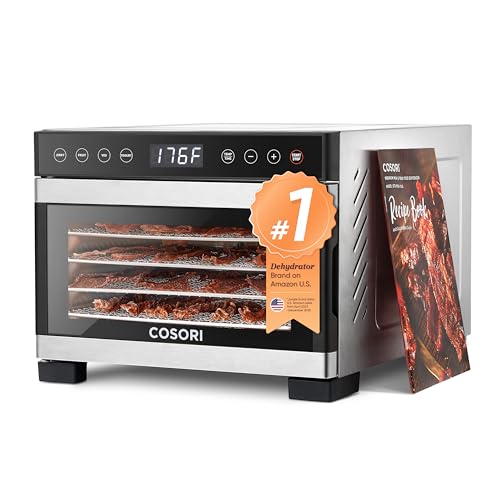
Cosori Food Dehydrator, 5 Stainless Steel Trays
Badge: Best Compact Quality
Strengths
- Horizontal airflow and stainless trays in a compact 3.1 ft² cabinet — the quality features of its larger sibling, shrunk honestly.
- No plastic contact with food, per the listing, for buyers who prioritise material purity.
- Four presets plus a 48-hour timer simplify repeatable results.
Trade-offs
- The listing states 176°F temperature control without stating the low end of the range in its title — confirm the floor on the listing if gentle drying is your priority.
- Five compact trays are a small-batch capacity by design.
- Presets help beginners but add nothing for users who always set manually.
Mini spec box (from listing data)
- Trays: 5, stainless steel; 3.1 ft² drying space
- Temperature: control up to 176°F (low end not stated in title)
- Airflow: horizontal; 4 presets; 48-hour timer
- Design: compact; no plastic contact with food (per listing)
Compact machines are where quality usually goes to die, which is why this Cosori matters: it keeps the architecture of the premium tier — horizontal airflow, stainless trays, a cabinet you load from the front — and simply makes it smaller. The no-plastic-contact design will decide the purchase for a specific kind of buyer on its own, and the four presets give repeatable starting points for the foods a small household dries most. Its stated ceiling of 176°F is the highest top-end figure in this guide, which suits jerky and crisp-finished snacks.
Who it suits: small households, apartment kitchens, and material-conscious buyers who want premium design at snack-and-herb scale. The honest limitation is the mirror of its sibling’s: the title states the top of the range but not the bottom, so a buyer whose craft is low-temperature work should verify the floor on the listing before ordering. Capacity is the other honest caveat — 3.1 ft² is a deliberate small-batch canvas, and households that outgrow it should look at the six-tray Cosori rather than forcing this one to be something it is not.
Best for: compact kitchens wanting premium airflow and materials / Not suited for: bulk batches, or buyers who need a stated low-temperature floor

Magic Mill Pro Food Dehydrator Machine, 7 Full-Size Stainless Steel Trays
Badge: Best Even-Drying System
Strengths
- A named 600W rear fan even-drying system — the listing tells you exactly how it moves air.
- The widest fully stated range here: 95°–176°, plus keep warm and auto shutoff.
- ETL listed, with seven full-size stainless trays.
Trade-offs
- Seven trays is mid-size: bulk preservers will still want the 15-tray machine.
- No drying-area figure is stated in the title data.
- No included accessory bundle is named in the title.
Mini spec box (from listing data)
- Trays: 7, full-size, stainless steel
- Fan: 600W rear fan even-drying system
- Temperature: 95°–176°; timer up to 48 hours
- Extras: keep warm, auto shutoff; ETL listed
This is the engineer’s pick. A rear-mounted fan blowing across full-size trays is the layout most directly aimed at the dehydrator’s core quality problem — evenness — and the listing says so in plain terms, then backs it with the widest stated range in the guide, from 95° for delicate work to 176° at the top. Keep warm and auto shutoff add the finishing discipline that separates a controlled process from a hopeful one, and the ETL listing completes an evidence set with no gaps that matter. Seven full-size trays will not win a capacity contest, but capacity was never this machine’s argument; consistency is.
Who it suits: precision-minded dryers — jerky makers chasing uniform batches, fruit dryers who hate rotating trays, anyone whose complaint about their last machine was uneven results. The honest limitation is scale, again: a harvest household will run this machine in relays where the fifteen-tray Premium finishes once. Judge it as the quality-per-batch champion of the mid-size class, the standard the team also applies across Best Food Dehydrators For Jerky, where even drying decides texture more than any other factor.
Best for: the most even, controlled batches at mid-size scale / Not suited for: maximum-volume preserving

PSIIDAN Food Dehydrator, 8 Full-Size Stainless Steel Trays
Badge: Best Quality Capacity Balance
Strengths
- Eight full-size stainless trays split the difference between mid-size and harvest machines.
- A fully stated 95°–167° range with a 48-hour digital timer.
- 650W gives the eight-tray load real pace.
Trade-offs
- The listing title names no fan layout, certification, or accessory bundle.
- A less familiar brand than the Magic Mill and Cosori names around it.
- No drying-area figure is stated in the title data.
Mini spec box (from listing data)
- Trays: 8, full-size, stainless steel
- Temperature: 95°–167°
- Timer: 48-hour digital
- Power: 650W
The PSIIDAN earns the closing slot by balancing the two numbers quality buyers juggle most: eight full-size stainless trays is enough for a serious family batch without crossing into furniture, and 650W behind a fully stated 95°–167° range means the control story is complete — gentle at the bottom, jerky-capable at the top, with a two-day timer for the wettest loads. On stated core evidence, it matches machines from bigger names figure for figure.
Who it suits: households that have outgrown five or six trays and want the next honest step without the fifteen-tray commitment. The honest limitation is the thinner evidence around the edges: no fan layout, certification, or accessory information appears in the title data, so buyers for whom those details are decisive should confirm them on the listing, and brand-history shoppers may simply prefer the longer track records elsewhere in this guide. On the core specification, though, this is a quality machine by the same measures applied to every pick here.
Best for: growing households wanting eight full-size stainless trays and a complete stated range / Not suited for: buyers who need certification or airflow details confirmed in advance
Comparison Table
| Pick | Badge | Trays / area | Stated temperature | Listing |
|---|---|---|---|---|
| Magic Mill Premium 15 | Best Overall Quality | 15 extra-large stainless | 95°–167°; 800W; 48H timer | Check on Amazon |
| Magic Mill Pro 10 | Best Quality Mid-Size | 10 stainless | Digital control; range not stated in title; keep warm; ETL | Check on Amazon |
| Cosori 6 | Best Horizontal Airflow | 6 stainless; 6.5 ft² | 95–165°F; 600W; horizontal airflow | Check on Amazon |
| Cosori 5 | Best Compact Quality | 5 stainless; 3.1 ft² | Up to 176°F; horizontal airflow; 4 presets | Check on Amazon |
| Magic Mill Pro 7 | Best Even-Drying System | 7 full-size stainless | 95°–176°; 600W rear fan; ETL | Check on Amazon |
| PSIIDAN 8 | Best Quality Capacity Balance | 8 full-size stainless | 95°–167°; 650W; 48H timer | Check on Amazon |
A final note on how to read the rankings that follow: the order reflects the quality evidence as a whole, not a single championship metric. The fifteen-tray flagship leads on completeness at scale, but a household that will never load fifteen trays experiences the seven-tray rear-fan machine as the higher-quality purchase, because every one of its batches will be more even. Read each review’s verdict line before the ranking position — the verdicts, not the order, are where this guide matches machines to lives.
How to Choose a Quality Food Dehydrator
Choose on the evidence chain, in this order. First, airflow architecture, because it decides evenness, and evenness decides whether you supervise the machine or trust it. Rear-fan and horizontal-airflow cabinets dry across their trays most uniformly; if a listing names its fan layout, that transparency is itself a quality marker. Second, a fully stated temperature range. You want the floor for herbs and delicate work — the quality picks here state 95° floors — and the ceiling your jerky or crisping methods require, stated in writing, not implied. Third, tray material and area: stainless steel for longevity and cleaning, and a drying area figure, in trays and ideally square feet, matched to your real batch size. A useful sizing rule is to picture your largest honest batch — a jerky marinade load, a box of peaches — and buy the smallest machine that takes it in one layer.
Fourth, finishing discipline: a 48-hour timer, auto shutoff, and keep-warm functions turn a long process into a controlled one, and their presence signals a maker designing for real routines. Fifth, verifiable extras — certifications named in the listing, stated noise figures, included accessories — each one a small proof that claims elsewhere in the listing were also made carefully. Finally, judge the silences. At the quality tier, a missing wattage or an unstated range end is not a trivial gap; either confirm it on the listing or choose the machine whose maker told you everything. The picks above were ranked by exactly that standard, which is why completely specified mid-size machines outrank larger vaguer ones for many households.
How to Use a Quality Dehydrator Well: Setup, Drying, Cleaning, and Troubleshooting
Premium control only pays if your technique matches it. Set the machine on a level, heat-safe surface with vent clearance, wash trays before first use, and preheat briefly while you slice. Slice uniformly — a mandoline or a disciplined knife hand matters more than any feature in this guide — and load in a single layer with airflow gaps, grouping pieces of similar thickness on the same tray so each tray finishes together. Use the stated range deliberately: gentle heat for herbs and delicate fruit, mid-range for most produce, the top end for jerky following your recipe’s complete safety process. Start checking before the earliest expected finish, because a precise machine dries on schedule and the last hour is where texture is decided: fruit pliable but not sticky, jerky cracking on the bend, herbs crumbling cleanly.
Cool before sealing, condition fruit in jars for several days with daily shaking, and clean trays while residue is fresh — stainless rewards a prompt wash with years of stain-free service. Wipe the cabinet interior, keep vents dust-free, and store trays dry. Troubleshooting follows the pattern. Problem: edges finish well ahead of centres on the same tray → pieces were loaded at uneven thickness or the tray was crowded; slice uniformly and leave gaps. Problem: a whole tray lags the rest → rotate tray positions on tall loads and check that no vent is blocked by an overhanging piece. Problem: dried food softens in storage → it was sealed warm or under-dried; return it for more time and condition before re-sealing. A quality machine narrows the margin for error; these habits close what remains.
What Quality Actually Buys You Over Five Years
The case for the quality tier is arithmetic over time, not luxury. A dehydrator’s working life is measured in hundreds of long, warm, humid runs — an environment that punishes cheap fans, thin trays, and vague thermostats. Stainless trays keep washing clean instead of accumulating the stained, odour-holding surface that makes owners quietly stop using a machine. A stated, accurate-feeling temperature range makes recipes repeatable, and repeatability is what turns dehydrating from an experiment into a pantry system: the jerky is the same in October as it was in June. Even airflow removes the labour tax of rotation, which is the difference between a machine used monthly and one used weekly. None of this appears on a feature list as a single line; it appears as the machine still being on your counter, in regular use, years after purchase. That is also why this guide is unimpressed by capacity alone — a huge machine with vague control is a big purchase, not a quality one, a distinction explored from the snack side in Best Food Dehydrators For Making Vegan Bread, where low, steady, even heat decides the result.
Materials in Depth: Why Stainless Trays Anchor Every Pick Here
All six picks use stainless steel trays, and that uniformity is a deliberate editorial choice rather than a coincidence of the pool. A dehydrator tray lives a hard life: acidic tomato juice, salty jerky marinade, sticky fruit sugars, and hours of warm humid air, repeated weekly for years. Stainless shrugs off that cycle. It does not absorb odour, so last month’s garlic jerky does not perfume this month’s apple rings; it does not stain into a permanent sunset after tomato season; and it tolerates the scrubbing that dried-on marinade eventually demands. Just as important, steel trays stay flat. A warped tray rocks, pools puree, and creates the thick-and-thin patches that dry unevenly, so material rigidity is quietly a drying-quality feature, not just a durability one.
The one deliberate exception in spirit is the compact Cosori, whose listing emphasises that food never contacts plastic anywhere in the drying chamber — a design statement aimed at buyers who think about materials beyond the trays themselves. If your household includes BPA-free plastic trays from an older machine, there is no need for alarm; the point of this section is forward-looking. When you buy at the quality tier, you are buying the surfaces your food will sit on for a decade, and stainless is the surface with the longest, cleanest track record in the category. Judge any future machine the same way: trays first, then the chamber, then the accessories that touch wet food, because those are the parts time tests hardest.
Noise, Heat, and Living With a Quality Machine
A dehydrator runs for hours in a lived-in home, so quality includes how the machine behaves as a roommate. Two picks here state a noise figure — under 48 dB in their listings — and the presence of that number matters beyond its value: it tells you the maker measured the machine in a real room and expects you to run it overnight in one. If you plan to dry in an open-plan kitchen or a small apartment, weight stated noise heavily and place the machine away from bedrooms for overnight jerky runs regardless of model. Heat is the second roommate factor. A dehydrator is a gentle space heater by design; in summer it will warm a small kitchen noticeably over a long batch, which is an argument for running big harvest loads in the evening and for the timer discipline the quality picks provide. Vent clearance is the third: every cabinet here exhales warm moist air, and a machine shoved against a wall or under a low cabinet dries worse and ages faster. Give it the clearance its manual asks for and the engineering you paid for can actually perform. These are unglamorous checks, but they are the difference between a quality machine experienced as quality and one experienced as a nuisance with good specifications.
Delivery-Day Quality Checks: Verifying the Machine You Ordered
Quality buying does not end at checkout; it ends with a fifteen-minute verification when the box arrives. First, count and inspect the trays: they should be flat, evenly finished, and free of sharp edges, and they should slide or stack smoothly through every position. Second, run the empty machine through its range — set the lowest stated temperature, then the highest, and confirm the display, the fan, and the timer all respond as the listing described; this is the moment to discover a discrepancy, not during your first harvest. Third, check the door or lid seal and the fit of every accessory named in the listing. Fourth, dry a single test tray of apple slices and note the time and evenness, tray by tray, in the drying log you will keep for the machine’s first month. If anything contradicts the listing — a missing stated feature, a range that does not match — you have learned it while returns are simple. This ritual sounds fussy, but it is exactly the habit that separates buyers who own quality machines from buyers who merely purchased them, and it takes less time than one batch of jerky.
There is also a quieter dividend: confidence with expensive ingredients. Nobody hesitates to load a tray of home-grown tomatoes into any machine, but a side of salmon for jerky, a farmers-market flat of ripe peaches at the peak of a short season, or a year’s supply of garden herbs concentrates the mind. A machine with a stated range, an even fan, and a timer you trust gets loaded without the hovering and second-guessing that vague machines provoke, and the food — which was the expensive part all along — comes out right the first time. Quality, in the end, is insurance on everything you will ever put inside the machine, priced once and claimed weekly.
Features That Signal Quality — and Features That Only Signal Marketing
Learn to sort a dehydrator’s feature list into evidence and decoration. In the evidence column: keep warm, which protects finished batches from the moisture reabsorption that quietly ruins texture; auto shutoff, which ends a batch on schedule instead of whenever you remember it; a timer measured in days rather than hours, because real food sometimes needs them; and presets only when they encode sensible temperatures for named foods, as on the compact Cosori, rather than a dozen mystery buttons. In the decoration column: vague claims of professional or commercial grade without a certification to match, drying-speed boasts with no wattage beside them, and accessory counts padded with pieces no home dryer uses. The picks in this guide were filtered by that sorting. Every headline feature in their reviews — the rear fan’s even-drying system, the horizontal airflow, the keep-warm functions, the ETL listings — is a feature you can point to, test on delivery day, and feel in the second year of use. When you evaluate any machine beyond this list, run the same sort and the quality tier separates itself from the merely expensive one surprisingly fast.
Matching the Quality Tier to Your Household
Three household profiles cover most quality buyers, and each maps to a different pick. The preserving household — garden, orchard trips, hunting season, a pantry of jars — should buy capacity with complete control: the fifteen-tray Magic Mill Premium, sized so the year’s biggest weekend fits in one load. The weekly-routine household — jerky for lunches, fruit for kids, herbs for cooking, every week without drama — should buy evenness and finishing discipline: the rear-fan seven-tray Pro for consistency, the ten-tray Pro for keep-warm forgiveness, or the six-tray Cosori for horizontal airflow and the clearest specification in the guide. The small-space household should refuse to compromise architecture for size: the compact Cosori keeps horizontal airflow, stainless, and a no-plastic-contact chamber at 3.1 ft². Notice what none of these profiles buys: the largest machine by default. Quality spending is precision spending — the right engineering for your actual routine — and a guide that ranks a compact machine beside a fifteen-tray flagship is making exactly that point.
Common Buying Mistakes
- Equating size with quality. Fifteen trays of vague control lose to seven trays of stated, even, certified engineering for most households.
- Skipping the range check. A quality purchase still fails if its stated floor or ceiling misses your recipes; read both ends before ordering.
- Ignoring airflow layout. Evenness is the daily quality experience; a named rear fan or horizontal airflow is worth more than extra presets.
- Treating certifications as decoration. Named listings like ETL are verifiable; unadorned claims of durability are not.
- Buying for the biggest batch of the year. Size for your typical large batch, and run the rare giant harvest in two loads on a right-sized machine.
- Forgetting the sink test. Extra-large trays must fit your sink and storage, or cleaning friction will quietly end the habit.
Final Recommendation
For the committed preserver, the first choice is the Magic Mill Premium Food Dehydrator Machine, 15 Extra-Large Trays — the most complete combination of capacity, stated range, timer, and power in this guide. Households drying weekly should take the Magic Mill Pro, 10 Trays with its keep-warm discipline, and evenness purists should take the Cosori Food Dehydrator, 6 Stainless Steel Trays for horizontal airflow and the most transparent specification here. The compact Cosori is the quality answer for small kitchens, the seven-tray rear-fan Magic Mill Pro is the consistency champion, and the PSIIDAN is the balanced eight-tray step up. Whichever you choose, you are buying the same thing: a machine whose evidence you could verify before it arrived.
Frequently Asked Questions
What is the single best marker of a quality dehydrator?
Specification honesty backed by materials: stainless trays, a fully stated temperature range, a named airflow layout, and a long timer. A maker that publishes drying area, wattage, and noise figures — as the Cosori six-tray does — is showing you its engineering instead of describing it in adjectives.
Is horizontal airflow really better than a stackable design?
For evenness with minimal supervision, generally yes: air moving across the trays treats the back of the cabinet like the front, reducing rotation. Stackable machines can dry beautifully with tray rotation built into the routine, but at the quality tier most buyers are paying precisely to remove that labour.
How wide a temperature range should a quality machine state?
Look for a floor around 95° for herbs and delicate work and a ceiling in the 165°–176° band for jerky and crisp finishes — the span the strongest picks here state. More important than any single figure is that both ends are stated in writing before you buy.
Do certifications like ETL matter for a dehydrator?
They are one of the few quality claims you can verify independently, which is why this guide notes them where listings name them — on the ten-tray and seven-tray Magic Mill Pro models here. A certification does not guarantee great drying, but it does evidence a product that passed a defined external check.
Are more trays always better at the quality end?
No. Trays you never load add cleaning, storage, and warm-up burden to every batch. The right quality purchase is the smallest machine that takes your largest typical batch in one layer — which is why this guide ranks a seven-tray consistency specialist alongside fifteen-tray capacity.
Is a quality dehydrator worth it for a beginner?
If you already know you will dry regularly, yes — even drying and honest controls make early batches succeed, and early success is what turns a new appliance into a habit. If you are genuinely unsure whether dehydrating suits your kitchen, a simpler starter is a rational first step; the quality tier will still be here when your first season of notes tells you exactly which upgrade you need.
Does wattage tell me anything about quality?
Indirectly. Wattage should make sense for the capacity it serves — the picks here run from 600W behind six or seven trays to 800W behind fifteen extra-large ones — and a listing that states wattage alongside area and range is practising the transparency this guide rewards. Very low wattage behind a very large tray count is a question worth asking on the listing, because moving enough warm air across that much food is real work.
Should I prioritise a stated noise figure?
Only if the machine will live near where people sleep or work. Two picks here state operation under 48 dB, which suits overnight runs in most homes. If your dehydrator will live in a utility room or garage, noise drops down the priority list and airflow, range, and materials should take its place.
How long should a quality dehydrator last?
There is no honest fixed figure, and this guide will not invent one. What predicts longevity is visible in advance: stainless trays that tolerate years of scrubbing, a fan and control system from a maker who specifies them fully, and finishing features like auto shutoff that reduce wear from forgotten batches. Buy the evidence, maintain the machine, and the years follow.