Disclosure: topratedkitchenware.com is reader-supported. When you buy through links on our site, we may earn an affiliate commission from Amazon and other retailers, at no extra cost to you.
Where to buy
A reusable chopstick is a promise: this pair, washed and used again, hundreds of times, instead of a disposable pair thrown away after one meal. The best material for reusable chopsticks is the one that keeps that promise longest and most hygienically — and the evidence points clearly at stainless steel. All six verified sets below are steel, all six are explicitly sold as reusable, and all six are listed as dishwasher safe, which is the practical heart of reusability. They differ in grade, construction, finish and fleet size, and the reviews judge each as a long-service material: how it washes, how it ages, and how completely it can replace disposables in a real household.
- MUYOS Stainless Steel Chopsticks, 5 Pairs — hollow-core lightweight; the reusable pair that feels like wood’s weight.
- Greatamzor Multicolor Stainless Steel Chopsticks, 5 Pairs — color-coded steel for a household reusable system, 9 1/4 inches.
- Greatamzor Titanium Plated Stainless Steel Chopsticks, 2 Pairs — the premium reusable, plated over a steel core.
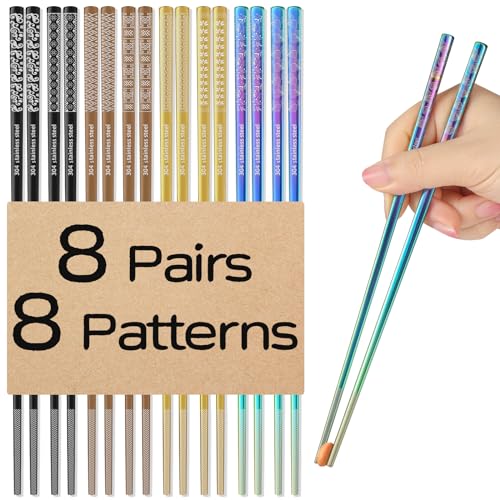
- NEWDRIP Multicolor Metal Chopsticks, 8 Pairs — eight reusable pairs, listed for cooking and eating.
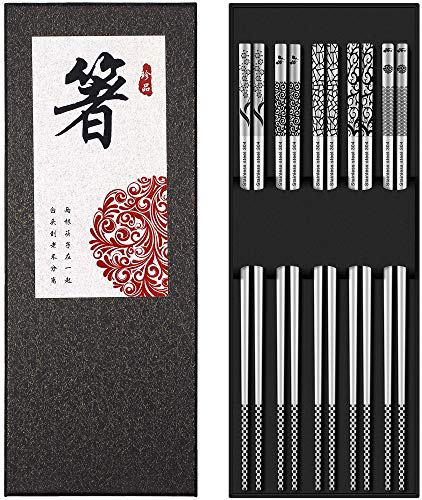
- Lazycorner 304 Stainless Steel Chopsticks, 10 Pairs — food grade 304 in the deepest reusable fleet here.
- IQCWOOD 304 Stainless Steel Chopsticks, 5 Pairs — classic 304 silver, 9.25 inches.
Read the full guide ↓ for what reusability really demands of a material, how steel compares with reusable wood, bamboo and fiberglass over years of washing, and the care routine that keeps a reusable set in service indefinitely.
Disposable chopsticks are a marvel of convenience and a quiet catastrophe of waste: a tree or bamboo culm grown, cut, shaped, wrapped, shipped and used for twenty minutes. Most people who search for the best material for reusable chopsticks have felt the small wrongness of the throwaway pair once too often — at a desk lunch, a takeaway night, a picnic — and want out. The exit is easy to start and surprisingly subtle to finish, because “reusable” is printed on many materials that age very differently under the one activity reusability actually consists of: washing, hundreds of times.
That is the lens of this guide. A reusable material must survive its own cleaning. Wood is reusable for a while, then the washing that keeps it hygienic is the washing that destroys it — a paradox with no solution, only a timeline. Bamboo lives the same paradox faster. Fiberglass resolves it honorably and lasts well. Stainless steel resolves it completely: the material of the dishwasher itself, non-porous, non-absorbent, indifferent to heat, detergent and time. The six sets below are steel in several grades and constructions, and the interesting questions among them are not whether they can be reused — they plainly can — but how gracefully each does it, for whom, and at what scale.
We will also keep the honesty standard of this series: reusability is a behavior as much as a material. A steel set abandoned in a drawer reuses nothing; a modest set carried daily displaces disposables by the hundreds over its life. The guide therefore covers the habits — carrying, storing, washing, assigning — that turn a material’s potential into actual reuse, alongside the picks themselves.
Key Takeaways
- Stainless steel is the strongest reusable material because it survives its own cleaning indefinitely: non-porous, non-absorbent, dishwasher-proof, with no finish that washing can strip unless one was applied for decoration.
- Reusable wood and bamboo live a paradox — washing keeps them hygienic and also destroys them — while fiberglass is the respectable runner-up material, a comparison we extend under Best Metal Chopsticks.
- Every pick here is sold as reusable and listed as dishwasher safe; several name their alloy (304 appears twice), which is the specification of a long washing life.
- Fleet size is a reusability feature: five to ten pairs means a clean pair is always ready, which is what actually breaks the disposable habit — see the eight- and ten-pair picks.
- Color coding turns reusables into a system each household member owns, the same logic that makes steel the favorite under Best Multi Use Chopsticks.
- The greenest chopstick is the one you actually reuse: choose the weight and feel you will carry and wash happily, not merely the most virtuous specification.
In this guide
Quick Picks
| Pick | Badge | Reusable strength | Link |
|---|---|---|---|
| MUYOS Stainless Steel Chopsticks, 5 Pairs | Best Lightweight Reusable | Hollow-core ease makes daily carrying and use effortless | Check on Amazon |
| Greatamzor Multicolor Stainless Steel Chopsticks, 5 Pairs | Best Household System | Colors assign every member a personal reusable pair | Check on Amazon |
| Greatamzor Titanium Plated Chopsticks, 2 Pairs | Best Premium Reusable | A keepable pair you will want to carry and reuse | Check on Amazon |
| NEWDRIP Multicolor Metal Chopsticks, 8 Pairs | Best Family Fleet | Eight pairs — reusables for the whole table and the lunch bags | Check on Amazon |
| Lazycorner 304 Stainless Steel Chopsticks, 10 Pairs | Best Bulk Reusable | Ten pairs of 304: disposables fully retired, at any scale | Check on Amazon |
| IQCWOOD 304 Stainless Steel Chopsticks, 5 Pairs | Best Classic Reusable | 304 silver in traditional proportions | Check on Amazon |
How These Picks Were Chosen
Reusability was the first filter, applied literally: a set qualified only if its verified listing presents it as reusable — all six here do, most in the title itself. The second filter was washability: every listing states dishwasher safe, because a reusable that cannot be machine washed will, in most households, quietly stop being reused. The third was material specification: named grades and described constructions were credited, because a maker who specifies the material is a maker expecting the set to be judged over years.
We then ranked by the lived experience of reuse. Weight decides whether a pair gets carried and used daily; grip decides whether it is pleasant enough to choose over the disposable in the takeaway bag; fleet size decides whether a clean pair exists at the moment of need; finish decides how the set looks after its five-hundredth wash. Each review weighs those factors for its pick and names the point where its reusable story is weakest.
This is a research-led guide. We invented no wash-cycle counts, lifespan years or waste statistics; where the environmental argument appears, it is made qualitatively, from the simple arithmetic that a pair used daily displaces a disposable daily. Spec boxes quote only the listings.
The 6 Best Reusable Chopsticks, by Material
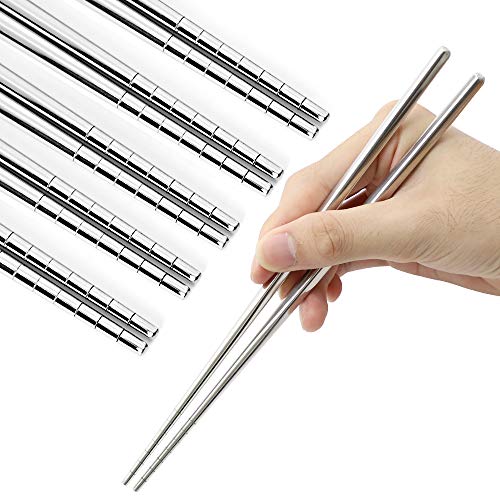
MUYOS Stainless Steel Chopsticks, 5 Pairs
Badge: Best Lightweight Reusable
- Material: Stainless steel
- Pairs: 5
- Construction: Hollow-core, lightweight design
- Tips: Non-slip
- Finish: Silver
- Care: Dishwasher safe; reusable for daily meals
Strengths
- Featherweight steel removes the main objection to carrying a reusable pair daily — it disappears into a bag or pocket case.
- One-piece simplicity: no joints, coatings or parts to fail across years of washing.
- Plain silver surface has nothing to peel, so the five-hundredth wash looks like the first.
Trade-offs
- Hollow construction can dent under crushing loads; a case is a wise companion.
- No steel grade or length is stated in the listing.
- Very light feel divides opinion among users who like heft.
Reusability research, if we can call kitchen common sense that, keeps rediscovering the same truth: the reusable that gets used is the one that is easy. The MUYOS set is engineered around that truth. Its hollow-core steel weighs closer to the wooden pairs people are used to, so the daily decision — take my pair or accept the disposable — tilts toward taking it. In a lunch bag, a desk drawer, a travel kit, this is the pair that is simply there, and being there is ninety percent of displacement.
The material supports the mission without asterisks. The listing says reusable and dishwasher safe in plain terms; the construction is a single formed piece of steel with non-slip tips, which means the washing that reusability demands has nothing to attack — no lacquer to lift, no glue line to open, no porous grain to saturate. A pair can be washed nightly for years and its specification sheet never changes.
Its care instructions are the lightest in this guide with one exception: do not crush it. A hollow stick in the bottom of a heavy bag is a dent waiting to happen, so give it the simple case or sleeve its portability invites. Do that, and this is the reusable most likely to actually be reused — which, as the introduction argued, is the only metric the planet grades on. It is also, not coincidentally, the pair cocktail and garnish work keeps borrowing, as noted under Best Metal Chopsticks Stirring Cocktails.
Best for: daily carriers — desk lunches, travel kits, takeaway regulars / Not suited for: users who want a heavy, solid-feeling stick

Greatamzor Multicolor Stainless Steel Chopsticks, 5 Pairs
Badge: Best Household System
- Material: Stainless steel
- Pairs: 5, in multiple colors
- Length: 9 1/4 inches (as stated in the listing)
- Design: Laser engraved copper coin pattern; square, non-slip profile
- Care: Dishwasher safe
- Format: Gift set
Strengths
- Color assignment is the behavior engine of household reuse: a pair that is “mine” gets used, washed and kept.
- Engraved grip is permanent through unlimited wash cycles.
- Steel hygiene supports personal pairs — a genuinely sanitary reason to keep your own.
Trade-offs
- Colors mellow over years of washing; the system survives, the saturation softens.
- The system needs household agreement to assign colors once.
- Bold pattern will not suit every table.
Households do not adopt reusables; people do, one pair at a time. This set understands that. Five colors convert an anonymous bundle into personal property — your color is your pair, at the table, in the wash, in the drawer — and personal property gets the care that communal property never does. The reusable revolution in most homes will not look like a manifesto; it will look like a kid insisting on the blue pair. This is the set designed for that reality.
The material makes the personal-pair system hygienic as well as psychological. Steel is non-porous and fully dishwasher safe, so a personal pair is a genuinely clean pair, reset completely at every wash; the engraved grip is cut into the metal, so the pair’s performance in year three matches its first week. Even the pattern plays along — the copper coin motif gives each color a traditional, giftable dignity, so the set arrives feeling like an upgrade rather than an eco lecture.
The honest caveats: colors are a finish, and finishes soften under years of detergent, though the assignment system works at any saturation; and the system asks for one household conversation to assign colors and mean it. Make that small investment and this set delivers the highest actual reuse rate of any pick here — the metric that matters, measured in disposables never opened. Its blend of system and steel is also why it anchors the wider survey under Best Metallic Chopsticks.
Best for: families converting from disposables who need a system everyone buys into / Not suited for: solo users or monochrome minimalists

Greatamzor Titanium Plated Stainless Steel Chopsticks, 2 Pairs
Badge: Best Premium Reusable
- Material: Stainless steel with titanium plating
- Pairs: 2
- Colors: Black and silver
- Design: Laser engraved, non-slip; Japanese Korean style
- Care: Dishwasher safe (per listing); reusable
- Format: Premium gift set
Strengths
- A reusable you are proud to carry displaces disposables in restaurants and offices, where they breed fastest.
- Titanium plating over stainless: the surface is hard, the core is forever.
- Two distinct colors make it a natural his-and-hers reusable set.
Trade-offs
- Two pairs cannot run a household’s whole reusable life.
- Plating prefers gentle washing to stay at its richest.
- No length or grade is stated in the listing.
There is a reusable strategy based on desire rather than duty: own a pair so nice that leaving it behind feels like leaving your good pen. This titanium plated set is that strategy in steel. It goes where disposables are most automatic — the restaurant table, the office lunch, the celebration — and replaces them with something that feels like an occasion. The listing presents it as a premium gift set, and as a gift it carries a gentle payload: reusability, delivered as luxury rather than as homework.
Materially it is built for the role. The plated surface is hard and stable; the core beneath is stainless, so the pair’s working life is not hostage to its finish. It is listed as reusable and dishwasher safe, so the premium object asks for no special pleading in the wash — though an owner who wants the black to stay deep will favor gentle cycles, as with any fine finish.
Its boundary is arithmetic: two pairs serve two people, beautifully, and no one else. Households should pair it with a fleet set below — the premium pair for going out, the fleet for staying in — which is, in the end, how most complete reusable systems actually look. As the personal, carried, kept end of the reusable spectrum, nothing in this pool does it better; community discussions of forever pairs circle the same ideal, as we note under Best Metal Chopsticks Reddit.
Best for: couples and gift givers who want reusability with a premium face / Not suited for: equipping a whole household from one box

NEWDRIP Multicolor Metal Chopsticks, 8 Pairs
Badge: Best Family Fleet
- Material: Stainless steel
- Pairs: 8, in multiple colors
- Length: 9.25 inches (as stated in the listing)
- Design: Laser engraved, non-slip; Japanese Korean Chinese styles
- Care: Dishwasher safe
- Stated uses: Cooking and eating; gift set format
Strengths
- Eight pairs is a complete displacement system: table, lunch bags and spares, all reusable.
- Colors scale the personal-pair system to a full family.
- Listed for cooking and eating, so the same fleet replaces disposable and single-use tools at the stove too.
Trade-offs
- Colors soften with years of washing, as all colored finishes do.
- No steel grade is stated in the listing.
- Eight pairs need organized storage to stay a fleet rather than a pile.
If the five-pair multicolor set is a household system, this is the same system at full strength. Eight engraved, color-coded steel pairs mean the reusable answer exists at every point of need: four at the table, two in lunch bags, two in the wash, and the disposable’s last excuse — “there wasn’t a clean pair” — retired permanently. Displacement is a logistics achievement before it is a moral one, and this set is logistics in a box.
The cooking-and-eating listing widens the displacement in a way worth noticing: single-use and disposable-adjacent tools accumulate at the stove as well as the table — the takeaway pair used to stir, the wooden pair sacrificed to a frying session. A steel fleet that cooks, serves and eats, then dishwashes as one, closes those leaks too. The engraved grip is permanent, the steel is non-porous, and the whole fleet resets together.
Expect the colors to mellow over the years — the system’s assignments survive fading, but the showroom palette does not — and give the fleet a holder worthy of it. For families serious about retiring disposables completely, this is the most capable instrument in the guide, and its only real rival is the ten-pair plain-steel set below, which trades the color system for a named alloy and a finish that cannot fade at all.
Best for: families who want disposables fully retired, at the table and the stove / Not suited for: small households that would rather own fewer, finer pairs

Lazycorner 304 Stainless Steel Chopsticks, 10 Pairs
Badge: Best Bulk Reusable
- Material: 304 stainless steel, food grade
- Pairs: 10
- Design: Non-slip, lightweight; heat resistant per listing wording
- Finish: Silver
- Care: Dishwasher safe; reusable for daily meals and gifts
Strengths
- Named 304 alloy is the reusable specification par excellence — the grade of equipment washed industrially forever.
- Ten pairs is total coverage: no meal, guest or lunch bag ever meets a disposable again.
- Plain silver cannot fade, peel or date; the fleet ages as one, evenly.
Trade-offs
- No color system, so personal assignment is by habit rather than hue.
- No length is stated in the listing.
- Utilitarian presentation; a working fleet, not a gift.
The Lazycorner set is the infrastructure answer. Ten pairs of named, food grade 304 stainless — the alloy of commercial kitchens, where reusables are washed at industrial tempo for years — in plain silver with non-slip tips. There is no finish to protect, no color to fade, no specification to apologize for. As a material proposition for reuse, it is close to a proof: this substance, in this count, ends the disposable question for a household of almost any size.
Scale changes the reusable experience in one more way worth naming: generosity. With ten pairs, the reusable pair becomes the house pair — handed to guests, lent to a neighbor’s picnic, sent in a lunch bag without a pang. Reusables that are precious get hoarded; reusables that are plentiful get used, and use is the entire point. The listing even nods at gifting, and a pair given from a fleet of ten is a small, practical ambassadorship for the whole idea.
Its compromises are the plain set’s own: no colors to assign, no stated length, no ceremony. Households that need the assignment system should take the NEWDRIP above; households that want the deepest, most specification-solid fleet should take this one — and will likely still be using it, unchanged, when today’s disposable habits are a memory. It is the natural flagship for the idea explored under Best Pair Of Chopsticks: that the right pair, multiplied, becomes a household standard.
Best for: large households, hosts and anyone buying the last fleet they intend to buy / Not suited for: buyers who want color assignment or gift presentation

IQCWOOD 304 Stainless Steel Chopsticks, 5 Pairs
Badge: Best Classic Reusable
- Material: 304 stainless steel
- Pairs: 5
- Length: 9.25 inches (as stated in the listing)
- Design: Lightweight, non-slip tips; Korean Japanese style
- Care: Dishwasher safe; reusable
Strengths
- The classic reusable form: named 304 steel, traditional proportions, no applied finish to age.
- Lightweight build makes the daily-use pair an easy habit.
- Non-slip tips keep performance constant across years of washing.
Trade-offs
- Plain styling; no color or pattern story.
- Five pairs is a household fleet, not a party fleet.
- Brand name suggests wood; the reusable material here is steel, as listed.
The IQCWOOD set is the reusable idea in its classic form, the way Korea — the culture that standardized metal chopsticks for daily life — has practiced it for generations: a named food-grade alloy, a plain bright finish, a comfortable traditional length, and a pair for each member of the household. Nothing about it is a campaign. It is simply what chopsticks look like when a whole society decides they are permanent objects, and that normalcy is its own argument: reusability succeeds when it stops feeling like a statement.
The details keep the promise quietly. 304 steel takes unlimited dishwasher cycles; the lightweight build keeps daily use pleasant; the non-slip tips are part of the stick, so the grip that makes the pair usable on day one is the grip of year five. Five pairs is the right fleet for a small household’s rotation — enough that washing never creates a shortage, few enough to store in a single holder.
Choose it if your reusable philosophy is “buy the correct thing once, in its standard form.” Choose the fleets above if you entertain, the colors if your household needs assignment, the hollow-core MUYOS if carry weight is your deciding factor, and the plated set if you want the reusable to feel like an occasion. The classic will be waiting, unchanged, whenever the drawer is reorganized — that is rather its point.
Best for: buyers who want the standard, correct reusable set without fuss / Not suited for: buyers who want color, pattern or maximum fleet size
Comparison Table
| Pick | Material (as listed) | Pairs | Finish | Reusable role | Link |
|---|---|---|---|---|---|
| MUYOS | Stainless steel, hollow-core | 5 | Silver | Daily carry | Check on Amazon |
| Greatamzor Multicolor | Stainless steel | 5 | Multicolor, engraved | Household system | Check on Amazon |
| Greatamzor Titanium Plated | Stainless steel, titanium plated | 2 | Black and silver | Premium personal pair | Check on Amazon |
| NEWDRIP Multicolor | Stainless steel | 8 | Multicolor, engraved | Family fleet | Check on Amazon |
| Lazycorner | 304 stainless steel | 10 | Silver | Bulk infrastructure | Check on Amazon |
| IQCWOOD | 304 stainless steel | 5 | Silver | Classic standard | Check on Amazon |
How to Choose a Reusable Chopstick Material
Judge reusability by the wash test: imagine the material after hundreds of hot, detergent-rich cycles, because that is the life you are actually buying. Wood emerges from that thought experiment swollen, faded and fraying; bamboo, sooner; melamine, warped at the edges of its tolerance; fiberglass, largely itself, with tips a little tired; stainless steel, itself, full stop — which is why every pick in this guide is steel and why the interesting choices are among steels, constructions and fleets.
Within steel, the reusable hierarchy is simple. A named grade (304 here, twice) is the specification of a long washing life. A plain finish outlasts an applied one cosmetically; engraving outlasts everything because it is geometry. A one-piece construction outlasts anything assembled. Then leave metallurgy and choose by behavior: the pair you will carry (lightweight), the system your household will honor (colors), the fleet size that guarantees a clean pair (five minimum, eight to ten for families and hosts). Reusability is a material multiplied by a habit; choose both halves deliberately.
And keep the disposable comparison honest. A reusable set displaces disposables only where it is present and pleasant — at the desk, in the bag, at the takeaway counter. That is an argument for owning pairs where life happens, not for owning one perfect pair in a drawer. The fleets in this guide exist because their makers understand the arithmetic of presence.
How to Keep a Reusable Set in Service for Years
The routine is short, and steel makes all of it easy.
- Wash after every use, by machine where possible. Every pick here is listed as dishwasher safe; load tips-down, un-nested, and let the machine do the sanitizing it was built for.
- Dry and store in a holder or tray. Pairs kept together stay pairs; loose pairs migrate, and migration is how reusable sets quietly shrink back into disposable habits.
- Assign and carry. Give each person their pair (colors help), and keep a pair where disposables ambush you — desk, bag, car.
- Refresh the surface occasionally. A paste of baking soda and water on a soft cloth lifts water spots and dullness from plain steel and returns the bright finish in a minute.
- Retire honestly. A bent or damaged pair should leave service; a fleet with spares makes that painless.
Troubleshooting. Problem: the set keeps shrinking → pairs are leaving in bags and not returning; assign colors, add a return spot by the sink, and top up with the fleet sizes in this guide. Problem: a pair smells of a strong meal → it should not, if it is steel; wash it once more, thoroughly, and check that what you own is truly non-porous steel rather than a coated lookalike. Problem: water spots make the fleet look tired → the spots are mineral film, not wear; a soft-cloth polish or a rinse aid in the machine restores the brightness that makes people happy to reuse.
The Disposable Comparison, Without the Lecture
It is worth understanding what a reusable displaces, calmly. A disposable pair is a manufactured object with a supply chain — grown, harvested, milled, wrapped, shipped, stocked — that delivers about twenty minutes of service. Multiplied by daily habits, the arithmetic becomes difficult to defend, which is why so many cuisines’ home cultures never adopted disposables for home use at all: the throwaway pair is largely a restaurant-and-takeaway artifact that leaked into homes. A reusable fleet reverses the leak. Its supply chain runs once; its service runs for years; its end-of-life is a recycling stream for a valuable metal rather than a bin.
The honest caveats keep the argument credible. A reusable set manufactured and abandoned displaces nothing, so buy for your real habits, not your aspirations. And disposables retain legitimate niches — large gatherings beyond your fleet, travel situations where washing is impossible. The goal this guide serves is not purity; it is a household default. When the default pair is steel, clean and present, the disposable becomes the exception it should always have been.
The Life Cycle, Compared Honestly
Walk each candidate material through a year of daily use and the reusable ranking explains itself. A wooden pair begins warm and grippy, spends its middle months raising grain at the tips despite careful hand washing, and ends the year either retired or demoted to cooking duty where its roughness matters less. A bamboo pair runs the same story at double speed with a lighter heart — it knew it was semi-disposable all along. A melamine pair survives the year structurally but shows it: scuffed, stained at the edges, faintly tired in a way that makes people reach for the disposable again, which is its own environmental failure.
Fiberglass writes the best non-metal story: unchanged in shape, unbothered by the dishwasher, its surface perhaps a little less silky at the tips by year’s end. It is the material this guide recommends without hesitation to anyone who cannot abide metal’s weight or sound. And steel simply declines to participate in the aging narrative: the year leaves it with a fine, even patina of use and every functional property intact. That refusal is why, in category after category of kitchen equipment, the professional world’s reusable default is the same alloy family as the six picks above.
One more year-two observation belongs in an honest guide: fleets age socially as well as materially. The set that still looks unified gets treated as a set — washed together, stored together, replaced never. The set that has become a miscellany of survivors gets treated as a drawer of sticks, and drawers of sticks leak pairs until someone buys disposables “just for now.” Plain, matching, unfading steel is not vanity; it is how a reusable system stays a system.
Teaching the Household: Kids, Guests and the Converted
A reusable fleet succeeds or fails at its edges — the child, the guest, the skeptical partner — more than at its center. For children, the winning properties are lightness and ownership: a light pair in their color, at their place, with the grown-ups using the same system rather than a superior exception. Steel’s durability quietly helps here too; the pair survives the drops, the drum solos and the dishwasher without a single parental wince, and the non-slip tips shorten the frustrating phase of learning.
For guests, the reusable offer should feel like hospitality, not policy. A clean steel pair at their setting, presented exactly like your own, converts better than any explanation — most guests simply enjoy the better tool. Keep enough fleet depth that guests never trigger a shortage (the eight- and ten-pair picks exist for this), and never make a guest wash their pair or feel monitored about it. The system’s job is to be invisible infrastructure with a visible upgrade.
For the skeptical partner, lead with performance rather than virtue: the grip is better, the pair is always clean, the takeaway tastes the same and the bin is emptier. Virtue can arrive later, at its own pace. Households that frame reusables as an improvement in the meal, not a tax on it, are the ones still reusing in year three — which is, not coincidentally, exactly the framing of every review in this guide.
When a Reusable Should Retire
Even steel has an end of service, and naming it protects the system’s standards. Retire a pair when it is bent beyond gentle trueing, when a tip is damaged enough to feel rough against the tongue or the bowl, or when a colored or plated finish has worn to a patchiness the owner no longer enjoys — function may persist past all three points, but a reusable people dislike gets quietly replaced by disposables, which is the worst retirement of all. Retire it, too, when its partner is lost and the fleet has no spare in its color; a half-pair lingering in the drawer is clutter, not thrift.
The good news is how rarely the fleet needs this conversation, and how painless depth makes it: with five to ten pairs, a retirement is an edit, not a crisis, and the set’s standard never dips. Recycle retired steel with household metal where your local system accepts it — the material’s last reusable act is becoming feedstock, which is a fitting end for the substance this whole guide is about.
The Personal Pair: A Carrying Culture
The reusable idea has an older, more personal form than the household fleet: my chopsticks. In Japan, the concept of one’s own pair — kept at home, sometimes carried in a case — has been ordinary for generations, and the personal pair collapses every reusability problem at once. It is always present, because it travels with its owner. It is always clean to its owner’s standard. It is never lost in a communal drawer, because it is property in the emotional sense. And it displaces disposables in the places fleets cannot reach: the office, the noodle bar, the train bento, the friend’s house.
The material for a carried pair has a specific profile, and it is instructive that the market converged on metal for it: light enough to forget in a bag (the hollow-core pick’s whole philosophy), tough enough to survive that bag (steel’s whole philosophy), and indifferent to being washed in an office sink and dried on a paper towel. The premium plated pick in this guide is the dressed-up version of the same idea — a personal pair as a small possession of quality, like a good pen — while the lightweight MUYOS is its everyday workhorse form.
If the fleet sections of this guide spoke to households, let this one speak to individuals: the single highest-leverage reusable purchase is one pair, in a case, that goes where you go. Fleets civilize the home; the personal pair civilizes everywhere else. A complete reusable life usually contains both, and every pick in this guide can play one of the two roles — which is why, beneath all the grades and finishes, this guide keeps returning to presence as the master property. The pair that is there is the pair that gets reused.
Common Buying Mistakes
- Buying “reusable” wood for a dishwasher household. The washing that reuse requires is the washing that ends wood; match material to your real cleaning habits.
- Buying one pair and calling it a system. Reuse fails at the moment no clean pair exists; fleet size is the fix.
- Choosing a finish you will not maintain. Colored and plated reusables are excellent — if gentle cycles are acceptable to you. Otherwise buy plain steel.
- Ignoring carry. Disposables ambush you away from home; a light pair in the bag is worth three in the drawer.
- Treating unnamed materials as equal to named grades. For a years-long purchase, a stated alloy is the specification you can hold.
- Letting pairs migrate. Holders, assignment and a return spot keep the fleet a fleet.
Final Recommendation
For the complete reusable answer, take the MUYOS set for daily carrying, the Greatamzor Multicolor set as the household system, or the titanium plated pair as the premium personal reusable — and scale up to the NEWDRIP eight or the Lazycorner ten when the household is large or the entertaining is frequent, with the IQCWOOD as the classic five-pair standard. The material verdict underneath all of them is the same, and it is the answer to the question in this guide’s title: for a chopstick meant to be used, washed and used again for years, stainless steel — named where possible, textured at the tips, present in enough pairs — is the best material there is.
Buy it once, assign it, carry it, wash it without ceremony, and the disposable pair becomes what it should always have been in a home that cooks: a rare exception for extraordinary days, not the default utensil of ordinary ones.
Frequently Asked Questions
What is the best material for reusable chopsticks?
Stainless steel, for one controlling reason: reusability is mostly washing, and steel is the only mainstream chopstick material that washing cannot degrade. It is non-porous, non-absorbent, dishwasher-proof and hygienic across unlimited cycles. Fiberglass is the strongest alternative; wood and bamboo are reusable for a shorter, gentler life.
How long can a stainless reusable set actually serve?
There is no fixed figure, and this guide invents none: the material has no wear-out mechanism in normal use, so service life is governed by loss and cosmetic finish aging rather than by the steel. That is why the guide emphasizes fleets and storage — the practical determinants of how long a set remains a set.
Are reusable chopsticks more hygienic than disposables?
A properly washed reusable is at least as hygienic: dishwashers wash hotter than hands and dry with heat, and steel’s non-porous surface gives residues nowhere to hide. The disposable’s hygiene advantage is that it is new — an advantage that evaporates the moment a reusable routine is in place, which the fleets in this guide are designed to make effortless.
Why not reusable bamboo, if it is renewable?
Bamboo is a good material with a shorter clock: it frays at the tips, dislikes soaking and dishwashers, and must be replaced far more often. Over years of daily use, the steel pair’s single manufacture can outweigh bamboo’s renewability — and a household that prefers bamboo can still choose it knowingly, hand wash it, and replace it on schedule. The guide’s objection is only to buying bamboo while expecting steel’s lifespan.
How many reusable pairs does a household need?
Enough that a clean pair always exists: five for most small households, eight to ten for families, hosts and lunch-bag households. The picks here are sized exactly along that scale, from the two-pair personal premium set to the ten-pair Lazycorner fleet.
Do colored reusable chopsticks stay hygienic?
Yes — the color is a finish on a steel body, and the set is listed as dishwasher safe, so the hygiene story is steel’s story. What changes over years is saturation, not safety. If you want the finish and the hygiene to age at the same slow rate, plain silver sets remove the question entirely.
What should I do with a reusable pair at a restaurant?
Use it exactly as you would the house pair, rest it on its rest or case rather than the table where custom prefers, and rinse it when you can before it goes back in its case. Carrying a personal pair — the premium and lightweight picks here are built for it — is normal practice in much of the world and quietly welcomed anywhere disposables are the alternative.
Should each family member have their own reusable pair?
It helps more than any other single habit. A personal pair — assigned by color in the multicolor sets here, or simply by agreement — gets used more, washed more reliably and lost less than communal pairs, and it is the pattern that cultures with personal-chopstick traditions settled on long ago. Fleets make it possible; assignment makes it personal.
Can a reusable steel set go in the dishwasher every day?
Yes — that is precisely the life it is built for, and every pick in this guide is listed as dishwasher safe. Plain silver finishes are the most indifferent to daily cycles; colored and plated finishes keep their looks longest on regular rather than hottest settings. Either way, daily machine washing is not a risk to the steel; it is the routine the material was chosen for.