Disclosure: topratedkitchenware.com is reader-supported. When you buy through links on our site, we may earn an affiliate commission from Amazon and other retailers, at no extra cost to you.
Where to buy
Searching for the best most accurate measuring spoons you can buy without a laboratory budget? The six sets below are this guide’s recommendations, in review order. Each name links to its Amazon listing, where you can check the latest price on Amazon and verify the stated sizes and accessories.
- U-Taste 18/8 Stainless Steel Measuring Spoons Set of 9 — Check on Amazon
- THLHKD 13-Piece Stainless Steel Measuring Cups and Spoons Set with Funnel
- Rena Chris 6-Piece Heavy Duty Stainless Steel Measuring Spoons Set
- Spring Chef Stainless Steel Magnetic Measuring Spoons Set of 8, Black
- TILUCK Stainless Steel Measuring Cups and Spoons Set of 10
- TILUCK Stainless Steel Measuring Cups and Spoons Set of 6 with Coffee Scoop
Read the full guide ↓ for an honest account of what accuracy means for a spoon, which design features actually support it, and which parts of accuracy are your technique rather than your tools.
Accuracy is the most abused word in the measuring spoon category, so this guide starts with a definition. A measuring spoon is accurate when it delivers the same volume every time you use it, and when that volume matches the standard the recipe assumes. Two different things can go wrong: the spoon itself can be inconsistent, because it flexes, its rim is uneven, or its size is badly formed; and the cook can be inconsistent, heaping one spoon and leveling the next. The best most accurate measuring spoons attack the first problem with rigid stainless steel construction, true rims, fine stated increments, clear markings, and in one case here an included leveler, while good technique, covered in the how-to section, handles the second. This guide compares six stainless steel sets on exactly those accuracy-relevant features: the fineness and completeness of their stated size ranges, the presence of a leveler, dual metric and US markings for cooks who convert, and the structural qualities that keep a spoon’s volume stable over years. It also covers the unglamorous systems around the spoons, storage that keeps a set complete, a measuring order that keeps dry spoons dry, and a two-week routine for turning careful measuring into an automatic habit, because in real kitchens those systems decide as much of the result as the steel does. No spoon here is certified laboratory equipment, and the guide does not pretend otherwise; what it offers is the honest hierarchy of which sets give a careful cook the most repeatable results.
Key Takeaways
- Repeatability is the practical form of accuracy: a rigid stainless steel spoon with a true rim delivers the same volume every time, while flexible spoons vary with every scoop.
- Fine stated increments, down to 1/16 teaspoon with 1/3 and 3/4 teaspoon sizes, remove estimation, which is the largest single source of measuring error.
- A leveler standardizes the sweep across a spoon or cup, and one set here includes one in the box.
- Dual metric and US markings prevent conversion errors for cooks working from international recipes.
- Technique contributes at least half of real-world accuracy: level dry goods, fill liquids to the brim, and never measure with eating spoons.
- For ingredients where grams matter most, such as bread flour at scale, a spoon set pairs with a kitchen scale; spoons remain the right tool for small, potent quantities.
- Storage is an accuracy feature: nesting, stacking, and magnetic sets stay complete and in size order, and a complete set prevents the estimations that missing pieces force at the counter.
- Measure dry ingredients before liquids, or dry the spoon completely in between, because a damp spoon measurably changes the next dry amount it picks up and delivers.
In this guide
Quick Picks
| Pick | Badge | Set size | Accuracy-relevant feature from the listing | Link |
|---|---|---|---|---|
| U-Taste Spoons Set of 9 | Best Overall for Accuracy | 9 spoons | Finest stated increments: 1/16, 1/3, 3/4 tsp included | Check on Amazon |
| THLHKD 13-Piece Set | Best Complete Kit | 13 pieces plus funnel | Cups and spoons in one stackable steel system | Check on Amazon |
| Rena Chris Spoons Set of 6 | Best Dual Markings | 6 spoons | Metric and US measurements, heavy duty build | Check on Amazon |
| Spring Chef Magnetic Set of 8 | Best with Leveler | 8 spoons plus leveler | Included leveler, dual sided, magnetic nesting | Check on Amazon |
| TILUCK Set of 10 | Best Nesting Kit | 10 pieces, cups and spoons | Nesting steel cups and spoons for cooking and baking | Check on Amazon |
| TILUCK Set of 6 with Coffee Scoop | Best for Coffee Routines | 6 pieces | Cups and spoons plus a coffee scoop spoon | Check on Amazon |
How These Picks Were Chosen
This is a research-led guide. No laboratory volume testing was performed, and the guide does not claim any. Instead, the six sets were compared on the accuracy-relevant facts their manufacturers state: the exact sizes included, because estimation between sizes is where error enters; the material, because rigid stainless steel holds a formed volume while flexible materials do not; included accessories, because a leveler mechanically standardizes the most variable step in dry measuring; and marking systems, because dual metric and US markings remove conversion arithmetic. Sets earned their ranking by how many of those error sources they eliminate on paper, and the reviews state plainly what each listing does not tell us. Prices change and are not printed; check the latest price on Amazon through the links. If your accuracy problem is really about reaching into jars, the companion guide to Best Narrow Measuring Spoons covers the profiles that measure accurately at the jar mouth, and the guide to Best Professional Measuring Spoons looks at the same category through a working-kitchen lens.
The 6 Best Most Accurate Measuring Spoons
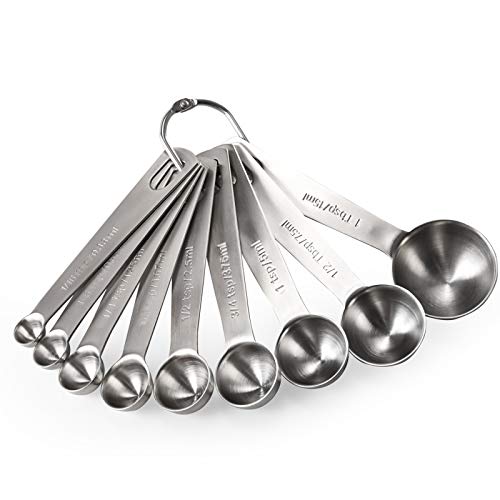
U-Taste 18/8 Stainless Steel Measuring Spoons Set of 9
Badge: Best Overall for Accuracy
Strengths
- The most complete stated size ladder here: 1/16, 1/8, 1/4, 1/3, 1/2, and 3/4 teaspoon, 1 teaspoon, 1/2 tablespoon, and 1 tablespoon, so almost no amount needs estimating.
- 18/8 stainless steel is stated, and rigid steel keeps each formed volume stable across years of use.
- Intermediate sizes make scaled recipes exact, which is where home measuring error concentrates.
Trade-offs
- No leveler is included, so the leveling step still depends on your knife technique.
- Nine similar spoons require reading the handle every time; grabbing by memory invites the wrong size.
- Spoons only, with no cups for volume baking measures.
Mini spec box
- Material: 18/8 stainless steel
- Pieces: 9
- Sizes stated: 1/16 tsp, 1/8 tsp, 1/4 tsp, 1/3 tsp, 1/2 tsp, 3/4 tsp, 1 tsp, 1/2 tbsp, 1 tbsp
- Use: dry and liquid ingredients
Accuracy fails most often not because a spoon is badly made but because the needed size does not exist and the cook estimates. This set’s stated ladder attacks that failure directly. When a recipe is cut to a third, the 1/3 teaspoon exists. When a half recipe needs 3/4 teaspoon of baking soda, the spoon exists. When a spice blend calls for a pinch-level amount, the 1/16 teaspoon turns a gesture into a number. Each of those moments, handled by estimation with a lesser set, is a small error; across a recipe they compound into the familiar complaint that the dish never comes out the same twice. The stated 18/8 stainless steel supports the other half of accuracy, consistency over time, since the bowls will not flex or warp under normal kitchen use. The honest limits are the missing leveler and the attention nine spoons demand. Neither undermines the core case: for a cook who measures carefully, this is the set that removes the most estimation from the process, and estimation is the enemy accuracy shoppers are actually fighting.
Best for: bakers and blenders who scale recipes and hate estimating / Not suited for: cooks who want an included leveler above all

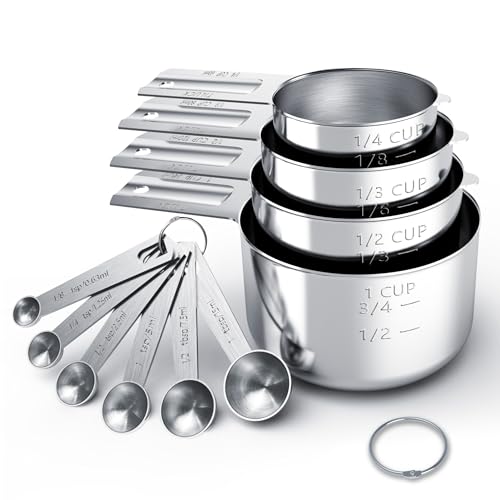
THLHKD 13-Piece Stainless Steel Measuring Cups and Spoons Set with Funnel
Badge: Best Complete Kit
Strengths
- Cups and spoons from one maker in one material, so the whole measuring system shares consistent forming and markings.
- Stackable storage keeps the system together, and a set that stays complete stays accurate.
- Dishwasher safe per the listing, and clean, dry spoons measure better than spoons with residue.
Trade-offs
- The listing summary does not enumerate the spoon sizes, so verify the ladder on the product page if fine increments matter.
- No leveler is stated among the accessories.
- Thirteen pieces is more hardware than a spoons-only specialist needs.
Mini spec box
- Material: stainless steel
- Pieces: 13, measuring cups and spoons, plus funnel
- Storage: stackable
- Care: dishwasher safe
- Use: dry and liquid ingredients; baking and cooking
Most home measuring error does not come from spoons at all; it comes from cups, where scooping flour from the bag can overshoot a recipe dramatically. A combined steel kit addresses the whole system at once: rigid cups that hold their volume, spoons from the same maker, and markings in a single style so the eye learns one system. The stackable format supports accuracy in an unglamorous way, by keeping the set complete and findable; a missing quarter cup replaced by estimation is an accuracy failure caused by storage, and it happens constantly in disorganized drawers. The included funnel serves the pantry side of precision, refilling spice jars without the spills that lead to shaking spices directly into food. The caveats are real: the listing summary here does not state the exact spoon sizes, and no leveler is mentioned, so a buyer whose priority is the finest spoon ladder should choose the U-Taste set, while a buyer whose priority is a consistent cups-and-spoons system will find this kit the more complete answer.
Best for: equipping a full measuring system in one consistent material / Not suited for: specialists who need a stated 1/16 teaspoon

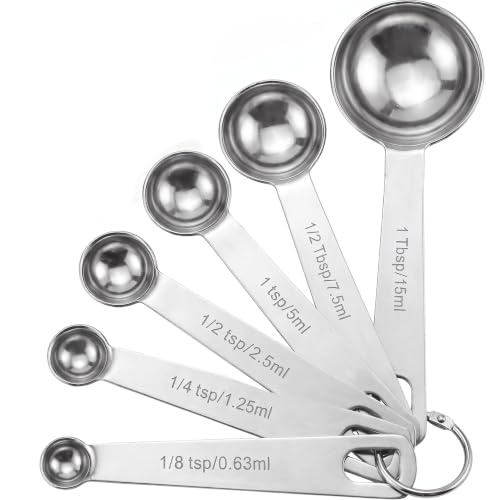
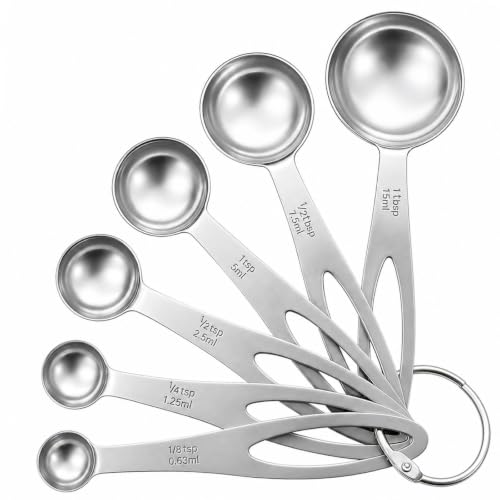
Rena Chris 6-Piece Heavy Duty Stainless Steel Measuring Spoons Set
Badge: Best Dual Markings
Strengths
- Metric and US measurements are both stated, eliminating the conversion step where many errors occur.
- Heavy duty stainless steel resists the bending that silently changes a spoon’s volume.
- A focused six-piece set means fewer wrong grabs than a large ring of similar spoons.
Trade-offs
- Six pieces cannot include every intermediate size, so some amounts still need combining.
- No leveler or cups are included.
- The listing describes a small tablespoon design, which suits small containers but holds liquid less forgivingly than a deep bowl.
Mini spec box
- Material: stainless steel, heavy duty
- Pieces: 6
- Design note: small tablespoon
- Measurements: metric and US
- Use: dry and liquid ingredients
A large share of measuring inaccuracy is actually arithmetic inaccuracy. A recipe in milliliters, a cook thinking in teaspoons, a hurried conversion at the counter: the spoon is fine and the number is wrong. Rena Chris removes that step by stating both measurement systems, so the cook reads the recipe’s own units off the handle. The heavy duty description supports the mechanical side of accuracy, because the most insidious spoon failure is a slowly bent handle or flexed bowl that changes volume without announcing itself; rigid construction is what prevents it. Six focused pieces also reduce selection error, the simple mistake of grabbing the half teaspoon when the recipe wanted the quarter. The trade-offs are scope: no fine intermediate ladder is claimed, no leveler is included, and the small-tablespoon profile is a compact design rather than a deep liquid bowl. For the internationally cooking household, though, this set eliminates an entire category of error that the other sets leave to mental math, and that is a genuine accuracy feature.
Best for: cooks using metric and US recipes interchangeably / Not suited for: bakers who need many intermediate spoon sizes

Spring Chef Stainless Steel Magnetic Measuring Spoons Set of 8, Black
Badge: Best with Leveler
Strengths
- Includes a leveler, the accessory that mechanically standardizes dry measuring, the most variable step in spoon accuracy.
- Dual-sided spoons let you measure a dry ingredient and a liquid with separate ends, avoiding wash-and-dry errors mid-recipe.
- Magnetic nesting keeps the full set together, so the size you need is present when you need it.
Trade-offs
- The listing summary does not enumerate the exact sizes, so check the product page for the ladder.
- The black finish may not suit every kitchen’s tools.
- Dual-sided spoons need both ends washed after use.
Mini spec box
- Material: stainless steel
- Pieces: 8, dual sided, plus leveler
- Finish: black
- Storage: magnetic nesting
- Care: dishwasher safe
- Use: dry and liquid ingredients
If one accessory in this category genuinely improves accuracy, it is the leveler. Dry measuring error lives in the sweep: the angle of the knife, the pressure, the decision of what counts as level. A leveler replaces judgment with a straight edge designed for the spoon, producing the same result on the first bake and the fiftieth. Spring Chef includes one here, and pairs it with two supporting systems. Dual-sided spoons prevent the wet-spoon problem, where a spoon rinsed mid-recipe and incompletely dried grabs extra dry ingredient and inflates the next measure; with separate ends for dry and liquid, the dry end stays dry. Magnetic nesting prevents the missing-spoon problem, where the needed size is absent and estimation fills the gap. The listing summary does not state the size ladder, which keeps this set from the top spot in an accuracy guide despite its accessories; verify the sizes on the product page. For cooks whose inconsistency comes from process rather than missing sizes, this is arguably the most practical set in the guide.
Best for: process-driven cooks who level everything / Not suited for: buyers who need the size list guaranteed before ordering

TILUCK Stainless Steel Measuring Cups and Spoons Set of 10
Badge: Best Nesting Kit
Strengths
- Cups and spoons in nesting stainless steel, giving one consistent system for cooking and baking.
- Nesting storage keeps the set complete and ordered by size, reducing selection errors.
- A mid-size piece count balances coverage against drawer clutter.
Trade-offs
- The listing summary states neither the exact spoon sizes nor a leveler.
- Buyers wanting stated fine increments should choose the U-Taste set instead.
- Cups and spoons together are more than a spoons-only cook needs.
Mini spec box
- Material: stainless steel
- Pieces: 10, cups and spoons
- Storage: nesting
- Use: cooking and baking
TILUCK’s ten-piece kit makes the system argument for accuracy: one maker, one material, cups and spoons nested in size order. There is a subtle benefit to nesting in size order that rarely gets mentioned: you learn the set spatially. The spoon you need sits in a predictable position in the stack, which reduces the grab-the-wrong-size errors that plague loose rings of similar spoons, and a missing piece is obvious at a glance, before it becomes an estimation at the counter. Rigid stainless steel throughout keeps both the cup volumes and spoon volumes stable, and for general cooking and baking that stability is the foundation everything else builds on. The limits are informational: the listing summary does not publish the spoon ladder or mention a leveler, so the precision specialist has better-documented options above. As a dependable, complete, mid-size system for a household that cooks and bakes regularly, it is a sound accuracy buy, and readers concerned with materials can cross-reference the discussion in Best Non Toxic Measuring Spoons.
Best for: households wanting one nesting cups-and-spoons system / Not suited for: precision shoppers who need stated fine increments

TILUCK Stainless Steel Measuring Cups and Spoons Set of 6 with Coffee Scoop
Badge: Best for Coffee Routines
Strengths
- A dedicated coffee scoop spoon supports the most repeated measuring routine in most kitchens, where consistency defines the result.
- Cups and spoons in stainless steel cover both the coffee station and general cooking.
- Six pieces is a compact system that stays complete easily.
Trade-offs
- The smallest piece count here means the least stated coverage for baking increments.
- No leveler is mentioned in the listing summary.
- Serious bakers will want a fuller spoon ladder alongside it.
Mini spec box
- Material: stainless steel
- Pieces: 6, cups and spoons, coffee scoop spoon included
- Use: cooking and baking
Accuracy is a habit before it is a specification, and no measuring habit repeats more often than coffee. A set that includes a dedicated coffee scoop spoon acknowledges that routine: the same scoop, filled the same way, produces the same cup, and drift in a daily routine is exactly what repeatability exists to prevent. The rest of the six-piece system covers everyday cooking and baking measures in the same rigid stainless steel, and the compact count makes the set easy to keep complete, which as this guide has argued is an underrated accuracy feature. The limits are coverage: six pieces cannot match the U-Taste ladder for baking increments, and no leveler is stated. Buy this set if your most consequential measuring happens at the coffee station and your baking is occasional; buy the U-Taste or a leveler-equipped set if your consequential measuring happens in recipes. Readers outfitting a small kitchen can compare retail options in Best Place To Get Measuring Spoons.
Best for: coffee-first households and compact kitchens / Not suited for: frequent bakers needing fine increments
Comparison Table
| Set | Pieces | Finest size stated | Leveler | Markings | Link |
|---|---|---|---|---|---|
| U-Taste 9 | 9 | 1/16 tsp | No | US sizes stated in listing | Check on Amazon |
| THLHKD 13-Piece | 13 plus funnel | Not stated in summary | No | Not stated in summary | Check on Amazon |
| Rena Chris 6 | 6 | Not stated in summary | No | Metric and US | Check on Amazon |
| Spring Chef Magnetic 8 | 8 plus leveler | Not stated in summary | Yes | Not stated in summary | Check on Amazon |
| TILUCK 10 | 10 | Not stated in summary | No | Not stated in summary | Check on Amazon |
| TILUCK 6 | 6 | Not stated in summary | No | Not stated in summary | Check on Amazon |
How to Choose Measuring Spoons for Accuracy
Rank the error sources in your own kitchen before ranking products. If your recipes fail when scaled, your error is estimation, and the fix is a stated fine ladder like the U-Taste set’s. If your results vary bake to bake with the same recipe, your error is process, and the fixes are a leveler, rigid spoons, and the leveling habit. If your errors cluster around imported recipes, your error is conversion, and dual markings are the fix. If your errors are random, missing sizes, wrong grabs, wet spoons, your error is organization, and nesting or magnetic sets that stay complete and ordered are the fix. Material underlies all of it: stainless steel holds a formed volume, while flexible materials and bent handles quietly change it. Beyond the spoons themselves, decide where spoons end and a scale begins. For small, potent ingredients, spoons are the precision instrument. For large dry quantities, weight is more repeatable than volume, and the wisest accuracy purchase may be a spoon set for the small end plus a scale for the large end. Tier differences in this category buy increments, accessories, and completeness rather than exotic materials, so match the spend to your dominant error source.
How to Measure with Maximum Repeatability
Adopt a fixed routine and never improvise it. For dry ingredients: stir the ingredient in its container to loosen it, spoon it into the measure until heaped, then level with a leveler or a straight knife edge in one sweep, without tapping or shaking the spoon first, since tapping packs the contents and inflates the measure. For flour in cups, spoon and level the same way; never scoop from the bag. For liquids: fill to the brim on a level surface, check at eye level, and pour in one steady motion. For sticky ingredients: oil the spoon lightly first so the full measure actually leaves the spoon. Sequence your measuring dry-first when a recipe allows, so spoons stay dry for dry ingredients; when you must alternate, wash and dry completely, because a damp spoon measurably changes the next dry measure. Read the handle every time, even when you are sure; selection error is the cheapest error to prevent and the most embarrassing to make. Finally, write down your adjustments: when a recipe works, the numbers that made it work are your kitchen’s data, and accurate tools are what make those numbers worth recording.
Troubleshooting
Problem: the same recipe varies from bake to bake → audit the process before the tools: heaping versus leveling, scooping versus spooning flour, and wet spoons are the usual causes; standardize one routine and the variation usually disappears.
Problem: scaled recipes taste wrong → the fractions were estimated; switch to a set with stated intermediate sizes such as 1/3 and 3/4 teaspoon, or convert the whole recipe to metric and use dual-marked spoons.
Problem: dry ingredients cling and the dose seems short → the spoon was damp or the ingredient is electrostatic; dry the spoon fully, tap the handle to release the contents, and for sticky liquids pre-oil the bowl.
Problem: two cooks in the same kitchen get different results from the same set → their routines differ, not the tools; agree on one written routine for leveling, filling, and measuring order, and keep it with the set until it becomes the house standard everyone follows without thinking.
The Four Sources of Spoon Error, Ranked
First and largest is estimation: measuring an amount the set does not include by eye. It is eliminated by size ladders, not by care. Second is process variation: heaping, packing, and inconsistent leveling, eliminated by routine and levelers. Third is tool deformation: flex, bends, and worn rims that change the formed volume, eliminated by rigid stainless steel and reasonable care. Fourth is selection and conversion error: the wrong spoon, or the right spoon in the wrong unit system, eliminated by readable markings, ordered storage, and dual-unit handles. Notice that only the third source is really about manufacturing quality in the way marketing implies. The other three are about the match between the set’s design and the cook’s habits, which is why this guide ranks sets by the errors they remove rather than by abstract quality claims, and why the cheapest accuracy upgrade available to any cook is a fixed measuring routine with the set they already own, applied while they decide which set removes the rest of their errors.
Spoons or Scale? An Honest Division of Labor
Accuracy shoppers eventually ask whether they should skip spoons and weigh everything. The honest answer is that the tools divide the kitchen between them. Weighing wins for large, variable-density ingredients: flour above all, where volume measures swing with packing and humidity. Spoons win for small quantities, where a scale’s resolution and the tare dance make weighing slower and often less reliable than a leveled spoon, and for liquids in teaspoon amounts, extracts, and potent spices where the dose is tiny and the spoon is the natural instrument. Most accurate kitchens run both: a scale for the flour, spoons for the salt, leavening, spices, and flavorings. The sets in this guide are the spoon half of that system, chosen so the small end of your measuring is as repeatable as the weighed end. A cook who pairs the U-Taste ladder with a basic scale has covered the realistic accuracy frontier of a home kitchen, and further spending buys convenience rather than correctness.
Reading the Markings: The Accuracy Feature You Use Every Time
Every measure begins with a reading, and reading errors are pure loss: the spoon was right, the recipe was right, and the cook grabbed the wrong size. Marking quality therefore deserves more weight in an accuracy guide than it usually gets. The practical questions are whether the size is marked on every spoon rather than only on a ring tag, whether the marking survives washing, and whether similar sizes are distinguishable at a glance in poor light. Stamped or deeply formed markings in metal are the most durable form, readable by touch as well as by sight, and they are the main reason a steel set’s accuracy persists while a printed plastic set’s accuracy quietly expires as its ink does. Dual-unit handles, like those on the Rena Chris set, add a second reading benefit: the cook reads the unit the recipe uses, rather than converting and risking a transposed number. There is also a human-factors point in set size. With nine spoons, as in the U-Taste set, the ladder is complete but the handles must be read every time; with six, selection is faster but some sizes are absent. Neither is universally better. The accurate kitchen is the one whose cook actually performs the reading step, so choose the set size you will genuinely read rather than the one that looks most complete in a photograph.
A small habit multiplies the value of good markings: store the set in size order. Nesting sets do this structurally, which is part of their accuracy case, and ring sets can be arranged the same way with ten seconds of attention when they are put away. Size order turns selection into a position check as well as a reading check, and two checks catch more errors than one. Cooks who bake with a partner benefit doubly, because either person can verify the other’s spoon at a glance. Accuracy culture sounds grand for a spoon drawer, but it is nothing more than these small, repeatable verifications, and they are available to any kitchen regardless of budget.
Accuracy at the Small End: Why Tiny Measures Drift First
Errors are proportional, and the small end of the spoon set is where proportionality bites. A slight heap on a tablespoon of flour is a small percentage of the total; the same slight heap on an eighth teaspoon of salt can approach the size of the measure itself. This is why the fine end of the ladder deserves the most scrutiny when buying for accuracy, and why the stated presence of 1/16 and 1/8 teaspoon sizes, and the intermediate 1/3 and 3/4 sizes, weighed so heavily in this guide’s ranking. Small spoons also suffer the most from clinging: a film of spice left in the bowl is a trivial share of a tablespoon and a serious share of a quarter teaspoon. The countermeasures are technique, not money: tap the handle to release, rinse and fully dry between potent ingredients, and level with extra care because the sweep error is proportionally largest exactly where the spoon is smallest. Dual-sided designs help here as well, since a dry end reserved for dry ingredients avoids the damp-spoon cling that inflates and then short-changes successive small measures. If your cooking lives at the small end, in blends, cures, and small bakes, weight your purchase toward the ladder and the leveler, and treat the larger spoons as the easy part of the set.
Building an Accuracy-First Measuring Drawer
An accurate drawer is a small system. Its elements: one complete spoon set with a fine ladder, kept together and in order; one set of rigid cups, ideally from the same material family, for the volume end; a straight-edged leveler or a designated leveling knife that lives with the spoons rather than wandering the kitchen; and, for households that bake by weight, a scale stored where it will actually be used. The combined kits in this guide, from THLHKD and TILUCK, are attempts to sell that system in one box, and their nesting and stacking formats are system features, not packaging trivia, because a system that stores as one object stays complete. Completeness deserves repeating as an accuracy principle: every missing piece is replaced at the counter by an estimate, and estimates are the top-ranked error source in this guide. The drawer should also evict its saboteurs: the bent teaspoon from an old set, the flatware spoons that drift in from the table, the unmarked scoop of unknown volume. Each is a wrong answer waiting to be grabbed in a hurry. What remains is unglamorous and effective: known tools, in known places, with readable sizes, used with a fixed routine. That is the entire accuracy program, and every product decision in this guide is simply a way to buy a head start on it.
What Accuracy Cannot Fix: Ingredient and Recipe Variables
An honest accuracy guide should end its advice with the limits of the tool. Spoons control volume; recipes are affected by much more. Flour varies in density with humidity and brand, brown sugar packs differently from week to week, and spice potency fades with age, so a perfectly leveled teaspoon of a year-old spice delivers less flavor than the same spoon when the jar was fresh. Oven thermostats drift, and two ovens set alike bake differently. None of this makes spoon accuracy pointless; it makes it foundational. When your measuring is repeatable, the remaining variables become visible and adjustable: you can learn that your oven runs hot, or that a particular flour needs a lighter hand, because the spoon is no longer changing the experiment every time. Cooks who complain that a recipe never works twice are usually fighting all the variables at once, including an unrepeatable measuring process. Remove the measuring variable with a rigid set, a fine ladder, and a fixed routine, and the rest of the kitchen becomes diagnosable. That, more than any single product feature, is what buying for accuracy actually purchases: not perfection, but a stable baseline from which a cook can genuinely improve.
There is a corollary for shoppers: be skeptical of any spoon marketing that promises outcomes rather than features. A listing that states its sizes, its material, and its accessories, as the picks in this guide do, gives you the evidence to judge accuracy for yourself. A listing that promises professional results without stating its ladder is asking you to buy the promise. The sets ranked highest here earned their places on stated, checkable facts: nine enumerated sizes, an included leveler, dual-unit markings, nesting systems that keep sets complete. Judge every future set the same way, and your drawer will keep improving long after this guide is out of date.
A Two-Week Accuracy Routine Worth Adopting
Tools arrive faster than habits, so here is the habit, scheduled. In the first week with a new set, measure everything by the book: spoon and level every dry ingredient, brim-fill every liquid, read every handle aloud if that is what it takes. Notice where your old routine used to improvise: most cooks find two or three personal shortcuts, a shaken-level spoon here, a scooped cup there, that were quietly authoring their inconsistency. In the second week, keep the routine and start recording: when a familiar recipe comes out right, note the exact measures beside it, including any spoon combinations you used for in-between amounts. By the end of the fortnight, two things have happened. The routine has become automatic, which means it now costs no extra time, and your recipe collection has begun accumulating your kitchen’s own verified numbers, which compound in value every time you cook. This is the unglamorous truth behind every accurate kitchen, professional or home: nobody is born consistent, and nobody buys consistency in a box. You buy tools that make consistency possible, a ladder with the sizes, a leveler for the sweep, markings you can read, and then you practice the small routine until it disappears into the cooking. The sets in this guide are ranked by how completely they equip that practice. The practice itself is yours, and it is worth more than any single item in the drawer.
Common Buying Mistakes
- Believing a premium badge guarantees accuracy while ignoring the stated size list, which is where accuracy actually lives.
- Buying a set without the intermediate sizes your scaled recipes need, then estimating forever.
- Skipping the leveler and blaming the spoons for what is really an unstandardized sweep.
- Measuring with flatware spoons, whose volumes are not standardized at all.
- Ignoring unit systems: conversion arithmetic at the counter is an error factory.
- Storing the set in pieces across drawers, guaranteeing a missing size at the critical moment.
Final Recommendation
Choose the U-Taste Set of 9 if accuracy is your headline concern: its stated ladder removes more estimation than any other set here. Choose the Spring Chef Magnetic Set of 8 if your inconsistency is process, for its leveler and dry-liquid separation. Choose Rena Chris if conversions are your error source, and one of the combined kits, THLHKD for stacking or TILUCK for nesting, if your whole measuring system needs one consistent material. Then fix your routine: level, brim-fill, read the handle, write down what worked. Accurate spoons plus an accurate habit is the whole secret, and it is a learnable one. Give the new routine two weeks of deliberate practice before judging the equipment; in kitchen after kitchen, the routine turns out to have been the missing instrument all along, and the right set simply makes that routine easy to keep for years.
Frequently Asked Questions
What makes one measuring spoon more accurate than another?
Three things: a rigid material that holds its formed volume, a size ladder fine enough that you rarely estimate, and markings you can read correctly at a glance. Accessories like a leveler help by standardizing your technique. Beyond that, accuracy is mostly the cook’s routine, which is why this guide weighs stated features over brand claims.
Is stainless steel the most accurate material for spoons?
For home use, it is the most consistent: it does not flex under a scoop, bend in a drawer, or lose its rim shape, so the volume it was formed with is the volume it keeps. Any rigid material can be accurate when new; stainless steel’s advantage is staying accurate for years.
Do I need a leveler for accurate measuring?
It is the single most helpful accessory for dry ingredients, because the leveling sweep is where most variation enters. A straight knife edge used with a fixed routine gets you most of the way there; a leveler, like the one included with the Spring Chef magnetic set, makes the result less dependent on your knife angle.
Why do my baked goods vary even with good spoons?
Usually process: scooping flour instead of spooning and leveling it, heaping small spoons, or using a damp spoon for dry ingredients. Ingredient temperature and oven variation also play roles. Standardize the measuring routine first; in most kitchens it closes most of the gap before any equipment change is needed.
Are dual-sided spoons accurate for both dry and liquid?
They are designed so each end serves one type, which prevents cross-contamination of technique: the dry end stays dry for leveling, the liquid end handles extracts and oils. Their accuracy benefit is really about keeping your process clean mid-recipe rather than about the spoon’s volume itself.
Should I weigh ingredients instead of using spoons?
Weigh large dry ingredients like flour when a recipe gives weights; use spoons for small quantities, spices, leavening, and liquids in teaspoon amounts, where spoons are faster and at least as repeatable. The most accurate home kitchens use both, each where it is strongest.
Does the order I measure ingredients in affect accuracy?
Yes, more than most cooks expect. Dry ingredients measured with a spoon that is still wet from a liquid will clump and over-deliver, and the residue of a strong spice will ride into the next ingredient. The accurate sequence is dry ingredients first, then liquids, or a wash and a complete dry in between. Dual-sided sets exist partly to solve this, giving you a clean dry end and a liquid end in one tool. Planning the measuring order takes seconds and removes a whole class of small, compounding errors from a recipe with many small parts.
How can I check my current spoons at home?
A simple consistency check: fill your teaspoon with water and pour it into your tablespoon measure three times; it should fill the tablespoon closely. Repeat with each spoon several times and compare. Large mismatches suggest a bent or badly formed spoon, and consistently careful leveling matters more than the result of any single home test.