Disclosure: topratedkitchenware.com is reader-supported. When you buy through links on our site, we may earn an affiliate commission from Amazon and other retailers, at no extra cost to you.
Where to buy
This shortlist of the best one touch can openers is built a little differently from most, and the difference starts here. Only two of the six models below state one-touch or single-touch operation in their own verified listings, and only those two carry purchase links: the Cuisinart Deluxe Electric Can Opener CCO-50BKN, with single-touch automatic operation, and the KITCHENMUH One Touch Electric Can Opener, a battery-operated one-touch model that fits all can sizes. The other four — the Amazon Basics 3-In-1 Electric Can Opener, the Hamilton Beach Smooth Touch, the Canslab Ultrablade PRO, and the Kitchen Mama Auto — are reviewed in full as prose-only comparisons because their listings describe automatic, lever, or hands-free operation without making the one-touch claim. They are close relatives worth understanding, but we do not link to a product as a one-touch opener when its own listing does not say so. If you want to go straight to a verified one-touch model, start with the Cuisinart CCO-50BKN — Check on Amazon, then read the full guide below.
Read the full guide ↓
Introduction: One Press, and the Machine Does the Rest
The appeal of the best one touch can openers is easy to state: you press once, and the opener grips the can, turns it, cuts the lid, and stops, while your other hand does nothing at all. For anyone whose grip is unreliable — because of arthritis, an injury, fatigue, or simply small hands and a large can — that single press replaces the three hardest parts of the manual job: the squeeze that pierces the lid, the sustained grip that holds the handles together, and the wrist torque that walks the wheel around the rim. It is also a convenience for everyone else. One press means the opener can be started with a knuckle, the heel of a palm, or the side of a hand that is holding something else, and it means the cycle is the same every time rather than depending on how steadily you can crank.
Because the phrase sells products, though, it gets stretched. Listings use one touch, single touch, automatic, hands free, and easy press almost interchangeably, and they are not the same promise. A lever model asks you to hold or press a lever through the cut. A fully automatic sit-on-top model asks for one press to start but then travels on its own. A true one-touch countertop model starts its whole cycle from a single press of its activation lever. This guide holds a strict line: a model is only linked here as a one-touch pick when its verified listing actually uses the one-touch or single-touch claim. The four prose-only models are included honestly as alternatives — several are excellent openers — with clear notes on how their operation differs, so you can decide whether the strict one-touch experience is what you need or whether a neighboring format serves you just as well.
Key Takeaways
- Only two of the six shortlisted models — the Cuisinart CCO-50BKN and the KITCHENMUH One Touch — state one-touch or single-touch operation in their verified listings, and only those two are linked.
- One-touch operation replaces grip, squeeze, and wrist torque with a single press, which is why it matters most to users with arthritis or weak hands.
- Automatic, hands-free, and lever operation are related but different promises; read listings literally before assuming a model is one-touch.
- The Cuisinart is the countertop, plug-in interpretation of one touch; the KITCHENMUH is the battery, sit-on-top interpretation with a smooth edge.
- Prose-only alternatives like the Canslab add auto stop and handsfree side cutting, but their listings do not claim one-touch control.
- Whichever style you choose, lid handling and cleanability decide long-term satisfaction more than the start mechanism does.
In this guide
Quick Picks
| Pick | Badge | Operation, as listed | Status in this guide | Link |
|---|---|---|---|---|
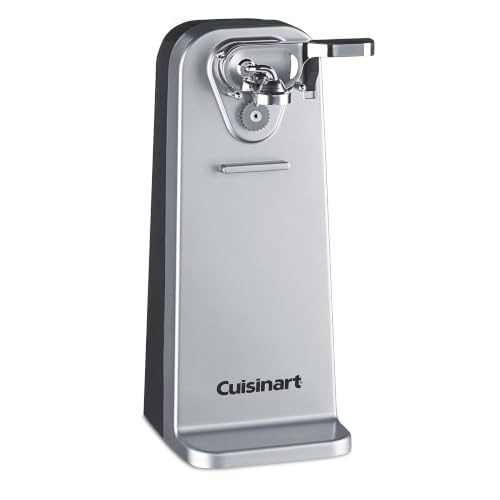
| Cuisinart Deluxe Electric Can Opener | Best Overall One Touch | Single-touch automatic, countertop | Linked — listing states single-touch | Check on Amazon |
| KITCHENMUH One Touch Electric Can Opener | Best One Touch for Arthritis | One touch, battery operated, smooth edge | Linked — listing states one touch | Check on Amazon |
| Amazon Basics 3-In-1 Electric Can Opener | Best Multi-Tool Alternative | Electric with lever cycle; no one-touch claim in listing | Prose-only comparison | — |
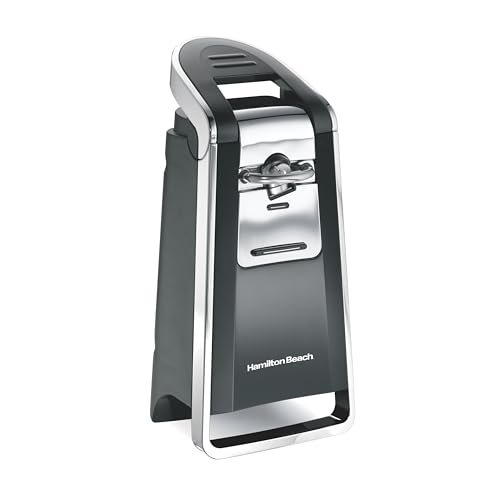
| Hamilton Beach Smooth Touch | Best Lever Alternative | Easy push-down lever; no one-touch claim in listing | Prose-only comparison | — |
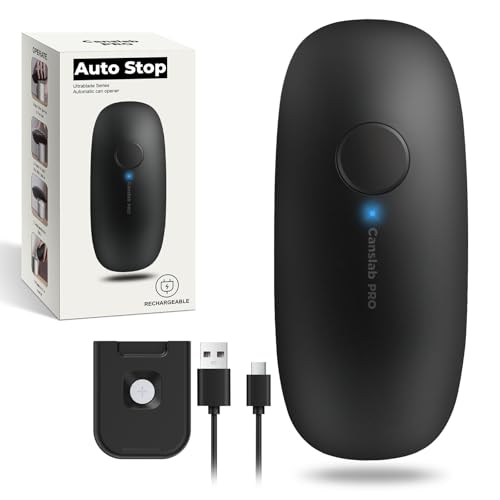
| Canslab Ultrablade PRO | Most Automated Alternative | Automatic, handsfree, smart auto stop; no one-touch claim in listing | Prose-only comparison | — |
| Kitchen Mama Auto Electric Can Opener | Compact Battery Alternative | Automatic, hands free, battery operated; no one-touch claim in listing | Prose-only comparison | — |
How These Picks Were Chosen
This is a research-led guide built from verified product listings, and the selection rule for this particular keyword was stricter than usual. We checked each shortlisted model’s own listing for the operation it actually claims. Two models claim one-touch or single-touch operation in so many words, and those two — one countertop and plug-in, one battery-powered and portable — became the linked picks, because they represent the two honest interpretations of the one-touch idea. The other four models were kept in the guide as prose-only comparisons rather than discarded, because shoppers researching this keyword will meet them everywhere, and a useful guide should explain exactly how a push-down lever, an automatic cycle, or a handsfree design differs from a one-touch start instead of pretending the difference does not exist.
Within that structure we compared the things that decide daily satisfaction: how the cycle starts and stops, how the lid is controlled at the end of the cut, whether the edge left behind is a conventional cut or a smooth edge, what can sizes the listing covers, and how the cutting area can be cleaned. Specifications in the mini spec boxes come only from each model’s listing; where a listing is silent, the box is shorter, and we never fill gaps with guesses. We also applied the standing rules of this site throughout — no fixed prices, because they change constantly, and no invented performance figures. Readers who want the wider electric countertop field, beyond the one-touch filter, will find it in our roundup of Best Easiest To Use Electric Counter Top Can Openers, where ease of operation is compared across every control style rather than just this one.
The 6 Best One Touch Can Openers and Close Alternatives

Cuisinart Deluxe Electric Can Opener CCO-50BKN
Badge: Best Overall One Touch
Strengths
- Single-touch automatic operation stated plainly in its listing — the genuine article.
- Magnetic lid holder controls the lid at the end of the cycle.
- Removable activation lever makes the cutting area properly cleanable.
Trade-offs
- Countertop and plug-in, so it needs a permanent spot near an outlet.
- Conventional cut rather than a smooth-edge side cut.
- A mature design without newer extras like battery operation or auto stop.
Mini spec box
- Type: Electric automatic can opener
- Model: CCO-50BKN
- Operation: Single-touch automatic
- Lid handling: Magnetic lid holder
- Cleaning: Removable activation lever
- Color: Black
The Cuisinart CCO-50BKN is what most people picture when they search this keyword, whether they know it or not: a countertop unit where one touch of the activation lever sets the whole cycle in motion. The can is gripped, turned, and cut automatically, the magnetic lid holder keeps the separated lid from dropping into the food, and your hands are free from the moment you press. Cuisinart positions the model for seniors, and the design earns that positioning — the press can be made with a palm or a knuckle, the body is stable on the counter, and there is no battery whose charge state you have to wonder about at the moment you need it.
The detail that lifts it above other countertop models is the removable activation lever. The area around a cutting wheel collects spray from tomatoes, tuna, and beans, and on sealed designs that buildup eventually causes skipping that owners misread as motor failure. Being able to remove the lever assembly and wash it properly turns the most common long-term complaint about electric openers into a two-minute chore. Its limitations are format limitations: it lives on the counter, it cuts conventionally rather than along the side seam, and it will not travel to a picnic or a rental kitchen. As the reference one-touch countertop opener, though, it is the model the rest of this list is measured against, and for a household opening cans daily it remains the most dependable interpretation of the idea.
Best for: Daily users who want true one-touch operation in a stable, plug-in countertop unit / Not suited for: Buyers wanting a portable battery model or a smooth-edge side cut

KITCHENMUH One Touch Electric Can Opener
Badge: Best One Touch for Arthritis
Strengths
- One-touch operation stated in its name and listing, in a battery-powered sit-on-top format.
- Smooth edge cutting removes the sharp rim from the job.
- Listing states it fits all can sizes and is aimed at seniors with arthritis.
Trade-offs
- Battery operation means keeping batteries fresh; a flat unit is a useless unit.
- Sit-on-top models need the can steadied on some surfaces.
- Described as food safe and automatic, but the listing offers fewer mechanical details than the Cuisinart’s.
Mini spec box
- Type: Electric can opener, battery operated
- Operation: One touch
- Cut: Smooth edge
- Can range: Fits all can sizes, per its listing
- Colors: Black and grey
Where the Cuisinart interprets one touch as a countertop appliance, the KITCHENMUH interprets it as a portable tool. It sits on top of the can, starts with one touch, and walks the rim under battery power, cutting with a smooth edge so neither the can nor the lid presents a sharp rim afterward. Its listing is aimed squarely at seniors with arthritis, and every part of the design supports that aim: no cord to route, no lever to hold down, no crank, and a can-size promise — fits all can sizes — that removes the hesitation of wondering whether this can is the one the opener refuses.
The honest costs are the costs of its format. Batteries are a consumable you must stay ahead of, and a sit-on-top opener asks for a stable, level can in a way a bolted-down-feeling countertop unit does not. The listing is also thinner on mechanical specifics than a shopper comparing cutter designs might like. None of that undermines its central virtue: it is a verified one-touch opener that can live in a drawer, travel between kitchens, and turn the hardest can of the week into a single press. For the user this keyword most often belongs to — someone whose hands have made manual openers a daily frustration — this is arguably the most direct answer on the page, and it is the natural companion pick to the countertop Cuisinart rather than a rival to it.
Best for: Arthritis and reduced grip, drawer storage, and anyone wanting a smooth edge from a portable one-touch model / Not suited for: Households that dislike managing batteries or open cans in high daily volume
Amazon Basics 3-In-1 Electric Can Opener — Prose-Only Comparison
Badge: Best Multi-Tool Alternative
Strengths
- Combines a can opener, bottle opener, and knife sharpener in one countertop unit.
- Stainless steel blade and magnetic lid holder cover the core job properly.
- Stated 50W motor in a sleek, simple black design.
Trade-offs
- Its listing does not claim one-touch operation, so it is not linked as a one-touch pick here.
- The lever-style cycle asks slightly more of the hand than a single-touch start.
- Extra functions are wasted if you already own a sharpener and never open crown caps.
Mini spec box
- Type: Electric can opener, 3-in-1
- Power: 50W
- Blade: Stainless steel
- Extras: Bottle opener, knife sharpener, magnetic lid holder
- Color: Black
The Amazon Basics 3-In-1 appears in this guide because shoppers comparing one-touch openers will constantly meet it, and it deserves a fair explanation rather than a silent omission. As an electric countertop opener it is entirely competent: motorized cutting takes the wrist work out of the job, the magnetic lid holder manages the lid, and the added bottle opener and knife sharpener make it a consolidation play for small kitchens. If your real need is simply “electric, so my hands stop doing the work,” it may serve you perfectly well.
But its listing describes an electric opener with a conventional activation cycle; it does not promise that one touch starts and completes the job in the way the Cuisinart and KITCHENMUH listings promise. That distinction is the entire subject of this keyword, so the Amazon Basics is reviewed here without a purchase link or product image, as a prose-only comparison. Readers who decide the multi-tool value matters more than the strict one-touch claim can find it easily enough through general search or through the wider electric countertop comparisons linked in this guide, including Best Counter Top Electric Can Openers. Within this page’s strict definition, though, it is an alternative — not a one-touch pick.
Best for: Shoppers who value a three-in-one countertop unit and do not need a literal one-touch start / Not suited for: Buyers for whom the single-press cycle is the whole point
Hamilton Beach Smooth Touch Electric Can Opener — Prose-Only Comparison
Badge: Best Lever Alternative
Strengths
- Easy push-down lever is a large, obvious control that many hands prefer.
- Listing covers all standard, extra-tall, and pop-top cans — the broadest can promise here.
- Black and chrome countertop design with a long-established format.
Trade-offs
- Its listing describes lever operation, not one-touch operation, so it is prose-only in this guide.
- A lever still asks for a deliberate downward press to engage the cycle.
- Tall-can clearance means a taller body on the counter.
Mini spec box
- Type: Electric can opener
- Model: 76606AG
- Operation: Easy push-down lever
- Can range: Standard, extra-tall, and pop-top cans
- Finish: Black and chrome
The Hamilton Beach Smooth Touch is the strongest argument that the control style matters less than the can range. Its push-down lever is not marketed as one-touch, and we respect that wording: it is a lever you press down to run the opener, a motion many users actually find easier than a small button because the whole palm can do it. What the Hamilton Beach offers in exchange for the strict one-touch label is breadth — standard cans, extra-tall cans, and pop-top cans are all explicitly covered, which no other model in this roundup states as completely.
That makes it the prose-only model most likely to be the right purchase for a particular kitchen: the one with tall stock cans and a snapped-off pop-top ring or two in its recent past. It is included here, unlinked, so that readers understand the trade they are making if they choose it — lever control and maximum can coverage, instead of a verified one-touch cycle. Shoppers who conclude that can coverage outranks control style should compare it against the full countertop field in Best Countertop Electric Can Openers, where it competes on its natural terms rather than under this keyword’s stricter filter.
Best for: Tall-can and pop-top households comfortable with a push-down lever / Not suited for: Buyers who specifically need a verified one-touch start
Canslab Ultrablade PRO Electric Can Opener — Prose-Only Comparison
Badge: Most Automated Alternative
Strengths
- Handsfree side cut with a smooth edge, designed for seniors with arthritis.
- Smart auto stop ends the cycle by itself when the cut completes.
- USB rechargeable, cordless, and wall mountable for flexible storage.
Trade-offs
- Its listing claims automatic and handsfree operation, not one-touch operation, so it is prose-only here.
- Rechargeable format requires charge awareness.
- The listing does not make the tall-can promises the Hamilton Beach makes.
Mini spec box
- Type: Electric can opener, automatic
- Power: USB rechargeable, cordless
- Cut: Side cut, smooth edge, handsfree
- Control: Smart auto stop
- Storage: Wall mountable
- Color: Black
The Canslab Ultrablade PRO is, in raw automation terms, the most advanced opener in this roundup: it cuts handsfree along the side of the rim, leaves a smooth edge, stops itself with smart auto stop, recharges over USB, and can even live on a wall mount. For a user with arthritis — the audience its listing names — that feature set may matter more than the semantic difference between “automatic” and “one touch.” We include it prominently because a guide that hid it on a technicality would be doing its readers a disservice.
The technicality still matters for honesty in labeling. Its listing describes an automatic cycle you start and the machine finishes; it does not use the one-touch claim that defines this keyword, so in this guide it is a prose-only comparison without a purchase link or image. The practical difference in daily use is small — you still press to start — but the starting control and cycle management are described differently by its maker, and we report listings as they are written. Readers who find the Canslab’s automation more attractive than the strict one-touch label will find it compared on equal footing in Best Cordless Can Openers, where cordless auto-stop designs are the main event.
Best for: Users who want maximum automation and a smooth edge, and are flexible on the one-touch label / Not suited for: Shoppers who want the literal one-touch claim verified in the listing
Kitchen Mama Auto Electric Can Opener — Prose-Only Comparison
Badge: Compact Battery Alternative
Strengths
- Automatic, hands-free operation in a compact battery-powered body.
- Smooth-edge, food-safe cutting per its listing.
- Small enough for a drawer and easy to take between kitchens.
Trade-offs
- Its listing says automatic and hands free, not one touch, so it is prose-only in this guide.
- Battery operation requires keeping batteries in reserve.
- The listing gives fewer specifics on can-size range than some rivals.
Mini spec box
- Type: Electric can opener, battery operated
- Operation: Automatic, hands free
- Cut: Smooth edge, food-safe
- Color: Red
The Kitchen Mama is the compact end of the automatic idea: a small battery-operated unit that sits on the can, runs hands free, and leaves a smooth edge, in a red body that is easy to spot in a drawer. As an everyday tool for a small kitchen it is easy to like — no cord, no counter footprint, no crank — and its listing’s emphasis on effortless everyday use matches the format’s real virtue, which is that opening a can becomes a non-event.
Like the Canslab, though, its listing’s own words are “automatic” and “hands free,” not “one touch,” so it stands in this guide as a prose-only comparison. That is not a judgment on its quality; it is the same labeling discipline we applied to every model here, and it is why the two linked picks can be trusted when they make the claim. If your hands are the reason you are shopping and the exact label is secondary, the Kitchen Mama’s format is very close in spirit to the linked KITCHENMUH — and the accessibility-focused comparisons in Best Disabled Persons Can Openers put both styles in a wider context of tools designed around limited hand function.
Best for: Small kitchens wanting a compact automatic opener, flexible on the one-touch label / Not suited for: Buyers who want the one-touch claim stated by the maker
Comparison Table
| Model | Control, as listed | Power / format | Edge | Status | Link |
|---|---|---|---|---|---|
| Cuisinart CCO-50BKN | Single-touch automatic | Plug-in countertop | Conventional cut | Linked | Check on Amazon |
| KITCHENMUH One Touch | One touch | Battery, sits on can | Smooth edge | Linked | Check on Amazon |
| Amazon Basics 3-In-1 | Electric lever cycle | Plug-in countertop, 50W | Stainless steel blade cut | Prose-only | — |
| Hamilton Beach Smooth Touch | Push-down lever | Plug-in countertop | Smooth Touch cut | Prose-only | — |
| Canslab Ultrablade PRO | Automatic, smart auto stop | USB rechargeable, cordless | Side cut, smooth edge | Prose-only | — |
| Kitchen Mama Auto | Automatic, hands free | Battery, sits on can | Smooth edge | Prose-only | — |
How to Choose a One Touch Can Opener
Begin by deciding which of the two verified formats fits your kitchen. The countertop interpretation, represented by the Cuisinart, is infrastructure: always plugged in, always in place, stable under tall cans, and ready the second you touch it. The portable interpretation, represented by the KITCHENMUH, is a tool: it stores in a drawer, travels, cuts with a smooth edge, and asks only that its batteries be alive. Households that open cans daily usually end up happier with infrastructure; occasional users and small kitchens usually end up happier with the tool. Neither is the “real” one-touch experience — both start the full cycle with a single press — so let your kitchen, not the label, decide.
Next, examine your hands honestly. A one-touch press can be delivered by a fingertip, a knuckle, or the heel of the hand, but the models differ in how much positioning work surrounds the press. A countertop unit asks you to seat the can under the cutter; a sit-on-top unit asks you to center it on the lid and keep the can steady on the counter. If your grip is the problem but your ability to position objects is fine, both work. If tremor or weakness makes positioning itself hard, the fixed countertop format, where the machine’s position never changes, is usually the calmer choice. Then consider the edge: smooth-edge cutting, offered by the KITCHENMUH among the linked picks, removes the sharp rim from the whole task, which matters in households with children or with anyone whose skin tears easily.
Finally, be a literal reader of listings — this keyword rewards it more than most. If one-touch operation is the feature you are paying for, the words should appear in the product’s own description of itself, as they do for both linked picks here. “Automatic” may describe a very similar experience, and the prose-only models in this guide are proof that excellent openers live under other labels, but a shopper who specifically needs the single-press cycle should not have to infer it from marketing adjectives. Buy the claim that is stated, and let everything else — lid magnets, cleanability, can range — break the tie between the models that make it.
Reliability deserves a final word in the choosing process, because the two linked formats fail in opposite ways. A plug-in countertop opener fails mechanically and slowly: residue builds, the wheel dulls over years, the lever loosens — problems that announce themselves gradually and yield to cleaning and care. A battery opener fails electrically and suddenly: it works perfectly until the day it does not, and the fix is a battery swap you either have on hand or do not. Neither failure pattern is a reason to avoid a format, but matching the pattern to your temperament is a real part of choosing well. Methodical households that keep spares of everything thrive with battery tools; households that prefer appliances to simply always work should lean countertop, and let the one-touch press be the only variable in the routine.
How to Use, Clean, and Troubleshoot a One Touch Opener
For a countertop one-touch model, the routine is: place the can, lift the activation lever, seat the rim against the cutting wheel as the design directs, then press once and step back. Resist the urge to hold the can and steer it; the machine’s gearing walks the can around, and your steadying hand mostly risks tilting it at the end of the cut, which is how lids end up in the food despite the magnet. For a sit-on-top one-touch model, center the unit on the lid, press once, and keep a relaxed hand nearby without gripping the body — the opener needs to travel freely around the rim, and squeezing it fights the mechanism you paid for.
Cleaning decides how long the one-touch magic lasts. Food residue around the cutting wheel is the main cause of the skipping and stalling that owners blame on motors. Wipe the cutter area after messy cans, wash removable lever assemblies where the design allows it, and never immerse a countertop or battery body in water. Keep the wheel dry in storage to prevent rust spots, and for battery models, swap in fresh batteries at the first sign of a slowing cycle rather than letting the unit strain through cans on a dying set.
Troubleshooting follows the same short pattern for both formats. Problem: the cycle starts but the can does not turn → the rim is probably dented or the can is seated crookedly; stop, reseat the can squarely, and clean the wheel before retrying. Problem: the lid drops into the food → the can was tilted at the end of the cut or lifted too early; keep it level until the magnet or the smooth-edge separation lets you lift the lid clear. Problem: a battery model stops mid-rim → the batteries are low; replace them rather than forcing the unit around by hand, which can damage the drive. If a plug-in model hums without cutting, unplug it and clear any trapped metal sliver from the wheel with a brush, never a fingertip.
One Touch, Lever, or Fully Automatic: What the Words Actually Mean
The vocabulary of this category deserves a plain translation, because the words describe genuinely different contracts with the user. One touch, as the linked picks here use it, means a single press initiates the complete cycle: grip, turn, cut, and — on the countertop Cuisinart — hold the lid. Lever operation means the user’s press on a lever is the engagement mechanism; on a good design like the Hamilton Beach that press is large and easy, but the control philosophy is manual engagement of an electric cutter rather than a fire-and-forget start. Fully automatic, as the Canslab and Kitchen Mama use it, means the machine manages the cycle once started, often including stopping itself; the start may be a button hold or a press-and-release pattern the listing describes as automatic rather than one touch.
None of these contracts is inherently superior — they distribute effort differently. One touch minimizes the user’s role to a moment. Lever designs give the user a feeling of control that some people, especially those who distrust small appliances, genuinely prefer. Fully automatic designs minimize attention, which is why they suit users who want to set a can going and turn back to the stove. The mistake is only in the labeling: paying for one contract while believing you bought another. This guide’s strict linking rule exists so that, at least on this page, the words on the label and the words in the listing match. Shoppers who realize their real priority is hand effort in general, rather than this specific control style, may also want the traditional contrast in Best Quality Heavy Duty Hand Can Openers to see exactly how much work even the best manual design asks of the hands.
Who Benefits Most from One-Touch Operation
The obvious beneficiaries are people with arthritis, and both linked picks acknowledge that audience in their positioning — the Cuisinart is listed for seniors, and the KITCHENMUH is listed for seniors with arthritis by name. For those users the benefit is not convenience but access: a can of beans stops being a task to plan around pain and becomes a press. The same applies after hand or wrist surgery, during flare-ups of conditions that come and go, and for anyone whose grip strength varies through the day. A one-touch opener is one of the rare kitchen purchases where the accessibility feature and the headline feature are the same thing.
The less obvious beneficiaries are busy cooks and caregivers. A press that can be delivered by a knuckle while the other hand holds a pan is a small but real expansion of what one person can do in a kitchen at once, and a caregiver opening cans for someone else values the repeatability of a cycle that works identically every time. Households cooking with children nearby benefit too, particularly with the smooth-edge linked pick, because the dangerous part of the old routine — a loose sharp lid and a jagged rim — is engineered down. If any of those descriptions sounds like your kitchen, the one-touch filter is not a gimmick; it is the correct first screen to put over this entire category.
Placement and Daily Routines: Getting the Most from a One-Touch Opener
Where a one-touch opener lives determines how one-touch it really feels. A countertop model parked at the back of a crowded counter, behind the fruit bowl, turns a one-press job into a reaching and clearing job first. Give it a permanent spot at the front edge of the counter where cans are actually opened — ideally a step from the trash, because every opened can produces a lid that wants to travel exactly that far. Keep the small zone around it clear enough for a tall can, and the appliance becomes what it promises: walk up, press, walk away. For the battery model, the equivalent discipline is a fixed drawer spot, always the same one, with spare batteries stored beside it. A portable tool that must be hunted for is not portable in any way that matters, and a one-touch opener found with flat batteries is a promise broken at the exact moment it was needed.
Routines matter just as much for the people around the primary user. In many households the one-touch opener is bought for one person’s hands but used by everyone, and it helps to make its quirks common knowledge: the countertop model wants the can seated before the press, not steadied during it; the battery model wants a level can and a hands-off cycle. A thirty-second demonstration saves months of family members fighting the machine in their own improvised ways. It also helps to decide, as a household, where separated lids go — straight into the trash, pressed down inside it, never balanced on the counter edge — because the smoothest opening cycle in the world still ends with a piece of cut metal that deserves a consistent destination.
Finally, treat the first month as a fitting period rather than a verdict. Hands that have used a crank for decades have habits — gripping, steering, bracing — that a one-touch cycle asks them to unlearn, and the unlearning takes a dozen cans or so. Most users who persist through that short apprenticeship report that the old way suddenly feels absurdly effortful, which is the real measure of this category: not speed, since a crank in practiced hands is fast, but the near-total removal of force and attention from a job that never deserved either.
Common Buying Mistakes
The defining mistake for this keyword is trusting the phrase instead of the listing: assuming that any opener described as automatic or easy is a one-touch opener, and discovering the difference with a sore hand. Read for the actual claim. The second mistake is choosing the format by novelty — buying the portable battery model for a high-volume kitchen, or the countertop model for a drawer-sized rental kitchen — when the daily pattern of use should have decided it. Third, buyers forget the batteries: a battery one-touch opener with no spare batteries in the drawer is a manual opener you cannot crank. Fourth, shoppers overlook cleanability, then blame the one-touch mechanism when a gummed wheel starts skipping. Finally, do not dismiss the prose-only alternatives out of hand or, conversely, buy one while telling yourself it is a one-touch pick; know which contract you are signing, and either choice can be the right one.
Final Recommendation
If you want the verified one-touch experience in its most dependable form, choose the Cuisinart CCO-50BKN: single-touch automatic operation, a magnetic lid holder, and a removable lever for cleaning, in a countertop unit that is always ready. If you want one touch in a portable, smooth-edge form — especially for arthritis — choose the KITCHENMUH One Touch and keep spare batteries in the drawer. The four prose-only models remain worth your consideration on their own terms — multi-tool value from the Amazon Basics, can coverage from the Hamilton Beach, maximum automation from the Canslab, compactness from the Kitchen Mama — but buy them for what their listings actually promise, and they will not disappoint you.
Whichever route you take, hold on to the habit this guide has tried to teach: read the operation claim in the listing itself, in the maker’s own words, before you buy any opener in this category. The two linked picks earned their links by making the one-touch promise explicitly. An opener bought on a verified promise, matched to your cans and your counter, will still be pleasing you years from now — long after the small differences in styling and finish have stopped registering at all.
Frequently Asked Questions
What does one touch mean on a can opener?
It means a single press starts the complete opening cycle: the opener grips the can, turns it, cuts the lid, and finishes without you holding a lever, squeezing handles, or turning a crank. Both linked picks in this guide state that claim in their own listings — single-touch for the Cuisinart, one touch for the KITCHENMUH.
Is an automatic can opener the same as a one-touch can opener?
Not necessarily. Automatic usually means the machine manages the cutting cycle once started, and some automatic models add features like auto stop. One touch is a specific claim about how the cycle starts. The experiences can be very close in practice, which is why this guide reviews automatic models as prose-only comparisons — but the labels are not interchangeable, and listings should be read literally.
Which one-touch style is better for arthritis, countertop or battery?
Both linked picks are positioned for seniors, and the KITCHENMUH names arthritis directly. The countertop Cuisinart suits users who find positioning a can under a fixed cutter easiest and who open cans often. The battery KITCHENMUH suits users who want a smooth edge and drawer storage. The deciding factor is usually how steady your hands are at positioning, not the press itself.
Do one-touch openers work on tall cans?
The countertop format generally handles tall cans more calmly because the body is fixed and the can hangs or stands against it. Sit-on-top models depend on the can standing stably on the counter. If tall cans are a staple of your pantry, weigh that heavily — and note that the prose-only Hamilton Beach in this guide makes the most explicit tall-can promise of any model here, at the cost of lever rather than one-touch control.
How do I keep a one-touch opener cutting cleanly?
Keep the cutting wheel clean and dry. Wipe the cutter area after messy cans, wash removable parts where the design allows, and never immerse the body in water. Most “failures” of electric openers are residue on the wheel causing skips, not motor problems, and a minute of cleaning after a tomato can prevents nearly all of them.
Can I press the control with the heel of my hand or a knuckle?
Yes — that is one of the quiet advantages of the format. Neither linked pick requires a fingertip pinch or a grip to start; the countertop lever and the battery model’s start control both respond to a press from a knuckle, the side of a hand, or the heel of a palm. On days when fingers are stiff or sore, that flexibility is often the difference between opening the can yourself and asking for help, which is precisely the independence this category exists to protect. If a particular morning makes even positioning the can difficult, that is the day the countertop format earns its place, because its cutter never moves and the can comes to it.
What should I do if the lid falls into the can?
Keep the can level until the cycle fully ends, then lift the lid away with the magnetic holder rather than shaking the can. On smooth-edge models, lift the lid straight up off the rim. If a lid does drop in, fish it out with a fork or clean tongs rather than fingers — the cut edge is the sharpest part of the whole process.