Disclosure: topratedkitchenware.com is reader-supported. When you buy through links on our site, we may earn an affiliate commission from Amazon and other retailers, at no extra cost to you.
Where to buy
The best stainless steel undermount kitchen sinks share one defining idea: the bowl hangs beneath the worktop, so crumbs wipe straight in, the counter line stays clean, and the sink reads as part of the stone rather than an appliance dropped into it. The six bowls below are this guide’s shortlist. Four are stainless undermounts and linked; two are fireclay farmhouse bowls reviewed prose-only, clearly labelled, because their material sits outside this list’s subject. Check the latest price on Amazon from any linked pick and read the full reviews before your worktop is cut.
- Oxwiser 32×18 Inch Undermount Sink Bundle — Best Overall
- KRAUS KHU640-33 33 Inch Undermount Sink — Best Extra-Wide Bowl
- Miuara Farmhouse Sink 30 x 18 Inch White Fireclay — Best Farmhouse Alternative (prose-only: fireclay, not stainless steel)
- Miuara Farmhouse Sink 33 x 18 Inch White Fireclay — Best Large Farmhouse Alternative (prose-only: fireclay, not stainless steel)
- SANYCASA 30 Inch Undermount Workstation Sink — Best Heavy-Duty Workstation
- KRAUS KHU100-30 30 Inch Undermount Sink — Best Classic 30-Inch Bowl
Read the full guide below for the reasoning, the trade-offs, and the undermount fitting guidance behind each pick.
Undermount is a commitment disguised as a style. Once the worktop is cut and the bowl is sealed beneath it, the pairing is effectively permanent: changing the sink later means changing or re-cutting the stone. That permanence is exactly why the type rewards careful buying and punishes casual buying more than any other sink category. The reward is real — a seamless wipe-in surface, a worktop that shows its full width, a bowl that can be deeper and wider than a drop-in rim would allow. The discipline it demands is the subject of half this guide: the right worktop material, the right support, the right reveal, and a bowl whose specification deserves the decade it will spend married to your counter.
The six entries here cover the undermount field honestly. Four are stainless steel undermounts in the strict sense: a 32-inch 16-gauge bundle, a 33-inch extra-wide KRAUS, a 30-inch heavy-gauge workstation and a 30-inch classic KRAUS. The remaining two are the Miuara fireclay farmhouse bowls, whose listings offer apron-front or drop-in (undermount) fitting but whose material is fireclay rather than steel; they are reviewed in full as prose-only alternatives, with no link and no image, so that a reader comparing mounting styles can see the farmhouse route without this guide blurring the material line its headline promises.
One warning belongs at the front of any undermount guide: these bowls belong under stone, quartz, solid surface or solid timber. Under a standard laminate worktop with a chipboard core, the cut edge is a water vulnerability no sealant fully redeems, and a top-mount sink is the honest recommendation for that kitchen. Everything below assumes a suitable worktop — and explains, in the buying guide, how to verify yours qualifies before the order goes in. Readers comparing mounting philosophies will also find the broader field in Best Stainless Undermount Kitchen Sinks and the workstation development of the idea in Best Stainless Steel Workstation Kitchen Sinks.
Key Takeaways
- Undermount fitting is permanent in practice — the worktop is cut for the bowl — so specification and measurement matter more here than in any other sink type.
- Four picks are stainless undermounts and linked; the two Miuara fireclay bowls are prose-only alternatives, labelled as such.
- Suitable worktops are stone, quartz, solid surface and solid timber — not standard chipboard-core laminate.
- Support is structural, not optional: rails or a frame beneath the bowl, never clips and adhesive alone.
- The Oxwiser 32 bundle includes grid and drain assembly; the SANYCASA brings 11-gauge (3mm) steel and a workstation ledge at 30 inches.
- Choose your reveal — negative, flush or positive — with your fabricator before the cut, not after it.
In this guide
Quick Picks
| Pick | Badge | Size | Material / Gauge | Standout feature | Check |
|---|---|---|---|---|---|
| Oxwiser 32×18 Bundle | Best Overall | 32 x 18 in | Stainless, 16 gauge | Five-item bundle with grid and drain | Check on Amazon |
| KRAUS KHU640-33 | Best Extra-Wide Bowl | 33 in | Stainless, 18 gauge | Widest bowl, NoiseDefend pads | Check on Amazon |
| Miuara Farmhouse 30 | Best Farmhouse Alternative | 30 x 18 in | White fireclay | Apron-front alternative material | Prose-only |
| Miuara Farmhouse 33 | Best Large Farmhouse Alternative | 33 x 18 in | White fireclay | Farmhouse width in fireclay | Prose-only |
| SANYCASA 30 Workstation | Best Heavy-Duty Workstation | 30 in | Stainless, 11 gauge (3mm) | Integrated ledge, workstation set | Check on Amazon |
| KRAUS KHU100-30 | Best Classic 30-Inch Bowl | 30 in | Stainless, 16 gauge | TRU16 steel, grooves, NoiseDefend | Check on Amazon |
Badges match the detailed reviews below, and prose-only entries are marked in the table and carry no link anywhere in the guide.
How These Picks Were Chosen
This is a research-led guide built from the verified specifications of the six assigned bowls — mounting style, material, gauge, dimensions, included parts — read against what undermount ownership actually involves. We did not install the sinks or claim hands-on testing, and we print no prices or ratings; the linked listings carry current figures.
Mounting came first in the audit, because it is the keyword’s core: the four linked bowls are undermount by design and by name. Material came second, and it separated the Miuara pair: fireclay is a legitimate, durable sink material, and the bowls’ own listings describe apron-front or drop-in (undermount) fitting, but a guide titled stainless steel must not link a fireclay bowl as if it were steel. They are therefore reviewed completely — strengths, trade-offs, the lot — as prose-only reference points for readers whose real decision includes the farmhouse material.
Among the stainless four, the spread covers the undermount briefs that matter: bundle completeness at family size (Oxwiser 32), maximum width (KRAUS KHU640-33), heavy-gauge workstation duty (SANYCASA), and the classic branded bowl at the most common size (KRAUS KHU100-30). Between them, a buyer with a suitable worktop and a measured cabinet will find a specification worth sealing under stone for a decade — which is the only standard an undermount purchase should be judged by.
The 6 Best Stainless Steel Undermount Kitchen Sinks, Reviewed

Oxwiser 32×18 Inch Undermount Sink Bundle
Badge: Best Overall
Strengths
- 16-gauge single bowl at the full 32 x 18 inch family size.
- Five-item bundle: grid, drain assembly, cap and towel — the undermount arrives complete.
- Grid sized to the bowl protects the floor from day one of the installation’s life.
Trade-offs
- Smaller-brand support; keep the paperwork for parts.
- Needs the larger cabinet a 32-inch undermount requires.
- A big single fill is thirstier for small wash-ups.
Mini spec box: Size: 32 x 18 in · Mount: undermount · Steel: 16-gauge stainless · Bowl: single · Included: bottom grid, drain assembly, drain cap, towel
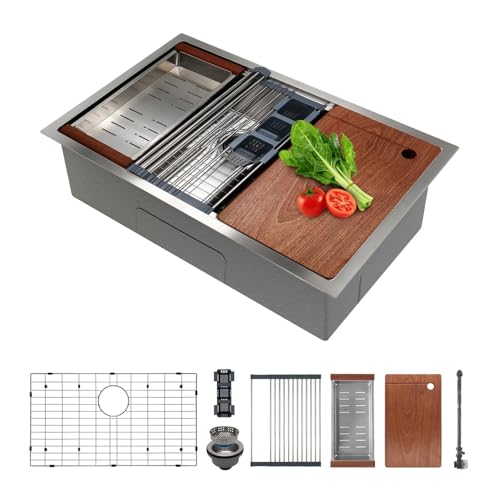
An undermount purchase is the wrong place to discover missing parts, because the bowl’s installation window — fabricator booked, worktop cut — does not forgive a second delivery. The Oxwiser 32 bundle is built against that risk: the bowl, its grid and its drain assembly travel together, specified together, so the fitting day proceeds in one pass. The bowl itself is the right flagship specification for the type — 16-gauge steel, a generous undivided volume, and the grid that will spend a decade protecting the floor that the worktop’s permanence makes worth protecting.
It suits family renovations under stone or quartz, where the cabinet takes 32 inches and the household cooks at volume. The honest limitation is the brand’s smaller support footprint — mitigated by the bundle’s completeness and your own filed paperwork. Among undermount bundles it is the most convincing on this page, and it anchors the installations discussed in Best Kitchen Sinks For Quartz Countertops projects as well.
Best for: family kitchens wanting a complete 32-inch undermount package / Not suited for: compact cabinets or laminate worktops

KRAUS KHU640-33 33 Inch Undermount Sink
Badge: Best Extra-Wide Bowl
Strengths
- 33 inches — the widest undermount span here, for the largest pans.
- Rounded corners resist buildup; channel grooves drain the broad floor.
- NoiseDefend pads keep the big surface quiet in open-plan rooms.
Trade-offs
- 18-gauge steel, a step below the 16-gauge picks.
- The largest cabinet, cutout and support demand in this guide.
- No grid or drain assembly in the verified specification — budget for both.
Mini spec box: Size: 33 in · Mount: undermount · Steel: 18-gauge stainless · Corners: rounded · Drainage: channel grooves · Soundproofing: NoiseDefend pads
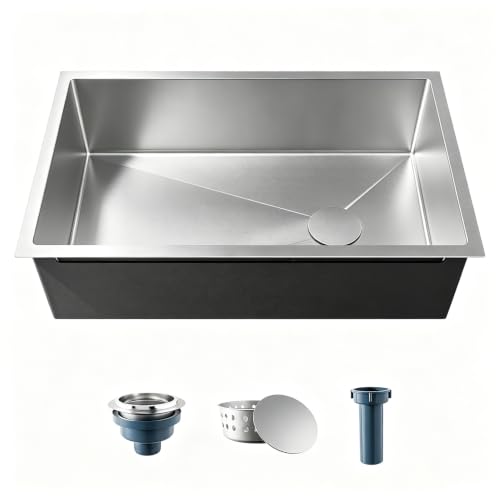
Undermounting a very wide bowl is a structural conversation as much as a shopping one: the cutout removes more worktop, the span carries more water weight, and the support beneath must be planned rather than improvised. The KHU640-33 rewards that planning with the category’s core pleasure at maximum scale — a vast, seamless, wipe-in surface that takes commercial-width pans flat. KRAUS’s grooves and corners keep the broad floor draining and cleanable, and the pads keep it composed.
It suits large kitchens, entertainers and bakers whose equipment dictates width. The honest limitations are the 18-gauge steel and the accessories to source — buy the widest grid you can find for it, because a floor this size, sealed under stone for years, deserves its protection from day one. If width is your brief, this is the bowl; if gauge is, read on to the SANYCASA and the KHU100-30.
Best for: large kitchens needing maximum undermount width / Not suited for: standard cabinets, laminate worktops, or gauge-first buyers
Miuara Farmhouse Sink 30 x 18 Inch White Fireclay
Badge: Best Farmhouse Alternative
Strengths
- Fireclay single bowl with stated resistance to stain, crack, heat and scratch damage.
- Reversible apron front; listing describes apron-front or drop-in (undermount) fitting.
- A furniture-like presence no flush steel bowl attempts.
Trade-offs
- Fireclay, not stainless steel — prose-only in this guide.
- Heavy, and the apron front requires adapted cabinetry rather than a simple undermount bay.
- Its fitting logic differs from the steel undermounts around it — plan separately.
Mini spec box: Size: 30 x 18 in · Material: white fireclay · Bowl: reversible single · Mount: apron front or drop-in (undermount) · Stated resistance: stain, crack, heat, scratch
The Miuara 30 appears in an undermount guide because its listing genuinely offers an undermount route among its fitting options — and it appears prose-only because its material is fireclay, and this guide’s headline promises steel. Taken on its own terms it is a handsome, durable farmhouse bowl: a reversible apron that lets you choose the face, a glazed surface with stated resistance to the usual farmhouse hazards, and a single volume as practical as any here.
It suits readers whose mounting research has led them to the farmhouse form instead — a legitimate destination, reached honestly. For the stainless-committed, its role is contrast: this is what the same money and space buy in a different material with a different cabinet story. Readers drawn by its fitting flexibility will find the fuller discussion in Best Kitchen Sinks For Laminate Countertops, where apron and drop-in options are weighed honestly.
Best for: farmhouse-style kitchens considering an undermount-capable fireclay bowl / Not suited for: a stainless steel shortlist
This pick is prose-only, so there is no Amazon link for it in this guide.
Miuara Farmhouse Sink 33 x 18 Inch White Fireclay
Badge: Best Large Farmhouse Alternative
Strengths
- The fireclay farmhouse form at a full 33-inch width.
- Reversible single bowl with apron-front or drop-in (undermount) options.
- Stated resistance to stain, crack, heat and scratch damage.
Trade-offs
- Fireclay, not stainless steel — prose-only for the same material reason.
- The heaviest cabinet and support commitment on this page.
- Apron-front cabinetry is a one-way design decision.
Mini spec box: Size: 33 x 18 in · Material: white fireclay · Bowl: reversible single · Mount: apron front or drop-in (undermount) · Stated resistance: stain, crack, heat, scratch
At 33 inches the larger Miuara is a piece of kitchen furniture first and a basin second: a wide white apron that organises the room around it, with a genuinely capacious single bowl behind the face. Its undermount-capable listing keeps it relevant to this guide’s conversation, and its material keeps it prose-only within it. The installation is the most demanding here — adapted cabinet, serious support, a decision you make once — and the kitchens that suit it know themselves: large, character-led, and committed to the farmhouse direction.
It suits those kitchens and no others, which is a perfectly respectable verdict for a specialist product. Stainless readers should file it as the reference for the alternative route at maximum width, and return to the steel four for the actual shortlist.
Best for: large farmhouse kitchens wanting width in fireclay / Not suited for: stainless lists or reversible renovation plans
This pick is prose-only, so there is no Amazon link for it in this guide.
SANYCASA 30 Inch Undermount Workstation Sink
Badge: Best Heavy-Duty Workstation
Strengths
- 11-gauge (3mm) stainless — by far the heaviest construction in this guide.
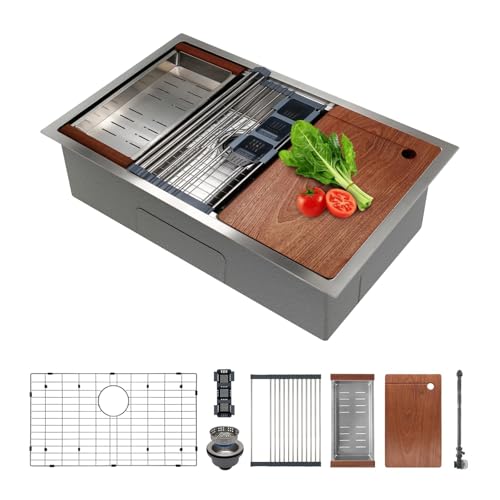
- Integrated ledge turns the undermount into a workstation; set supplied as a system.
- Superior-drain design counters the pooling flat floors can suffer.
Trade-offs
- Heavy bowl: installation support and handling need planning.
- Premium construction tier.
- The ledge rewards prep-at-the-sink cooks specifically.
Mini spec box: Size: 30 in · Mount: undermount · Steel: 11-gauge (3mm) stainless · Bowl: single · Feature: integrated ledge, workstation set · Drain: superior drain design
If undermount permanence argues for buying the most durable bowl you can, the SANYCASA is that argument’s conclusion. Eleven-gauge steel at 3mm is fabrication-grade material; sealed under a worktop, it is the bowl least likely to flex, dent or drum over the installation’s long life. The integrated ledge adds the workstation layer — prep over the bowl, boards and racks riding the rim — and the maker’s drain design addresses the one geometric weakness of wide flat floors.
It suits serious cooks and anyone who has replaced a sink once and intends never to repeat the experience. The honest limitations are weight and tier: the support beneath must be built for it, and light-use households will never tax the steel enough to justify it. For the kitchens that will, it is the most future-proof 30 inches on this page, and a natural anchor for island installations like those in Best Kitchen Sinks For Kitchen Island planning.
Best for: heavy-duty 30-inch undermount duty with a workstation system / Not suited for: light-use kitchens or minimal installation budgets

KRAUS KHU100-30 30 Inch Undermount Sink
Badge: Best Classic 30-Inch Bowl
Strengths
- 16-gauge TRU16 steel from an established, systematic maker.
- Rounded corners and channel grooves — cleanability and drainage done right.
- NoiseDefend pads; a stable model line for future parts confidence.
Trade-offs
- No ledge and no bundle — a classic bowl, plainly.
- Brand tier sits above direct listings.
- 30 inches is the sensible size, not the spectacular one.
Mini spec box: Size: 30 in · Mount: undermount · Steel: 16-gauge TRU16 stainless · Corners: rounded · Drainage: channel grooves · Soundproofing: NoiseDefend pads
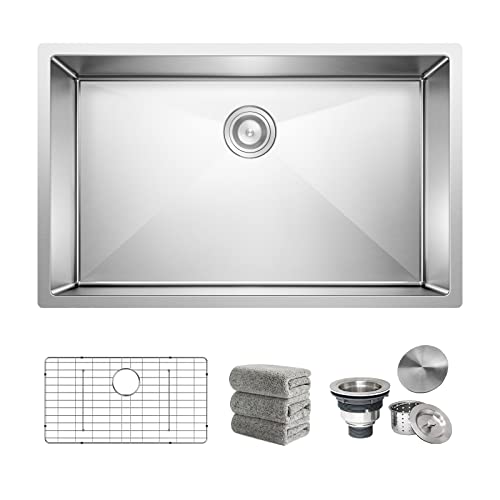
The KHU100-30 is the undermount benchmark: the size most cabinets accept, the gauge most households should buy, from the maker whose documentation a fabricator would choose to work from. Its virtues are the durable kind — corners that clean, grooves that drain, pads that quiet, and a model line stable enough that a grid or part in year five is a lookup rather than a quest. Sealed under stone, that steadiness is worth more than any novelty.
It suits the broad middle of renovators: stone or quartz worktop, 30-inch brief, a decade in mind. The honest limitation is plainness — no system, no statement — and buyers who want the workstation layer should take the SANYCASA above. As the classic answer, it closes this list the way it opens most shortlists in the category.
Best for: most undermount renovations at the standard 30-inch size / Not suited for: workstation seekers or the tightest budgets
Comparison Table
| Pick | Material | Size | Gauge | Mount | Check |
|---|---|---|---|---|---|
| Oxwiser 32×18 | Stainless | 32 x 18 in | 16 | Undermount | Check on Amazon |
| KRAUS KHU640-33 | Stainless | 33 in | 18 | Undermount | Check on Amazon |
| Miuara Farmhouse 30 | Fireclay | 30 x 18 in | — | Apron / drop-in | Prose-only |
| Miuara Farmhouse 33 | Fireclay | 33 x 18 in | — | Apron / drop-in | Prose-only |
| SANYCASA 30 | Stainless | 30 in | 11 (3mm) | Undermount | Check on Amazon |
| KRAUS KHU100-30 | Stainless | 30 in | 16 | Undermount | Check on Amazon |
How to Choose an Undermount Sink
Start with the worktop audit, because it is the gate everything else passes through. Stone, quartz, solid surface and solid timber: proceed. Standard laminate over a chipboard core: stop, and buy a top-mount sink instead — the exposed core at an undermount cutout will eventually meet water, and no bead of sealant changes that material fact. If you are replacing the worktop in the same project, the gate opens; sequence the purchases so the bowl is chosen before the stone is cut, never after.
Cabinet maths comes next. The bowl must fit the cabinet’s interior with room for clips, sealant and plumbing: as a working rule, allow roughly three inches beyond the bowl’s width, and verify the front-to-back fit against the worktop’s depth and the tap position. The 30-inch bowls here suit the commonest large base units; the 32 and 33-inch bowls demand verified larger cabinets. Write the interior measurement down and judge every row of the comparison table against it.
Then choose the reveal with your fabricator, because it is a joint decision between taste and tolerance. A negative reveal tucks the worktop edge slightly over the bowl — cleanest to wipe, hardest on the fabricator. A flush reveal aligns edge and bowl wall — elegant, demanding. A positive reveal exposes a slim ledge of the bowl’s rim — the most forgiving to fit and to clean around the seam. None is wrong; an unchosen reveal, discovered on fitting day, is the only wrong one.
Sound deserves a place in the choice as well, because an undermount bowl is mechanically coupled to a large worktop that can act as a sounding board. Pads and undercoating on the bowl — the NoiseDefend treatment on the KRAUS entries is the named example here — are the manufacturer’s half of the answer; firm support is the installer’s half. In an open-plan kitchen, where the sink shares the room with conversation and television, treat the acoustic specification as a real selection criterion rather than a footnote, and raise it with your fitter when the support system is being chosen.
Gauge and system complete the choice. Sixteen-gauge is the durable default; the SANYCASA’s 11-gauge is the heavy-duty extreme for households that will stress the bowl for decades; 18-gauge at 33 inches is a width trade to make consciously. Workstation ledges suit prep-heavy cooking; plain bowls suit everyone else. And whatever you choose, price the complete installation — bowl, grid, drain, support and fitting — because undermount mistakes are the expensive kind, and they are almost all made on paper before anyone picks up a tool.
How to Fit and Care for an Undermount Sink
Professional fitting follows a strict order, and the order is the lesson. The bowl arrives and is inspected — rim flatness, finish, drain fit, contents — before the worktop is cut. The fabricator cuts to the bowl or its verified template and finishes the cut edge. The bowl is then offered up, supported from below by rails, a frame or a dedicated support system rated for the loaded weight (a full 33-inch bowl of water is heavier than intuition suggests, and an 11-gauge bowl starts heavy empty). The rim joint receives a continuous bead of sanitary silicone, the assembly is clamped evenly, and cure times are respected before plumbing is connected and the fill-and-inspect leak test is run from below.
- Inspect the bowl on arrival; photograph any issue the same day.
- Confirm cabinet interior, reveal style and tap position with the fabricator.
- Cut the worktop only against the physical bowl or its verified template.
- Fit underside support; seal evenly; respect adhesive cure times.
- Connect the waste, fill the bowl, and leak-check every joint from below.
Care centres on the seam. The silicone joint between bowl and worktop is the undermount’s one maintenance item: keep it clean, inspect it yearly, and renew it if it ever lifts or discolours — a thirty-minute job that protects the cabinet beneath. The bowl itself takes standard stainless care: rinse, wipe with the grain, dry in hard-water areas, no steel wool, no harsh chlorides, and a grid to carry the abrasion of daily pans. Problem: water weeps from the rim joint. → The seal has failed locally; dry the area, renew the bead, and check the support has not shifted. Problem: the bowl feels springy under load. → Support is inadequate; add rails or a frame before the seal is stressed further. Problem: grime gathers at the seam line. → A soft brush and a gentle cleaner, worked along the joint, lifts it; prevention is a weekly wipe of the seam as part of the normal clean.
Undermount vs Top-Mount: Deciding Without Regret
The top-mount sink’s virtues are real and worth stating in an undermount guide: it fits any worktop including laminate, it can be replaced in an afternoon, its rim protects the cut edge, and it asks nothing structural of the cabinet. Kitchens that change often, budgets that must prioritise elsewhere, and laminate worktops that are staying all argue for it honestly. The undermount’s case is the seamless surface, the wipe-in clean, the deeper and wider bowls the format allows, and the way it lets a beautiful worktop run uninterrupted — advantages that compound daily in a kitchen being built for a decade.
The regret pattern is predictable on both sides. Undermount regret belongs to buyers who forced the format onto an unsuitable worktop or an unmeasured cabinet. Top-mount regret belongs to buyers who kept a rim they wipe around ten thousand times, in a forever kitchen, to save a decision they only had to make once. Read your own project honestly — its worktop, its horizon, its budget — and the mounting decision makes itself. The bowls in this guide serve the undermount answer; the specification lessons in them serve either.
Support Systems in Detail: What Holds the Bowl Up
Because an undermount bowl’s support is invisible after installation, it is the part of the project most often under-specified — and the part whose failure is most disruptive, since a bowl that drops even a few millimetres breaks its seal, stresses its plumbing and can crack a worktop’s cut edge. The options form a ladder of seriousness. At the base are the manufacturer’s clips used with adhesive: adequate for a light bowl in the short term, and the minimum this guide would accept for any of these picks. Above that sit support rails — bars or timber battens fixed across the cabinet beneath the bowl’s rim, carrying the load into the cabinet’s structure. Above those, a full frame or cradle, and dedicated adjustable support systems that let the fitter level the bowl precisely before the seal is made.
Choosing the rung is a matter of weight and span. Water is the load nobody budgets for: a deep 32 or 33-inch bowl filled for soaking holds a surprising mass of it, on top of the bowl’s own steel — and in the SANYCASA’s case, 3mm steel starts heavy before a drop is added. Wide bowls also span further between supports, which is why the KHU640-33’s installation plan should name its support explicitly rather than leave it to fitting-day improvisation. The professional habit to copy is simple: the support decision is made on paper, with the bowl’s loaded weight in mind, and the parts are on site before the fabricator arrives. Retrofitting support beneath a sealed, plumbed bowl is possible and miserable in roughly equal measure.
There is a quieter benefit to proper support: sound. A bowl carried firmly on rails or a frame is a bowl that cannot flex against its fixings, and flex is a component of the drumming that makes thin installations feel cheap. Support, seal and soundproofing work as one system — which is why the fitters who insist on all three are not upselling; they are describing how the format actually behaves over ten years of breakfasts.
Undermount Sinks in Islands, Rentals and Forever Kitchens
The island is the undermount’s showcase setting, and it changes two calculations. Access is the first: an island bowl is approached from several sides, so its width is usable in a way a wall-backed bowl’s is not, and wide single bowls — the Oxwiser 32, the KHU640-33 — come into their own as shared workstations. Plumbing is the second: waste and supply arrive through the island’s own cabinetry, which must be planned with the same cabinet-interior honesty as any other run, plus the discipline that an island offers no wall to hide a mistake in. Kitchens planned around an island sink reward the complete-bundle approach, because the island’s fitting day has the least slack of any in the project.
Rental kitchens argue the opposite aesthetic and the same engineering. An undermount stainless bowl under a durable worktop is close to tenant-proof: no rim to trap grime, no chip-prone edge at the sink, a surface that wipes down between tenancies and photographs as quality at reletting. The 16-gauge bowls here, with grids included or added, standardise well across units, and the support-once-properly principle means the installation is not revisited. Landlords should simply note the seam inspection in the property’s maintenance rhythm — the one recurring task the format asks for.
Forever kitchens — the decade-and-more renovations — are where the undermount decision deserves its full weight of thought, because the format’s permanence is the point. In that horizon, the hierarchy in this guide inverts the usual shopping instinct: durability first (the SANYCASA’s steel, the KRAUS line’s stability), format second, fashion last. A bowl chosen on that order will still be the right bowl when the kitchen around it has been repainted twice. That, more than the seamless photograph, is what undermount buyers are actually purchasing.
The First Year With an Undermount: What to Expect
New undermount owners go through a predictable first year, and knowing its chapters in advance turns surprises into routine. The first month is delight and vigilance in equal parts: the wipe-in surface is as good as promised, and every owner develops the seam-checking glance — a quick look at the joint while the kettle boils — that becomes the format’s background habit. This is also when the bowl’s acoustic character announces itself; a well-supported, well-padded bowl settles into the kitchen’s soundscape, while an under-supported one drums, which is why the support conversation belongs before installation, not in a first-month complaint.
Months two to six are when water behaviour teaches its lessons. Hard-water households meet their first deposits around the drain and the tap base and learn the descale-and-dry routine described in this guide. Households with wide bowls learn their splash geometry — which tap pressure the bowl likes, how the grid changes the stream’s landing — and the small choreography of a big single volume becomes automatic. The seam, if the installation was sound, asks for nothing in this period beyond being wiped like the rest of the counter.
By the end of the first year the installation should be boring, and boring is the goal. The annual seam inspection joins the household’s other small rituals; the grid has taken the year’s abrasion on the bowl floor’s behalf; the steel has acquired the fine, even patina of use that brushed stainless wears gracefully. Owners who reach that point with a well-chosen bowl rarely think about their sink again — which, for a fixture sealed permanently into the most-used surface in the house, is the highest available praise. The buying decisions in this guide are all, in the end, aimed at that unremarkable, satisfactory first year and the nine that follow it.
Choosing Between the Four Stainless Bowls in This Guide
With the format decided, the remaining choice among the linked four is a matter of matching specification to household, and it resolves into four recognisable briefs. The first brief is completeness at family scale: a renovation that wants the sink, its grid and its drain to arrive as one specified package, in a cabinet that takes 32 inches. That is the Oxwiser bundle’s home ground, and its 16-gauge steel means the completeness is not bought with thin metal. The second brief is span: a kitchen whose pans, trays and entertaining habits are defeated by standard widths, with the cabinet and the support plan to match. That is the KHU640-33, bought for width with its 18-gauge trade understood.
The third brief is duty: a household that cooks hard, owns heavy cookware, and is choosing a bowl for the longest possible service under the stone. That is the SANYCASA, whose 11-gauge construction and workstation system make it the most over-engineered 30 inches in the guide — deliberately, for buyers who will use the engineering. The fourth brief is steadiness: the mainstream renovation that wants the category’s benchmark specification from its most systematic maker, at the size most cabinets accept. That is the KHU100-30, and it is the right answer for more kitchens than any other row in the table.
Notice what does not decide between them: the photograph. All four are brushed stainless undermounts that will look near-identical in a listing image. The differences that matter — gauge, completeness, span, system — live in the specification columns, which is why this guide is organised around them. Read your brief off your own kitchen’s facts — cabinet width, cookware weight, cooking volume, renovation horizon — and the table narrows itself to one bowl with very little argument left over. That narrowing, done on paper before the fabricator is booked, is the entire craft of buying a permanent fixture well.
Common Buying Mistakes
- Undermounting into chipboard-core laminate. The format’s one absolute incompatibility — choose top-mount there.
- Cutting the worktop before the bowl arrives. The physical bowl, inspected, is the only safe template.
- Hanging the bowl on clips and adhesive alone. Support rails or a frame are structural, not optional.
- Never choosing a reveal. Negative, flush or positive — decide with the fabricator in advance.
- Neglecting the seam. The silicone joint is a maintenance item; inspect it yearly and renew it when it lifts.
- Skipping the grid on a wide bowl. A broad floor sealed under stone deserves protection from day one.
Final Recommendation
For most undermount renovations, the benchmark pair is this: the Oxwiser 32×18 bundle where the cabinet takes 32 inches and completeness matters, and the KRAUS KHU100-30 where 30 inches and an established maker’s steadiness are the brief. The SANYCASA is the heavy-duty answer for cooks who will stress a bowl for decades, and the KHU640-33 serves the genuinely large kitchen. Keep the Miuara fireclay pair in their labelled column if the farmhouse route is alive in your plans. Whatever you seal under the stone, measure the cabinet, verify the worktop, support the bowl properly — permanence rewards the careful.
One final piece of sequencing advice, offered because it prevents the commonest undermount regret of all: choose the sink before you finalise the worktop order, and tell the fabricator the model at booking, not at the templating visit. Fabricators plan their cutting around known bowls; a late substitution — even to a bowl of the same nominal width — can differ in corner radius, rim profile and drain position enough to matter. The four stainless bowls in this guide are all, in that sense, safe early decisions: fully specified, stably modelled, and dimensioned completely enough for a fabricator to work from. Make the decision early, write it into the project paperwork, and let every later trade work from the same page.
Frequently Asked Questions
Can an undermount sink be replaced later?
Only with difficulty — the worktop was cut for that bowl, so a replacement must match the cutout or the stone must be reworked. This is why undermount buying emphasises specification and durability: choose as if the pairing is permanent, because practically it is.
What worktops can take an undermount sink?
Stone, quartz, solid surface and solid timber all work well. Standard laminate with a chipboard core does not, because the cut edge exposes a water-vulnerable core; use a top-mount sink with that worktop instead.
How is an undermount sink supported?
From below, with rails, a frame or a dedicated support system, supplemented by clips and a silicone seal at the rim. A heavy bowl full of water should never rely on adhesive and clips alone.
What is a reveal, and which should I choose?
The reveal is how the worktop edge relates to the bowl wall: negative (edge overhangs slightly), flush (aligned), or positive (a slim rim of bowl shows). Negative is cleanest to wipe, positive is most forgiving to fit and clean at the seam. Agree it with your fabricator before cutting.
Why are two picks in this guide prose-only?
The Miuara bowls are fireclay, not stainless steel. Their listings offer undermount-capable fitting, so they are relevant to the mounting conversation, and they are reviewed fully as farmhouse alternatives — but they carry no link or image in a stainless steel guide.
How do I maintain the seal around an undermount sink?
Keep the joint clean, inspect it about once a year, and renew the silicone if it lifts, cracks or discolours. It is a short job that protects the cabinet and worktop edge from the one leak path an undermount has.
Can I install an undermount sink in an existing cabinet?
Yes, provided the cabinet’s interior width and the worktop material both qualify — the cabinet must host the bowl plus its support and plumbing, and the worktop must be stone, quartz, solid surface or solid timber. In practice the worktop is usually being replaced in the same project, since the cut is made for the specific bowl; fitting a new undermount beneath an existing, already-cut worktop only works when the existing cutout matches the new bowl, which is a measurement to verify rather than assume.
Does an undermount sink add value to a kitchen?
In a stone or quartz worktop renovation, it is the expected format, and its absence is more noticeable than its presence — buyers read a rimmed sink in a premium worktop as a corner cut. That does not make it a financial instrument, and no guide should promise returns on a sink; it makes it the conventional, broadly appealing choice for a kitchen being built to a standard, which is the honest way to frame its resale relevance alongside its daily ones.
How long should an undermount installation last?
The bowl itself, in the gauges represented here, is a decades-long fixture; the installation around it has two renewable elements — the silicone seam, renewed when it eventually lifts or discolours, and the drain assembly’s seals, refreshed if a weep ever appears. Everything else — support, cut, bowl — should be done once and done properly, which is the entire argument for the measurement and support discipline this guide repeats. Keep the model number and the fabricator’s cut dimensions in the kitchen’s paperwork, and even the rare future intervention starts from facts rather than guesswork.
Do undermount sinks work with a garbage disposal?
Yes — the combination is standard. The points to verify are cabinet clearance (bowl depth, disposal body and trap share the space) and support, since a disposal adds weight and vibration beneath the bowl, which is one more reason the support system should be rails or a frame rather than the minimum. Bundled drain assemblies simplify the compatibility check, because the bowl and its drain were specified as one system before the disposal enters the plan.
Is a deeper undermount bowl better?
Deeper bowls soak more, splash less and hide accumulation below the rim — valuable in open-plan kitchens — but they ask more reach of shorter users and more clearance in the cabinet, where the bowl’s underside, the waste and any disposal share space. Choose depth against your household’s heights and your cabinet’s interior, not by the assumption that more is automatically better; the right depth is the one your family uses comfortably every day.