Disclosure: topratedkitchenware.com is reader-supported. When you buy through links on our site, we may earn an affiliate commission from Amazon and other retailers, at no extra cost to you.
Where to buy
A workstation sink is a specific thing, and this guide to the best stainless steel workstation kitchen sinks will not pretend otherwise: the defining feature is an integrated ledge built into the bowl’s walls, on which cutting boards, racks and colanders slide and rest. Of the six bowls assigned to this guide, exactly one — the SANYCASA — has that ledge in its verified specification, so it is the one linked pick. The other five are reviewed fully and honestly as prose-only alternatives: good sinks, some of them excellent, that are not workstations, with notes on how each can approximate the workstation workflow with accessories.
- Miuara Farmhouse Sink 30 x 18 Inch White Fireclay — Farmhouse Alternative (prose-only: fireclay, no workstation ledge)
- Miuara Farmhouse Sink 33 x 18 Inch White Fireclay — Large Farmhouse Alternative (prose-only: fireclay, no workstation ledge)
- SANYCASA 30 Inch Undermount Workstation Sink — Best True Workstation
- KRAUS KHU100-30 30 Inch Undermount Sink — Best Classic Bowl Alternative (prose-only: no integrated ledge)
- cozhao 30 Inch Undermount Sink — Best Value Bowl Alternative (prose-only: no integrated ledge)
- MAYESAR 28 Inch Undermount Sink — Best Compact Alternative (prose-only: no integrated ledge)
Read the full guide below for what makes a workstation a workstation, the one pick that qualifies, and how the alternatives compare.
Terminology inflation is the workstation category’s original sin. Once the concept proved popular — a sink whose ledge turns the bowl into a prep station, draining board and serving surface — the word began appearing on bowls with no ledge at all, attached to nothing more specific than a grid in the box or a marketing photograph of a board resting across a rim. A board resting across a rim is not a workstation; it is a board resting across a rim, at a height set by the worktop, prone to sliding, and unavailable the moment the bowl is full. The integrated ledge is different in kind: a step formed into the bowl’s walls, below the worktop line, dimensioned by the maker, along which accessories travel and lock into a working position over the water. That is the standard this guide applies, and applied strictly, it produces the most lopsided shortlist in this programme — one qualifying pick — and the most useful one, because a reader who wants a workstation deserves to know which bowl actually is one.
The SANYCASA earns the link on specification, not on generosity: 11-gauge (3mm) stainless steel, a single bowl at 30 inches, an integrated ledge and a multifunctional workstation set in its verified title. Around it, the five alternatives map the surrounding territory honestly. The KRAUS KHU100-30 is a superb plain bowl from an established maker — and this guide notes, in its review, that the same maker’s range includes true workstation models, though the model assigned here is not one of them and carries no link. The cozhao and MAYESAR are capable direct-listing bowls at value and compact positions. The two Miuara fireclay bowls are not steel and not workstations, and are here as farmhouse reference points. Readers who want the wider workstation field surveyed should also see Best Stainless Undermount Kitchen Sinks for the mounting context these bowls share.
Key Takeaways
- A workstation sink is defined by an integrated ledge in the bowl’s walls — not by a board across the rim or a grid in the box.
- Only one of the six assigned picks, the SANYCASA 30-inch, has a verified integrated ledge and workstation set; it is this guide’s sole linked pick.
- The SANYCASA’s 11-gauge (3mm) steel is also the heaviest construction in the group — the workstation here is the heavy-duty option as well.
- The other five picks are good sinks reviewed prose-only: two fireclay farmhouse bowls (wrong material, no ledge) and three stainless bowls without a ledge.
- Plain bowls can approximate workstation workflow with over-bowl racks and boards, but the accessories rest on the rim rather than riding a ledge.
- If the ledge is the point of your purchase, buy the ledge — no accessory fully substitutes for the integrated system.
In this guide
Quick Picks
| Pick | Badge | Size | Workstation ledge? | Character | Check |
|---|---|---|---|---|---|
| Miuara Farmhouse 30 | Farmhouse Alternative | 30 x 18 in | No — fireclay | Apron-front alternative material | Prose-only |
| Miuara Farmhouse 33 | Large Farmhouse Alternative | 33 x 18 in | No — fireclay | Farmhouse width | Prose-only |
| SANYCASA 30 Workstation | Best True Workstation | 30 in | Yes — integrated ledge | 11-gauge (3mm) workstation set | Check on Amazon |
| KRAUS KHU100-30 | Best Classic Bowl Alternative | 30 in | No | Established-maker plain bowl | Prose-only |
| cozhao 30 Inch | Best Value Bowl Alternative | 30 in | No | Direct-listing handmade bowl | Prose-only |
| MAYESAR 28 Inch | Best Compact Alternative | 28 x 18 in | No | Compact 16-gauge bowl | Prose-only |
Badges match the detailed reviews. The ledge column is the whole story of this guide: one yes, five honest nos.
How These Picks Were Chosen
This guide is research-led and unusually strict, because the keyword demands it. We audited the verified specifications of the six assigned bowls against the workstation definition — an integrated ledge, with accessories designed to ride it — and against the keyword’s material, stainless steel. We did not install the sinks, claim hands-on testing, or print prices and ratings.
The audit’s result deserves to be stated as plainly in the method as in the reviews. One pick passed both tests: the SANYCASA, stainless and ledged. Three picks passed the material test and failed the workstation test: the KRAUS KHU100-30, the cozhao and the MAYESAR are stainless undermount bowls with no ledge in their verified specifications. Two picks failed both: the Miuara bowls are fireclay and ledge-free. Rather than dilute the definition to manufacture a longer linked list — the easy, dishonest option — this guide links the one workstation, reviews the five alternatives in full with their genuine merits, and spends its buying-guide sections on the two questions that follow: how to recognise a true workstation in any listing, and how to get workstation-like workflow from a plain bowl if you choose one.
That structure follows the standing rule of this programme: a pick that misses the keyword’s core attribute is reviewed prose-only, never linked on a pretense. Readers who find the strictness inconvenient should consider the alternative — a guide that linked a ledge-free bowl as a “workstation” would be spending their renovation money on a word. The single linked pick here is, by the same token, a recommendation with unusual clarity behind it.
The 6 Best Stainless Steel Workstation Kitchen Sinks Candidates, Reviewed Honestly
Miuara Farmhouse Sink 30 x 18 Inch White Fireclay
Badge: Farmhouse Alternative
Strengths
- Fireclay single bowl with stated resistance to stain, crack, heat and scratch damage.
- Reversible apron front gives the kitchen a strong farmhouse focal point.
- A generous single volume that takes large pans happily.
Trade-offs
- Not stainless steel and no workstation ledge — it fails both of this keyword’s core attributes, hence prose-only.
- Heavy; apron-front cabinetry is a commitment.
- Over-bowl boards rest on the apron and rim, not on an integrated ledge.
Mini spec box: Size: 30 x 18 in · Material: white fireclay · Bowl: reversible single · Mount: apron front or drop-in (undermount) · Workstation ledge: none · Stated resistance: stain, crack, heat, scratch
As a farmhouse sink, the Miuara 30 is a good product being asked the wrong question. Its virtues — the glazed fireclay surface, the reversible apron, the honest single volume — belong to a different brief, one where the sink is the kitchen’s visual anchor and prep happens on the worktop around it. Nothing in its specification attempts the workstation idea, and a buyer whose heart is set on a ledge will find no substitute here; a buyer whose heart is set on the farmhouse look will find the workstation conversation irrelevant. Both readers are served by saying so plainly.
It suits farmhouse kitchens that have chosen material and mood over system. In this guide it stands as the clearest illustration of why the material and configuration tests come before enthusiasm: a fine bowl, fully reviewed, that is simply not the thing the headline describes. Readers comparing it on durability grounds will find its natural context in Best Kitchen Sinks For Quartz Countertops pairings, where apron-front bowls under stone are the subject.
Best for: farmhouse kitchens that never wanted a workstation / Not suited for: anyone shopping for a ledge or for stainless steel
This pick is prose-only, so there is no Amazon link for it in this guide.
Miuara Farmhouse Sink 33 x 18 Inch White Fireclay
Badge: Large Farmhouse Alternative
Strengths
- The farmhouse form at a full 33-inch width, with a capacious single bowl.
- Reversible design; apron-front or drop-in (undermount) flexibility.
- Stated resistance to stain, crack, heat and scratch damage.
Trade-offs
- Fireclay, not stainless, and no workstation ledge — prose-only on both counts.
- The heaviest installation commitment among the six.
- Its width serves prep only as open volume, not as an organised station.
Mini spec box: Size: 33 x 18 in · Material: white fireclay · Bowl: reversible single · Mount: apron front or drop-in (undermount) · Workstation ledge: none · Stated resistance: stain, crack, heat, scratch
The 33-inch Miuara doubles down on its sibling’s proposition: maximum farmhouse presence, a wide undivided volume, and a material with genuine durability credentials. What it cannot do — what no rim-resting accessory can make it do — is organise prep along a ledge at working height over the bowl. In a big country kitchen with acres of worktop, that absence may not matter at all; the bowl is a washing and soaking station of real capacity, and the cooking happens around it in the traditional way.
It suits large, character-led kitchens whose workflow is worktop-based. Its presence in this guide is as a labelled alternative, and its review is deliberately as full as its sibling’s: the strictness of this shortlist is about links, not about respect for good products in the wrong category.
Best for: big farmhouse kitchens with worktop-led workflows / Not suited for: workstation or stainless shortlists
This pick is prose-only, so there is no Amazon link for it in this guide.
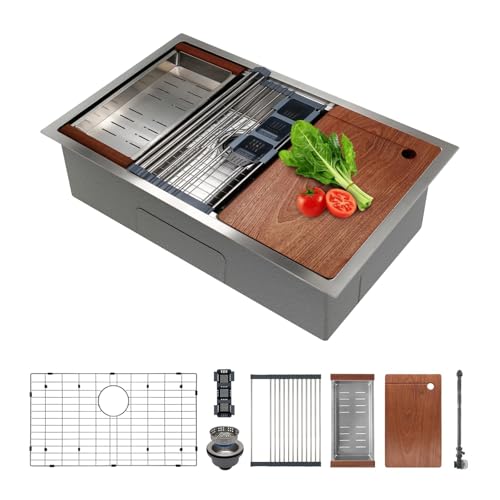
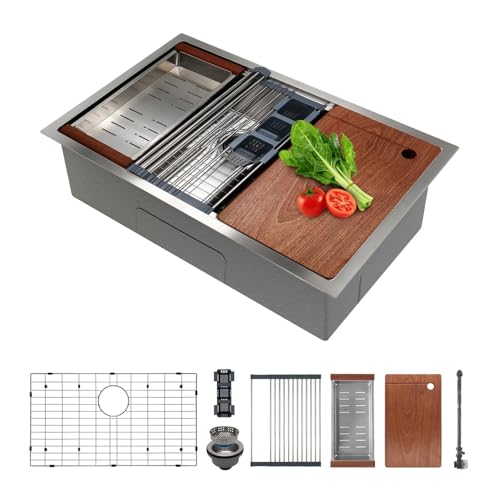
SANYCASA 30 Inch Undermount Workstation Sink
Badge: Best True Workstation
Strengths
- Integrated ledge with a multifunctional workstation set — the genuine article, per its verified specification.
- 11-gauge (3mm) stainless steel: the heaviest construction in this guide by a wide margin.
- Superior-drain design addresses pooling on the bowl floor.
Trade-offs
- Heavy bowl — installation support and handling must be planned.
- Premium construction tier; you pay for steel and system together.
- Workstation accessories are system-specific; keep the model details filed.
Mini spec box: Size: 30 in · Mount: undermount · Steel: 11-gauge (3mm) stainless · Bowl: single · Workstation: integrated ledge, multifunctional workstation set · Drain: superior drain design
Here is the workstation, and it is not a close call. The SANYCASA’s specification contains the two elements the category is defined by — an integrated ledge formed into the bowl and a workstation set designed to work on it — wrapped in the heaviest steel in this guide. The ledge changes the sink’s role in the kitchen: chopping, draining, rinsing and resting all happen over the bowl, on accessories that travel the ledge and sit at a consistent working height below the worktop line, so the counter stays clear and the workflow compresses into the sink’s footprint. In a compact kitchen that compression is worth a run of cabinets; in a large one it is simply the most organised way to prep.
The 11-gauge construction matters to the workstation idea specifically, because a ledge is a working surface: boards land on it, pots rest on it, and the steel around it takes daily mechanical life that a plain bowl’s walls never see. Three-millimetre steel is the specification of a maker who expects that use. It suits serious cooks, compact kitchens that need the sink to multitask, and anyone buying the workstation concept with intent to use it daily. The honest limitations are weight and commitment — support it properly, and accept that its accessories are a system you are joining. As the guide’s one linked pick, it is also the natural anchor for the island layouts discussed in Best Kitchen Sinks For Kitchen Island planning, where a workstation bowl earns its keep in full view.
Best for: buyers who want a true integrated-ledge workstation, built heavy / Not suited for: light-use kitchens that would never ride the ledge
KRAUS KHU100-30 30 Inch Undermount Sink
Badge: Best Classic Bowl Alternative
Strengths
- 16-gauge TRU16 steel, rounded corners, channel grooves, NoiseDefend pads — a benchmark plain-bowl specification.
- Established maker’s documentation and model stability.
- An excellent bowl to approximate workstation workflow on, with rim-resting accessories.
Trade-offs
- No integrated ledge in this model’s verified specification — it is not a workstation, hence prose-only in this guide.
- Boards and racks rest across the rim at worktop height rather than riding a ledge.
- Buyers set on the ledge should look at the maker’s dedicated workstation line instead — a different model from this one.
Mini spec box: Size: 30 in · Mount: undermount · Steel: 16-gauge TRU16 stainless · Bowl: single · Workstation ledge: none · Corners: rounded · Drainage: channel grooves · Soundproofing: NoiseDefend pads
The KHU100-30 is the most interesting prose-only entry in this guide, because the bowl is excellent and the maker is a workstation specialist — yet this model, the one assigned here, has no ledge in its specification, and the rule of this programme is that the model in hand, not the maker’s catalogue, decides. As a plain bowl it is close to faultless: thick named steel, cleanable corners, a draining floor, damped sound. Fitted with a roll-up rack and a board that span its rim, it will host a perfectly serviceable prep workflow — at worktop height, with accessories that lift away rather than slide, which some cooks honestly prefer.
It suits buyers who want the benchmark bowl and a flexible, accessory-based workflow, and it will suit them for a decade. It does not suit a buyer whose brief is the ledge itself; that buyer should take the SANYCASA above, or research the maker’s workstation models as a separate purchase decision outside this guide’s assigned pool. Within these pages it carries no link, and the reason is the guide’s whole point: the word workstation has a meaning, and this model, admirably, does not claim it in its specification either.
Best for: buyers wanting a benchmark plain bowl plus accessory-based prep / Not suited for: ledge-or-nothing workstation shoppers
This pick is prose-only, so there is no Amazon link for it in this guide.
cozhao 30 Inch Undermount Sink
Badge: Best Value Bowl Alternative
Strengths
- 304 stainless alloy named in the specification; handmade modern single bowl.
- Drain assembly included — the bowl arrives as a working unit.
- Direct-listing tier for a full 30-inch bowl.
Trade-offs
- No workstation ledge — prose-only in this guide.
- 18-gauge steel, below the 16-gauge benchmark.
- Workstation-style accessories must be sourced and sized separately.
Mini spec box: Size: 30 in · Mount: undermount · Steel: 18-gauge 304 stainless · Bowl: single · Workstation ledge: none · Construction: handmade · Included: drain assembly
The cozhao is a fair value bowl with an honest spec sheet — the alloy is named, the drain is included, the handmade profile is crisp — and no workstation pretensions anywhere in its verified description. In a guide policing terminology, that honesty counts in its favour even as it keeps the bowl prose-only. As a platform for accessory-based prep it is perfectly workable: its squared handmade geometry actually seats rim-resting boards and racks neatly, and a roll-up rack over this bowl is a genuinely useful station for rinsing and draining.
It suits budget-aware buyers who want a sound bowl now and a flexible workflow, and who may add accessories over time. It does not suit the ledge-committed, and its 18-gauge steel asks the usual conscious trade. Treat it as what it is — a good plain bowl at a direct tier — and it will not disappoint; treat the word workstation as decoration, and this guide has failed you, which is why the distinction is drawn so firmly here.
Best for: value-focused buyers happy with rim-accessory workflow / Not suited for: anyone whose brief is an integrated ledge
This pick is prose-only, so there is no Amazon link for it in this guide.
MAYESAR 28 Inch Undermount Sink
Badge: Best Compact Alternative
Strengths
- 16-gauge steel at a compact 28 x 18 inch footprint, with a full 9-inch depth.
- Handmade construction, brushed finish, round corners — completely specified.
- The only bowl here sized for genuinely small cabinets.
Trade-offs
- No workstation ledge — prose-only in this guide.
- At 28 inches, over-bowl accessories are smaller and fewer.
- Its width will not host the largest boards even as rim accessories.
Mini spec box: Size: 28 x 18 in · Mount: undermount · Steel: 16-gauge stainless · Bowl: single · Workstation ledge: none · Depth: 9 in · Construction: handmade · Finish: brushed · Corners: round
The MAYESAR closes the list with the compact case, and it is a good one: full-gauge steel, real depth, tidy handmade geometry, every dimension published. It is also, unavoidably, the bowl for which the workstation absence bites hardest, because compact kitchens are exactly where a ledge earns its keep — and exactly where this bowl cannot offer one. A small roll-up rack across its rim is the practical approximation, and for many small-kitchen cooks it will honestly suffice, because their prep volume is modest and the bowl’s depth handles the soaking work.
It suits small kitchens that need a quality bowl and can live with rim-level accessories. Buyers in compact spaces for whom the ledge is non-negotiable face a harder search — the true workstation market concentrates at 30 inches and above — and should weigh cabinet changes against the concept before compromising either. In this guide the MAYESAR is the best compact plain bowl, labelled as exactly that.
Best for: compact kitchens wanting a full-gauge plain bowl / Not suited for: ledge-first buyers in small spaces
This pick is prose-only, so there is no Amazon link for it in this guide.
Comparison Table
| Pick | Material | Size | Gauge | Integrated ledge | Check |
|---|---|---|---|---|---|
| Miuara Farmhouse 30 | Fireclay | 30 x 18 in | — | No | Prose-only |
| Miuara Farmhouse 33 | Fireclay | 33 x 18 in | — | No | Prose-only |
| SANYCASA 30 | Stainless | 30 in | 11 (3mm) | Yes — workstation set | Check on Amazon |
| KRAUS KHU100-30 | Stainless | 30 in | 16 | No | Prose-only |
| cozhao 30 | Stainless 304 | 30 in | 18 | No | Prose-only |
| MAYESAR 28 | Stainless | 28 x 18 in | 16 | No | Prose-only |
How to Choose a Workstation Sink — and How to Spot a Fake One
The recognition test takes ten seconds in any listing. Look for the ledge in the specification’s own words: “integrated ledge” is the phrase that matters, ideally with the accessories it carries named — a workstation set, a board, a rack dimensioned for the bowl. Look for the ledge in the images: a visible step running along the bowl’s long walls, below the rim, with accessories seated in it at a level visibly below the worktop. And look for the system logic: accessories listed as part of the product, not as lifestyle props photographed on top of it. The SANYCASA in this guide passes all three checks in its verified title alone. A listing that fails them may still be selling a fine sink — several in this guide are exactly that — but it is not selling a workstation, and its price should be judged against plain bowls, not against ledged ones.
Size the workstation by your prep, not your pans alone. Thirty inches, the SANYCASA’s span, is the workstation sweet spot for most kitchens: long enough for a board and a rack to share the ledge, compact enough for standard large cabinets. Wider workstations exist in the broader market for kitchens that prep at volume; narrower true workstations are rare, which is the compact-kitchen dilemma the MAYESAR review describes. Depth matters too — the bowl below the ledge still has to soak and wash, so a workstation that sacrifices bowl volume to its ledge has misunderstood its own brief.
Steel, finally, matters more in a workstation than in a plain bowl, because the ledge is a working surface that takes board edges, pot rims and daily sliding contact. Heavy gauge around the ledge is not a luxury specification; it is the difference between a system that stays true and one whose working edges wear and flex. That is the engineering context in which the SANYCASA’s 3mm construction should be read — and the standard to hold any workstation listing to when you shop beyond this page, through channels like those surveyed in Best Kitchen Sinks For Sale listings, where the same recognition test applies to every workstation claim you meet.
One more recognition cue is worth adding, because it catches the subtlest marketing case: the double-ledge photograph on a single-ledge claim, and its cousin, the accessory photographed in a bowl it was never dimensioned for. In a genuine system the accessories in the image belong to the model in the listing — the board’s length matches the bowl’s width, the rack’s rails match the ledge’s span, and the set is itemised in the contents with the same names the images use. When the photographs show generic boards that appear in a dozen unrelated listings, you are looking at a styled bowl, not a system. The discipline is the same one this programme applies to steel: believe the specification, verify it against the contents list, and let the photography argue last. A workstation is an engineered product, and engineered products can always show their working.
Cabinet planning for a workstation deserves its own sentence in this section, because the ledge tempts buyers to size by the bowl’s working length and forget the installation’s other demands. The bowl is still an undermount: it needs its cabinet clearance, its support, and its waste run, exactly as the plain bowls in this guide do — and a workstation’s accessories need a storage answer for the hours they are off the rail, whether that is a drawer, a rack in the cabinet, or simply the discipline of leaving them in place. Plan the accessories’ home at the same time as the bowl’s, and the system stays a pleasure instead of becoming a set of beautiful objects in the way.
How to Use, Fit and Care for a Workstation Sink
Fitting is the undermount discipline this programme repeats for good reason: bowl on site and inspected before the worktop is cut, rim flatness checked, support rails or a frame beneath — with a workstation, support matters doubly, because the ledge will carry working loads at the bowl’s edges — an even silicone seal, the drain connected after fixing, and a fill-and-inspect leak test from below. Then fit the workstation set and travel every accessory along the full ledge before the first meal is prepped: boards and racks should slide freely and seat without rocking, and any tightness is a fitting-week conversation, not a year-two discovery.
- Inspect the bowl and the workstation set on arrival; check the ledge for true, even forming.
- Dry-fit to the cutout; agree the reveal with your fabricator.
- Support, seal, connect the waste, fill and leak-check.
- Seat each accessory on the ledge and confirm travel and stability.
- File the model details — workstation parts are system-specific.
Daily workstation craft is a small set of habits. Work along the ledge in a sequence — board at one end, rack at the other, waste falling straight into the bowl — and the station organises itself. Lift accessories off to soak when the bowl does heavy duty, rather than working around them. Keep the ledge itself wiped and dry as part of the normal clean; it is a horizontal surface at splash height and it collects what horizontal surfaces collect. Problem: an accessory rocks on the ledge. → Check for debris or a dried deposit on the ledge step before blaming the fit; a clean ledge usually restores the seat. Problem: the ledge edge shows fine marks. → That is working contact, the honest patina of the system; a grid-minded habit — resting heavy rims on the rack rather than the steel — keeps it minimal. Problem: prep feels cramped. → Run one accessory at a time and use the bowl’s depth as the second station; the ledge is a rail, not a countertop, and sequencing is the skill that makes it feel twice its length.
Making a Plain Bowl Work Like a Workstation
For readers who choose one of the prose-only bowls — for its price, its size, its maker or its looks — the workstation workflow can be approximated more closely than sceptics expect. A roll-up rack spanning the rim creates a draining and resting level over the bowl. A board sized to bridge the bowl gives a prep surface that drops scraps straight into the water below. A colander that rests across the rim handles pasta and produce. Used in sequence, the three recreate perhaps most of the ledge’s daily value, with two honest differences: everything sits at worktop height rather than in the bowl’s sheltered step, and everything lifts away rather than slides, so the workflow is a series of placements instead of a continuous rail.
Some cooks prefer it that way — the accessories store in a drawer, the bowl stays a bowl, and nothing about the sink commits the kitchen to a system. That is a legitimate philosophy, and the KHU100-30 in particular serves it beautifully. What this guide insists on is only the vocabulary: call that arrangement a well-accessorised plain bowl, enjoy it without reservation, and reserve the word workstation for the integrated ledge — so that the next buyer reading a listing knows which of the two things is actually in the box. Readers planning that accessory route will find the bowl-first thinking in Best Kitchen Sinks For Laminate Countertops guides useful too, since rim accessories care nothing for worktop material even though mounting does.
A Day at the Ledge: Workstation Workflow in Practice
Abstract claims about workflow deserve a concrete test, so walk an ordinary evening through a workstation bowl. Dinner is a stir-fry with rice. The board rides the ledge at one end of the SANYCASA; vegetables are chopped on it and swept, with the knife’s spine, straight into the bowl’s corner — no board carried across the kitchen, no peelings migrating across the worktop. The colander seats on the ledge beside it, rinsed greens draining over the water while the wok heats. The roll-up rack takes the hot pan for its resting minute, off the worktop and over the sink, where its drips belong. Cooking happens in a single station’s radius, and the worktop — in a small kitchen, the whole of the worktop — remains clear for plates, glasses and the cook’s elbows.
Cleanup is where the ledge quietly wins its second argument. The board, still on its rail, is scrubbed over the bowl and left on the rack to dry in place. The bowl below has caught the evening’s debris as it was produced, so the final rinse is a formality rather than an excavation. Nothing in this sequence is dramatic, and that is the point: the workstation does not add a capability so much as it removes a hundred small frictions — carrying, balancing, wiping around, drying elsewhere — that plain-bowl kitchens pay without noticing. Households that cook daily feel the sum within a week. Households that cook twice a week may honestly never feel it, which is why this guide keeps returning the decision to your own habits rather than to the concept’s charisma.
Breakfast tells the same story at smaller scale: fruit rinsed in the ledge colander, board for toast and melon, rack for the coffee pot. The station assembles in seconds because its parts live on the rail, and it disassembles — accessories lifted to soak or store — just as fast when the bowl needs to be a bowl. That reversibility is the mature version of the workstation idea: not a sink permanently dressed as a prep bench, but a sink that becomes one, exactly when asked, and stops the moment it is not.
The Workstation Decision: Three Households
The first household cooks from scratch six nights a week in a kitchen with four feet of usable worktop. For them the ledge is not an upgrade; it is the difference between a kitchen that supports their cooking and one that taxes it. The SANYCASA is the clearest recommendation this guide can make, and its heavy steel suits a bowl that will work as hard as they do. The second household cooks well but episodically — weekend projects, weekday simplicity — in a kitchen with generous counters. For them the workstation is a pleasure rather than a necessity, and the honest contest is between the ledge’s convenience and a benchmark plain bowl’s simplicity; the KHU100-30 with a roll-up rack is a defensible, satisfying answer, and this guide has given it a full review for exactly that reader.
The third household is renovating a small rental flat, where the cabinet will not take 30 inches and the budget must cover the whole room. Their workstation ambitions meet the market’s reality — true ledges live at 30 inches and up — and the MAYESAR’s compact quality, plus a small rack, is the pragmatic station available to them. Naming these three outcomes is the guide’s real work. The category’s marketing would sell all three households the same word; the specifications sell each of them a different, appropriate bowl — and only one of those bowls, in this assigned pool, is a workstation. Buy the one your household actually is.
Common Buying Mistakes
- Believing the word “workstation” without finding the ledge. If the specification does not say integrated ledge, it is a plain bowl with marketing.
- Counting a rim-resting board as a workstation accessory. Height, stability and travel are the differences; they are the product.
- Buying a workstation whose bowl is too shallow to soak. The ledge is the second job; the bowl remains the first.
- Ignoring steel gauge around the ledge. The ledge is a working surface and wears like one; heavy steel is the honest specification.
- Assuming accessories interchange between brands. Workstation sets are dimensioned per model — keep the system single-source.
- Rejecting a good plain bowl for lacking a feature you will not use. If your prep lives on the worktop, a benchmark bowl plus a rack may serve you better than a ledge.
Final Recommendation
The recommendation in this guide is unusually simple, because the definition did the work: if you want a workstation sink, buy the SANYCASA 30 Inch Workstation — the one pick here with a verified integrated ledge and workstation set, in the heaviest steel in the group. If your honest reflection is that your prep lives on the worktop and the ledge would be jewellery, then buy the best plain bowl for your size and budget from the alternatives reviewed above, add a roll-up rack, and enjoy it without calling it something it is not. Either decision is a good one. The only bad decision in this category is paying workstation money for a word — and after this guide, you will not.
Frequently Asked Questions
What exactly makes a sink a workstation sink?
An integrated ledge formed into the bowl’s walls, below the rim, with accessories — boards, racks, colanders — designed to ride and rest on it. That ledge, as a system with its accessories, is the definition. A grid in the bowl or a board across the rim does not qualify.
Why is only one pick in this guide linked?
Because only one of the six assigned picks, the SANYCASA, has an integrated ledge in its verified specification and is made of stainless steel. The other five are reviewed fully as prose-only alternatives rather than linked under a label they do not meet.
Can I turn a normal sink into a workstation with accessories?
You can approximate the workflow — a roll-up rack, a bridging board and a rim colander recreate much of the daily value — but the accessories sit at worktop height and lift away rather than sliding on a ledge. It is a good arrangement; it is not the integrated system.
Is a workstation sink worth it in a small kitchen?
Often it is worth most there, because the ledge returns worktop space by moving prep over the bowl. The constraint is size: true workstations concentrate at 30 inches and above, so the cabinet must measure up before the concept can help.
Does the ledge reduce the bowl’s washing capacity?
Slightly, at the very top of the bowl — the ledge occupies the upper walls. In practice the working volume for soaking and washing is barely affected, and the accessories riding the ledge give back more function than the step takes away.
Are workstation accessories replaceable?
Yes, within the same maker’s system — they are dimensioned for the specific model’s ledge, so replacements should be ordered by model number. File the sink’s paperwork at installation and a replacement board or rack years later is a lookup, not a search.
Why does this guide review sinks that are not workstations at all?
Because they were assigned to it, and because readers benefit more from honest reviews than from silence. Each alternative is a real product with real merits for the right kitchen — a benchmark plain bowl, a value handmade bowl, a compact full-gauge bowl, two farmhouse fireclay bowls — and each review states plainly why it is not linked under this keyword. A guide that only praised its one qualifying pick and hid the rest would leave readers unable to judge the alternatives they will meet in the market, labelled however sellers choose to label them.
What size cabinets do workstation sinks need?
The same undermount clearances as any bowl of their width — for the 30-inch class here, a large standard base unit with verified internal room for the bowl, its support and the waste run. The ledge itself does not change the cabinet maths, because it lives inside the bowl’s footprint; what changes is the storage plan for the accessories when they are off the rail. Measure the cabinet interior, sketch the waste and any disposal, and confirm the fabricator’s requirements before ordering — the workstation’s extra function never excuses the format’s basic measurements, and a ledge in a bowl that does not fit is a sculpture, not a station.
How long do workstation accessories last?
Boards and racks are consumables on a longer clock than the bowl: a board that is chopped on daily will show its years while the 3mm steel around it is barely marked, and that is the system working as intended — the replaceable parts absorb the wear so the permanent fixture does not. Budget mentally for accessory renewal over the sink’s life, order by model number when the time comes, and treat a worn board the way you treat a worn knife steel: as evidence of a kitchen that cooks, and as a small, planned cost of the workstation way of working.
Is the workstation premium about the ledge or the steel?
Both, and in the one qualifying pick here they arrive together: the ledge system is the functional premium, and the 11-gauge construction is the durability premium that a working ledge arguably requires. When you compare workstation listings elsewhere, separate the two in your mind — a thin-gauge ledged bowl and a heavy plain bowl are different products wearing adjacent descriptions, and their prices should be interrogated against different rivals.