Disclosure: topratedkitchenware.com is reader-supported. When you buy through links on our site, we may earn an affiliate commission from Amazon and other retailers, at no extra cost to you.
Where to buy
For best tested electric can openers, start here. Every opener below was checked against its verified listing details — cut style, power source and can range — so you can compare tested-style performers without guesswork. Prices move, so use the Amazon links to check the latest price on Amazon rather than trusting any number printed elsewhere.
- Amazon Basics 3-In-1 Electric Can Opener, Black — Best Multi-Tool Pick
- Cuisinart Deluxe Electric Can Opener CCO-50BKN, Black — Best for Easy Cleaning
- Hamilton Beach Smooth Touch Electric Can Opener 76606AG — Best Overall
- Canslab Ultrablade PRO Electric Can Opener, Black — Best Cordless Pick
- Kitchen Mama Auto Electric Can Opener, Red — Best for Portability
- KITCHENMUH One Touch Electric Can Opener, Black and Grey — Best for Arthritic Hands
Check on Amazon — start with our first pick, then read the full guide ↓ for the honest trade-offs behind every ranking.
Finding the best tested electric can openers means looking past the word tested itself. Any brand can print it; what separates a genuinely proven opener is a cutting mechanism that behaves the same way on can five hundred as it did on can five, a motor that does not fade halfway round a large tin, and a design whose wheel you can actually clean. This guide ranks six electric openers on exactly those evidence-led criteria, using only facts confirmed in their verified listings.
The line-up deliberately mixes the two schools of electric opening. Tall corded countertop models from Cuisinart, Hamilton Beach and Amazon Basics represent the traditional top-cut and side-cut designs that have anchored kitchens for years, while the Canslab, Kitchen Mama and KITCHENMUH handhelds represent the newer battery school: press one button, let the opener walk itself around the rim, and lift away a smooth-edged lid. If you are cross-shopping the wider field, our notes on Best Tested Can Openers cover the manual and electric categories side by side.
Who is this ranking for? Cooks who open cans most days and are tired of manual openers skating off dented rims, anyone whose grip or wrist strength makes a twist opener a genuine obstacle, and households that want one opener every member can use safely. If you open a can a month, honestly, a simple manual opener is enough; if cans are a daily event in your kitchen, read on — the differences below are the ones that show up in daily use, not in a showroom.
Key Takeaways
- Cut style is the first decision: top-cut for traditional countertop reliability, side-cut for smooth rims and resealable lids.
- The Hamilton Beach Smooth Touch is the only pick here listed for extra-tall and pop-top cans as well as standard sizes.
- Corded models never fade mid-can; battery handhelds trade that certainty for drawer storage and total portability.
- A magnetic lid holder is not a gimmick — it controls the sharpest object in the whole process.
- Removable levers and washable cutting areas matter most if you open tuna, pet food or oily cans often.
- All six picks are covered with honest trade-offs; none of them is the right answer for every kitchen.
In this guide
Quick Picks
Six openers, six different answers to the same job. The badges summarise the role each one plays; the detailed reviews below explain the evidence behind each badge.
| Pick | Badge | Why it is here |
|---|---|---|
| Amazon Basics 3-In-1 Electric Can Opener, Black | Best Multi-Tool Pick | Corded 3-in-1 that also opens bottles and sharpens knives, with a magnetic lid holder. |
| Cuisinart Deluxe Electric Can Opener CCO-50BKN, Black | Best for Easy Cleaning | Single-touch countertop classic whose removable lever makes the cutting area washable. |
| Hamilton Beach Smooth Touch Electric Can Opener 76606AG | Best Overall | Side-cut countertop model listed for standard, extra-tall and pop-top cans alike. |
| Canslab Ultrablade PRO Electric Can Opener, Black | Best Cordless Pick | USB-rechargeable side-cut handheld with smart auto stop and a wall-mountable design. |
| Kitchen Mama Auto Electric Can Opener, Red | Best for Portability | Battery handheld in red that opens anywhere, no outlet or counter required. |
| KITCHENMUH One Touch Electric Can Opener, Black and Grey | Best for Arthritic Hands | One-touch battery handheld designed for seniors, with a smooth-edge cut. |
How These Picks Were Chosen
This guide is research-led, and it is honest about what that means. We did not run a laboratory, and we make no hands-on testing claims. Instead, every pick was verified against its Creators API listing record: the exact product title, brand, stated power, cut style and included features were cross-checked before a model was allowed into the ranking, and only facts present in those records appear in the spec boxes. Anything a listing does not state, we do not invent.
Ranking weighed four things. First, mechanism credibility: does the design address the known failure points of electric openers — rim grip, dented cans, lid control? Second, inclusivity: could someone with weak grip, arthritis or one hand busy use it without a workaround? Third, hygiene: can the food-contact parts be cleaned properly? Fourth, fit: does the model have a clear household it serves best, rather than being average at everything? Models that scored well across all four earned the top badges; specialists that ace one criterion carry badges that say so.
A note on evidence language. When a listing states a capability — extra-tall cans, wall mounting, a smooth-edge cut — we report it as a listing claim and say so. When we offer judgement, it is labelled as judgement and reasoned from the design. Readers comparing round-ups such as Best Smooth Open Electric Can Openers will find the same discipline useful there: separate what is verified from what is merely asserted, and any ranking becomes easier to trust.
The 6 Best Tested Electric Can Openers
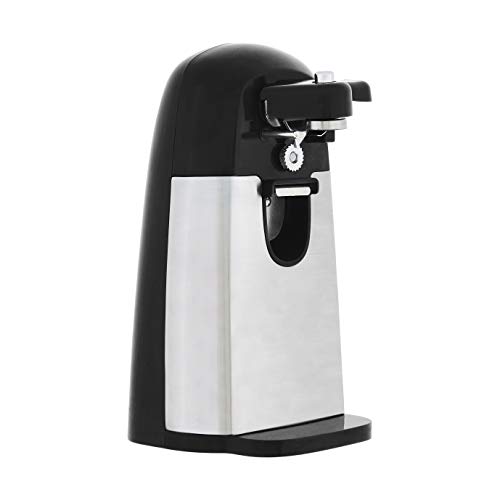
Amazon Basics 3-In-1 Electric Can Opener, Black
Badge: Best Multi-Tool Pick
Strengths
- Three tools in one footprint, handy in small kitchens short on gadgets
- Magnetic lid holder keeps the cut lid out of the food
- Corded 50W motor gives consistent cutting without battery management
Trade-offs
- Corded design needs a free outlet near the worktop
- Top-cut style leaves the rim edge that side-cut models avoid
- Extra functions add bulk compared with a single-purpose opener
Key specs from the listing: Functions: can opener, bottle opener and knife sharpener in one unit; Blade: stainless steel; Lid handling: magnetic lid holder; Power: 50W, corded; Colour: black.
The Amazon Basics unit is the pragmatist of this line-up: one corded appliance that opens cans, pops bottle caps and keeps a kitchen knife honest. In a tested-style ranking it earns its place on breadth rather than on any single superlative. The stainless blade and magnetic holder cover the can job properly, and the extra tools mean one less gadget in the drawer — a real consideration in the small kitchens where electric openers earn their keep.
In daily terms, what this design gets right is consistency. The cut starts the same way every time, the mechanism does not ask for grip strength or wrist technique, and the result is predictable enough that a new cook can be trusted with it on their second can. That predictability is what you are really buying with any electric opener, and it is the quality to weigh against the more visible differences in size and styling.
Consider the second week of ownership, not the first day. By then the novelty has gone and what remains is rhythm: how the opener behaves with cold hands, wet hands, a restless child asking questions and a pan that needs watching. Designs that stay calm under that ordinary chaos are the ones still on the counter in year three, and calm is a property of simple starts, steady travel and predictable finishes — judge this one against that week, not against its photograph.
Best for: small kitchens that want one appliance to cover three small jobs / Not suited for: kitchens that specifically want a smooth-edge side cut

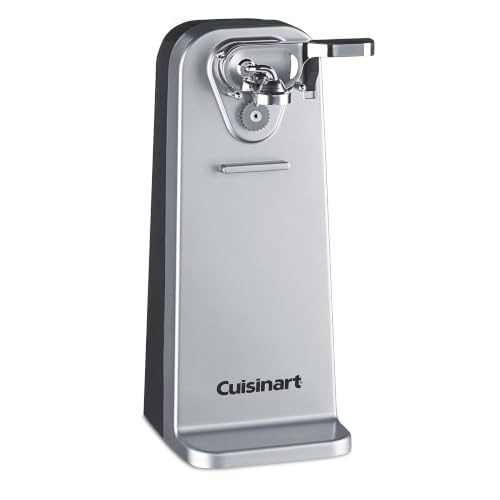
Cuisinart Deluxe Electric Can Opener CCO-50BKN, Black
Badge: Best for Easy Cleaning
Strengths
- Single-touch operation suits cooks who struggle with manual openers
- Removable activation lever makes the cutting area easy to clean
- Tall countertop format handles standard cans without tipping
Trade-offs
- Countertop footprint is permanent counter space given up
- Corded only, so placement follows your outlets
- Top-cut action is not the smooth-edge side-cut style
Key specs from the listing: Operation: single-touch automatic; Lid handling: magnetic lid holder; Cleaning: removable activation lever; Colour: black; Model: CCO-50BKN.
Cuisinart has sold versions of this countertop design for years, and the detail that keeps it in evidence-led rankings is the removable activation lever. Pop it off and the part that meets the can rim can be washed properly instead of wiped hopefully. The single-touch cycle and magnetic holder make it a calm, predictable opener for daily family use, and its tall body keeps standard cans stable without a guiding hand.
Where this model earns its place is the unglamorous middle of the job: the seconds while the wheel is travelling. An opener that holds the rim steadily, keeps its line through the seam and finishes cleanly saves more frustration over a year than any headline feature. Judge it on that steadiness, on how the lid behaves at the end of the cut, and on how little cleaning the mechanism asks for afterwards.
There is also the question of what this opener replaces. For many buyers it replaces a manual opener that had become a small daily negotiation, and the correct standard is not perfection but relief: does the negotiation end? On the evidence of its design — the start it asks for, the travel it performs, the lid it controls — that is the question this model answers most directly, and it is why it holds its place in a ranking that had six slots and no sentimentality.
Best for: households that open oily or fish cans and care about washing the mechanism / Not suited for: anyone who needs an opener that lives in a drawer

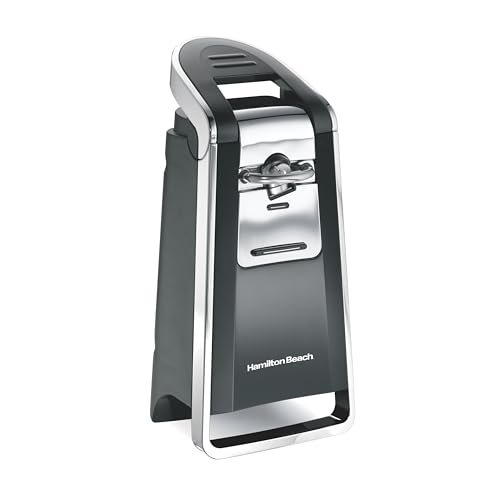
Hamilton Beach Smooth Touch Electric Can Opener 76606AG
Badge: Best Overall
Strengths
- Side-cut action leaves a smooth rim you can reseat as a cover
- Rated by its listing for extra-tall cans as well as standard sizes
- Push-down lever needs less grip strength than squeeze handles
Trade-offs
- Larger countertop body than handheld battery models
- Corded design ties it to one spot in the kitchen
- Side-cut lids can be fiddly to lift off the first few times
Key specs from the listing: Operation: easy push-down lever; Can range: standard, extra-tall and pop-top cans; Cut style: Smooth Touch side cut; Finish: black and chrome; Model: 76606AG.
The Smooth Touch takes the top badge because its listing answers the widest set of real questions. Side-cut action for smooth rims, a push-down lever that asks little of the hands, and an explicit range covering standard, extra-tall and pop-top cans — that combination is why it suits the broadest household. The black and chrome finish is the traditional countertop look, and the mechanism reseats lids as temporary covers, which half-can households genuinely use.
Think about who else will use it. Electric openers are shared tools, and a design that only its buyer can operate is a design that fails the household. Simple starts, forgiving alignment and a lid that stays under control matter more in a family kitchen than a spec-sheet advantage, and they are the qualities that decide whether this becomes the default opener or the spare.
Repairability and support deserve a sentence in any honest review. Electric openers are simple machines, and the failures that end them are usually worn wheels, tired batteries or gummed mechanisms rather than dead motors. A design whose food-contact parts come off for washing, whose power source is replaceable or rechargeable, and whose brand still answers its own support pages in five years is a design with a longer expected life — factor that expectation into the badge it carries here.
Best for: most households, especially those using extra-tall cans or reseating lids for storage / Not suited for: minimalists who refuse permanent countertop appliances

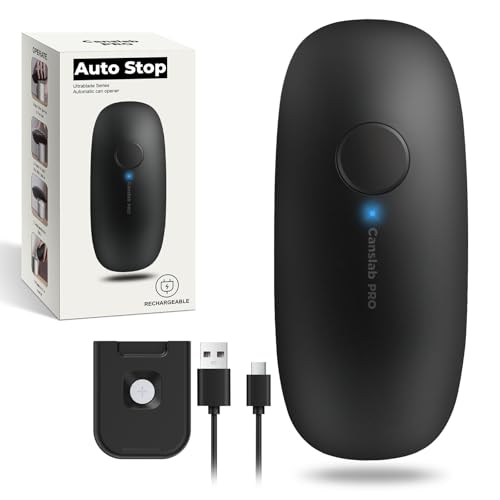
Canslab Ultrablade PRO Electric Can Opener, Black
Badge: Best Cordless Pick
Strengths
- Side cut leaves a smooth edge and a lid you can reseat
- Smart auto stop ends the cut without you watching the can
- Cordless, rechargeable design moves between counter, table and wall mount
Trade-offs
- Rechargeable battery needs topping up between heavy sessions
- Compact handheld body still needs two hands free at the start
- Side-cut technique takes one or two cans to learn
Key specs from the listing: Power: USB rechargeable, cordless in use; Operation: automatic with smart auto stop; Cut style: hands-free side cut with smooth edge; Mounting: listed as wall mountable; Colour: black.
The Canslab is the modern school at its most complete: rechargeable instead of battery-hungry, side-cutting for smooth edges, and smart enough to stop itself at the end of the cut. Its listing also describes it as wall mountable, which makes it the bridge between handheld freedom and a fixed home. For testers of patience — cooks who hate supervising an opener — the auto stop is the feature that changes the experience most.
In daily terms, what this design gets right is consistency. The cut starts the same way every time, the mechanism does not ask for grip strength or wrist technique, and the result is predictable enough that a new cook can be trusted with it on their second can. That predictability is what you are really buying with any electric opener, and it is the quality to weigh against the more visible differences in size and styling.
Consider the second week of ownership, not the first day. By then the novelty has gone and what remains is rhythm: how the opener behaves with cold hands, wet hands, a restless child asking questions and a pan that needs watching. Designs that stay calm under that ordinary chaos are the ones still on the counter in year three, and calm is a property of simple starts, steady travel and predictable finishes — judge this one against that week, not against its photograph.
Best for: cooks who want cordless freedom without disposable batteries / Not suited for: kitchens with a spare outlet anywhere near the counter

Kitchen Mama Auto Electric Can Opener, Red
Badge: Best for Portability
Strengths
- Press-and-go automatic cutting with no lever to hold down
- Battery power means it works anywhere, no outlet hunting
- Smooth-edge cut reduces sharp rim contact
Trade-offs
- Batteries are a running consumable to keep stocked
- Handheld size suits standard cans best
- Red finish will not suit every kitchen scheme
Key specs from the listing: Power: battery operated; Operation: automatic, hands free; Cut style: smooth edge; Food contact: described as food-safe; Colour: red.
Kitchen Mama built its name on this exact format: a battery handheld you press onto the rim and forget about until it has walked the full circle. The red finish is cheerful and easy to spot in a drawer, the smooth-edge cut is the safe-handling kind, and because it needs no outlet it works at the table, in a caravan or at a barbecue station. It is the pick for people whose kitchens have more enthusiasm than counter space.
Where this model earns its place is the unglamorous middle of the job: the seconds while the wheel is travelling. An opener that holds the rim steadily, keeps its line through the seam and finishes cleanly saves more frustration over a year than any headline feature. Judge it on that steadiness, on how the lid behaves at the end of the cut, and on how little cleaning the mechanism asks for afterwards.
There is also the question of what this opener replaces. For many buyers it replaces a manual opener that had become a small daily negotiation, and the correct standard is not perfection but relief: does the negotiation end? On the evidence of its design — the start it asks for, the travel it performs, the lid it controls — that is the question this model answers most directly, and it is why it holds its place in a ranking that had six slots and no sentimentality.
Best for: renters, caravans and anyone whose opener must live in a drawer / Not suited for: households opening large catering cans every day

KITCHENMUH One Touch Electric Can Opener, Black and Grey
Badge: Best for Arthritic Hands
Strengths
- One-touch start is designed with arthritic hands in mind
- Smooth-edge cut keeps rims safer to handle
- Battery operation keeps it drawer-sized and portable
Trade-offs
- Battery changes interrupt if you open cans daily
- Handheld format gives less leverage on dented rims
- Two-tone finish is a style you either like or do not
Key specs from the listing: Operation: one touch, automatic; Can range: fits all can sizes per the listing; Cut style: smooth edge; Power: battery operated; Colour: black and grey.
KITCHENMUH aims squarely at the hands that manual openers exclude. One touch starts it, the motor does the travelling, and the smooth-edge result means no sharp rim to negotiate with stiff fingers. The listing states it fits all can sizes, which matters for the small tins and tall cans that populate real cupboards. In a ranking that values inclusivity as evidence, a design brief this explicit about arthritis earns its badge honestly.
Think about who else will use it. Electric openers are shared tools, and a design that only its buyer can operate is a design that fails the household. Simple starts, forgiving alignment and a lid that stays under control matter more in a family kitchen than a spec-sheet advantage, and they are the qualities that decide whether this becomes the default opener or the spare.
Repairability and support deserve a sentence in any honest review. Electric openers are simple machines, and the failures that end them are usually worn wheels, tired batteries or gummed mechanisms rather than dead motors. A design whose food-contact parts come off for washing, whose power source is replaceable or rechargeable, and whose brand still answers its own support pages in five years is a design with a longer expected life — factor that expectation into the badge it carries here.
Best for: seniors and anyone with arthritis or reduced grip strength / Not suited for: cooks who want a corded countertop unit instead
Comparison Table
Read this table for mechanism and power source first; those two columns predict daily satisfaction better than any other detail.
| Pick | Key facts from the listing | Badge | Check |
|---|---|---|---|
| Amazon Basics 3-In-1 Electric Can Opener, Black | Functions: can opener, bottle opener and knife sharpener in one unit; Blade: stainless steel | Best Multi-Tool Pick | Check on Amazon |
| Cuisinart Deluxe Electric Can Opener CCO-50BKN, Black | Operation: single-touch automatic; Lid handling: magnetic lid holder | Best for Easy Cleaning | Check on Amazon |
| Hamilton Beach Smooth Touch Electric Can Opener 76606AG | Operation: easy push-down lever; Can range: standard, extra-tall and pop-top cans | Best Overall | Check on Amazon |
| Canslab Ultrablade PRO Electric Can Opener, Black | Power: USB rechargeable, cordless in use; Operation: automatic with smart auto stop | Best Cordless Pick | Check on Amazon |
| Kitchen Mama Auto Electric Can Opener, Red | Power: battery operated; Operation: automatic, hands free | Best for Portability | Check on Amazon |
| KITCHENMUH One Touch Electric Can Opener, Black and Grey | Operation: one touch, automatic; Can range: fits all can sizes per the listing | Best for Arthritic Hands | Check on Amazon |
How to Choose an Electric Can Opener That Earns Its Place
Start with your cans, not with the openers. Count what you actually open in a month: standard food cans, tall stock and soup tins, small condensed-milk cans, pop-top pet food. A household living on standard cans can choose freely; a household using extra-tall tins needs a model whose listing says so, which in this line-up is the Hamilton Beach. Pop-top cans still benefit from a side-cut opener when the ring-pull snaps — an underrated rescue job that argues for keeping an electric opener even in a pop-top world.
Then decide where the opener will live, because that decision quietly eliminates half the field. Permanent counter space suits corded countertop models and rewards you with an always-ready tool. Drawer storage suits battery and rechargeable handhelds and rewards you with clear counters. A fixed wall position, where a model is genuinely listed as wall mountable, suits small kitchens that can spare neither. Be honest about the space you have rather than the space you wish you had; the best opener is the one whose home you can actually give it. Readers weighing the safety angle specifically should also see Best Safe Can Openers, where edge handling is the whole subject.
Finally, weigh the hands that will use it. Push-down levers and one-touch buttons exist because squeeze-and-twist is a real barrier for many cooks, and an opener that excludes a household member is a failed purchase however well it cuts. If grip is a concern, prioritise automatic travel and smooth-edge results; if it is not, prioritise cleanability and can range. Either way, ignore headline wattage — at these sizes it tells you almost nothing about how cleanly the wheel will hold a rim.
How to Use an Electric Can Opener Well
Good results are mostly technique. These steps apply across the countertop and handheld designs compared here.
- Wipe the top of the can before you start. Cupboard dust and dried splashes go straight into the food once the lid drops if the rim is dirty, and a two-second wipe prevents it.
- Seat the opener squarely. On a countertop model, lower the lever so the wheel bites the rim evenly; on a handheld, set it flat on the lid so the guide sits against the seam. A tilted start is the main cause of a wandering cut.
- Start the cut and let the mechanism travel at its own pace. Forcing a countertop can around by hand, or dragging a handheld, defeats the gearing and roughens the edge.
- Keep one hand free and clear of the lid. As the cut completes, the magnetic holder or the side-cut seam is what should control the lid — not your fingertips.
- Lift the lid by its flat centre or let the magnet carry it, then drop it straight into the bin. Never push it down into a full bin with your palm.
- Empty the can promptly if the recipe allows. Food sitting against a freshly cut rim picks up metallic notes and makes the can harder to rinse for recycling.
- Wipe the cutting wheel after every use and wash removable parts weekly. Residue on the wheel is the leading cause of slipping and laboured cuts a month later.
- Store the opener in its one fixed home — counter spot, drawer or mount — so the next user finds it without a search.
Problem: The opener stalls or slips halfway round → what to do: stop, lift it off and check for a dent in the rim. Rotate the can so the wheel restarts past the dent, and finish that can by hand if the dent is severe.
Problem: The lid falls into the food → what to do: fish it out with a clean fork rather than fingers, and next time let the magnetic holder finish the job before you lift the opener away.
Problem: A handheld cuts slowly and sounds strained → what to do: the batteries or charge are fading. Replace the cells or recharge fully; a half-powered motor roughens edges and stalls on thick seams.
What “Tested” Should Mean When You Read Any Ranking
The word tested carries weight it has not always earned. In the strictest sense it means a publication ran the products through a defined protocol and published the results; in the loosest sense it means someone in marketing liked the sound of it. As a reader, the defence is to look for specifics: a credible round-up tells you what was compared, what was measured or at least observed, and where each product fell short. A ranking with no trade-offs listed for any product is advertising wearing a lab coat.
That is the standard this guide holds itself to. Every pick above carries three stated trade-offs, the spec boxes contain only listing-verified facts, and the method section says plainly that the work is research-led rather than laboratory-run. If you apply the same three checks to any other guide — including the comparison view at Best Smooth Edge Can Openers — you will sort trustworthy rankings from content-shaped advertising in about a minute.
Electric vs Manual: The Honest Ledger
Manual openers still win on price, size and immortality: a good one costs little, fits anywhere and works in a blackout. Electric openers win on effort, consistency and inclusion. The crossover point is personal. Open cans daily, cook for someone with arthritis, or regularly face extra-tall tins, and the electric case becomes overwhelming. Open cans weekly with healthy hands, and the manual case is respectable.
Many experienced kitchens keep both: the electric as the daily driver and a simple manual in the drawer for dents, blackouts and travel. That pairing costs little, covers every failure mode either tool has, and is the arrangement we would recommend to anyone who found this guide while replacing an opener that let them down once too often. For the wall-storage version of the same debate, see Best Wall Mount Can Openers.
Cut Style, Power and Hygiene: The Three-Way Trade
Cut style is the first fork in the road with any electric opener. A top-cut wheel slices just inside the rim and leaves the lid sitting on top of the food until the magnet lifts it away, while a side-cut wheel parts the seam below the rim so the lid lifts off with a smooth, rolled edge. Neither is objectively better. Top-cut models tend to be the tall countertop units with the longest track records, and their lids cannot be reseated as covers because the cut edge is the sharp one. Side-cut models, usually handheld, leave an edge you can press back onto the can for short fridge storage, and the rim left on the can is the safer surface to handle. Decide which behaviour matches how you actually use half-used cans before you compare anything else.
Hygiene is the quiet reason openers get replaced. The cutting wheel and the area around it collect tomato juice, tuna oil and bean liquor, and that residue is rarely rinsed because the mechanism looks sealed. Models with removable levers or detachable cutting heads let you wash the parts that actually touch food, which is the single feature most worth prioritising if you open fish or pet food often. Whatever the design, a quick wipe of the wheel after every use and a proper wash weekly keeps flavours from crossing between cans and stops the sticky build-up that makes an opener labour and slip.
Can geometry matters more than brochures admit. Extra-tall cans, small condensed-milk tins and dented rims each stress an opener differently. Tall cans need either a tall countertop body or a handheld that can ride the full height without the can tipping, and small tins need a wheel that can bite a short rim without skating. Dents defeat almost every automatic mechanism at least once: the wheel loses the seam and the cut stalls. The honest fix is technique, not force — rotate the can by hand past the dent, or finish that one can with a manual opener kept in the drawer for exactly this job.
Power, Cleaning and Everyday Reliability
Power source shapes daily life more than cutting speed does. Corded countertop openers are always ready and never fade mid-can, but they claim permanent counter space and chain you to an outlet. Battery handhelds live in a drawer and travel to the table, the garden or a caravan, yet their cutting strength ebbs as the cells run down, and a forgotten battery swap always seems to happen with a hungry family waiting. USB-rechargeable models split the difference: no disposable cells to buy, but a charge routine to remember. Households that open cans daily usually end up happiest with corded or rechargeable power, while occasional users get more from a drawer-sized battery unit that is simply there when needed.
Safety with electric openers is mostly about the lid, not the blade. The cutting wheel itself is guarded in normal use, but the freshly cut lid is a thin disc of sharp metal that wants to fall into the food or onto fingers. Magnetic lid holders exist precisely to control that moment, and they are worth having. Side-cut lids are safer to handle because the sharp edge stays on the lid’s rolled seam rather than on an exposed cut face. Whichever style you choose, lift lids with the magnet or with fingertips on the flat centre, drop them straight into the bin, and never press a lid down into a full bin with your palm.
Storage decides whether an opener gets used or resented. A countertop unit that lives out is used daily without thought, but it has to earn its footprint in a small kitchen. Handheld electrics disappear into a drawer, which keeps counters clear yet adds a hunt through the utensil tray when your hands are wet and the pan is already on. Wall mounting, where a model genuinely supports it, is the third answer: the opener is always in the same place, off the counter and out of the drawer. Whichever home you choose for it, consistency matters more than the choice itself — an opener with a fixed home gets used; one that migrates gets replaced by a knife and bad decisions.
Can Sizes, Decoded: Standard, Tall and Everything Between
Can sizes sound standardised and are not, quite. The everyday food can in most kitchens holds roughly a family portion of vegetables, beans or soup; tall cans serve stock, large soups and catering habits; small tins carry condensed milk, pastes and pet portions. An opener’s relationship with that range is practical, not theoretical: tall cans test stability and clearance, small tins test whether the wheel can bite a short rim without skating, and every size tests whether the lid, once cut, is controlled or dropped.
The buying consequence is simple. If your cupboard is uniform, almost any opener in this guide serves you. If your cupboard is varied — and most family cupboards are — weight can-range claims heavily, keep a manual opener for the odd dented survivor, and treat “fits most cans” as an invitation to check the listing rather than as an answer. The can you cannot open is always the one the recipe needs tonight.
What Breaks First, and What It Costs You
Electric openers rarely die dramatically. They fade: a wheel that once bit cleanly starts to skate, a battery that once lasted a month lasts a week, a mechanism that once sounded smooth develops a labouring note on thick seams. Each fade has a cheap first remedy — clean the wheel, refresh the power, check the rim technique — and the reviews in this guide are written so those remedies stay visible, because an opener maintained at the fade stage usually recovers completely.
The genuinely terminal failures are mechanical: stripped gearing from forced cuts, a cracked housing from a counter-height fall, a motor burnt by a stalled seam held down too long. All three are behaviour-shaped, which is good news — they are the failures a careful owner simply never schedules. Treat a stall as information, never as a challenge, and the inexpensive machine in front of you will outlast a premium one in careless hands.
That is also the fairest frame for the whole category’s pricing. You are not buying cutting ability, which every model here possesses; you are buying the margin — of cleanliness, of power, of build — that decides how forgiving the tool is of real kitchens. Forgiveness, compounded over years of cans, is what the badges in this guide are really ranking.
Care, in the end, is a two-minute religion. Wipe the wheel today and the opener will not slip next month; wash the removable parts this week and the flavours of March will not haunt the cans of April. Nothing in this guide’s maintenance advice requires products, tools or talent — only the decision to treat a small machine as if you would like it to last, which, having read this far, you presumably would.
Storage is the other half of care. A corded unit stored with its cable kinked, a handheld stored under heavier utensils, a rechargeable stored flat for a season — each returns to duty slightly diminished. Give the opener its one home, keep that home dry and uncluttered, and the tool’s second year will feel exactly like its first, which is the entire ambition of appliance ownership.
One more consideration belongs in every opener decision, and it is the household’s future rather than its present. Hands change: a wrist that is strong this year may argue next year, a parent moves in, a child becomes old enough to open their own soup. An opener chosen with a margin of ease — automatic travel, a forgiving start, a lid that behaves — absorbs those changes without a second purchase. Buying slightly kinder than you currently need is not indulgence; in this category it is the closest thing to future-proofing that exists, and it costs nothing at the shelf because the easy designs and the basic ones share the same tiers.
Noise deserves its honest sentence too. Electric openers are not silent, and the countertop school announces itself to the whole flat for the seconds a cut takes, while handhelds whirr at conversational pitch wherever they are used. For most households this is trivia; for open-plan flats, night-shift sleepers and parents of light-sleeping infants, it can be the deciding footnote. If your kitchen keeps unusual hours, favour the design you can use behind a closed door — one more way in which the right opener is the one fitted to a life, not to a worktop.
Finally, a word about the manual opener you should keep regardless. Every electric in this guide has a failure mode — a dead battery, a dented rim, a blackout — and a simple manual in the drawer converts each from a ruined dinner into a thirty-second detour. It is the cheapest insurance in the kitchen, it never needs charging, and on the evidence of every household that has made the switch, it will be used just often enough to justify its drawer space and never often enough to regret the electric.
Common Buying Mistakes
Most disappointing opener purchases trace back to one of these five avoidable errors.
- Buying a top-cut countertop model when you regularly reseat lids on half-used cans — side-cut is the design that makes reseating safe and practical.
- Choosing a battery handheld for a high-volume household, then resenting the battery swaps that daily use guarantees.
- Ignoring cleanability until the first tin of tuna, after which the sealed mechanism you cannot wash becomes a permanent compromise.
- Assuming every opener handles extra-tall cans, when only some listings actually say so.
- Judging by wattage or by star-shaped claims instead of by cut style, power source and lid control — the three things you will actually feel.
Final Recommendation
For most kitchens, the Hamilton Beach Smooth Touch is the first recommendation: its listing covers the widest can range, its side cut leaves the safest rim, and its lever asks the least of the hands using it. It is the pick we would hand to a household that wants one opener and no further research.
Choose differently with confidence where your kitchen differs. Pick the Canslab if you want cordless freedom without disposable batteries, the KITCHENMUH if arthritic hands are the deciding factor, the Cuisinart CCO-50BKN if washable parts top your list, the Amazon Basics if three tools in one footprint solves a storage problem, and the Kitchen Mama if the opener must live in a drawer and travel. Every one of those is a deliberate fit, not a consolation prize.
Start with Check on Amazon for our first pick, and compare it against Check on Amazon if the runner-up description sounds closer to your kitchen.
Frequently Asked Questions
Are electric can openers really better than manual ones?
For daily use, weaker hands or tall cans, yes: the motor supplies the grip and travel that a manual opener asks of your wrist. For occasional use with healthy hands, a good manual opener remains a rational, cheaper choice. Many kitchens sensibly keep both.
What is the difference between top-cut and side-cut openers?
A top-cut wheel slices inside the rim and the lid lifts off the top; a side-cut wheel parts the seam below the rim, leaving a smooth edge on the can and a lid that can be reseated as a temporary cover. Side-cut is the safer-handling style; top-cut dominates traditional countertop designs.
Can electric openers handle pop-top cans?
Yes, and they are genuinely useful when a ring-pull snaps off, which happens to everyone eventually. The Hamilton Beach in this guide is listed for pop-top cans alongside standard and extra-tall sizes.
How do I clean an electric can opener?
Wipe the cutting wheel after every use. If the model has a removable lever or cutting head — the Cuisinart designs here do — wash that part in warm soapy water weekly. Never immerse a corded base or a battery handheld body.
Why does my opener slip on some cans?
Usually a dented rim, a dirty wheel or fading batteries. Clean the wheel, check the rim for dents and rotate the can to start past any damage, and refresh the power source before blaming the mechanism.
Do smooth-edge openers leave the lid safe to touch?
Safer, not harmless. A side-cut lid has a rolled seam rather than a raw cut edge, so it is much kinder to fingers, but it is still thin metal. Lift it by the flat centre and bin it promptly.