Disclosure: topratedkitchenware.com is reader-supported. When you buy through links on our site, we may earn an affiliate commission from Amazon and other retailers, at no extra cost to you.
Where to buy
Choosing the best type of chopsticks for reuse starts from a simple truth: reuse is a specification, not a vibe. A chopstick earns the word by surviving hundreds of wash-and-eat cycles without splintering, staining, warping or shedding its grip. The six verified sets below are all stainless steel — the material that defines the reusable end of this category — and every one is linked. Between them they cover the reusable type’s main forms: square textured, premium 18/10 gift, hollow-core light, colour-coded household, plated occasion and eight-pair bulk. The sections after the reviews do the honest wider work, weighing bamboo, wood and fibreglass as reuse materials, because choosing the best type of chopsticks for reuse is finally a question about what survives your kitchen.
- Zliutob Stainless Steel Chopsticks, 5 Pairs — square textured steel built for daily reuse cycles
- LIXTONGR Dragon & Phoenix Black Stainless Steel Chopsticks, 2 Pairs — 18/10 steel in a gift box: the longest-horizon pair here
- MUYOS Stainless Steel Chopsticks, 5 Pairs, Silver — hollow-core steel that stays light across years of meals
- Greatamzor Multicolor Stainless Steel Chopsticks, 5 Pairs — square colour-coded pairs: a reuse system for shared homes
- Greatamzor Titanium-Plated Stainless Steel Chopsticks, 2 Pairs — plated pairs for occasions that repeat for years
- NEWDRIP Multicolor Stainless Steel Chopsticks, 8 Pairs — eight pairs so reuse survives guests and dishwasher lag
Read the full guide ↓ for the detailed reviews, the comparison table, and the technique and care guidance that decides which of these sets actually fits your hands and your table.
Every reusable chopstick makes the same promise — thousands of meals from one purchase — and the types differ mainly in how honestly they keep it. The best type of chopsticks for reuse is the one whose material, construction and finish are all indifferent to repetition: to hot water, to detergents, to oily broths, to the drawer, to the decade. That standard eliminates more of the category than marketing suggests, and it is why this guide’s verified pool is steel from end to end: not because other materials cannot be reused, but because steel’s reuse is unconditional, asking nothing of your routine in return.
Judge the six linked sets below as reuse machines with different secondary talents. One is built around grip geometry, one around material grade and presentation, one around lightness that keeps daily use pleasant in year five as in week one, two around the household systems — colour-coding and bulk depth — that make reuse a default rather than a virtue practised on good days, and one around occasions that recur. The reviews keep the reuse ledger for each: what wears, what does not, and what care the type actually demands, which in steel’s case is close to none.
The wider sections then take the material question seriously on reuse grounds alone — how bamboo ages, how wood asks to be treated, where fibreglass wins — so a buyer committed to another material can still choose its most reusable form. But the headline finding is simple and the six picks embody it: if reuse is the brief, the type to beat is textured stainless steel, owned in enough depth that the reusable choice is always the easy choice.
Key Takeaways
- Reuse is won or lost on repetition: the best type survives washing, heat, oil and years without losing grip or shape.
- All six linked picks are stainless steel, the unconditional reuse material — dishwasher safe, non-porous, effectively permanent.
- Household systems decide real-world reuse: colour-coding and multipack depth make the reusable pair the easy pair.
- Engraved texture outlasts printed or coated grip, because the pattern is cut into the material itself.
- Buy reuse in depth: a pair per eater plus spares, so no meal defaults back to disposables for logistical reasons.
In this guide
Quick Picks
| Pick | Badge | Why it stands out |
|---|---|---|
| Zliutob Stainless Steel Chopsticks, 5 Pairs | Best Reuse Grip | Square textured steel: grip that survives the years |
| LIXTONGR Dragon & Phoenix Black Stainless Steel Chopsticks, 2 Pairs | Best Reuse Investment | 18/10 gift steel: the buy-once pair in presentation form |
| MUYOS Stainless Steel Chopsticks, 5 Pairs, Silver | Best Lightweight Reuser | Hollow-core steel: daily reuse without the weight tax |
| Greatamzor Multicolor Stainless Steel Chopsticks, 5 Pairs | Best Household Reuse System | Colour-coded square pairs: reuse organised by household member |
| Greatamzor Titanium-Plated Stainless Steel Chopsticks, 2 Pairs | Best Occasion Reuser | Plated pairs: occasions reused for a decade |
| NEWDRIP Multicolor Stainless Steel Chopsticks, 8 Pairs | Best Bulk Reuse | Eight pairs: reuse with hosting depth |
How These Picks Were Chosen
Selection applied a reuse audit to the verified pool. Each set was checked for the properties repetition punishes: a non-porous material, a grip treatment that is structural rather than applied, construction without fragile joints, and care requirements a normal household will sustain indefinitely. Stainless steel sets passed by design; within them we kept the spread of forms — profile, grade, construction, finish, format — that lets different households build their reuse system. All specifications come from the verified listings, and where a listing omits a fact such as length or grade, the review leaves the gap open.
As with every guide in this programme, the method is research-led comparison, not claimed hands-on testing, and category knowledge is labelled as such when it appears. The reuse judgements — how engraving ages compared with printing, how hollow cores behave across years, why set depth decides whether reuse actually happens — rest on the documented behaviour of these materials and designs. A reuse claim is a claim about the future, so we have kept every such claim tied to a mechanism you can inspect in the listing itself.
The 6 Best Type Of Chopsticks For Reuse

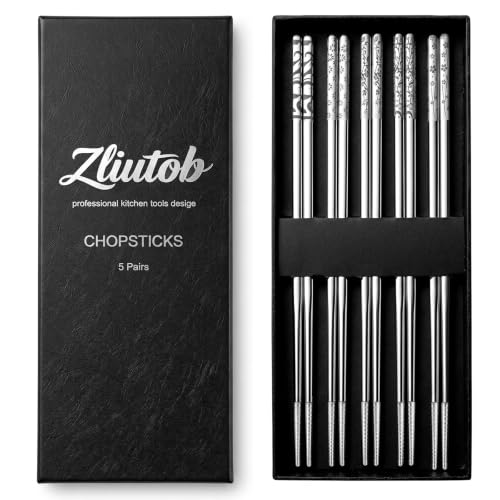
Zliutob Stainless Steel Chopsticks, 5 Pairs
Badge: Best Reuse Grip Readers comparing nearby options often also look at Best Type Of Chopsticks.
The Zliutob set makes its case through shape. A square grip profile does not roll on the table, sits steadier between the fingers, and gives a learner’s hand four flat reference faces instead of a slippery cylinder; textured tips then do the food-side work on ramen noodles and sushi pieces, the two jobs the listing itself names. Five pairs keep it a household set rather than a hosting arsenal. The listing does not state a length or a steel grade, so this is a pick you choose for geometry and texture, not for published dimensions — measure your current favourite pair first if length matters to you.
Judged purely as reuse equipment, the square profile is a durability feature disguised as a grip feature. Its texture cannot wear off, because the texture is the shape; its tips present flat faces to food after a thousand washes exactly as they did at the first. Add the dishwasher indifference of steel and this set’s reuse ledger is almost empty of debits — no coating to lose, no finish to protect, no care ritual to keep up. For a household that wants reusables it can treat exactly like its forks, this geometry is the most honest offer in the line-up.
Strengths
- Square profile resists rolling and steadies finger placement
- Textured tips are aimed squarely at noodles and sushi
- Five pairs is a sensible household quantity
Trade-offs
- Length and steel grade are not stated in the verified listing
- Square edges feel angular to diners raised on round bamboo
- Texture holds onto oily sauces until washed
At a glance:
- Set size: 5 pairs
- Grip: square profile
- Tips: textured, non-slip
- Care: dishwasher safe
- Listing uses: sushi, ramen, daily meals
Best for: daily eaters building a permanent set / Not suited for: diners wanting a disposable-light feel

LIXTONGR Dragon & Phoenix Black Stainless Steel Chopsticks, 2 Pairs
Badge: Best Reuse Investment
Two pairs, a gift box, and the richest steel grade in this cluster: the LIXTONGR Dragon & Phoenix set is the presentation pick. 18/10 stainless steel is the grade restaurants associate with their best flatware, the black finish and dragon-and-phoenix motif make it a deliberate object rather than a utensil-drawer afterthought, and at 9 inches it runs slightly shorter than the 9.25 inch sets around it — a small difference that some hands prefer for control. The listing itself names dining, travel, housewarming and wedding use, which is exactly the life this set is built for: given, kept, and used on occasions. Readers comparing nearby options often also look at Best Type Of Chopsticks To Buy.
The reuse case for a premium pair is amortisation: one purchase, at the highest common steel grade, presented properly, and then a decade or more of occasions served without a second thought. 18/10 steel does not degrade across that horizon, the non-slip grip is part of the object, and the gift box doubles as the storage that keeps the pair from drawer damage between uses. Occasions are where households relapse into disposables for presentation’s sake; a kept reusable pair this presentable removes the excuse permanently.
Strengths
- 18/10 steel: the premium grade in this line-up
- Gift box presentation suits weddings and housewarmings
- Slightly shorter 9 inch length can feel more controllable
Trade-offs
- Only two pairs: not a family-drawer solution
- Black decorative finish asks for gentler handling to stay pristine
- Motif styling is a matter of taste and will not suit minimal tables
At a glance:
- Material: 18/10 stainless steel
- Length: 9 inches
- Set size: 2 pairs
- Grip: non-slip
- Care: dishwasher safe
- Presentation: gift box
- Listing uses: dining, travel, housewarming, wedding
Best for: buyers purchasing once, for years / Not suited for: rotation across a big household
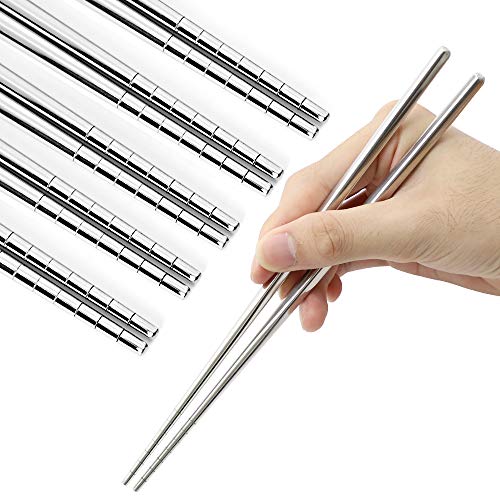
MUYOS Stainless Steel Chopsticks, 5 Pairs, Silver
Badge: Best Lightweight Reuser
Weight is the MUYOS argument. A hollow-core build trims the heft that makes solid steel chopsticks tiring over a long meal, which matters more than most first-time metal buyers expect: chopstick fatigue is real, and it shows up as a cramping grip and sloppy pickups halfway through a bowl of noodles. Five silver pairs with non-slip tips keep the format familiar — daily meals, per the listing — while the lighter hand feel narrows the gap between metal durability and bamboo lightness. If you have bounced off steel chopsticks before because they felt like knitting needles, this is the design that answers that complaint.
A reusable that is unpleasant to use is a reusable that stops being used, which is why this hollow-core set’s lightness is a reuse specification. Daily repetition is the whole game, and a pair that keeps hands comfortable across a long meal in year five sustains the habit that a heavier pair quietly erodes. Its construction has no coatings to lose and its care is the dishwasher; the reuse ledger here is dominated by a single credit — it will be reached for tomorrow, and the day after, which is the only prediction that matters. Readers comparing nearby options often also look at Best Type Of Reusable Chopsticks.
Strengths
- Hollow-core build is noticeably lighter over long meals
- Non-slip tips compensate for the lighter touch
- Plain silver finish matches any existing flatware
Trade-offs
- Featherweight feel can read as insubstantial to some diners
- Length is not stated in the verified listing
- Hollow construction rewards avoiding use as a kitchen pry tool
At a glance:
- Set size: 5 pairs
- Build: hollow-core, lightweight
- Tips: non-slip
- Care: dishwasher safe
- Finish: silver
- Listing use: daily meals
Best for: daily users with tired hands / Not suited for: diners who prefer solid heft

Greatamzor Multicolor Stainless Steel Chopsticks, 5 Pairs
Badge: Best Household Reuse System
The second Greatamzor entry pairs a square profile with a laser-engraved copper coin pattern and a multicolor finish across five pairs at 9 1/4 inches. Square sides keep the pair from rolling off a plate rim, the engraving gives fingers and food something to hold onto, and the colour spread lets a household assign pairs by colour — a small system that quietly ends the shared-drawer mix-ups. It reads as the personality pick of the steel sets: all the practical engineering of its plainer sibling, with a finish that makes the table setting part of the point.
In a shared household, reuse is an organisation problem wearing a material’s clothes, and this colour-coded square set is the organisational answer. A pair per person, identifiable at a glance, means pairs are washed because they are missed, kept because they are claimed, and present at every meal because everyone knows whose is whose. The square profile and engraved pattern keep the physical side honest across the years. Systems like this are why some households never think about disposables again, while identical steel in an unassigned drawer leaks takeaway pairs within a season.
Strengths Readers comparing nearby options often also look at Best Type Of Wood For Chopsticks.
- Square profile plus engraving: grip help at both ends
- Colour variety supports a pair-per-person household system
- Five pairs at full 9 1/4 inch adult length
Trade-offs
- Copper coin motif will not match every table style
- Engraved grooves need deliberate washing after oily meals
- Multicolor sets can clash with formal flatware
At a glance:
- Length: 9 1/4 inches
- Set size: 5 pairs
- Profile: square, non-slip
- Pattern: laser-engraved copper coin
- Care: dishwasher safe
- Finish: multicolor
Best for: families assigning pairs per person / Not suited for: formal place settings

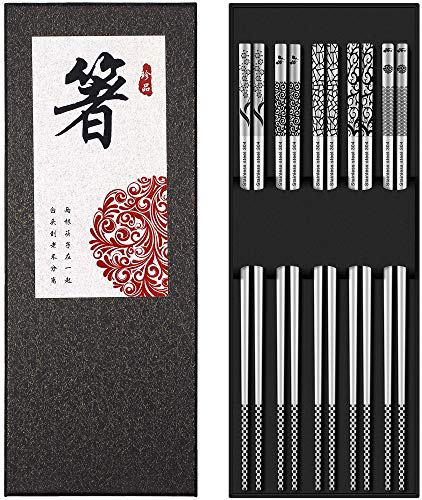
Greatamzor Titanium-Plated Stainless Steel Chopsticks, 2 Pairs
Badge: Best Occasion Reuser
Two pairs with a titanium-plated black-silver finish: this Greatamzor set is built to be looked at as much as used. The plating gives the steel a darker, more formal presence than bright silver pairs, the laser engraving keeps the non-slip story intact, and the gift-set presentation points it at couples, hosts and anyone furnishing a first serious table. Plated finishes do ask for a little respect — they are not the pair to toss loose into a cutlery drawer or scrub with abrasives — but as a kept-for-best set that also works daily, it occupies a niche none of the multipacks try to fill.
Occasions recur — that is what makes them occasions — and a plated pair built for them is a reusable in the truest sense: bought once, brought out for years of celebrations, returned to its box between. The engraved tips keep its function as permanent as its finish is formal, provided the household honours the one care rule plating asks, gentle washing over abrasion. As reuse, its role is to defend the celebrations, the meals where presentation pressure most often smuggles disposables back onto an otherwise converted table.
Strengths
- Titanium-plated finish: the most formal look in this line-up
- Engraved non-slip tips keep function under the styling
- Two-pair gift format suits couples and occasions
Trade-offs Readers comparing nearby options often also look at Best Tips For Using Chopsticks.
- Plated finishes reward gentle washing over abrasive scrubbing
- Two pairs only: a kept set, not a household workhorse
- Length is not stated in the verified listing
At a glance:
- Set size: 2 pairs
- Finish: titanium-plated, black silver
- Tips: laser-engraved, non-slip
- Care: dishwasher safe
- Style: Japanese / Korean
- Presentation: gift set
Best for: hosts with recurring occasions / Not suited for: daily rough rotation

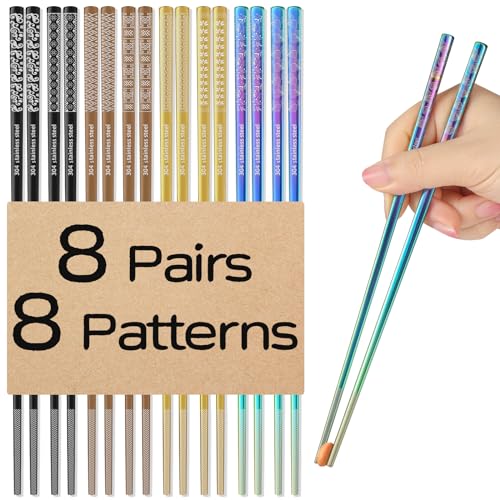
NEWDRIP Multicolor Stainless Steel Chopsticks, 8 Pairs
Badge: Best Bulk Reuse
This NEWDRIP variant takes the eight-pair format and adds colour: a multicolor finish across the set, with the same 9.25 inch length and laser-engraved non-slip detailing as its plainer sibling. Colour-coding sounds like a gimmick until a household starts arguing about whose pair is whose, or a parent wants each family member to keep their own set for hygiene. It also makes the set read as a gift rather than a restock — the kind of multipack that can go straight from box to table at a housewarming. The steel grade is not stated in the listing, so judge it on format and finish rather than metallurgy claims.
Scale is a reuse argument. Eight pairs mean the reusable option survives the guest list, the dishwasher cycle and the pair that went to the office — the three shortages that actually break reusable households. The multicolor finish runs the assignment system across the bench, and the engraved tips keep every pair’s grip structural rather than applied. Bought once, this set converts a table’s default for years; the per-meal cost of that conversion, divided across its service life, is as close to zero as kitchen equipment gets.
Strengths
- Multicolor finish lets each diner claim an identifiable pair
- Eight pairs cover hosting without a second purchase
- Engraved tips keep the food-grip story intact despite the colour
Trade-offs
- Steel grade is not stated in the verified listing
- Bright finishes will not suit every table aesthetic
- Colour sets can look informal for formal place settings
At a glance: Readers comparing nearby options often also look at Best Titanium Chopsticks.
- Set size: 8 pairs
- Length: 9.25 inches
- Tips: laser-engraved, non-slip
- Care: dishwasher safe
- Style: Japanese / Korean / Chinese
- Finish: multicolor
Best for: households replacing disposables entirely / Not suited for: minimalist small households
Comparison Table
| Pick | Set size | Length (as listed) | Standout trait | Link |
|---|---|---|---|---|
| Zliutob Stainless Steel Chopsticks, 5 Pairs | 5 pairs | Not stated in listing | Square textured steel: grip that survives the years | Check on Amazon |
| LIXTONGR Dragon & Phoenix Black Stainless Steel Chopsticks, 2 Pairs | 2 pairs | 9 inches | 18/10 gift steel: the buy-once pair in presentation form | Check on Amazon |
| MUYOS Stainless Steel Chopsticks, 5 Pairs, Silver | 5 pairs | Not stated in listing | Hollow-core steel: daily reuse without the weight tax | Check on Amazon |
| Greatamzor Multicolor Stainless Steel Chopsticks, 5 Pairs | 5 pairs | 9 1/4 inches | Colour-coded square pairs: reuse organised by household member | Check on Amazon |
| Greatamzor Titanium-Plated Stainless Steel Chopsticks, 2 Pairs | 2 pairs | Not stated in listing | Plated pairs: occasions reused for a decade | Check on Amazon |
| NEWDRIP Multicolor Stainless Steel Chopsticks, 8 Pairs | 8 pairs | 9.25 inches | Eight pairs: reuse with hosting depth | Check on Amazon |
For a reuse brief, compare the trait column first — it names each set’s durability mechanism — and set size second, because reuse fails logistically before it fails materially. Lengths are printed only where the verified listing states them; a reuse purchase is a long commitment, and it should be made on published facts.
How to Choose Chopsticks for Reuse: Choosing the Type That Lasts
Rank materials by what repetition does to them. Stainless steel is the reference: non-porous, unreactive, dishwasher-indifferent, and immune to the staining, splintering and warping that retire organic pairs; its only reuse tax is weight, which hollow construction manages. Fibreglass is the credible challenger — heat-tolerant, plain, nearly indestructible — with a less pleasant hand feel. Bamboo reuses honestly for a good while, especially in thicker, carbonised forms, but it is a consumable on a long fuse: it will stain, roughen and eventually split, and its low cost is the compensation. Wood’s reuse depends entirely on the wood and its finish, from workhorse pairs to lacquer that must be babied — a type whose care you must want to perform.
Within a material, choose structural grip. Engraving, scoring and profile geometry are part of the object and age with it; printed patterns, paints and many coatings are guests that leave early, taking the pair’s food grip with them. This is the quiet reason so many of this guide’s picks are engraved or square: their defining feature is guaranteed to be present at meal five hundred, not just meal five. Apply the same test to any pair you consider, in any material: rub the feature mentally across five hundred washes and ask what remains.
Then buy the system, not the pair. Reuse collapses at the margins — the guest night, the dishwasher backlog, the pair that travelled and never returned — and each collapse reintroduces disposables that linger. Depth is the defence: a pair per regular eater, spares for the wash cycle, a couple extra for guests, organised by colour or pattern where a household needs assignment. The multipack and colour-coded types in this line-up exist because their makers understand that reuse is a logistics achievement wearing a product’s clothes.
How to Keep Reusable Chopsticks at Their Best for Years
Steel’s care routine is short, which is precisely its reuse argument — but short is not nothing. Wash after meals rather than leaving pairs soaking in dishwater for hours; rinse oily and acidic foods promptly; and give engraved and textured sections a deliberate pass with the brush or sponge, because the same texture that grips food grips residue. Dry before storing in a closed space. That is the whole liturgy, and a pair kept to it will outlast trends, kitchens and possibly the table it serves.
The habits below extend any reusable type’s life, steel included, and mark the few behaviours that genuinely shorten it:
- Wash promptly after oily meals; residue left overnight in engraved tips is the main cause of lingering flavours.
- Use the dishwasher freely for steel, but keep pairs from rattling against heavy items cycle after cycle.
- Store dry, ideally in a crock or divided drawer where tips are not crushed under cutlery weight.
- Never use eating pairs as cooking pry tools, pot scrapers or package openers — reuse ends at the toolbox, not the table.
- Audit the set yearly: retire any pair with a bent tip or damaged finish into the utility drawer, and let the bench absorb the loss.
One reuse habit matters more than all maintenance: keeping the system complete. A set that drifts below its household’s needs starts leaking disposable purchases at exactly the meals — guests, rush nights — where volume is highest. Top the bench back up when it thins, ideally with the same type so the drawer stays coherent, and the reusable default defends itself. Permanence, in a kitchen, is a stocking decision renewed annually, not a purchase made once.
Troubleshooting:
- Problem: flavours linger in engraved tips → residue, not material failure. A thorough wash with a brush, and prompt washing after oily meals, ends it.
- Problem: a pair has bent at the tip → it met a load eating never applies. Demote it to kitchen utility and replace it from the bench; steel forgives much, not leverage.
- Problem: the household keeps ‘running out’ of pairs → a depth problem disguised as a product problem. Add pairs before adding rules.
The Honest Ledger: Reuse vs Replacement Across Materials
Reuse has an accounting identity most guides avoid: a reusable pair only wins when it is actually reused, and it is actually reused when it is pleasant, present and clean at the moment of the meal. Expensive permanence that lives in a presentation box loses, on the ledger, to modest pairs in daily rotation. This is why the guide weights format and system — multipacks, colour assignment, dishwasher care — as reuse features equal to metallurgy. The greenest chopstick in your home is the one your hand reaches for at 7pm on a tired Tuesday, and engineering that reach is a legitimate design discipline.
The replacement side deserves equal honesty. Bamboo’s defenders are right that a cheap, renewable pair replaced yearly can be a rational system — provided the replacements actually happen and the retired pairs do not linger as drawer guilt. Steel’s counter is that it removes the decision entirely: no replacement cycle to manage, no degradation curve to watch, one less recurring purchase in a household’s life. For buyers who know they will not maintain a replacement rhythm, permanence is not a luxury; it is the only version of reuse that survives their calendar.
Grip That Ages Well: Why Engraving Beats Coating
Run a mental five-hundred-wash simulation on the two ways of making a chopstick grippy. A printed or coated texture sits on the surface, and every wash, every dishwasher cycle, every drawer rattle spends a little of it; the pair’s defining feature is a depreciating asset from the first meal. An engraved or profiled texture is the surface, cut or shaped into the material itself; washing cannot remove it without removing the chopstick. This single distinction predicts long-term satisfaction in this category better than any other, and it is visible in a listing’s wording before you spend anything.
The same logic blesses the square profile, whose grip contribution is pure geometry, and quietly indicts novelty finishes whose texture is a photograph of texture. When you shop beyond this guide — for a second type, a gift, a child’s first reusable pair — ask of every feature the engraver’s question: is this made of the object, or merely on it? Reuse belongs to the features that are made of the object, and the six sets linked here were chosen because, feature by feature, theirs are.
Length deserves more respect than it gets in most product listings. The standard adult eating length across these sets sits around nine to nine and a quarter inches, and that is not arbitrary: it keeps fingertips clear of hot broth, spans a dinner plate comfortably, and balances in the hand without the tail end catching on sleeves. Shorter pairs feel nimble for sushi and small plates; longer pairs earn their keep at a hot pot or a shared serving bowl. If you already own a pair you like, measure it before ordering anything new — matching a known-good length removes the single biggest source of first-week disappointment with an otherwise good set.
Care is where stainless steel quietly wins the long game. There are no lacquers to chip, no fibres to swell, no finishes that object to the dishwasher, and no seasoning ritual. What steel does ask for is basic thoroughness: engraved and textured sections hold onto oils and sauces, so a proper wash — not a rinse — keeps them tasting like nothing, which is exactly what a utensil should taste like. Dry storage matters too. A pair put away wet in a closed case or a sealed drawer compartment will eventually show it, whatever the grade stamped on the listing.
The honest way to think about set size is to count eaters, then add friction. A household of two that hosts monthly needs a different bench than a family of five eating with chopsticks nightly, and the dishwasher cycle is a real constraint: pairs in the wash are pairs you cannot use. Multipacks look excessive on a product page and feel inadequate on a Friday night with six guests and a hot pot. Buy for the table you actually set most months of the year, not the table you set once at a holiday, and let the big-occasion problem be solved by a second, cheaper backup set if it ever becomes real.
Etiquette travels with the tool. Resting a pair across the bowl is fine on a rest and contentious without one; sticking chopsticks upright in rice is widely read as a funerary image and worth avoiding at any table where it might land badly; passing food directly from one pair to another carries similar associations in Japanese settings. None of this affects which set you should buy, but a buyer learning chopsticks as an adult is usually also learning the table culture around them, and the two educations are cheaper together. A simple rest, incidentally, also keeps engraved tips off tablecloths and stops round pairs rolling onto the floor.
Finally, judge any pair by its third month, not its first meal. New steel can feel slick until your grip adjusts; new textures can feel aggressive until your fingers learn how little pressure they need. The sets that last are the ones whose compromises you stop noticing: the weight that becomes normal, the length that becomes instinct, the finish that survives your actual dishwasher rather than an idealised one. That is why this guide weights durability signals — steel grade where stated, construction, dishwasher care — as heavily as first-impression features. A chopstick is a ten-year object bought in a ten-minute decision; the least a guide can do is slow the decision down.
Grip is a trainable skill, and the timeline is kinder than most new users expect. The first week with any new pair is mostly about the rest position: the lower stick stays still, braced against the ring finger and the base of the thumb, while the upper stick does all the travelling, pivoted by the index and middle fingers. Once that division of labour clicks, the hand stops squeezing, and squeezing was the real source of most early failures — dropped noodles, aching fingers, food launched across the table. Practice with forgiving foods first: thick noodles, chunky stir-fry pieces, anything with texture. Save peas, beans and glossy dumplings for when the motion is boring, because boring is what mastery feels like from the inside.
A note on rests, the smallest accessory in this world: a rest keeps tips off the table, keeps round pairs from emigrating to the floor, and gives a meal a small, civilised pause button. Households that adopt rests find their pairs last longer in finish and in dignity, and guests read the table as considered. Rests are not bundled with the sets in this guide — the listings do not claim them — so treat them as a separate, inexpensive completion of any set you buy, chosen in a material that shares your pairs’ care routine.
Children at the table change the arithmetic of any set, even in an adult-focused guide. Small hands need shorter tools, and a household’s adult pairs will be borrowed, brandished and occasionally lost to the sofa regardless of policy. The pragmatic defence is depth — a bench that absorbs the chaos — plus one deliberate decision: keep the pair you care about out of the general pool, by colour, pattern or a separate rest by your own setting. Households that plan for the borrowing lose less to it.
There is a sensory detail experienced eaters mention and listings never do: temperature. Steel arrives at the mouth at room temperature and warms instantly; it neither insulates like bamboo nor chills like a spoon from a cold drawer. Most diners stop registering this within a week. Those who never do are not wrong — they are simply telling you their material preference is real, and the correct response is to honour it with a second type in the drawer rather than to argue a palate out of its own evidence.
Sustainability claims in this category deserve the same audit as product claims. A durable pair used daily for a decade displaces a small mountain of disposables; a durable pair used twice displaces almost nothing, and a cheap pair replaced yearly sits honestly in between, provided the replacements are genuinely recycled or composted where the material allows. The variable is never the object alone — it is object multiplied by meals. Which is one more reason this guide keeps returning to depth, comfort and care routines: they are what turn a purchase into the multiplied term.
If you take one analytical habit from this guide into the rest of your kitchen, let it be the contents-list habit: read what is verifiably in the box before admiring what is in the photograph. It applies to chopsticks, to the combined travel sets this programme has audited, and to nearly everything sold with styling. Sellers who state grades, lengths, counts and contents are competing on facts; sellers who state only adjectives are competing on fog. Your money is a vote for which kind of listing gets written next year.
Storage sounds like the least important decision in this category and quietly determines how long any set stays pleasant. Pairs kept loose in a cutlery drawer collide with heavier utensils thousands of times a year; pairs kept in a crock, a divided insert or their own case meet almost nothing but air and meals. Tips deserve the gentlest berth, since they do the finest work and show damage first. None of this requires equipment more elaborate than a jam jar — it requires only the decision that the pairs have a home, made once and then simply kept.
Common Buying Mistakes
Reuse purchases fail when the buyer optimises the object and ignores the system around it. The errors below are the usual ones.
- Buying one beautiful pair for a household. Reuse needs depth; a single pair guarantees disposable relapses at every guest night and wash cycle.
- Choosing grip that is printed on. Surface patterns retire early. Engraved, scored or profiled grip is the reuse-grade kind.
- Ignoring the care you will actually do. A type needing hand-washing in a dishwasher household has a short career, whatever its material virtues.
- Using the good pairs as tools. Prying, scraping and stove work bend tips and end eating lives. Keep a utility pair for the abuse.
- Letting the bench quietly thin. Lost pairs are normal; not replacing them is how a reusable household slides back to disposables.
Final Recommendation
For the reuse brief, the first name is the type itself: textured stainless steel, and within this guide the Zliutob square set wears it best for daily eating, with the LIXTONGR 18/10 pair as the buy-once presentation form of the same idea. Households should build the system around the colour-coded Greatamzor or the eight-pair NEWDRIP bench; hands that tire should start with the hollow-core MUYOS, whose lightness is what keeps daily reuse pleasant in year five. The plated Greatamzor set covers the occasions that recur.
Buy the depth your table needs, choose grip that is made of the object, and keep the wash routine boring. Do those three things and the question in this keyword answers itself permanently — which is, after all, the entire point of choosing for reuse.
Start here: Zliutob Stainless Steel Chopsticks, 5 Pairs (Best Reuse Grip); LIXTONGR Dragon & Phoenix Black Stainless Steel Chopsticks, 2 Pairs (Best Reuse Investment); MUYOS Stainless Steel Chopsticks, 5 Pairs, Silver (Best Lightweight Reuser).
Frequently Asked Questions
What is the best type of chopsticks for reuse?
Textured stainless steel, owned in household depth. Steel is non-porous, dishwasher safe and immune to the splintering, staining and warping that retire organic pairs, while engraved or square-profile grip is structural — cut or shaped into the material — so it survives the same years the pair does. The six picks in this guide span that type’s main forms, from the square Zliutob set to multipacks that keep a whole household reusable by default. Bamboo and fibreglass are credible alternatives with shorter or plainer service lives.
How long do reusable stainless steel chopsticks last?
In ordinary home use, effectively indefinitely — there is no wear mechanism in normal eating and washing that retires a sound steel pair on any household timescale. What ends steel pairs’ service is loss, bending from misuse as tools, or a household simply drifting away from them. That permanence is the core of the reuse case for steel: the purchase decision is made once, and the environmental and economic returns compound across every year the set stays in rotation.
Are bamboo chopsticks a good reusable choice?
A reasonable one, with a shorter horizon. Bamboo is light, naturally textured and inexpensive, and thicker or carbonised pairs can serve a household well for an extended period. But bamboo is porous and organic: it stains, roughens and eventually splits, so its reuse model is honest replacement on a cycle rather than permanence. Households that will actually sustain that cycle can choose bamboo with a clear conscience; households that will not should choose steel and remove the recurring decision.
Does the dishwasher damage reusable chopsticks?
For stainless steel, no — dishwasher care is one of its defining reuse advantages, and every set in this guide is listed as dishwasher safe. The practical cautions are minor: wash engraved sections thoroughly after oily meals, and avoid letting pairs rattle trapped against heavy items. Organic materials are another story — bamboo and many woods degrade faster with machine washing and heat drying — which is one more reason the care routine you will actually perform belongs in the type decision from the start.
Why do multipacks matter for reuse?
Because reuse fails logistically before it fails materially. Guests, dishwasher lag, a pair left at the office — each shortage is a moment where disposables re-enter the house, and habits re-form around them. A bench sized to the household, like the eight-pair set in this guide, absorbs those moments silently. Colour-coding adds the organisational layer for shared homes, keeping each person’s pair identifiable. Depth plus assignment is what turns a reusable purchase into a reusable household.
How should reusable chopsticks be stored?
Clean, dry and uncrushed: a crock on the counter, a divided drawer insert, or a rest-and-rack arrangement that keeps tips from bearing weight under piles of cutlery. Avoid sealing pairs away damp in closed containers, which invites odours even in steel, and keep eating pairs out of the utility drawer’s orbit, where they will be borrowed as tools. Storage sounds trivial until a bent tip or a missing pair traces back to it — in a reuse system, the drawer is part of the product.