Disclosure: topratedkitchenware.com is reader-supported. When you buy through links on our site, we may earn an affiliate commission from Amazon and other retailers, at no extra cost to you.
Where to buy
Ask ten cooks for the best type of chopsticks and you will start an argument about materials — but type means more than material. Profile, construction, finish and format each split the category into kinds that behave differently in the hand. The six verified sets below are all stainless steel, and this guide is upfront about that: they cannot settle wood versus bamboo versus steel for you, and the taxonomy sections below take that wider question seriously. What the six do superbly is map the types within steel — square and textured, premium and gift-boxed, hollow-core light, colour-coded, plated, and bulk — with links, so the most durable branch of the family tree can be bought from this page and judged in detail.
- Zliutob Stainless Steel Chopsticks, 5 Pairs — the square, textured type: control engineered into the profile
- LIXTONGR Dragon & Phoenix Black Stainless Steel Chopsticks, 2 Pairs — the premium type: 18/10 steel in a gift box at 9 inches
- MUYOS Stainless Steel Chopsticks, 5 Pairs, Silver — the lightweight type: hollow-core steel for long meals
- Greatamzor Multicolor Stainless Steel Chopsticks, 5 Pairs — the household type: square, engraved and colour-coded
- Greatamzor Titanium-Plated Stainless Steel Chopsticks, 2 Pairs — the formal type: titanium-plated pairs for kept occasions
- NEWDRIP Multicolor Stainless Steel Chopsticks, 8 Pairs — the bulk type: eight multicolor pairs for a whole table
Read the full guide ↓ for the detailed reviews, the comparison table, and the technique and care guidance that decides which of these sets actually fits your hands and your table.
Type is the most useful word in this category and the least examined. Shoppers ask for the best type of chopsticks and receive a material ranking — wood, bamboo, plastic, steel — as if material were the only axis along which chopsticks differ. It is not even the axis that matters first. Two steel pairs can differ more in the hand than a steel pair and a bamboo pair do: one square and textured, one round and polished; one solid, one hollow; one bought singly for occasions, one by the ten for a household. This guide treats type as the full specification — material, profile, construction, finish and format — and ranks accordingly.
The verified pool behind the guide is stainless steel from end to end, six sets deep, and we make no apology for building the detailed reviews there: steel is where the type variety is currently richest and the durability argument strongest. But the wider taxonomy gets its due in the sections after the reviews, where wood, bamboo, fibreglass and disposable types are weighed on their genuine merits — because a buyer deciding between materials deserves that map before narrowing to the six linked sets that represent the steel branch in its main sub-types.
Read the reviews as a tour of kinds, not a ladder. Each set was chosen to embody a type at its most characteristic — the square grip type, the premium gift type, the lightweight type and so on — and each review names the eater that type serves. The comparison and buying sections then reassemble the taxonomy into decisions: which type for your hand, your table, your washing habits and your budget of attention. By the end, the question in the keyword should feel smaller, because you will know which of its several questions is actually yours.
Key Takeaways
- Type is five decisions, not one: material, profile, construction, finish and format each change how a pair behaves.
- All six linked picks are stainless steel, spanning its main sub-types: square-textured, premium gift, hollow-core, colour-coded, plated and bulk.
- Profile is the most underrated type variable — square faces resist rotation and rolling in a way round pairs cannot.
- Construction splits steel itself: hollow-core pairs are a different type in the hand from solid pairs of the same material.
- Choose the type by the eater and the table first; the material argument usually settles itself afterwards.
In this guide
Quick Picks
| Pick | Badge | Why it stands out |
|---|---|---|
| Zliutob Stainless Steel Chopsticks, 5 Pairs | Best Grip Type | Square profile with textured tips: the control type |
| LIXTONGR Dragon & Phoenix Black Stainless Steel Chopsticks, 2 Pairs | Best Premium Type | 18/10 steel, gift box, shorter length: the premium type |
| MUYOS Stainless Steel Chopsticks, 5 Pairs, Silver | Best Lightweight Type | Hollow-core construction: steel’s lightweight type |
| Greatamzor Multicolor Stainless Steel Chopsticks, 5 Pairs | Best Household Type | Square, engraved, colour-coded: the household system type |
| Greatamzor Titanium-Plated Stainless Steel Chopsticks, 2 Pairs | Best Formal Type | Titanium-plated finish: the kept-for-best type |
| NEWDRIP Multicolor Stainless Steel Chopsticks, 8 Pairs | Best Bulk Type | Eight pairs in colour: the hosting capacity type |
How These Picks Were Chosen
We selected for coverage of kinds. From the verified steel pool we assembled six sets that, between them, demonstrate the category’s live distinctions: a square textured profile against rounder engraved ones; a premium 18/10 gift format against household multipacks; a hollow-core lightweight construction against solid builds; decorative systems — colour-coding and plating — against plain utility. A ranking of six near-identical pairs would have been easier to write and useless to read; a taxonomy you can buy from is the point of the page. Every specification in the reviews traces to the verified listings, and unstated facts are flagged, not filled.
The method is comparative and research-led: manufacturer specifications and design documentation, read against the accumulated kitchen knowledge of how these variables behave — how square faces sit in fingers, how hollow cores change a long meal, how engraving outlasts printing. We claim no hands-on testing and invent no measurements. Where the wider taxonomy enters — wood, bamboo and the rest — it enters as buying guidance in the dedicated sections, clearly separated from the six verified steel picks, so you always know which statements are product facts and which are category knowledge.
The 6 Best Type Of Chopsticks

Zliutob Stainless Steel Chopsticks, 5 Pairs
Badge: Best Grip Type Readers comparing nearby options often also look at Best Type Of Chopsticks For Reuse.
The Zliutob set makes its case through shape. A square grip profile does not roll on the table, sits steadier between the fingers, and gives a learner’s hand four flat reference faces instead of a slippery cylinder; textured tips then do the food-side work on ramen noodles and sushi pieces, the two jobs the listing itself names. Five pairs keep it a household set rather than a hosting arsenal. The listing does not state a length or a steel grade, so this is a pick you choose for geometry and texture, not for published dimensions — measure your current favourite pair first if length matters to you.
In the taxonomy of types, this set represents the square-profile school: flat faces that resist rolling and rotation, a geometry with deep roots in Japanese and Korean metal chopstick design. Type is not trivia — profile decides how a pair behaves in the hand before material ever gets a vote — and a square steel pair is the type buyers reach for when control, not novelty, is the requirement. Its textured tips complete the type’s argument: grip at the finger end, grip at the food end.
Strengths
- Square profile resists rolling and steadies finger placement
- Textured tips are aimed squarely at noodles and sushi
- Five pairs is a sensible household quantity
Trade-offs
- Length and steel grade are not stated in the verified listing
- Square edges feel angular to diners raised on round bamboo
- Texture holds onto oily sauces until washed
At a glance:
- Set size: 5 pairs
- Grip: square profile
- Tips: textured, non-slip
- Care: dishwasher safe
- Listing uses: sushi, ramen, daily meals
Best for: eaters who prioritise control / Not suited for: diners who want a round traditional profile

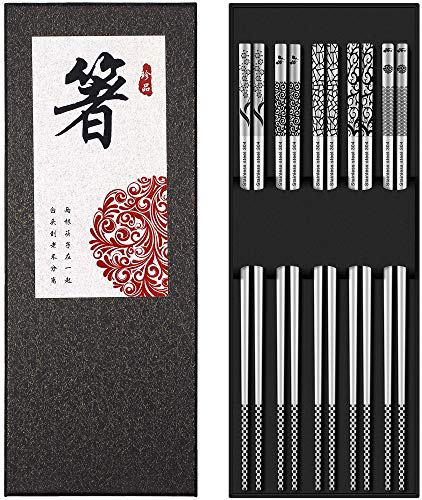
LIXTONGR Dragon & Phoenix Black Stainless Steel Chopsticks, 2 Pairs
Badge: Best Premium Type
Two pairs, a gift box, and the richest steel grade in this cluster: the LIXTONGR Dragon & Phoenix set is the presentation pick. 18/10 stainless steel is the grade restaurants associate with their best flatware, the black finish and dragon-and-phoenix motif make it a deliberate object rather than a utensil-drawer afterthought, and at 9 inches it runs slightly shorter than the 9.25 inch sets around it — a small difference that some hands prefer for control. The listing itself names dining, travel, housewarming and wedding use, which is exactly the life this set is built for: given, kept, and used on occasions. Readers comparing nearby options often also look at Best Type Of Chopsticks To Buy.
As a type, this is the presentation steel pair: top-grade material, a decorative finish and a box, built for the occasions end of the category rather than the drawer end. Every category of object develops this type eventually — the version whose specifications serve ceremony as much as function — and chopsticks, given as wedding and housewarming gifts across Asia for centuries, developed it early. Judge it by type-appropriate standards: grade, finish and presentation first, rotation depth last.
Strengths
- 18/10 steel: the premium grade in this line-up
- Gift box presentation suits weddings and housewarmings
- Slightly shorter 9 inch length can feel more controllable
Trade-offs
- Only two pairs: not a family-drawer solution
- Black decorative finish asks for gentler handling to stay pristine
- Motif styling is a matter of taste and will not suit minimal tables
At a glance:
- Material: 18/10 stainless steel
- Length: 9 inches
- Set size: 2 pairs
- Grip: non-slip
- Care: dishwasher safe
- Presentation: gift box
- Listing uses: dining, travel, housewarming, wedding
Best for: gift-givers and occasion tables / Not suited for: households needing rotation depth
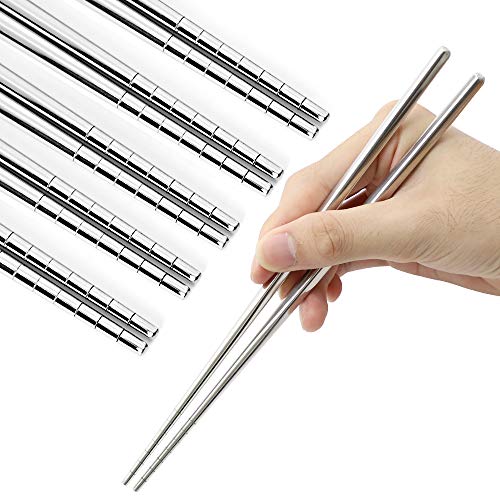
MUYOS Stainless Steel Chopsticks, 5 Pairs, Silver
Badge: Best Lightweight Type
Weight is the MUYOS argument. A hollow-core build trims the heft that makes solid steel chopsticks tiring over a long meal, which matters more than most first-time metal buyers expect: chopstick fatigue is real, and it shows up as a cramping grip and sloppy pickups halfway through a bowl of noodles. Five silver pairs with non-slip tips keep the format familiar — daily meals, per the listing — while the lighter hand feel narrows the gap between metal durability and bamboo lightness. If you have bounced off steel chopsticks before because they felt like knitting needles, this is the design that answers that complaint.
This set is the lightweight type, and its hollow core is a reminder that ‘stainless steel’ names a material, not a weight. Within one material, construction splits the category: solid pairs with their heft and feedback, hollow pairs with their ease over long meals. Neither type is the correct one; they are answers to different hands. Buyers who have rejected ‘metal chopsticks’ wholesale after one heavy pair have usually rejected a construction type while blaming a material — this set exists to correct that sampling error. Readers comparing nearby options often also look at Best Type Of Reusable Chopsticks.
Strengths
- Hollow-core build is noticeably lighter over long meals
- Non-slip tips compensate for the lighter touch
- Plain silver finish matches any existing flatware
Trade-offs
- Featherweight feel can read as insubstantial to some diners
- Length is not stated in the verified listing
- Hollow construction rewards avoiding use as a kitchen pry tool
At a glance:
- Set size: 5 pairs
- Build: hollow-core, lightweight
- Tips: non-slip
- Care: dishwasher safe
- Finish: silver
- Listing use: daily meals
Best for: long-meal eaters and lighter hands / Not suited for: diners who equate heft with quality

Greatamzor Multicolor Stainless Steel Chopsticks, 5 Pairs
Badge: Best Household Type
The second Greatamzor entry pairs a square profile with a laser-engraved copper coin pattern and a multicolor finish across five pairs at 9 1/4 inches. Square sides keep the pair from rolling off a plate rim, the engraving gives fingers and food something to hold onto, and the colour spread lets a household assign pairs by colour — a small system that quietly ends the shared-drawer mix-ups. It reads as the personality pick of the steel sets: all the practical engineering of its plainer sibling, with a finish that makes the table setting part of the point.
The multicolor type treats finish as information: colour as an identification system for shared households. It is easy to dismiss as decoration until a drawer holds five identical pairs and three people’s hygiene preferences; then colour becomes the feature the household actually uses daily. The type keeps its engineering honest underneath — square profile, engraved tips — so the identification layer costs nothing in function. In a taxonomy of chopsticks, this is the organisational type.
Strengths Readers comparing nearby options often also look at Best Type Of Wood For Chopsticks.
- Square profile plus engraving: grip help at both ends
- Colour variety supports a pair-per-person household system
- Five pairs at full 9 1/4 inch adult length
Trade-offs
- Copper coin motif will not match every table style
- Engraved grooves need deliberate washing after oily meals
- Multicolor sets can clash with formal flatware
At a glance:
- Length: 9 1/4 inches
- Set size: 5 pairs
- Profile: square, non-slip
- Pattern: laser-engraved copper coin
- Care: dishwasher safe
- Finish: multicolor
Best for: shared households / Not suited for: formal minimalists

Greatamzor Titanium-Plated Stainless Steel Chopsticks, 2 Pairs
Badge: Best Formal Type
Two pairs with a titanium-plated black-silver finish: this Greatamzor set is built to be looked at as much as used. The plating gives the steel a darker, more formal presence than bright silver pairs, the laser engraving keeps the non-slip story intact, and the gift-set presentation points it at couples, hosts and anyone furnishing a first serious table. Plated finishes do ask for a little respect — they are not the pair to toss loose into a cutlery drawer or scrub with abrasives — but as a kept-for-best set that also works daily, it occupies a niche none of the multipacks try to fill.
Plating is the type-defining choice here: a titanium-plated finish over steel, trading a measure of carefree handling for the most formal presence in this line-up. Categories sort themselves by such trades — the type you keep for best is defined by what it asks you to protect. Engraved tips keep this pair’s function uncompromised beneath the ceremony, which is what separates a plated working pair from a merely decorative object: it can be the kept set and still earn its place at Tuesday’s noodles.
Strengths
- Titanium-plated finish: the most formal look in this line-up
- Engraved non-slip tips keep function under the styling
- Two-pair gift format suits couples and occasions
Trade-offs Readers comparing nearby options often also look at Best Tips For Using Chopsticks.
- Plated finishes reward gentle washing over abrasive scrubbing
- Two pairs only: a kept set, not a household workhorse
- Length is not stated in the verified listing
At a glance:
- Set size: 2 pairs
- Finish: titanium-plated, black silver
- Tips: laser-engraved, non-slip
- Care: dishwasher safe
- Style: Japanese / Korean
- Presentation: gift set
Best for: formal tables and kept sets / Not suited for: rough daily rotation

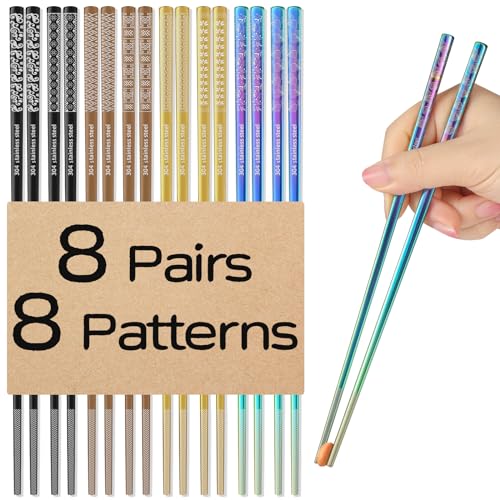
NEWDRIP Multicolor Stainless Steel Chopsticks, 8 Pairs
Badge: Best Bulk Type
This NEWDRIP variant takes the eight-pair format and adds colour: a multicolor finish across the set, with the same 9.25 inch length and laser-engraved non-slip detailing as its plainer sibling. Colour-coding sounds like a gimmick until a household starts arguing about whose pair is whose, or a parent wants each family member to keep their own set for hygiene. It also makes the set read as a gift rather than a restock — the kind of multipack that can go straight from box to table at a housewarming. The steel grade is not stated in the listing, so judge it on format and finish rather than metallurgy claims.
This is the capacity type: eight or ten pairs bought as household infrastructure rather than as individual objects. The type’s specifications are logistical — depth for guests, spares for the dishwasher cycle, a bench that absorbs loss — and its steel and texture specifications, while real, serve the logistics. Households that eat with chopsticks daily live inside this type whether they name it or not; the only question is whether the bench was bought deliberately, in matching steel, or accumulated by accident.
Strengths
- Multicolor finish lets each diner claim an identifiable pair
- Eight pairs cover hosting without a second purchase
- Engraved tips keep the food-grip story intact despite the colour
Trade-offs
- Steel grade is not stated in the verified listing
- Bright finishes will not suit every table aesthetic
- Colour sets can look informal for formal place settings
At a glance: Readers comparing nearby options often also look at Best Titanium Chopsticks.
- Set size: 8 pairs
- Length: 9.25 inches
- Tips: laser-engraved, non-slip
- Care: dishwasher safe
- Style: Japanese / Korean / Chinese
- Finish: multicolor
Best for: hosts and large families / Not suited for: small households
Comparison Table
| Pick | Set size | Length (as listed) | Standout trait | Link |
|---|---|---|---|---|
| Zliutob Stainless Steel Chopsticks, 5 Pairs | 5 pairs | Not stated in listing | Square profile with textured tips: the control type | Check on Amazon |
| LIXTONGR Dragon & Phoenix Black Stainless Steel Chopsticks, 2 Pairs | 2 pairs | 9 inches | 18/10 steel, gift box, shorter length: the premium type | Check on Amazon |
| MUYOS Stainless Steel Chopsticks, 5 Pairs, Silver | 5 pairs | Not stated in listing | Hollow-core construction: steel’s lightweight type | Check on Amazon |
| Greatamzor Multicolor Stainless Steel Chopsticks, 5 Pairs | 5 pairs | 9 1/4 inches | Square, engraved, colour-coded: the household system type | Check on Amazon |
| Greatamzor Titanium-Plated Stainless Steel Chopsticks, 2 Pairs | 2 pairs | Not stated in listing | Titanium-plated finish: the kept-for-best type | Check on Amazon |
| NEWDRIP Multicolor Stainless Steel Chopsticks, 8 Pairs | 8 pairs | 9.25 inches | Eight pairs in colour: the hosting capacity type | Check on Amazon |
Read this table as a taxonomy, not a ladder: each row is a type at its most characteristic, and the standout trait names the distinction that defines it. Lengths appear only where the verified listing states them, because type comparisons built on guessed dimensions are how buyers end up with the right kind of chopstick in the wrong size.
How to Choose Chopsticks: Choosing Your Type
Work through the five type decisions in the order your hand notices them. Profile first: square faces for control and stillness on the table, round for traditional feel and subtle adjustment. Construction second: hollow-core if meals are long or hands tire, solid if you like feedback and heft. Material third — and here the wider family enters honestly: bamboo is light, cheap and kind to beginners but wears and stains; wood is beautiful and varied but asks for hand-washing and oiling in its finer forms; fibreglass is the restaurant workhorse, heat-tolerant and plain; steel is the durability answer, dishwasher-proof and effectively permanent, at the cost of weight that construction must manage.
Finish and format finish the specification. Finishes divide into the functional — engraving and texture that grip — and the organisational or ceremonial: colour systems that run a household, plating and gift presentation that mark occasions. Neither is lesser; they answer different questions, and the mistake is buying one while needing the other. Format is set size, and it is a household decision wearing a product’s clothes: count eaters, guests and dishwasher lag, then buy the bench that matches the table you actually set.
A word on cuisine types, because they cut across all five decisions. Japanese styles run shorter and finer-tipped for fish and precision; Korean styles are often metal, flatter in profile, and built for slippery noodles and grill-side heat; Chinese styles run longer, suiting shared dishes and cooking reach. The sets in this guide sit in the Japanese-Korean steel tradition at nine to nine and a quarter inches where stated — a versatile middle — but a buyer devoted to one cuisine should weight its native type first and treat all-purpose claims second.
How to Match a Chopstick Type to a Meal: A Practical Tour
Type knowledge becomes real at the table, where each meal quietly votes for a kind. Noodle soups reward texture — engraved or square tips against wet strands — and enough length to work a deep bowl. Sushi rewards a finer, shorter control, where the premium 9 inch type in this line-up feels at home. Hot pot and shared cooking reward length and heat indifference, steel’s home turf. A weeknight rice bowl rewards whatever is clean, which is a format argument: the type that wins most weeknights is the one your household owns enough of.
Use the tour below across a week of ordinary eating and your own type preference will announce itself more honestly than any quiz:
- Monday noodles: reach for texture — an engraved or square-tip pair — and note how little grip force the meal required.
- Wednesday shared dishes: take the longer pair and work from communal plates; reach and stillness on the table are the lesson.
- Friday sushi or small plates: try the shortest, finest pair you own and feel the precision difference a type can make.
- The long meal: a slow, many-dish dinner with the lightest pair, checking at the end whether your hand noticed the time.
- The hosting test: set the table entirely from one type and watch guests — their ease is data about your next purchase.
Care closes the loop between type and ownership. Steel types of every profile share one routine — wash thoroughly, mind the engraved sections after oily meals, store dry — while wood and bamboo types ask for gentler, drier handling that some households will sustain and others will not. Choose the type whose care routine matches the life you actually live; a theoretically superior pair that your dishwasher destroys, or your schedule never hand-washes, is not superior in any sense that survives the year.
Troubleshooting:
- Problem: your pair rolls off every plate and table → a profile problem. Round pairs roll; square types were invented to end exactly this.
- Problem: metal feels unbearably heavy by dessert → a construction problem, not a material verdict. The hollow-core type exists for your hand.
- Problem: guests keep mixing pairs and hygiene suffers → a finish problem. Colour-coded types turn identification into a glance.
The Wider Family: Wood, Bamboo, Fibreglass and Disposable Types
A steel-only shortlist owes the reader the rest of the family portrait. Bamboo is the beginner’s friend and the traditionalist’s default: light, grippy when textured, inexpensive enough to replace without grief — and mortal, staining, splitting and eventually retiring. Wood spans the widest quality range in the category, from disposable-adjacent pairs to lacquered craft objects that are effectively jewellery for the table; its care demands scale with its beauty. Fibreglass owns the restaurant middle: heat-tolerant, dishwasher-brave, unglamorous and nearly indestructible, the type professionals choose when romance is not on the menu.
Disposable types deserve a sentence of respect and a paragraph of caution: they are the right tool for picnics, parties and takeaways at scale, and the wrong foundation for a household’s daily eating, on cost, waste and feel alike. Plastic and melamine pairs serve children’s tables and institutional settings well. None of this demotes the steel types reviewed above; it locates them. Steel is the type a household buys when it wants the question settled — one purchase, one care routine, a decade of meals — and the six linked sets are that settlement in its main varieties.
Profile, the Type Variable Nobody Shops For
Ask buyers what type they chose and they will name a material; ask their hands and the answer is a profile. Round, square and flattened profiles change the mechanics of eating more than most material swaps do: rotation, rolling, finger reference, tip alignment all live in the cross-section. Korean metal chopsticks are traditionally flatter for good reason — grip on slippery food with minimal squeeze — and the square types in this line-up inherit that logic in steel. It is the cheapest experiment in the category, too: most households can try a square pair for the cost of a takeaway meal.
The practical advice is to let one meal arbitrate. If your current pair twists, rolls or demands a squeeze, your next type decision is already made, whatever the material. If your pair sits still and disappears from attention, your profile is right and upgrades should spend themselves elsewhere — on grade, on format, on a second type for occasions. Taxonomies exist to route spending toward the variable that is actually failing; in this category, that variable is the shape in your fingers far more often than the substance it is made from.
Grip is a trainable skill, and the timeline is kinder than most new users expect. The first week with any new pair is mostly about the rest position: the lower stick stays still, braced against the ring finger and the base of the thumb, while the upper stick does all the travelling, pivoted by the index and middle fingers. Once that division of labour clicks, the hand stops squeezing, and squeezing was the real source of most early failures — dropped noodles, aching fingers, food launched across the table. Practice with forgiving foods first: thick noodles, chunky stir-fry pieces, anything with texture. Save peas, beans and glossy dumplings for when the motion is boring, because boring is what mastery feels like from the inside.
Length deserves more respect than it gets in most product listings. The standard adult eating length across these sets sits around nine to nine and a quarter inches, and that is not arbitrary: it keeps fingertips clear of hot broth, spans a dinner plate comfortably, and balances in the hand without the tail end catching on sleeves. Shorter pairs feel nimble for sushi and small plates; longer pairs earn their keep at a hot pot or a shared serving bowl. If you already own a pair you like, measure it before ordering anything new — matching a known-good length removes the single biggest source of first-week disappointment with an otherwise good set.
Care is where stainless steel quietly wins the long game. There are no lacquers to chip, no fibres to swell, no finishes that object to the dishwasher, and no seasoning ritual. What steel does ask for is basic thoroughness: engraved and textured sections hold onto oils and sauces, so a proper wash — not a rinse — keeps them tasting like nothing, which is exactly what a utensil should taste like. Dry storage matters too. A pair put away wet in a closed case or a sealed drawer compartment will eventually show it, whatever the grade stamped on the listing.
The honest way to think about set size is to count eaters, then add friction. A household of two that hosts monthly needs a different bench than a family of five eating with chopsticks nightly, and the dishwasher cycle is a real constraint: pairs in the wash are pairs you cannot use. Multipacks look excessive on a product page and feel inadequate on a Friday night with six guests and a hot pot. Buy for the table you actually set most months of the year, not the table you set once at a holiday, and let the big-occasion problem be solved by a second, cheaper backup set if it ever becomes real.
Etiquette travels with the tool. Resting a pair across the bowl is fine on a rest and contentious without one; sticking chopsticks upright in rice is widely read as a funerary image and worth avoiding at any table where it might land badly; passing food directly from one pair to another carries similar associations in Japanese settings. None of this affects which set you should buy, but a buyer learning chopsticks as an adult is usually also learning the table culture around them, and the two educations are cheaper together. A simple rest, incidentally, also keeps engraved tips off tablecloths and stops round pairs rolling onto the floor.
Finally, judge any pair by its third month, not its first meal. New steel can feel slick until your grip adjusts; new textures can feel aggressive until your fingers learn how little pressure they need. The sets that last are the ones whose compromises you stop noticing: the weight that becomes normal, the length that becomes instinct, the finish that survives your actual dishwasher rather than an idealised one. That is why this guide weights durability signals — steel grade where stated, construction, dishwasher care — as heavily as first-impression features. A chopstick is a ten-year object bought in a ten-minute decision; the least a guide can do is slow the decision down.
Storage sounds like the least important decision in this category and quietly determines how long any set stays pleasant. Pairs kept loose in a cutlery drawer collide with heavier utensils thousands of times a year; pairs kept in a crock, a divided insert or their own case meet almost nothing but air and meals. Tips deserve the gentlest berth, since they do the finest work and show damage first. None of this requires equipment more elaborate than a jam jar — it requires only the decision that the pairs have a home, made once and then simply kept.
A note on rests, the smallest accessory in this world: a rest keeps tips off the table, keeps round pairs from emigrating to the floor, and gives a meal a small, civilised pause button. Households that adopt rests find their pairs last longer in finish and in dignity, and guests read the table as considered. Rests are not bundled with the sets in this guide — the listings do not claim them — so treat them as a separate, inexpensive completion of any set you buy, chosen in a material that shares your pairs’ care routine.
Children at the table change the arithmetic of any set, even in an adult-focused guide. Small hands need shorter tools, and a household’s adult pairs will be borrowed, brandished and occasionally lost to the sofa regardless of policy. The pragmatic defence is depth — a bench that absorbs the chaos — plus one deliberate decision: keep the pair you care about out of the general pool, by colour, pattern or a separate rest by your own setting. Households that plan for the borrowing lose less to it.
There is a sensory detail experienced eaters mention and listings never do: temperature. Steel arrives at the mouth at room temperature and warms instantly; it neither insulates like bamboo nor chills like a spoon from a cold drawer. Most diners stop registering this within a week. Those who never do are not wrong — they are simply telling you their material preference is real, and the correct response is to honour it with a second type in the drawer rather than to argue a palate out of its own evidence.
Sustainability claims in this category deserve the same audit as product claims. A durable pair used daily for a decade displaces a small mountain of disposables; a durable pair used twice displaces almost nothing, and a cheap pair replaced yearly sits honestly in between, provided the replacements are genuinely recycled or composted where the material allows. The variable is never the object alone — it is object multiplied by meals. Which is one more reason this guide keeps returning to depth, comfort and care routines: they are what turn a purchase into the multiplied term.
If you take one analytical habit from this guide into the rest of your kitchen, let it be the contents-list habit: read what is verifiably in the box before admiring what is in the photograph. It applies to chopsticks, to the combined travel sets this programme has audited, and to nearly everything sold with styling. Sellers who state grades, lengths, counts and contents are competing on facts; sellers who state only adjectives are competing on fog. Your money is a vote for which kind of listing gets written next year.
Common Buying Mistakes
Type purchases go wrong when one axis of the specification is bought and the other four are left to chance. The recurring errors:
- Shopping by material alone. Two pairs of the same material can be different types in the hand. Specify profile and construction too.
- Buying the occasion type for daily duty. Plated and gift types are kept sets. Rotation belongs to the household and bulk types.
- Ignoring cuisine fit. A devoted sushi eater and a hot-pot household want different lengths and tips, whatever the material.
- Choosing care you will not perform. Fine wood in a dishwasher household is a short story. Match the type to your real routine.
- One type for every job, forever. Most settled households end with two types — a daily and an occasion pair — and that is a destination, not indecision.
Final Recommendation
If one type must be named first, name the square textured steel type embodied by the Zliutob set: it solves the control problems most eaters actually have, in the material that ends the durability question. The MUYOS hollow-core is the type for hands that tire, the LIXTONGR the type for occasions and gifts, and the Greatamzor and NEWDRIP colour types are how households turn a purchase into a system. Choose the type whose problem is your problem, and the specific set follows naturally.
And keep the taxonomy with you after this page. Chopsticks will be bought again — for a child, a guest drawer, a second home — and the five decisions in this guide, asked in order, will specify the right type faster than any ranking. Material last, profile first, format honestly: that sequence is the real answer to the keyword, with the six linked sets as its steel-branch evidence.
Start here: Zliutob Stainless Steel Chopsticks, 5 Pairs (Best Grip Type); LIXTONGR Dragon & Phoenix Black Stainless Steel Chopsticks, 2 Pairs (Best Premium Type); MUYOS Stainless Steel Chopsticks, 5 Pairs, Silver (Best Lightweight Type).
Frequently Asked Questions
What is the best type of chopsticks overall?
There is no single best type, but there is a best-supported default: stainless steel in a textured or square profile, at an adult length around 9 to 9.25 inches, in a set sized to your household. That specification — represented across the six picks in this guide — combines durability, dishwasher care, food grip and control. Beyond the default, type follows use: hollow-core steel for hands that tire, premium gift types for occasions, bulk types for hosting households, bamboo for traditional lightness, and fibreglass for restaurant-grade indifference to abuse.
Are metal chopsticks better than wood or bamboo?
Better at durability and hygiene, not better at everything. Steel is effectively permanent, dishwasher safe and consistent in feel for years; bamboo is lighter and often grippier when new, but stains and wears; fine wood is beautiful and asks for hand care. Many households end up owning both — steel as the daily settlement, wood or bamboo for tradition and guests. The mistake is treating the material question as the whole decision, when profile, construction and format change the eating experience as much as material does.
Why does profile — square versus round — matter so much?
Because the cross-section controls rotation, rolling and finger reference. Square faces resist the slow twist that misaligns beginners’ tips, sit still on plates and tables instead of rolling, and give fingers flat surfaces to register. Round profiles feel more traditional and allow subtle rolling adjustments that skilled eaters use. Neither is universally better, but a buyer whose current pair twists or rolls has a profile problem that no material upgrade will fix — and square steel types, like several picks in this guide, address it directly.
What type of chopsticks do restaurants use?
It varies by cuisine and country, but the professional pattern is durability-led: fibreglass and melamine in high-turnover settings, stainless steel across much of Korea and in modern establishments elsewhere, wood and bamboo where tradition and presentation lead. Home buyers can borrow the professionals’ logic without copying their exact types — prioritise the care routine you will actually sustain and the abuse your household actually delivers. For most homes, that logic lands on steel.
Which type is best for beginners?
A textured one. Beginners fail on friction — food slipping, sticks rotating — before they fail on anything else, so engraved tips and square or flattened profiles are the beginner types within any material. Bamboo’s natural texture is the traditional starting point; textured steel, like the square Zliutob and engraved sets in this guide, offers the same forgiveness with permanent durability. Heavy, polished, round steel is the one configuration beginners should avoid, whatever its other merits.
How many types should a household own?
Two covers most lives: a daily type in depth — enough pairs of a durable, dishwasher-safe set for the household’s real rotation — and an occasion type for guests and set tables, where presentation earns its place. Add a cooking length if you cook with chopsticks at the stove. Beyond that, additional types serve collections more than meals. The six picks in this guide map onto that structure deliberately: household and bulk types for the daily role, the gift and plated types for occasions.