Disclosure: As an Amazon Associate, topratedkitchenware.com earns from qualifying purchases. Links on this page are affiliate links; they cost you nothing extra. Prices and availability change often, so check the current Amazon listing before you buy.
These electric kettle reviews cover the everyday end of the category: six cordless jug kettles that boil water for tea, coffee, instant food, and cooking, assessed side by side on the qualities that survive daily use. This is deliberately not a gooseneck roundup — the slender-spouted kettles built for pour-over coffee are a specialist class with their own shortlist — and it is not a smart-appliance survey either. It is a practical comparison of the ordinary electric kettle in its main forms: glass and steel, simple and temperature-controlled, family-size and compact, premium tier and entry tier.
The headline finding is reassuring: there is no bad kettle in this set, only mismatched ones. Every model here boils quickly, switches itself off, and pours from a cordless jug, so the reviews below concentrate on fit — which household, which drinks, which counter, which water. The COSORI electric kettle takes the overall recommendation for its balance of visibility, cleanability, and simplicity. The Cuisinart PerfecTemp kettle is the clear choice for varied tea drinkers. The Hamilton Beach electric kettle serves big households best, the Amazon Basics kettle is the honest starter, the Ovente glass kettle is the one to enjoy looking at, and the Mueller electric kettle is the compact steel answer for small kitchens.
Key Takeaways
- All six kettles deliver the class essentials — fast boil, automatic shut-off, cordless jug — so choose on material, capacity, and controls, not on boil speed.
- Glass models (COSORI, Ovente) show level and scale at a glance; steel models (Hamilton Beach, Mueller, Cuisinart) trade that visibility for toughness.
- Only the Cuisinart PerfecTemp offers preset temperatures, and only households drinking green or white tea regularly will feel the benefit.
- Every pick is prose-only in these reviews, in qualitative tiers; check price on Amazon on the current listing before deciding.
- Whichever you choose, fill between the marks, keep the powered base dry, and descale on schedule — the reviews assume those habits.
How These Electric Kettle Reviews Were Assessed
Each kettle was judged against the same household tests. The morning round: several drinks in succession, half-awake, where gauge honesty, lid behaviour, and pour control show themselves. The cooking test: filling pans and making instant foods, where capacity and a confident stream matter. The tea test: black tea at a full boil for every model, and delicate teas for the one model with presets. The upkeep test: how the kettle invites or resists its one real chore, descaling, judged by mouth width, interior surface, and whether scale is visible before it becomes a problem. And the safety test, applied to all: automatic shut-off, boil-dry protection, a lid that stays shut through the pour, a stable base, and a handle that keeps hands clear of hot walls and the steam path.
Two things these reviews deliberately do not do. They do not print prices or popularity figures, because those change constantly and a review that depends on them ages in weeks; tiers and design judgements age in years. And they do not invent specifications: where a detail varies between versions of a model, the review says so and sends you to the current listing to confirm it. What remains is the durable part of a review — how each kettle is built, whom it suits, where it compromises, and whether you should choose it or skip it. The single-model deep dive in our electric kettle review explains the class behind these judgements, and the framework in the electric kettle buying guide turns them into a step-by-step method.
In this guide
Quick Picks
| Model | Badge | Tier | Choose it if |
|---|---|---|---|
| COSORI electric kettle | Best Overall | Mid | You want one glass kettle that does everything well |
| Cuisinart PerfecTemp kettle | Best for Tea Variety | Premium | You drink green, white, and black teas and want presets |
| Hamilton Beach electric kettle | Best for Families | Mid | You boil large amounts all day, every day |
| Amazon Basics kettle | Best Starter | Entry | You need a simple, light kettle for a first kitchen |
| Ovente glass kettle | Best Looking | Entry to mid | You enjoy watching the boil and spotting scale early |
| Mueller electric kettle | Best Compact | Entry to mid | Your counter is small but you want steel |
The Reviews in Detail

COSORI Electric Kettle — Best Overall
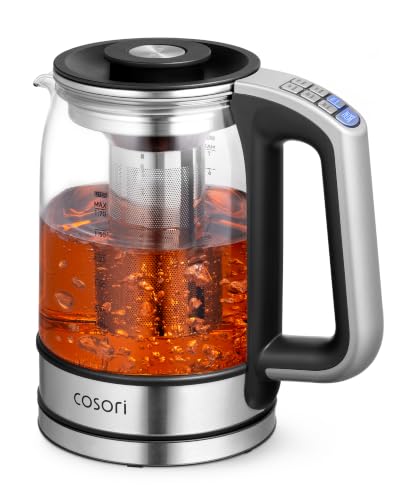
Who it suits: the household that wants one kettle to be good at everything and has no strong feelings about presets. The COSORI’s glass jug makes the water level a non-question — you can see it from anywhere in the kitchen — and makes limescale a visible, early, manageable event rather than a hidden decline. The wide opening is the detail owners praise longest, because it turns descaling from a fiddle with a bottle brush into a straightforward wipe-and-rinse, and a chore that is easy is a chore that happens.
In the morning round it behaves exactly as the best overall pick should: quick to fill under the tap, clear to judge, clean in the pour, and simple enough that a guest can operate it without a briefing. Its honest limitation is the material itself. Glass asks for a calmer counter than steel does, and a full glass jug is the heavier lift in this set, so households with very young helpers or very hard luck with breakables should look at the steel picks instead. Choose it if you want the balanced default. Skip it if your kitchen eats glassware. Tier: mid — check price on Amazon.
Cuisinart PerfecTemp Kettle — Best for Tea Variety
Who it suits: the household whose tea shelf spans green, white, oolong, and black, and whose coffee comes from a cafetière. The PerfecTemp’s preset buttons replace the boiled-kettle-standing-open guesswork with a single press, and its keep-warm hold covers the second-cup window gracefully. In the tea test it is simply in a different conversation from the five boil-only kettles here: delicate leaves get water at a temperature that flatters them, every time, without a thermometer or a timer.
Its honest limitation is the mirror of its strength. Every control it offers is wasted on a household that only ever wants a rolling boil, and in that household the premium tier buys a more complicated panel and nothing else. The steel body is tough and the build feels like the flagship it is, but flagship pricing logic applies: pay it for the drinks, not for the badge. Choose it if your teas vary. Skip it if they do not. Tier: premium — check price on Amazon, and compare its preset layout on the current listing with the drinks you actually make.

Hamilton Beach Electric Kettle — Best for Families
Who it suits: the high-throughput kitchen — big family, shared house, or a cook who starts every pan with kettle water. The Hamilton Beach pattern is a generous steel jug with simple controls and no interest in being admired, and in the cooking test that plainness is a virtue: fill it, boil it, pour it into the pasta pan, refill it, and start the drinks, all without a single menu or mode. Steel shrugs off the knocks of a crowded counter that would end a glass jug’s career.
Its honest limitations are size and subtlety. On a small counter it is a presence, and for a solo drinker most of its capacity is heated air’s neighbour — water you did not need, in a jug heavier than your habit requires. Steel also hides its limescale, so this is the pick whose owners most need the calendar descale described in how to clean an electric kettle. Choose it if your boil count is high. Skip it if your household is one or two people. Tier: mid — check price on Amazon.

Amazon Basics Kettle — Best Starter
Who it suits: first flats, dorm rooms, spare rooms, offices, and anyone who needs a second kettle more than they need a better kettle. The Amazon Basics model keeps the class essentials intact — a fast boil, an automatic shut-off, a cordless jug — in a light body at the entry tier, and judged against that brief it is a complete success. It is the kettle you buy when the kettle is not the point: the new home, the exam term, the guest room before visitors arrive.
Its honest limitations are refinement and longevity. The materials and fittings are plainer than the mid-tier picks, the plastic body will show its age sooner than steel or glass, and nobody should expect it to be the last kettle they buy. Within its intended service, though, those are the right compromises, and its lightness is a genuine virtue for users who find a full steel or glass jug heavy. Choose it if you are starting out or stocking a spare. Skip it if you are buying for a busy decade. Tier: entry — check price on Amazon.
Ovente Glass Kettle — Best Looking
Who it suits: the drinker for whom making tea is a small ceremony and the kitchen counter is a place that should please the eye. The Ovente leans into glass’s natural theatre — the water visibly climbing to a rolling boil — and gives its owner the clearest possible read on both level and limescale. In the upkeep test it scores the way all glass does: nothing hides, so nothing festers, provided the owner acts on what they see.
Its honest limitations are glass’s own: weight when full, care needed around taps and worktop edges, and a surface that shows fingerprints and scale alike, rewarding owners who wipe as they go. It is a kettle for a calmer kitchen, and it knows it. Choose it if you will enjoy it daily and descale willingly. Skip it if your counter is a contact sport. Tier: entry to mid — check price on Amazon. Tea-focused readers will also want the best electric kettles for tea, where this style of kettle is compared on leaf-specific grounds.

Mueller Electric Kettle — Best Compact
Who it suits: the small kitchen that refuses to surrender on material. The Mueller pattern keeps steel’s toughness and neutral taste in a jug sized for one or two drinkers, answering the counter-space objection that rules family models out of studio flats and compact galleys. In the morning round for a solo household it is arguably the best-matched kettle in this entire set: no wasted capacity, no wasted counter, no wasted weight in the hand.
Its honest limitation is the flip side of its virtue. The day six guests want tea, or the cook wants a big pan started, the compact jug means a second boil, and households that entertain often will feel that regularly enough to resent it. Choose it if your boils are small and your counter is precious. Skip it if your kitchen regularly serves a crowd. Tier: entry to mid — check price on Amazon, and check the minimum-fill behaviour on the listing if your habit is a single mug.
Comparison Table
| Model | Material | Presets | Capacity character | Watch-out |
|---|---|---|---|---|
| COSORI electric kettle | Glass | No | Family-capable | Glass needs a calm counter |
| Cuisinart PerfecTemp kettle | Steel | Yes, plus keep-warm | Family-capable | Premium tier wasted on boil-only drinkers |
| Hamilton Beach electric kettle | Steel | No | Largest appetite | Scale hides in steel; descale by calendar |
| Amazon Basics kettle | Plastic | No | Everyday | Plainest build; a starter, not a heirloom |
| Ovente glass kettle | Glass | No | Everyday | Shows every mark; rewards tidy owners |
| Mueller electric kettle | Steel | No | Compact | Second boils when guests arrive |
Read across any row and the pattern of the whole set appears: one decision about material, one about size, one about presets. Get those three right for your household and the specific badge matters far less than reviewers usually pretend — a truth the balance sheet in electric kettle pros and cons reaches from the opposite direction.
Head to Head: The Glass Pair
The COSORI and the Ovente invite direct comparison, because both make the same fundamental bet — that seeing the water is worth the care glass demands — and then diverge in emphasis. The COSORI pattern argues its case on upkeep: the wide mouth turns the descale into the easiest version of the chore in this entire set, and in a hard-water home that single detail may outweigh every other difference between the two. The Ovente pattern argues on pleasure: the boil as a small visual ceremony, the jug as an object the counter is better for hosting. In the morning round both pour respectably and read clearly; in the upkeep test the COSORI edges ahead; in the slow Sunday test the Ovente’s charm is its own argument. A household choosing between them should ask which it values on the two hundred ordinary mornings, not the two dozen leisurely ones — and for most, the cleaning argument will quietly win, which is why the COSORI holds the overall badge while the Ovente holds the affection of the ritual-minded.
Head to Head: The Steel Three
The Hamilton Beach, the Mueller, and the Cuisinart PerfecTemp share a material and almost nothing else, which makes them the cleanest illustration in this set of how size and control — not substance — divide a category. The Hamilton Beach is steel as utility: the biggest appetite, the plainest controls, the clearest brief. The Mueller is steel as economy of space: the same toughness in a jug that respects a small counter and a single mug. The PerfecTemp is steel as instrument: presets and a hold function wrapped in the flagship’s build. Put the three in one kitchen and each finds its owner within the week — the family cook takes the Hamilton Beach without a glance at the others, the flat-dweller takes the Mueller, and the tea collector takes the PerfecTemp and considers the matter closed. Reviewers sometimes manufacture contests between models that were never competing; these three are a reminder that a roundup’s real job is casting, not combat.
Head to Head: Simple Versus Preset
Five of these kettles boil and stop; one thinks about temperature, and the comparison deserves its own space because it is the only fork in this set that changes what ends up in the cup. For black tea, coffee, instant drinks, and cooking water, the five and the one are equals, full stop: the water is at a boil, the kettle has switched off, and nothing the PerfecTemp’s panel offers improves a single one of those drinks. For green tea, white tea, and delicate infusions, the fork becomes a wall. The preset kettle delivers water at a kinder temperature at the press of a button, identically every time; the simple kettles ask their owner to boil, wait, and guess, and the guess is sometimes wrong in the direction of a scorched, bitter cup. Households should therefore not ask whether presets are better in general — they are, narrowly — but whether their own shelves contain the drinks that can tell the difference. If they do, the comparison is already over. If they do not, five excellent kettles are waiting at lower tiers, and choosing among them returns to material and size, where this review began.
What a Month of Ownership Teaches
Reviews are written at the beginning of ownership, but kettles are judged at its middle, so these notes project each pick a month forward. The COSORI’s owners have usually descaled once, easily, and forgotten the event; the wide mouth has done its quiet work. The PerfecTemp’s owners have either built a genuine preset habit — in which case the premium has dissolved into daily pleasure — or they have not, in which case the panel has become furniture and the lesson about their tea shelf has been learned at flagship prices. The Hamilton Beach’s owners have stopped noticing it entirely, the highest state a workhorse reaches, provided somebody owns the descale calendar that its steel walls make necessary. The Amazon Basics’ owners have received exactly what they bought and are content, or have discovered a household boil count that justifies stepping up a tier with the knowledge of what the step buys. The Ovente’s owners have wiped it often and enjoyed it often, in roughly equal measure. The Mueller’s owners have reclaimed a patch of counter and think about capacity only when guests arrive. None of these months contains a surprise, and that predictability — each kettle becoming what its design promised — is the strongest collective verdict this roundup can offer.
The Details That Separated Them
Across six kettles that all boil water competently, the separation lives in four details, and shoppers should weight them in this order. First, the lid. The best lids in this set open at a button press to a wide, fill-friendly angle and close with a certainty you can feel; the merely adequate ones ask for a second hand or a second attempt often enough to be remembered. Second, the gauge. The glass pair abolish the question by making the whole jug a gauge, and they are right to; among the steel and plastic models, prefer the window you can read from your natural side, in ordinary kitchen light, without rotating the jug. Third, the spout. A clean start and a clean stop to the pour, with no dribble down the jug’s flank and no lid rattle, is the difference between a kettle that disappears into the routine and one that wets the counter daily. Fourth, the base: flat, stable, with cord storage that actually swallows the cord, and contacts that sit protected from the kitchen’s splashes. None of these details appears in a headline, and together they are most of what owners mean, a year later, when they call a kettle good or disappointing.
Which Kettle for Which Reader
To make the casting explicit: the new household setting up its first real kitchen should take the COSORI electric kettle and stop deliberating, because its balance survives every future the kitchen is likely to have. The household that has discovered teas beyond black should take the Cuisinart PerfecTemp kettle, and should take it without resenting the tier, because it is buying a daily difference in the cup. The big, busy, many-handed kitchen should take the Hamilton Beach electric kettle and assign somebody the descale calendar on the day it arrives. The student, the renter between homes, and the office manager stocking a kitchenette should take the Amazon Basics kettle in the numbers their situation requires. The drinker who makes tea slowly and looks at their kitchen should take the Ovente glass kettle and enjoy it without apology. The small flat with high standards should take the Mueller electric kettle and the counter space it hands back. Every reader not described here is described by the framework in the electric kettle buying guide, which will cast them just as precisely.
A Word on Versions and Listings
Popular kettles are revised quietly over their lives — a lid mechanism improved, a gauge redrawn, a finish changed — and a review that pretended otherwise would mislead the reader it claims to serve. These reviews therefore judge the enduring design of each model: its material, its size class, its control philosophy, and the details above, which survive revisions. The specifics of the version currently on sale belong to the current listing, which is why every pick here ends with the same instruction to check price on Amazon and confirm the present details there. If a listing photograph shows a lid or a gauge that contradicts the character described in these reviews, believe the photograph and reconsider; the framework will still tell you how much the difference matters for your household. That honesty about versions is not a hedge. It is the difference between a review that ages in years and one that expires with the next production run.
If Your Water Is Hard, Read This Twice
Hard water rearranges these reviews more than any other household variable, because it converts the descale from an occasional event into the rhythm of ownership. For hard-water readers, the casting changes at the margins: the COSORI’s wide mouth and visible walls move from virtues to near-necessities, the Ovente’s transparency earns a practical point alongside its beauty, and the steel pair — Hamilton Beach and Mueller — should be chosen with the calendar descale accepted in advance, not discovered in arrears. The PerfecTemp is unaffected in its logic, since presets and scale are separate questions, but its owners in hard water should know that delicate teas are the first to betray a scaled kettle’s taste. Whichever pick a hard-water household makes, the reviews’ advice converges: buy the jug you can clean without a fight, keep the simple solution in the cupboard, and let how to descale an electric kettle become a monthly habit rather than an annual rescue.
If You Are Replacing a Kettle You Hated
Many readers arrive at a roundup like this one carrying a specific grievance, and the grievance is the best shopping list they own. If your old kettle dribbled, shop with your eyes on spouts and lids and let the detail sections above be your guide. If it scaled into slowness, shop for mouth width and visibility, and be honest about whether the descale or the kettle was really at fault. If it was simply too big, too small, or too complicated, the casting in this roundup is organised around exactly those axes and will place you in one reading. And if it failed — a switch, a shut-off, a base — buy the tier your boil count justifies, because a kettle cycled many times a day earns its build quality in a way a twice-a-week kettle never needs to. Replacement buyers are this category’s wisest shoppers when they trust their grievance over any badge, including the badges in the quick-picks table.
Owner Scenarios: The Reviews Applied
Abstract casting becomes clearer in concrete kitchens. Consider the household of five with a hard-water postcode and a breakfast that resembles a small café service: their reviews point to the Hamilton Beach for volume, with the COSORI as the honourable alternative if somebody in that house will genuinely descale by sight — and the deciding voice should be the person who will actually do the descaling, because they are the one the design must please. Consider the couple in a small flat who drink green tea on weekends and black tea on weekdays: the PerfecTemp tempts them, and the honest test is the weekend habit’s strength; if the green tea is a real pleasure rather than an occasional idea, the presets will be used enough to justify the tier, and if not, the Mueller’s compact steel serves their weekdays better and their counter best of all. Consider the student in a shared house, where the kettle will be boiled by six people and cleaned by none: the Amazon Basics at the entry tier is not a compromise but a strategy, cheap enough to be replaced without grief and simple enough to survive communal life, with a descale rota pinned above it as the house’s one act of civilisation. Consider, finally, the grandparent setting up a smaller home: lightness and a clear gauge outrank capacity and presets entirely, and the reviews’ advice is to choose the jug that is kindest in a full hand, whichever badge it wears. Four kitchens, four different right answers, one set of reviews — that is what a roundup is for.
What These Reviews Deliberately Leave Out
A roundup earns trust partly by what it refuses to print, so the refusals should be visible. These reviews contain no prices, because a figure printed today misleads next season and because the tiers — entry, mid, premium — carry the honest part of the price story, which is what you get for stepping up. They contain no popularity figures or scored verdicts borrowed from other people’s counting, because those numbers describe a moment in a marketplace rather than a kettle in a kitchen. And they contain no specifications recited from listings, because versions change and because the durable truths about these six models are structural: a material, a size, a control philosophy, a mouth wide or narrow, a gauge honest or hidden. A reader who wants the current figures for any pick should check price on Amazon and read the present listing with this roundup’s framework in hand; the framework will still be true when the figures have changed twice more. What is left, after those refusals, is the part of reviewing that cannot be automated or scraped — judgement about fit, earned by comparing the same six kettles against the same household tests and reporting where each one pleased and where each one compromised.
The Reviews in One Household Each
Sometimes a single sentence per kettle, addressed to a single reader, says more than a table. To the first-time buyer with no strong opinions and a normal kitchen: the COSORI, and welcome to the easiest appliance decision you will ever make. To the tea collector whose shelf has regions: the PerfecTemp, because your palate has already made this decision and the review is merely informing your wallet. To the parent whose kettle will boil more this month than most do in a season: the Hamilton Beach, a calendar reminder for the descale, and a counter spot chosen like a stove’s. To the student whose entire kitchen is one socket and a hotplate: the Amazon Basics, unapologetically, with the money saved spent on tea worth boiling water for. To the slow-breakfast romantic in a calm flat: the Ovente, and may your mornings always have time for it. To the minimalist whose counter is a curated surface: the Mueller, which will earn its small square of it daily. If none of those readers is you, the sections above have given you the axes — material, size, control — and your own household will finish the sentence.
A Final Casting Note for the Undecided
If you have read this far and still stand between two kettles, the tie-breakers that actually work are these. Choose the one whose mouth you can clean, if your water is hard, over the one whose finish you prefer. Choose the one whose gauge you can read in the listing’s worst photograph, because your kitchen light at dawn is worse. Choose the smaller kettle when the contest is size alone, because a second boil is a minute’s patience while an oversized jug is a daily weight. Choose the simpler kettle when the contest is features, unless your tea shelf has already voted. And if the tie survives all four tests, choose either with a clear conscience: the distance between two well-matched finalists in this category is smaller than the distance between a matched kettle and a mismatched one, and you have already crossed the gap that matters by reading reviews this closely at all.
And If None of the Six Is Quite Right
A roundup should admit the existence of the reader it cannot cast. If your household needs a kettle for a boat, a caravan, or a workplace with unusual power arrangements, or your heart is set on a design language none of these six speaks, the wider field in the best electric kettles compared is the next stop, and the framework from this roundup travels with you: decide material, size, and control before you look at badges, interrogate lids and gauges in photographs, and let your water hardness veto any jug you cannot clean. The six kettles reviewed here cover the broad centre of the category honestly; the edges belong to specialists, and there is no shame in a household discovering it lives on an edge.
A closing word on confidence: readers sometimes worry that choosing the wrong one of six good kettles is a mistake they will live with for a decade. The reviews’ honest finding is the opposite — the regret stories in this category are almost never about badges, and almost always about the three axes a buyer can settle from their own kitchen in five minutes. Settle those, and whichever of these six arrives will feel, within a week, like the kettle your household was always supposed to own.
One more reassurance for the reader who fears buyer’s remorse in a category with this many near-identical jugs: the cost of a slightly imperfect choice here is unusually low. A kettle that turns out a size too small still boils beautifully for drinks and merely asks for a second boil at gatherings; a kettle a tier too simple still delivers every essential. The only choices that truly punish are the mismatches this roundup has flagged repeatedly — glass in a breakage-prone kitchen, presets bought for drinks that never come, capacity bought for guests who rarely do — and those are visible from your own kitchen before any money moves. Avoid them, and the six-way choice in front of you is closer to a pleasure than a risk.
That is the spirit in which to read the six verdicts above: not as a league table to be obeyed, but as six honest descriptions waiting for a household to recognise itself in one of them. Recognition, in this category, is the whole of shopping.
How to Choose Among These Six
Start with the preset question, because it is the only one that eliminates a favourite. If your household drinks green or white tea most days, the Cuisinart PerfecTemp kettle is not merely the best pick in this set, it is the only pick that does the job properly, and the remaining five are competing for a different household. If your drinks all want a rolling boil, cross the PerfecTemp off without regret and let the other questions decide. Next, the material question. Choose glass if you want to see the level and the scale and your counter is a calm place; choose steel if the kettle will be knocked, carried, and used by many hands; choose the entry plastic model if lightness and a starter budget rule the decision. Finally, the size question, which is really a household census: families and cooks go large with the Hamilton Beach pattern, solo drinkers and couples go compact with the Mueller pattern, and everyone in between lands on the everyday middle where the COSORI and Ovente jugs sit.
Then apply the universal checks that no badge can pass on your behalf. Confirm automatic shut-off and boil-dry protection. Look hard at the lid and the gauge in the listing photographs. Prefer a wide mouth if your water is hard, because your descale life will be lived through that opening. And keep the safety basics in view while you shop, because they become habits the day the kettle arrives: the powered base lives on a dry stretch of counter away from the sink’s splash, the jug is filled between its minimum and maximum marks and never beyond the maximum, and boiling water is poured with the lid closed and the steam path respected. The step-by-step version of this method is in how to choose an electric kettle, and the wider shortlist is in the best electric kettle guide.
Common Mistakes These Reviews See Repeatedly
The first mistake is buying capacity for the household you host twice a year instead of the one you feed every day, and then living with an oversized, overweight jug for the other hundreds of mornings. The second is buying presets for a tea shelf that does not exist — or, just as costly in pleasure, refusing presets while drinking green tea daily and scalding it with boiling water for years. The third is choosing glass for a counter where it cannot survive, or steel for a hard-water home whose owner will never descale what they cannot see. The fourth is ignoring the minimum mark and boiling splash after splash for a single mug in a big jug, which is hard on the element and leans on the safety cut-out. The fifth is treating the kettle’s arrival as the end of the decision, when the descale calendar, the base placement, and the fill-between-the-marks habit are what actually determine whether any of these six kettles still earns its review in three years’ time. Every pick above is a good kettle; the mistakes are all in the matching, and matching is the one part of the purchase that is entirely yours.
Final Recommendation
For most households, the COSORI electric kettle is the recommendation: visible water, easy cleaning, simple controls, and a balance that survives every test in this review without winning any single one by a landslide. Tea households should step deliberately to the Cuisinart PerfecTemp kettle and not look back. Families and serious cooks should take the Hamilton Beach electric kettle’s capacity and toughness. New households should start on the Amazon Basics kettle without a moment’s snobbery, romantics should enjoy the Ovente glass kettle, and small kitchens should claim the Mueller electric kettle’s compact steel as their own. Whichever name you choose, the reviews’ closing advice is identical: check price on Amazon on the current listing, place the base somewhere dry and safe, descale on schedule using how to descale an electric kettle as your method, and let the kettle do the one job it does better than anything else in your kitchen.
Score It Yourself: A First-Week Test Plan for the Electric kettle
Use this scorecard during the first week, while changing your mind is still easy, and run the same ordinary jobs you bought the electric kettle for rather than showcase tasks chosen to flatter it. Score setup first: how long the box-to-ready journey took, whether the instructions answered the question you actually had, and whether anything needed a tool the box did not mention. Score the core job on a normal weekday portion, with your usual ingredients and timing, and write the result down before you try any advanced mode or accessory. Score consistency by repeating that same job on another day and comparing the two outcomes side by side, since repeatability is the quality that separates a good example from a lucky one.
Score the controls under real conditions, with damp hands, low light, or a timer running elsewhere, because that is the environment the electric kettle will actually be judged in. Score cleaning honestly by timing it once, including the drying and reassembly, and by noting any corner, seam, or crevice that needed a second attempt. Where a shortlist names specific examples, such as COSORI Electric Kettle, run these same checks against that listing line by line rather than assuming the general verdict transfers unchanged. Apply the identical test to Cuisinart PerfecTemp Kettle as well, on the same day and under the same conditions, because a fair comparison needs one ruler rather than two moods.
- Time the box-to-ready setup
- Repeat the core job on two separate days
- Time the full clean including drying
- Watch a second user try without coaching
- Deliberately make the common mistake once
- File the scorecard with the receipt
If Hamilton Beach Electric Kettle is also in contention, give it the same worksheet and let the three sets of answers sit side by side before anyone reaches for a checkout button. Score the storage reality: whether the electric kettle and its parts return to their spot without a rearrangement ritual, and whether anything migrates to a counter because it has no home. Score the noise, heat, steam, or vibration against the room it lives in, at the hour you most often use it, and note whether anyone in the household comments unprompted. Score the small parts: lids, seals, trays, attachments, and fasteners, because in long ownership the small parts are where satisfaction quietly leaks away.
Score the documentation by looking up one real question mid-task and timing how long the answer takes to find, in the booklet or on the maker’s support pages. Score the fit against the measurements you took before ordering, and note any surprise, generous or otherwise, while the details are still fresh enough to help another buyer. Score the second user experience by watching someone else in the household use the electric kettle without coaching, and noting exactly where they hesitate or guess. Score the worst job, not the best: the largest load, the trickiest ingredient, or the latest tired evening, because that score predicts your feelings in month six.
Score the recovery: deliberately make the common mistake, such as overfilling, mis-seating a part, or choosing the wrong setting, and judge how obvious and forgiving the fix is. Add the scores without weighting them, then read the lowest two again, because those are the entries that decide whether this example stays in your house. If a low score surprises you, repeat that single test once before concluding anything, since first attempts often measure the operator rather than the product. Keep the finished scorecard with the receipt and warranty details, so a future claim, resale, or replacement decision starts from evidence rather than from a fading impression.
Revisit the card after a month and change only the scores that genuinely moved, because the difference between week one and month one is the learning curve made visible. Note which score you would check first if you were buying a second electric kettle as a gift, since that priority usually reveals what the product is really about. Finish by writing one sentence describing who should not buy this example, because a clear exclusion is the most useful line in any honest assessment. Whatever the category, photograph your intended spot with the neighbouring items in place, because a picture exposes crowding that measurements alone politely ignore.
Keep every measurement, tally, and note from these checks in one place, ideally with the receipt, so the next decision in this category starts from your evidence rather than from scratch. Involve the household early where the product is shared, since a decision everyone helped measure is a decision nobody relitigates at the first inconvenience. Prefer the option that fits your existing routine with the fewest new habits, because each new habit is a small tax collected every single day. Be wary of solving a storage problem by creating a carrying problem, since distance between storage and use is where good equipment goes to be forgotten.
Frequently Asked Questions
Which electric kettle is best overall?
For a household with no special requirements, the COSORI electric kettle takes the overall badge in these reviews: the glass jug makes level and limescale visible, the wide mouth makes cleaning genuinely easy, and the simple boil-and-stop controls suit every user in the house. Best overall always means best balanced, though, and the reviews are explicit about the exceptions — tea variety points to the Cuisinart PerfecTemp, family volume to the Hamilton Beach, and small kitchens to the Mueller.
Is a temperature-control kettle worth choosing over a simple one?
It is worth it precisely to the extent that your drinks use it. Green tea, white tea, and delicate infusions are demonstrably better made with water below a rolling boil, and a preset kettle delivers that water at a button press, consistently, with a keep-warm hold for the second cup. Black tea, coffee, and cooking water gain nothing from the feature. Judge the PerfecTemp tier against your actual tea shelf, not against an imagined one, and the answer will be obvious in one direction or the other.
Glass or stainless steel: which do reviewers recommend?
Both, for different kitchens, and these reviews refuse to fake a universal winner. Glass gives information — level, boil, and scale at a glance — and asks for careful handling and a heavier lift. Steel gives toughness and hides its scale, which obliges its owner to descale by the calendar rather than by sight. In hard-water areas glass has a hidden advantage, because visible scale gets removed; in busy family kitchens steel has the obvious one, because it survives the knocks that end glass.
What size kettle should a small household buy?
Match the jug to your largest regular job, not your largest imaginable one. A solo drinker or a couple making a few drinks at a time is best served by a compact model like the Mueller electric kettle, with a low minimum fill that suits a single mug. A family, or a cook who starts pans with kettle water, should choose the larger steel pattern. Oversized kettles cost counter space, weight, and wasted boils every day to save an occasional second boil; undersized ones reverse the bargain.
How do these reviews handle prices?
They leave figures out on purpose. Prices move, listings are revised, and the numbers attached to products change constantly, so any figure printed in a review is a small falsehood waiting for its date. Instead, each kettle here is placed in a qualitative tier — entry, mid, or premium — and judged on design, fit, and compromises that stay true as listings change. When you are ready to buy, check price on Amazon on the current listing and weigh it against the tier and the verdict given here.
What maintenance do all six kettles share?
One task: descaling. Hard water lays scale on every kettle’s floor regardless of badge, slowing the boil and dulling delicate drinks, and a periodic descale followed by a rinse boil restores all six completely. Beyond that, the shared rules are safety habits rather than maintenance: fill between the marks and never past the maximum, keep the powered base dry and never immerse it, pour with the lid closed, and respect the steam. A kettle given those basics will hold its review verdict for years.
Related Reading
Pair these reviews with the single deep dive in our electric kettle review, the maintenance guide in how to clean an electric kettle, and the broader field in the best electric kettles compared.