Disclosure: As an Amazon Associate, topratedkitchenware.com earns from qualifying purchases. Links on this page are affiliate links; they cost you nothing extra. Prices and availability change often, so check the current Amazon listing before you buy.
This electric kettle review treats the appliance the way it deserves: not as a commodity to be skimmed in a roundup, but as a mature product class worth examining closely, design by design and habit by habit. The electric kettle in question is the everyday jug — a cordless vessel on a powered base that boils water for tea, coffee, noodles, and cooking — and not the narrow-spouted gooseneck of pour-over coffee, which is a different instrument reviewed in its own cluster. Here the focus is the ordinary kettle that most households actually live with, judged on the things that decide whether it delights or irritates across thousands of boils.
The verdict, up front: the modern electric kettle is one of the most completely solved appliances in the kitchen. A well-chosen example boils fast, pours cleanly, switches itself off, and asks for nothing but a periodic descale. The class suits virtually every household that drinks hot drinks or cooks with boiling water. It does not suit the household that boils water rarely, or the romantic who loves the stovetop ritual for its own sake. Within the class, the meaningful differences are not speed — nearly all are fast — but the quality of the pour, the honesty of the gauge, the ease of cleaning, and the small matter of whether the lid, switch, and base still feel sound after years of daily cycles.
Key Takeaways
- Judge the class by pour quality, gauge honesty, and cleanability; boil speed differences between reputable models are minor in daily life.
- Stainless steel and glass are the two serious body materials, trading toughness and visibility; plastic is the light, entry-tier alternative.
- Temperature presets are the one feature that genuinely divides the class: essential for varied tea drinkers, invisible value for everyone else.
- Safety design is strong — automatic shut-off and boil-dry protection are standard on reputable models — but the water itself remains a scald hazard that habits must manage.
- Descaling is the whole maintenance story; a kettle descaled on schedule performs like new for years, and one that is not, does not.
What an Electric Kettle Is and Where It Fits
An electric kettle is a dedicated water boiler: a jug with a concealed or exposed heating element, seated on a powered base, governed by a thermostat that cuts power at a rolling boil and by safety cut-outs that intervene if the jug is empty or boils dry. That is the whole machine, and its simplicity is the point. It does one thing with a completeness that multi-purpose appliances rarely match, and it does it at the exact point in the kitchen where hot drinks and half of all cooking begin. In the ecology of the counter it sits alongside the toaster and the coffee maker as a permanent resident rather than a cupboard appliance, because its value is readiness: water, at a boil, whenever the thought occurs, with no hob lit and no pan watched.
The class divides along three axes. The first is material: steel for toughness, glass for visibility, plastic for lightness and entry cost. The second is control: simple boil-and-stop designs against temperature-preset designs that can hold water below boiling for delicate drinks. The third is scale: compact jugs for one or two drinkers against family jugs that fill pots and serve rounds. Almost every buying decision in this review is a position taken on those three axes, and almost every disappointment comes from taking the wrong position for the household — a family jug bought for a solo flat, presets bought for a black-tea drinker, glass bought for a household with hard worktops and harder luck.
Where the kettle fits culturally is worth a sentence too. In tea-drinking households it is close to sacred, the first appliance on in the morning and the last off at night. In coffee households it partners the cafetière, the moka pot’s rivals, and the instant jar. In cooking households it is the stove’s fastest assistant. The class review that follows therefore judges the kettle as all three: a drinks appliance, a cooking tool, and a piece of safety equipment for handling boiling water, because in a real kitchen it is all three before breakfast. Readers who want the ranked shortlist instead can go straight to our electric kettle reviews roundup or the step-by-step in the electric kettle buying guide.
In this guide
Design, Build and Setup
Pick up a modern kettle and the design decisions announce themselves in a specific order. First, the base: a powered disc, usually with cord storage underneath, onto which the jug seats from any direction. This swivel arrangement is one of the class’s quiet triumphs, because it makes the kettle equally easy for left- and right-handed users and removes any fumbling alignment from a task performed half-awake. The base should sit flat, grip the counter, and keep its electrical contacts protected and dry; it is the part of the appliance that must never be splashed, rinsed, or immersed, and good designs make that easy by placing the kettle’s home away from the sink’s working splash zone.
Second, the jug. The best designs share a short list of virtues: a wide mouth that admits a hand or brush for descaling, a lid that opens decisively at a button and closes with a positive feel, a gauge that can be read from the side you naturally stand on, a handle that balances a full jug without wrist strain and keeps knuckles off the hot wall, and a spout that shapes the pour. Lesser designs compromise in the same predictable places — narrow mouths, vague gauges hidden behind handles, lids that need two hands — and those compromises are exactly what this review weights most heavily, because they are the ones repeated at every use.
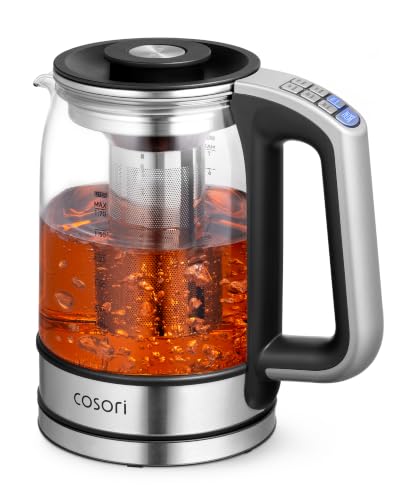
Third, the interior. A concealed element beneath a flat floor is the modern standard and the easiest to live with: scale forms on a smooth surface where a descale can reach it, and there is no coil to trap debris. Exposed elements survive mainly at the entry tier. Materials inside matter for taste; steel and glass are neutral, and a new kettle of any material should be given a few throwaway boils before its first drink, a setup ritual that also lets you confirm the shut-off works and the lid behaves before the appliance enters service. Setup otherwise consists of choosing the kettle’s permanent home — flat, dry, back from the edge, cord routed safely — and that small decision, made once and made well, is a genuine part of the product’s safety design. The reference models used through this review span the class: the COSORI electric kettle in glass, the Cuisinart PerfecTemp kettle for control, the Hamilton Beach electric kettle as the family workhorse, the Amazon Basics kettle at the entry tier, the Ovente glass kettle for visibility, and the Mueller electric kettle in compact steel.
Performance in Real Use
The Morning Round
The defining test of an everyday kettle is the morning round: several drinks, in quick succession, made by someone who is not yet fully awake. Here the class performs superbly. Fill to the gauge, click, and the water is at a boil before the mugs are out and the tea is measured, and the kettle has switched itself off if the doorbell or a child intervenes. Refills are quick because the jug returns to its base from any angle and the lid opens at a button under the thumb. The differences between models in this test are ergonomic rather than thermal: a kettle whose gauge you misread overfills and wastes a boil; a kettle whose lid dribbles scalds nobody but wets the counter every morning; a kettle that pours cleanly disappears from your attention entirely, which is the highest state a kettle can achieve.
Tea, Coffee and the Temperature Question
For black tea, cafetière coffee, and instant drinks, the whole class is on home ground: a full boil, poured promptly, is exactly what those drinks want, and any reputable kettle delivers it identically. The performance story changes with green tea, white tea, and delicate infusions, which scorch at a rolling boil and taste grassy and bitter for it. A boil-only kettle can still serve these drinkers — let the boiled water stand with the lid open for a short while and it will fall to a kinder temperature — but the routine is guesswork, and guesswork is what temperature-preset designs exist to remove. The Cuisinart PerfecTemp pattern, with one-touch presets and a keep-warm hold, performs this task with a consistency no standing-and-waiting method matches. Whether that performance gap matters is a question about your tea shelf, not about the kettles, and the analysis in electric kettle pros and cons gives it a full hearing.
Cooking Support
The kettle’s second career is as the stove’s assistant, and in real kitchens this may account for half its boils. Water for pasta, rice, vegetables, stock, and blanching reaches the pan already at a boil, cutting the slowest, most passive stretch of cooking to nearly nothing. Instant noodles, couscous, oatmeal, and soups are made directly, without a pan at all. Performance here is about capacity and pour confidence: a family jug that pours a strong, controlled stream into a deep pan, without the lid complaining or steam washing the hand, earns its counter space at dinner as surely as at breakfast. This is the Hamilton Beach electric kettle’s home fixture — big, plain, and constantly in play — and the test that eliminates undersized kettles from serious cooking households.
Repeat Boils, Taste and Scale Over Time
Long-run performance is where care tells. Fresh water, boiled once, tastes clean in any sound kettle. Water left standing and reboiled through a day tastes progressively tired, and scale accumulating on the floor slows the boil, raises the noise, and eventually flakes into drinks. None of this is a defect of the class; it is the physics of boiling mineral water, and it is fully managed by the routine in how to clean an electric kettle — a periodic descale, a rinse boil, and fresh water for the first drinks of the day. In this review’s judgement, the difference between a kettle that feels premium at year three and one that feels tired is rarely the purchase tier. It is whether somebody in the house owned the descale calendar.
Strengths and Trade-Offs
Strengths
- Boils quickly and, more importantly, unattended: automatic shut-off turns a watched chore into a background event.
- Consistent results at a full boil, and at preset temperatures on control models, make drinks taste the same every day.
- Cordless jug on a swivel base is genuinely accessible design — one-handed, either-handed, and safe to carry.
- Versatility across drinks, instant foods, and cooking support gives the appliance an unmatched uses-per-day count.
- Ownership is simple: no consumables, no filters, and one maintenance task that a calendar reminder can own.
Trade-offs
- Limescale is inevitable in hard-water areas and taxes speed, noise, and taste until it is removed.
- The jug carries a full load of scalding water and produces scalding steam; the appliance is safe by design and hazardous by content, both at once.
- It claims permanent counter space and a socket, and works only where electricity is, doing nothing else at all.
- Materials compromise in every direction: glass can break, steel hides its scale and runs hot outside, plastic ages fastest.
Weighed together, the strengths are structural and the trade-offs are manageable, which is the signature of a mature product class. The full, formal weighing is in is an electric kettle worth it; this review’s role is to show where the balance comes from, model by model.
How It Compares
Within the class, the reference models separate cleanly once you know what to look for. The COSORI electric kettle and the Ovente glass kettle both bet on visibility: a clear jug that shows level, boil, and scale, with the COSORI pattern emphasising a wide, cleaning-friendly opening and the Ovente pattern emphasising the pleasure of the object itself on the counter. Against steel, glass asks for gentler handling and gives back information; in a hard-water home that information — scale you can see forming — is worth real money in avoided neglect. The Hamilton Beach electric kettle and the Mueller electric kettle make the steel case at two sizes: the family workhorse that treats boiling as a bulk utility, and the compact jug that treats counter space as the scarce resource. Between them they cover most households that want toughness and neutral taste without a thought for presets.
The Cuisinart PerfecTemp kettle stands slightly apart as the class’s control flagship: presets for the drink families and a keep-warm hold, in a steel body, at the premium tier. Its comparison point is not really the other five; it is the boil-only kettle in the same household, and the question is whether the drinks justify the panel. The Amazon Basics kettle anchors the other end: the entry tier proving that the class’s core virtues — fast boil, shut-off, cordless jug — survive intact at the simplest level, with refinement rather than function as the thing surrendered. A household choosing between these six is really choosing a material, a size, and a position on presets, and the models are honest representatives of each combination.
| Model | Material | Control | Character |
|---|---|---|---|
| COSORI electric kettle | Glass | Boil and stop | All-rounder with a cleaning-friendly wide mouth |
| Cuisinart PerfecTemp kettle | Steel | Presets plus keep-warm | Control flagship for varied tea drinkers |
| Hamilton Beach electric kettle | Steel | Boil and stop | Family-size workhorse |
| Amazon Basics kettle | Plastic | Boil and stop | Entry-tier starter and spare |
| Ovente glass kettle | Glass | Boil and stop | Visibility and counter appeal |
| Mueller electric kettle | Steel | Boil and stop | Compact durability for small kitchens |
Against the neighbouring categories, the everyday kettle’s position is equally clear. A stovetop kettle offers resilience and ritual at the cost of supervision. A gooseneck kettle offers pouring precision for one coffee method at the cost of speed and capacity for everything else, as the shortlist in the best electric kettles makes plain when the two shapes sit side by side. A temperature-control smart kettle adds connectivity to the preset idea for those who want it, surveyed in the best smart kettles with temperature control. The plain jug remains the centre of the category because it matches the centre of demand: fast, safe, boiling water, several times a day.
Who Should Buy It and Who Should Skip It
Buy an electric kettle if your household boils water daily in any quantity, if mornings run on tea or cafetière coffee, if you cook with pans that could start at a boil, or if you are equipping a first kitchen and need the highest usefulness per appliance. Buy the temperature-control tier if your tea shelf includes green, white, or delicate infusions that you drink often enough to taste the difference presets make. Buy glass if you value seeing the level and the scale, steel if you value toughness, and the entry tier without embarrassment if the kettle’s job is a dorm, an office, or a spare room.
Skip it — or at least delay it — if you boil water a few times a month and a pan already serves you without complaint; if your counter genuinely has no safe, dry, back-from-the-edge home for a powered base; or if your heart is set on the stovetop ritual and you know a countertop jug would feel like a betrayal of a pleasure you actually take daily. Also skip the premium tier, specifically, if your drinks all want a full boil: that is not frugality, it is fit. Before buying, run this short checklist: capacity matched to your largest regular job; minimum fill matched to your smallest; material matched to your handling and your water; lid, gauge, and pour checked in the listing photographs; shut-off and boil-dry protection confirmed; and a descale routine you are actually willing to keep. A kettle that passes those six checks will not disappoint you.
Setup, Care and Maintenance Essentials
Setup takes five minutes and repays care. Place the powered base on a flat, dry surface away from the sink’s splash zone, route the cord so it cannot be snagged, and fill the jug off the base at the tap. Run two or three full boils and discard the water before the first drink, to clear any new-appliance taste and to confirm the shut-off and lid behave. From then on the safety liturgy is short: fill between the minimum and maximum marks — never above the maximum, because a boiling kettle filled past its line can spit scalding water from the spout — never switch on empty, pour with the lid closed, and open the lid away from your face so the first rush of steam passes clear of you. Keep the base dry at all times; it is an electrical component, and neither it nor the jug should ever be immersed or rinsed under a tap. Wipe exteriors with a damp cloth.
Maintenance is the descale, and the descale is everything. Hard water lays mineral scale on the floor and element; the boil slows and roughens, the noise rises, and delicate drinks begin to taste of the kettle instead of the leaf. A regular descale with a simple household solution, followed by a rinse boil and a wipe of the spout and lid, restores the appliance completely, and glass-bodied owners get the advantage of seeing the scale arrive while steel owners should simply keep a calendar rhythm. The complete walkthrough, including the spout, filter, and exterior, is in how to clean an electric kettle, with the deep-descale method in how to descale an electric kettle. Do that, and the kettle reviewed here will still be performing to this review’s standard years from now.
The Reference Models in Detail
The six models below are the reference points this review keeps returning to. They are presented prose-only, in qualitative tiers, so the comparison stays about design and fit rather than figures that change with every listing update. Check price on Amazon for any of them when you are ready, and confirm the current version’s details on the listing itself.

COSORI Electric Kettle
The glass all-rounder. Its wide opening makes the descale — this review’s central maintenance theme — as easy as the task gets, its clear jug answers the gauge question by making the whole wall a gauge, and its controls stay admirably out of the way. It is the model this review would hand to a household that asked for one kettle, no special requirements. Best for: mixed households that clean as they go. Not suited for: the chronically clumsy. Tier: mid.
Cuisinart PerfecTemp Kettle
The control flagship. Presets for the main drink families and a keep-warm hold give it a performance dimension the other five do not attempt, and its steel body keeps the toughness argument on its side. It earns its premium tier in a tea-varied household and wastes it in a boil-only one, and this review respects it for knowing exactly what it is. Best for: green and white tea drinkers. Not suited for: anyone whose drinks all want a rolling boil. Tier: premium.

Hamilton Beach Electric Kettle
The family workhorse. A generous steel jug, simple controls, and a design that treats boiling as a bulk utility make it the reference for high-throughput kitchens and cooking support. It will not charm you, and it is not trying to; it is trying to be boiled twelve times a day without complaint, and its owners should repay it with descaling by the calendar, since steel hides its scale. Best for: families and cooks. Not suited for: solo drinkers and preset seekers. Tier: mid.

Amazon Basics Kettle
The entry-tier proof. Light, simple, and complete in the essentials — fast boil, automatic shut-off, cordless jug — it demonstrates that the class’s core virtues do not depend on tier. Refinement is what the step up buys, not function. As a first kettle, a dorm kettle, or a spare, it is a rational purchase that this review makes no apology for including. Best for: first flats, students, guest rooms. Not suited for: buyers shopping for a decade-long appliance. Tier: entry.
Ovente Glass Kettle
The aesthete’s glass. Where the COSORI pattern argues for glass on practical grounds, the Ovente pattern argues for it on pleasure: the sight of the water climbing to a boil, the clear read on level and scale, the small ceremony of it. The same glass caveats apply — weight when full, kindness required around hard edges — and the same descale dividend arrives early because nothing hides. Best for: ritual tea drinkers in calm kitchens. Not suited for: crowded counters. Tier: entry to mid.

Mueller Electric Kettle
The compact steel answer. It keeps steel’s toughness and neutral taste while surrendering the capacity a small kitchen cannot use, and it is the model this review points to when the counter-space objection is raised honestly. A solo drinker or a couple will find its size a daily relief rather than a limit. Best for: small flats and tidy counters. Not suited for: entertainers and big households. Tier: entry to mid.
The Sound, Weight and Feel of Quality
Reviewing this class honestly requires admitting how much of a kettle’s quality is sensory rather than measurable. A good kettle sounds right: a deep, building rumble rather than a thin rattle, a switch that clicks with intent, a lid that closes with a soft finality instead of a plastic clatter. It feels right in the hand at the exact moment that matters, which is full and hot and being carried three steps to the counter; the handle neither flexes nor twists, the balance does not tip toward the spout, and the jug returns to its base with a seated certainty you can feel through your wrist. It looks right on the small details listings rarely mention: a gauge whose markings align with the water they claim to measure, a spout whose lip is finished rather than merely cut, a base whose cord wraps away instead of trailing.
These are not luxuries. In an appliance used several times a day, sensory quality is durability’s public face, because the switch that feels vague in month one is the switch that fails in year two, and the lid that rattles when new is the lid that leaks steam when old. This is also where the tiers honestly separate. The Amazon Basics kettle performs every function in this review and feels plain while doing it; the mid-tier COSORI, Hamilton Beach, and Mueller designs feel composed; the Cuisinart PerfecTemp feels like the flagship its panel promises. A reviewer can call that difference mere finish, but a household will feel it a thousand times a year, and this review counts it as a real, if secondary, axis of judgement — the difference between an appliance that is merely adequate and one that quietly pleases.
A Week With the Class
Live with these kettles through an ordinary week and their characters settle into routine. Monday’s early start belongs to whichever jug fills fastest under the tap and boils while the household is still assembling itself; by Wednesday, the gauge you can read without glasses and the lid that opens under one thumb have stopped being features and become the definition of a normal morning. The weekend exposes capacity: guests, a big cook, pans started at a boil, and the family jug earns its counter while the compact one asks for a second boil and gets it without resentment, because nobody promised it a crowd. Somewhere in the week the glass owners notice the first film of scale and set a descale in motion in minutes, while the steel owners rely on the calendar reminder — and both are right, because each material has told its owner the truth in its own language.
What the week does not produce is drama. No kettle in this set failed a boil, missed a shut-off, or made a drink taste of itself. That absence is the class’s maturity speaking, and it reframes what a review can usefully do: not to find a winner by elimination, but to match characters to households. The PerfecTemp’s presets, ignored by Monday’s black-tea drinker, are the whole point of Thursday’s green tea. The Ovente’s theatre, a pleasure at a slow Sunday breakfast, is invisible during the weekday rush it also serves perfectly well. Reviewing kettles is therefore mostly an exercise in honesty about households — yours included — and the models are simply the vocabulary in which that honesty gets expressed.
What Would Make the Class Better
A fair review should say what even good products have not yet solved. Gauges remain the class’s weakest standard component: too many are small, dim, or positioned for a user standing in the one place nobody stands. Lids have improved and still vary more than they should, from mechanisms that feel engineered to buttons that feel apologetic. Noise is treated as weather rather than as a design problem, though insulated bodies prove it can be softened. And the descale, the one task every owner owes, is still supported mostly by silence in the manuals, when a simple printed rhythm matched to water hardness would prevent more disappointment than any feature added in a decade. None of these gaps overturns this review’s verdict. They mark the distance between a mature class and a perfect one, and they give the next buyer a sharper list of things to check in a listing’s photographs than any badge or tier can provide.
Durability: What Years of Boils Do to Each Design
A review written at the moment of purchase is half a review, so it is worth projecting each design forward. The components that age are known: the switch and its contacts, the lid’s hinge and spring, the thermostat’s calibration, and the interior’s surface under its mineral load. Steel bodies age most gracefully in appearance, carrying small dents as character, while their interiors depend entirely on the owner’s descale rhythm. Glass ages visibly and honestly — a well-kept glass jug looks new for years, a neglected one advertises its neglect in chalk — and its true lifespan is set less by time than by the probability of one bad knock, which is a household statistic, not a product flaw. Plastic ages fastest in looks while often remaining perfectly functional, which is why the entry tier is best bought as a deliberate starter rather than as a reluctant compromise.
The controls divide by complexity over time. A boil-and-stop kettle has almost nothing to drift, confuse, or fail, and its third year is its first year repeated. A preset kettle carries more electronics and more to go gently wrong, balanced by a maker at the premium tier who builds accordingly; its owners should simply know that the panel is a commitment as well as a convenience. Across all six reference models, the projection is the same in outline: descaled, filled sanely, and kept on a dry base, each will serve for years, and the differences in lifespan between reputable models are smaller than the differences made by the household’s habits. That is a slightly humbling conclusion for a reviewer, and it is the truest one in this piece: in this class, the owner is a component, and the review of the kettle is partly a review of the care it will receive.
The Kettle in the Wider Kitchen
No appliance is reviewed in a vacuum, and the electric kettle’s place among its neighbours clarifies its value. Against the coffee machine, it is the humbler and busier servant: fewer rituals, more boils, and a supporting role in half the machine’s own drinks. Against the microwave, it is the specialist beating the generalist at the one task both attempt, heating water, with a consistency and a safety story the microwave cannot match at volume. Against the stovetop it trades resilience for supervision-free speed, a trade most households make gladly on weekdays and some reverse happily on slow weekends, which is why so many kitchens keep both and feel no contradiction. Against the hob kettle’s modern rival, the temperature-controlled smart designs, the plain jug holds its ground on simplicity: nothing to pair, nothing to update, nothing between the drinker and the boil but a switch.
There is also the matter of what the kettle replaces in a life. For many households it replaces the watched pan, the reheated mug, the drink postponed because the boil was a chore — small frictions whose removal is felt not as luxury but as the day running more smoothly. A reviewer should be careful with claims that large for an object this small, but the evidence of the category’s near-universal adoption is difficult to argue with. Kitchens vote with their counters, and on that ballot the electric kettle is among the most elected appliances in the home. This review’s detailed judgements — about pours, lids, gauges, materials, and the descale — are all refinements of a verdict the households themselves delivered long ago.
Electric Kettle Review Testing Notes: Where the Class Surprised This Review
Three findings from living with this class deserve record because they contradict the assumptions buyers bring to it. The first is how little boil speed matters in practice: the theoretical gap between the fastest and slowest reputable kettle dissolves into the time it takes to find the mugs, and no household in this review’s experience has ever chosen its kettle on that basis twice. The second is how much the lid matters: the single component buyers never shop for is the one whose daily behaviour — the button under the thumb, the decisive open, the firm close — colours their opinion of the whole appliance within a week. The third is how completely the descale dominates the ownership story after the first year, outweighing material, tier, and badge combined; the kettles that still delighted at year two were not the most expensive ones but the ones whose owners had a rhythm and whose mouths made the rhythm easy. A review that began by judging designs ends, honestly, by judging the partnership between a design and a household — and on that measure, every model in the reference set can be the right kettle, which is precisely what a mature class looks like.
A Note on This Review’s Limits
Every review should confess its method’s edges. This one judges the electric kettle as a product class through its reference models, in prose, without printed figures that would expire — which means it will not tell you a boil time to the second or a price to the coin, and it regards that restraint as honesty rather than omission. It also speaks from the standpoint of households that boil water often, because they are the class’s natural constituency; the rare boiler will find this review’s enthusiasm disproportionate to their need, and the checklist in the buying section exists to tell them so before they spend anything. Within those limits, the judgements here — pour before speed, lid before finish, descale before everything — are offered with confidence, because they are the judgements that survive contact with a real kitchen and a real year.
That partnership point deserves the last word before the verdict, because it explains the review’s otherwise puzzling tolerance. A class in which the owner’s habits matter as much as the maker’s design is a class that has finished its engineering argument and moved into its domestic one, and the electric kettle reached that point years ago. What remains for a buyer is not research but self-knowledge — of drinks, of counters, of water, of hands — and what remains for an owner is a calendar reminder and a bottle of something mildly acidic. Few appliances ask so little and return so much, and fewer still have been returning it, unnoticed, several times a day, in almost every kitchen in the country.
One final observation belongs in the record. Of all the appliances this site reviews, the kettle is the one whose owners most often replace like with like, immediately, when it finally retires — no deliberation, no category rethink, just the same utility restored by the weekend. A product class that has earned that reflex has passed the only review that ultimately matters, and this long examination of its designs and compromises is, in the end, an explanation of a loyalty the reader probably already feels.
Final Verdict
The electric kettle is a solved problem executed at several tiers, and the reviewer’s honest advice is refreshingly simple: choose your material and your size, decide the preset question by looking at your tea shelf, insist on the safety basics, and then stop worrying, because every reputable model in this class will boil your water beautifully. The COSORI electric kettle is this review’s all-round reference, the Cuisinart PerfecTemp kettle its control reference, and the Hamilton Beach electric kettle its family reference, with the Amazon Basics kettle, the Ovente glass kettle, and the Mueller electric kettle each owning a legitimate niche. What separates a satisfying purchase from a mediocre one is rarely the badge; it is the fit between the jug and the household, and the descale calendar on the fridge.
The Home Scorecard: How to Judge This Electric kettle in Week One
Use this scorecard during the first week, while changing your mind is still easy, and run the same ordinary jobs you bought the electric kettle for rather than showcase tasks chosen to flatter it. Score setup first: how long the box-to-ready journey took, whether the instructions answered the question you actually had, and whether anything needed a tool the box did not mention. Score the core job on a normal weekday portion, with your usual ingredients and timing, and write the result down before you try any advanced mode or accessory. Score consistency by repeating that same job on another day and comparing the two outcomes side by side, since repeatability is the quality that separates a good example from a lucky one.
Score the controls under real conditions, with damp hands, low light, or a timer running elsewhere, because that is the environment the electric kettle will actually be judged in. Score cleaning honestly by timing it once, including the drying and reassembly, and by noting any corner, seam, or crevice that needed a second attempt. Where a shortlist names specific examples, such as COSORI Electric Kettle, run these same checks against that listing line by line rather than assuming the general verdict transfers unchanged. Apply the identical test to Cuisinart PerfecTemp Kettle as well, on the same day and under the same conditions, because a fair comparison needs one ruler rather than two moods.
- Time the box-to-ready setup
- Repeat the core job on two separate days
- Time the full clean including drying
- Watch a second user try without coaching
- Deliberately make the common mistake once
- File the scorecard with the receipt
If Hamilton Beach Electric Kettle is also in contention, give it the same worksheet and let the three sets of answers sit side by side before anyone reaches for a checkout button. Score the storage reality: whether the electric kettle and its parts return to their spot without a rearrangement ritual, and whether anything migrates to a counter because it has no home. Score the noise, heat, steam, or vibration against the room it lives in, at the hour you most often use it, and note whether anyone in the household comments unprompted. Score the small parts: lids, seals, trays, attachments, and fasteners, because in long ownership the small parts are where satisfaction quietly leaks away.
Score the documentation by looking up one real question mid-task and timing how long the answer takes to find, in the booklet or on the maker’s support pages. Score the fit against the measurements you took before ordering, and note any surprise, generous or otherwise, while the details are still fresh enough to help another buyer. Score the second user experience by watching someone else in the household use the electric kettle without coaching, and noting exactly where they hesitate or guess. Score the worst job, not the best: the largest load, the trickiest ingredient, or the latest tired evening, because that score predicts your feelings in month six.
Score the recovery: deliberately make the common mistake, such as overfilling, mis-seating a part, or choosing the wrong setting, and judge how obvious and forgiving the fix is. Add the scores without weighting them, then read the lowest two again, because those are the entries that decide whether this example stays in your house. If a low score surprises you, repeat that single test once before concluding anything, since first attempts often measure the operator rather than the product. Keep the finished scorecard with the receipt and warranty details, so a future claim, resale, or replacement decision starts from evidence rather than from a fading impression.
Revisit the card after a month and change only the scores that genuinely moved, because the difference between week one and month one is the learning curve made visible. Note which score you would check first if you were buying a second electric kettle as a gift, since that priority usually reveals what the product is really about. Finish by writing one sentence describing who should not buy this example, because a clear exclusion is the most useful line in any honest assessment. Whatever the category, photograph your intended spot with the neighbouring items in place, because a picture exposes crowding that measurements alone politely ignore.
Keep every measurement, tally, and note from these checks in one place, ideally with the receipt, so the next decision in this category starts from your evidence rather than from scratch. Involve the household early where the product is shared, since a decision everyone helped measure is a decision nobody relitigates at the first inconvenience. Prefer the option that fits your existing routine with the fewest new habits, because each new habit is a small tax collected every single day. Be wary of solving a storage problem by creating a carrying problem, since distance between storage and use is where good equipment goes to be forgotten.
Frequently Asked Questions
What should I look for first in an electric kettle?
The pour, the lid, and the gauge, in that order, because you will feel those three at every use while boil-speed differences between reputable models blur into irrelevance. A spout that starts and stops the stream cleanly, a lid that opens at a button and closes firmly, and a gauge you can read from your natural standing position are the marks of a kettle designed by people who use one. After those, confirm automatic shut-off, boil-dry protection, and a mouth wide enough to descale without a struggle.
Are glass kettles as durable as stainless steel kettles?
No, and they do not claim to be. Borosilicate glass is tougher than ordinary glass and handles boiling water without complaint, but a hard knock against a tap or a worktop edge can chip or crack it in a way steel would shrug off with a dent. What glass returns for that fragility is information: the level, the boil, and the first film of scale are all visible at a glance. Households with calm counters and careful hands lose nothing by choosing glass; crowded, knock-prone kitchens should choose steel.
Do temperature presets really change how tea tastes?
For green tea, white tea, and delicate infusions, yes, in a way most drinkers can taste immediately: water at a full boil scalds those leaves and draws out a harsh, grassy bitterness, while cooler water leaves the cup sweet and clear. For black tea and coffee, presets change nothing, because those drinks want water at or near boiling anyway. The feature is therefore neither a gimmick nor a necessity in the abstract; it is a precise answer to a specific shelf of teas.
Why has my kettle become slower and louder?
Almost certainly limescale. Mineral deposits insulate the heating surface, so the kettle works longer and harder to reach a boil, and the roughened floor makes the boil itself noisier. The fix is a descale, not a replacement: run the simple routine, rinse with a fresh boil, and the kettle’s original speed and manners usually return in full. If a thorough descale does not restore it, or the switch and shut-off have grown unreliable, that is the honest signal to retire the appliance.
Is it safe to reboil water already in the kettle?
It is safe in the mechanical sense — the kettle will simply boil and switch off again — but it is not ideal for taste, and repeatedly reboiling the same water concentrates the tired, flat character that tea drinkers notice. The better habit is to boil roughly what you need, empty and refill with fresh water for the first drinks of the day, and top up through the day as needed. What you must never do is let the level fall below the minimum mark and boil a near-empty jug, which stresses the element and leans on the safety cut-out.
Can I heat anything other than water in an electric kettle?
No. The kettle is a water-only appliance. Milk, soup, and other liquids foul the element and the interior, can boil over violently through the spout, and may damage the thermostat’s judgement of the boil. Use the kettle to boil water, then make the drink or the dish in its proper vessel; the kettle’s genius is its narrowness, and every attempt to widen its job description ends with a cleaning problem and a worse result than the right tool would have given you.
Related Reading
Continue with the ranked roundup in electric kettle reviews, the tea-specific shortlist in the best electric kettles for tea, and the buyer’s framework in how to choose an electric kettle.